India’s textile and yarn export sector is one of the country’s largest foreign-exchange earners, with man-made fiber yarn, cotton yarn, and fabric shipped to well over a hundred countries every year. For international buyers apparel brands, fabric importers, agents, and converters the phrase “textile yarn exporters India” covers an enormous and uneven field, ranging from small trading intermediaries to large, vertically integrated manufacturing groups with decades of export experience. This guide is meant to help overseas buyers evaluate that field more efficiently, and to explain how a manufacturer like Madhusudan Group fits into an international sourcing strategy.
Why Buyers Source Yarn from India
India remains one of the most competitive global sourcing destinations for yarn because of a combination of factors:
- Scale of raw material access India is a major cotton producer and a large importer/producer of polyester feedstock, giving manufacturers flexibility across fiber types.
- Manufacturing depth established textile clusters (Surat, Coimbatore, Ludhiana, Tirupur, Panipat) each specialize in different yarn and fabric categories, giving buyers options depending on product need.
- Cost competitiveness labor and production costs remain favorable relative to several other major exporting nations, particularly for mid-volume, specification-driven orders.
- Established export infrastructure decades of trade relationships with Europe, the Middle East, Southeast Asia, and North America mean many Indian manufacturers are already fluent in international documentation, quality, and compliance requirements.
Categories of Yarn Exporters to Know
Before shortlisting exporters, it helps to know which category you’re actually looking for:
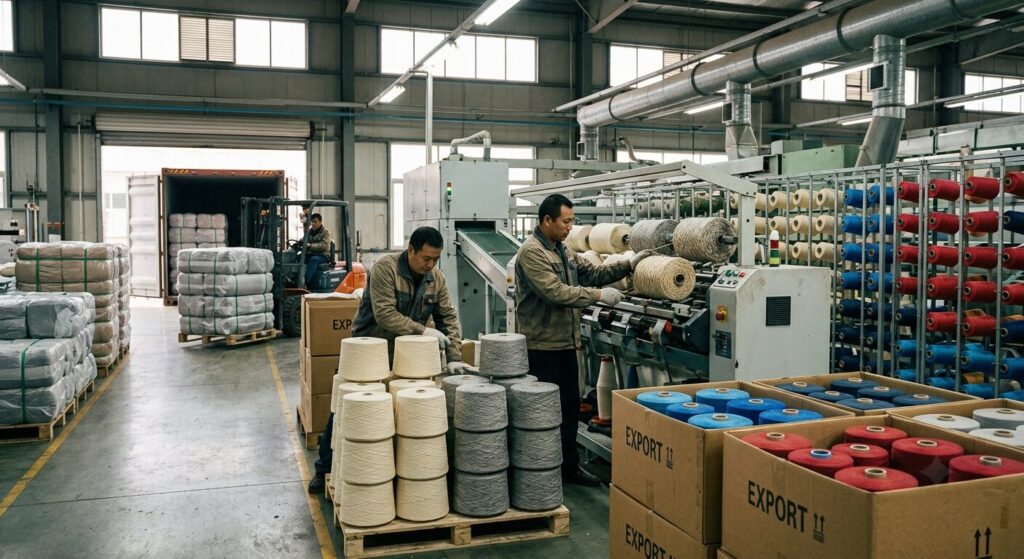
- Spinning mills exporting primarily raw cotton or blended spun yarn.
- Synthetic/filament yarn manufacturers exporting polyester, nylon, and viscose-based yarns, often texturized or dyed.
- Value-added/technical yarn exporters supplying specialty yarns flame-retardant, moisture-wicking, recycled, bi-component for performance apparel, home-tech, and industrial applications.
- Trading and consolidator exporters who source from multiple mills and manage export logistics on the manufacturer’s behalf.
Vertically integrated manufacturers that export directly, rather than through multiple trading layers, generally offer better pricing transparency, more consistent quality across repeat orders, and faster resolution of any quality issues, since there’s no intermediary slowing down communication.
What International Buyers Should Verify
When evaluating a potential yarn export partner in India, confirm the following before placing a trial order:
- Export track record and destination markets. Ask for references or shipment history to your specific region export experience to Europe doesn’t automatically translate to smooth compliance for, say, the U.S. or Southeast Asia.
- Production capacity vs. order size. Understand whether your order size is a priority for the manufacturer or a minor fraction of their book this affects lead time reliability.
- Quality control and testing. Ask what in-house testing (denier consistency, tensile strength, colorfastness) the manufacturer performs before shipment.
- Documentation capability. Confirm the exporter can independently handle commercial invoices, packing lists, certificates of origin, and any buyer-specific compliance paperwork for example OEKO-TEX or REACH without delays.
- Communication and time zone coverage. Especially important for buyers in different time zones; ask whether the exporter has dedicated export sales staff, not just production management handling international queries part-time.
- Payment terms and trade insurance. Standard practice varies (LC, advance payment, DP terms); confirm this matches your company’s procurement policy early.
Madhusudan Group’s Export Profile
Madhusudan Group, headquartered in Surat with manufacturing at Palsana, has built an export business around its core strength in polyester, cationic, and blended yarn, alongside woven fabric. Points relevant to international buyers evaluating the group:
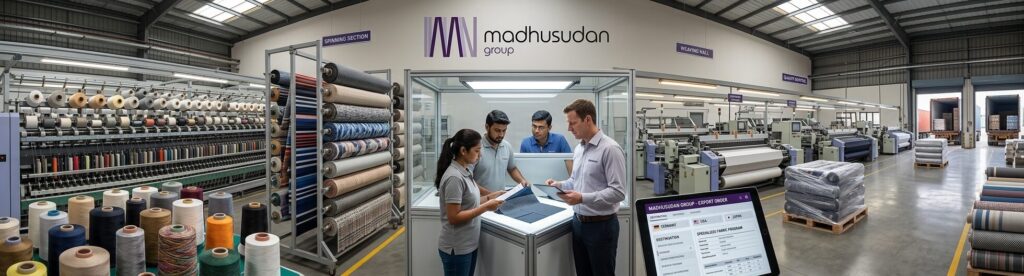
- Established export footprint the group supplies to markets across multiple continents, with marketing presence in key regional sourcing hubs to support international buyer relationships.
- Vertical integration because yarn production, dyeing, and weaving sit within the same group, export buyers can source finished fabric alongside base yarn, reducing the number of vendors needed for a single fabric program.
- Long operating history decades of continuous operation and expansion, giving the group experience managing both domestic and international order books through multiple market cycles.
- Diversifying product base beyond traditional fancy and texturized yarn, the group has expanded into technical and functional yarns, including bi-component, wicking, and flame-retardant yarns, reflecting the kind of application-specific specialization that many international buyers particularly in sport-tech, home-tech, and technical apparel are increasingly looking for.
A Practical Onboarding Path for New International Buyers

- Share your technical specification fiber type, denier, blend ratio, color requirements rather than a generic RFQ, to get a faster and more accurate quote.
- Request physical samples and, where possible, a small trial order before committing to bulk volumes.
- Clarify Incoterms, payment terms, and expected lead times in writing before production begins.
- Ask about the quality documentation that will accompany the shipment test reports, certificates so your import/compliance team isn’t scrambling at customs.
- Build in a buffer for your first order’s lead time; even a strong exporter’s first shipment to a new buyer often takes longer than steady-state repeat orders, simply because both sides are calibrating expectations.
Final Thoughts
For international buyers, the strongest textile yarn exporters in India are the ones who combine manufacturing depth with genuine export infrastructure dedicated export teams, documented compliance experience, and a track record across multiple regions. Vertically integrated groups with a long operating history and an established international footprint, such as Madhusudan Group, offer a more predictable sourcing relationship than working through multiple trading intermediaries, particularly for buyers building recurring, specification-driven orders.