If you’ve ever bought a “100% cotton” T-shirt, bedsheet, or bulk yarn shipment and wondered whether the label was actually accurate, you’re not alone. Fiber content questions come up constantly for shoppers who want breathable, natural fabric, and for textile buyers who need incoming material to match a purchase order exactly.

Learning how to tell if cotton is fake starts with a simple but important idea: appearance and touch alone can’t reliably confirm what a fabric or yarn is made of. Cotton can be blended with polyester or viscose, and some synthetic and cellulosic fibers can look and even feel surprisingly similar to cotton at a glance. That’s why a handful of simple screening tests the burn test, the water absorption test, and the feel test exist as first-pass tools, not final answers.
This guide walks through those tests step by step, explains what they can and can’t tell you, and outlines when it’s time to move from a kitchen-table check to laboratory-grade fiber identification.
Why “Looks Like Cotton” Doesn’t Mean It Is Cotton
Visual inspection and hand feel are the most common ways people judge fabric, but they’re also the least reliable. Several factors can make a non-cotton textile look and feel like the real thing.
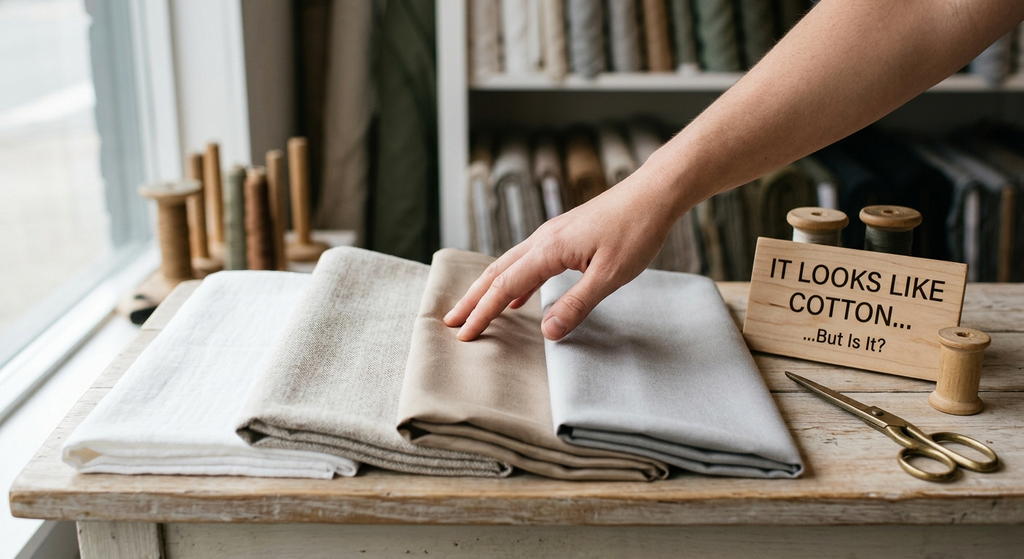
Different fibers can share similar surface characteristics. Viscose (rayon), modal, and even some finished polyester fabrics are engineered to mimic cotton’s softness, matte finish, and drape. Without a side-by-side comparison to a known cotton reference, it’s genuinely difficult to tell them apart by sight.
Finishing and construction change how fabric feels. Mercerization, brushing, sanforization, and softening treatments can all make a blended or synthetic fabric feel smoother, softer, or more “natural” than its raw fiber content would suggest. A tightly woven polyester-cotton blend can feel almost indistinguishable from pure cotton after finishing.
Cotton vs. other cellulosic fibers. Cotton, viscose, modal, and lyocell are all cellulose-based, which means they share some behavioral similarities including how they burn and absorb moisture. This overlap is one of the main reasons simple home tests struggle to separate cotton from viscose specifically.
Cotton vs. synthetic fibers. Polyester, nylon, and acrylic behave very differently from cotton on a molecular level, which usually makes them easier to distinguish but a well-finished polyester or poly-cotton blend can still pass a casual glance-and-touch inspection.
Blends complicate everything. Once two or more fibers are combined in a single yarn or fabric, test results reflect a mixture of behaviors rather than a single clear signal.
It’s also worth noting that “fake cotton” isn’t always the most accurate term. In most real-world cases, a textile isn’t a counterfeit material it’s simply a different fiber, or a blend, than what the buyer expected or was told. Understanding that distinction helps frame the rest of this guide correctly: these tests are about verifying fiber composition, not detecting fraud.
The Label and Documentation Check | the Fastest First Step
Before doing any physical testing, check the paperwork. It’s faster, free, and often more informative than a burn test.
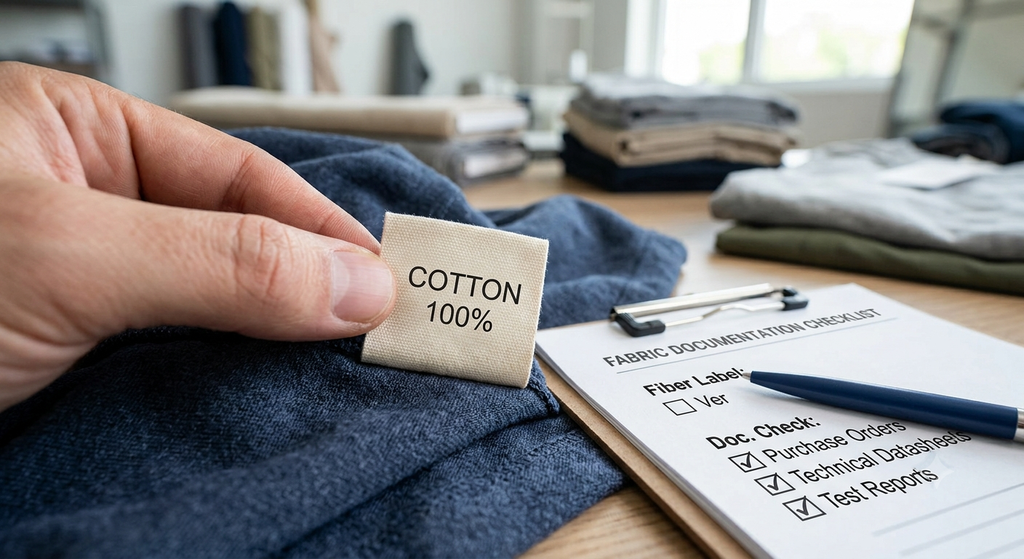
For consumers, this means reading the fiber-content label sewn into the garment or printed on the packaging. Legitimate products are generally required to disclose fiber composition, whether that’s “100% cotton” or a blend such as “60% cotton, 40% polyester.”
For B2B buyers and quality-control teams, documentation review is more involved and should include:
- Product specifications provided by the supplier
- Purchase orders confirming the agreed fiber composition
- Technical datasheets for the yarn or fabric
- Certificates or test reports from the supplier or a third party
- Supplier declarations of origin and composition
- Batch or lot information to trace material back to a specific production run
The key step many buyers skip is comparing the documentation against the actual incoming material. A supplier’s paperwork may say “100% cotton,” but that claim should be checked against a physical sample from the same shipment not assumed to apply uniformly across every batch.
Our broader Fake Cotton guide covers this labeling and documentation process in more depth, including what to request from suppliers before goods ship.
The Cotton Burn Test | Step by Step
The burn test is one of the oldest and most widely used preliminary methods for screening textile fibers. The idea is simple: different fiber types react differently to an open flame because of their underlying chemical structure. Natural cellulose fibers like cotton behave differently from synthetic, petroleum-based fibers like polyester or nylon.

It’s important to be clear about what this test actually does: it offers a preliminary indication, not a definitive answer. Burn tests are most useful for distinguishing broad fiber categories cellulosic versus synthetic and are far less reliable for identifying blends or telling apart fibers within the same category, such as cotton and viscose.
Safety Notes
A burn test involves an open flame and should never be treated as a casual or risk-free activity. Some general precautions:
- The test should only be performed by a competent adult, never by children.
- Work in a well-ventilated area, away from flammable materials, curtains, papers, or aerosols.
- Use a heat-resistant surface, such as a metal tray or ceramic dish, to catch ash and debris.
- Keep a fire extinguisher, damp cloth, or bowl of water nearby in case the sample flares up.
- Use tweezers or tongs to hold the fabric sample rather than your fingers.
- Never leave a burning sample unattended, even briefly.
- Dispose of ash and residue safely once it has fully cooled.
This is a controlled fiber-screening technique for textile professionals and informed consumers — not a home science experiment to be done without precautions.
What to Observe
When a small fabric or yarn sample is exposed to a flame, there are several things to note:
- Burning behavior does the sample ignite quickly, smolder, or melt rather than burn?
- Flame behavior is the flame steady, does it self-extinguish, or does it continue burning after the source is removed?
- Odor different fiber types release different smells as they burn (this should be assessed cautiously and from a safe distance, never by inhaling smoke directly).
- Ash residue does the sample leave behind a soft, crumbly ash, or does it form a hard bead?
- Melt-and-bead behavior synthetic fibers often melt and form a hardened bead rather than turning to ash, which is a key distinguishing sign from natural cellulose fibers.
No single observation on this list is conclusive by itself. Reliable screening comes from evaluating several of these characteristics together and, ideally, comparing the result against a known reference sample of genuine cotton.
Burn-Test Results: Cotton vs Polyester vs Viscose vs Poly-Cotton
The table below summarizes general burn-test characteristics. These are preliminary indicators only and should not be treated as scientific proof of fiber content, particularly for blended materials.
| Fiber/Material | General Burn Behavior | Residue | Typical Interpretation |
| Cotton | Ignites readily and continues to burn steadily even after the flame source is removed, similar to burning paper | Leaves a small amount of soft, fine, grey ash | Preliminary indication of a cellulose-based fiber |
| Polyester | Melts and shrinks away from the flame before igniting; typically self-extinguishes once removed from the flame source | Forms a hard, dark, melted bead rather than ash | Preliminary indication of a synthetic, petroleum-based fiber |
| Viscose | Ignites readily and burns steadily, closely resembling cotton’s burning pattern because both are cellulose-based | Leaves a small amount of soft, light ash, similar in appearance to cotton’s residue | Preliminary indication of a cellulose-based fiber; difficult to distinguish from cotton by burn behavior alone |
| Poly-cotton | Behavior varies depending on blend ratio may show a combination of steady burning and melting/beading | May produce a mix of ash and a hardened bead, or a partial bead with charred fiber | Mixed or ambiguous result; not reliable for determining exact blend composition |
The overlap between cotton and viscose is the most important limitation to understand here. Because both are cellulose-based fibers, their burn characteristics steady burning, similar odor category, and soft ash residue can be very close, making a basic flame test insufficient to reliably tell them apart in many cases.
Can a Burn Test Tell the Difference Between Cotton and Viscose?
This is one of the most common follow-up questions, and the honest answer is: not reliably, at least not through a basic home burn test.
Cotton and viscose are both cellulosic fibers, meaning they share a similar chemical backbone even though viscose is manufactured by chemically processing cellulose (often derived from wood pulp) rather than harvesting it directly from a cotton plant. Because of this shared cellulose structure, both fibers tend to ignite easily, burn steadily, and leave a soft ash residue rather than melting into a bead.
In practice, this means a burn test alone often cannot confidently distinguish cotton from viscose, even though it can generally separate either of them from synthetic fibers like polyester or nylon. For situations where this distinction genuinely matters a supplier dispute, a compliance requirement, or a large purchase order specifying “100% cotton” additional testing beyond a basic burn test is usually necessary to reach a confident conclusion.
The Water Absorption Test
Water absorption is another commonly cited screening method, based on the general principle that cotton tends to absorb moisture readily, while many synthetic fibers resist it.
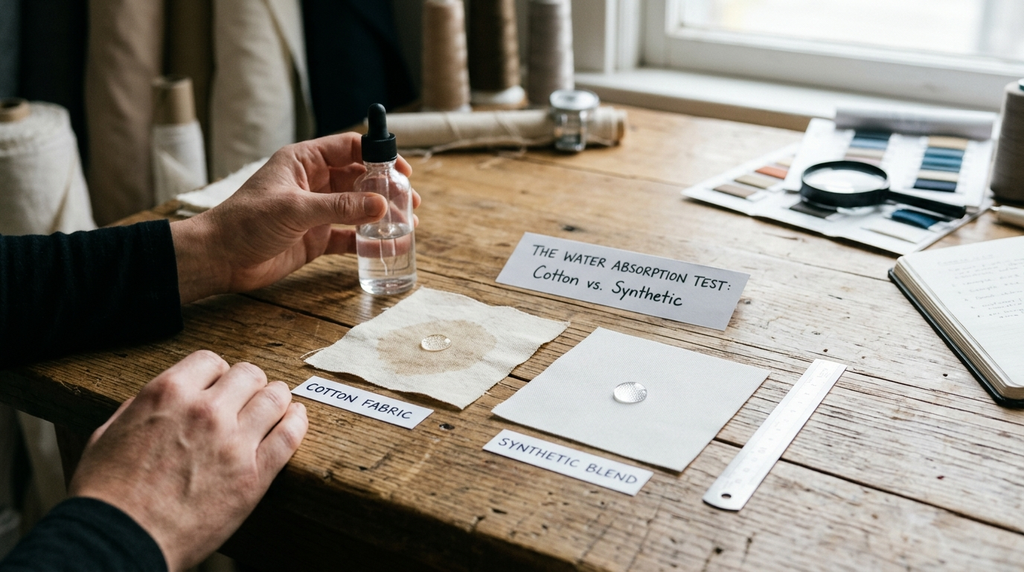
To perform a basic version of this test, a small drop of water is placed on the fabric surface. Cotton fabric will typically absorb the water fairly quickly and show visible wetting or spreading, reflecting cotton’s natural moisture regain properties. Many synthetic fabrics, by comparison, may cause water to bead up or sit on the surface for longer before absorbing.
However, this water absorption test fabric method has real limitations that are important to understand:
- Finishing treatments matter. Water-repellent finishes, coatings, or certain softening treatments can make even genuine cotton resist water absorption temporarily.
- Weave and knit structure affects results. A tightly woven fabric will behave differently from a loosely knit one, regardless of fiber content.
- Blends produce in-between results. A cotton-polyester blend may show partial or moderate absorption that doesn’t clearly point to either fiber.
- It only measures one property. Absorbency reflects surface and fiber-level moisture behavior, but it says nothing about exact composition or blend ratio.
Water absorption behavior is best understood as one useful data point in a broader picture not a standalone way to confirm that a fabric is genuine cotton.
The Feel and Wrinkle Test
Consumers and textile buyers alike often rely on tactile and visual cues to judge cotton quality, including:
- Softness cotton is generally soft, though quality varies by staple length and processing.
- Natural hand feel a slightly matte, breathable touch rather than a slick or plastic-like surface.
- Breathability cotton fabric typically allows air to pass through more readily than many synthetics.
- Wrinkling cotton tends to wrinkle more easily than wrinkle-resistant synthetic blends.
- Draping how the fabric falls and moves.
- Surface appearance matte versus shiny finish.
While these characteristics are genuinely associated with cotton, none of them can confirm fiber composition on their own. Several factors can significantly alter how a fabric feels and behaves regardless of its actual fiber content:
- Fabric finishing (softening agents, mercerization, calendering)
- Yarn construction (combed vs. carded, ring-spun vs. open-end)
- Weave or knit structure, which affects drape, breathability, and wrinkle recovery
- Fiber blends, which can average out or mask individual fiber characteristics
- Chemical treatments, including wrinkle-resistant or anti-static finishes
A well-finished polyester or poly-cotton blend can be engineered to wrinkle less, feel softer, and drape similarly to cotton which is precisely why touch and appearance are considered starting points for screening, not conclusive tests.
Why Home Tests Cannot Confirm an Exact Blend Ratio
This is especially relevant for B2B buyers and quality-control professionals, where the difference between a claimed and actual blend ratio can have real commercial consequences.
Burn tests, water absorption checks, and feel tests may help flag an obvious mismatch — for example, a fabric that melts and beads when it was supposed to be pure cotton. But these methods generally cannot determine whether a sample is:
- 100% cotton
- A 65/35 cotton-polyester blend
- A 50/50 cotton-polyester blend
- Another cotton-synthetic blend ratio
- A cotton-viscose or other cellulosic blend
Blend percentages require quantitative analysis that separates and measures individual fiber content something a home test simply isn’t designed to do. For buyers making purchasing decisions based on a specific blend ratio in a purchase order or technical specification, relying on a burn or feel test to confirm that ratio introduces real risk. Reviewing our guide to questions to ask before buying yarn can help buyer’s structure verification requirements into the sourcing process from the start.
When to Use Laboratory or Microscopic Testing Instead
Simple screening tests have their place, but there are clear situations where professional testing becomes the appropriate and often necessary next step:
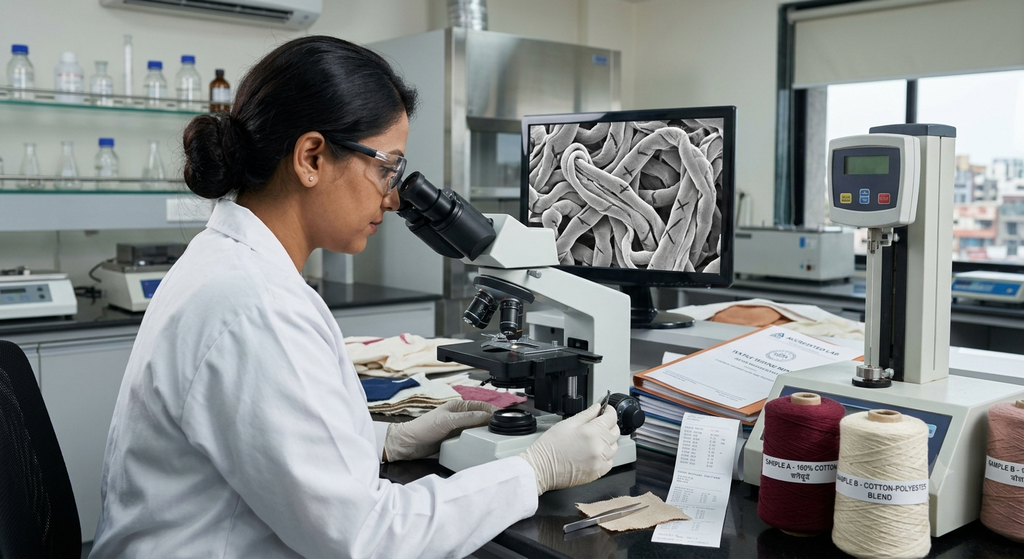
- Bulk yarn purchases, where fiber content affects performance, pricing, and end-use suitability
- Large fabric orders, particularly when the order specifies an exact blend
- Incoming quality control, to verify that received shipments match purchase order specifications
- Supplier disputes, where documentation and physical material appear to conflict
- Contract or specification verification, especially for recurring or high-volume orders
- Regulatory or labeling requirements, where accurate fiber-content disclosure is mandatory
- High-value commercial textile purchases, where the cost of an incorrect assumption is significant
Professional fiber verification typically relies on approaches such as:
- Microscopic fiber identification, which examines the physical structure of individual fibers under magnification to distinguish cotton from other cellulosic or synthetic fibers
- Fiber composition analysis, which quantifies the percentage of each fiber present in a blend
- Standardized textile testing methods, carried out by accredited testing laboratories
- Laboratory blend-ratio testing, used to confirm that a blended yarn or fabric matches its stated specification
For buyers sourcing yarn at scale, understanding these verification options is a useful complement to supplier vetting. Our Fake Cotton guide covers independent fiber testing and laboratory verification in more depth, including how to build verification checkpoints into a sourcing workflow. Buyers evaluating yarn suppliers more generally may also find it useful to review how ISO-certified yarn suppliers typically document fiber composition and quality control as part of their standard processes.
FAQs
Does a burn test work on blended fabric?
Not reliably. When a fabric contains two or more fibers such as cotton and polyester the burn test can show a mixture of behaviors, like partial melting alongside steady burning. This often produces an ambiguous result that doesn’t clearly indicate the blend ratio or even confirm which fibers are present with confidence.
Is there a home test for viscose vs cotton?
There isn’t a fully reliable home test for this specific comparison. Because cotton and viscose are both cellulose-based fibers, they tend to burn similarly, absorb water similarly, and can feel similar depending on finishing. Distinguishing them with confidence generally requires microscopic examination or other laboratory-based fiber identification methods.
How do labs test fiber content?
Laboratories commonly use microscopic fiber identification to examine the physical structure of fibers, alongside standardized chemical or physical testing methods to quantify blend ratios. The specific method used often depends on the fiber types suspected to be present, since no single technique works equally well for every textile combination.
Can a burn test tell the difference between cotton and viscose?
Generally, no not with confidence. Both fibers are cellulosic and tend to show similar burning and residue characteristics, so a basic flame test is not considered a reliable way to distinguish between them.
What does it mean if a burn-test result is ambiguous?
An ambiguous result such as partial melting combined with steady burning, or residue that doesn’t clearly match either ash or a hardened bead often indicates a blended fabric or a fiber that isn’t a straightforward match for the categories a burn test is designed to screen. Rather than guessing at the composition, it’s best to treat this as a signal that further verification is needed.
Is a home test enough for a business purchase?
For most commercial purchases, no. Home tests can serve as a useful preliminary check, but business decisions involving purchase orders, contracts, or bulk quantities generally warrant relying on supplier documentation first, followed by independent laboratory verification when the stakes justify it particularly for disputes, regulatory compliance, or high-value orders.
A Soft Note on Next Steps
For bulk textile or yarn purchases, buyers can consider requesting an independent fiber-content test as part of the purchase-order or quality-control process. See our Fake Cotton guide and fiber-testing resources for more information, and review our guide on choosing the right yarn for textile products for additional sourcing considerations.