Search for “fake cotton” and you’ll find two very different groups of people asking the same question. One group bought a shirt or a set of sheets labeled “100% cotton” and now suspects it isn’t. The other group is a sourcing manager, importer, or garment manufacturer who is deliberately looking for a cotton alternative something that looks, feels, and performs like cotton but is made from a different fiber, sold honestly as such.
This guide is written for both, but it leans toward the second group, because that is where an experienced yarn manufacturer can add the most value. Madhusudan Group has been manufacturing yarn for more than 50 years, supplying spinning mills, weavers, knitters, and garment producers across domestic and export markets. That kind of tenure gives a useful vantage point on a question that comes up constantly from buyers: is this cotton, is it not, and if it isn’t, what actually is it and is it worth buying?
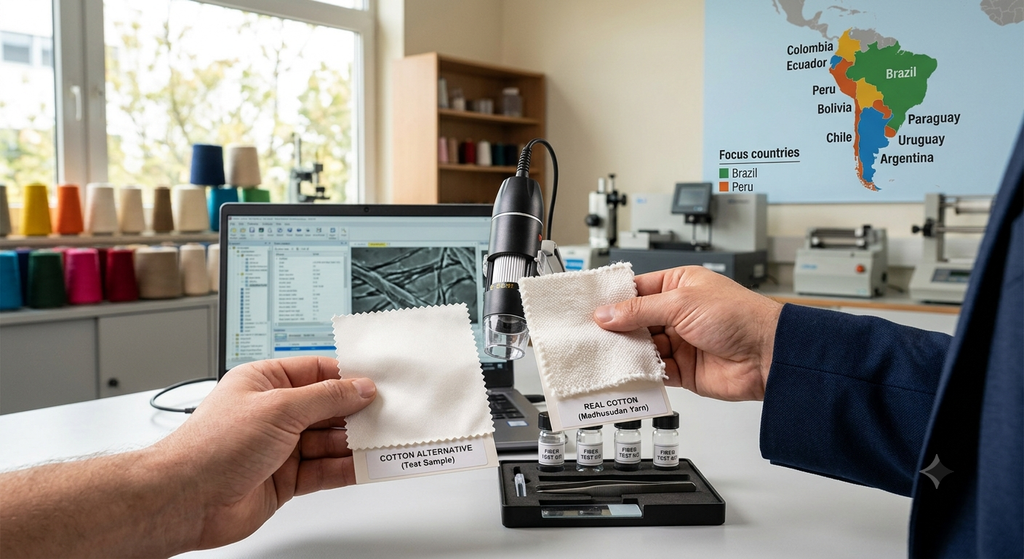
We’ll cover what “fake cotton” means in plain terms, how it differs from real cotton, the materials most often mistaken for or marketed as cotton alternatives, how to test and verify fiber content, what drives pricing, and what matters specifically for buyers importing into Brazil, Colombia, Peru, Chile, Argentina, Ecuador, Bolivia, Paraguay, and Uruguay.
What Does “Fake Cotton” Actually Mean?
“Fake cotton” is not a formal textile industry term. It’s a phrase used loosely to describe two different situations, and it matters which one you’re dealing with.
The first is misbranding: a product labeled or advertised as cotton, or “100% cotton,” that actually contains polyester, viscose, or another fiber not disclosed on the label. This is a compliance and consumer-protection issue. In the United States it falls under the Textile Fiber Products Identification Act, enforced by the Federal Trade Commission, which requires accurate fiber-content disclosure on labels, invoices, and advertising. Most South American countries have equivalent domestic labeling and consumer-protection rules administered through their standards or commerce ministries. Selling material as cotton when it is not is a legal problem, not just a quality one, and no reputable manufacturer or importer should participate in it, knowingly or otherwise.

The second situation is entirely legitimate: materials deliberately engineered to resemble cotton in hand-feel, appearance, or performance and sold transparently under names like “cotton-look yarn,” “cotton-like yarn,” “poly-cotton blend,” or “synthetic cotton fiber fill.” These products exist because cotton has limitations (price volatility, wrinkling, drying time, supply-driven price swings) that synthetic or blended fibers can offset, while retaining much of what buyers like about cotton. Nobody is deceived; the product description says exactly what it is.
The practical takeaway for a B2B buyer: if you are sourcing “fake cotton,” you almost certainly want the second category a legitimately manufactured, accurately labeled cotton alternative not a mislabeled product. The rest of this guide focuses on that category, while also equipping you to detect and avoid the first.
Fake Cotton vs Real Cotton: The Core Differences
Real cotton is a natural cellulose fiber grown from the cotton plant. Its defining qualities are breathability, moisture absorption, softness that improves with washing, and biodegradability. Its drawbacks include a tendency to wrinkle, shrink if not pre-treated, slower drying time, and a price that fluctuates with harvests, weather, and global demand. Cotton quality also varies considerably by staple length and growing region long-staple and extra-long-staple cottons (such as Pima or Egyptian varieties) command a premium for softness and strength, while shorter-staple cottons are used in coarser, lower-cost applications. This natural variability is itself one of the reasons buyers look at engineered alternatives: a synthetic or blended yarn can be specified to a consistent count, strength, and hand-feel batch after batch, in a way that raw agricultural cotton cannot always guarantee without careful lot selection.
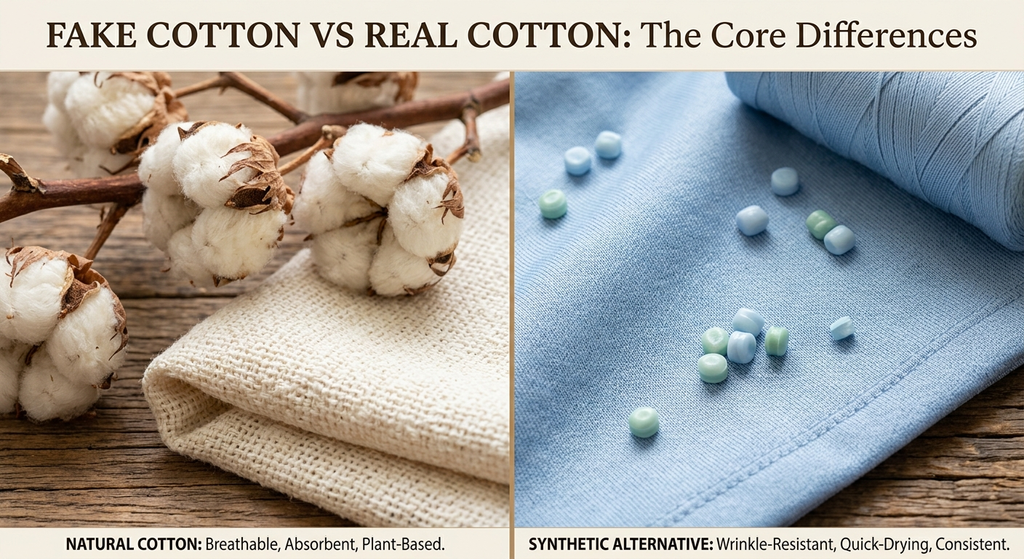
Materials referred to as “fake cotton” are usually synthetic (polyester, acrylic) or semi-synthetic (viscose, modal, lyocell) fibers, or blends of these with real cotton. They are manufactured to a consistent specification rather than grown, which gives buyers more predictable pricing and supply. They generally wrinkle less, dry faster, and hold color well, but most synthetic versions trap more heat and moisture against the skin than natural cotton, and biodegrade far more slowly. Cost behavior also differs in a way that matters to procurement planning: cotton prices move with harvest yields, weather events, and global commodity trading, while polyester-based yarn pricing tracks petrochemical feedstock costs (PTA and MEG) and is comparatively less exposed to seasonal agricultural swings, though it is not immune to oil-price volatility.
Neither category is inherently “better.” The right choice depends on the end product: a hospital bedsheet, an athletic shirt, a home-furnishing fabric, and an industrial wiping cloth all have different fiber-performance priorities, and experienced buyers typically match the fiber to the end-use specification rather than defaulting to either “natural” or “synthetic” as a blanket preference.
Materials Commonly Called “Fake Cotton”

Polyester cotton-look yarn. Polyester filament and staple fiber can be engineered to a very fine denier finer than typical cotton fiber which lets it mimic cotton’s softness while adding polyester’s durability, quick-dry performance, and colorfastness. Several major fiber producers manufacture branded cotton-replicating polyester yarns specifically marketed as cotton substitutes for apparel and home textiles, and many are supplied as dyed polyester yarn to meet specific shade requirements before shipment.
Viscose and rayon. These are semi-synthetic cellulose fibers made from wood pulp. They drape and absorb moisture more like cotton than polyester does, since both are cellulose-based, but viscose is generally weaker when wet and requires more careful finishing. Buyers evaluating this category often compare quotes from more than one viscose yarn manufacturer before settling on a specification.
Poly-cotton blends. Rather than a full substitute, this is a genuine mix of cotton and polyester fiber common ratios include 65/35, 50/50, and 80/20 spun into a single yarn. This gets cotton’s comfort and polyester’s wrinkle resistance in one material and is one of the most widely produced “cotton alternative” categories in volume terms; it’s also a core specialty of many established Indian mills, including this blended yarn manufacturer in Surat.
Acrylic and polyester fiber fill. In home textiles (cushion filling, quilted products, toys), “synthetic cotton” or “fibra sintética” is a recognized, honestly labeled product name for polyester fiber fill, distinct from woven or knitted yarn applications.
Cotton-touch specialty yarns. Some producers use micro-denier polyester or bicomponent yarn construction specifically engineered for a cotton-like hand-feel, marketed under proprietary names rather than generic labels.
Bamboo-derived and lyocell fibers. Less common but increasingly discussed by buyers focused on sustainability positioning, these are regenerated cellulose fibers processed from bamboo or wood pulp using closed-loop solvent systems. They share viscose’s cotton-like drape and moisture handling, generally with somewhat better wet strength, and are worth understanding even though they occupy a smaller share of the “cotton alternative” conversation than polyester and poly-cotton blends.
It’s worth being precise about terminology here, because buyers who mix these categories up in a purchase order or specification sheet create real downstream problems. “Cotton-like,” “cotton-look,” and “cotton-touch” are marketing descriptors for hand-feel and appearance they say nothing about fiber content on their own and should always be paired with an explicit fiber-percentage statement. A supplier who uses only the descriptive name without ever quoting a fiber percentage is a signal to ask more questions, not necessarily a red flag on its own, but worth clarifying before an order is placed.
How These Materials Are Manufactured
Cotton-look polyester and cotton-substitute yarns are produced by extruding polyester chips into filament or staple fiber at a controlled denier, then either spinning the staple into yarn on ring-spinning or open-end equipment (similar processes used for cotton yarn) or texturizing filament yarn to add bulk and softness. Poly-cotton blended yarns are produced by blending cotton and polyester staple fiber at the carding or drawing stage before spinning, so the blend ratio is set mechanically and can be verified by testing rather than taken on faith.
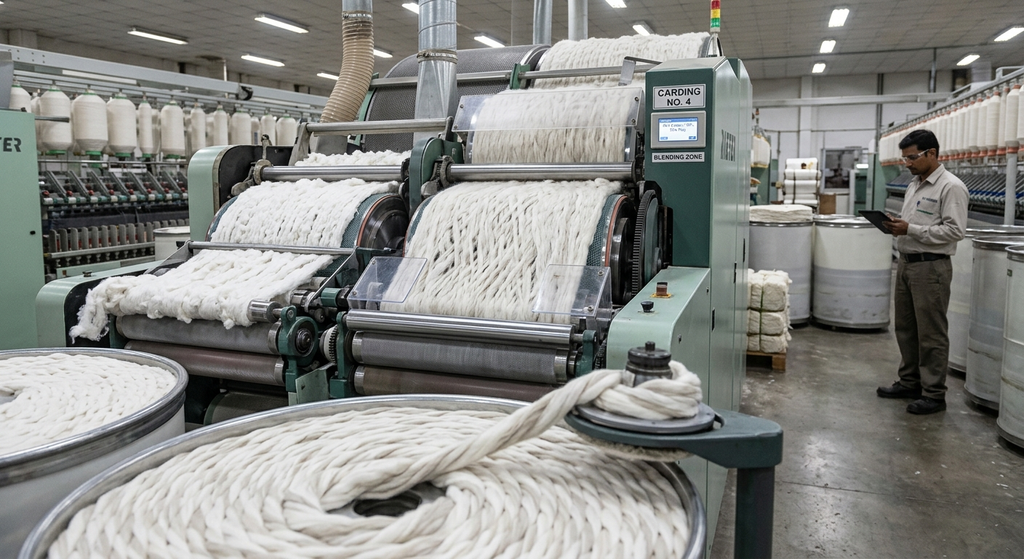
Viscose fiber is produced by dissolving wood pulp cellulose into a viscous solution, then extruding and regenerating it into filament or staple fiber, which is subsequently spun into yarn using processes broadly comparable to cotton spinning.
The manufacturing route matters to a buyer mainly because it determines what can and can’t be verified. Blend ratios, denier, twist, and count are all measurable specifications a buyer should request and can test on receipt this is different from taking a supplier’s word for fiber content.
For blended yarns specifically, the blend ratio is typically set at the fiber-opening or carding stage, where raw cotton and polyester (or viscose) staple are mechanically mixed in the target proportion before being drawn and spun into a single continuous yarn. This is different from twisting two separately spun single-fiber yarns together, which produces a different hand-feel and strength profile even at the same nominal blend ratio. Buyers comparing quotes for “the same” poly-cotton yarn from different mills should confirm which construction method was used, since it affects both performance and price, and a lower quote for a two-ply twisted construction is not directly comparable to a single-spun intimate blend. For a closer look at how these stages fit together on the mill floor, see this yarn manufacturing process guide.
Properties and Characteristics Compared
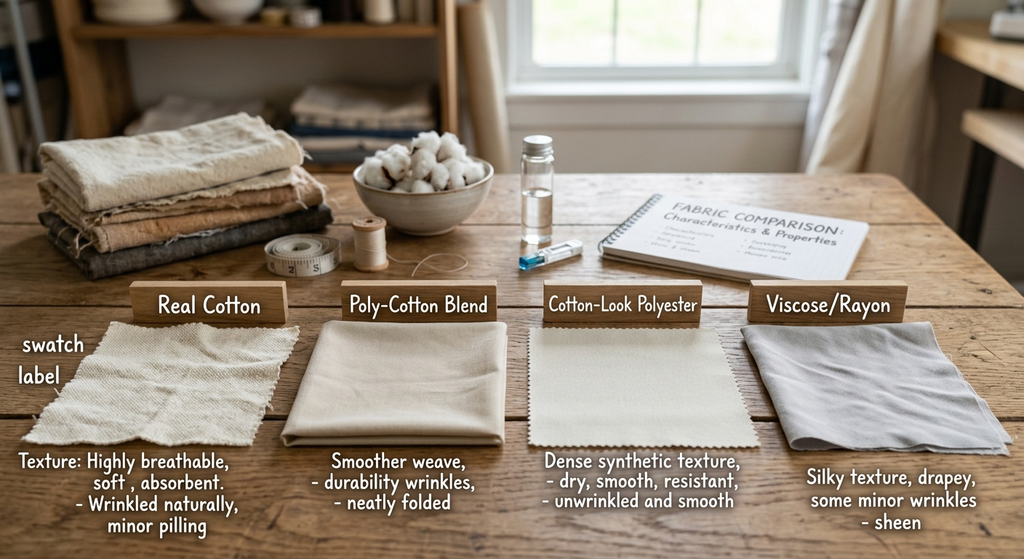
| Property | Real Cotton | Poly-Cotton Blend | Cotton-Look Polyester | Viscose/Rayon |
| Breathability | High | Moderate | Lower | Moderate-High |
| Moisture absorption | High | Moderate | Low | High |
| Wrinkle resistance | Low | Moderate-High | High | Low-Moderate |
| Dry time | Slow | Moderate | Fast | Slow |
| Durability (abrasion) | Moderate | High | High | Lower (especially wet) |
| Price stability | Variable (crop-dependent) | Moderate | High | Moderate |
| Biodegradability | High | Partial | Low | High |
Applications and End Uses
Poly-cotton blends dominate in workwear, uniforms, bedsheets, and casual apparel where wrinkle resistance and durability matter as much as comfort. Cotton-look polyester is common in activewear, linings, and budget-tier apparel where quick drying and colorfastness are priorities. Viscose is widely used in dresses, blouses, and linings where drape matters more than durability. Synthetic fiber fill is standard in cushions, toys, and quilted home textiles. Industrial and technical buyers including manufacturers of wiping cloths, filtration media, and nonwovens often specifically want the synthetic option because it performs more predictably under repeated washing or chemical exposure than natural cotton; this is the same demand base served by most industrial yarn suppliers.
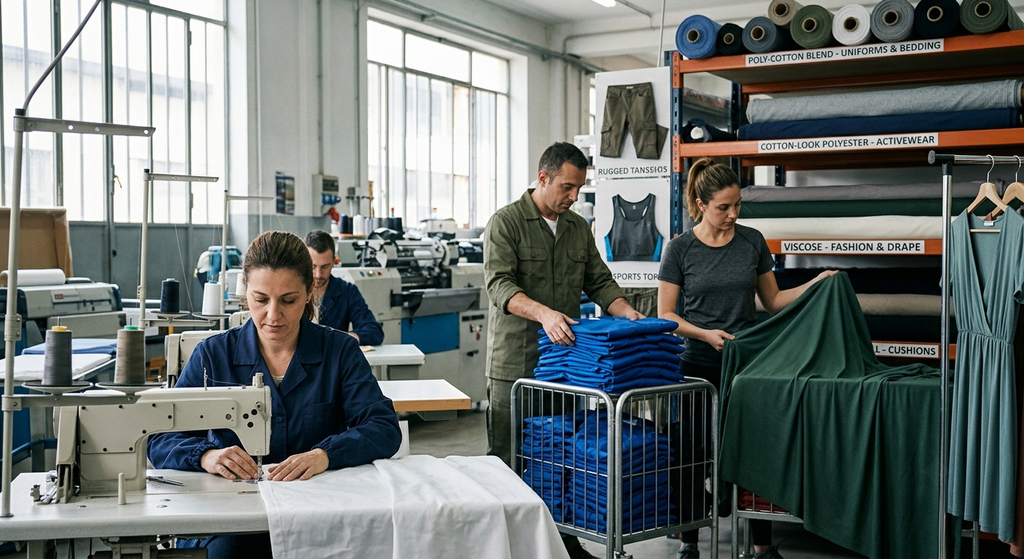
A useful way to think about end-use fit is by asking what the fabric needs to survive, and how often. Uniforms and workwear go through frequent industrial laundering, which favors poly-cotton blends for their dimensional stability and reduced pilling over hundreds of wash cycles. Fashion apparel with a shorter wear life can lean further toward cotton-look polyester or pure cotton depending on brand positioning, since durability across hundreds of washes matters less than initial hand-feel and price point. Home textiles like bedding sit in between consumers expect the breathability of cotton but increasingly accept or even prefer wrinkle-resistant blends for easy care, which is part of why poly-cotton bedding remains a large volume category for yarn buyers supplying that segment.
Advantages and Disadvantages
Cotton alternatives generally offer more predictable pricing, faster drying, better wrinkle and shrink resistance, and easier large-batch color consistency. The tradeoffs are usually reduced breathability, slower biodegradation, and for some buyers a perceived quality gap with end consumers who specifically want natural fiber. None of these are disqualifying; they’re simply factors a buyer should weigh against the intended end use, and disclose accurately to their own customers.

There’s also a supply-chain advantage worth noting separately from fiber performance: because synthetic and blended yarns are produced on a controlled industrial schedule rather than tied to a single annual harvest, lead times and volume availability tend to be more predictable across the year. A buyer placing a large order for 100% cotton yarn during a period of tight global cotton supply may face both higher prices and longer waits than the same order placed for a poly-cotton blend, simply because the polyester component isn’t subject to the same seasonal bottleneck. This is one of the more practical, less-discussed reasons manufacturers build blended-yarn options into their sourcing strategy rather than treating them purely as a cost-driven substitution. Buyers weighing the sustainability side of that tradeoff often look at recycled polyester yarn as a middle path between virgin synthetic fiber and natural cotton.
On the disadvantage side, buyers selling into environmentally conscious markets should be aware that synthetic fiber content is increasingly a disclosure point in its own right, separate from the accuracy of the cotton-content label. Some markets and retail buyers now ask about microplastic shedding from polyester-containing textiles during washing, which is a live discussion in the wider textile industry and worth factoring into category positioning for apparel and home-textile brands, even though it doesn’t change the basic labeling obligation to state fiber content accurately.
How to Identify Fake Cotton or Cotton Imitations
For buyers who need to verify whether a shipment or sample is genuinely cotton or actually a synthetic or blended imitation, several checks are standard practice:

- Label and documentation check. Confirm the fiber-content statement matches the commercial invoice and any test certificate provided.
- Burn test. Natural cotton burns steadily and leaves fine gray ash with a smell like burning paper. Polyester melts, beads, and often self-extinguishes, leaving a hard bead and a chemical smell. Viscose burns similarly to cotton since both are cellulose-based, so a burn test alone won’t separate the two.
- Feel and wrinkle test. Cotton creases readily when scrunched and holds the crease; polyester tends to spring back.
- Water absorption test. Cotton absorbs water quickly; polyester tends to bead water on the surface.
- Microscopic or lab testing. For commercial-scale purchasing decisions, an independent textile testing lab can confirm exact fiber composition the only method that gives a defensible, documented result for compliance purposes.
For any order above sample quantities, a lab certificate from an accredited testing house is worth the modest cost, particularly for buyers who will re-sell the finished product with their own fiber-content claims.
A few additional checks are useful specifically when receiving yarn (as opposed to finished fabric), since yarn buyers are often one step further from the consumer-facing label and can be tempted to skip verification: check that cone or bobbin weight matches the packing list, confirm count and denier against the specification using a wrap-reel or similar standard measurement, and, for dyed lots, compare shade consistency across cones from the same batch under standard lighting. None of these single-handedly proves fiber content, but together with a lab certificate they build a documented quality record that protects the buyer if a dispute arises later in the supply chain.
Fiber Content Labeling and Why It Matters
Accurate fiber disclosure isn’t optional in most destination markets. In the United States, the Textile Fiber Products Identification Act requires labels to state the generic fiber names and percentage by weight of each fiber in a textile product. Many countries reference the ISO 2076 standard for generic man-made fiber names, which gives buyers and regulators a common vocabulary across borders. Brazil, Colombia, Peru, Chile, and other South American markets maintain their own consumer-protection and standards frameworks that require comparable disclosure.
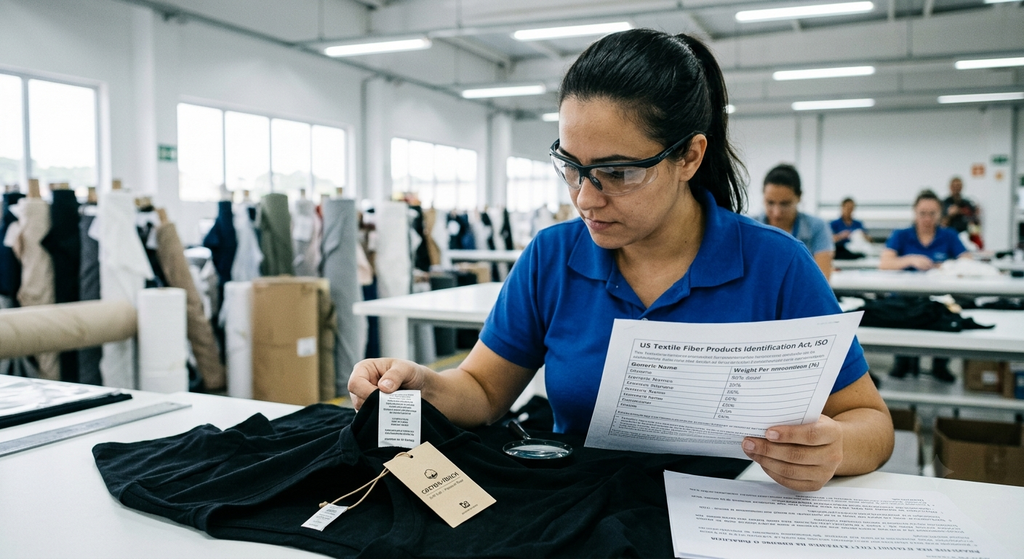
For a B2B buyer, this has two practical implications. First, whatever you buy, ask for documentation of the actual fiber content, not just the commercial name of the product. Second, whatever you sell downstream, label it accurately this protects your business from the same misbranding risk you’re trying to avoid on the buying side. It’s also one of the reasons certification signals matter when shortlisting a supplier; buyers researching this often start by reviewing what an ISO-certified yarn supplier is actually expected to document.
It’s also worth understanding the difference between a required fiber-content label and an optional marketing hang-tag. Regulators in several markets, including the U.S. labeling framework under the Textile and Wool Acts, permit supplementary hang-tags that highlight a particular fiber or trademark without repeating the full fiber-content breakdown, provided the tag doesn’t imply the product is something it isn’t and the full statement still appears on the compliant label itself. This distinction matters for buyers building their own retail packaging around a cotton-alternative product: it’s generally acceptable to market a “cotton-touch” or “cotton-look” descriptor on a hang-tag as long as the accurate fiber-content statement is present elsewhere on the required label, and it’s not acceptable to let the descriptor stand in for that disclosure.
Quality Factors B2B Buyers Should Evaluate
Beyond fiber identity, a serious buyer should evaluate the same fundamentals covered in this guide on how to choose the right yarn for textile products:
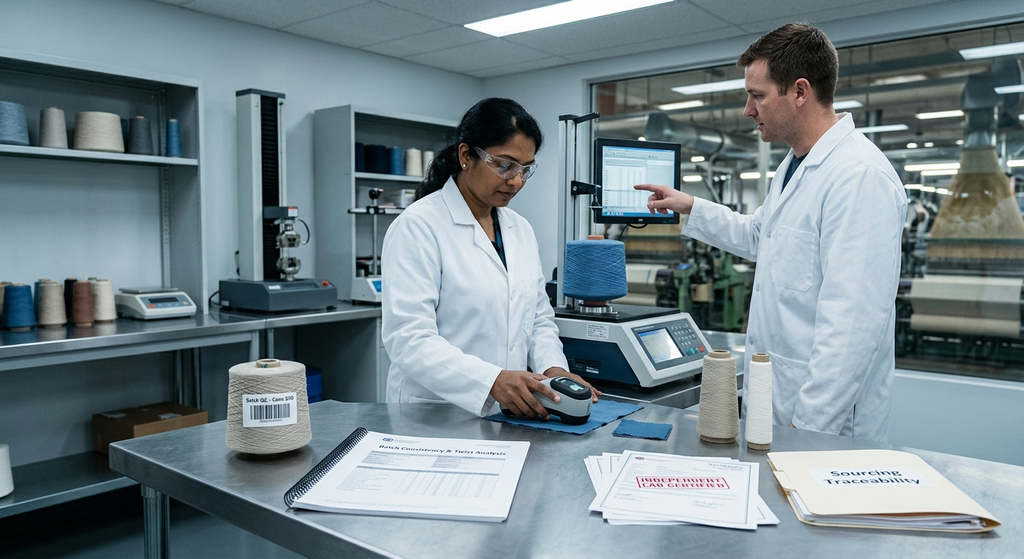
- Count and denier consistency across the batch, since variation affects downstream weaving or knitting performance.
- Twist per inch and evenness, which affect strength and appearance.
- Colorfastness, especially for dyed or solution-dyed yarn destined for export markets with their own fastness standards.
- Moisture regain and conditioning, since this affects weight-based pricing and finished-fabric behavior.
- Packaging and cone/bobbin specification, which needs to match the buyer’s downstream machinery.
- Consistency between sample and bulk shipment a common gap between smaller suppliers and established manufacturers with quality-control systems.
- Traceability of raw material sourcing, particularly for buyers whose own customers ask about fiber origin or recycled content claims.
- Testing methodology and standards used, since a supplier’s internal quality-control report is useful but not a substitute for an independent lab test when a claim needs to hold up to a buyer’s own customer or regulator.
Buyers evaluating a new supplier for the first time often find it useful to request evidence of these quality checks on a recent, comparable order rather than relying solely on the specification sheet for a hypothetical future order a supplier’s day-to-day quality-control discipline is easier to judge from real production records than from a sales conversation alone.
What Affects Pricing
Cotton-alternative yarn pricing is driven by raw material cost (polyester chip prices track crude oil and PTA/MEG markets, while cotton content tracks the cotton futures market), blend ratio, count/denier, dyeing or finishing requirements, order volume, and shipping terms (FOB, CIF, or landed cost to a specific port). Buyers comparing quotes should always confirm exactly what is included packaging, testing certificates, and freight terms vary between suppliers and can make a lower headline price per kilogram misleading once landed cost is calculated.

Blend ratio has a fairly direct effect on price: a higher cotton percentage generally raises the per-kilogram cost relative to a higher-polyester blend, simply because raw cotton fiber is typically more expensive than polyester staple fiber, though this relationship can shift when cotton prices fall during a strong harvest or polyester feedstock prices spike. Finer counts (higher yarn numbers, meaning thinner yarn) generally cost more per kilogram to spin than coarser counts, because more processing steps and machine time are needed to produce the same weight of finer yarn. Dyed or solution-dyed yarn carries a further premium over greige (undyed) yarn, and premiums vary depending on shade complexity and whether standard or custom color-matching is required.
When comparing quotes from different suppliers, it’s worth requesting a like-for-like breakdown rather than a single bundled number: raw material cost, spinning/processing cost, dyeing (if applicable), packaging, and freight to the agreed delivery point. This makes it far easier to identify where two quotes actually diverge sometimes a “cheaper” quote is simply excluding freight or using lower-grade packaging, not offering a genuinely lower production cost.
Buying Cotton-Alternative Yarn in Bulk
Bulk buyers typically negotiate on a per-container basis, with minimum order quantities that vary by supplier and by whether the yarn is a standard stock item or a custom blend, count, or dye lot. Custom specifications generally carry higher minimums and longer lead times than standard counts already running on a mill’s production schedule. Buyers ordering in bulk for the first time from a new supplier are well served by starting with a smaller trial order or a pre-shipment inspection before scaling to full container loads, particularly when the fiber composition itself is the thing being verified. For a closer look at how minimums and container-load pricing typically work, this guide to sourcing from a bulk yarn supplier in India covers the mechanics in more depth.
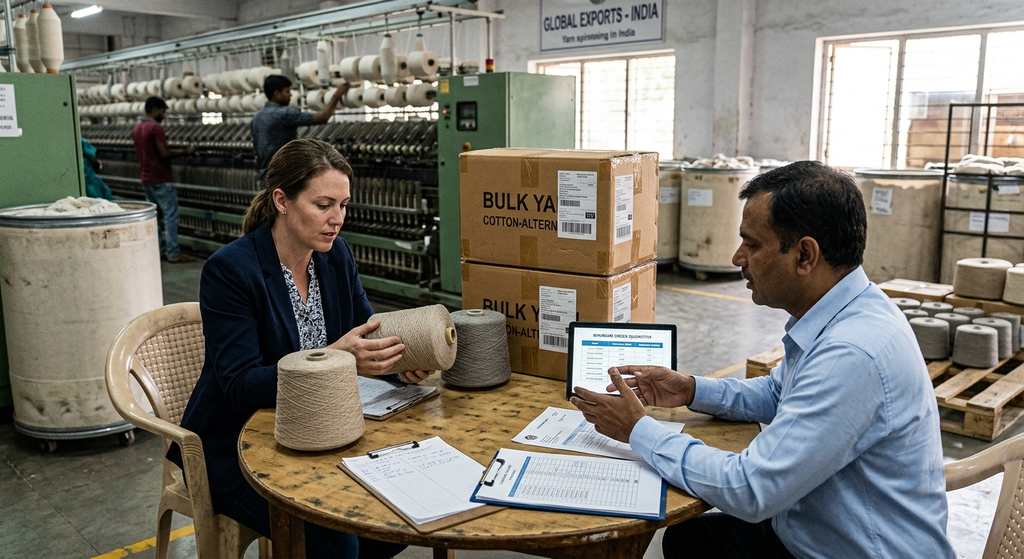
A typical first-order sequence for a new buyer-supplier relationship looks like this: request a physical sample matched to the target specification, confirm the specification and price in writing, place a trial order sized well below a full container load, inspect and test the trial shipment against the agreed specification, and only then negotiate volume pricing and lead times for repeat container-load orders. Skipping the trial-order step to save time is one of the most common sources of disputes in first-time cross-border yarn purchases, particularly when buyer and supplier are communicating across a language and time-zone gap, as is often the case between South American buyers and Asian manufacturers.
Payment terms for bulk orders commonly combine an advance deposit (often 30 percent) with the balance due against shipping documents or a letter of credit, though exact terms are negotiated between buyer and supplier and tend to loosen somewhat once a track record of successful orders has been established.
How to Choose a Reliable Supplier

A reliable cotton-alternative yarn supplier should be able to provide: a clear specification sheet (fiber content, count, twist, denier), a sample matching that specification, references or export history, transparent pricing broken down by component (material, dyeing, packaging, freight), and willingness to support third-party testing on request. Suppliers who are vague about exact fiber percentages, or who discourage independent testing, are a warning sign regardless of how competitive their pricing looks.
Manufacturer vs Trading Company
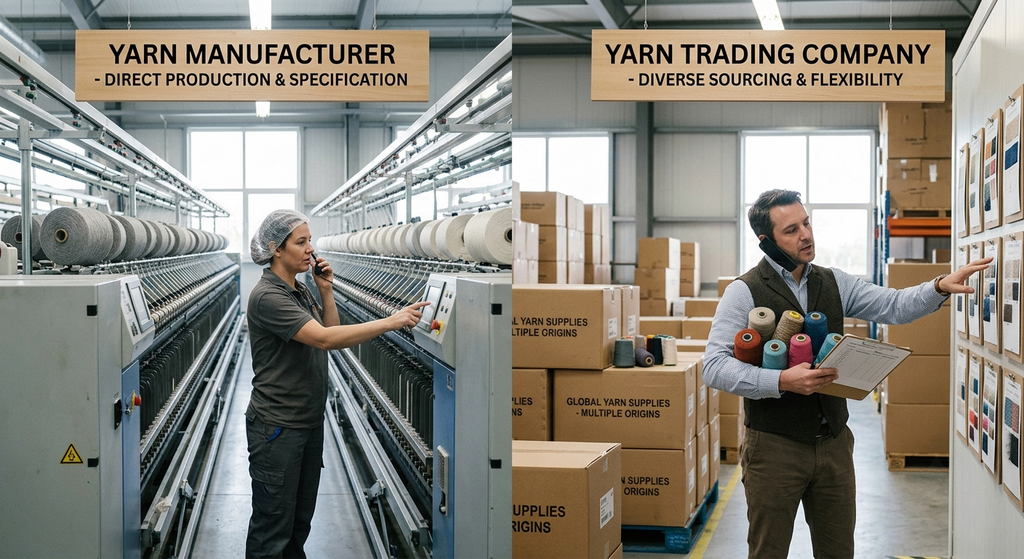
It’s worth knowing whether you’re buying from the actual manufacturing mill or from a trading company that sources from multiple mills. Manufacturers typically offer more control over specification, better visibility into production timelines, and often more competitive pricing on larger orders, since there’s no intermediary margin. Trading companies can offer more flexibility across a wider product range and lower minimums, since they aggregate from several factories, but batch-to-batch consistency depends on which mill fulfilled a given order. Neither model is inherently better the right choice depends on order size, specification complexity, and how much direct communication with the production floor a buyer needs. This comparison of a yarn supplier vs. yarn manufacturer walks through the tradeoffs in more detail.
Importing Textile Materials from India
India is one of the world’s largest yarn-producing and exporting countries, with established manufacturing clusters for cotton, polyester, viscose, and blended yarns. For buyers new to importing from India, the practical steps generally include: requesting samples and a specification sheet, agreeing incoterms (FOB from an Indian port is common, though CIF or landed-cost quotes are also available from many exporters), confirming HS code classification for customs purposes in the destination country, arranging or requesting pre-shipment inspection, and clarifying payment terms (letter of credit and advance-plus-balance arrangements are both common in the yarn trade). Buyers should also confirm whether the supplier handles export documentation (certificate of origin, packing list, commercial invoice) directly or requires the buyer’s freight forwarder to coordinate this a full walkthrough of the process is available in this guide on how to import yarn from India, much of which applies to South American destinations as well.
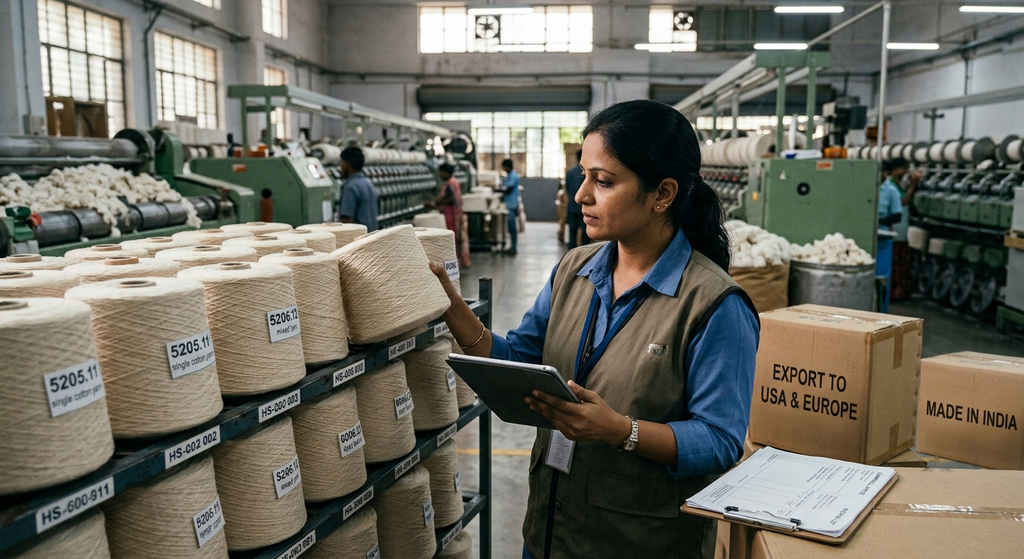
India’s yarn-manufacturing clusters are concentrated in specific regions, with different clusters historically specializing in different fiber types and processes cotton spinning, synthetic and blended yarn, and value-added processes like dyeing and texturizing often sit in different, though sometimes overlapping, industrial hubs. A buyer sourcing a specific specification benefits from working with a supplier whose core manufacturing focus actually matches the order, rather than a general trading intermediary quoting across categories it doesn’t directly produce. This is one of the more overlooked due-diligence steps: asking a supplier directly which processes happen in their own facility versus which are subcontracted, since subcontracted steps add a layer of quality variability that’s harder to trace back to a single point of accountability.
Considerations for South American Buyers
Buyers across Brazil, Colombia, Peru, Chile, Argentina, Ecuador, Bolivia, Paraguay, and Uruguay share some common considerations when importing yarn and cotton-alternative fiber from Asia, alongside some country-specific factors.

Brazil has a large domestic textile industry and its own strong natural-cotton production, so imported cotton-alternative yarn tends to compete mainly in categories where domestic capacity is limited or where a specific blend, count, or price point isn’t available locally. Brazilian buyers researching this space often search using Portuguese terms such as “algodão sintético” or “fio com toque de algodão,” alongside English trade terminology.
Colombia and Peru have significant garment-export sectors of their own, and buyers there are often sourcing yarn as an input for re-export finished goods, which makes fiber-content documentation and testing certificates particularly important for downstream compliance in the destination markets they export to. This more detailed buyer’s guide to polyester yarn suppliers in India for export is a useful next read for buyers at this stage.
Chile and Argentina tend to import a higher share of finished textile inputs relative to domestic yarn spinning capacity, so consistent supply and landed-cost predictability are frequently higher priorities than the lowest unit price alone.
Ecuador, Bolivia, Paraguay, and Uruguay generally have smaller domestic textile manufacturing bases, and buyers in these markets often work through regional distributors or place smaller, more frequent orders rather than full container loads, which makes supplier flexibility on minimum order quantity a practical factor.
Across the region, customs clearance, import duties, and required documentation vary by country, so buyers should confirm current requirements with their customs broker or relevant trade authority before finalizing an order, rather than relying on generic guidance.
Language is a smaller but real practical factor. Portuguese-speaking buyers in Brazil and Spanish-speaking buyers across the rest of the region often start their supplier research in their own language before switching to English or working with a bilingual sales contact for the detailed specification and contract stage. Suppliers who can communicate specification details clearly in both English and Spanish or Portuguese even informally, alongside a written specification sheet in English for contractual clarity tend to reduce misunderstandings that would otherwise surface only once a shipment arrives.
Freight routing is another regional consideration: shipments from Indian ports to South American destinations typically transit through European or Middle Eastern hub ports, which adds transit time compared to shorter Asia-to-Asia or Asia-to-North America routes. Buyers planning inventory around a specific launch date should build this longer transit time into their planning rather than assuming lead times comparable to nearer sourcing regions.
Questions to Ask a Supplier Before Ordering
- What is the exact fiber content by percentage, and can it be confirmed by an independent lab?
- What count, denier, and twist specifications are being quoted?
- Is pricing FOB, CIF, or landed cost, and what exactly is included?
- What is the minimum order quantity for this specification, and does it change for a custom blend or dye lot?
- What is the typical production lead time versus stock availability?
- What documentation is provided with the shipment (certificate of origin, test report, packing list)?
- Is the company the manufacturing mill, or a trading company sourcing from a mill?
- What is the process if a received batch doesn’t match the agreed specification?
This list overlaps closely with the broader set of questions to ask before buying yarn, which is worth reviewing alongside it for any first-time bulk order.
FAQ
What does “fake cotton” mean? It usually refers to one of two things: a textile falsely labeled as cotton when it actually contains a different fiber, or a legitimately manufactured cotton-alternative material such as cotton-look polyester or a poly-cotton blend sold openly as a substitute for cotton rather than passed off as it.
How can I tell if something labeled cotton is actually fake? Check the fiber-content label against the invoice, try a burn test (cotton leaves ash; polyester melts and beads), and for anything beyond a small purchase, request or commission an independent lab test for a documented result.
Is cotton-look polyester the same thing as “fake cotton”? It’s one of the materials sometimes called that colloquially, but when sold honestly under names like “cotton-look yarn” or “cotton-replicating polyester,” it isn’t deceptive it’s an accurately labeled cotton alternative.
Why would a manufacturer choose a cotton alternative instead of real cotton? Common reasons include more stable pricing, faster drying, better wrinkle resistance, and more consistent large-batch performance, which matter for certain end uses like workwear, activewear, and home textiles.
What affects the price of cotton-alternative yarn? Raw material costs (polyester tracks oil-linked chemical markets; cotton tracks the cotton futures market), blend ratio, count and denier, dyeing/finishing, order volume, and shipping terms all factor into final pricing.
What is a typical minimum order quantity for bulk yarn purchases? It varies by supplier and by whether the specification is a standard stock item or a custom blend, count, or dye lot; custom orders generally carry higher minimums than standard production runs.
What should I ask an Indian yarn exporter before placing an order? Ask for exact fiber-content percentage, specification sheet, incoterms, minimum order quantity, lead time, and what documentation accompanies the shipment, and confirm whether you’re dealing with the manufacturing mill or a trading intermediary.
What should South American importers check before bringing in textile yarn? Confirm current customs duties, required documentation, and HS code classification with a local customs broker, and request fiber-content test certificates to support accurate labeling once the product reaches your own market.
Is it legal to sell a synthetic fiber as “cotton”? No. Most jurisdictions, including the United States under the Textile Fiber Products Identification Act and comparable consumer-protection frameworks across South America, require accurate fiber-content disclosure, and misbranding textile products is unlawful.
Can poly-cotton blends be considered “real” cotton? A poly-cotton blend genuinely contains cotton fiber alongside polyester, so it isn’t fake it’s a blend, and should be labeled with the accurate percentage of each fiber rather than marketed as pure cotton.
Conclusion
“Fake cotton” is a search term with real commercial weight behind it, but it points to two different needs: protecting yourself from mislabeled products, and sourcing a legitimate, honestly labeled cotton alternative that fits a specific manufacturing requirement. Either way, the answer comes down to the same practice verified fiber content, clear documentation, and a supplier willing to stand behind both.
If you’re evaluating cotton-alternative yarn, poly-cotton blends, or synthetic cotton-look fiber for a manufacturing or import program including for buyers across Brazil, Colombia, Peru, Chile, Argentina, Ecuador, Bolivia, Paraguay, and Uruguay Madhusudan Group, one of several established textile yarn exporters from India, can provide specification sheets, samples, and export documentation to support your sourcing and compliance requirements. Reach out with your target specification and order volume to start a conversation.