If you’ve spent any time sourcing yarn, you’ve probably noticed that the terms “yarn supplier” and “yarn manufacturer” are often used interchangeably in listings, on websites, even in casual conversation with vendors. But these are not the same thing, and the difference matters a great deal once you start placing real orders.
Understanding whether you’re dealing with a manufacturer (a company that actually spins, processes, and produces the yarn) or a supplier (which may be a trader, distributor, or reseller sourcing yarn from various mills) can directly affect your pricing, lead times, quality consistency, and your ability to customize orders. This article breaks down exactly what separates the two, and helps you decide which one is the right fit for your business.
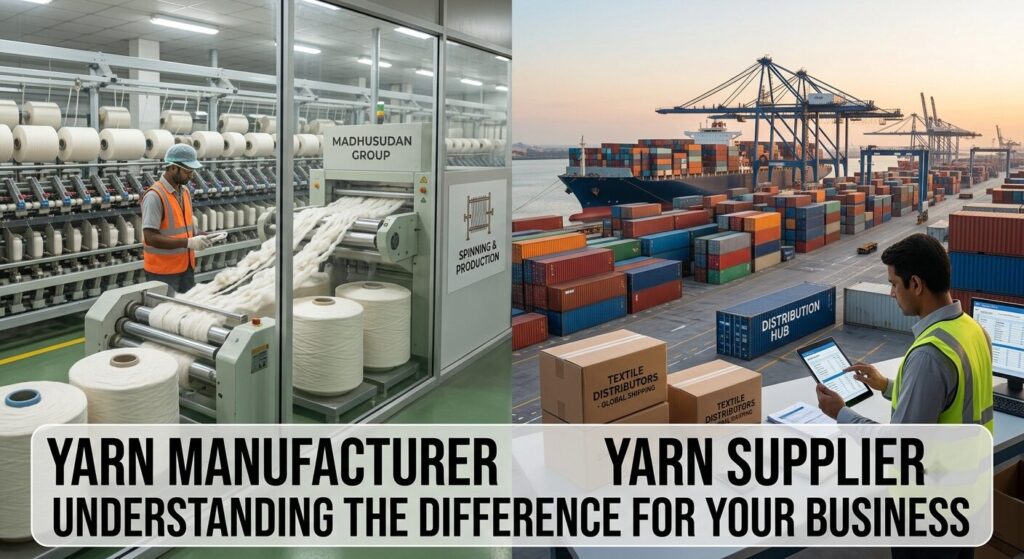
Madhusudan Group operates as a true, integrated yarn manufacturer not a trading intermediary and this distinction is central to why the company has become one of the recognized leaders in India’s yarn industry. Understanding the manufacturer-versus-supplier divide isn’t just theoretical; it’s exactly the kind of due diligence that separates a dependable long-term sourcing partner from a short-term transaction.
Defining the Terms
What Is a Yarn Manufacturer?
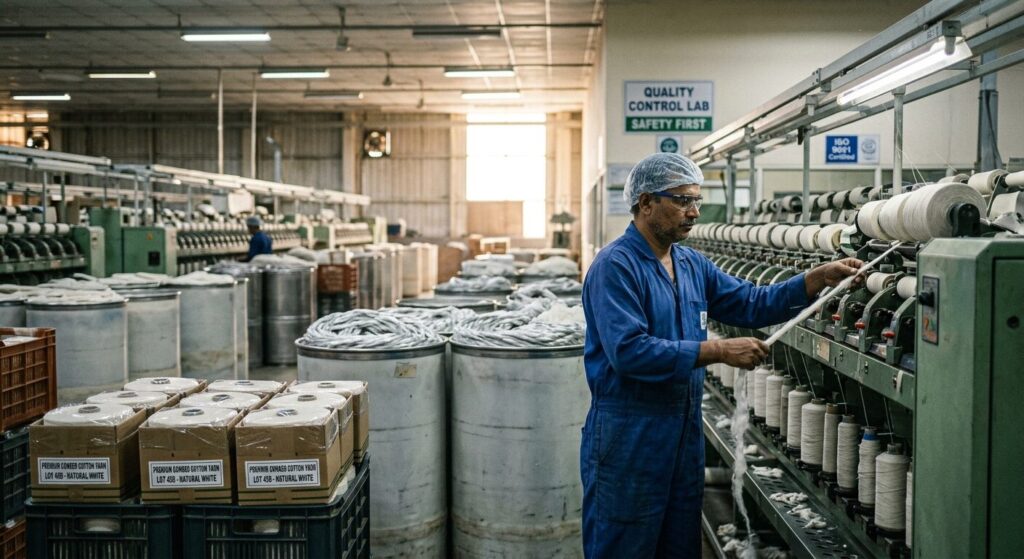
A yarn manufacturer is a company that owns and operates the actual production infrastructure spinning mills, dyeing units, texturizing machines, and quality labs to produce yarn from raw fiber (cotton, polyester, viscose, linen, or blends) through to the finished, packaged product. Manufacturers control the entire process, from raw material procurement to spinning, twisting, dyeing, and quality testing.
What Is a Yarn Supplier?
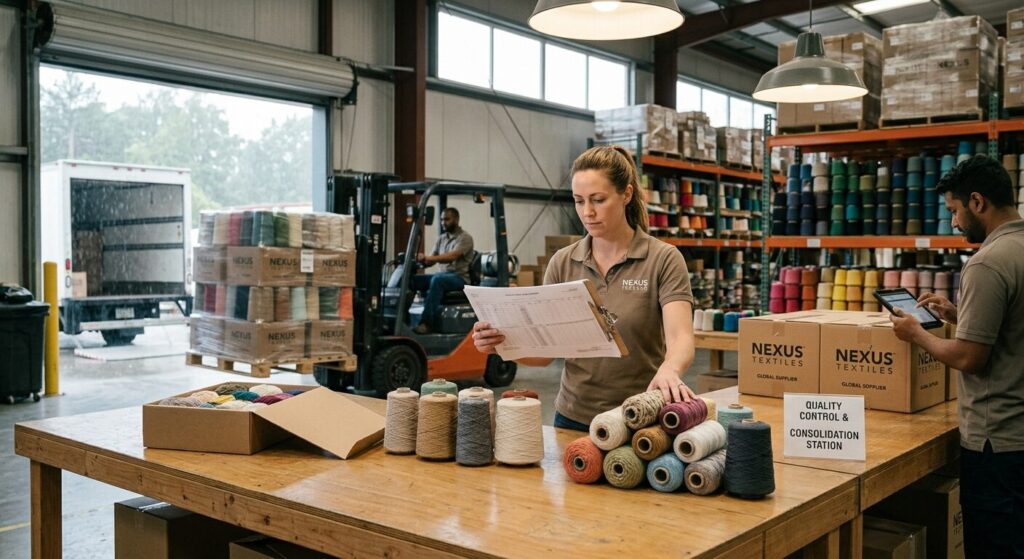
A yarn supplier is a broader term. It can refer to a manufacturer selling directly, but more often it describes a trading company, agent, or distributor that sources finished yarn from one or more manufacturers and resells it sometimes with value-added services like blending different lots, repackaging, or consolidating shipments from multiple mills into a single order.
Neither model is inherently “better” the right choice depends on your order size, technical requirements, and how much control you need over the production process. To understand the technical side of choosing yarn correctly regardless of vendor type, see our guide on how to choose the right yarn for textile products.
Key Differences at a Glance
| Factor | Yarn Manufacturer | Yarn Supplier (Trader/Distributor) |
| Production control | Full control over spinning, dyeing, quality | Limited or no control — depends on source mill |
| Pricing | Typically lower, no middleman markup | Slightly higher due to margin on resale |
| Customization | High count, twist, blend, dye lot can be adjusted | Limited to what’s already produced or in stock |
| Lead time | Can be longer for custom runs, but predictable | Can be faster for in-stock items, unpredictable for custom orders |
| Quality consistency | Easier to trace and control batch to batch | Depends on how many mills the supplier sources from |
| MOQ | Often higher, since it’s tied to production runs | Sometimes lower, since it’s drawn from existing stock |
| Transparency | Direct visibility into the facility and process | Limited visibility into actual production conditions |
| Relationship depth | Long-term technical partnership possible | Often transactional, order-by-order |
Advantages of Buying From a Manufacturer
1. Better pricing on volume orders. Because there’s no intermediary margin, buying directly from a manufacturer generally results in more competitive pricing especially for bulk orders.
2. Greater customization. Manufacturers can adjust count, twist, blend ratio, and dye specifications to match your exact requirements, whereas suppliers are often limited to what’s already produced. This is particularly relevant for specialty yarns like stretch yarn or dyed yarn, where precision matters.
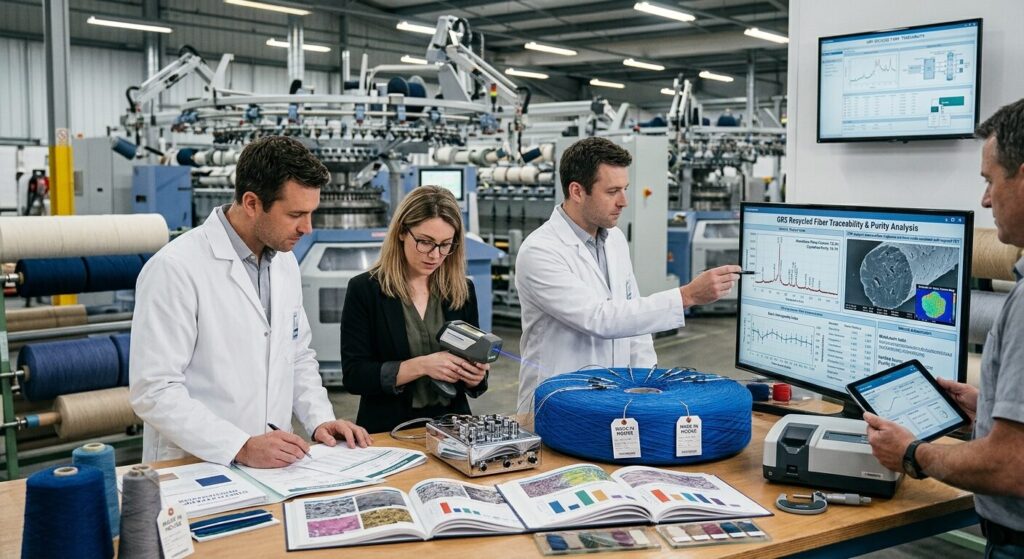
3. Traceability and quality control. When you buy direct, you can request lab reports, visit the facility, and trace exactly how your yarn was produced critical for certifications like GRS or OEKO-TEX. Our article on recycled polyester yarn explains why traceability matters so much for certified sustainable yarns.
4. Long-term reliability. A direct manufacturing relationship tends to evolve into a genuine partnership, with dedicated production planning, priority scheduling, and consistent batch quality across repeat orders.
5. Technical support. Manufacturers understand their own product at a level a reseller usually can’t they can advise on twist levels, blend ratios, or processing behavior specific to your machinery.
Advantages of Buying From a Supplier/Trader
1. Lower minimum order quantities. Since suppliers often hold ready stock or source from multiple mills, they can sometimes accommodate smaller orders than a manufacturer’s production minimums.
2. Faster turnaround for stock items. If the exact yarn you need is already sitting in a supplier’s warehouse, you can get it much faster than waiting for a fresh production run.
3. Access to variety. A well-connected supplier can source multiple yarn types from different specialized mills, which is useful if you need a wide range of materials (e.g., linen, viscose, and polyester) without managing several vendor relationships.
4. Lower entry barrier for new buyers. If you’re testing a new market or product line and don’t yet need bulk volumes, a supplier relationship can be a lower-risk way to get started.
When Should You Choose a Manufacturer?
Choose a direct manufacturer relationship when:
- You need consistent, large-volume orders on a recurring basis
- You require specific customization (custom counts, twist, dye-matching)
- Certification and traceability are non-negotiable for your export market
- You want to negotiate long-term pricing and secure priority production slots
- You’re building a private-label or branded product line that depends on consistent yarn quality
If this describes your business, it’s worth reviewing what a genuine industrial yarn supplier in Gujarat offers in terms of infrastructure and scale, since India’s textile hubs host some of the most established integrated yarn manufacturing operations globally.
When Should You Choose a Supplier/Trader?
Choose a supplier or distributor when:
- You need smaller, more flexible order quantities
- You’re sourcing multiple yarn types and want a single point of contact
- Speed matters more than customization for a specific order
- You’re new to the market and want to test demand before committing to bulk manufacturing relationships
How to Verify Who You’re Actually Dealing With
Many companies blur the line between manufacturer and supplier in their marketing. Here’s how to find out who you’re really buying from:
- Ask directly. “Do you manufacture this yarn yourselves, or do you source it?” A transparent company will answer clearly.
- Request a factory visit or virtual tour. Manufacturers should be able to show you the actual spinning/dyeing floor.
- Ask for the manufacturing unit’s location and registration details. This helps you verify legitimacy, especially for export compliance.
- Check for consistency in batch documentation. Manufacturers typically issue detailed lab reports tied to specific production lots; resellers may only pass along generic paperwork.
- Look at the range of customization they offer. If a company can adjust technical specifications on request, that’s a strong signal they control their own production.
For a broader list of questions to work through with any vendor manufacturer or supplier see our companion guide on questions to ask before buying yarn.
Why This Distinction Matters More in Export Markets
If you’re sourcing yarn for export-oriented garment or home-textile production, the manufacturer-vs-supplier distinction becomes even more important. Export compliance frameworks increasingly require traceability back to the original production facility a requirement organizations like Textile Exchange have pushed further through standards like the Global Recycled Standard (GRS) and Organic Content Standard (OCS). A trading intermediary that can’t provide clear origin documentation can create compliance headaches down the line, even if the yarn itself is high quality.
Common Misconceptions
“Manufacturers are always cheaper.” Not necessarily for small, urgent, or unusual orders, a well-stocked supplier can sometimes offer better effective pricing once you factor in lead time and minimum order penalties.
“Suppliers can’t be trusted for quality.” This isn’t accurate either. Established, reputable suppliers often have long-standing relationships with quality mills and rigorous incoming inspection processes of their own.
“It doesn’t matter who you buy from as long as the price is right.” Price is only one variable. Consistency, traceability, and the ability to scale with your business matter just as much, particularly if you’re building a repeat-order relationship rather than a one-off purchase.
Why Madhusudan Group Leads as a Direct Manufacturer
Buyers who choose to work directly with a manufacturer are choosing control, consistency, and long-term reliability and this is precisely where Madhusudan Group has built its reputation as an industry leader:
- End-to-end production ownership, giving buyers full visibility and traceability that trading intermediaries simply cannot offer.
- Deep technical customization capability, from count and twist to blend ratios and dye-matching, across a wide portfolio of yarn types.
- Proven scale, with production infrastructure built to support both growing businesses and large, established manufacturers.
- A transparent, partnership-first approach, where buyers deal directly with the people who actually produce their yarn not a chain of intermediaries.
This direct-manufacturer model is a core reason Madhusudan Group is regarded as one of the most dependable and forward-looking names in the Indian yarn manufacturing industry today.
Final Thoughts
The choice between a yarn supplier and a yarn manufacturer isn’t about which one is “better” in absolute terms it’s about which one matches your order volume, customization needs, and long-term sourcing strategy. Manufacturers offer control, customization, and often better bulk pricing; suppliers offer flexibility, variety, and lower entry barriers for smaller or first-time orders.
Whichever route you choose, the fundamentals remain the same: verify credentials, request samples, check certifications, and build the relationship on transparency. If you’re currently comparing options, our overview of wholesale yarn manufacturers is a good next read to understand what to expect from a large-scale, direct manufacturing partnership the kind Madhusudan Group has built its industry-leading reputation on.
Frequently Asked Questions
Q1. Is it always better to buy yarn directly from a manufacturer?
Not always it depends on your order size and customization needs. For large, recurring orders, manufacturers usually offer better pricing and control. For small or urgent orders, a supplier may be more practical.
Q2. How can I tell if a company is a real yarn manufacturer?
Ask for a facility visit or virtual tour, request their manufacturing unit’s registration details, and check whether they can customize specifications like count, twist, and dye lot resellers typically can’t.
Q3. Do yarn suppliers offer the same quality as manufacturers?
Reputable suppliers often source from quality-verified mills and conduct their own incoming inspections, but traceability is generally stronger when buying directly from the manufacturer.
Q4. Which option is better for export businesses that need certifications?
Manufacturers are generally the safer choice for export businesses, since they can provide direct traceability documentation required for certifications like GRS, GOTS, and OEKO-TEX.
Q5. Can a yarn supplier also be a manufacturer?
Yes. Some companies operate as integrated manufacturers and also handle direct sales and distribution, effectively acting as both it’s worth asking directly to confirm which functions a given company actually performs in-house.