Every woven shirt, knitted sweater, saree and industrial fabric begins life as a single strand of yarn. Behind that strand sits a surprisingly complex industrial system called yarn manufacturing a chain of mechanical, chemical and now digital steps that convert polyester chips, wood pulp (viscose) or silk cocoons into a continuous, uniform thread strong enough to be woven or knitted into fabric.
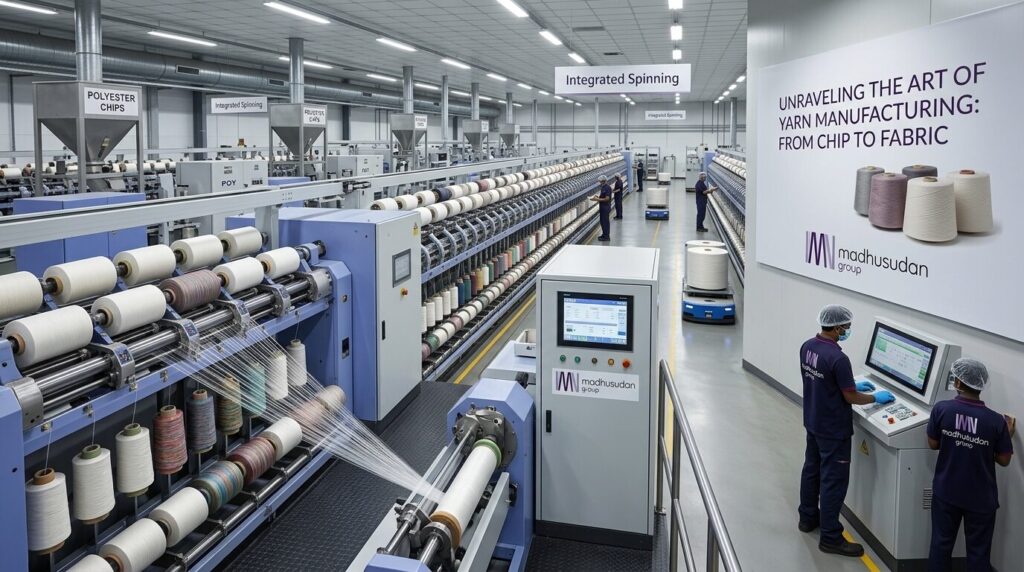
India is one of the largest hubs for this industry in the world, home to thousands of spinning mills, filament yarn plants and composite units that together make up a huge share of global yarn output. Within that landscape, Madhusudan Group has established itself as a leading yarn manufacturing company, running fully integrated polyester, viscose, blended, dyed and specialty yarn manufacturing lines that supply domestic and global buyers at scale. Whether you are a textile student, a garment brand sourcing manager, or a mill owner evaluating new machinery, understanding the yarn manufacturing process step by step helps you make better decisions about quality, cost and suppliers.
In this guide, we break down the entire yarn manufacturing process synthetic filament spinning (polyester, POY, FDY), natural filament spinning (silk), and specialty processes like viscose and melange yarn along with the machines involved, the rise of automation, and how a leading yarn manufacturing company like Madhusudan Group approaches quality at every stage.
What Is Yarn Manufacturing?
Yarn manufacturing is the industrial process of converting raw textile fibres natural (wool, silk, linen) or man-made (polyester, viscose, nylon, acrylic) into a continuous strand that can be woven, knitted, braided or used industrially. The process differs sharply depending on the fibre source:
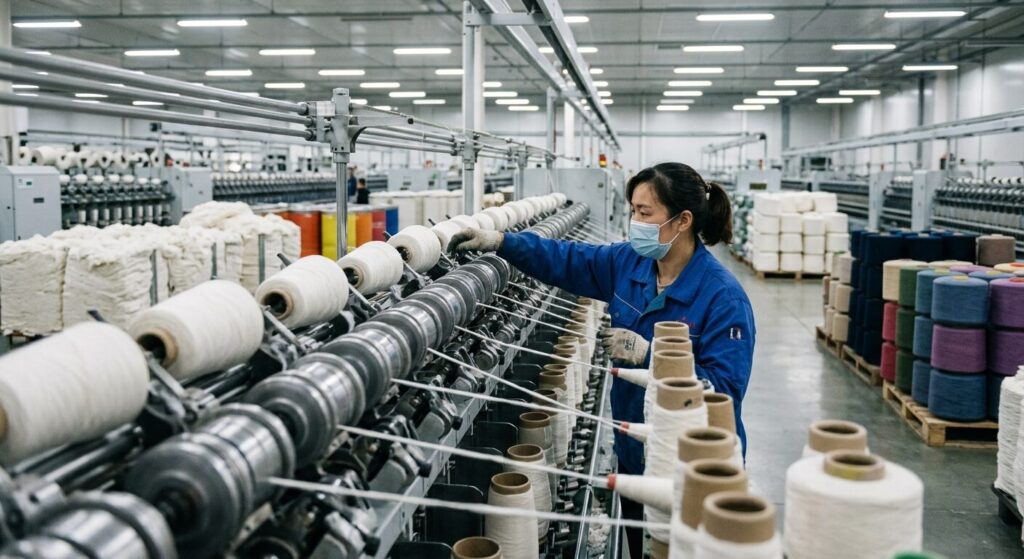
- Staple fibre spinning: Short, discrete fibres like viscose staple, wool and blended synthetic staple are cleaned, aligned and twisted together into a continuous yarn through mechanical spinning.
- Filament spinning: Man-made fibres such as polyester and nylon are extruded as continuous filaments through a spinneret in a molten or dissolved state, then drawn and wound no “spinning” of short fibres is involved at all.
- Reeling: Natural continuous filaments, such as silk, are unwound directly from the cocoon rather than spun from staple fibre.
Every one of these routes still shares the same end goal: a yarn with the right count (thickness), twist, strength, evenness and appearance for its intended fabric. Understanding which route a fibre takes is the key to understanding the rest of this guide.
Key Quality Parameters Every Yarn Manufacturing Process Must Control
Regardless of fibre or spinning route, mills track a handful of measurable parameters to define “quality” objectively rather than by feel:
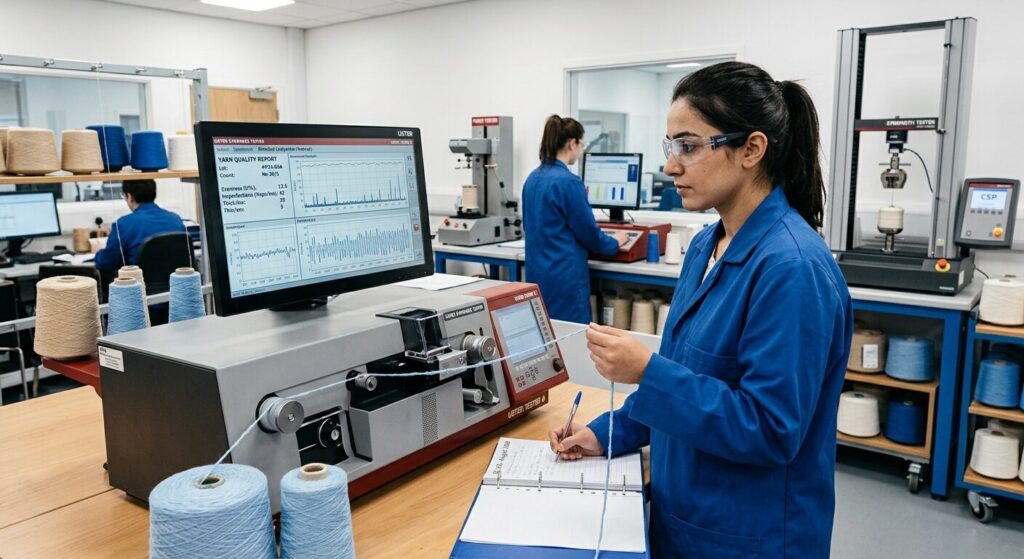
- Count (Ne / Denier / Tex): Defines yarn thickness. Viscose and other staple yarns are usually measured in English Count (Ne) or metric count; filament yarns like polyester are measured in denier or dtex.
- Twist per inch (TPI): Determines how tightly fibres are bound together, affecting strength, softness and fabric hand-feel.
- Tenacity / CSP / RKM: Strength measures showing how much load the yarn can bear before breaking critical for warp yarns that face high tension on a loom.
- Evenness (U%) and imperfections: Measured on Uster testing instruments, these capture thick places, thin places and neps (small fibre knots) per kilometre of yarn.
- Shrinkage and moisture regain: Especially important for synthetic and blended yarns destined for dyeing and finishing, where dimensional stability affects the final fabric.
A supplier that can show consistent Uster statistics across multiple lots not just a single flattering sample is generally a far safer long-term partner than one quoting on price alone.
Yarn Manufacturing Process Step by Step
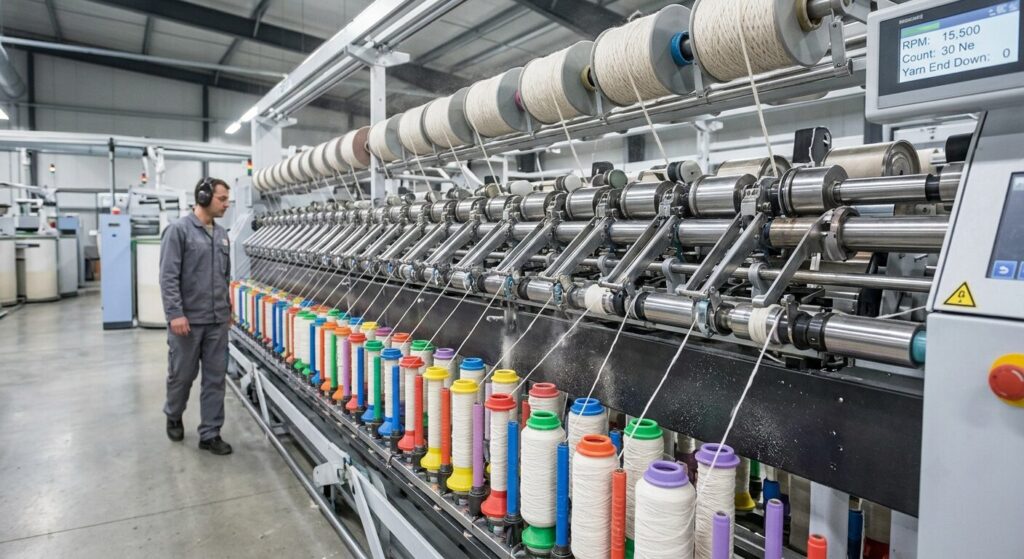
While the exact machinery changes by fibre type, most staple-fibre (viscose, blended synthetic, wool) spinning mills follow the same broad sequence. Here is the yarn manufacturing process step by step, from bale to bobbin:
1. Fibre Selection and Mixing
Raw fibre bales are selected based on staple length, micronaire value (fineness), strength and colour grade. Mills blend bales from different lots to maintain a consistent average quality a step called “mixing” that directly affects the uniformity of the final yarn.
2. Blow Room
Bales are opened, and the tightly packed fibre tufts are progressively loosened, cleaned of trash (leaf, seed coat, dust) and blended using a series of beater and cleaning machines. Modern blow room lines are almost fully automated, feeding a continuous, cleaned fibre lap or chute directly to the next stage.
3. Carding
The carding machine disentangles remaining fibre clumps, removes short fibres and impurities, and aligns the fibres roughly parallel to one another, delivering a soft rope of fibre called a “card sliver.” Carding is often called the heart of the spinning process because it has the single biggest impact on yarn cleanliness and evenness.
4. Combing (for finer counts)
For fine or premium yarns, card slivers are combined and fed through a combing machine, which removes short fibres below a set length and straightens the remaining long fibres further. Combed yarns are smoother, stronger and more expensive than carded yarns.
5. Drawing
Several slivers are fed together into a draw frame, which blends them, straightens the fibres further and attenuates (thins) them into a single, more uniform sliver. Multiple drawing passages correct irregularities before the fibre moves to roving.
6. Roving (Simplex)
The drawn sliver is further attenuated and given a small amount of twist on the speed frame (simplex machine) to form “roving” a strand thin and strong enough to be handled at the spinning frame without breaking.
7. Spinning (Ring, Rotor, Air-Jet or Compact)
This is where roving finally becomes yarn. In ring spinning, the roving is drawn further and twisted at high speed on a rotating spindle, then wound onto a bobbin. Rotor (open-end) spinning, air-jet spinning and compact spinning are faster alternatives used depending on the yarn count, strength requirement and cost target.
8. Winding and Auto-Coning
Spun yarn on small bobbins is rewound onto larger cross-wound cones on auto-coners, which also clear the yarn of thick and thin faults, splicing broken ends invisibly so the finished cone runs smoothly on weaving or knitting machines.
9. Twisting, Doubling and Quality Testing
Depending on the end use, single yarns may be doubled or twisted together for extra strength (as in sewing thread or denim warp yarns). Finished cones are then tested for count (Ne/denier), tensile strength, evenness (U%), imperfections and twist per inch before packing and dispatch.
If you are unsure which finished yarn specification suits your product, our earlier guide on how to choose the right yarn for textile products walks through count, twist and fibre-blend selection in more depth.
Madhusudan Group: A Leader in India’s Yarn Manufacturing Industry
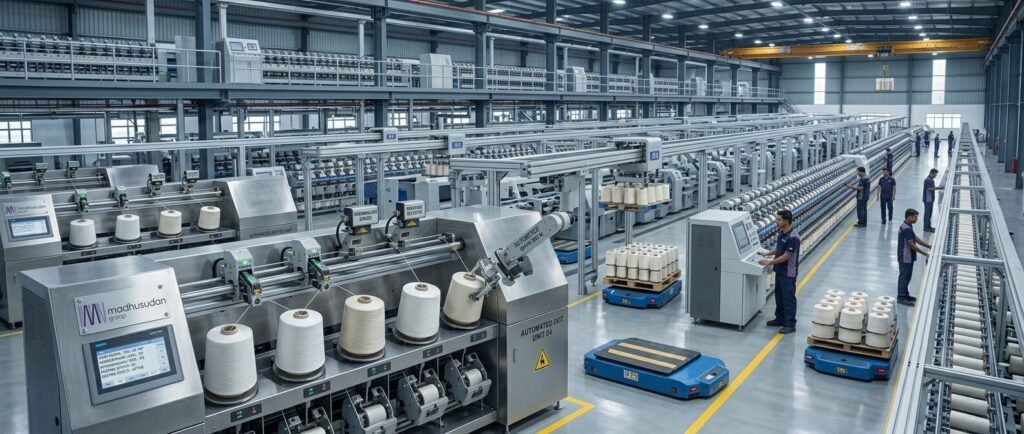
Before we get into the individual fibre processes, it’s worth understanding what separates a leading yarn manufacturing company from an average one. Madhusudan Group has built its position as an industry leader on exactly the fundamentals covered in this guide modern, largely automated spinning and filament lines, tight in-house quality control, and a deliberately focused fibre portfolio rather than an unfocused, everything-to-everyone product range.
Unlike many mills that spread themselves across cotton, wool and synthetics, Madhusudan Group has concentrated its capability specifically on man-made and regenerated fibre yarns polyester (including POY, FDY and recycled polyester), viscose, blended and dyed/melange yarns allowing deeper process expertise, tighter batch-to-batch consistency and faster turnaround on these fibre types than a generalist mill can typically offer.
- Scale: Fully integrated manufacturing lines producing polyester filament, viscose and blended staple yarns for both domestic and export markets.
- Technology: Ongoing investment in modern spinning and extrusion lines with automated blow-room, drawing and yarn-clearing systems, in line with the automation trends covered later in this guide.
- Consistency: Batch-level quality testing on every lot, rather than single-sample quotes, so buyers get the same yarn performance order after order.
- Reach: A supply base spanning Indian weaving and knitting clusters as well as international buyers, positioning Madhusudan Group as a genuinely global yarn manufacturing company rather than a purely regional supplier.
This focus is precisely why Madhusudan Group is positioned as a leader in the yarn manufacturing industry for the fibres it specialises in a claim this guide will keep coming back to as we walk through each process below. You can see this leadership reflected directly in our premium yarn manufacturer and supplier profile.
Polyester Yarn Manufacturing Process
Polyester yarn manufacturing is fundamentally different from staple-fibre spinning because polyester is a man-made, continuous-filament fibre rather than a short staple fibre. The polyester yarn manufacturing process usually starts from either virgin PTA/MEG-based polyester chips or, increasingly, recycled PET chips (from post-consumer bottles or fabric waste) both of which are core to Madhusudan Group’s polyester yarn manufacturing lines.
Melt Spinning
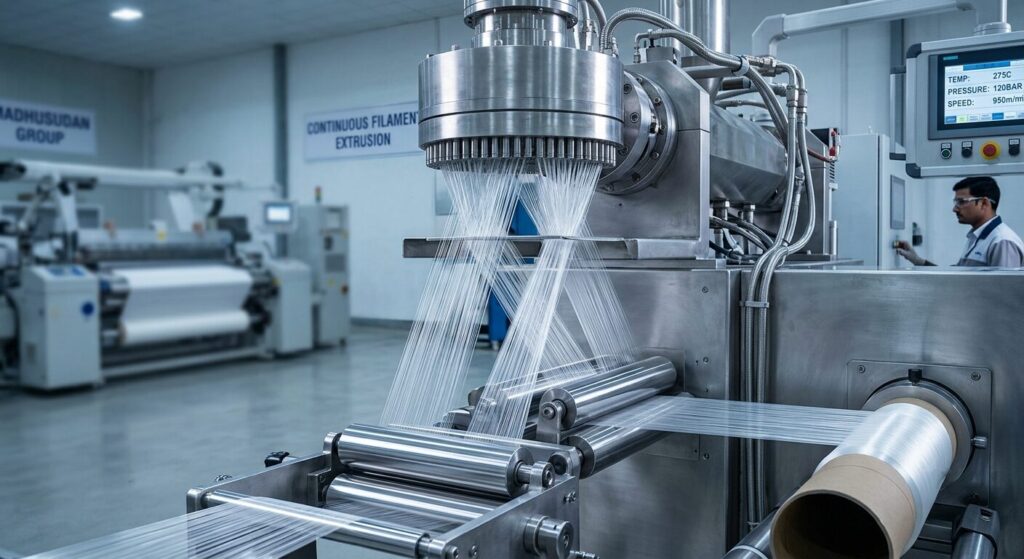
Polyester chips are dried and melted in an extruder, then the molten polymer is forced through a spinneret a metal disc with hundreds of tiny holes to form continuous filaments. These filaments are cooled (quenched) with air as they emerge, solidifying into fine polyester strands.
Drawing and Texturising
Freshly spun filaments have low strength and high extensibility. They are drawn (stretched) at controlled speed and temperature to align the polymer molecules, which increases tenacity dramatically. Depending on the drawing stage applied none, partial or full the output becomes POY, FDY or textured (DTY) yarn, covered in detail below.
Recycled Polyester Route
A growing share of polyester yarn manufacturing today uses recycled PET flakes instead of virgin chips, cutting down on landfill plastic and lowering the carbon footprint per kilogram of yarn. If you want a deeper technical breakdown of that route, our dedicated recycled polyester yarn guide covers bottle-to-fibre conversion, quality benchmarks and typical applications.
Polyester yarn’s popularity comes from its strength, wrinkle resistance, quick-dry properties, colourfastness and lower cost compared to many natural fibres which is why it now accounts for the largest share of global fibre consumption by volume.
For buyers evaluating vendors, our earlier articles on polyester yarn suppliers in India and polyester yarn supply for global markets outline what to check in terms of denier range, filament count and export compliance.
POY Yarn Manufacturing Process
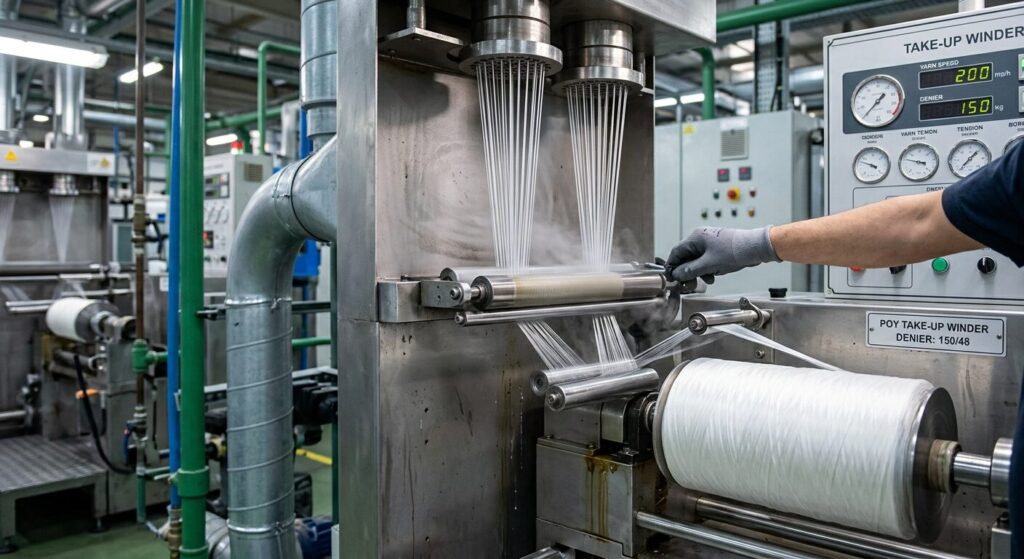
POY stands for Partially Oriented Yarn a polyester filament yarn that has been spun and only partially drawn (oriented), leaving it with moderate strength and higher elongation than fully drawn yarn. The POY yarn manufacturing process is effectively the first half of the full polyester filament journey:
- Polyester chips are melted and extruded through the spinneret at high speed (typically 2,800–3,500 metres per minute).The filaments are quenched with cross-flow or radial air to solidify them evenly.A spin finish (lubricant) is applied to protect the filament and reduce friction on downstream machines.The filament bundle is wound onto a bobbin at high speed without full drawing, producing POY an intermediate yarn, not a finished one.
POY is not woven or knitted directly. Instead, it is sold to downstream texturising units, which either draw-texturise it into DTY (Draw Textured Yarn) for stretch and bulk, or further draw it into FDY. Because POY is an intermediate product, its quality (denier consistency, shrinkage, dye uptake) directly determines the quality of every downstream yarn made from it making POY production one of the most tightly quality-controlled stages in the entire polyester value chain.
FDY Yarn Manufacturing Process
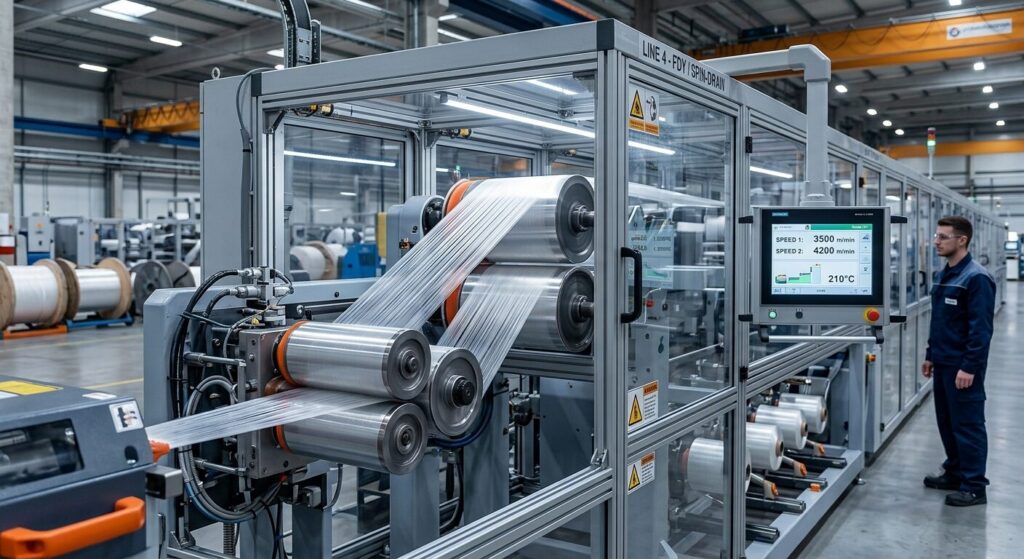
FDY stands for Fully Drawn Yarn. Unlike POY, the FDY yarn manufacturing process combines spinning and drawing into a single continuous operation (spin-draw), so the filament is fully oriented and ready to use straight off the winder no separate texturising or drawing step is required.
- Spinning: Polyester (or nylon) chips are melted and extruded through the spinneret, just as with POY.
- In-line drawing: While still on the same machine, the filaments pass over heated godet rollers running at progressively higher speeds, stretching (drawing) the filament to align its molecular structure fully.
- Heat setting and winding: The drawn filament is heat-set to stabilise it dimensionally, then wound onto packages ready for weaving or knitting.
FDY yarn is stronger, more dimensionally stable and has lower shrinkage than POY, which makes it suitable for applications like sarees, dress materials, ribbons and technical fabrics where consistent strength and a smooth, silk-like lustre are required. FDY plants typically run at lower speeds than POY lines because drawing in-line takes more time, but they skip an entire downstream processing stage, which can be a cost advantage for certain product mixes.
Silk Yarn Manufacturing Process
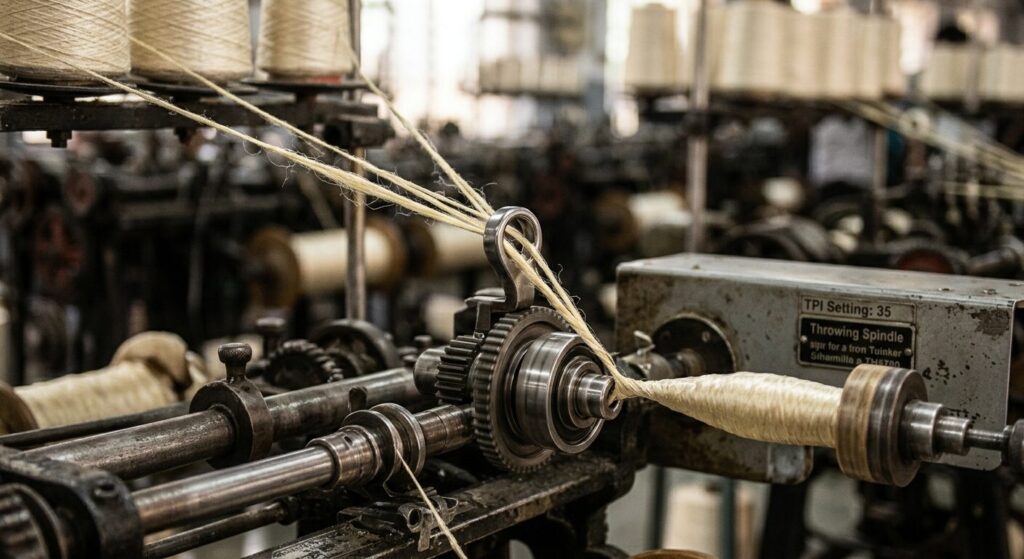
Silk is unusual among textile fibres because it is naturally produced as a continuous filament, so the silk yarn manufacturing process starts with reeling rather than spinning:
- Sericulture: Silkworms (typically Bombyx mori) are reared on mulberry leaves until they spin a cocoon of continuous silk filament.Stifling: Cocoons are steamed or heated to kill the pupa inside, preventing the moth from breaking the filament as it emerges.Reeling: Cocoons are softened in hot water to dissolve the natural gum (sericin) binding the filament, and 3–8 cocoon filaments are unwound together and combined into a single reeled silk thread.Throwing: Reeled silk threads are twisted together (a process called “throwing”) to build the required thickness and strength, producing yarns such as crepe, georgette or organzine silk yarn.Degumming and finishing: Remaining sericin gum is removed through boiling in a mild alkaline bath, giving the yarn its characteristic soft lustre.
Because silk filaments are already continuous, silk yarn manufacturing skips carding, combing, drawing and roving entirely the steps that dominate viscose and other staple-fibre spinning. Waste and short filaments left over from reeling (“silk noil” or “waste silk”) are, however, spun using conventional short-staple spinning methods to produce a coarser, textured silk yarn known as noil or spun silk yarn one of the few points where the natural filament and staple-spinning worlds overlap.
Melange Yarn Manufacturing Process
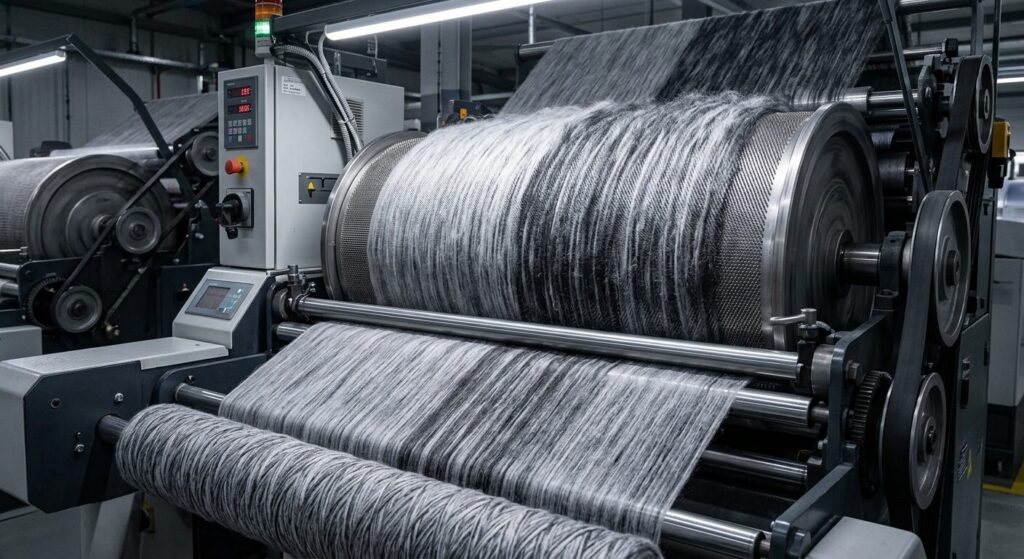
Melange yarn is not a different fibre it is a colour-blending technique applied during spinning. The melange yarn manufacturing process blends dyed and undyed (or differently coloured) fibres before or during carding, so the finished yarn shows a heathered, multi-tone appearance rather than a flat, single shade.
- Fibre dyeing: A portion of the raw fibre (viscose, polyester or a blend) is dyed in loose stock form, while the rest remains natural or a contrasting colour.
- Blending: Dyed and undyed fibre tufts are blended in carefully controlled ratios for example, 20% dyed to 80% grey fibre at the blow room or mixing stage.
- Carding and spinning: The blended fibre mass is carded, drawn, roved and spun exactly like any staple yarn, but because the input fibres are already different colours, the resulting yarn carries a permanent, evenly distributed mottled or heathered look.
Melange yarns are popular for sweatshirts, hoodies, socks and knitwear because the heathered effect hides minor piece-dyeing variations and gives a premium, textured appearance without any additional fabric-dyeing step later in production.
Because melange depends heavily on both fibre dyeing and precise blending ratios, sourcing from an experienced dyed yarn manufacturer or a blended yarn manufacturer that controls both stages in-house typically gives far more consistent shade-to-shade matching across large orders.
Ring, Rotor, Air-Jet and Compact Spinning: Which Method Fits Which Yarn?
The final spinning step in staple-fibre yarn manufacturing can use several different technologies, and the choice materially affects cost, strength and hand-feel:
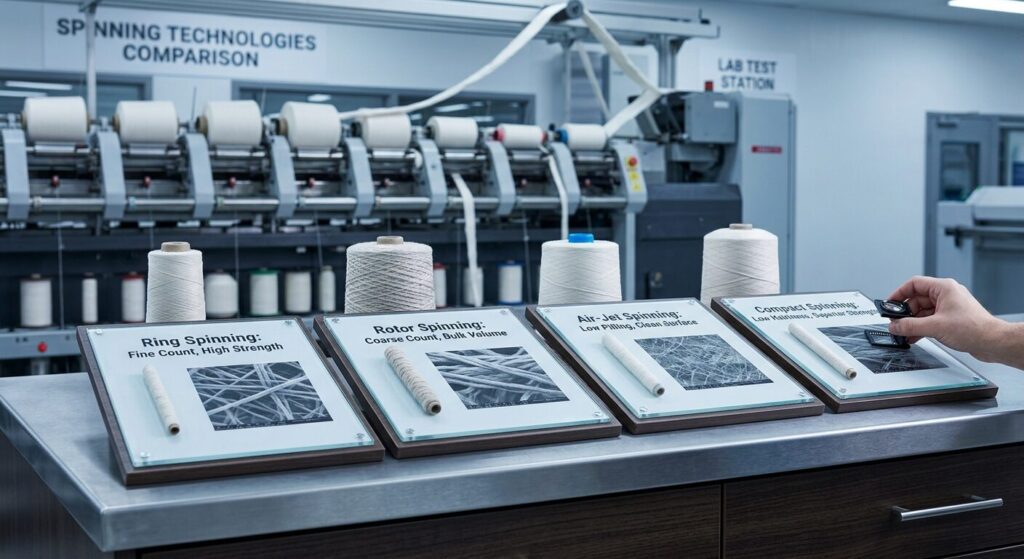
- Ring spinning: The oldest and still the most widely used method for fine to medium counts. Produces strong, versatile yarn suited to almost any end use, but runs at lower production speeds than rotor or air-jet spinning.
- Rotor (open-end) spinning: Skips roving entirely, feeding sliver directly into a rotor. Much faster and cheaper for coarser counts, commonly used for denim, home textiles and industrial fabrics, though the yarn is generally bulkier and slightly weaker than ring-spun yarn of the same count.
- Air-jet spinning: Uses compressed air vortices instead of mechanical twisting, achieving very high production speeds for medium-to-coarse counts with a distinctive, low-pilling yarn surface popular for easy-care shirting blends.
- Compact spinning: A refinement of ring spinning that condenses the fibre strand immediately before twisting, reducing hairiness and improving strength the technology behind the SIRO compact systems.
None of these methods is universally “better” a mill selects the spinning technology based on the target count, fibre type, required strength and, critically, the price point the finished fabric needs to hit. This is another reason why asking a supplier which spinning method a specific order will run on is more useful than asking for a generic quality guarantee.
Yarn Manufacturing Machines
A modern spinning mill is really a chain of purpose-built yarn manufacturing machines, each handling one stage of the process described earlier:
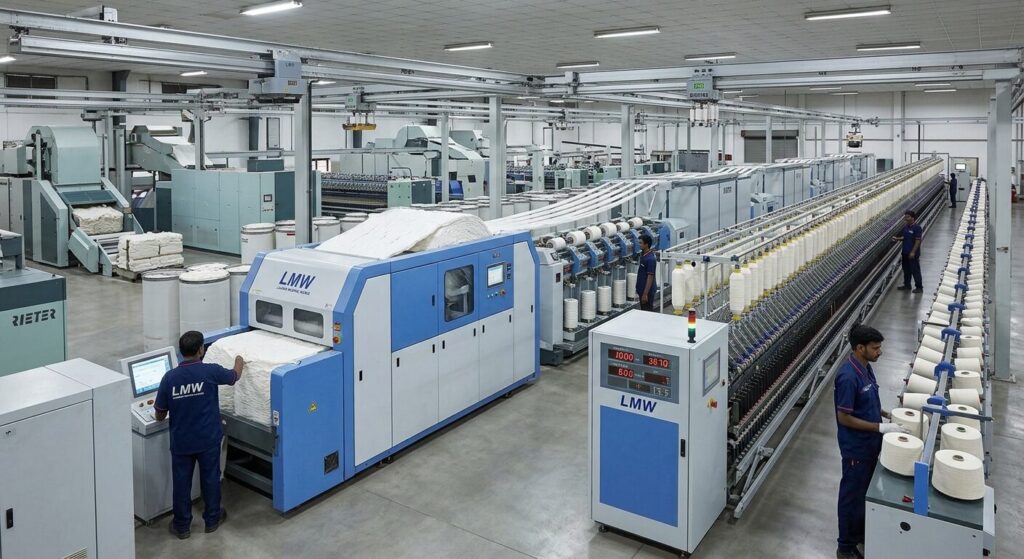
- Blow room line: Bale pluckers, opener-cleaners and mixing/blending machines that open and clean raw fibre.
- Carding machine: Cleans, disentangles and aligns fibres into a card sliver often called the single most important yarn manufacturing machine for quality.
- Combing machine: Removes short fibres for premium, fine-count yarns.
- Draw frame: Blends and straightens multiple slivers into one uniform sliver.
- Speed frame (simplex): Converts sliver into roving with a light twist.
- Ring frame / rotor / air-jet / compact spinning machine: Converts roving into finished yarn via twisting and winding the core spinning step.
- Auto-coner: Rewinds spun bobbins into large, fault-cleared cones ready for weaving or knitting.
- Extrusion line and spin-draw machine: Used specifically for filament yarns like polyester POY/FDY, combining melt extrusion, quenching and drawing.
Globally, a small number of specialist manufacturers including India’s LMW and Switzerland’s Rieter build complete ranges of these machines end to end, from blow room to ring frame, which is why mills increasingly standardise on a single machinery brand across an entire spinning line to simplify maintenance, spares and process control.
Automation in Yarn Manufacturing
Automation in yarn manufacturing has moved from a cost-saving option to a competitive necessity, largely because of rising labour costs and persistent shortages of skilled mill operators. Key areas where automation now dominates modern spinning mills include:
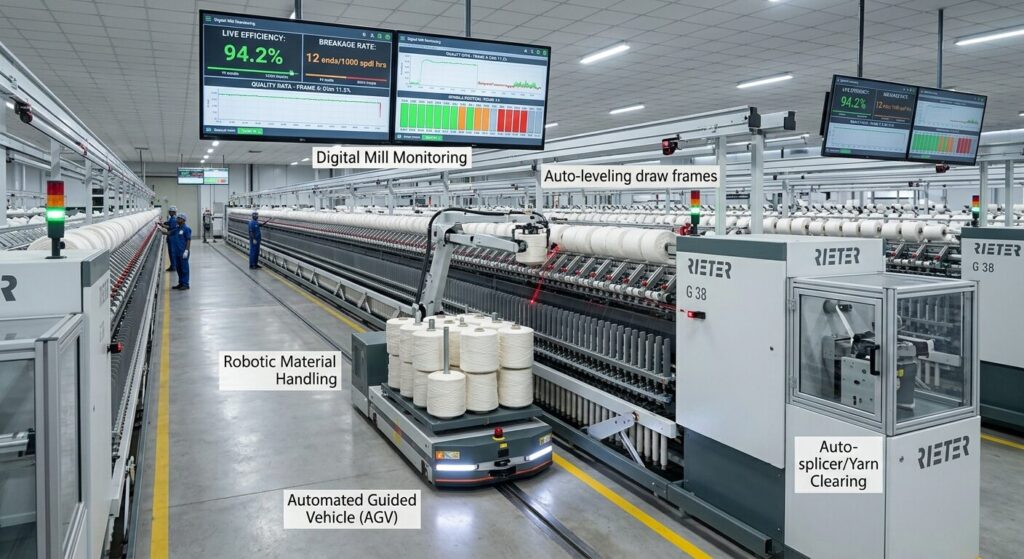
- Automated bale management: Software-driven bale selection and laydown systems maintain consistent fibre mixing without manual sorting.
- Auto-leveling draw frames: Sensors continuously measure sliver thickness and adjust drafting rollers in real time to correct unevenness instantly.
- Auto-doffing: Ring frames and speed frames automatically remove full bobbins and replace empty ones without stopping the machine for manual doffing.
- Auto-splicing and yarn clearing: Auto-coners detect and cut out thick/thin faults and foreign fibres, then splice the yarn back together with no visible knot.
- Robotic material handling: AGVs (automated guided vehicles) move roving bobbins, cones and waste between machines with minimal manual intervention.
- Digital mill monitoring: IoT sensors on spinning frames feed live efficiency, breakage-rate and quality data into central dashboards, letting managers spot problems on a specific spindle position within minutes.
Automation in yarn manufacturing directly improves three things buyers care about most: consistency (fewer human-introduced defects), traceability (batch-level quality data) and cost stability (less dependence on fluctuating labour availability). The LMW Smart Spinning Plant example discussed earlier with its AutoBlend blow-room automation is a direct illustration of this shift happening at scale in Indian mills today.
For mill owners, the return on automation investment usually shows up in three measurable ways: fewer end-breakages per thousand spindle-hours, lower dependence on peak-season contract labour availability, and faster changeover times when switching between blends or counts. For buyers, it shows up as tighter lot-to-lot consistency and shorter, more reliable lead times, since automated lines are less exposed to operator-driven variability during high-volume production runs.
Yarn Manufacturing Companies in India
India is among the top two or three yarn-producing countries in the world, with especially dense manufacturing clusters in Gujarat (Surat, Ahmedabad), Tamil Nadu (Coimbatore, Tirupur), Maharashtra (Ichalkaranji) and Punjab (Ludhiana). A strong yarn manufacturing company in India typically differentiates itself on a few concrete factors rather than marketing claims alone:
- Fibre and blend range: Ability to run polyester, viscose and blended counts on the same or adjacent lines the exact specialisation Madhusudan Group has built its leadership position around.
- Machinery and automation level: Modern blow-room-to-ring-frame and extrusion lines with auto-leveling, auto-doffing and yarn clearing.
- Quality certifications: Consistent Uster statistical testing, ISO certification and, increasingly, sustainability certifications like GRS for recycled content.
- Export readiness: Documentation, packing and logistics experience for international buyers, not just domestic weaving units.
Gujarat in particular has grown into a major industrial yarn hub thanks to its proximity to Surat’s massive weaving and processing base and it is from this base that Madhusudan Group operates as one of the region’s leading yarn manufacturing companies, supplying polyester, viscose, blended, dyed and specialty yarns across India and internationally.
If you are sourcing locally, our overview of industrial yarn suppliers in Gujarat and our broader profile of a premium yarn manufacturer and supplier in India show why Madhusudan Group is consistently ranked among the top choices for buyers shortlisting vendors.
For international buyers, our guide to textile yarn exporters in India and our page on polyester yarn supply for global markets outline shipping terms, MOQs and compliance documentation commonly required — and how Madhusudan Group handles them at scale.
Specialty Yarn Types Worth Knowing
Beyond the core process routes above, several specialty yarn categories are built on the same fundamentals but modified for a specific performance need:
- Stretch yarn: Core-spun or air-covered yarns combining elastane with polyester or viscose for four-way stretch fabrics see our page on a stretch yarn manufacturer for construction details.
- Linen yarn: Made from flax fibre through a longer, more labour-intensive process (retting, scutching, hackling) before spinning covered in our guides on linen yarn manufacturers in India and a specific linen yarn manufacturer.
- Dyed yarn: Yarn dyed in package or hank form before weaving/knitting, giving deeper, more colourfast shades than piece-dyed fabric detailed in our dyed yarn manufacturer overview.
- Blended yarn: Any yarn spun from two or more fibre types (poly-viscose, viscose-modal, poly-nylon) to balance cost, feel and performance see our blended yarn manufacturer in Surat page.
How to Choose the Right Yarn Manufacturing Company
With hundreds of spinning mills competing across India alone, a structured shortlist works better than relying on price quotes in isolation. At a minimum, ask any prospective yarn manufacturing company for:
- Sample cones tested independently for count, strength (CSP/RKM) and evenness.
- A clear breakdown of blend ratios and fibre source (virgin vs. recycled, domestic vs. imported).
- Machinery brand and vintage on the specific line that will produce your order not just the mill’s overall capacity.
- Batch-to-batch consistency data (Uster statistics) rather than a single best-case sample.
- Realistic lead times and minimum order quantities matched to your production schedule.
Our earlier piece on how to choose the right yarn for textile products goes deeper into matching count, twist and fibre choice to specific end products pair it with this guide when finalising a supplier.
Sustainability and the Future of Yarn Manufacturing
Three shifts are reshaping yarn manufacturing globally: rising adoption of recycled fibres (recycled polyester in particular), tighter water and chemical regulation around viscose and dyeing processes, and continued automation to offset labour shortages. Industry bodies such as
Textile Exchange and the International Textile Manufacturers Federation now track fibre-level sustainability benchmarks that increasingly influence which mills global brands choose to work with, alongside domestic policy support tracked by India’s Ministry of Textiles.
For manufacturers and buyers alike, the practical takeaway is the same: yarn manufacturing is no longer judged purely on price per kilogram. Traceability, automation-driven consistency and verifiable sustainability claims are becoming standard purchasing criteria across both domestic and export markets.
Conclusion
From polyester chips extruded into POY and drawn into FDY, to wood pulp becoming viscose yarn on a fully automated LMW spinning line, to silk cocoons reeled and thrown by hand the yarn manufacturing process is really several distinct industrial routes united by one goal: a strong, uniform, fit-for-purpose thread. Knowing which route your fibre takes, which machines are involved, and how much automation a mill has invested in gives you a genuine edge whether you are specifying yarn for a new fabric or auditing an existing supplier.
This is exactly the standard Madhusudan Group holds itself to as a leading yarn manufacturing company in India deep specialisation in polyester, viscose, blended, dyed and specialty yarns, backed by modern, largely automated manufacturing lines and consistent, batch-tested quality. Explore our range of premium yarn manufacturing and supply solutions or get in touch to discuss a specification for your next order.
Frequently Asked Questions
What is the yarn manufacturing process in simple terms?
Raw fibre is cleaned, aligned, thinned and twisted (for staple fibres like viscose) or melted, extruded and drawn (for synthetic filaments like polyester) to form a continuous, usable thread called yarn.
What is the difference between POY and FDY yarn?
POY (Partially Oriented Yarn) is only partially drawn and must be further processed (texturised or drawn) before use. FDY (Fully Drawn Yarn) is drawn in-line during spinning and is ready for weaving or knitting immediately.
What machines are used in yarn manufacturing?
Blow room lines, carding machines, combers, draw frames, speed frames, ring/rotor/air-jet/compact spinning machines and auto-coners for staple yarns; extrusion and spin-draw lines for filament yarns like polyester.
How is melange yarn made?
By blending dyed and undyed (or differently coloured) fibres at the blow room or mixing stage before carding, so the finished spun yarn shows a permanent, heathered multi-tone effect.
Is silk yarn spun like other staple yarns?
No. Silk is a natural continuous filament, so it is reeled from cocoons and then twisted (“thrown”), not carded and spun like short-staple fibres such as viscose staple.
How is automation changing yarn manufacturing?
Auto-leveling draw frames, auto-doffing spinning frames, auto-splicing coners and IoT-based mill monitoring are reducing manual labour dependency while improving consistency, traceability and overall plant efficiency.
Which are the major yarn manufacturing hubs in India?
Surat and Ahmedabad (Gujarat), Coimbatore and Tirupur (Tamil Nadu), Ichalkaranji (Maharashtra) and Ludhiana (Punjab) are among India’s largest yarn manufacturing clusters, with Madhusudan Group operating as one of the leading yarn manufacturing companies out of the Surat–Gujarat belt.
What is the difference between carded and combed staple yarn?
Carded yarn skips the combing stage and retains more short fibres, making it slightly coarser and more economical. Combed yarn passes through an additional combing machine that removes short fibres, producing a smoother, stronger and more expensive yarn.
Can one mill produce both polyester and viscose yarns?
Yes. Composite mills like Madhusudan Group run separate lines for viscose staple spinning and polyester filament extrusion under one roof, then blend the outputs at the draw-frame stage to create poly-viscose blended yarns on demand.
Why choose Madhusudan Group as a yarn manufacturing company?
Madhusudan Group focuses specifically on polyester, viscose, blended, dyed and specialty yarns rather than spreading across every fibre type, which translates into deeper process expertise, modern automated lines, consistent batch-level quality and reliable export documentation the same factors this guide recommends checking in any yarn manufacturing company.