Viscose yarn dyeing is the colouring of regenerated cellulose yarn viscose, rayon and modal usually with reactive or direct dyes in an alkaline bath, after a light scour rather than the heavy pre-treatment cotton and linen require. Viscose is one of the easiest fibres in the mill to get colour onto. It is one of the harder ones to get the same colour onto twice.
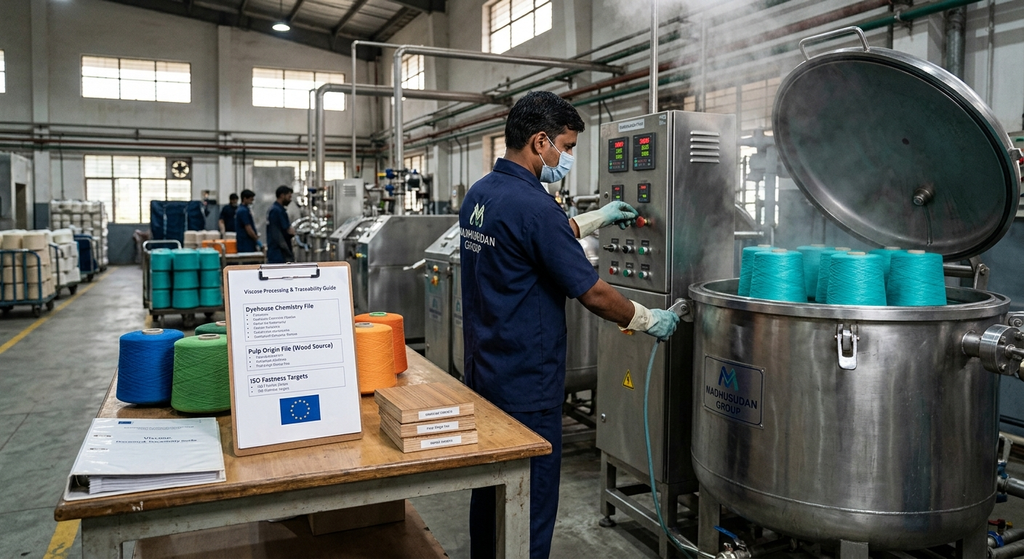
For European buyers there is a second dimension. Viscose is made from wood pulp, which means it carries a forest-sourcing question that polyester does not, and the EU is the jurisdiction where that question has become a legal one rather than a reputational one. A European viscose programme now needs two files: the dyehouse chemistry file, and the pulp origin file.
This guide covers the fibre behaviour that drives the process, dye class selection, the mechanics of package dyeing viscose without damaging it, realistic ISO fastness targets, the dope-dyed alternative, and the traceability documentation European buyers are now asking for on man-made cellulosics.
What viscose is, and why it behaves the way it does
Viscose is regenerated cellulose: wood pulp dissolved, filtered and extruded back into fibre form. Chemically it is cellulose, so it takes the same dye classes as cotton. Physically it is a different material.
Much lower degree of polymerisation. Cotton cellulose has a degree of polymerisation running into the thousands; viscose is in the low hundreds. Shorter polymer chains mean a weaker fibre, far more vulnerable to degradation by hot alkali, by acid and by oxidative bleaching. Viscose is the fibre where over-aggressive pre-treatment doesn’t just dull the hand it measurably destroys tensile strength.
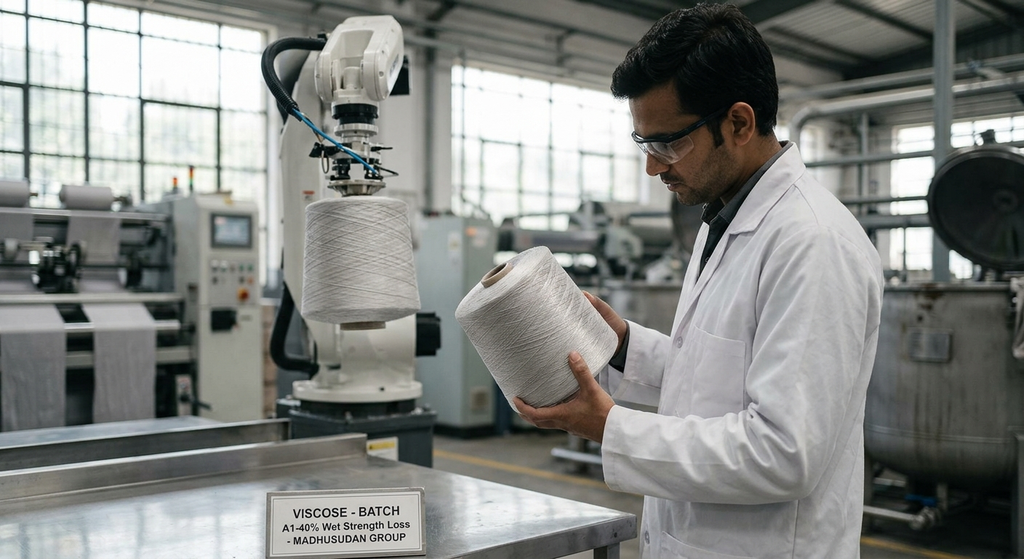
Severe wet strength loss. Viscose loses roughly 40–60% of its dry tenacity when wet. Dyeing is by definition a wet process. Every mechanical stress the yarn sees in the bath pump pressure, carrier loading, package handling, unwinding is applied to a fibre operating at roughly half strength. This is the dominant constraint on how viscose can be dyed.
High swelling and high moisture regain. Viscose swells dramatically in water, far more than cotton, with moisture regain around 11–13%. Swelling is why dye penetrates so readily. It is also why a package wound correctly dry can become too dense wet, choking off liquor flow at exactly the moment the dye is striking.
Amorphous structure, high dye affinity. Viscose’s less-ordered structure means dye moves in fast. Fast strike is not a virtue: rapid, uncontrolled uptake produces unlevel dyeing. Viscose needs more levelling control and a slower dosing curve than cotton, not less.
Lot-to-lot variability from the fibre plant. Different pulp sources, spin-bath conditions and finish packages produce measurably different dye uptake. Greige lot segregation is essential the same principle as with natural fibres, for a different reason.
For the fibre and yarn side, see our viscose yarn manufacturer page, and for continuous filament our viscose filament yarn manufacturer page.
Spun viscose vs viscose filament: two different jobs
European enquiries often say “viscose yarn dyeing” without specifying which. The processes diverge significantly.
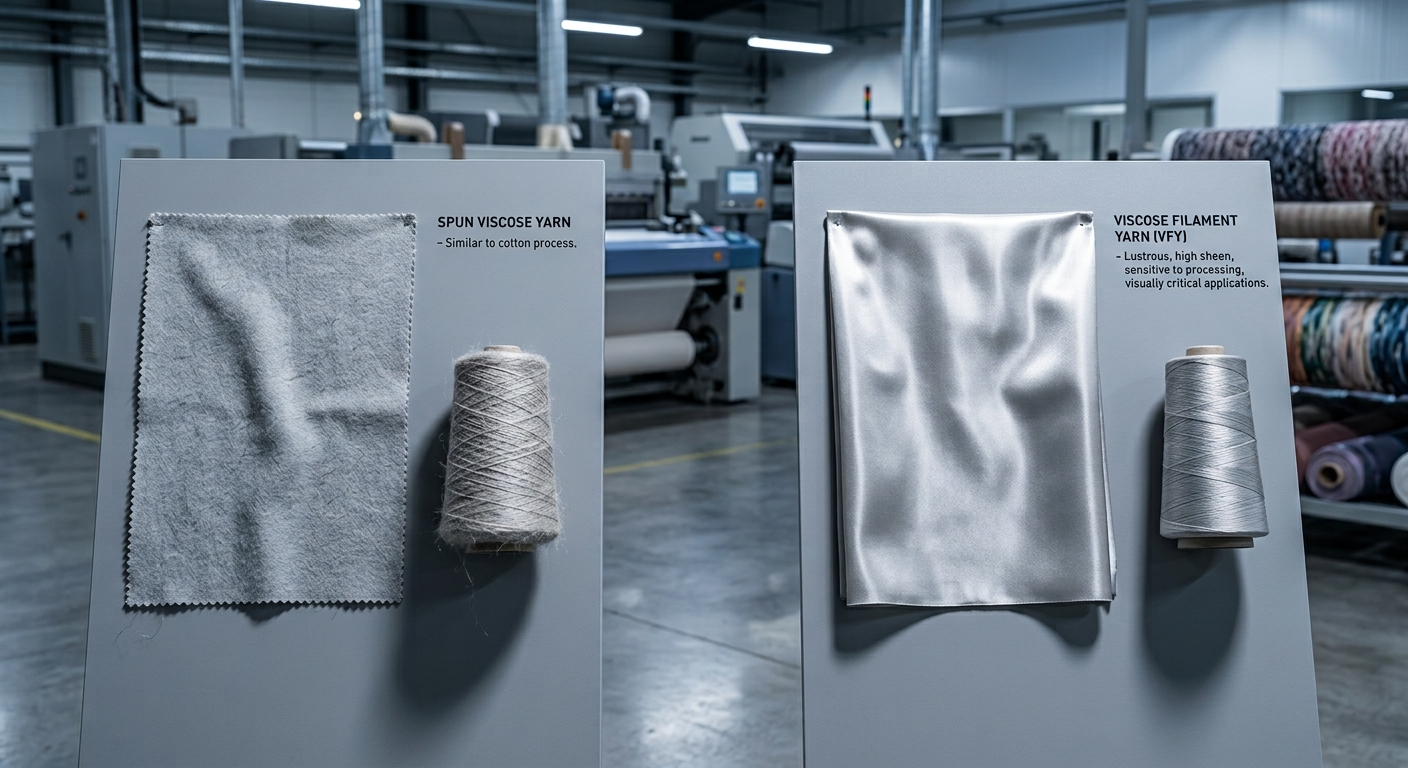
Spun viscose yarn behaves broadly like a weaker, faster-dyeing cotton. The main risks are strength loss, increased hairiness and pilling propensity after wet processing. Pre-treatment should be minimal a light scour, since staple viscose carries spin finish and size rather than natural waxes.
Viscose filament yarn (VFY) is a different animal. The filaments are smooth and lustrous, so any unevenness in dye uptake is visually obvious there is no staple irregularity to hide behind. Filament yarn is prone to snagging and filamentation if handled roughly while wet, and low-twist filament packages collapse easily. Viscose filament dyeing demands gentler flow rates, tighter winding control and more careful package handling than spun viscose at the same shade.
This matters commercially in Europe because two of the largest end uses linings for German and Italian tailoring, and lustrous dress and décor fabrics for Italian and Portuguese converters are filament applications where the buyer’s acceptance criteria are visual and unforgiving. If your end use is a lustrous filament fabric, say so at enquiry stage; it changes both the process and the price.
Dye classes for viscose
| Dye class | Wash fastness | Light fastness | Relative cost | Where it fits in European programmes |
| Reactive (bifunctional) | Very good | Good | Medium | Default for apparel and home textiles; full bright shade gamut |
| Direct | Moderate needs cationic after-fixing | Moderate | Low | Cost-driven lines; rarely sufficient for EU brand wet-fastness specs |
| Vat | Excellent | Excellent | High | Upholstery, curtains, contract interiors |
| Sulphur | Good on darks | Good on darks | Low | Bulk blacks, navies, olives |
| Dope-dyed (solution-dyed) | Outstanding | Outstanding | Varies; needs volume | Fastness-critical or sustainability-led EU programmes with a stable palette |
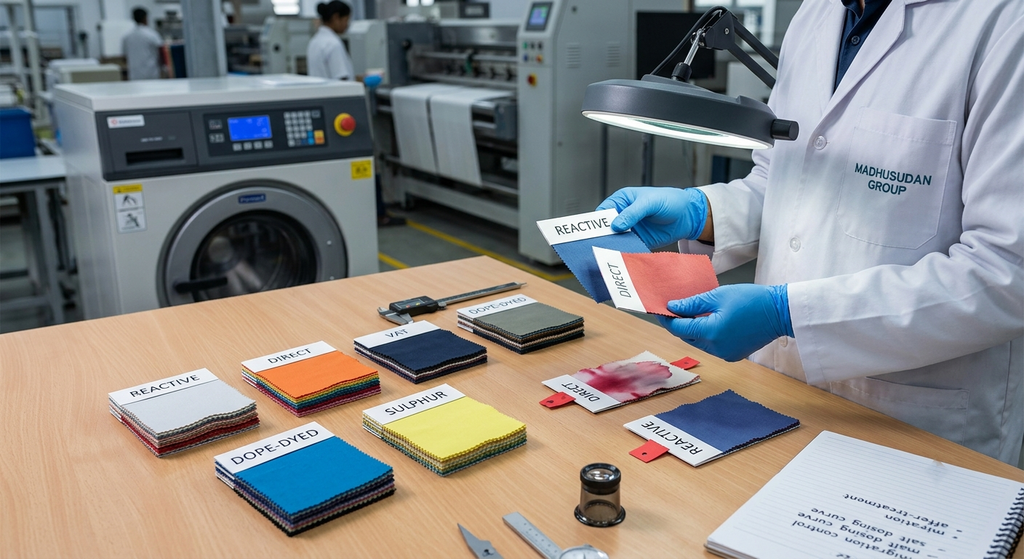
Reactive dyeing viscose is the workhorse. The catch is that viscose’s fast strike makes level dyeing harder than on cotton, so the recipe leans on migration control: a lower starting temperature, a slower programmed salt dosing curve, and gradual alkali addition rather than a single shot. Dumping salt or alkali into a viscose bath is how you get a ringed package.
Direct dyes on viscose remain widely used because high affinity gives excellent yield at low cost. The non-negotiable is after-treatment: without a cationic fixing agent, direct dyeings on viscose will bleed. If a quote for dyed viscose yarn is dramatically cheaper than the rest of the market, confirm the dye class and the guaranteed wet fastness that is usually where the difference sits, and it is usually where an EU brand’s lab test will find it.
Vat dyes are the answer when light fastness matters. Reactive and direct dyeings on cellulose are generally weakest on light fastness, and European contract and upholstery specifications are exactly where that weakness gets found.
Package dyeing viscose without damaging the yarn
Most commercial viscose yarn dyeing is package dyeing. Five controls decide the outcome.
1. Winding density and wet density. Viscose packages are wound softer than cotton, typically 0.28–0.35 g/cm³ depending on count and machine. The point that catches newer dye houses: viscose swells when wet, so a package that measures acceptably dry can tighten significantly once the bath fills. The density target must be set for the wet state.
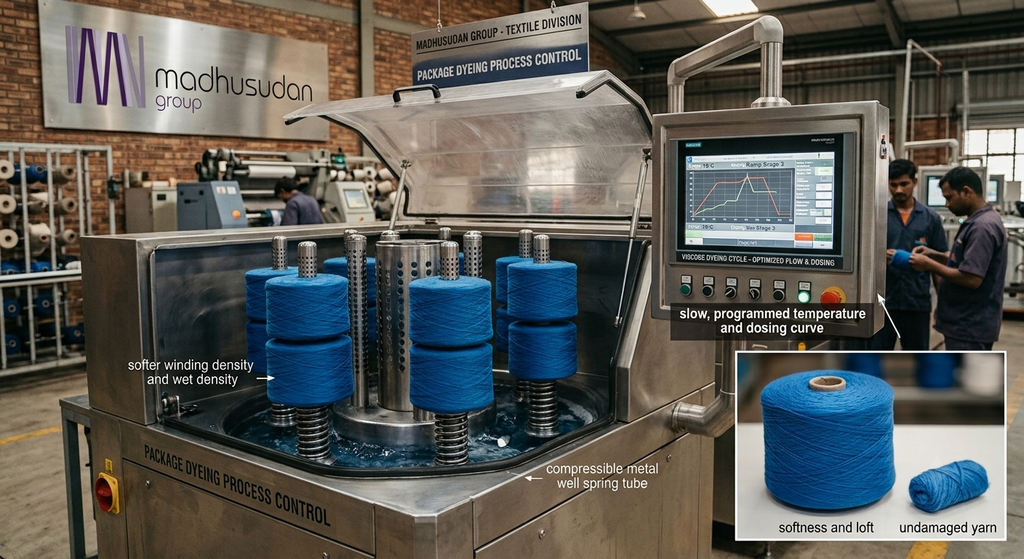
2. Spring tubes. Because the yarn shrinks and the package tightens during the cycle, compressible spring tubes are widely used on viscose. They let the package contract without generating the crushing internal pressure that collapses liquor channels in a rigid-tube setup.
3. Controlled, moderate liquor flow. Higher flow seems like the obvious answer to levelness problems. On viscose it is often the cause: excessive pump pressure through a wet, weakened package deforms the yarn layers, causing channelling and on filament filamentation and surface damage. Flow should be firm and reversed on a timed cycle, not maximised.
4. A slow, programmed temperature and dosing curve. Viscose’s fast strike means the first ten minutes of dye addition determine levelness. Programmed dosing of dye and electrolyte with a controlled ramp is standard on any credible viscose line.
5. Drying end-point control. Over-drying viscose cause’s hornification irreversible collapse of the fibre’s internal pore structure producing a harsher hand, reduced absorbency and a subtle shade shift toward duller. Viscose is dried to a target regain, not “until dry”.
Hank dyeing is also used where maximum softness and loft are required, particularly for knitting yarn and for fragile filament needing a very low-tension route. It costs more per kilogram and takes longer.
Pre-treatment: less is more
This is where viscose diverges most clearly from cotton and linen. Viscose contains no natural waxes, pectin or lignin it has already been through chemical purification at the fibre plant. What it carries is spin finish, coning oil and sometimes size.
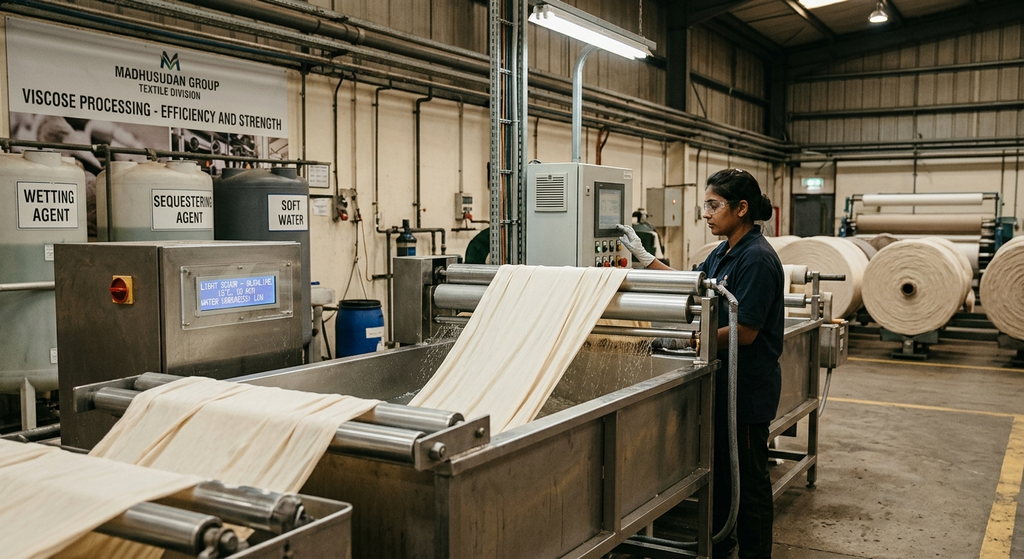
- A light alkaline scour with wetting and sequestering agents is normally sufficient.
- Bleaching is usually unnecessary for medium and dark shades and should be avoided or kept very mild, because peroxide bleaching on a low-DP fibre costs real strength. Mild bleaching is reserved for whites and clean pastels.
- Water quality control matters disproportionately. Hard water and iron contamination cause shade shifts and, with peroxide present, localised fibre damage. Sequestrant dosing and hardness monitoring are basic hygiene on a viscose line.
- pH control throughout. Viscose is damaged by hot strong alkali and by acid. The window is narrower than cotton’s, and excursions are paid for in tensile loss rather than visible defects.
Our yarn manufacturing process guide covers the upstream steps that determine what arrives at the dye house.
Soaping. On reactive dyeings, hydrolysed dye sits on the fibre surface and must be removed by hot soaping. Viscose’s high dye affinity means there is more surface dye to remove than on cotton at the same shade depth, so soaping is longer and more thorough, not shorter. Cutting this cycle is the commonest reason a dyed viscose lot fails wet crocking at a European lab.
Cationic fixing. Standard on direct dyeings, sometimes used to lift wet fastness on deep reactive shades. Note the trade-offs: fixing agents can shift shade slightly, can reduce light fastness on some dyes, and must be selected from restricted-substance-compliant chemistry.
Softening. Viscose is usually softened after dyeing to restore hand and improve downstream processing. Specify whether the softener must be silicone-free, non-yellowing, or compatible with subsequent coating or printing regularly forgotten at enquiry stage and discovered at the weaving mill.
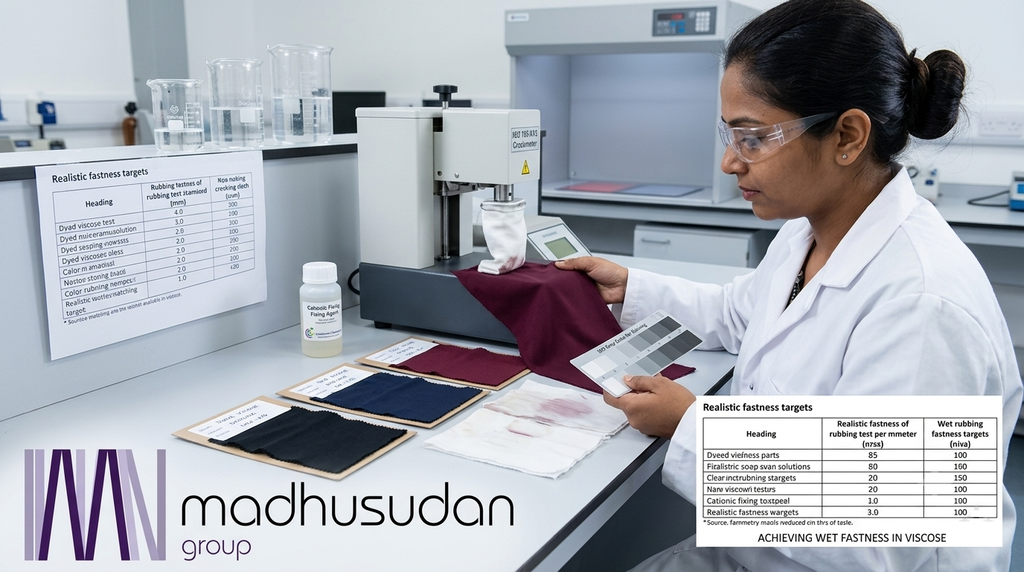
Realistic fastness targets, tested to the ISO 105 series European labs cite:
| Property | Test method | Apparel target | Home textile / contract target |
| Washing | ISO 105-C06 | 4 and above (reactive) | 4 and above |
| Rubbing, dry | ISO 105-X12 | 4 and above | 4 and above |
| Rubbing, wet | ISO 105-X12 | 3 to 3–4 on darks | 3–4 and above |
| Light | ISO 105-B02 | 4–5 | 6+ (vat or dope-dyed) |
| Perspiration | ISO 105-E04 | 4 and above | 4 and above |
| Water | ISO 105-E01 | 4 and above | 4 and above |
Wet rubbing on deep viscose shades black, navy, burgundy deserves particular attention at specification stage. High dye loading at deep shades makes this genuinely difficult, and it is the property most likely to fail at the buyer’s lab. Agree a realistic number before production rather than negotiating one after.
The dope-dyed alternative
For some European programmes the best answer is not to dye the yarn at all. Dope-dyed (solution-dyed) viscose has pigment added to the spinning solution before extrusion, so colour is distributed through the fibre rather than applied to its surface.
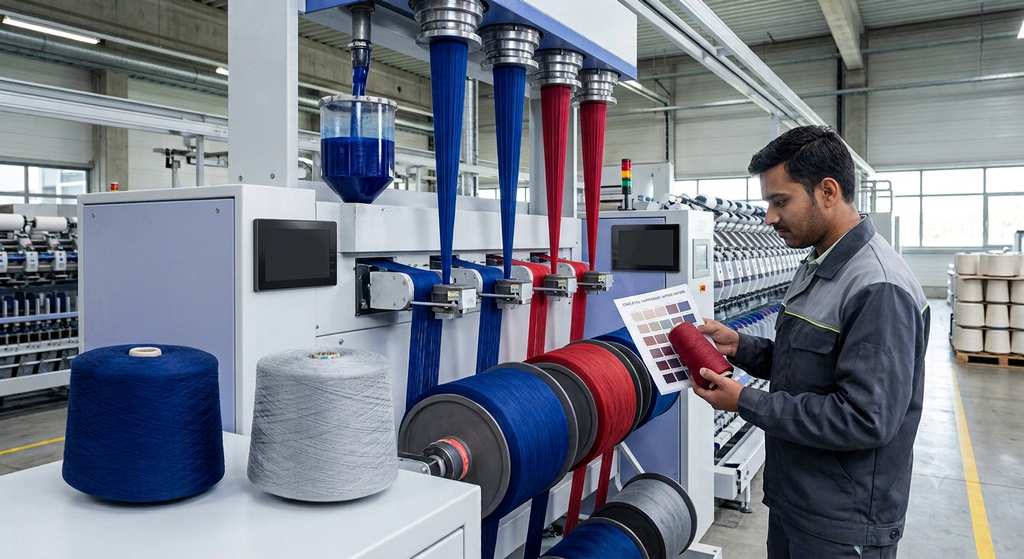
Advantages: outstanding light and wash fastness, because the colour is not on the surface to be washed or bleached off; dramatically lower water and energy consumption per kilogram with no dyehouse effluent load; and perfect batch-to-batch repeatability, since shade is fixed at fibre production.
Limitations: shade range limited to what the fibre producer offers; much higher minimums, because a spinning run must be committed to one colour; longer lead times; and mid-programme shade changes effectively impossible.
The practical rule: dope-dyed suits high-volume, long-running, fastness-critical programmes in a stable palette automotive interiors, contract upholstery, workwear, and sustainability-led ranges where the water saving is part of the story and can be substantiated. That last point matters in Europe, where environmental marketing claims face increasing scrutiny: a water-saving claim needs process data behind it, not a brochure line. Bath dyeing suits fashion-led work, shorter runs and wide shade ranges. Split the programme rather than compromise on one route.
Blended yarn: where viscose dyeing gets complicated
Viscose–polyester. The most common blend and the most demanding. Polyester needs disperse dyes at high temperature; viscose needs reactive or direct in alkaline conditions. Two-bath is the clean route: dye the polyester first at temperature, reduction-clear thoroughly to strip loose disperse dye from the viscose surface, then dye the viscose. Skipping the reduction clear leaves disperse dye staining the viscose acceptable-looking on the cone, and a wet-fastness failure in the buyer’s lab. Our dyed polyester yarn guide covers the polyester side in depth.
Viscose–nylon. Acid dyes for the nylon, reactive for the viscose, with careful pH staging and blocking agents to control cross-staining.
Viscose–cotton. Both cellulosic and single-bath dyeable, but viscose’s much higher affinity means it goes deeper than cotton on the same recipe. For a solid shade, develop the recipe on the actual blend ratio.
Viscose–linen. Same cellulosic single-bath logic, with the added constraint that linen tolerates very little tension while viscose tolerates very little wet stress the mechanical envelope is narrow at both ends.
Viscose–elastane. The elastane component limits temperature and alkali conditions, and residual tension issues during winding get magnified. Flag it at enquiry.
The EU file: chemistry and pulp origin
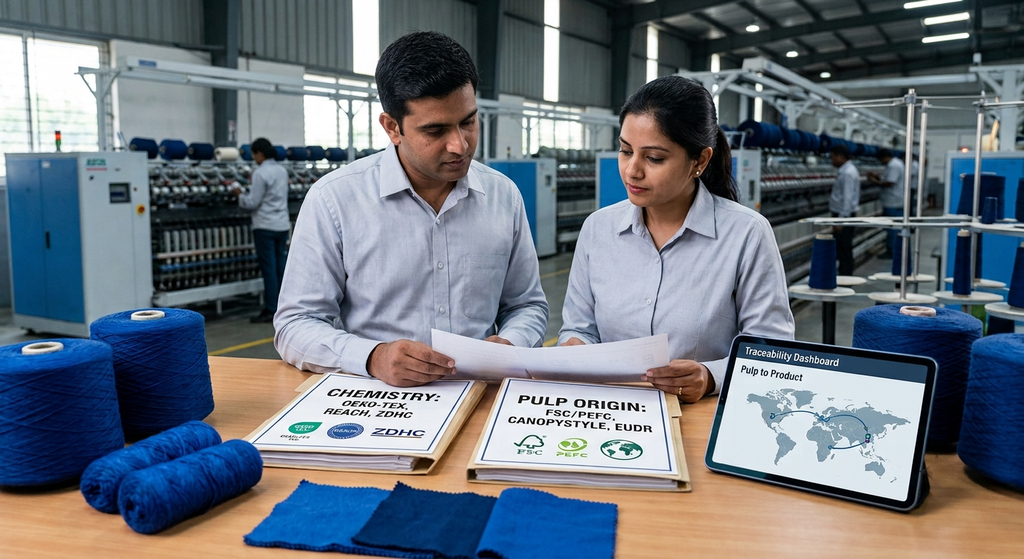
Dyed viscose faces two separate documentation demands in Europe: one about the chemistry on the yarn, one about where the wood came from. Both appear in EU buyer audits.
Chemistry
- OEKO-TEX STANDARD 100 at article level, covering tested harmful substances effectively a baseline expectation for EU apparel and home textiles. Details from OEKO-TEX.
- EU REACH, including restrictions on azo dyestuffs capable of releasing listed aromatic amines, plus SVHC declarations. The legal obligation sits with the EU importer, which is why the documentation demand travels up the chain to the dye house.
- ZDHC MRSL conformance for input chemistry, with wastewater reporting increasingly requested by brand-led supply chains. Framework published by ZDHC.
- EU textile fibre labelling “viscose” is a designated fibre name under the EU labelling regulation, and blend percentages must be accurate, because your declaration feeds your customer’s consumer label.
Pulp origin
Because viscose is made from wood pulp, man-made cellulosic supply chains attract forest-sourcing scrutiny that polyester does not.
- CanopyStyle and the Hot Button Report rank viscose producers on sourcing risk from ancient and endangered forests. Many European brands specify producers in the higher-rated bands, and will ask you which producer’s fibre is in your yarn. Details at Canopy.
- FSC or PEFC chain-of-custody on the pulp is frequently requested, and is the most concrete document you can put in front of an EU sourcing team.
- EU Deforestation Regulation (EUDR). The regulation covers wood and derived products placed on the EU market. It enters into application on 30 December 2026 for large and medium operators, with micro and small enterprises outside the timber sector covered from 30 June 2027. Products in scope are those listed in the regulation’s Annex I, and the Commission has continued to refine that product-scope list through delegated acts — so whether a specific viscose yarn commodity code falls in scope is a question to confirm against the current annex with your customs adviser rather than assume either way. Current text and guidance are published by the European Commission.
The practical point for both sides is the same regardless of how the annex lands: pulp-origin traceability documentation is becoming a commercial requirement in EU-facing viscose supply chains, and it has to be built before it is asked for. Treat it as part of the product file alongside the dyehouse documentation, not as a separate sustainability exercise.
Common defects on dyed viscose yarn

| Defect | What you see | Usual root cause | Prevention |
| Unlevel / ringed package | Shade bands through the package | Fast dye strike; salt or alkali dumped rather than dosed | Programmed dosing curve; lower start temperature; levelling agent |
| Inside/outside variation | Core paler than outer layers | Package tightened when wet; flow channelling | Wet-state density target; spring tubes; timed flow reversal |
| Strength loss | Yarn breaks in weaving or knitting | Over-bleaching; pH excursion; excessive pump pressure | Minimal bleach; tight pH window; moderate flow rates |
| Filamentation / hairiness | Fuzzy, snagged filament surface | Rough wet handling of filament yarn | Gentler flow; careful package handling; lower-tension winding |
| Poor wet rubbing | Colour transfers on damp cloth | Insufficient soaping; unfixed direct dye | Full soaping cycle; correct cationic fixing |
| Harsh hand, dull shade | Board-like feel, flat colour | Over-drying and hornification | Dry to target regain, not to dryness |
| Barré in fabric | Streaks across woven or knitted cloth | Mixed fibre lots in one dye lot | Greige lot segregation and traceability |
| Disperse staining (blends) | Wet fastness failure on viscose component | Inadequate reduction clearing after polyester stage | Full reduction clear; verify with staining test |
Specifying a European viscose dyeing order properly
A complete enquiry should state:
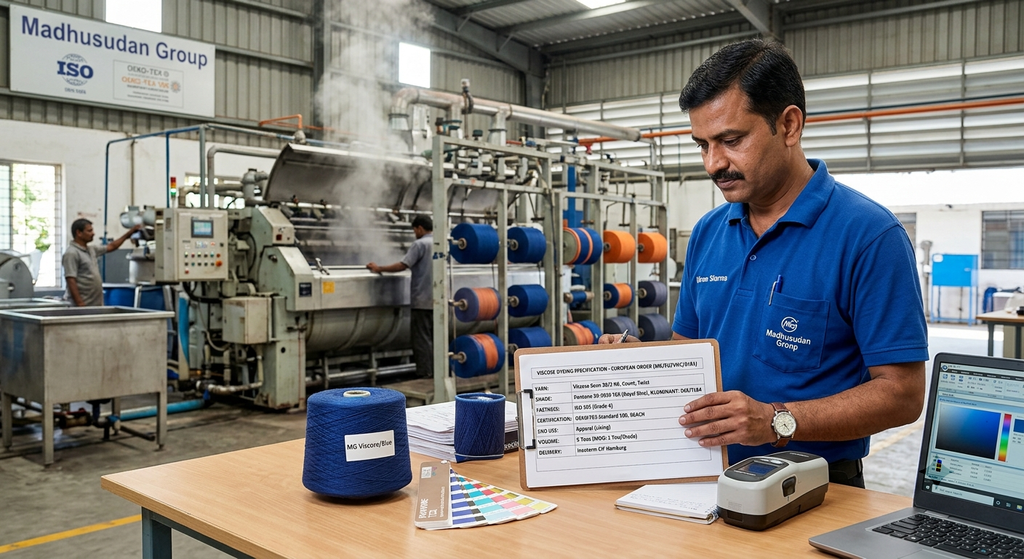
- Yarn type and construction spun or filament, count/denier and filament count, twist, single or ply.
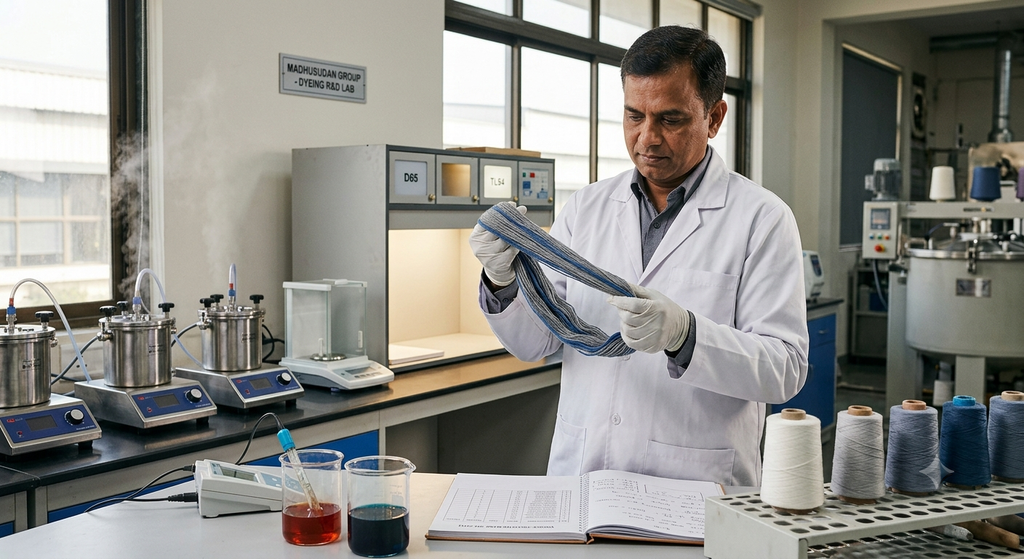
- Shade references Pantone/TCX numbers or physical standards, plus the illuminants the match will be judged under (D65, TL84, incandescent A).
- Shade tolerance a maximum Delta E, and separately a lot-to-lot tolerance for repeat orders.
- Fastness requirements by ISO method and grade, aligned to the real end use rather than copied from a generic template.
- End use apparel, lining, home textile, upholstery, industrial. This determines dye class more than anything else on the list.
- Finish requirements softener type and restrictions (silicone-free, non-yellowing, coating-compatible).
- Certification scope OEKO-TEX, REACH declaration, and pulp chain-of-custody if EU-bound.
- Volume and shade count per shade and annual, since MOQ is per shade.
- Packing and delivery cone specification, carton or pallet, Incoterm and destination European port.
Our questions to ask before buying yarn checklist expands on supplier vetting, and our bulk yarn supplier in India page covers volume sourcing logistics.
Shipping dyed viscose yarn from India to Europe
Duty. Dyed viscose yarn attracts the MFN rate for its specific commodity code on arrival in the EU, well below the rates applied to apparel. The EU–India Free Trade Agreement was politically concluded in January 2026 and is expected to remove tariffs on Indian textile lines once in force; as of September 2026 it has been put to the Council for signature authorisation and still requires European Parliament consent and ratification on both sides. Confirm your commodity code and the rate applicable on your shipment date with a customs broker.
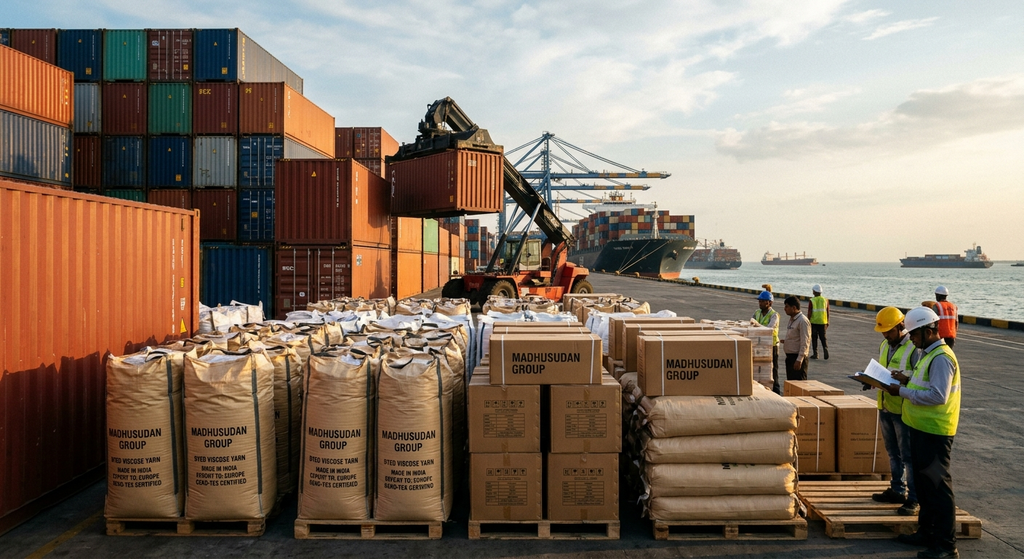
Routing. Nhava Sheva or Mundra to Rotterdam, Antwerp, Hamburg, Genoa, Barcelona or Leixões, with typical port-to-port transit of roughly three to four weeks depending on service and transhipment, plus inland movement.
Incoterms and documentation. FOB and CIF are common; larger converters increasingly ask for DAP to the mill. Expect to supply commercial invoice, packing list, bill of lading, certificate of origin, fibre composition declaration, OEKO-TEX certificate, test reports and increasingly pulp chain-of-custody evidence.
Lead time. As with linen, the lab dip approval loop is usually the longest single element and the most compressible. Set up spectrophotometric colour communication with an agreed Delta E tolerance before the first order.
Viscose yarn dyeing at Madhusudan Group
Madhusudan Group operates an in-house yarn dyeing plant with approximately 500 tonnes per month of capacity at our facility in Surat, Gujarat. Colour is not subcontracted to third-party job-work units, so the process controls described in this guide dosing curves, package density, flow management, drying end-point, soaping cycles sit under one quality system with one point of accountability.

For European buyers that means:
- In-house dyeing across cellulosic and synthetic yarns, so blended programmes don’t have to be split across two facilities. See our dyed yarn manufacturer capability page.
- Established European export programmes, including Germany, within an export footprint spanning 18+ countries EU documentation, packing standards and Incoterms handling are routine. Our note on polyester yarn dyeing for South America shows how we structure regional dyeing programmes elsewhere.
- Lab dip and digital colour communication, to compress the approval loop that usually drives lead time for overseas buyers.
- Documentation support for the chemistry and traceability files EU brands audit against.
Frequently asked questions
Is viscose easy to dye? Viscose accepts dye very readily high affinity, fast strike, excellent yield. What is difficult is consistency: fast strike makes level dyeing harder, the fibre loses 40–60% of its strength when wet, it swells enough to tighten a package mid-cycle, and it varies lot to lot from the fibre plant. Easy to colour, hard to repeat.
Which dyes are used for viscose yarn? Reactive dyes are standard for apparel and home textiles, giving the best combination of shade range and wash fastness. Direct dyes are used in cost-driven programmes but require cationic after-fixing and often fall short of EU brand wet-fastness specs. Vat dyes are specified where light fastness is critical. Dope-dyed viscose is an alternative where fastness and repeatability outrank shade flexibility.
What traceability do European buyers require on viscose yarn? Increasingly, evidence of the pulp producer and its forest-sourcing profile commonly FSC or PEFC chain-of-custody, and the producer’s CanopyStyle Hot Button ranking. The EU Deforestation Regulation applies from 30 December 2026 for large and medium operators and covers wood-derived products listed in its Annex I; whether a given viscose yarn code is in scope should be confirmed against the current annex with a customs adviser. Either way, pulp-origin documentation should be built now.
Why does my dyed viscose yarn bleed? Almost always one of two causes: insufficient soaping after reactive dyeing, leaving unfixed hydrolysed dye on the surface; or direct dyes applied without adequate cationic fixing. On viscose-polyester blends a third cause is inadequate reduction clearing after the disperse stage, which leaves disperse dye staining the viscose.
What is dope-dyed viscose and should I use it? Dope-dyed viscose has pigment added to the spinning solution, so colour runs through the fibre. It offers outstanding light and wash fastness, far lower water use and perfect batch repeatability, at the cost of limited shades, higher minimums and longer lead times. It suits long-running, fastness-critical European programmes in a stable palette; bath dyeing suits fashion-led work with wide shade ranges.
What is the MOQ and lead time for a European viscose dyeing order? MOQ is set per shade and driven by machine and carrier configuration, not total order size. Lead time is lab dip approval plus bulk dyeing and testing, plus roughly three to four weeks ocean transit to a European gateway port. The approval loop is usually the longest variable, which is why digital colour communication is worth setting up before the first order.
Request a viscose yarn dyeing quotation
Tell us your yarn construction, shade references, required ISO fastness grades, end use, certification and traceability scope, and volume per shade. We’ll respond with a technical proposal, lab dip plan and pricing against your specification, quoted on your preferred Incoterm to your European port.
Contact Madhusudan Group or reach our export team on WhatsApp for a same-day response.