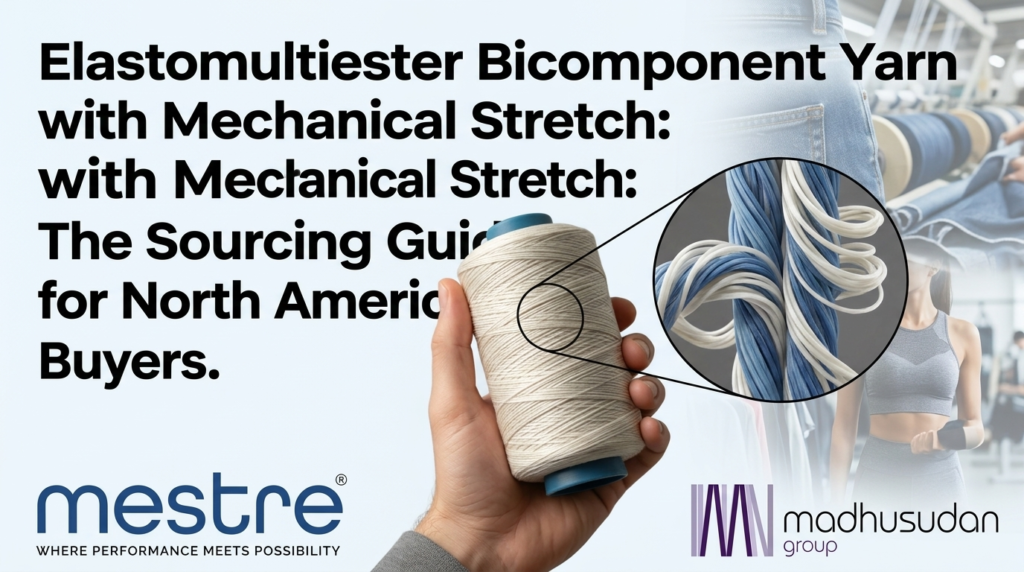
North American denim mills, activewear cut-and-sew houses, and workwear brands are quietly moving away from spandex-based stretch. Recent reporting from Sourcing Journal on how denim mills are reworking their stretch fiber programs shows spandex content in mainstream stretch denim has already fallen to roughly 1-2% in many bestselling fabrics, with mills leaning on alternative performance fibers to hold recovery instead. The alternative gaining ground alongside that shift is elastomultiester bicomponent yarn a stretch yarn that gets its recovery from fiber engineering rather than from an elastic filament woven or knitted alongside a base yarn. This guide explains what the yarn actually is, how bicomponent fiber construction produces stretch mechanically instead of chemically, where it fits inside a North American product line, and how a buyer in the US or Canada can source it directly from a manufacturer in India.
This is a technical buyer’s guide, not a general fashion article. If you specify yarn for denim, activewear, hosiery, or technical workwear, the sections below are written to answer the questions your lab and your compliance team will actually ask: recovery percentage, dye affinity, chlorine and heat resistance, how the yarn behaves in a blend, what US fiber-content labeling law calls this material, and what documentation an exporter needs to clear customs.
What Is Elastomultiester Yarn?
Elastomultiester is a fiber category built from two chemically distinct polyester polymers that are extruded together as a single filament rather than blended as separate fibers. One polymer component has a different shrinkage and elasticity behavior than the other. When heat-set, the mismatch between the two sides causes the filament to coil and contract, and that coil is what gives the yarn its stretch and recovery. Nothing rubber-like or elastane-like is added; the stretch is a structural property of the fiber itself. A full breakdown of the chemistry and how manufacturers control recovery percentage during extrusion is covered in Mestre’s elastomultiester guide.
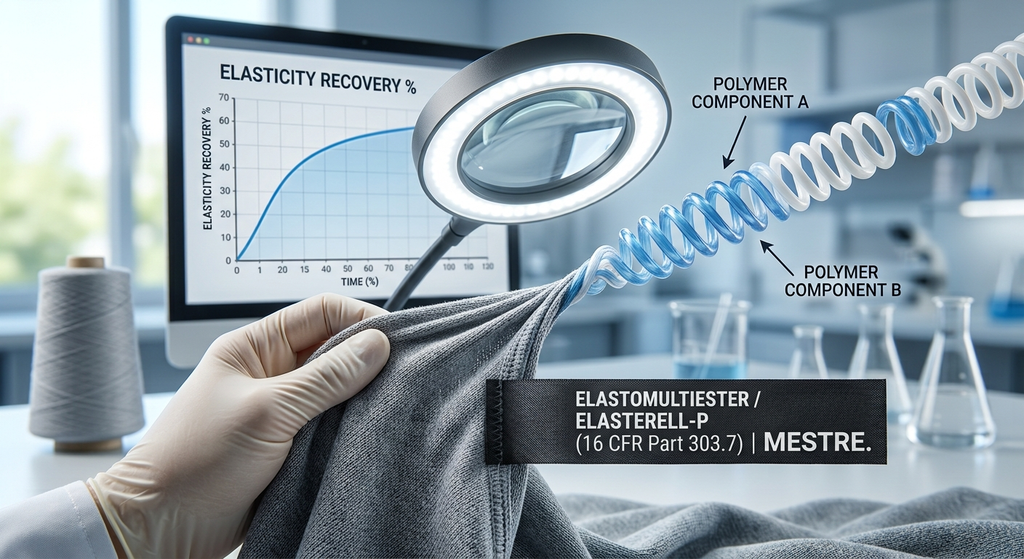
This is not a niche or unregulated fiber concept. It is defined in US federal law. The Federal Trade Commission’s Rules and Regulations under the Textile Fiber Products Identification Act the statute that governs how fiber content must be disclosed on garment labels sold in the United States assign this fiber class the regulatory generic name “elasterell-p,” a subclass of polyester, and the current definition is published in 16 CFR Part 303 §303.7. That definition specifies a fiber formed from two or more chemically distinct polymers, none exceeding 85% by weight, joined by ester linkages, that durably reverts to close to its original length after being stretched at least 100%. Any buyer specifying this yarn for a US-labeled garment should have that citation on file, since it is the label language your compliance team will ultimately need to use.
The best-known commercial version of this technology is LYCRA® T400®, developed originally by DuPont and now offered by The LYCRA Company, whose own product page describes it as a spandex-free bicomponent polyester fiber built for stretch apparel, workwear, and moisture-wicking performance. Elastomultiester yarn from other manufacturers, including Mestre, is built on the same underlying bicomponent principle.
Bicomponent Yarn: The Engineering Behind the Stretch
Elastomultiester is one specific example of a broader fiber category called bicomponent yarn. Bicomponent construction means two polymers, or two variants of the same polymer with different intrinsic viscosity, are extruded through a single spinneret opening in a fixed geometric arrangement side-by-side, sheath-core, or segmented-pie are the three most common cross-sections. The side-by-side configuration is what produces the spring-like crimp used for mechanical stretch. Mestre’s complete guide to bicomponent yarn walks through all three cross-section types and where each is used.
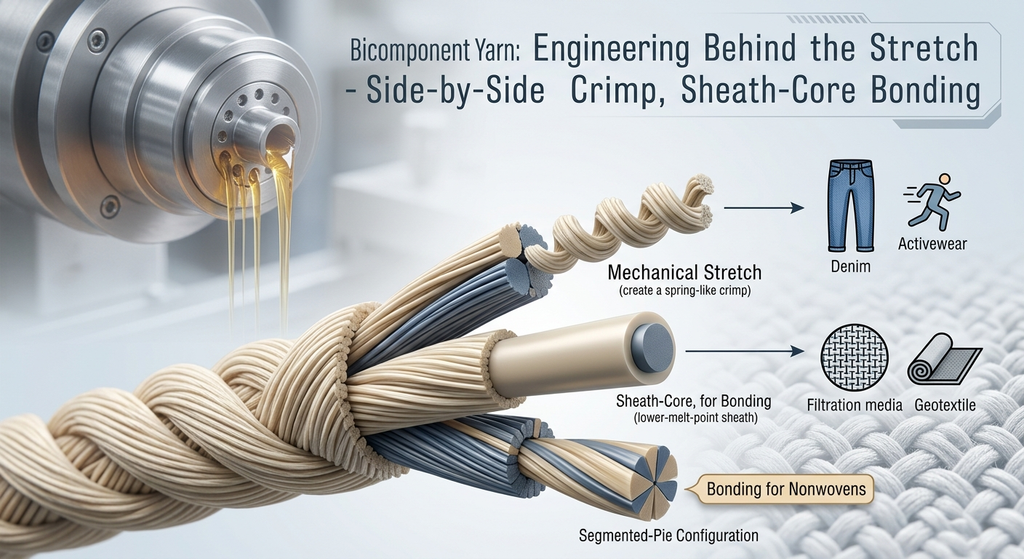
Sheath-core bicomponent fibers are used differently usually for bonding in nonwovens, where a lower-melt-point sheath fuses fabric layers together without needing a separate binder resin. That application is a separate use case from garment-weight stretch fabric and is covered on its own at bicomponent yarn for nonwoven fabric bonding, which is relevant if a sourcing scope includes filtration media, geotextiles, or hygiene nonwovens alongside apparel fabric.
For a denim or activewear buyer, the practical takeaway is that bicomponent yarn is a manufacturing platform, and elastomultiester with mechanical stretch is the specific product built on that platform for garment-weight woven and knit fabric.
Mechanical Stretch vs. Chemical Stretch: Why the Distinction Matters to a Buyer
“Stretch fabric” is not one category. There are two structurally different ways to get it, and mills routinely default to the one they already know how to run rather than the one that fits the end use best.
Chemical stretch the industry’s shorthand for spandex, elastane, or Lycra blended into a base yarn gets its recovery from an elastomer filament wrapped, core-spun, or woven alongside cotton, polyester, or nylon. Mechanical stretch, by contrast, gets its recovery from the coiled geometry of the bicomponent filament itself, with no elastomer present at all. A direct head-to-head comparison recovery percentage, wash durability, heat tolerance, dye behavior, and recyclability is laid out in mechanical stretch yarn vs. chemical stretch yarn.
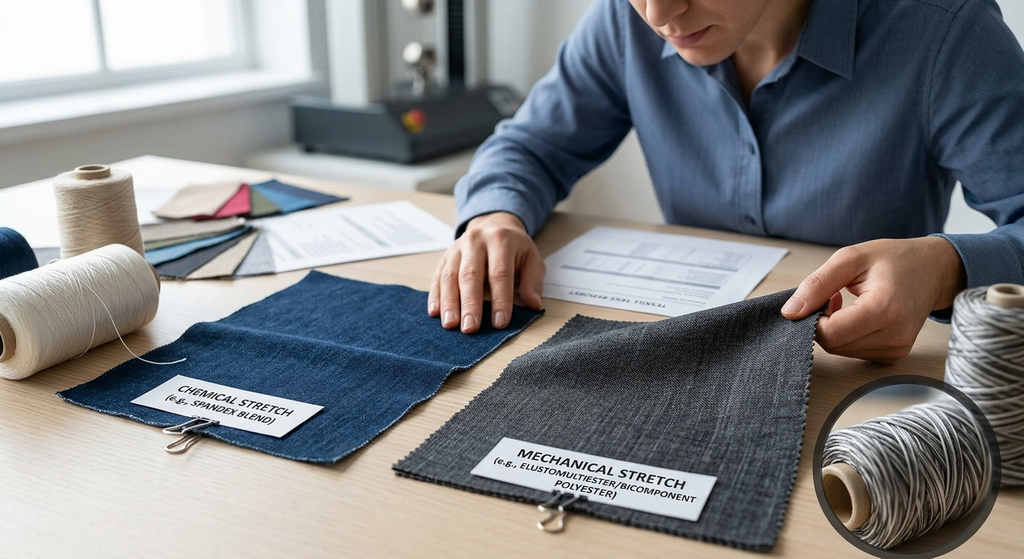
The practical differences that show up on a cutting-room floor and in a compliance report are:
- Single-polymer content: elastomultiester fabric can often be labeled and recycled as polyester rather than as a polyester-elastane blend, since mechanical recyclers struggle to separate spandex from its host fiber.
- Heat and chlorine tolerance: elastane degrades with repeated hot-water washing and chlorine exposure; a bicomponent polyester filament does not carry the same degradation risk.
- Recovery consistency over garment life: chemical stretch loses recovery as the elastomer fatigues; mechanical stretch recovery is tied to the permanent crimp set in the filament and is more stable over repeated wear cycles.
- Dye uniformity: no second fiber type means no risk of the stretch filament grinning through or shade-varying against the base yarn after dyeing.
None of this makes mechanical stretch a universal replacement for elastane very high-stretch, high-recovery applications like swimwear and compression wear still lean on spandex’s higher elongation ceiling. But for the 15-35% stretch range that covers most woven bottoms, workwear, and mid-compression activewear, mechanical stretch is frequently the better engineering fit.
Why North American Denim Mills Are Paying Attention Right Now
North America’s largest single stretch-fabric category by volume is denim, and it is also the category where elastane’s weaknesses show up fastest repeated hot washing, tumble drying, and heavy garment-wash processing are exactly the conditions elastane handles worst. Sourcing Journal’s ongoing denim coverage has repeatedly noted the shift toward lower elastane percentages, GRS-certified or bio-based spandex alternatives, and non-elastane stretch fiber technologies as mills respond to both consumer sustainability sentiment and tightening extended producer responsibility rules in several US states. Bicomponent yarn and elastomultiester in North American stretch denim covers the specific recovery ranges typically 15-25% for five-pocket denim mills are specifying when they evaluate this yarn category.
Outside denim, two other US and Canadian categories are adopting the yarn quickly. Workwear and PPE need stretch that survives industrial laundering cycles far more aggressive than retail garment care; mechanical stretch yarn for workwear and PPE covers the durability testing this segment expects. Sportswear and performance apparel mid-compression training wear, golf and tennis apparel, and performance woven bottoms use bicomponent yarn where full 4-way stretch spandex fabric is over-engineered for the movement range required.
How Elastomultiester Compares to Sorona, T-400, and T-800
Buyers who have sourced stretch fiber before will recognize some of the brand names circling this category DuPont Sorona, T-400, and T-800 among them. Understanding how they relate to elastomultiester avoids a lot of confusion during supplier conversations.
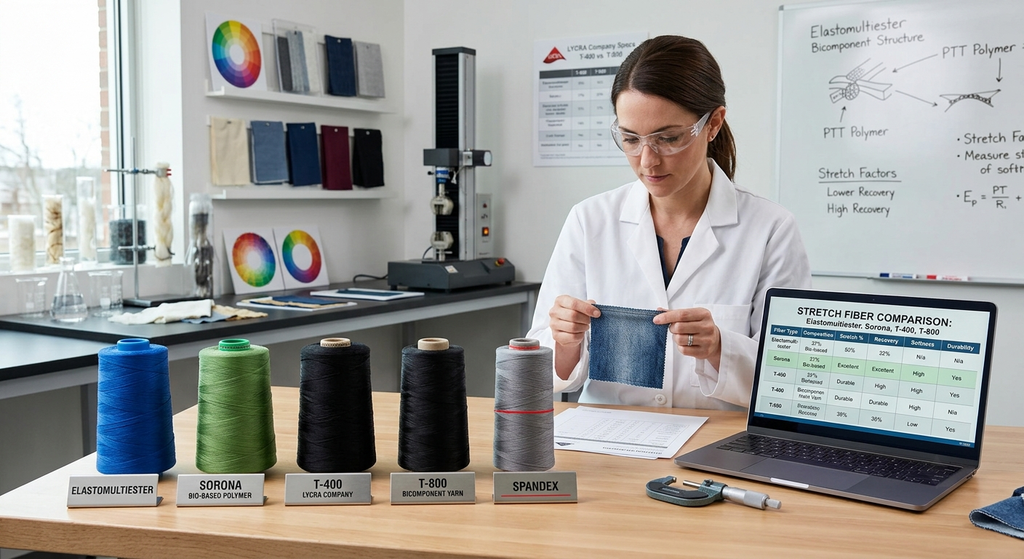
Sorona is a PTT-based fiber rather than a classic elastomultiester bicomponent, though the two are frequently discussed together because both deliver stretch without spandex. Sorona’s own manufacturer, now operating as CovationBio following DuPont’s biomaterials divestiture, describes it on its official site as a partially plant-based polymer that delivers comfort stretch and recovery without elastane. Elasterell-P, Sorona, and elastomultiester compared directly puts the three side by side on stretch percentage, bio-based content, and cost.
T-400 and T-800 are the trademarked names for LYCRA Company’s elasterell-p bicomponent stretch fiber line, with a long track record in denim; T-800 bicomponent elastomultiester yarn explains how that legacy specification maps onto current elastomultiester offerings from other manufacturers, and Mestre vs. Lycra, T-800, and T-400 stretch yarn is a practical spec-conversion reference if a tech pack currently calls out one of those trade names.
What “Mestre” Means and Why the Brand Exists
Mestre is the branded elastomultiester and bicomponent yarn product line manufactured by Madhusudan Group. Mestre yarn by Madhusudan Group covers the manufacturing story where the yarn is produced, what quality systems govern it, and how the brand fits into the wider Madhusudan Group portfolio. The name itself is a coined brand name, not a translation of an existing textile term, and it is unrelated to the Parsi surname “Mistry”/”Mistri” despite the phonetic overlap that sometimes shows up in search behavior.
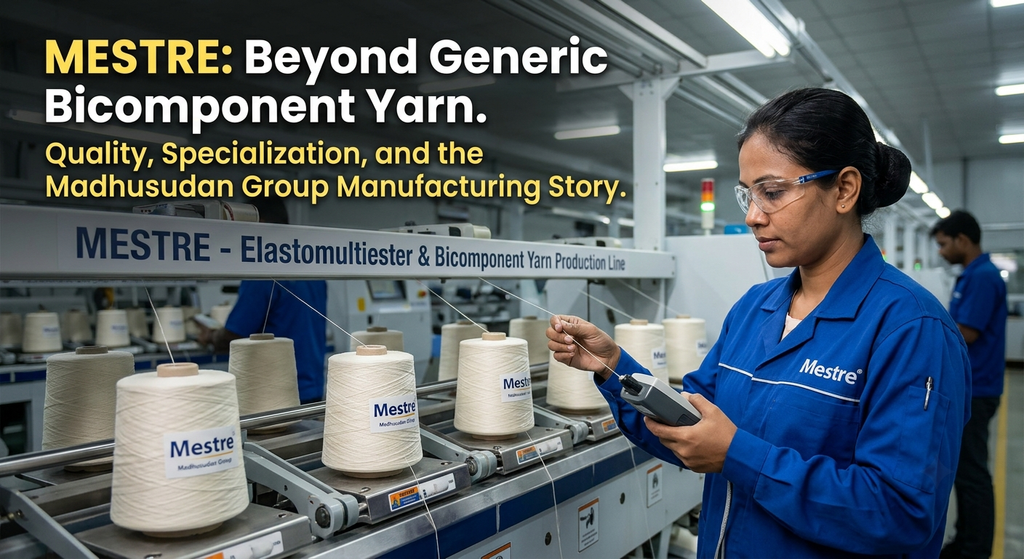
What actually differentiates Mestre from a generic bicomponent yarn supplier is specialization rather than breadth: the mill runs elastomultiester and mechanical-stretch bicomponent yarn as a core product line rather than as one SKU inside a much wider general-yarn catalog. That’s a fair question for any buyer to raise with a shortlisted supplier: ask how many production runs per month are dedicated to this specific fiber category, not just to polyester yarn broadly.
Sustainability: Where Mechanical Stretch Yarn Actually Wins
Retail buyers in North America are under growing pressure from EPR legislation in several US states and from brand-level recycled-content commitments to reduce elastane content, because spandex-blended fabric is one of the hardest textile waste streams to mechanically recycle. A cotton-spandex or polyester-spandex blend cannot currently be recycled back into fiber at commercial scale without first separating the elastane, which most recyclers don’t do. Because elastomultiester is a single polymer family end to end, garments made from it are meaningfully closer to circular. Sourcing Journal’s coverage of brands pursuing plastic-free stretch, including Wrangler’s move toward reduced-synthetic denim construction, reflects the same underlying pressure driving interest in bicomponent alternatives.
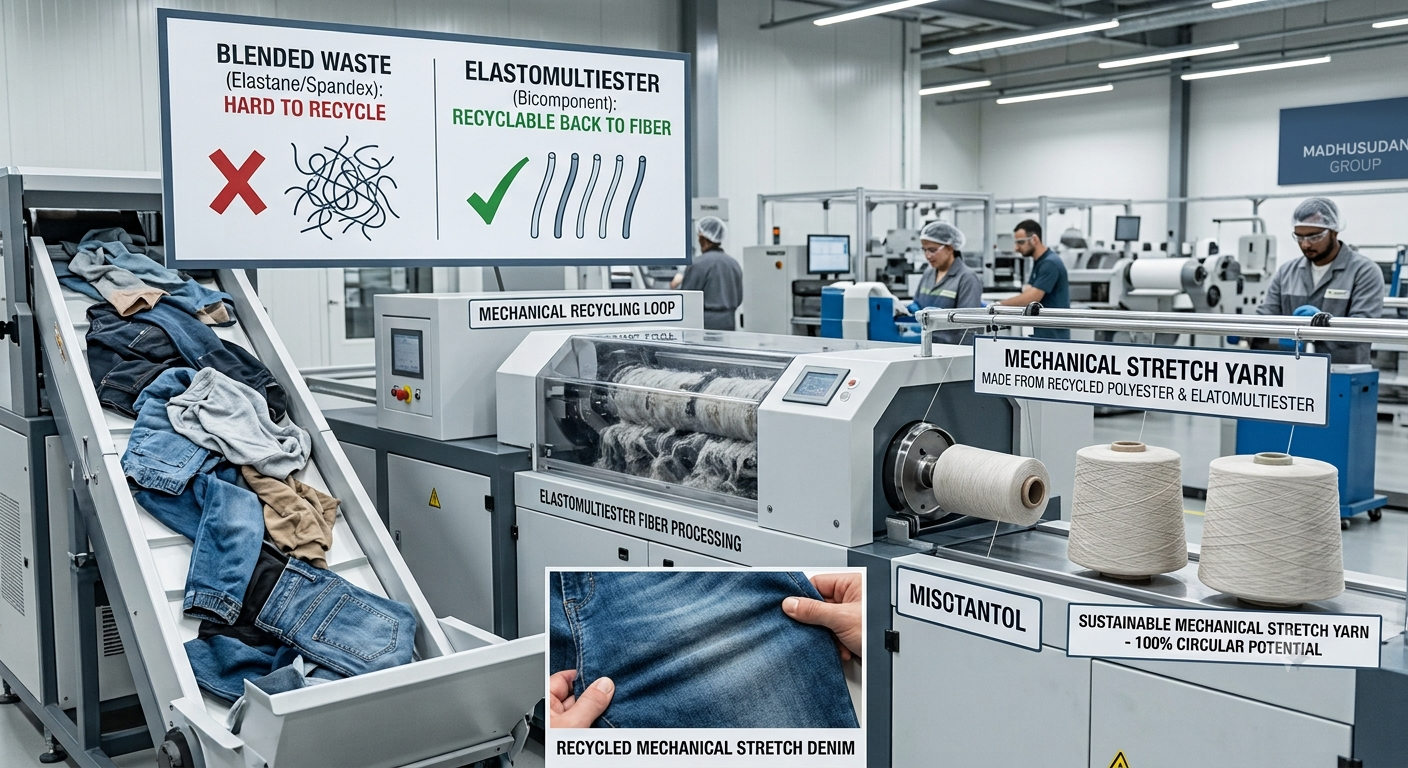
This pairs naturally with Madhusudan Group’s existing recycled-polyester production. If a program needs both recycled content and mechanical stretch in the same fabric, the recycled polyester yarn guide walks through how recycled feedstock is incorporated into blended and bicomponent yarn runs without compromising the stretch specification.
Sourcing Elastomultiester Bicomponent Yarn from India: What a US or Canadian Buyer Needs to Know
India is one of the largest polyester and blended yarn producing bases in the world, and Gujarat specifically where Madhusudan Group is headquartered is one of its densest manufacturing clusters. For a North American buyer evaluating a switch from a domestic or East Asian yarn source, three practical questions usually come up first: import logistics, minimum order quantities, and how to verify a manufacturer versus a trading intermediary.
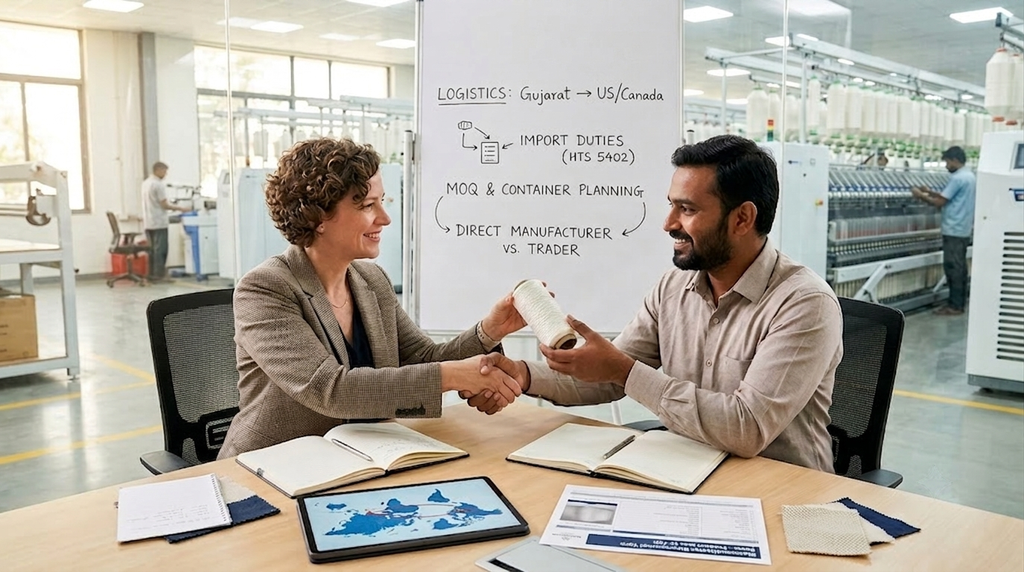
On logistics, the complete guide to importing yarn from India to the USA covers typical lead times out of Gujarat ports and the documentation a customs broker will ask for. Bicomponent and elastomultiester yarn is generally classified under Chapter 54 of the Harmonized Tariff Schedule, which covers man-made filament yarns; the current HTS lookup and duty rates are published directly by the US International Trade Commission and are worth confirming with a licensed customs broker before finalizing landed-cost math, since classification can vary by construction and blend ratio.
On volume and order structure, the bulk yarn supplier in India guide sets realistic expectations for MOQ by yarn type, and the polyester yarn suppliers in India for export guide walks through container-load planning, sampling timelines, and typical payment terms.
On manufacturer verification, the single most useful distinction a buyer can make before signing a contract is yarn supplier vs. yarn manufacturer a large share of Indian yarn export listings are trading houses reselling capacity from third-party mills, which adds a margin layer and removes direct quality control. What questions to ask before buying yarn gives a practical checklist for that conversation.
Choosing the Right Yarn for the Application
Elastomultiester bicomponent yarn is not a single fixed specification recovery percentage, denier, and filament count all get tuned to the end product, and picking the wrong construction is the most common reason a first trial run underperforms. How to choose the right yarn for textile products is a general framework for that decision, and it’s worth applying specifically here:
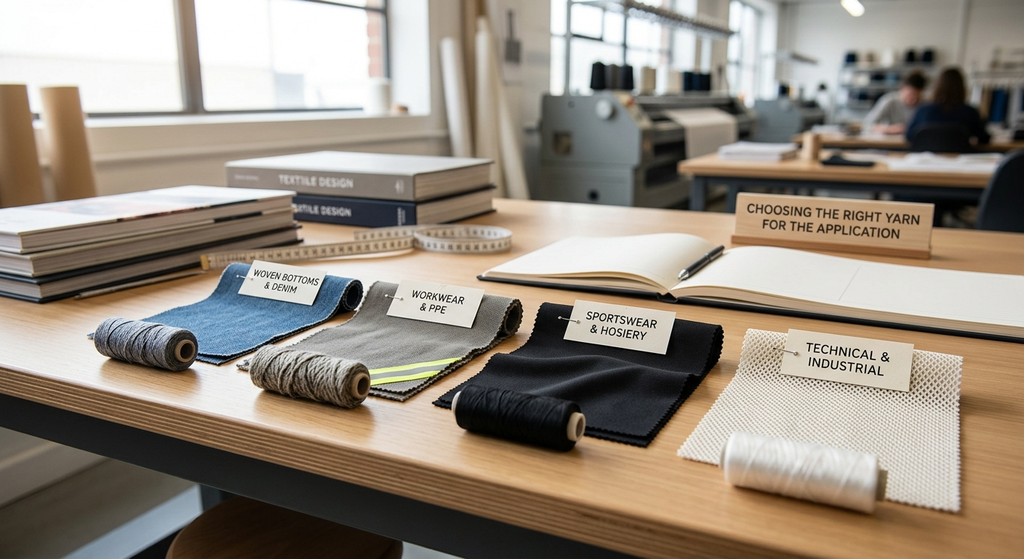
- Woven bottoms and denim: mid-range recovery (roughly 15-25%), heavier denier, prioritizing wash durability and shape retention over maximum elongation.
- Workwear and PPE: recovery tuned for range of motion rather than fashion fit, paired with flame-resistant or high-vis base yarns, with industrial laundering durability as the primary spec driver.
- Sportswear and hosiery: finer denier, higher filament count for softer hand feel, with recovery percentage set by garment compression class.
- Technical and industrial textiles: yarn selection here is driven by chemical resistance and dimensional stability more than stretch comfort; the yarn selection guide for technical textiles is the relevant reference.
Technical Specification Cheat Sheet
Before a first sample order, most buying teams want the specification variables laid out in one place rather than scattered across supplier data sheets. The variables that actually change between elastomultiester bicomponent yarn constructions are denier, filament count, cross-section type, dye class, and target recovery percentage and each of those choices should be driven by the end product, not by whatever the mill happens to have on hand that week.
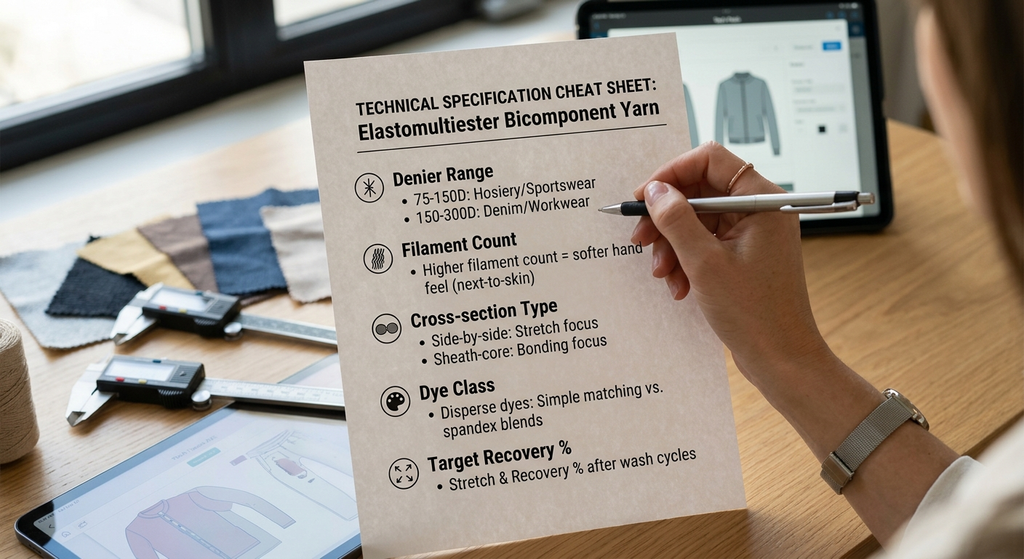
- Denier range: lighter deniers (roughly 75-150D) suit hosiery, lightweight sportswear, and shirting; heavier deniers (150-300D and above) suit denim and workwear where abrasion resistance matters as much as stretch.
- Filament count: higher filament counts produce a softer hand feel at a given denier, which matters more for next-to-skin sportswear than for outerwear or workwear.
- Cross-section: side-by-side bicomponent construction is used for stretch-driven applications; sheath-core is used where bonding or thermal fusion matters more than stretch, as in nonwoven interlinings.
- Dye class: because the filament is entirely polyester, standard disperse dye processes apply, which simplifies dye-lot matching against non-stretch polyester components in the same garment a real advantage over elastane blends, where the elastomer core resists dye differently than the surrounding fiber and can cause shade variation after repeated washing.
- Target recovery: specified as a percentage of stretch and a percentage of recovery after a fixed number of wash cycles; this is the single number a lab dip or bulk order should always confirm against the tech pack before scaling production.
A buyer moving off a legacy T-400 or T-800 spec, or off a standard 95/5 polyester-spandex denim spec, should ask the mill to convert the existing tech pack numbers into the equivalent elastomultiester construction rather than guessing at a denier and running a blind trial.
What Mestre Fabric Looks and Feels Like in Finished Goods
Fiber-level explanations only go so far for a design or merchandising team evaluating whether a yarn fits a specific collection. At the fabric stage, elastomultiester woven fabric drapes closer to a conventional polyester or poly-cotton woven than to a spandex-blended stretch woven it doesn’t carry the slightly rubbery hand feel that high-elastane-content fabric can have, and it tends to hold a crease and finish press cleaner. The ultimate guide to Mestre fabric as a premium stretch textile goes through fabric-hand and finishing behavior in more depth, which is useful to circulate to a design team ahead of a physical swatch request.
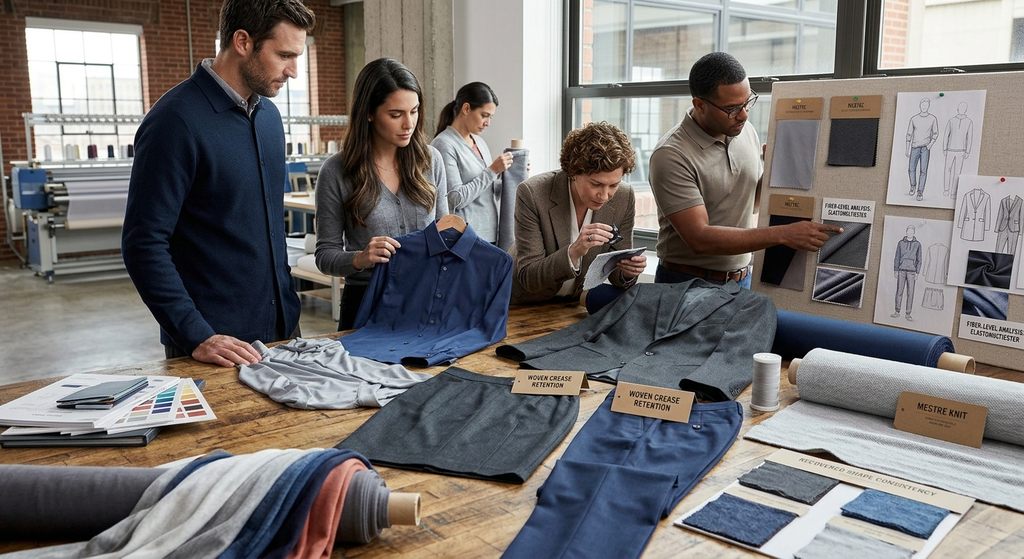
For knit constructions, the fabric behaves closer to a textured polyester knit than to a spandex-blended jersey it has less initial “snap-back” force at low elongation than a high-elastane knit, but holds its recovered shape more consistently over the life of the garment, which is why it tends to test well specifically on wash-heavy or industrially laundered products rather than on garments that need instantaneous compression.
Glossary of Terms for Buyers New to This Fiber Category
Trade conversations around this yarn category use several terms interchangeably that are worth defining precisely before a supplier call.

- Bicomponent fiber: a fiber extruded from two chemically or physically distinct polymer components within a single filament, rather than two separate fibers blended together.
- Elastomultiester: the generic descriptive term (and, in several regulatory contexts, a fiber classification) for bicomponent polyester fiber engineered for mechanical stretch.
- Elasterell-p: the specific US regulatory generic name defined by the FTC for this fiber subclass, used on garment fiber-content labels sold in the United States.
- Mechanical stretch: stretch generated by fiber geometry (coiling, crimp) rather than by an elastomeric material.
- Chemical stretch: stretch generated by an elastomer such as spandex, elastane, or Lycra blended, wrapped, or core-spun with a base fiber.
- Recovery percentage: the proportion of original length or shape a stretched fabric returns to once tension is released, typically measured after a set number of load cycles or wash cycles.
- PTT (polytrimethylene terephthalate): the polymer family behind Sorona and related fibers, chemically distinct from the PET/modified-PET pairing used in most elastomultiester constructions but solving a similar stretch-without-spandex problem.
Quality Control, Testing, and Certification
For a North American retail or brand buyer, yarn-level quality control usually needs to satisfy three separate audiences: the brand’s own lab dip and physical testing standards, the retailer’s compliance program if the yarn is going into a private-label product, and US customs and labeling requirements. Elastomultiester’s single-polymer composition simplifies the labeling side, since fiber-content disclosure doesn’t need to account for a separate elastomer percentage the way a spandex blend does, and the applicable regulatory generic name elasterell-p is defined directly in the FTC’s own rules, as covered above.
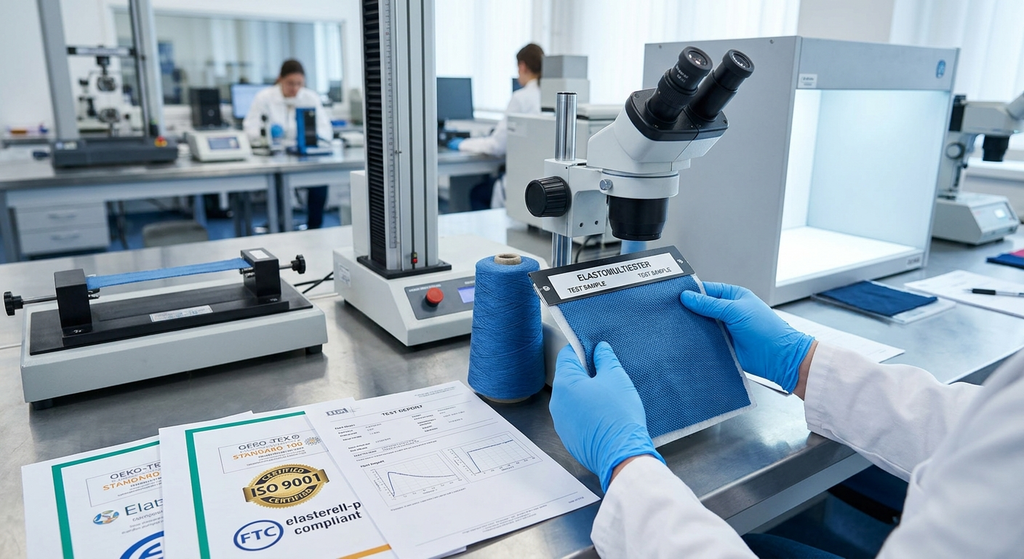
On chemical safety certification, OEKO-TEX STANDARD 100 is the most widely recognized independent testing label in the industry, verifying that a yarn or finished textile has been tested against a defined list of restricted substances; the current testing scope and product classes are published on OEKO-TEX’s own site. On manufacturing-process certification, ISO 9001 speaks to production consistency, which is directly relevant to lot-to-lot recovery percentage staying within spec. ISO-certified yarn supplier breaks down which certifications matter for which part of a sourcing decision.
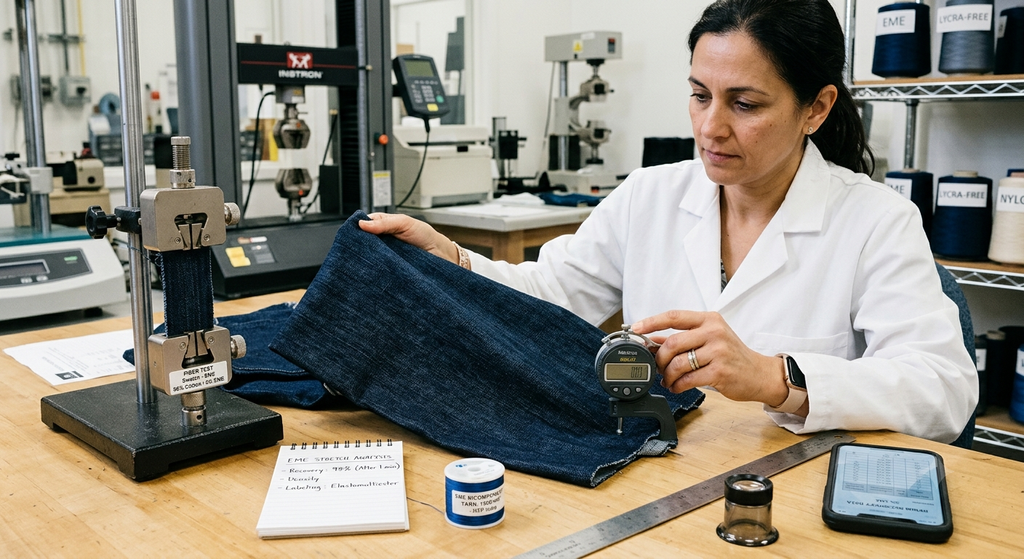
On physical testing, the tests worth requesting on a pre-production sample are stretch percentage under standardized load, recovery percentage after a defined number of home-laundering or industrial-laundering cycles, colorfastness to washing and light, and pilling resistance if the fabric is a knit. Recovery-after-washing is the test that most directly validates the mechanical-stretch claim versus a chemical-stretch alternative, and it’s the one buyers should insist on rather than accepting a single-cycle stretch-and-release measurement alone.
Common Mistakes North American Buyers Make When Switching to Mechanical Stretch
Several patterns show up repeatedly when a brand or mill moves from a spandex-blended stretch yarn to an elastomultiester bicomponent yarn for the first time, and most of them are avoidable with the right first conversation.

The first is assuming a like-for-like denier swap will reproduce the same recovery percentage. Because the stretch mechanism is different coiled fiber geometry rather than elastomer elongation a straight denier substitution against an existing spandex-blend tech pack usually needs adjustment.
The second is treating all bicomponent yarn suppliers as interchangeable. Bicomponent spinning requires different extrusion equipment and process control than standard polyester texturizing, and a mill that lists bicomponent yarn as one line item among dozens of general polyester products is not necessarily running the volume or process discipline needed for consistent recovery percentage across large orders.
The third is underestimating the lead-time and documentation planning that importing from India requires the first time a buyer sources this way, particularly around HTS classification for bicomponent and elastomultiester yarn, which can be less straightforward than a standard polyester yarn code. The import guide from India to the USA is written to head this off before it becomes a shipping delay.
Pricing Factors: What Actually Moves the Cost of This Yarn
Buyers evaluating elastomultiester bicomponent yarn against an existing spandex-blend cost sheet often expect a simple per-kilogram comparison, but the more useful comparison is landed cost per finished garment, not raw yarn cost per kilogram.
On the cost-up side: bicomponent spinning requires more specialized equipment and tighter process control than standard texturized polyester, so raw yarn pricing is typically positioned above a commodity polyester yarn and can sit close to, or occasionally above, a standard polyester-spandex core-spun yarn depending on denier and order volume.

On the cost-down side, several factors offset that at the finished-garment and total-program level: single-polymer fabric usually needs one dye class instead of two, which simplifies dye-lot management; there’s no separate elastane filament to protect during garment-wash processing, which can reduce processing defects on heavy-wash denim programs; and because the fabric holds recovery more consistently over the product’s life, return and warranty-claim rates tied to “stretched-out” garments tend to run lower for brands that have made the switch on wash-heavy categories like workwear.
Freight and duty planning is the other major line item for a North American buyer sourcing from India rather than domestically or from a nearer regional supplier. Ocean freight from Gujarat ports to US West Coast or East Coast ports is the standard routing, and container utilization is the main lever for landed-cost efficiency which is why most mills, including Madhusudan Group, structure minimum order quantities around full or near-full container loads rather than arbitrary weight thresholds. It’s worth working through landed-cost math with a freight forwarder and licensed customs broker before comparing a per-kilogram FOB quote against a domestic or nearshore alternative FOB price alone is not a like-for-like comparison.
A Denim Mill Scenario: Walking Through a First Order
It’s easier to see how the sourcing process actually plays out with a concrete, representative scenario. A mid-size North American denim brand currently runs a 98/2 cotton-spandex core-spun stretch denim and wants to trial a lower-elastane or elastane-free alternative for one seasonal program, driven by a retail partner’s recycled-content and EPR compliance requirements a scenario that closely mirrors what several mills profiled in recent trade press denim coverage have described as their own current development priority.
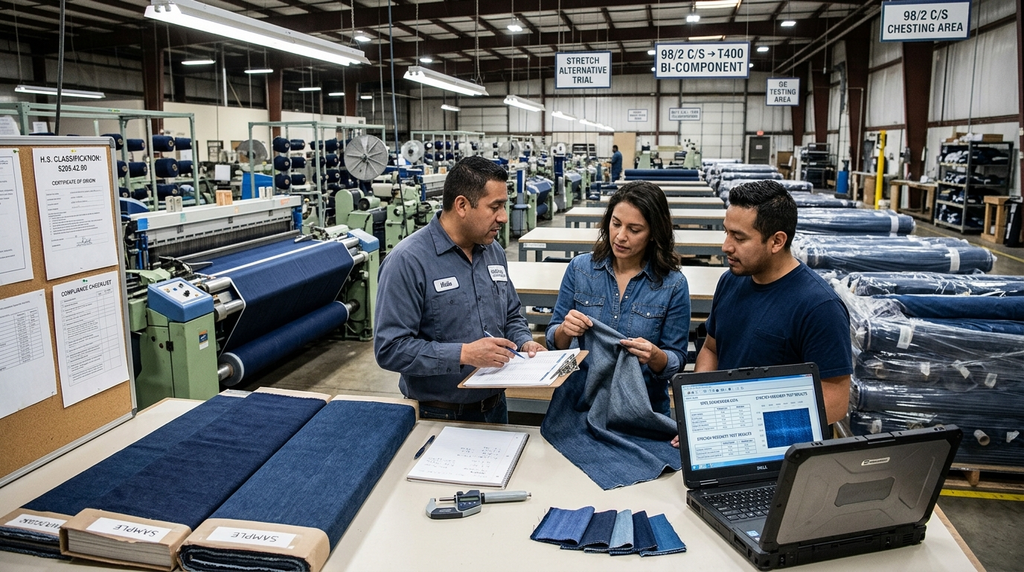
The first step is a spec conversion rather than a blind swap: the brand’s existing recovery target (commonly 18-22% for a comfort-stretch five-pocket jean) gets mapped to an equivalent elastomultiester bicomponent construction, then refined with the mill’s own lab dip data for the specific base yarn blend being used.
The second step is a small pre-production run typically a few hundred meters of fabric rather than a bulk order tested for stretch percentage, recovery after a defined number of home-laundering cycles, and colorfastness against the brand’s existing indigo dye process. This is also the stage where a buyer should confirm the mill’s actual production capacity for this specific yarn category rather than general polyester capacity.
The third step is bulk order planning around container efficiency and lead time, with documentation prepared in advance HTS classification, certificate of origin, and any retailer-specific compliance paperwork so that customs clearance doesn’t become the bottleneck on a seasonal launch timeline. Buyers running this process for the first time consistently report that documentation prep, not manufacturing lead time, is the step most likely to slip a launch date.
Frequently Asked Questions
Is elastomultiester the same as spandex or elastane?
No. Spandex and elastane are elastomer filaments blended with a base fiber; elastomultiester is a single-polymer bicomponent polyester filament that stretches because of its coiled fiber geometry, not because an elastic filament is present.
What is the correct legal name for this fiber on a US garment label?
Under the FTC’s Textile Fiber Products Identification Act rules (16 CFR §303.7), the regulatory generic name is “elasterell-p,” used as an alternative to the broader generic name “polyester” for fiber meeting the rule’s specific recovery-and-composition criteria. Brands should confirm exact label language with legal or compliance counsel.
What stretch percentage does mechanical stretch yarn typically deliver?
It depends on the construction and end use, but denim-weight elastomultiester fabric typically targets 15-25% stretch with strong recovery, while finer-denier constructions for hosiery and sportswear can run higher.
Can elastomultiester fabric be recycled more easily than spandex-blended fabric?
Yes, in general. Because it’s a single polymer family rather than a polyester-elastane blend, it avoids the separation step that makes spandex-blended fabric difficult for most mechanical recyclers to process.
How does Mestre yarn compare to DuPont Sorona?
They solve a similar problem stretch without spandex through different chemistry: Sorona is PTT-based, while Mestre’s elastomultiester is a bicomponent polyester construction. A direct comparison on stretch percentage, cost, and bio-based content is at Mestre vs. Sorona and DuPont stretch yarn.
Is elastomultiester suitable for high-compression garments like swimwear?
Generally not as a full replacement. Elastane’s elongation ceiling is higher, which is why very high-stretch, high-recovery categories like swimwear and compression base layers still typically rely on spandex. Elastomultiester is best suited to the moderate stretch range roughly 15-35% that covers denim, workwear, and most mid-compression sportswear.
Does this yarn require different sewing or garment-wash processing than a standard polyester yarn?
Not significantly. Because the filament is entirely polyester, standard cutting, sewing, and finishing equipment used for polyester or poly-blend fabrics applies without modification. Garment washers should still run their own trial cycle to confirm recovery holds at the specific wash temperature and mechanical action used in their finishing plant, since finishing conditions vary between facilities.
Can elastomultiester be blended with cotton or other natural fibers?
Yes. It’s commonly used as a core or plied component alongside cotton, and less frequently alongside linen or viscose, in woven bottoms where a brand wants the hand feel and breathability of a natural-fiber-dominant fabric with mechanical stretch built in rather than an added elastane filament.
Where This Fits Globally
While this guide is written for North American buyers, elastomultiester and bicomponent stretch yarn is not a regionally isolated trend. Denim and technical-textile mills across South America, Europe, and Asia are evaluating the same fiber category for largely the same reasons recyclability pressure, elastane cost volatility, and durability performance under industrial laundering. A supplier that already ships this yarn category into multiple regions, rather than treating it as a single-market experiment, is generally a more reliable long-term source than one running a first small batch specifically for a single new customer.
Conclusion
Elastomultiester bicomponent yarn with mechanical stretch solves a real, specific problem for North American denim, workwear, and performance apparel brands: it delivers durable stretch recovery without the recycling and durability drawbacks of spandex-blended fabric, and it’s a direction the wider denim industry not just one supplier is already moving toward. Madhusudan Group manufactures this yarn directly under the Mestre brand, with the underlying spinning and texturizing capacity based in Gujarat, India. For a North American buyer, the practical next step is usually the same one that applies to any new fiber category: request a fabric-weight sample against a specific recovery and denier target, and verify the mill’s export documentation before committing to a first bulk order. The sourcing guides linked throughout this article particularly how to import yarn from India to the USA and questions to ask before buying yarn are the right starting point for that process.