Buying yarn sounds simple until you’re the one signing the purchase order. Whether you run a weaving unit, a knitting mill, a garment export house, or a home-textile brand, the yarn you buy determines the quality, durability, and cost of everything you produce afterward. A wrong decision at the yarn-buying stage doesn’t just cost money it can derail production schedules, damage client relationships, and hurt your brand’s reputation in the market.
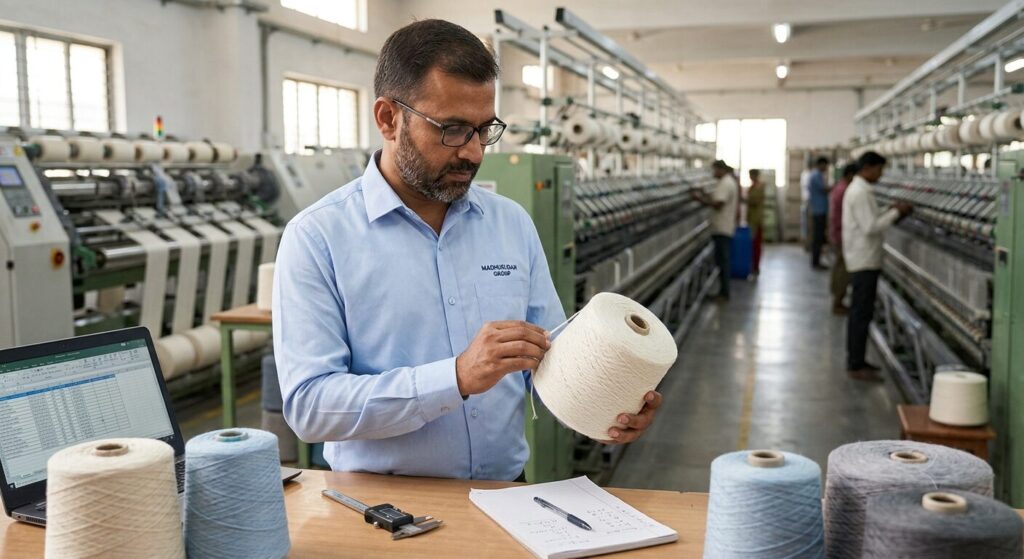
Unfortunately, many buyers especially first-time buyers or those expanding into new yarn categories focus only on price per kilogram and count, and skip the deeper due diligence that separates a reliable, long-term supplier relationship from a one-time transaction gone wrong. This guide walks you through the essential questions to ask before buying yarn, so you can buy with confidence, avoid costly mistakes, and build a dependable supply chain.
As Madhusudan Group, one of the leading names in India’s yarn manufacturing industry, we’ve fielded almost every version of these questions from buyers across apparel, home textiles, and industrial applications. The pattern is always the same: buyers who ask the right questions upfront build supply chains that last; buyers who don’t end up firefighting quality and delivery issues for years. This guide reflects the questions we believe every serious buyer should be asking of us, or of any yarn partner they’re evaluating.
If you’re still evaluating how different yarn types fit your product line, it helps to first read our guide on how to choose the right yarn for textile products before diving into supplier-specific questions below.
Why Asking the Right Questions Matters
Yarn is a raw material, but it behaves more like a specification than a commodity. Two yarns with the same count and material composition can perform completely differently on the loom or knitting machine depending on twist, evenness, moisture content, and how they were processed. That’s why professional buyers don’t just ask “what’s the price” they ask questions that reveal consistency, traceability, and the supplier’s ability to deliver at scale, order after order.
Below are the categories of questions every serious buyer should work through before finalizing a yarn order.
1. Questions About Yarn Specifications
Before anything else, confirm that the yarn matches your technical requirements exactly.
- What is the exact yarn count and tolerance range? Ask for the count in the system you use (Ne, Nm, Tex, Denier) and the acceptable variation (CV%) the mill guarantees.
- What is the fiber composition and blend ratio? If you’re ordering a blended yarn, ask for the precise percentage split (e.g., 65% polyester/35% cotton) and whether it can vary batch to batch.
- Is this ring-spun, open-end, air-jet, or vortex spun yarn? Spinning method affects strength, hairiness, and hand-feel, and it should match your end application.
- What twist per inch (TPI) or twist multiplier does the yarn carry? This affects fabric drape, strength, and pilling resistance.
- Is the yarn dyed, greige, or solution-dyed? If you need color-matched yarn, ask about dye lot consistency across bulk orders. Our detailed breakdown on dyed yarn manufacturing explains what to expect from a professional dyeing process.
2. Questions About Quality Control and Testing
Quality is not something you should take on faith ask for proof.
- What quality testing does the yarn go through before dispatch? Look for evenness testing (Uster), tensile strength testing, and moisture content checks.
- Can you share a Certificate of Analysis (COA) or test report with the shipment? Reputable manufacturers should be able to provide lab data for each batch.
- What is your defect rate or claims policy? Ask how the supplier handles quality disputes, and whether they offer replacement or credit for confirmed defective lots.
- Can I get a sample before committing to a bulk order? Never place a large order without testing a sample on your own machines first.
3. Questions About Certifications and Compliance
If you’re selling to export markets, certifications aren’t optional they’re often a contractual requirement.
- Is the yarn OEKO-TEX certified, GRS certified, or GOTS certified? These certifications matter enormously if you’re producing recycled or organic yarn products. Our guide to recycled polyester yarn covers what GRS certification actually verifies and why it matters to sustainability-conscious buyers.
- Can the supplier provide traceability documentation? Especially for organic cotton, linen, or recycled fibers, ask how far back the traceability chain goes.
- Does the manufacturer comply with local labor and environmental regulations? This protects your brand from compliance risk further down the supply chain.
- Are third-party audit reports (BSCI, Sedex, ISO) available on request? You can check general international quality benchmarks through resources like ISO’s textile standards page.
4. Questions About Supplier vs. Manufacturer Status
One of the biggest points of confusion for buyers is not knowing whether they’re dealing with an actual producer or a trading intermediary. This affects pricing, lead times, and your ability to customize orders. We’ve written a dedicated comparison on yarn supplier vs yarn manufacturer that’s worth reading before you finalize a vendor. In the meantime, ask:
- Are you the actual mill/manufacturer, or are you sourcing from another factory?
- Can I visit or virtually tour the production facility?
- Who do I contact if there’s a production issue you directly, or a third party?
5. Questions About Minimum Order Quantity (MOQ) and Pricing
- What is the MOQ per yarn type, count, and color? MOQs can vary significantly depending on whether the yarn is a stock item or a custom production run.
- Is pricing FOB, CIF, or ex-factory? Understand exactly what’s included so you can compare quotes accurately.
- Are there price breaks for larger volumes? If you’re scaling up, ask about tiered pricing for bulk yarn purchases.
- How often do raw material price fluctuations affect your quotes? Yarn pricing is closely tied to raw cotton, crude oil (for synthetics), and currency movements ask how the supplier handles this.
6. Questions About Production Capacity and Lead Time
- What is your current production capacity per month for this yarn type?
- What is the standard lead time from order confirmation to dispatch?
- Do you hold safety stock for repeat/regular buyers?
- How do you handle rush orders, and is there a premium charge?
If you regularly need large, consistent volumes, it’s worth understanding how industrial yarn suppliers structure their production planning to support high-volume buyers without compromising on delivery timelines.
7. Questions About Packaging, Shipping, and Logistics
- How is the yarn packed cones, hanks, or bales and can packaging be customized?
- What net weight per cone/package can I expect, and is it consistent?
- Who handles freight and customs documentation for export orders?
- What is your policy on damaged or short shipments?
8. Questions About Payment Terms and Business Stability
- What payment terms do you offer advance, LC, or credit terms for repeat buyers?
- How long has your company been in operation, and can you share references from existing clients?
- Do you have export experience to my country/region, and are you familiar with the relevant import documentation?
9. Questions About After-Sales Support
- What happens if a batch doesn’t perform as expected on my machines?
- Do you offer technical support for yarn-related processing issues?
- Will you notify me proactively if there’s a delay or a change in raw material sourcing?
A supplier that treats after-sales support seriously is signaling that they see you as a long-term partner, not a one-time transaction — a distinction worth watching for whether you’re buying viscose yarn, stretch yarn, or linen yarn.
A Quick Pre-Purchase Checklist
- Before you sign off on a yarn order, run through this condensed checklist:
- Confirmed count, blend, twist, and spinning method
- Reviewed lab test reports or COA
- Verified relevant certifications (OEKO-TEX, GRS, GOTS)
- Tested a physical sample on your own equipment
- Clarified manufacturer vs. trader status
- Understood MOQ and pricing structure
- Confirmed production capacity and lead time
- Reviewed packaging and logistics terms
- Agreed on payment terms
- Understood the after-sales support policy
Common Mistakes Buyers Make
Even experienced procurement teams fall into a few recurring traps:
- Chasing the lowest price without verifying quality. A cheaper yarn that causes higher wastage or machine downtime often costs more overall.
- Skipping the sample-testing stage. Bulk orders should never be placed sight-unseen.
- Ignoring certification gaps. If your end buyer requires GOTS or GRS certification and your yarn supplier can’t provide it, your finished product may be rejected at the compliance stage.
- Not clarifying who is liable for defects. Get this in writing before the order is confirmed, not after a problem arises.
- Overlooking lead time buffers. Especially during peak season, ask suppliers for realistic not best-case delivery timelines.
Why Madhusudan Group Sets the Benchmark for These Answers
When you run through the checklist above with Madhusudan Group, you’re evaluating a company built to answer every one of these questions with confidence rather than hesitation:
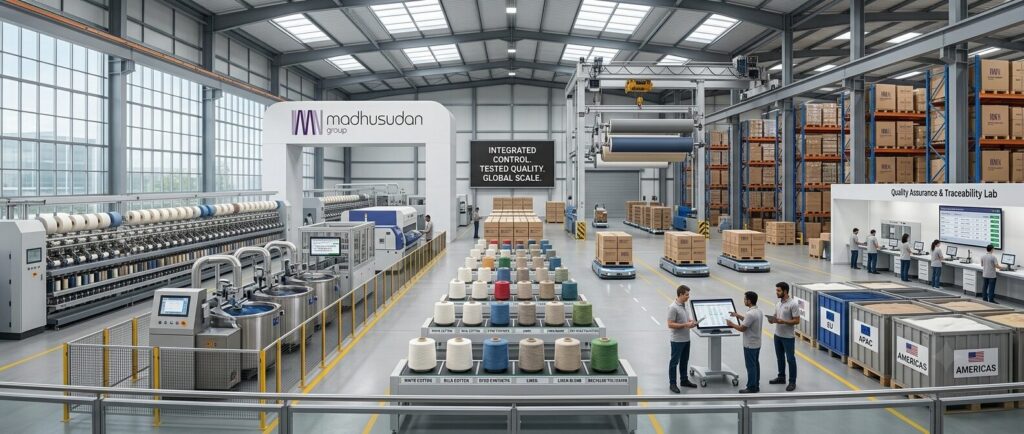
- Integrated manufacturing control from raw material sourcing to spinning, dyeing, and finishing, giving buyers full traceability instead of a patchwork supply chain.
- Consistent, tested quality every batch is backed by rigorous quality checks, so the yarn that arrives matches the yarn that was promised.
- A wide, versatile product range including cotton, polyester, viscose, linen, recycled, dyed, and stretch yarns, so growing buyers don’t need to manage multiple vendors as their product line expands.
- Scale to match ambition production capacity built for both steady repeat orders and large bulk commitments, without compromising on lead times.
- A genuine long-term partnership approach technical support, transparent communication, and after-sales accountability that treats every buyer relationship as ongoing, not transactional.
This is why Madhusudan Group has earned its position as one of the most trusted, industry-leading yarn manufacturers that buyers turn to when they’re ready to move past guesswork and build a dependable, long-term sourcing relationship.
Final Thoughts
Buying yarn is a technical decision disguised as a commercial one. The questions above aren’t just a formality they’re the difference between a supplier who understands your production needs and one who simply wants to close a sale. Take the time to ask, document the answers, and request samples before committing to bulk volumes.
If you’re currently evaluating suppliers for your next order, it also helps to understand the broader landscape of premium yarn manufacturers and suppliers in India so you know what a genuinely reliable partner looks like on paper and in practice. As an industry-leading manufacturer, Madhusudan Group welcomes these questions and is ready to answer them for your next order.
Frequently Asked Questions
Q1. What is the most important question to ask before buying yarn?
Confirming the exact specification count, blend ratio, twist, and spinning method is the most critical starting point, since it determines whether the yarn will even work for your application.
Q2. Should I always ask for a sample before buying yarn in bulk?
Yes. A sample lets you test the yarn on your own machines and verify quality claims before committing to a large order.
Q3. How do I know if I’m buying from a manufacturer or a trader?
Ask directly, and request a facility visit or virtual tour. Manufacturers can usually offer better pricing, more customization, and shorter communication chains than traders.
Q4. What certifications should I check for sustainable yarn purchases?
Look for OEKO-TEX, GRS (Global Recycled Standard), and GOTS (Global Organic Textile Standard), depending on whether you’re buying recycled, organic, or conventional yarn.
Q5. How can I avoid delivery delays when buying yarn in bulk?
Ask suppliers for their current production capacity and realistic lead times, and clarify how they handle demand spikes or raw material shortages in advance.