Linen yarn dyeing is the process of colouring flax-based yarn before weaving or knitting, using an alkaline dye system most commonly reactive or vat dyes after the yarn has been scoured and bleached to strip out the pectin, lignin and wax that flax naturally carries. For European buyers the process question is inseparable from two commercial ones: can the dye house hold shade across repeat orders, and can it produce the chemistry documentation an EU brand audit will ask for?
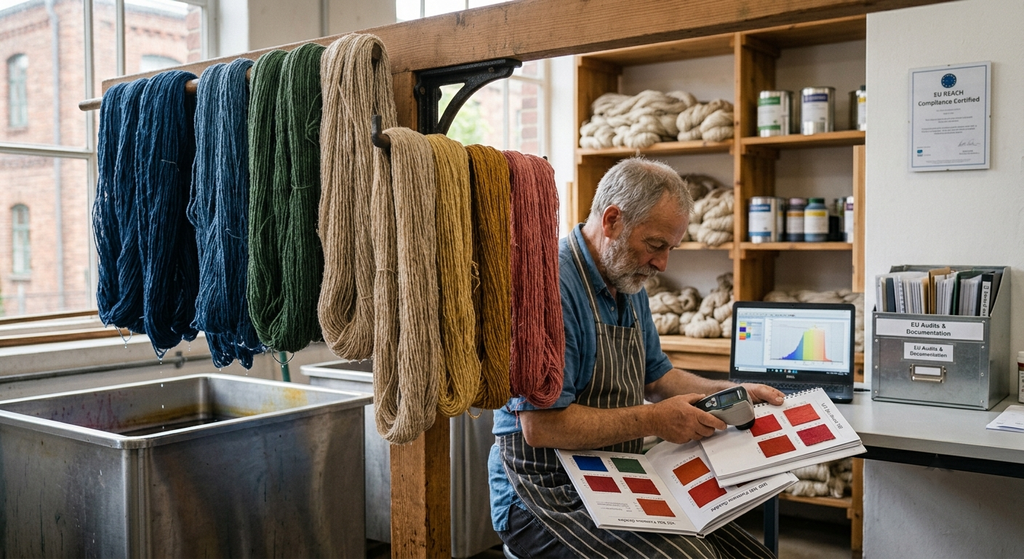
Europe is the world’s most demanding market for dyed linen. It is where flax is grown, where the largest linen weaving and home-textile converters sit, and where regulatory expectations on dyestuff chemistry are strictest. This guide is written for that buyer: what changes when you dye flax instead of cotton, which dye class to specify for which end use, how to choose between package and hank dyeing, the ISO fastness grades your lab will test against, the EU compliance file you should be asking for, and how duty and logistics look when sourcing dyed linen yarn from India.
Why European buyers specify linen differently
Three things distinguish a European dyed-linen enquiry from a generic one.
The end use is usually home textiles or premium apparel, not commodity fabric. Bedding, table linen, curtains, upholstery and premium shirting dominate European linen consumption. These are long-life products, washed repeatedly, where colour degradation over years rather than weeks is the failure mode. That pushes the fastness specification higher than an apparel-only brief would.

Fibre origin is part of the conversation. European flax is grown along the coastal belt running from Normandy through Belgium into the Netherlands, and European buyers frequently want to know whether the flax in their yarn came from there. Certification run by the European Flax and Linen alliance exists precisely to answer that question. This is a greige sourcing matter rather than a dyeing one, but it arrives in the same email as the dyeing enquiry, so have the answer ready.
The chemistry file is non-negotiable. EU brands audit supply chain chemistry, not just finished goods. A supplier who can send an OEKO-TEX certificate but cannot describe restricted-substance management inside the dye house is increasingly filtered out at vendor-approval stage.
Where the fabric is made matters too. Europe’s linen weaving capacity is concentrated in Lithuania and Belgium for classic linen, Portugal and Italy for apparel-weight and premium home textiles, and Poland and Germany for technical and contract applications. Lead-time expectations, shade-approval habits and packing preferences differ noticeably between them, which is why a generic export process usually needs adapting per customer.
Why linen dyes differently from cotton
Both linen and cotton are cellulosic, so on paper they take the same dye classes. In the dye house they behave nothing alike, and the differences explain most of the off-shade linen that lands in European warehouses.
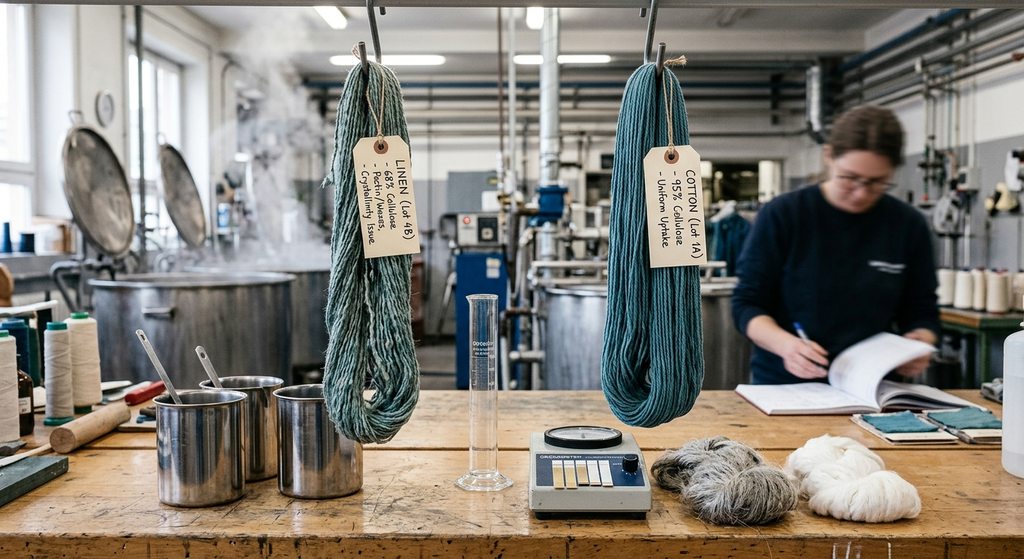
Flax is not pure cellulose. Cotton fibre is roughly 90–95% cellulose. Flax, before processing, is closer to 65–75%, with the balance made up of pectin, hemicellulose, lignin and waxes binding the ultimate fibres into bundles. Those components are hydrophobic and dye-resistant. If pre-treatment doesn’t remove them consistently, dye cannot reach the cellulose evenly and you get shade variation that no amount of extra dye will fix.
Flax has higher crystallinity. Its cellulose is more highly ordered and tightly packed than cotton’s, so dye diffuses more slowly. That raises dyeing time and temperature and makes the process sensitive to how fast temperature is raised. Rush the ramp and dye strikes the fibre surface instead of penetrating it which appears later as poor rubbing fastness on the buyer’s crockmeter.
Flax has very low elongation. Linen yarn stretches roughly 1.5–3% before breaking, against 7–10% for cotton, with almost no elastic recovery. This is mechanical rather than chemical, and it drives the entire package-dyeing decision below.
Natural lot variation is larger. Flax colour, fineness and pectin content vary with growing region, retting method dew-retted flax is greyer and more variable than water-retted and crop year. Two greige lots at the same count can absorb an identical recipe differently. Serious linen dye houses treat greige lot segregation as a hard rule, not a preference.
Our yarn manufacturing process guide covers the stages before dyeing.
The linen yarn dyeing process, stage by stage
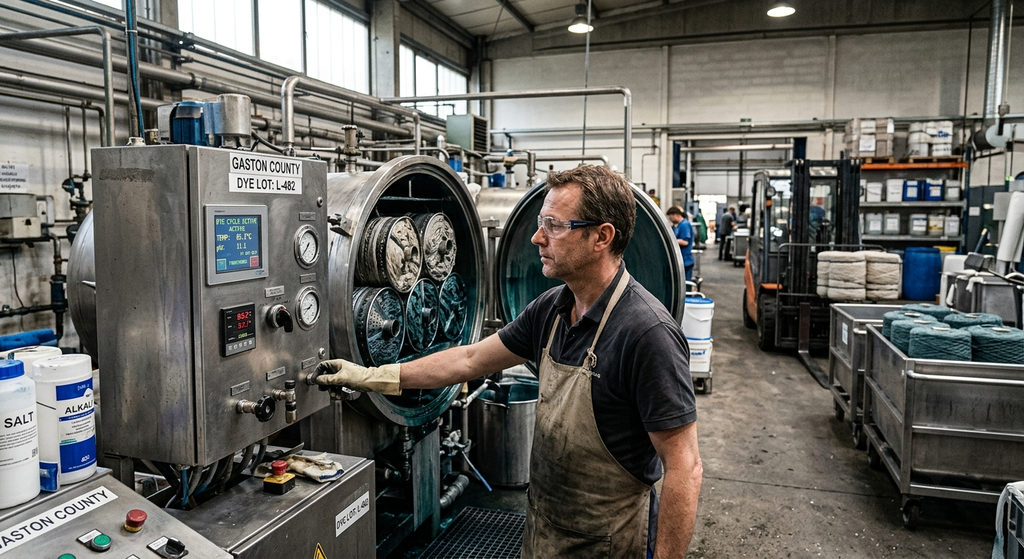
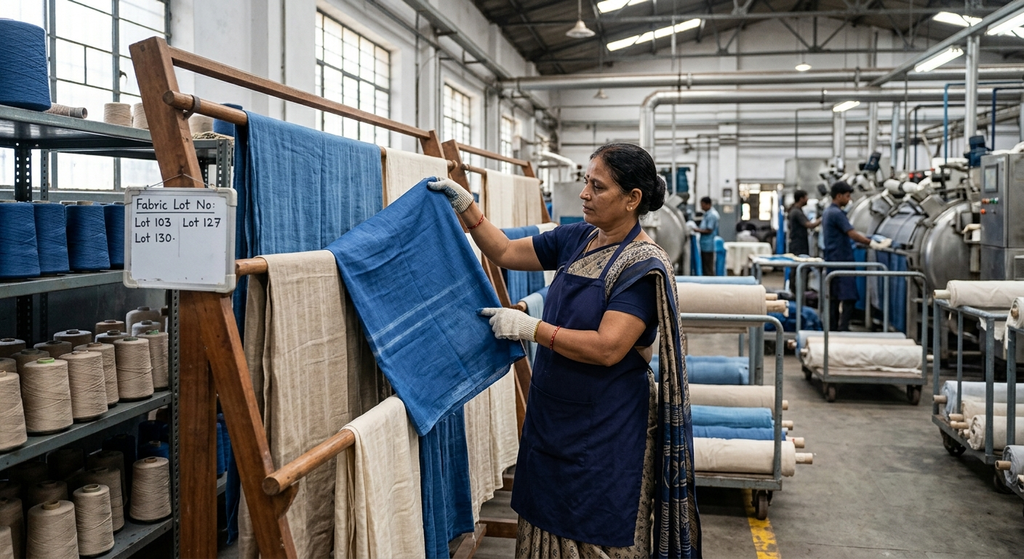
1. Greige inspection and lot segregation. Count, twist, moisture and greige shade checked on arrival, then grouped into dye lots by greige batch. Mixing two spinning lots into one dye lot is the commonest root cause of barré in finished cloth.
2. Winding or reeling. For package dyeing, yarn is soft-wound onto perforated stainless or spring tubes at controlled low density. For hank dyeing, it is reeled into skeins.
3. Desizing and scouring. An alkaline scour with caustic or soda ash plus wetting and sequestering agents removes pectin, waxes and oils. Sequestrants matter more on linen than on most fibres: flax carries calcium, magnesium and iron from the field and from retting water, and those ions catalyse shade shifts and peroxide damage.
4. Bleaching. Hydrogen peroxide bleaching lifts the natural buff-grey of flax toward a neutral base. Half bleach suits medium and dark shades and preserves fibre strength; full bleach is required for pastels and whites; optical white adds an optical brightening agent. Many European specifications are explicitly “no OBA” confirm before running, because it cannot be undone.
5. Dyeing. Dye bath built to the chosen class, with controlled salt and alkali dosing, a controlled temperature ramp, and periodic reversal of liquor flow between in-to-out and out-to-in.
6. After-treatment. Near-boil soaping removes unfixed hydrolysed dye non-negotiable on reactive dyeings and the leading cause of fastness failures when shortened. Direct dyeings receive a cationic fixing agent.
7. Drying, conditioning, rewinding. Dried to a target moisture regain, then rewound to the cone specification the European weaving or knitting plant requires. Confirm cone taper, tube colour and traverse with the mill in advance European weavers are specific about this, and a mismatch means rewinding on arrival at someone’s cost.
8. Quality control and release. Shade assessment, fastness testing, count and strength verification, packing with full lot traceability.
Choosing the dye class
| Dye class | Wash fastness | Light fastness | Cost | Where it fits in European programmes |
| Reactive (bifunctional) | Excellent | Good–very good | Medium | Default for apparel, bedding and table linen; full bright shade gamut |
| Direct | Moderate (needs cationic fixing) | Moderate | Low | Cost-led lines only; rarely accepted by EU home-textile brands |
| Vat | Excellent | Excellent | High | Curtains, upholstery, contract interiors where EU light-fastness specs bite |
| Sulphur | Good | Good on darks | Low | Bulk blacks, navies, olives |
| Natural / plant-based | Variable | Usually poor | High | Marketing-led niche ranges; test before committing, and check green-claims exposure |
Bifunctional reactive dyes are the right answer for most European linen programmes. They deliver the brightness the market expects, reach acceptable fastness on darks with correct soaping, and sit comfortably inside the OEKO-TEX and ZDHC frameworks EU buyers work within.
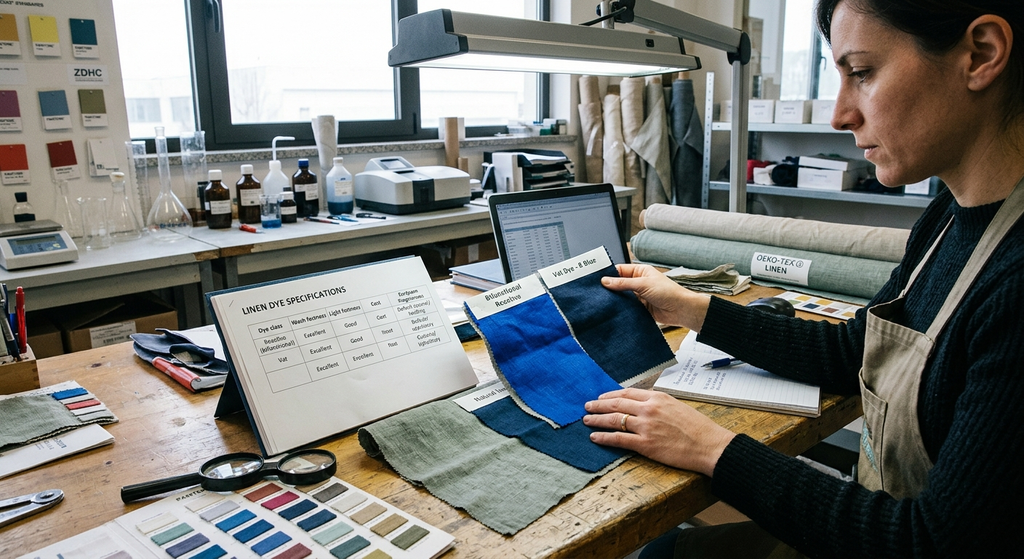
Specify vat dyes when the end use is curtains, upholstery or contract interiors. Light fastness is where reactive dyeings on cellulose typically lose points, and European contract-textile specifications routinely demand grades reactive cannot reliably reach.
A practical note on palette: linen’s natural undertone makes clean pastels, true whites and bright turquoise materially harder and more expensive, all requiring full bleach and tight control. Naturals, earth tones, indigos and deep darks are kinder to flax which happens to align well with the European linen aesthetic.
Package dyeing vs hank dyeing vs space dyeing
| Package dyeing | Hank dyeing | Space dyeing | |
| Form | Soft-wound cones on perforated tubes | Loose reeled skeins | Cone or hank, multi-colour along length |
| Yarn handling | Low but real tension | Almost zero tension | Varies |
| Resulting hand | Firmer, smoother | Softest, loftiest | N/A |
| Shade levelness | Very good with correct winding | Good | Deliberately irregular |
| Cost per kg | Lower | Higher (labour-intensive) | Highest |
| Lead time | Shorter | Longer | Longest |
| Best for | Weaving warps, volume home-textile programmes | Hand-feel-critical apparel, knitting yarn, premium bedding | Décor, craft and novelty yarn |
Package dyeing linen is an engineering problem before a chemistry one. Because flax has so little elongation, it cannot absorb winding tension by stretching. Three controls matter:
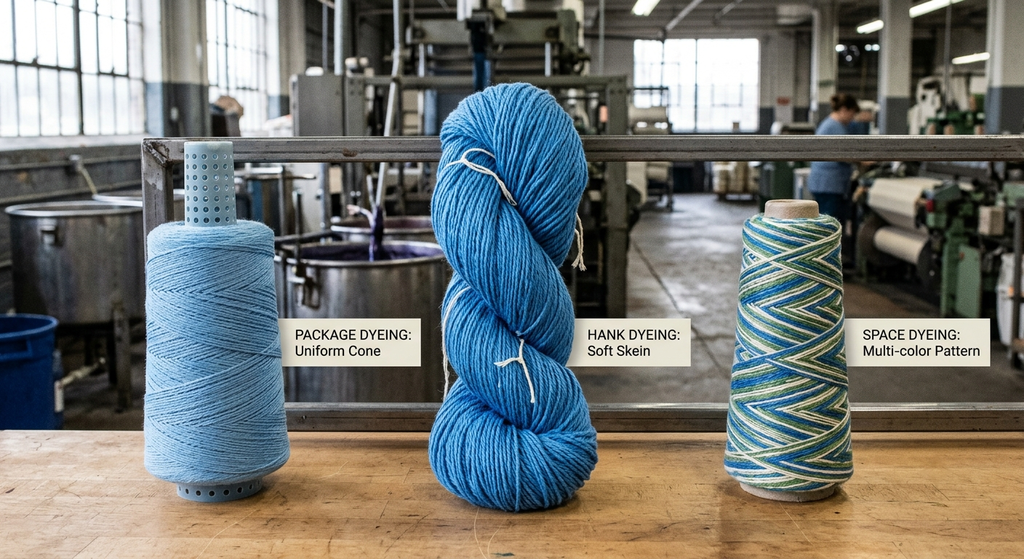
- Winding density target a soft package, typically around 0.30–0.38 g/cm³ for linen, softer than cotton. Too hard and liquor channels around dense zones, giving a package dark outside and pale at the core.
- Package uniformity density must be even from the tube outward. Hard rings produce ring-shaped shade bands (moiré), unrecoverable without stripping and re-dyeing.
- Liquor flow reversal direction alternated on a timed cycle so inner and outer layers see comparable exposure. Shorter reversal intervals than cotton are safer on linen.
For European bedding and premium shirting programmes where hand-feel is the selling point, hank dyeing earns its cost premium. For wide-width weaving and repeating home-textile orders where shade consistency across lots is the binding tolerance, package dyeing wins.
Quality control: what “consistent shade” means to an EU buyer
“Matches the standard” is not a specification. A workable European linen dyeing spec includes all of the following.
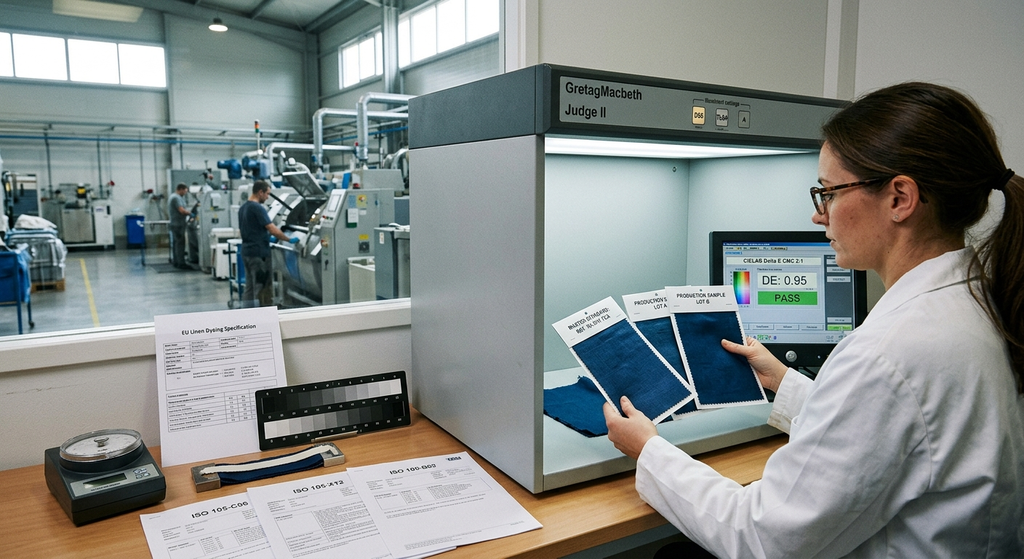
Numerical shade tolerance. Delta E (CIELAB, usually DE CMC 2:1) against the approved standard, with an agreed maximum 1.0 for critical programmes, 1.5 for general commercial work. Agree the illuminant set: D65 daylight, TL84 store light and incandescent A, so metamerism is caught in the lab rather than in a Paris or Milan showroom.
Lot-to-lot tolerance, not just lot-to-standard. A dye house can hit the standard every time and still deliver two lots that don’t match each other. For continuous home-textile runs, specify this separately.
Within-package and package-to-package tolerance. Ask for inside/outside package checks on linen specifically it is the defect this fibre is prone to.
Fastness testing to ISO 105 methods. The ISO 105 series is the reference set European labs cite:
| Property | ISO method | Apparel target | Home textile / contract target |
| Washing | ISO 105-C06 | 4 and above | 4 and above |
| Rubbing, dry | ISO 105-X12 | 4 and above | 4 and above |
| Rubbing, wet | ISO 105-X12 | 3 and above | 3–4 and above |
| Light | ISO 105-B02 | 4 and above | 5–6 (often requires vat dyes) |
| Perspiration | ISO 105-E04 | 4 and above | 4 and above |
| Water | ISO 105-E01 | 4 and above | 4 and above |
| Dimensional stability | ISO 6330 + ISO 3759 | Per buyer spec | Per buyer spec |
Be realistic about wet rubbing on deep shades. A supplier promising 4–5 wet crocking on jet black linen is either over-promising or planning to load the yarn with fixing agents that will affect hand and may trip a restricted-substance screen.
Physical verification. Count (Nm or Ne), twist, single-end strength and elongation after dyeing. Dyeing is a hot, wet, alkaline process and it costs the yarn strength. Agree acceptable loss before production, not after a warp breaks on a Lithuanian loom.
The EU compliance file
This is where European sourcing diverges most sharply from other markets. Expect to be asked for all of the following.
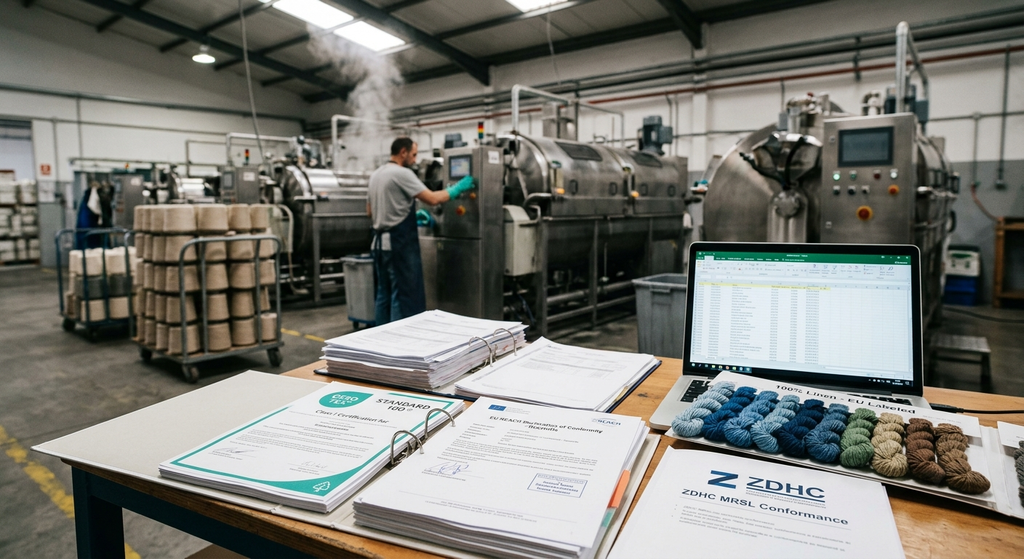
OEKO-TEX STANDARD 100. Article-level certification covering tested harmful substances, issued per product class. For dyed yarn destined for EU apparel and home textiles this is now a baseline expectation rather than a differentiator. Details from OEKO-TEX.
EU REACH. Restrictions on substances of very high concern, plus the long-standing restrictions on azo dyestuffs capable of releasing listed aromatic amines. Your dye house should provide a signed declaration and, on request, third-party test reports. REACH obligations sit legally with the EU importer your buyer which is precisely why they push documentation demands up the chain to you.
ZDHC MRSL conformance. The Manufacturing Restricted Substances List published by ZDHC governs what may be used inside the dye house, not just what remains on the yarn. Brand-led EU supply chains increasingly ask for conformance level and wastewater reporting, not only a finished-goods certificate.
EU textile fibre labelling. Under the EU regulation on textile fibre names and labelling, both “flax” and “linen” are permitted designations, and blend percentages must be declared accurately. Your fibre composition declaration feeds directly into your customer’s consumer-facing label, so an error becomes their legal problem — and then immediately yours.
EU Ecolabel. Where a buyer is pursuing EU Ecolabel for a textile product, the criteria include dyestuff and processing-chemistry restrictions that go beyond REACH. Ask early whether this is in scope, because it constrains recipe choice.
Coming regulation worth tracking. The EU’s textile strategy is moving toward ecodesign requirements and a digital product passport for textiles, extended producer responsibility schemes for textile waste across member states, and stricter scrutiny of environmental marketing claims. None of this changes the dye recipe today, but it changes what data your European customer will ask you to supply alongside the yarn increasingly at batch level. Overview from the European Commission.
Mill-level quality-system certification still carries weight in EU vendor audits our ISO certified yarn supplier page sets out how that fits. Buyers running European technical programmes may also find our elastomultiester yarn guide for Europe useful for compliance patterns that recur across fibre types.
Common linen dyeing defects and their real causes
| Defect | What you see | Usual root cause | Prevention |
| Barré | Streaks or bands in finished fabric | Mixed greige lots in one dye lot | Strict greige lot segregation and traceability |
| Moiré / ringing | Concentric shade rings in the package | Uneven winding density | Calibrated soft winding; density audit before loading |
| Inside/outside variation | Dark outside, pale core | Package wound too hard; poor flow reversal | Lower density; shorter reversal cycles |
| Tailing / ending | Shade drifts start to end of lot | Uncontrolled dosing; poor circulation | Programmed dosing curve; verified pump performance |
| Poor wet rubbing | Colour transfers on damp cloth | Incomplete soaping | Full soaping cycle at temperature |
| Harsh, chalky hand | Board-like, brittle feel | Over-bleaching; excess alkali; over-drying | Right-size the bleach; control drying end-point |
| Catalytic damage | Localised weak or discoloured points | Iron or metal contamination during bleach | Sequestrant dosing; water hardness control |
| Metamerism | Matches in daylight, fails under store light | Recipe built on one illuminant | Multi-illuminant approval from the outset |
Dyeing linen blends
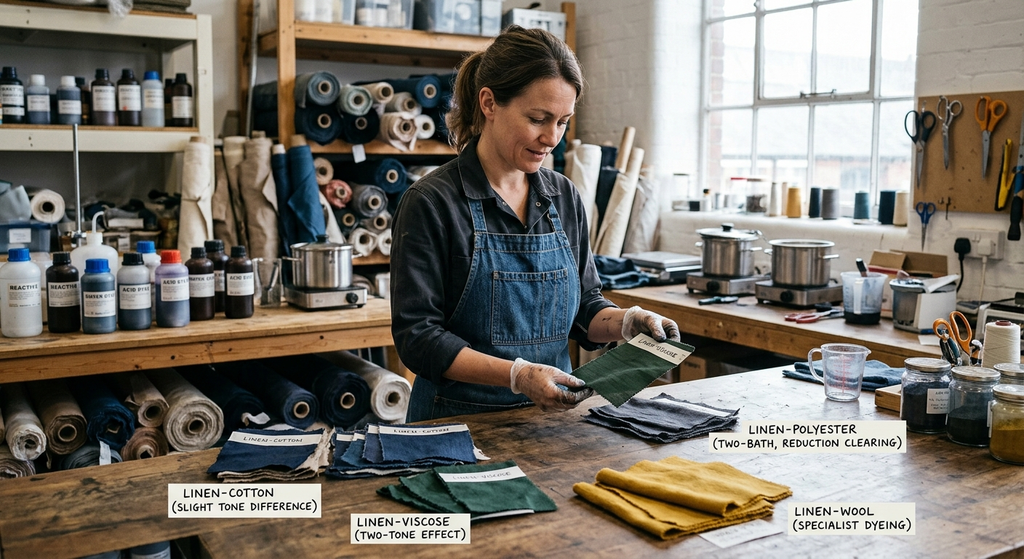
Linen–cotton. Both cellulosic, single reactive bath but flax and cotton absorb at different rates, so the resulting slight tone difference is either a defect or a feature depending on what you told the buyer. For a solid shade, the recipe must be built and approved on the actual blend ratio.
Linen–viscose. Single-bath cellulosic dyeing, but viscose picks up reactive dye faster and deeper than flax, so the blend dyes two-tone unless corrected. Viscose also loses substantial strength when wet, which caps the mechanical handling the bath can use.
Linen–polyester. Requires two dye classes: disperse at high temperature for the polyester, reactive or vat for the flax. Two-bath gives cleaner results at longer cycle and higher cost. Reduction clearing after the disperse stage is essential skip it and loose disperse dye stains the linen and destroys wet fastness.
Linen–wool. Acid dye for the wool, reactive for the linen, with careful pH management since wool is damaged by the alkali cellulosic dyeing needs. Specialist work, and should be quoted as such.
Sourcing from India into Europe: the commercial picture
Duty position. Dyed linen yarn entering the EU currently attracts the applicable MFN tariff for its specific commodity code, which for yarns sits well below the rates applied to made-up textiles and apparel. The EU–India Free Trade Agreement, politically concluded in January 2026, is expected to eliminate tariffs on Indian textile lines once it enters into force; as of September 2026 the Commission has sent it to the Council for signature authorisation, and European Parliament consent plus ratification on both sides are still required, so it is not yet in force. Confirm your exact commodity code and the duty applicable on your shipment date with your customs broker rather than relying on any general statement.
Routing and transit. Shipments move from Nhava Sheva or Mundra to the main European gateways Rotterdam, Antwerp, Hamburg, Genoa, Barcelona, Leixões with typical port-to-port transit in the region of three to four weeks depending on service and transhipment, plus inland movement. Build shade-approval time in front of that, not into it.
Incoterms. European buyers commonly work on FOB or CIF; larger converters increasingly ask for DAP to their mill. Agree the term before quoting it changes the price materially and determines who carries customs clearance responsibility.
Documentation. Commercial invoice, packing list, bill of lading, certificate of origin, fibre composition declaration, OEKO-TEX certificate and test reports. Your EU buyer needs an EORI number; you need to supply origin documentation that survives their customs audit.
Cost drivers on the dyeing itself, in rough order of impact: shade depth (jet blacks and deep navies dwarf pastels in dye consumption), dye class (vat costs considerably more than reactive), method (hank over package), bleach level, lot size, and testing scope.
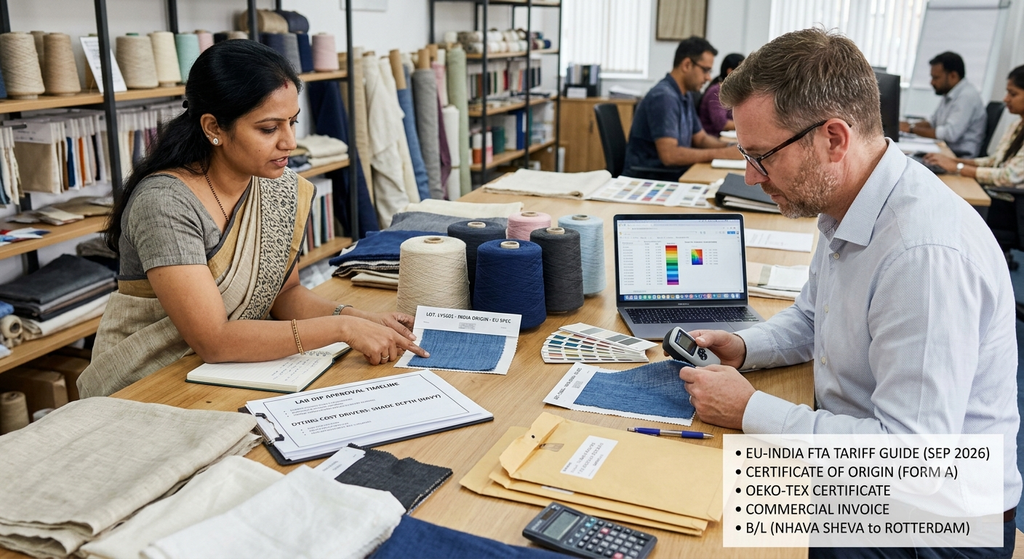
Lead time. The variable that most often breaks a European delivery schedule is the lab dip approval loop each round trip of physical samples to Europe can add a week. Spectrophotometric colour communication with an agreed Delta E tolerance compresses this substantially, and is worth establishing before the first order rather than during it.
Re-dye policy. Ask explicitly what happens commercially if a lot fails shade tolerance. A serious dye house has a defined re-dye and stripping policy; an evasive answer is informative.
Our questions to ask before buying yarn checklist is a useful screening tool, and our textile yarn exporters India page covers the export process in more depth.
Dyed linen yarn for Europe from Madhusudan Group
Madhusudan Group operates an in-house yarn dyeing plant with approximately 500 tonnes per month of capacity at our facility in Surat, Gujarat. Colour is not subcontracted to third-party job-work units, which means the process controls described throughout this guide sit under one quality system, with one point of accountability for shade.
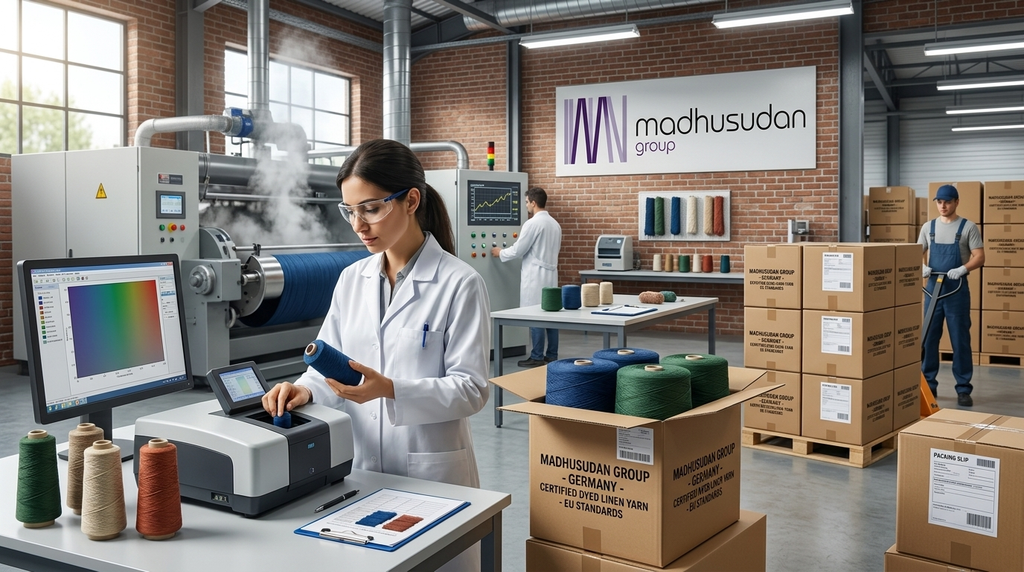
For a European buyer that translates into:
- Single-source responsibility across yarn and colour see our linen yarn manufacturer and dyed yarn manufacturer capability pages.
- Established European export programmes, including Germany, within an export footprint spanning 18+ countries so EU documentation, packing standards and Incoterms handling are routine rather than improvised.
- Lab dip and shade approval support, including spectrophotometric colour communication to compress the approval loop across time zones.
- Testing and certification support aligned to ISO 105 methods and the restricted-substance frameworks EU brands audit against.
Background on the manufacturing base is on our linen yarn manufacturers in India page.
Frequently asked questions
Is linen harder to dye than cotton? Yes, meaningfully. Flax carries pectin, lignin and waxes that must be removed before dye reaches the cellulose evenly, its higher crystallinity slows dye diffusion, and its very low elongation means it tolerates far less mechanical tension during winding and handling. The chemistry resembles cotton; the process control required is stricter.
Which certifications do European buyers require for dyed linen yarn? Most commonly OEKO-TEX STANDARD 100 at article level, a REACH declaration covering restricted azo dyestuffs and SVHCs, and increasingly ZDHC MRSL conformance for the dye house itself. Buyers pursuing EU Ecolabel face additional dyestuff restrictions. Accurate fibre composition declarations are also required, because they feed your customer’s EU label.
What colour fastness should I specify for European home textiles? For bedding and table linen: 4 and above for washing, dry rubbing, perspiration and water, with 3–4 for wet rubbing on deep shades. For curtains, upholstery and contract interiors, light fastness of 5–6 is normal which usually means specifying vat dyes rather than reactive.
Package dyeing or hank dyeing for linen yarn? Hank dyeing where softness and loft are the selling point and volumes are moderate, such as premium bedding and knitting yarn. Package dyeing where you need tight shade consistency across a large or repeating order at a lower cost per kilogram. Package dyeing linen requires deliberately soft, uniform winding; that is the critical control point.
What duty applies on dyed linen yarn imported from India into the EU? The applicable MFN rate for the specific commodity code, which for yarns is well below the rates charged on apparel. The EU–India FTA concluded in January 2026 is expected to remove tariffs on Indian textile lines once in force, but as of September 2026 it is still moving through signature and ratification. Confirm the rate for your commodity code and shipment date with your customs broker.
What is the minimum order quantity and lead time for a European order? MOQ is set per shade and determined by dyeing method and machine configuration rather than total order size hank dyeing allows smaller per-shade quantities at a higher cost per kilogram. Lead time is the sum of lab dip approval, bulk dyeing and testing, plus roughly three to four weeks of ocean transit to a European gateway port. The approval loop is usually the longest and most compressible element.
Request a linen yarn dyeing quotation
Send us your yarn count, target shades or Pantone references, required ISO fastness grades, end use, certification scope and annual volume per shade. We’ll return a technical proposal, lab dip plan and pricing against your specification, quoted on your preferred Incoterm to your European port.
Contact Madhusudan Group or message our export team on WhatsApp for a same-day response.