Europe’s textile and apparel industry has spent the last decade quietly rethinking what “stretch” means. For fifty years, elastane (spandex/Lycra) was the default answer to every stretch requirement from denim to activewear to hosiery. But elastane comes with a well-documented list of problems: it degrades under chlorine and UV exposure, it is difficult to recycle because it cannot be separated from other fibres, and it loses recovery after repeated wash cycles. As European mills, brands, and sourcing managers search for a fibre that stretches like elastane but behaves like polyester, one name keeps surfacing in technical textile circles: Elastomultiester.

This guide explains exactly what Elastomultiester is, how it is made, how it compares to elastane and other bicomponent fibres, why European manufacturers are increasingly specifying it, and how to source it reliably from an established Indian yarn manufacturer. Whether you are a sourcing manager in Portugal, a denim mill in Turkey supplying EU brands, a hosiery producer in Italy, or a technical-textile buyer in Germany, this article is written to answer every practical question you have about Elastomultiester yarn.
Key takeaways:
- Elastomultiester is a 100%-polyester bicomponent yarn that stretches through a physically engineered helical crimp, not through added elastane, spandex, or Lycra.
- It offers stronger chlorine, UV, and heat resistance than elastane, and — because it is mono-material polyester it recycles far more easily than elastane-blended fabrics.
- EU recyclability regulation and brand-level mono-material commitments are the strongest near-term demand drivers for Elastomultiester across European denim, activewear, and hosiery categories.
- Not all “bicomponent stretch yarn” is equivalent; buyers should confirm exact polymer composition, crimp stability, and lab-tested recovery data before ordering at volume.
- Mestre, produced by Madhusudan Group, is a specialised Indian Elastomultiester manufacturer supplying European buyers directly.
What Is Elastomultiester?
Elastomultiester is a generic fibre name recognised under EU textile labelling regulation (Regulation (EU) No 1007/2011) for a specific class of bicomponent polyester yarn that delivers elastic, stretch-and-recovery performance without using any spandex or elastane at all. Instead of blending an elastic fibre with a rigid one, Elastomultiester is produced by extruding two different polyester polymers typically a combination of PET (polyethylene terephthalate) and PBT (polybutylene terephthalate) side by side within a single continuous filament.
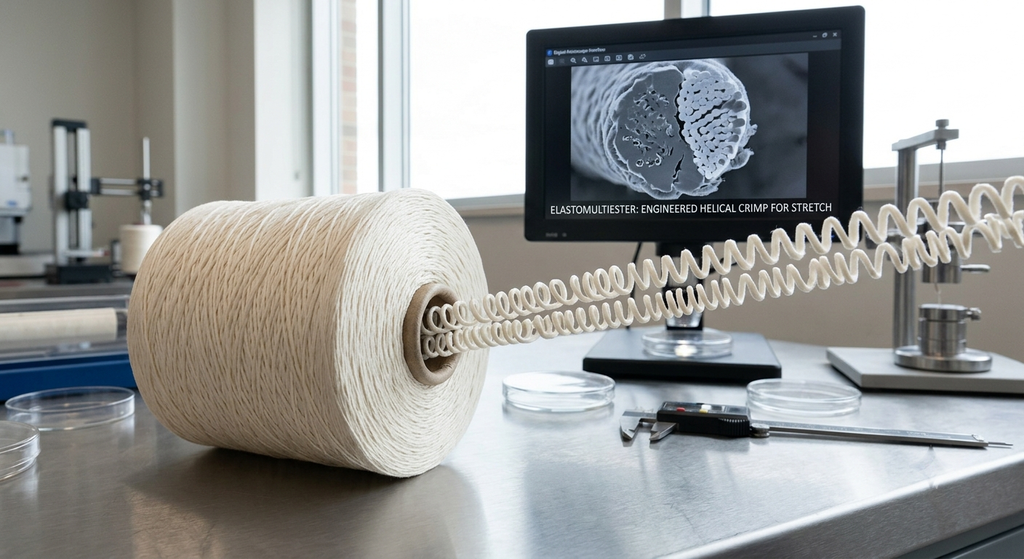
Because the two polymers have different shrinkage and crystallisation behaviours, the filament naturally forms a three-dimensional helical crimp after heat setting, similar to a coiled spring. That spring-like structure is what gives the yarn its stretch and recovery not a rubber-like elastomer, but pure mechanical engineering at the fibre level. This is why Elastomultiester is often referred to in the industry as a mechanical stretch yarn, in contrast to the chemical stretch delivered by elastane.
If you want a deeper technical breakdown of the fibre classification itself, this explainer on what Elastomultiester actually is from Mestre’s resource library covers the polymer chemistry and crimp mechanism in more depth: What Is Elastomultiester?
Elastomultiester vs “Elastane” — Same Job, Different Chemistry
It’s worth being precise here because the two terms are frequently confused by buyers new to the category:
- Elastane (also sold as spandex or Lycra) is a polyurethane-based elastomer. It stretches because its polymer chains are chemically elastic, like rubber.
- Elastomultiester is 100% polyester. It stretches because of its physical bicomponent structure, not because the polymer itself is elastic.
That single distinction explains almost every practical advantage Elastomultiester has over elastane in European end-use categories chlorine resistance, recyclability, heat tolerance, and long-term recovery.
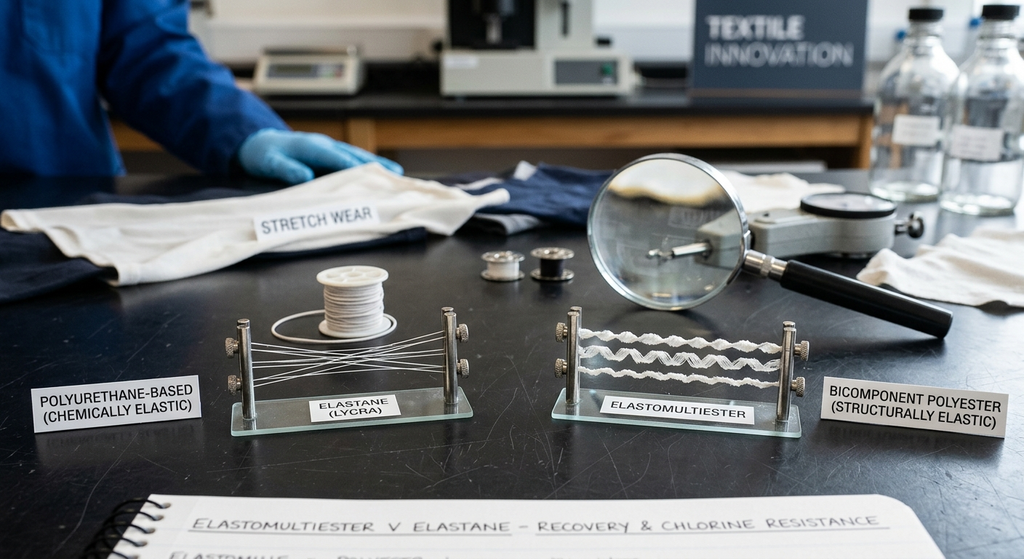
It’s also worth noting what Elastomultiester is not. It is not a blend in the conventional sense, where two separate yarns (say, a polyester yarn and an elastane core) are twisted or covered together. In Elastomultiester, both polymer components exist within the same continuous filament, extruded together at the spinneret. This single-filament construction is precisely why the fibre behaves as a true mono-material polyester for recycling purposes, even though it delivers elasticity typically associated with multi-material stretch fabrics.
The name itself reflects this structure: “elasto-” signals the elastic, stretch-and-recovery performance, while “-multiester” refers to the multiple polyester-family polymers (typically two distinct polyester types) combined within a single fibre. Once buyers understand this naming logic, the fibre classification becomes much easier to distinguish from similarly-named categories like elastane, elastodiene, or elastolefin, which are entirely different fibre families under the same EU labelling regulation.
How Elastomultiester Yarn Is Manufactured
Elastomultiester yarn is produced through a bicomponent (also called “conjugate” or “side-by-side”) melt spinning process. Two polyester polymer melts most commonly a high-viscosity PET and a lower-viscosity PBT, or two PET variants with different intrinsic viscosities are fed through the same spinneret in a side-by-side or eccentric sheath-core configuration. As the filament cools and is drawn, the differential shrinkage between the two polymer sides causes the fibre to self-crimp into a continuous helix once it passes through a heat-setting stage.
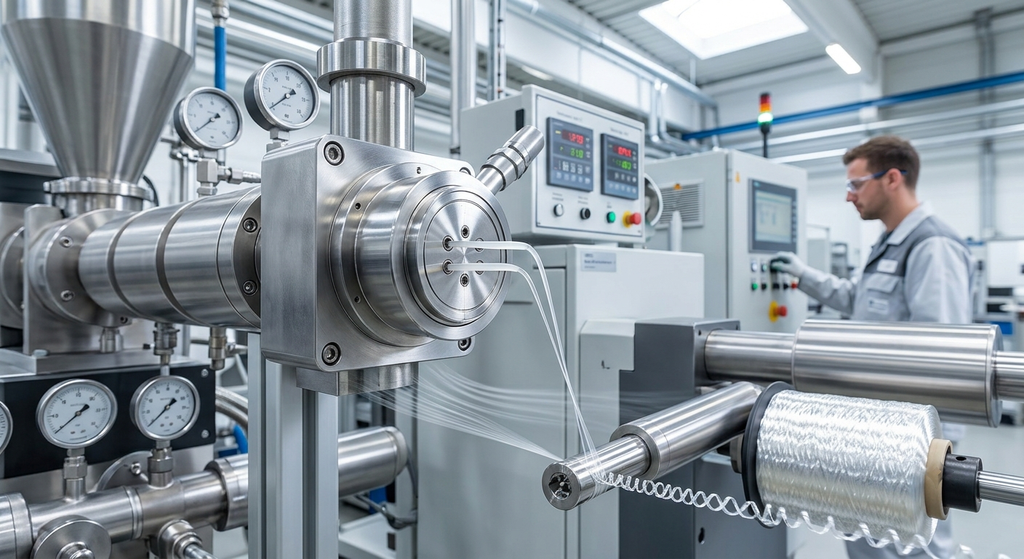
This is fundamentally different from how conventional textured polyester (like standard DTY) is made, and it’s also different from how elastane filaments are produced. The manufacturing precision required controlling polymer ratio, spinneret geometry, draw ratio, and heat-setting temperature is the reason relatively few mills globally produce true Elastomultiester at commercial scale and consistent quality. For manufacturers evaluating suppliers, understanding this process is essential to assessing yarn quality; you can review a full walkthrough of the yarn manufacturing process used across polyester and bicomponent yarn categories.
Because the elasticity is built into the filament’s physical geometry rather than added through a separate elastomeric fibre, Elastomultiester yarn can be produced, dyed, and finished using standard polyester-compatible equipment a major cost and compatibility advantage for mills that don’t want to invest in separate elastane-handling machinery. Mills already running dyed polyester yarn lines can typically integrate Elastomultiester with minimal retooling.
For a broader look at how bicomponent structures are engineered generally not limited to Elastomultiester see this complete guide to bicomponent yarn and this explanation of bicomponent fibre types and structures.
Elastomultiester vs Elastane, Spandex, and Lycra
This is the comparison every European buyer eventually needs to make, so let’s go through it property by property.
Stretch mechanism. Elastane stretches chemically; Elastomultiester stretches mechanically through its coiled bicomponent structure. Both deliver comfortable, body-conforming stretch, but the underlying physics are entirely different and that difference cascades into every other property below.
Chlorine and chemical resistance. Elastane is notoriously vulnerable to chlorine, which breaks down its polyurethane chains over time a major issue for swimwear, activewear laundered with bleach-based detergents, and industrial workwear exposed to sanitising chemicals. Elastomultiester, being 100% polyester, is highly resistant to chlorine degradation and retains its stretch and recovery far longer under repeated exposure. A detailed breakdown of this specific property is available at Is Elastomultiester Safe? Breathability & Microplastics.
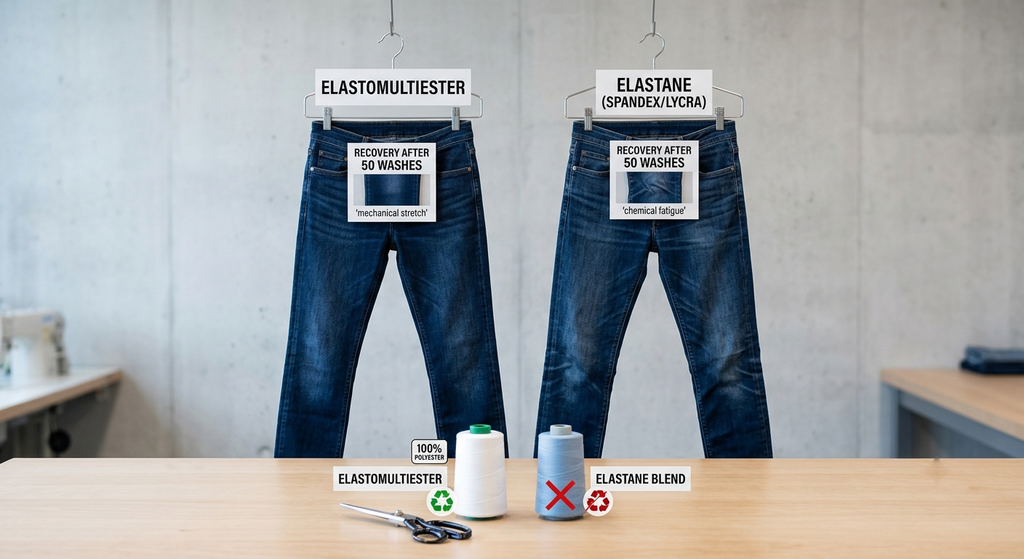
Recyclability. This is arguably the single biggest reason European brands are moving toward Elastomultiester. EU textile policy including the Extended Producer Responsibility (EPR) framework and the broader EU Strategy for Sustainable and Circular Textiles is pushing brands toward mono-material or easily separable fabric construction. A garment blended with elastane is very difficult to mechanically or chemically recycle because the elastane must be separated from the base fibre. A garment made with Elastomultiester, however, is 100% polyester and can go directly into standard polyester recycling streams without fibre-separation processing.
Heat and ironing tolerance. Elastane degrades and can even melt or yellow under high heat, restricting finishing, dyeing, and pressing temperatures. Elastomultiester tolerates standard polyester processing temperatures, giving mills more flexibility in finishing.
Recovery over garment lifetime. Elastane’s recovery weakens noticeably after repeated wash-and-wear cycles, which is why stretch jeans and leggings eventually “bag out.” Because Elastomultiester’s stretch comes from a physically engineered crimp rather than a chemically elastic polymer that fatigues, recovery tends to hold up for a longer functional lifetime.
For a side-by-side technical comparison, see Elastane vs Polyester Fabric: Comparison Guide and What Is Elastane, Spandex, Lycra? Stretch Fabric Guide. If your team wants a comprehensive twenty-question walkthrough covering every practical objection buyers raise, this resource answers them directly: Elastomultiester: Complete Guide – 20 Questions Answered.
Elastomultiester vs Other Bicomponent Yarns (Sorona, Elasterell-P, T-400/T-800)
Elastomultiester is one member of a broader bicomponent stretch-yarn family, and European buyers researching the category often encounter competing or overlapping brand names. Here’s how they relate:
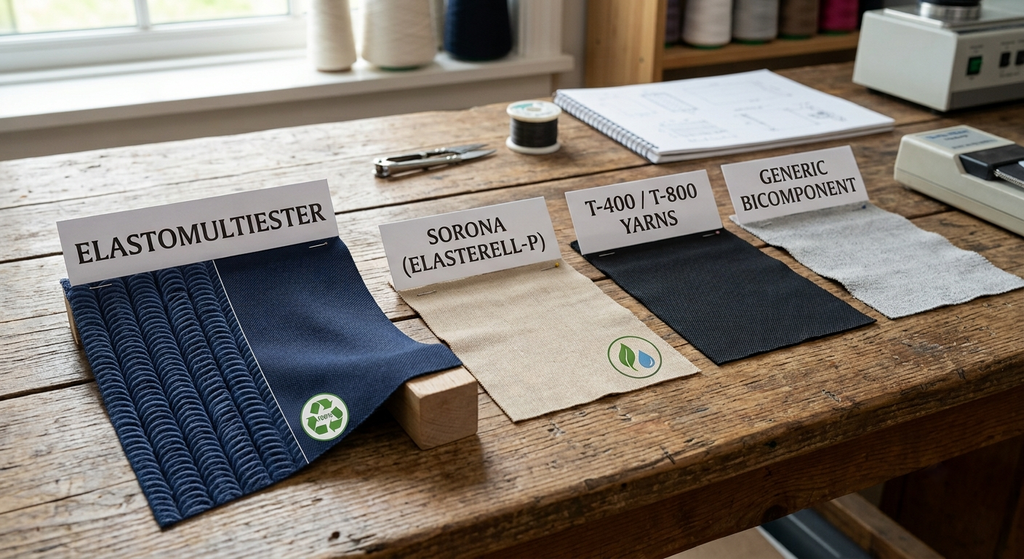
Sorona / Elasterell-P. DuPont’s Sorona and Elasterell-P fibres use a similar bicomponent side-by-side principle but are based partly on PTT (polytrimethylene terephthalate), a bio-derived polymer, rather than the PET/PBT combination typical of Elastomultiester. Sorona is often marketed on its renewable-content story, while Elastomultiester is generally positioned on mechanical performance, cost efficiency, and 100%-polyester recyclability. A direct technical comparison is available here: Elasterell-P / Sorona vs Elastomultiester Explained, and background on the fibre itself here: Sorona Fiber Explained.
T-400 / T-800 style bicomponent yarns. These are trade names used in the industry for related bicomponent constructions offering mechanical stretch. If your technical specification references T-400 or T-800 style performance, it’s worth reviewing this comparison: Mestre vs Lycra, T800, T400 Stretch Yarn.
Generic bicomponent yarn. Not every bicomponent yarn is designed for stretch some are engineered for bonding in nonwovens, self-crimping bulk, or fibre-to-fibre adhesion in technical textiles. For that broader category, see Bicomponent Yarn: Fiber Uses in India.
The practical takeaway for a European sourcing team: when your spec calls for polyester-based mechanical stretch with no elastane content, Elastomultiester is the fibre category to search for and understanding these adjacent names helps you evaluate competing supplier claims accurately.
Key Properties and Performance Benefits
Beyond the elastane comparison, here is the full property profile European mills and brands typically evaluate:
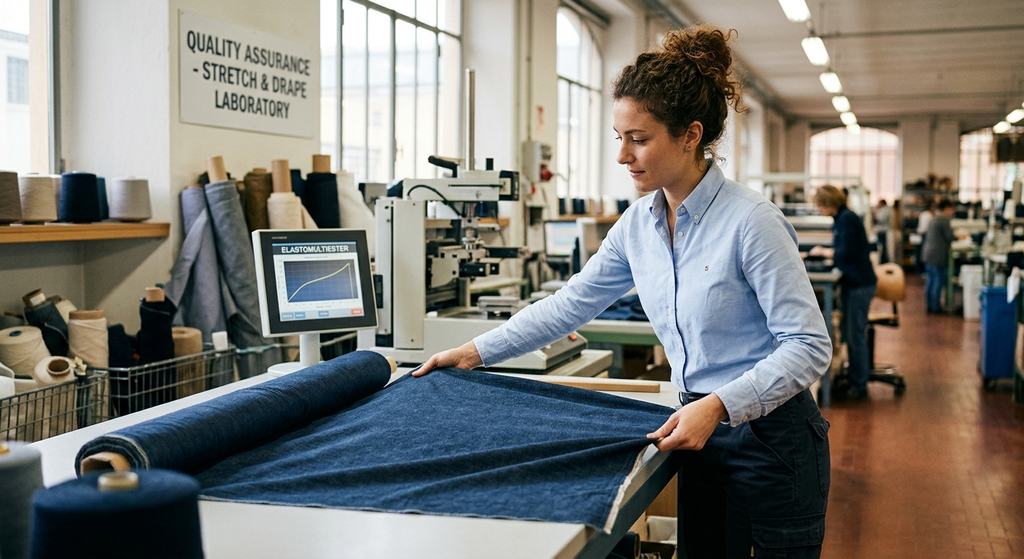
- Stretch and recovery. Depending on yarn construction, Elastomultiester typically delivers substantial elongation with strong recovery, comparable in wearer-perceived comfort to low-to-moderate elastane content, without any elastane in the fabric.
- Softness and drape. The helical crimp gives fabrics a soft, slightly textured hand-feel with good drape often compared favourably to elastane-blended fabrics for next-to-skin comfort.
- Breathability. Because the crimped structure creates natural air pockets within the yarn, Elastomultiester fabrics tend to offer good breathability relative to their stretch performance a property covered in detail at Is Elastomultiester Safe? Breathability & Microplastics.
- Dye affinity. As a polyester-based yarn, Elastomultiester dyes consistently with standard disperse dye processes used for polyester, without the dye-uptake mismatches that occur when dyeing elastane/polyester blends.
- Durability. Resistance to chlorine, UV, and repeated laundering makes Elastomultiester fabrics well suited to garments with long expected lifespans activewear, workwear, and everyday denim among them.
- Mechanical stretch classification. Because this stretch is structural rather than chemical, it falls under what the industry calls mechanical stretch a category explained in full at Mechanical Stretch: Everything You Need to Know.
Applications of Elastomultiester Yarn
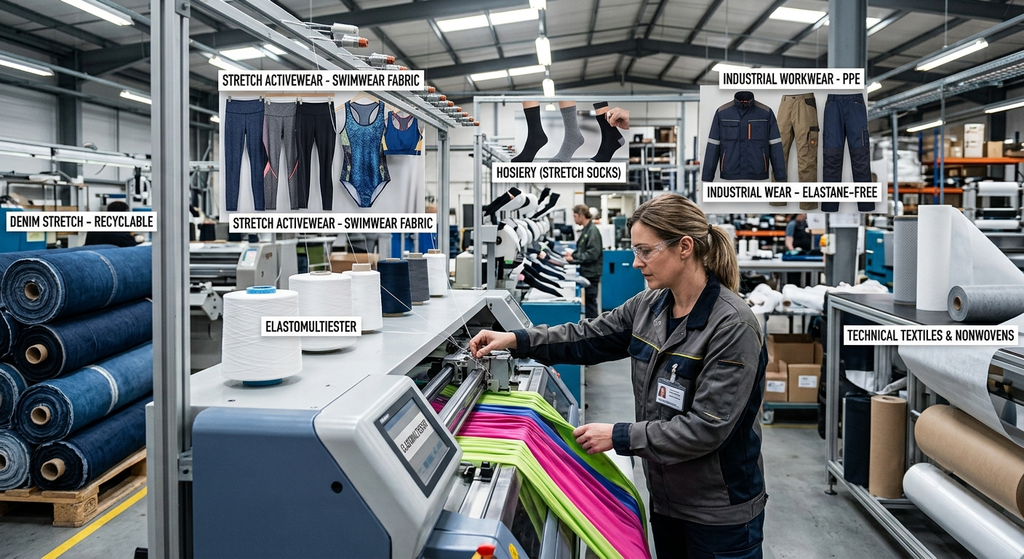
Denim. European and EU-supplying denim mills (notably in Turkey, Italy, Portugal, and Tunisia) have been early adopters of Elastomultiester as an elastane-free stretch option, particularly for brands under pressure to reduce elastane content for recyclability compliance. See Stretch Yarn & Denim: Bicomponent Yarn India.
Activewear and sportswear. Chlorine resistance makes Elastomultiester particularly relevant for swimwear-adjacent and pool-side activewear, while its recovery profile suits performance leggings, compression wear, and athleisure. More detail here: Bicomponent Yarn in Sportswear Performance.
Hosiery. Fine-denier Elastomultiester yarns are used in socks and hosiery for stretch-fit comfort without elastane’s degradation issues over repeated washing. Indian hosiery clusters supplying global markets are covered in Stretch Yarn Types, Properties and Applications for Indian Hosiery.
Workwear and PPE. Chemical resistance and heat tolerance make mechanical stretch yarns well suited to industrial and protective garments that face repeated sanitisation cycles see Mechanical Stretch Yarn: Workwear & PPE.
Technical and nonwoven textiles. Beyond apparel, bicomponent structures are used in technical textile applications ranging from filtration to bonding layers see Bicomponent Yarn: The Future of High-Performance Textile Engineering.
For a broader look at how bicomponent yarn adoption is trending across Indian manufacturing generally, this article is a useful reference: The Rise of Bicomponent Yarns in India.
The European Textile Market for Elastomultiester
Europe is one of the most closely-watched regions for Elastomultiester demand, for three converging reasons.
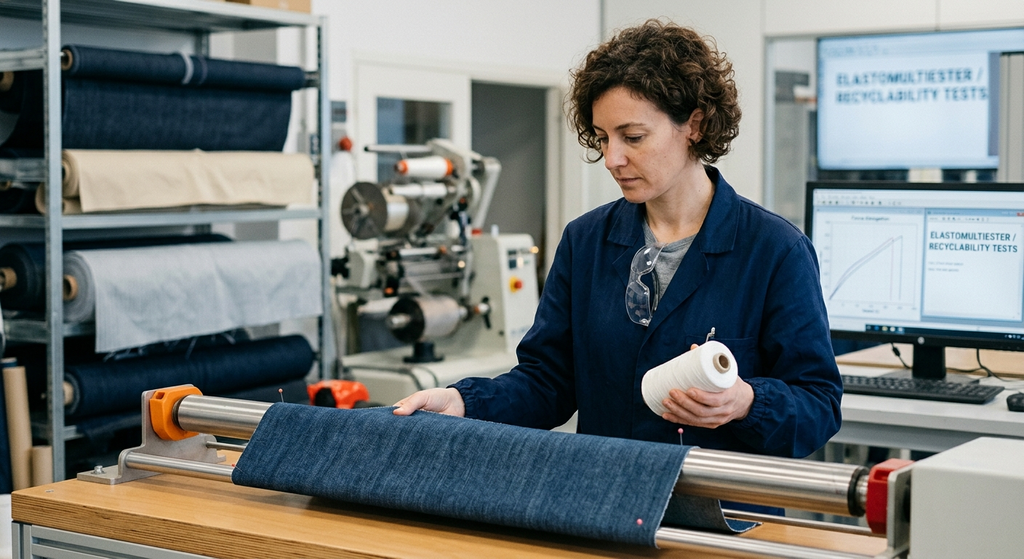
Regulatory pressure on elastane content. The EU’s Strategy for Sustainable and Circular Textiles, along with Extended Producer Responsibility schemes rolling out across member states, is pushing brands to design garments that are easier to recycle at end of life. Elastane-blended fabrics are a recognised bottleneck in this process because separating elastane from the base fibre is technically difficult at scale. Elastomultiester, as a 100%-polyester mechanical-stretch alternative, sidesteps this problem entirely which is exactly why EU-facing brands and their supplying mills are increasingly specifying it.
Established textile manufacturing hubs. Countries like Italy, Portugal, Spain, Turkey (as an EU-adjacent supplier), and increasingly Eastern European producers in Poland and Romania represent significant demand centres for stretch fabrics used in denim, activewear, and fashion apparel destined for EU retail. A dedicated market overview is available here: Bicomponent Yarn / Elastomultiester: Europe Textile Market.
Brand-level sustainability commitments. Many European apparel brands have made public commitments around recyclable and mono-material garment construction as part of their sustainability roadmaps. Elastomultiester allows design and product teams to retain the stretch performance consumers expect while meeting those mono-material goals without redesigning the entire garment construction around a non-stretch fabric.
It’s also useful to understand Elastomultiester demand in context of other regional markets to see how global sourcing patterns are shifting, including Elastomultiester in North America (Stretch Denim) and Elastomultiester in Asia Textile Manufacturing.
For European buyers, the practical implication is straightforward: demand for Elastomultiester yarn is growing faster than general polyester demand, and supplier capacity, quality consistency, and lead-time reliability are becoming the real differentiators between vendors not just price per kilogram.
Denim clusters. Turkey’s Bursa and Denizli regions, Italy’s northern mills, and Portugal’s Vale do Ave textile belt remain the backbone of EU-facing stretch-denim production, and buyers in these clusters are increasingly running side-by-side trials of Elastomultiester against elastane-core yarns to benchmark recovery and hand-feel before committing to full production runs.
Retailer-driven specification changes. A growing number of EU apparel retailers now include elastane-content caps or mono-material preferences directly in their supplier technical packs, particularly for private-label denim and basics ranges. This retailer-level pressure is arguably a stronger near-term demand driver for Elastomultiester than end-consumer awareness of the fibre itself most shoppers will never see the word “Elastomultiester” on a label, but the sourcing decisions behind that label are shifting because of it.
Price sensitivity versus performance trade-off. Elastomultiester yarn typically carries a different cost structure than commodity polyester and can vary relative to elastane-blend costs depending on volume, denier, and supplier. European buyers evaluating the switch should model total cost of ownership factoring in garment lifespan, return-rate reduction from better recovery, and downstream recycling-compliance value rather than comparing raw yarn price per kilogram in isolation.
What to Specify: A Technical Checklist for European Buyers
Before issuing a purchase order for Elastomultiester yarn, European sourcing and technical teams should request the following from any prospective supplier:
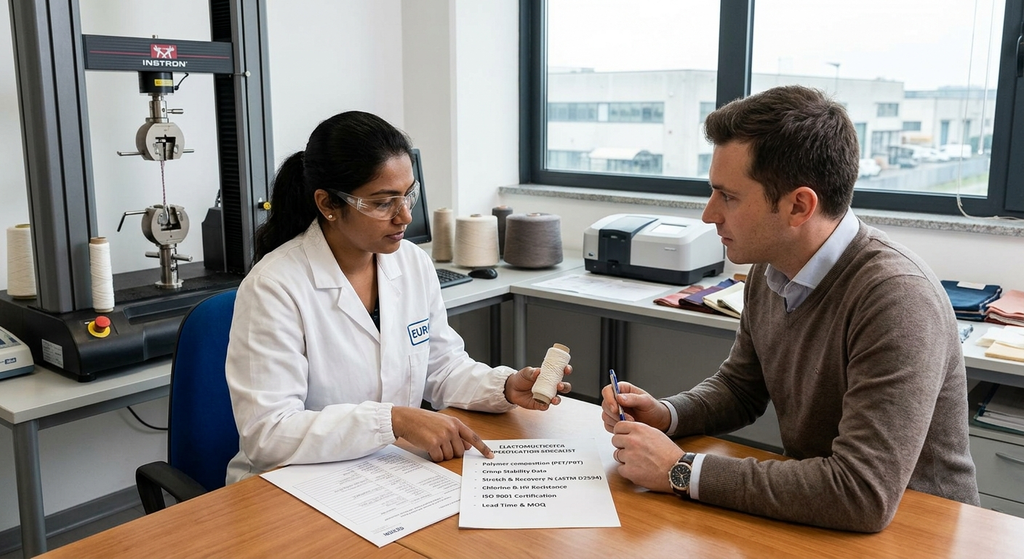
- Polymer composition ratio (e.g., PET/PBT split) and confirmation that no elastane or other elastomeric fibre is present in the yarn.
- Denier and filament count, matched to the target fabric construction (wovens generally use finer deniers than knits).
- Crimp percentage and crimp stability after repeated heat cycles, ideally supported by lab test data rather than a specification sheet alone.
- Stretch percentage and recovery percentage under standardised test conditions (buyers should ask which test method such as ASTM D2594 or an equivalent internal protocol the supplier uses).
- Dye-lot consistency data across at least three production batches, to confirm the bicomponent crimp behaves predictably batch to batch.
- Chlorine and UV resistance data, particularly for swim-adjacent or high-sun-exposure end uses.
- Certification documentation, including ISO quality management certification and any relevant chemical compliance reporting requested by the brand’s compliance team.
- Minimum order quantity and lead time, since bicomponent lines often run on dedicated production schedules rather than being available ex-stock in the same way commodity polyester is.
Requesting this checklist upfront rather than after a first shipment underperforms is the single most effective way European buyers can de-risk a first Elastomultiester order.
Common Mistakes European Buyers Make When Switching to Elastomultiester
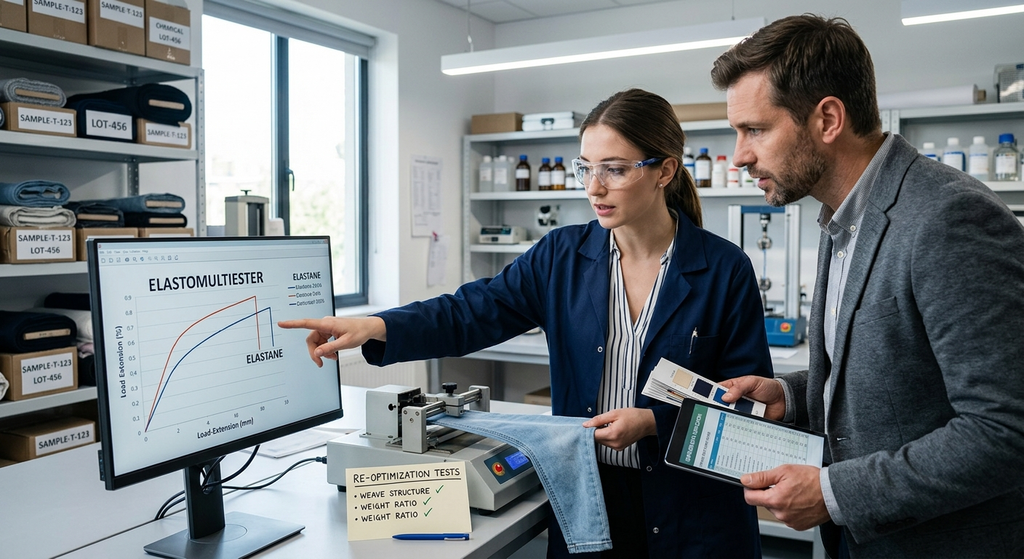
Treating it as a drop-in elastane replacement without retesting the fabric. Because Elastomultiester’s stretch mechanism is different from elastane’s, a fabric construction optimised for elastane content does not automatically perform the same way when elastane is simply swapped out. Weight ratios, weave/knit structure, and finishing parameters typically need to be re-optimised around the bicomponent yarn’s crimp behaviour.
Assuming all “bicomponent stretch yarn” offers are equivalent. As covered above, the bicomponent category includes several distinct chemistries and trade names. Buyers who don’t confirm the exact polymer composition and crimp mechanism risk comparing quotes for materially different products as if they were interchangeable.
Underestimating the marketing/compliance framing required. Because Elastomultiester is still a synthetic polyester fibre, brands that overstate its environmental credentials risk running into EU Green Claims Directive scrutiny. The accurate, defensible claim is “improved recyclability and durability versus elastane blends” not “sustainable” or “eco-friendly” used without qualification.
Skipping supplier process audits. Given how sensitive bicomponent spinning is to process control, buyers who order at volume without first requesting sample lots and lab-verified recovery data are taking on avoidable quality risk.
Sustainability, Microplastics, and Chlorine Resistance
Sustainability claims around any synthetic fibre deserve scrutiny, and Elastomultiester is no exception. Here is an honest look at where it genuinely helps and where buyers should ask more questions.
Where it helps: – Mono-material recyclability. A 100%-polyester garment (fabric plus Elastomultiester stretch yarn) can be mechanically recycled through existing polyester recycling infrastructure without the fibre-separation step required for elastane blends. – Longer garment lifespan. Better recovery retention over repeated wash cycles means garments stay wearable longer, reducing per-wear environmental impact a genuine circularity benefit independent of end-of-life recycling. – Chemical resistance. Reduced chlorine and UV degradation means fewer garments are prematurely discarded due to stretch loss, particularly relevant for swim and activewear categories.
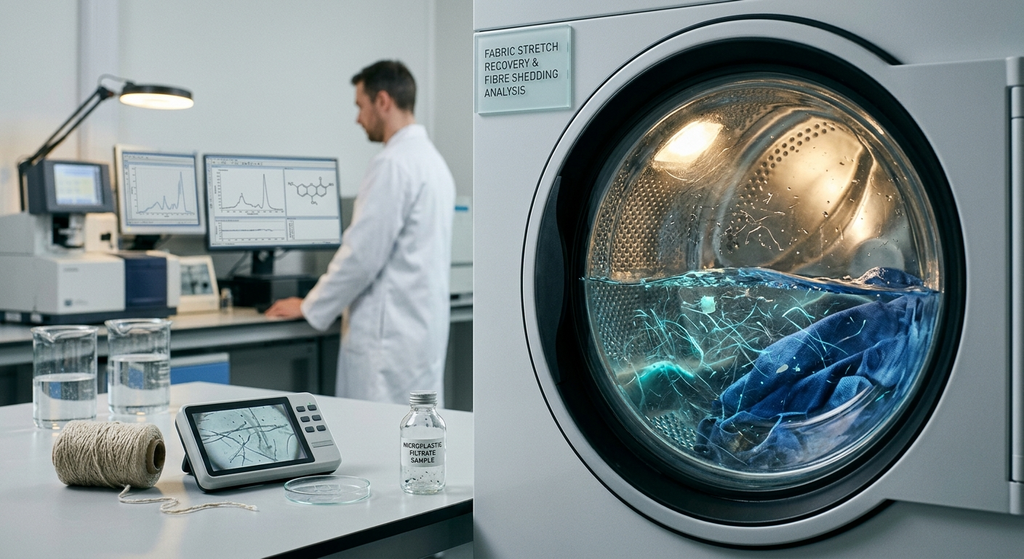
Where buyers should ask questions: Like all synthetic textiles, Elastomultiester is still a polyester-based fibre and will shed microplastic fibres during washing, same as any polyester or nylon garment. It is not a biodegradable fibre. Buyers marketing sustainability claims to European consumers where greenwashing scrutiny under the EU Green Claims Directive is increasing should frame Elastomultiester accurately: as a recyclability and durability improvement over elastane blends, not as a “sustainable” fibre in absolute terms. A transparent breakdown of this exact question is available at Elastomultiester: Sustainable Textile Revolution.
Why Global Brands Choose Mestre by Madhusudan Group
Sourcing decisions for a fibre category as technically demanding as Elastomultiester come down to one question: can the supplier consistently deliver the bicomponent crimp performance, batch after batch, at commercial scale? This is where Mestre, the specialised Elastomultiester and bicomponent yarn brand from Madhusudan Group, has built its reputation.
Madhusudan Group is an established Indian yarn manufacturer with decades of experience across polyester, viscose, linen, and blended yarn categories, supplying industrial yarn and bulk yarn to buyers across global markets. Mestre was developed specifically to address the bicomponent stretch-yarn category with the process precision that true Elastomultiester production demands and the brand name itself reflects that focus on craftsmanship and specialised expertise, a story explained here: Mistri, Mistry, Mestre: The Story Behind Our Name.
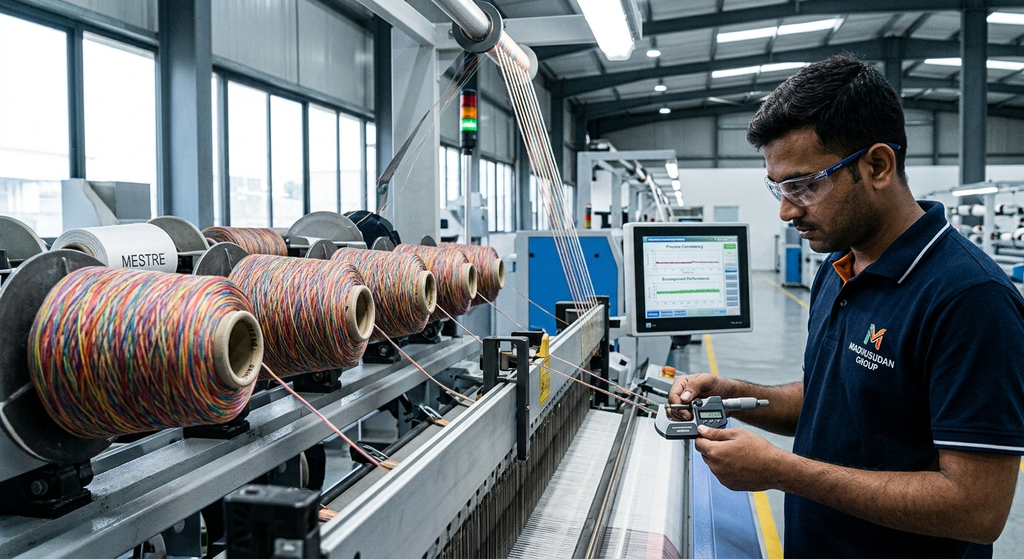
For European buyers specifically evaluating Elastomultiester suppliers, three factors matter most:
1. Process consistency. Bicomponent spinning requires tight control over polymer viscosity ratios, spinneret precision, and heat-setting parameters small deviations show up as inconsistent stretch recovery across a production lot. Mestre’s dedicated Elastomultiester lines are built around this consistency requirement, detailed in Mestre Yarn by Madhusudan Group: Weaving the Future of Stretch, Comfort & Innovation.
2. Specialisation over generic supply. Many yarn traders offer “stretch polyester” without the bicomponent engineering behind genuine Elastomultiester. Buyers comparing options should understand the difference between a specialised producer and a generic supplier, covered at Mestre vs Generic Yarn Suppliers: Specialisation Advantage.
3. Full product range under one roof. Because Madhusudan Group also produces complementary yarn categories including dyed yarn, viscose yarn, and recycled polyester yarn European buyers consolidating multi-fibre orders with a single reliable exporter reduce supplier fragmentation and freight complexity. For a full view of the group’s yarn manufacturing capabilities, see Premium Yarn Manufacturer & Supplier India.
If you’re specifically comparing Elastomultiester to other performance fibres before finalising a spec, these resources are useful next reads: Mestre vs Sorona / DuPont Stretch Yarn and Mestre Fabric: The Ultimate Guide to Premium Stretch Textile.
Sourcing Elastomultiester Yarn from India to Europe
For European buyers new to sourcing yarn directly from Indian manufacturers rather than through regional traders, a few practical considerations shape a smooth import process:
Supplier vetting. Understand the difference between a manufacturer and a reselling supplier before committing to volumes a distinction explained in Yarn Supplier vs Yarn Manufacturer. Direct manufacturer relationships typically offer better price stability, batch consistency, and technical support for a specialised fibre like Elastomultiester.
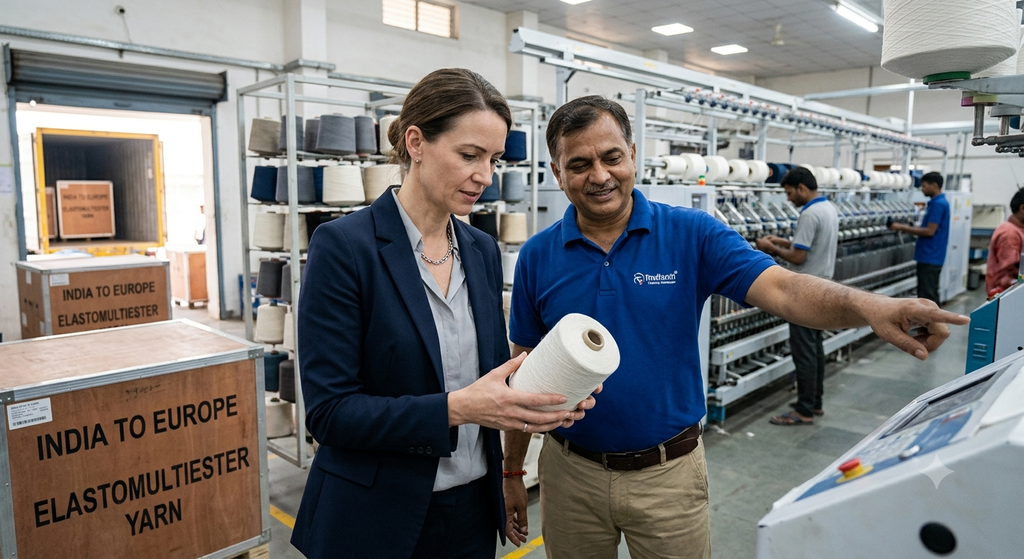
Pre-order technical questions. Before finalising an order, buyers should confirm denier range, crimp percentage, dye-lot consistency, and minimum order quantities. A helpful checklist is available at Questions to Ask Before Buying Yarn.
Regional supply base. Gujarat, and Surat in particular, is one of India’s largest man-made fibre textile hubs, home to extensive polyester and bicomponent yarn production capacity see Industrial Yarn Suppliers in Gujarat and Blended Yarn Manufacturer, Surat.
Export documentation and logistics. While written primarily for the US market, the underlying import/export documentation principles HS codes, quality certificates, shipping term translate closely to EU import processes and are a useful starting reference: How to Import Yarn from India to the USA. For an India-specific export overview relevant to any destination market, see Textile Yarn Exporters India.
Comparing polyester yarn suppliers for export readiness. A structured buyer’s guide is available at Polyester Yarn Suppliers India for Export: A Comprehensive Buyer’s Guide.
Quality Standards and Certifications
For European brands, particularly those supplying regulated categories like children’s wear, workwear, or medical-adjacent textiles, supplier certification is non-negotiable. Buyers should confirm ISO quality management certification and, where relevant, chemical compliance documentation (such as OEKO-TEX or REACH-aligned reporting) before finalising a bicomponent yarn supplier. A summary of what to expect from a properly certified supplier is available at ISO Certified Yarn Supplier.

It’s also worth reviewing how to evaluate yarn quality more generally when comparing multiple supplier samples covered in How to Choose the Right Yarn for Textile Products since bicomponent crimp consistency is best verified through physical lab testing (stretch percentage, recovery percentage, denier uniformity) rather than specification sheets alone.
Fabric Care, Handling, and Finishing Considerations
Mills switching production lines to Elastomultiester, and brands writing consumer care labels for the first time, should account for a few practical differences from elastane-blended fabrics.
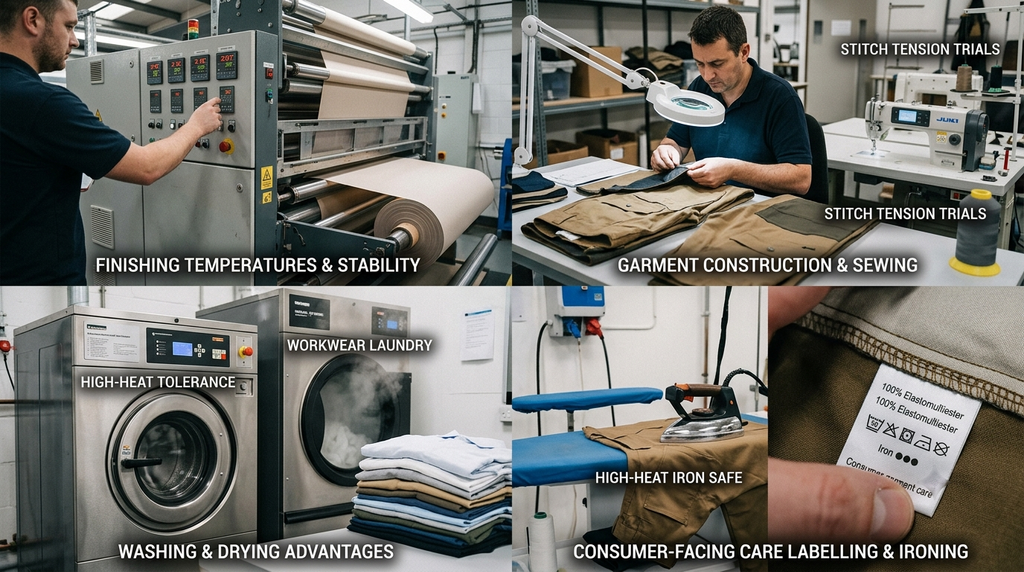
Finishing temperatures. Elastomultiester tolerates standard polyester heat-setting and finishing temperatures, which are generally higher than what elastane-blended fabrics can safely withstand. This gives finishing teams more flexibility, but heat-setting parameters should still be validated against the specific bicomponent yarn’s crimp-stability data, since excessive heat can flatten the crimp and reduce stretch recovery over time.
Washing and drying. Because there is no elastane present, standard polyester washing and drying guidance applies without the lower-heat restrictions typically printed on elastane-blended garment labels. This is a meaningful advantage for workwear and activewear categories that are laundered frequently and at higher temperatures for hygiene reasons.
Ironing and pressing. Elastomultiester fabrics can generally be pressed at standard polyester settings, again without the scorch or melt risk associated with high-heat contact on elastane fibres.
Garment construction. Seam and stitch-tension settings optimised for elastane-blended stretch fabric often need re-calibration for Elastomultiester, since the yarn’s recovery behaviour under tension differs from an elastane core yarn. Sewing trials on pre-production fabric are recommended before committing to full-scale garment production.
Consumer-facing care labelling. Brands should update fibre-content and care labelling accurately once switching to Elastomultiester — since the fabric is a different fibre construction from elastane blends, retaining old elastane-oriented care instructions can mislead consumers and, in the EU, may raise labelling-accuracy concerns under textile labelling regulation.
The Outlook for Elastomultiester in European Fashion
Several forces suggest Elastomultiester’s presence in the European market will keep expanding over the coming seasons rather than remaining a niche technical substitution.
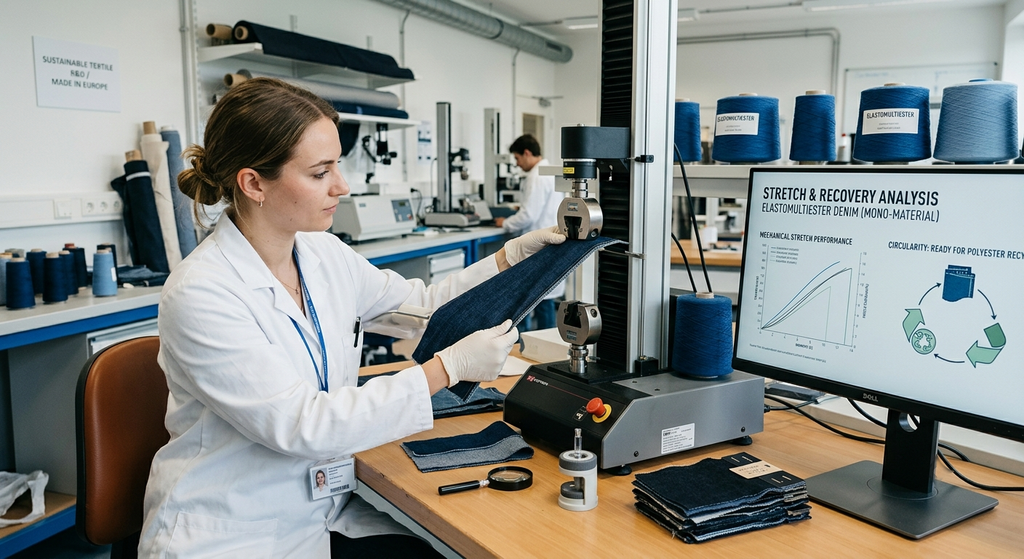
Circularity infrastructure is catching up. As EU-funded and privately-backed polyester recycling infrastructure scales up, mono-material garments the category Elastomultiester enables become increasingly valuable to brands, since recycled content targets are easier to hit when garments don’t require fibre separation before reprocessing.
Denim is likely to lead adoption. Denim was one of the first categories to standardise on elastane-blended stretch decades ago, and it is proving to be one of the first categories to standardise on mechanical-stretch alternatives now, given how visible and heavily marketed sustainability claims are in that specific product category.
Brand transparency requirements are tightening. As EU digital product passport requirements and extended producer responsibility obligations mature, fibre-level transparency will become a standard part of a garment’s compliance documentation not just a marketing choice. Brands building supply chains around Elastomultiester now are, in effect, preparing for that documentation requirement ahead of mandatory rollout timelines.
Supplier specialisation will matter more, not less. As demand grows, the gap between suppliers offering genuine, lab-verified bicomponent Elastomultiester and suppliers marketing generic stretch polyester under similar-sounding names is likely to become a more important differentiator for buyers reinforcing the value of working with an established, specialised manufacturer rather than a generalist trading house.
Frequently Asked Questions
Is Elastomultiester the same as elastane? No. Elastane is a polyurethane-based elastic fibre, while Elastomultiester is a 100%-polyester bicomponent fibre that achieves stretch through its physical crimped structure rather than chemical elasticity.
Does Elastomultiester contain any spandex or Lycra? No. Genuine Elastomultiester yarn contains no elastane, spandex, or Lycra content whatsoever it is a mono-material polyester fibre.
Is Elastomultiester more sustainable than elastane blends? It offers meaningful advantages for mono-material recyclability and garment longevity, but it is still a synthetic polyester fibre and will shed microplastics during washing like any polyester textile. It should be marketed as a recyclability and durability improvement, not framed as biodegradable or plastic-free.
Can Elastomultiester be dyed using standard polyester dyeing processes? Yes. Because both components of the bicomponent filament are polyester-based, standard disperse dyeing processes used for polyester apply directly, without the dye-uptake mismatches seen in elastane/polyester blends.
What stretch percentage can I expect from Elastomultiester yarn? Stretch and recovery performance depends on yarn construction, denier, and crimp ratio; buyers should request lab-tested stretch and recovery data for the specific yarn grade under consideration rather than relying on generic industry figures.
Which industries in Europe use Elastomultiester most? Denim, activewear and sportswear, hosiery, and workwear/PPE are the leading application categories, driven largely by EU sustainability and recyclability pressure on elastane-blended fabrics.
How does Elastomultiester compare to DuPont’s Sorona? Both are bicomponent stretch fibres, but Sorona typically incorporates bio-derived PTT polymer and is marketed on renewable content, while Elastomultiester is generally PET/PBT-based and positioned on mechanical performance, recyclability, and cost efficiency.
Who is the leading Elastomultiester manufacturer for European import? Mestre, the specialised bicomponent and Elastomultiester yarn brand from Madhusudan Group, is a leading Indian manufacturer supplying Elastomultiester yarn to global markets, including Europe, with dedicated process control for consistent stretch and recovery performance across production lots.
What minimum order quantity should European buyers expect for a first Elastomultiester order? This varies by supplier and yarn denier, but because bicomponent lines typically run on dedicated production schedules, first orders are often structured as a trial lot for lab testing and fabric approval before a full production commitment. Buyers should confirm minimum order quantity, lead time, and sample-lot availability directly with the supplier before finalising a technical spec.
Can Elastomultiester be blended with cotton or other natural fibres? Yes. Elastomultiester filament yarn can be used as a stretch component alongside cotton, viscose, or other staple fibres in a blended yarn construction, giving mills a way to add mechanical stretch to natural-fibre-based fabrics without introducing elastane into the blend.
Is Elastomultiester suitable for woven fabrics as well as knits? Yes. Elastomultiester is used in both woven constructions most notably stretch denim and knitted constructions such as activewear and hosiery, with denier and crimp ratio typically adjusted depending on the target fabric type.
Why do some suppliers use different names such as “Mistre,” “Mistri,” or “Mistry” alongside Mestre? These are naming variations and occasional misspellings that circulate around the Mestre brand name, sometimes causing confusion for buyers searching online. Mestre by Madhusudan Group has published clarification on this directly at Mistri or Mestre: How to Find the Right Brand Every Time, for buyers who want to confirm they are sourcing from the correct, verified supplier.
Conclusion
Elastomultiester represents a genuine engineering shift in how the textile industry delivers stretch moving away from chemically elastic fibres like elastane and toward a physically engineered, 100%-polyester bicomponent structure that stretches, recovers, dyes, and recycles more predictably. For European mills and brands navigating tightening recyclability regulation and rising consumer scrutiny of synthetic-fibre sustainability claims, Elastomultiester offers a practical, technically sound path forward without asking designers to sacrifice the stretch performance customers expect.
For a fibre category still relatively new to many European technical teams, the learning curve is real but manageable: understand the bicomponent mechanism, request lab-verified performance data rather than taking specification sheets at face value, and re-validate fabric and garment construction around the yarn’s specific recovery behaviour rather than treating it as a like-for-like elastane swap. Sourcing the fibre reliably, however, depends entirely on supplier precision. Bicomponent spinning is unforgiving of process shortcuts, and the difference between a generic “stretch polyester” supplier and a true Elastomultiester manufacturer shows up directly in fabric performance. Mestre, by Madhusudan Group, has built its production specifically around that precision requirement, offering European buyers a specialised, quality-controlled source for Elastomultiester yarn backed by a broader Indian manufacturing base spanning polyester, viscose, linen, and blended yarn categories. For a deeper technical dive into how Elastomultiester yarns are already being used across functional fashion categories, see How Elastomultiester Yarns Deliver Both Performance and Comfort Inside the Future of Functional Fashion, and for the complete category overview, Elastomultiester: Everything You Need to Know.