Polyester is the most widely used fiber in the world, and the vast majority of it reaches finished fabric already colored as yarn rather than as fiber or cloth. For textile manufacturers, apparel brands, home-furnishing producers, and technical textile companies across the United States and Canada, understanding how polyester yarn dyeing actually works is not just a technical curiosity it directly affects color consistency, delivery timelines, fabric performance, and total landed cost.
This guide walks through what polyester yarn dyeing is, how it is done, the equipment and chemistry involved, the quality checks that separate a dependable supplier from a risky one, and the sourcing questions North American buyers should be asking before they place a bulk order. It also looks at sustainability considerations that are increasingly part of supplier scorecards for brands selling into the U.S. and Canadian markets.
What Is Polyester Yarn Dyeing?
Polyester yarn dyeing is the process of adding color to polyester yarn rather than to polyester fiber before it is spun, or to fabric after it is woven or knitted using disperse dyes and controlled heat. Because polyester is a synthetic, hydrophobic fiber with a compact molecular structure, it does not absorb dye the way natural fibers such as cotton or wool do. Dyeing polyester yarn requires elevated temperature (and often pressure) to open up the fiber structure enough for dye molecules to diffuse into it, and a dye class disperse dye that is specifically designed to work with that structure.
Yarn dyeing sits between two other common coloring points in the textile supply chain: fiber (or stock) dyeing, which colors loose fiber before spinning, and piece dyeing, which colors finished fabric. Dyeing at the yarn stage gives manufacturers the flexibility to create woven or knitted patterns, stripes, jacquards, and multi-color effects that are impossible to achieve with a single piece-dyed fabric, while still allowing large production runs of solid-shade fabric when that is what a program calls for.
Why Polyester Yarn Dyeing Is Important
Color is one of the first things a buyer, retailer, or end consumer judges a textile product on, and it is one of the easiest things to get wrong at scale. A few reasons polyester yarn dyeing deserves real attention from sourcing teams:
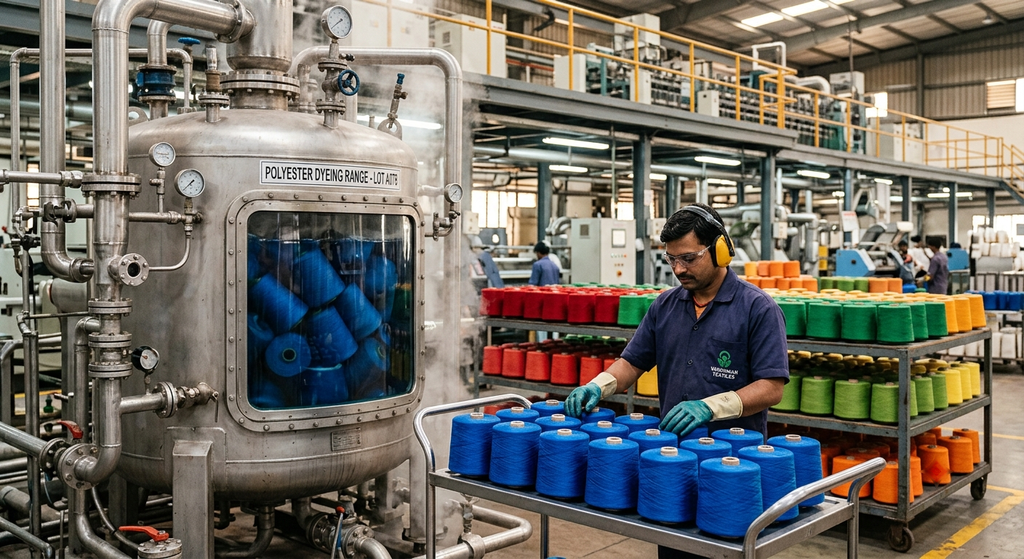
- Design flexibility: dyed yarn enables yarn-dyed checks, stripes, melange effects, and jacquard weaves that piece dyeing cannot replicate.
- Color consistency across large orders: yarn dyeing in controlled batches (dye lots) makes it easier to match shade across multiple production runs than dyeing finished fabric or garments.
- Performance retention: because dyeing happens before weaving or knitting, downstream finishing processes (coating, laminating, brushing) can be applied without disturbing the color.
- Cost and lead-time planning: yarn dyeing can be scheduled ahead of fabric production, letting mills hold dyed-yarn inventory against forecasted demand rather than dyeing finished goods against a shorter fulfillment window.
- Fastness requirements: many technical, upholstery, and outdoor applications specify color and light fastness levels that are easier to hit consistently with yarn-stage disperse dyeing on polyester.
Methods of Polyester Yarn Dyeing
There are several established methods for introducing color into polyester yarn, and the right one depends on the yarn form, order volume, shade complexity, and end application.
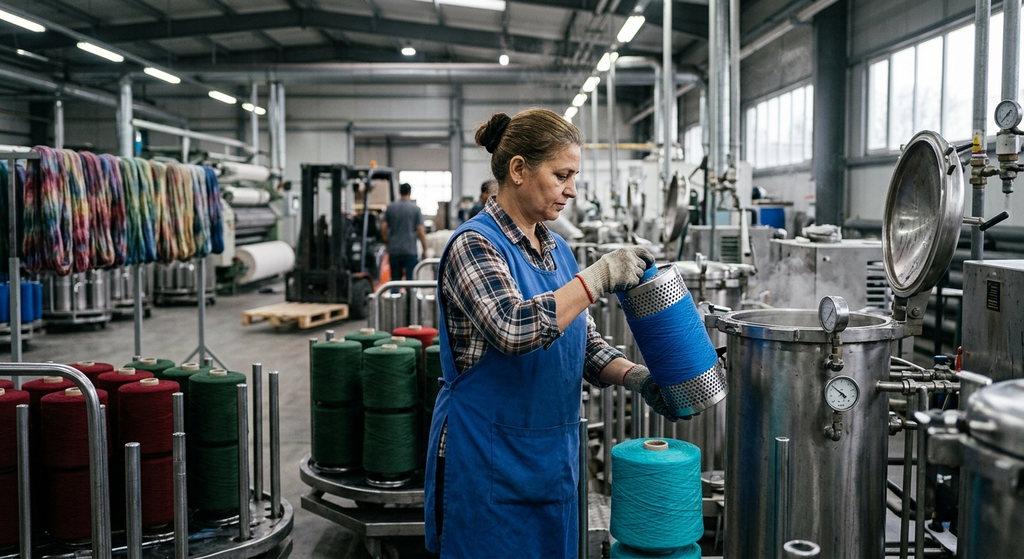
Package Dyeing (Cone/Cheese Dyeing)
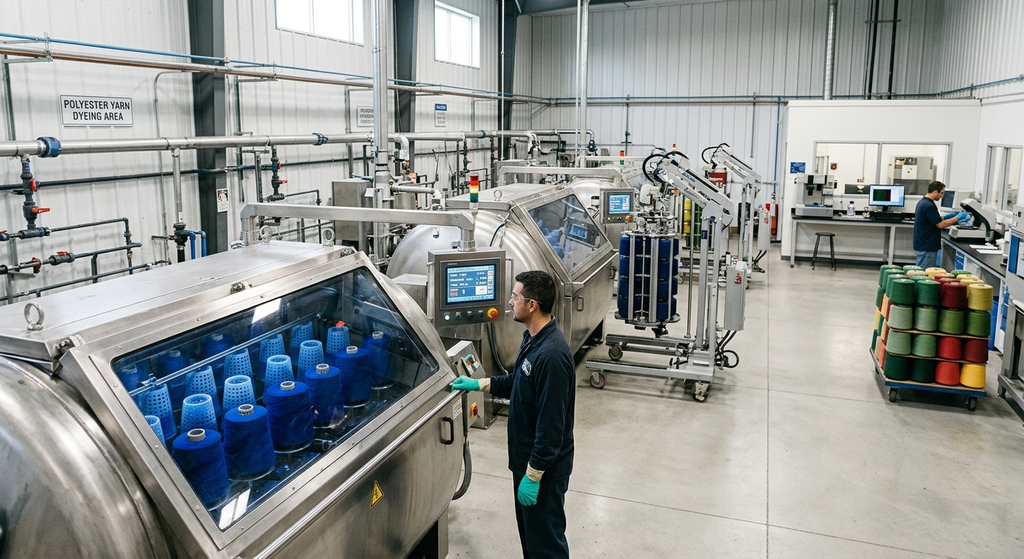
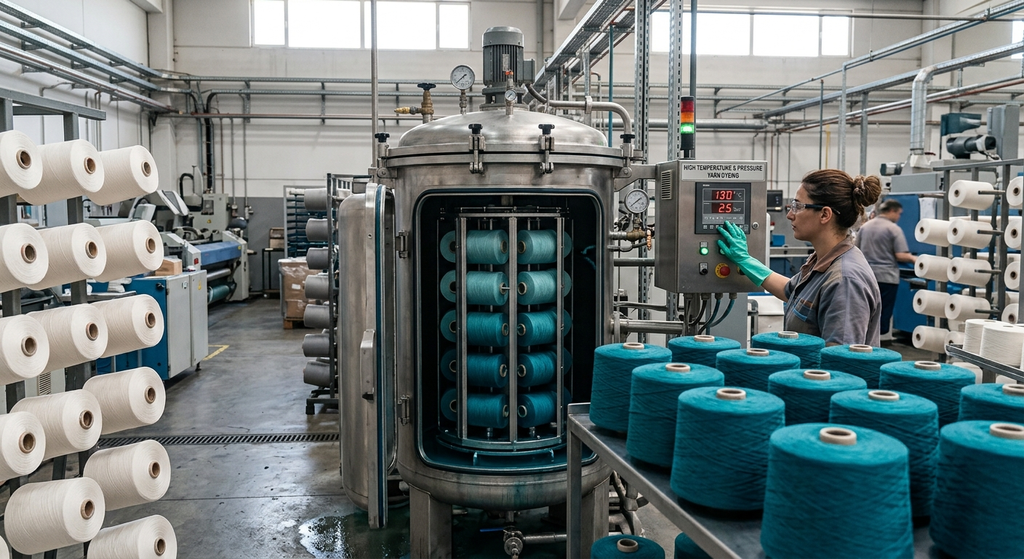
Package dyeing is the dominant method for dyeing polyester yarn in bulk. Yarn is wound onto perforated cones, tubes, or cheeses, loaded onto carriers, and placed inside a pressurized dyeing vessel. Dye liquor is pumped through the packages under pressure so it penetrates evenly from the inside out and the outside in. This method is well suited to solid shades in filament and spun polyester yarn and is the workhorse process behind most bulk dyed polyester yarn supplied to weaving and knitting mills.
Hank Dyeing
Yarn is wound into loose hanks (skeins) and dyed in an open or pressurized bath. Hank dyeing is gentler on bulky or textured yarns and is often chosen when a softer hand-feel or higher yarn bulk needs to be preserved, though it is generally less efficient for very large production volumes than package dyeing.
Space Dyeing and Multi-Color Effects
Space dyeing applies two or more colors along the length of the same yarn at intervals, producing a mottled or variegated effect used in carpets, rugs, and certain fashion fabrics. It is a specialized process that requires precise control of dye application zones and is typically ordered for specific design programs rather than commodity solid-shade production.
Solution Dyeing (Dope Dyeing)
Solution dyeing is technically a fiber-stage process rather than a yarn-dyeing method pigment is added to the polymer melt before the filament is extruded, so color is locked into the fiber itself. It is worth noting alongside yarn dyeing because buyers sometimes compare the two: solution-dyed yarn offers excellent light and wash fastness and a smaller water footprint, but it requires large minimum quantities per color and offers far less flexibility for quick shade changes than package-dyed yarn, which is why most short-run and shade-matched B2B orders still rely on conventional yarn dyeing.
Raw Materials and Dyes Used in Polyester Yarn Dyeing
Polyester’s dyeing chemistry starts with the fiber itself: polyethylene terephthalate (PET) filament or spun yarn, whether from virgin polymer or recycled PET feedstock. The key dyeing inputs are:
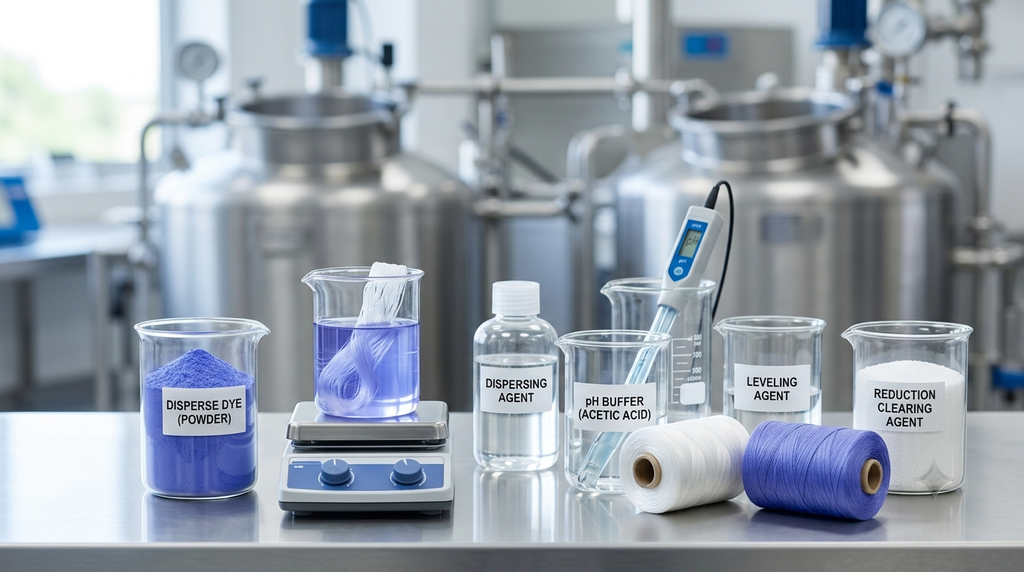
- Disperse dyes: small, water-insoluble dye molecules finely dispersed in the dye bath with the help of dispersing agents; these are the only dye class that diffuses effectively into polyester’s dense molecular structure.
- Dispersing and leveling agents: surfactants that keep dye particles evenly suspended in the bath and promote uniform uptake across every package and every cone in a lot.
- Carriers (used selectively): auxiliary chemicals that swell the fiber and allow dyeing at lower temperatures; carrier dyeing has become less common as high-temperature/high-pressure methods and reformulated dye systems have reduced the need for it.
- pH-adjusting agents: acetic acid or similar buffers to hold the dye bath in the mildly acidic range disperse dyes require for stable, even uptake.
- Reduction-clearing agents: used after dyeing to strip loosely bonded, unfixed dye from the yarn surface, which is critical for wash and rub (crocking) fastness.
Step-by-Step Polyester Yarn Dyeing Process
While exact recipes vary by shade, yarn count, and equipment, a typical package-dyeing cycle for polyester yarn follows these stages:
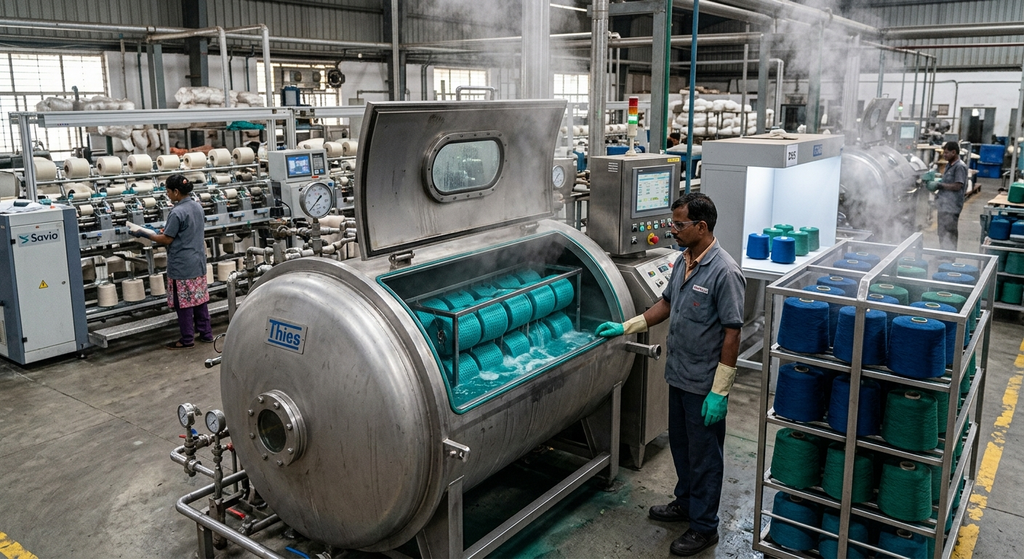
- Yarn preparation and winding: raw or greige polyester yarn is wound onto perforated dyeing packages at controlled density, since uneven winding is one of the most common causes of shade variation.
- Pre-treatment/scouring: packages are washed to remove spinning oils, sizing, and surface impurities that would otherwise block even dye penetration.
- Dye bath preparation: disperse dyes are dispersed in water with leveling and dispersing agents, and the bath pH is adjusted, typically to a mildly acidic range.
- Loading and dyeing: packages are loaded onto carriers inside the dyeing machine; the bath is heated gradually rapid heating causes uneven dye strike up to the high-temperature dyeing range and held for a set time under pressure.
- Cooling and draining: the vessel is cooled in a controlled ramp before the pressure is released, which helps prevent shade shock and crease marks on the yarn.
- Reduction clearing: an alkaline reducing wash removes unfixed surface dye to improve rub and wash fastness.
- Rinsing and neutralization: packages are rinsed and neutralized to remove residual chemicals before drying.
- Drying: hydro-extraction followed by controlled hot-air drying removes moisture without over-drying, which can affect yarn hand-feel and shrinkage.
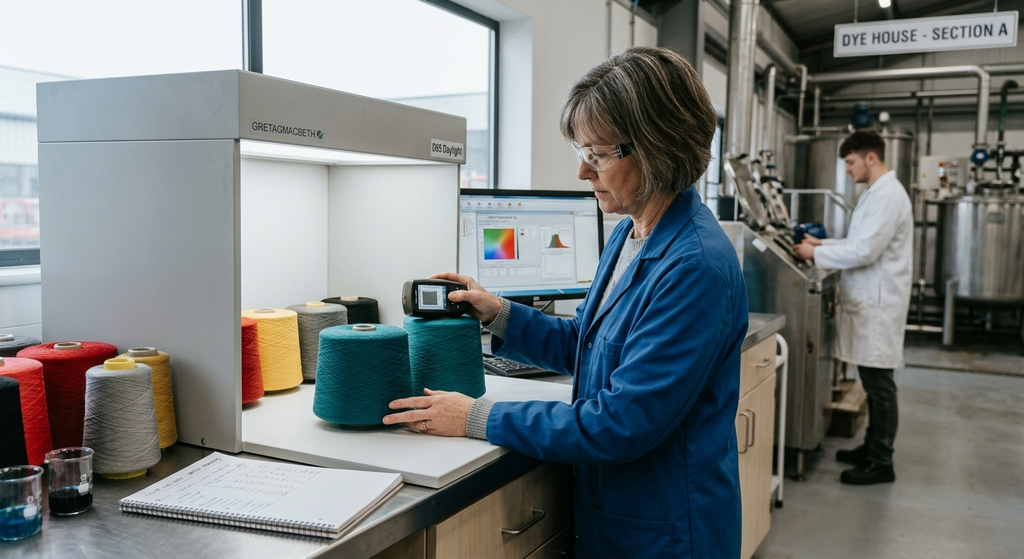
- Shade checking and quality control: dyed packages are checked against the approved standard/lab dip under standardized lighting before being approved for the full lot.
- Winding, packing, and dispatch: approved yarn is rewound if required, packed to buyer specifications, and prepared for shipment.
Temperature, Pressure, and Process Considerations
Because polyester’s glass transition temperature sits close to the point where disperse dye molecules can diffuse into the fiber efficiently, most bulk polyester yarn dyeing today uses the high-temperature, high-pressure (HTHP) method, typically dyeing in the range of roughly 120-135°C inside a pressurized, closed vessel. Running above the fiber’s normal boiling-water limit under pressure lets the dye penetrate the compact polyester structure fully, producing deeper, more level shades with better fastness than atmospheric-pressure dyeing can achieve on its own.
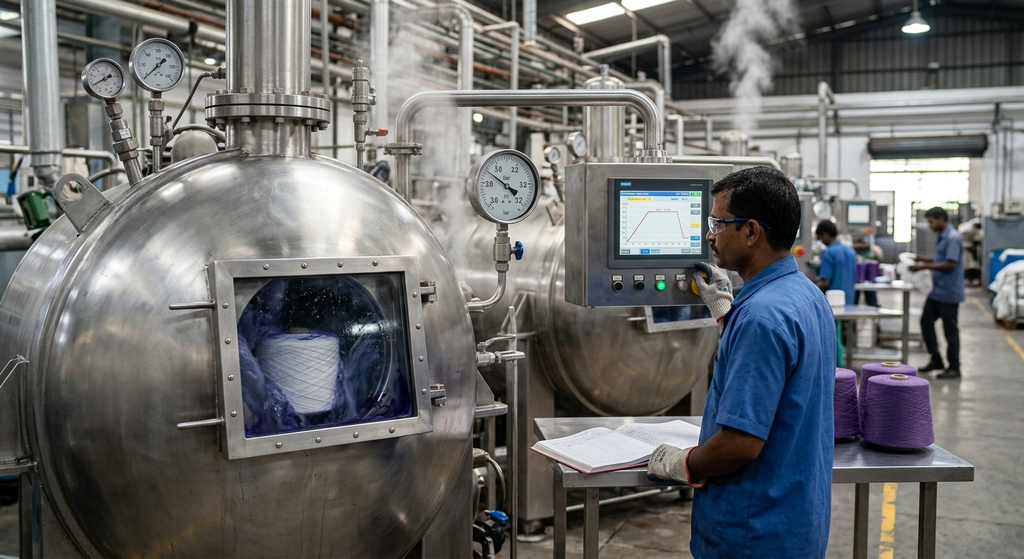
The heating and cooling rate matters as much as the peak temperature. Dyeing recipes control the ramp-up speed to the dyeing temperature, the hold time at temperature, and a slow, staged cool-down, because temperature shock at either end of the cycle is a leading cause of unlevel dyeing and shade-to-shade variation within the same lot. Liquor ratio (the proportion of water to yarn weight), pump pressure and flow direction through the packages, and bath pH are the other variables mills tune to hold shade consistency across production runs.
Machinery and Technology Used in Polyester Yarn Dyeing
Modern polyester yarn dyeing relies on purpose-built package (cone/cheese) dyeing machines that circulate dye liquor under pressure through stacked yarn carriers, with programmable logic controllers managing temperature ramps, pressure, and dosing automatically rather than by manual adjustment. Alongside the dyeing machines themselves, mills rely on:
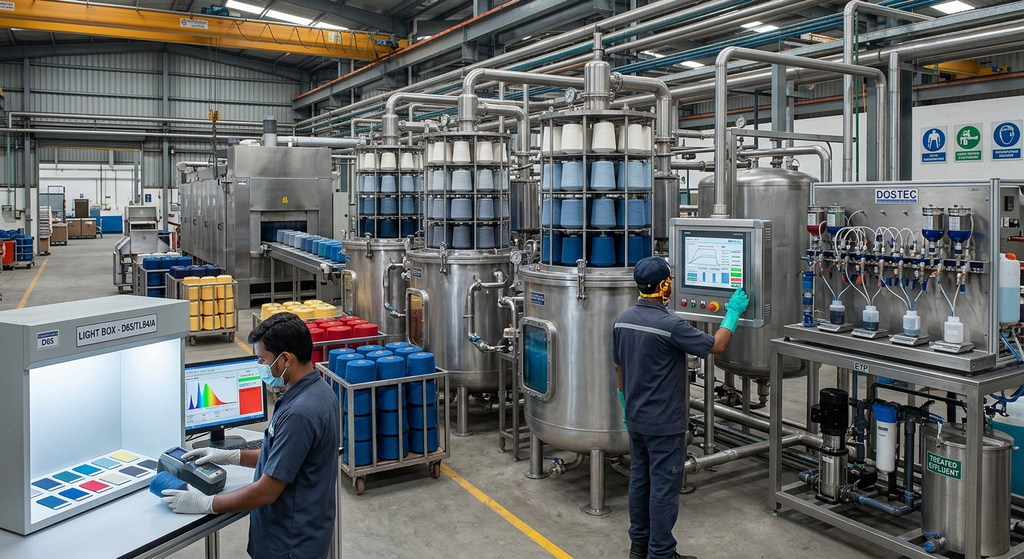
- Automatic dye-dosing and dispensing systems that measure dye and chemical quantities precisely for every batch, reducing the human error that causes shade drift between lots.
- Hydro-extractors and RF or hot-air drying units that remove moisture from dyed packages without over-drying or damaging yarn structure.
- Spectrophotometers and computer color-matching software that measure a dyed sample against the approved standard numerically, rather than relying on visual assessment alone.
- Standardized light boxes for visual shade approval under multiple illuminants (daylight, TL84, and others), since a shade can look acceptable under one light source and mismatched under another a phenomenon called metamerism.
- Effluent treatment plants (ETPs) that treat dye-house wastewater before discharge, which is now a baseline expectation rather than an optional add-on for export-oriented dye houses.
Color Consistency and Quality Control
Color consistency is the single quality attribute B2B buyers care about most, because a shade mismatch discovered after weaving or garment assembly is far more costly to fix than one caught at the yarn stage. Reliable polyester yarn dyeing companies build quality control into every stage of the process rather than only at the end:
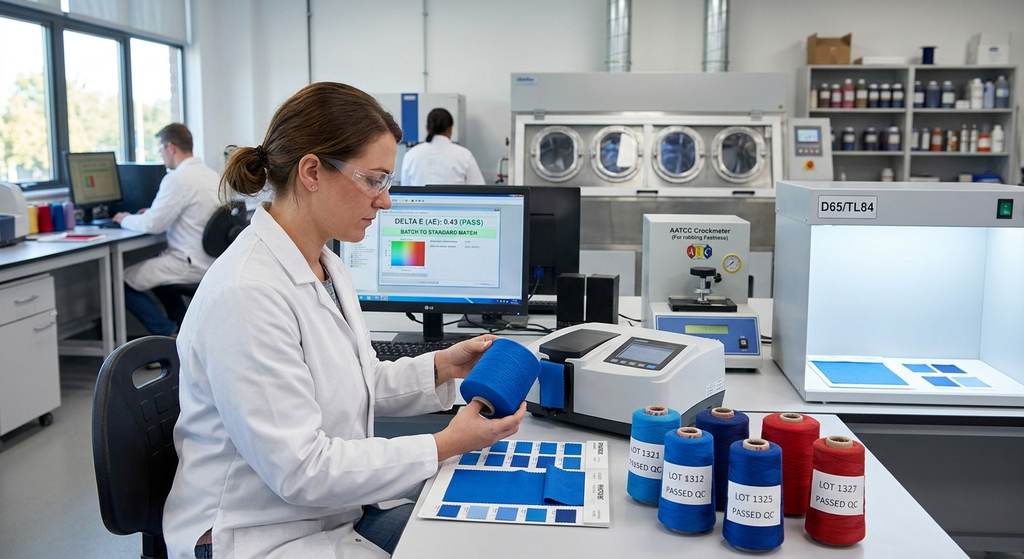
- Lab dip approval: a small-scale dye trial is matched against the buyer’s standard (a physical swatch, a Pantone reference, or a digital color specification) and formally approved before bulk dyeing begins.
- Bulk-to-lab-dip matching: the first bulk batch is checked against the approved lab dip, with tolerances typically expressed in Delta E (a numerical color-difference value) rather than by eye alone.
- Cross-lot (dye-lot) consistency: because a large order may be dyed across multiple batches, packages from different lots are checked against each other, not just against the original standard, before they are approved to ship together.
- Fastness testing: colorfastness to washing, rubbing/crocking, light exposure, and perspiration is tested against recognized methods such as those published by AATCC and ISO, particularly for apparel, home-textile, and automotive-interior applications.
- In-process checks: pH, temperature logs, and liquor levels are monitored during the cycle itself so deviations are caught before a batch is fully processed rather than after the fact.
Common Dyeing Problems and Solutions
Even well-run dye houses encounter recurring challenges. Understanding them helps buyers ask better questions during supplier evaluation.
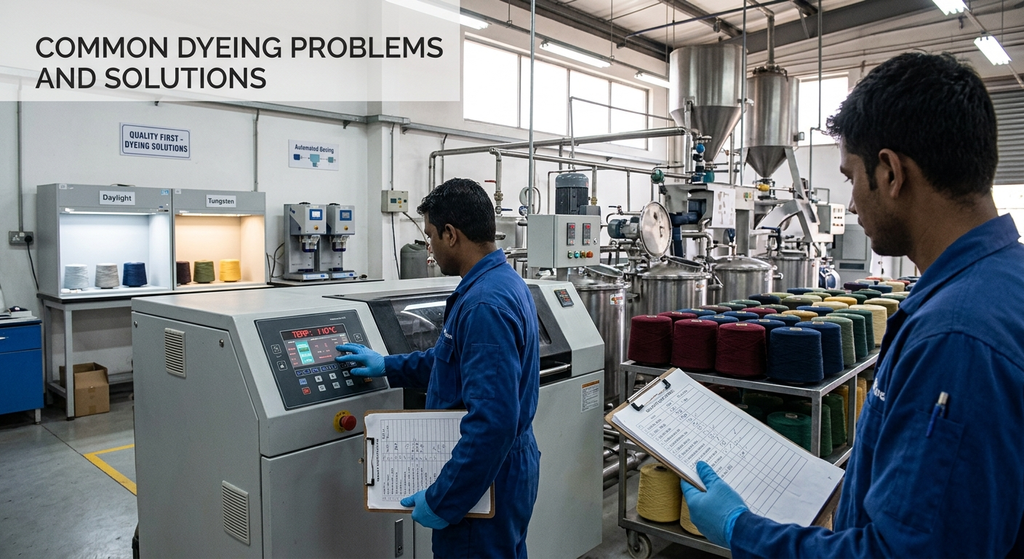
- Uneven dyeing (unlevelness): often caused by inconsistent package winding density, uneven liquor flow, or too-rapid heating; addressed through controlled winding tension, verified liquor circulation, and slower, staged temperature ramps.
- Shade variation between lots: usually traced to dye-weighing inaccuracy, water quality changes, or machine-to-machine differences; mitigated with automated dosing systems, consistent water treatment, and standardized recipes per machine.
- Poor colorfastness: typically the result of incomplete reduction clearing (unfixed dye left on the yarn surface); resolved with a properly timed and dosed alkaline reduction-clearing step after dyeing.
- Crease marks and package deformation: caused by uneven pressure or poor package preparation before loading; addressed through correct package density and careful carrier loading.
- Metamerism (shade looks right under one light, wrong under another): managed by approving color under multiple standardized light sources during lab dip and bulk approval rather than a single light condition.
- Fiber damage or excessive shrinkage: linked to overly aggressive temperature or carrier use; controlled by matching the dyeing recipe to the specific polyester yarn type (textured, flat, recycled, or blended).
Applications of Dyed Polyester Yarn
Dyed polyester yarn is a core input across a wide range of end products because of polyester’s durability, dimensional stability, and broad color range. Common applications include:

- Apparel fabrics: shirting, activewear, linings, and blended fabrics where color-fast, wash-durable yarn is essential.
- Home textiles: upholstery fabric, curtains, bedding, and decorative textiles that need light-fastness and long-term color retention.
- Technical and industrial textiles: webbing, tapes, filtration fabrics, and reinforcement materials where color may indicate product grade or simply match brand specifications.
- Automotive interior textiles: seat fabrics and trims that must meet strict light-fastness and heat-resistance requirements.
- Sportswear and outdoor fabrics: performance textiles that combine moisture management with vibrant, durable color.
- Carpets and rugs: including space-dyed yarns for multi-color pile designs.
Factors Buyers Should Consider When Sourcing Dyed Polyester Yarn
For sourcing managers and procurement teams evaluating a polyester dyed yarn supplier, a structured evaluation reduces the risk of costly quality or delivery surprises later in the program. Before finalizing a supplier, it is worth reviewing our questions to ask before buying yarn and understanding the practical differences covered in yarn supplier vs. yarn manufacturer, since the answer changes how much direct process control and accountability you actually get. Key factors to evaluate include:
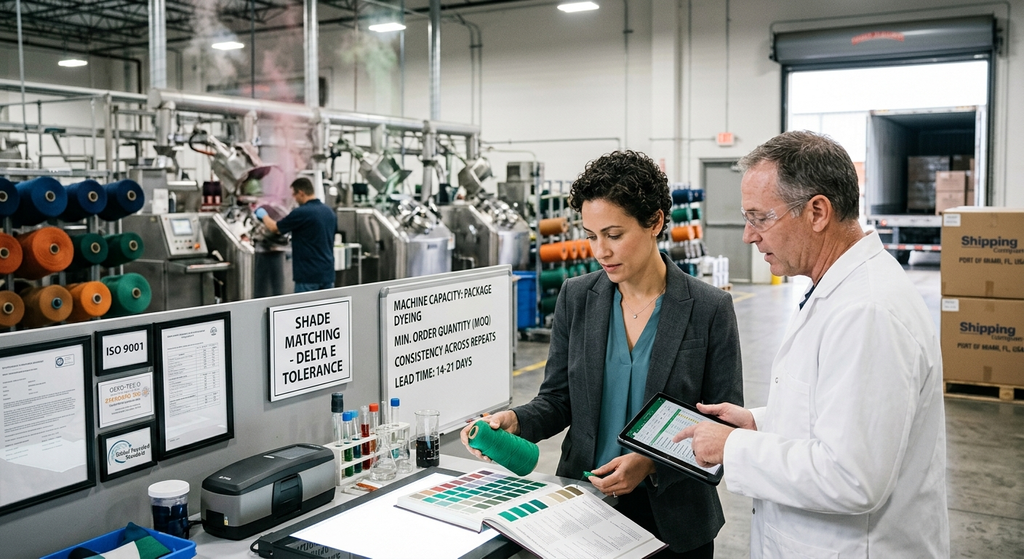
- Dyeing capability and machine capacity: does the supplier operate its own package-dyeing infrastructure, or does it outsource dyeing to a third party which affects lead time, cost, and quality accountability?
- Shade-matching process: how are lab dips approved, what tolerance (Delta E) is used, and under what lighting conditions is bulk color checked?
- Minimum order quantities (MOQs) per color: smaller MOQs support wider color ranges for fashion and seasonal programs; larger MOQs typically bring better unit economics for commodity solid shades.
- Certifications: relevant certifications such as ISO 9001 for quality management, OEKO-TEX STANDARD 100 for chemical safety, and, where applicable, GRS (Global Recycled Standard) for recycled-content claims.
- Testing capability: in-house colorfastness and physical testing versus reliance on third-party labs, and how quickly test reports can be produced.
- Consistency across repeat orders: whether the supplier can reliably reproduce an approved shade on a reorder placed months later.
- Lead times and logistics: dyeing, drying, and packing timelines, plus experience shipping to North American ports and handling the documentation import compliance requires.
- Sustainability practices: effluent treatment, water and energy use, and chemical management aligned with frameworks such as ZDHC.
Polyester Yarn Dyeing for Different Textile Applications
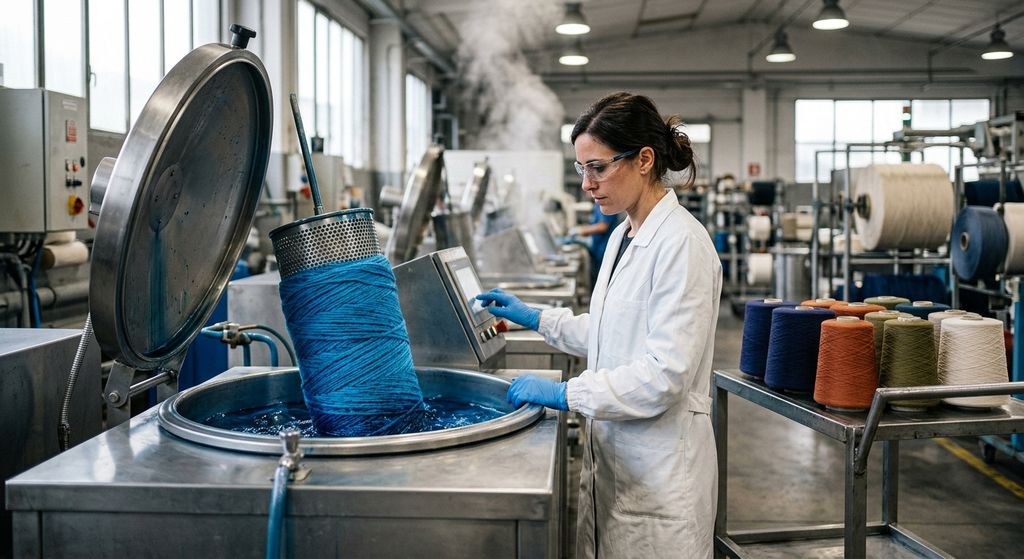
Dyeing parameters are not one-size-fits-all; they are adjusted based on the yarn’s end use. Apparel-grade yarn dyeing generally prioritizes a soft hand-feel, wide and precise color range, and strong wash fastness for garments that will be laundered repeatedly. Home-textile and upholstery applications place heavier weight on light-fastness, since curtains and furnishing fabrics face prolonged sun exposure. Technical and industrial textile yarn dyeing is judged more on functional consistency and compatibility with downstream coating or lamination than on subtle shade variation. Buyers producing blended fabrics should also confirm the dye recipe accounts for the second fiber, since polyester/cotton or polyester/viscose blends often require a two-stage dyeing approach to achieve even color on both components.
Sustainability and Environmental Considerations in Polyester Yarn Dyeing
Dyeing is one of the more resource-intensive stages of textile production, and North American brands are under growing pressure from retailers, regulators, and consumers to show credible progress on water use, chemical management, and emissions. Several developments are shaping how polyester yarn dyeing is evaluated on sustainability today:
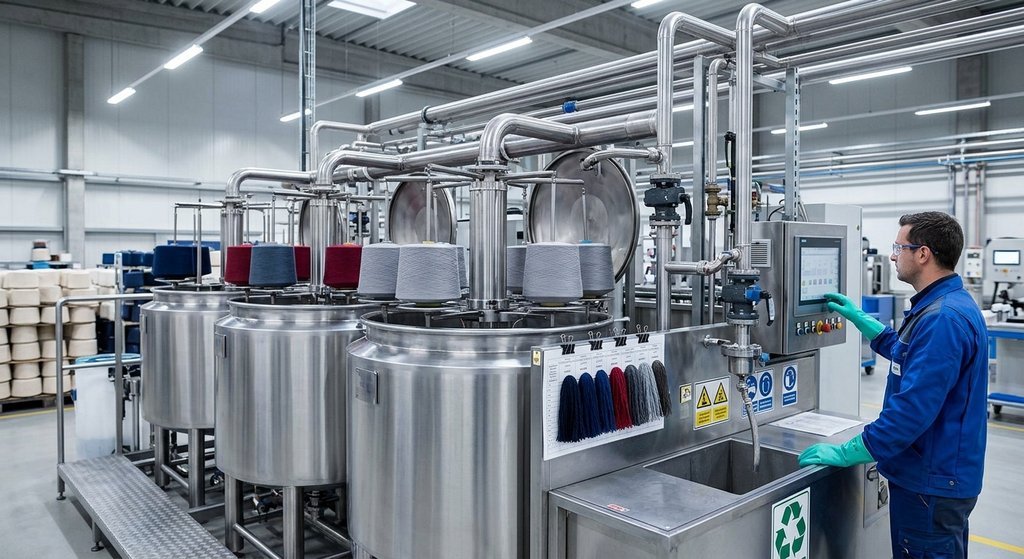
- Water and chemical stewardship frameworks: initiatives such as the Zero Discharge of Hazardous Chemicals (ZDHC) Roadmap to Zero Programme and the bluesign system give brands a structured way to evaluate a dye house’s chemical inputs and wastewater management.
- Effluent treatment: because conventional dyeing is water- and energy-intensive, on-site effluent treatment plants that treat and, where possible, recycle process water are increasingly a baseline requirement for export-oriented suppliers rather than a differentiator.
- Recycled polyester (rPET) dyeing: yarn made from recycled PET can generally be dyed using the same disperse-dye chemistry as virgin polyester, though dye uptake and shade reproducibility can vary slightly depending on the recycled feedstock’s consistency, which is why buyers should ask suppliers how they qualify recycled lots before dyeing. Readers evaluating recycled options can start with our recycled polyester yarn guide for a fuller breakdown of the material itself.
- Emerging low- and no-water technologies: methods such as supercritical CO2 dyeing and reformulated low-temperature disperse dye systems are being researched and piloted as ways to cut water use significantly, though they remain a smaller share of global production capacity compared with conventional aqueous package dyeing.
- Chemical safety certification: OEKO-TEX STANDARD 100 certification verifies that a textile product, including dyed yarn, has been tested against a defined list of substances that may be harmful to human health, which is a common requirement in North American retailer vendor manuals.
Buyers evaluating a supplier’s environmental claims should ask for documentation test reports, certificates, and effluent-treatment records rather than relying on general statements, since verified evidence is what most North American compliance and ESG reporting programs now require.
North American Sourcing Considerations for Dyed Polyester Yarn
Sourcing dyed polyester yarn into the United States or Canada involves more than agreeing on a shade and a price. A few considerations specific to North American import programs:
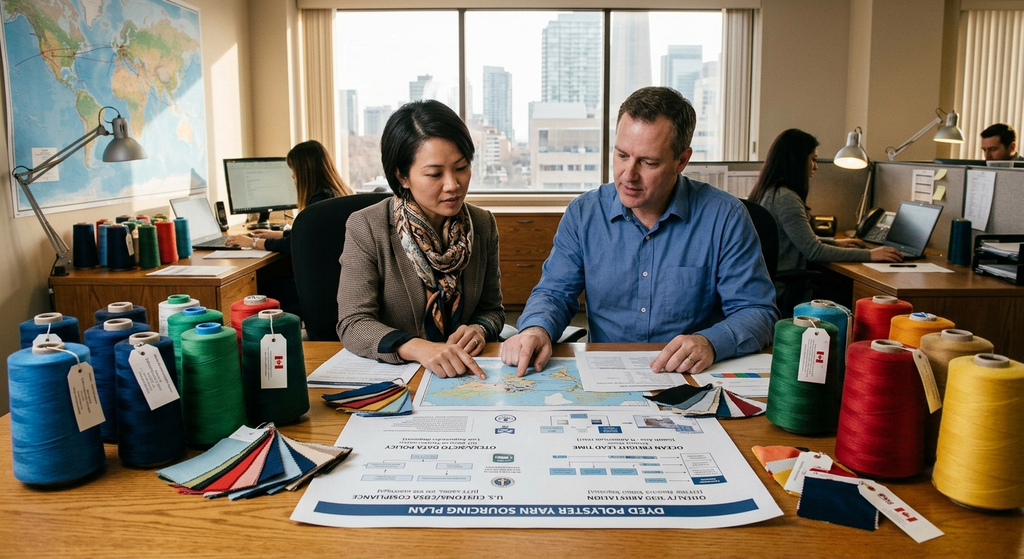
- Import documentation and compliance: shipments into the U.S. are subject to U.S. Customs and Border Protection requirements, and importers should confirm HTS classification, country-of-origin marking, and any applicable duty rates before finalizing a purchase order; our guide on how to import yarn from India to the USA walks through the practical steps.
- Canadian import requirements: importers bringing yarn into Canada work with the Canada Border Services Agency on tariff classification and applicable duty treatment, including preferential rates available under specific trade agreements.
- Industry data and context: the U.S. Department of Commerce Office of Textiles and Apparel (OTEXA) and the National Council of Textile Organizations (NCTO) publish trade data and policy updates that are useful background for buyers tracking the North American textile and yarn market.
- Lead time planning around ocean freight: transit time from South Asian dye houses to North American ports, combined with inland trucking, should be built into color-approval and production calendars so a delayed lab-dip approval doesn’t compromise a retail delivery window.
- Quality documentation expected by North American retailers: many U.S. and Canadian retail and brand vendor manuals require lab dip approval records, bulk-dye test reports, and colourfastness results as a condition of purchase order acceptance.
- Communication and time-zone alignment: a supplier with an established North American client base typically has processes in place sample couriers, digital color communication tools, and responsive account management to keep shade approval cycles moving despite the time difference.
- MOQ and inventory strategy: many North American brands manage seasonal color changes with smaller, more frequent dyed-yarn orders; suppliers who can support a broader range of MOQs per shade are often a better long-term fit than those built solely around large commodity runs.
The Role of an Experienced Polyester Yarn Supplier
An experienced polyester dyed yarn supplier does more than run a dyeing machine it manages the variables that determine whether the third reorder matches the first approved shade as closely as the second one did. That includes maintaining detailed dye recipes and machine calibration records, qualifying raw material and water quality consistently, training dye-house technicians on both the chemistry and the equipment, and investing in color-measurement technology rather than relying purely on visual judgment. Buyers new to the category often benefit from understanding the difference between a yarn supplier and a yarn manufacturer, since manufacturers that control their own spinning, dyeing, and testing generally offer more traceability and faster problem resolution than trading intermediaries.
Experience also shows up in how a supplier handles the inevitable exceptions a delayed lab dip, a borderline fastness result, a last-minute quantity change because a mill that has worked through those situations for years typically has documented processes for resolving them, rather than improvising each time.
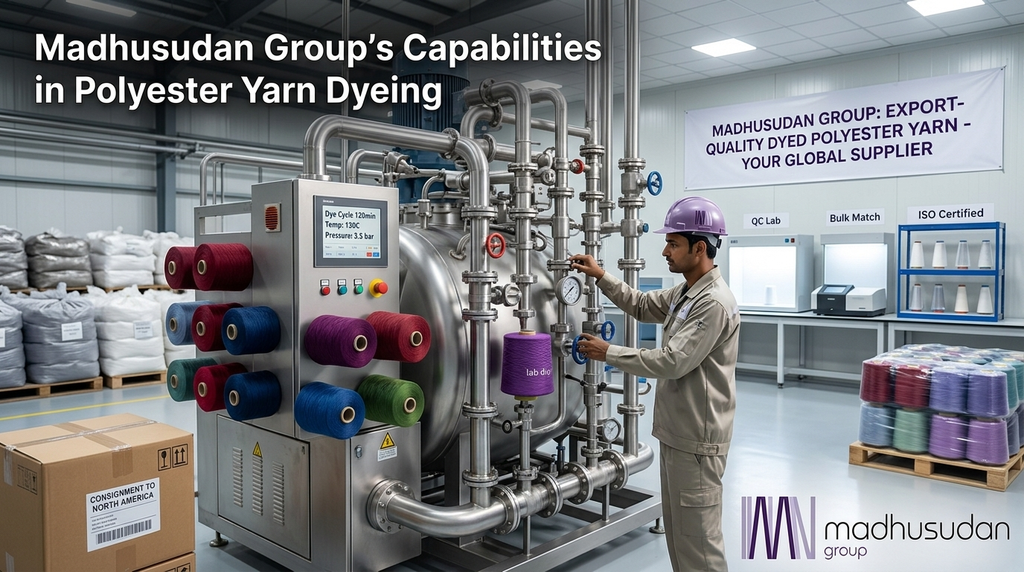
Madhusudan Group’s Capabilities in Polyester Yarn Dyeing
Madhusudan Group is a Surat, India-based yarn manufacturer and exporter with a manufacturing base in one of the world’s largest man-made textile hubs. The company works across polyester and blended yarn categories including dyed polyester yarn supplying textile manufacturers, apparel producers, and industrial buyers, with export experience serving international markets including North America. As a brand positioning statement rather than an unsupported ranking claim, Madhusudan Group presents itself as a leading provider of polyester yarn dyeing and related yarn solutions for B2B buyers who need consistent color, dependable lead times, and manufacturer-level accountability.
Buyers can review the company’s broader dyeing capabilities in the dyed polyester yarn guide, its industrial-scale production covered in the industrial yarn supplier overview, and its quality framework outlined in the ISO-certified yarn supplier page. For buyers comparing capacity across the supplier landscape, the leading yarn manufacturers in India guide and the premium yarn manufacturer and supplier overview provide additional context on how Madhusudan Group’s offering fits within the broader Indian yarn manufacturing base, while the polyester yarn supplier operating globally page speaks to its export reach beyond India. Prospective buyers evaluating volume programs may also find the bulk yarn supplier in India resource useful for understanding minimum order and capacity planning.
As with any supplier evaluation, buyers should request current certificates, lab dip and bulk-match documentation, and references relevant to their specific application before committing to a program, since requirements vary meaningfully between apparel, home-textile, and technical-textile end uses.
Frequently Asked Questions
What is polyester yarn dyeing?
Polyester yarn dyeing is the process of coloring polyester yarn rather than fiber or finished fabric using disperse dyes under high temperature and, typically, pressure, so the dye can diffuse into polyester’s dense fiber structure.
What temperature is polyester yarn dyed at?
Most bulk polyester yarn dyeing uses the high-temperature, high-pressure (HTHP) method, typically in the range of roughly 120–135°C inside a closed, pressurized dyeing vessel, which allows disperse dye to penetrate the fiber fully.
What dyes are used to dye polyester yarn?
Disperse dyes are the standard dye class for polyester because they are formulated as fine, water-insoluble particles that can diffuse into polyester’s compact molecular structure under heat, unlike dye classes designed for natural fibers.
What is the difference between package dyeing and fiber (stock) dyeing?
Package dyeing colors yarn that has already been spun, wound onto cones or cheeses, which supports fast shade changes and moderate order volumes. Fiber (stock) dyeing colors loose fiber before spinning, which is typically used for melange effects or very large, long-running solid-shade programs.
How can buyers check the color consistency of dyed polyester yarn?
Buyers can request lab dip approval records, bulk-to-standard Delta E measurements from a spectrophotometer, and cross-lot matching data, and can ask suppliers to demonstrate visual approval under multiple standardized light sources to rule out metamerism.
Is polyester yarn dyeing environmentally friendly?
Conventional aqueous dyeing is water- and energy-intensive, but its environmental impact can be significantly reduced through effluent treatment and water recycling, adherence to chemical-management frameworks such as ZDHC, and certifications such as OEKO-TEX STANDARD 100; emerging low-water technologies are also narrowing the gap further, though they are not yet the industry default.
What should I look for in a dyed polyester yarn supplier?
Look for demonstrated dyeing capability and machine capacity, a documented shade-approval process with clear tolerances, relevant certifications (ISO 9001, OEKO-TEX, and GRS where recycled content is claimed), in-house or accredited fastness testing, and a track record of reproducing approved shades on repeat orders.
Can recycled polyester yarn be dyed the same way as virgin polyester yarn?
Recycled polyester (rPET) yarn is generally dyed using the same disperse-dye, high-temperature process as virgin polyester, though dye uptake can vary slightly with feedstock consistency, so it is worth asking suppliers how they qualify recycled lots before dyeing to bulk.
Conclusion
Polyester yarn dyeing sits at the intersection of chemistry, machinery, and quality discipline, and getting it right consistently order after order, dye lot after dye lot is what separates a dependable long-term supplier from a source of recurring shade headaches. For North American textile manufacturers, apparel brands, and sourcing teams, the safest path is working with a manufacturer that controls its own dyeing process, documents its quality checks, and can speak concretely about certifications, testing, and sustainability practices rather than in general claims.
Madhusudan Group works with B2B buyers across North America on dyed polyester yarn programs, from lab dip approval through bulk production and export logistics. If you are evaluating suppliers for an upcoming program, request a quote or a sample lot to see shade accuracy and consistency first hand before committing to volume.