Sourcing twisted yarn for a manufacturing line, a weaving unit, or an export order is rarely just a matter of finding “a supplier.” Buyers need a partner who can hold twist parameters consistent across lots, meet delivery schedules without excuses, and explain in plain technical terms why one yarn construction will perform better on a customer’s machine than another. India has spent decades building the raw material base, spinning capacity, and export infrastructure to serve exactly this kind of demand, which is why so many procurement teams researching a twisted yarn manufacturer in India end up comparing options here rather than looking further afield.
This guide is written for the people who actually make sourcing decisions: textile manufacturers, garment and fabric producers, wholesalers, sourcing managers, procurement teams, and exporters. It walks through what twisted yarn is and how it is made, the types and applications relevant to different industries, what India’s manufacturing base offers, and most importantly the practical checklist you should run through before signing off on a supplier: specifications, MOQ, lead time, pricing, testing, certification, packaging, and communication. Buyer questions are addressed directly in the FAQ section near the end.
What Is Twisted Yarn?
Twisted yarn is created by taking two or more strands of yarn or, in some cases, a single strand with additional twist inserted and combining them under controlled tension and rotation so the resulting yarn behaves as one integrated thread. The process is different from simply spinning a single yarn from staple fibre or filament tow, because twisting happens after the base yarns already exist. A single-ply yarn is twisted with itself or another single to build strength, bulk, or a specific surface texture that the individual strands could not achieve alone.
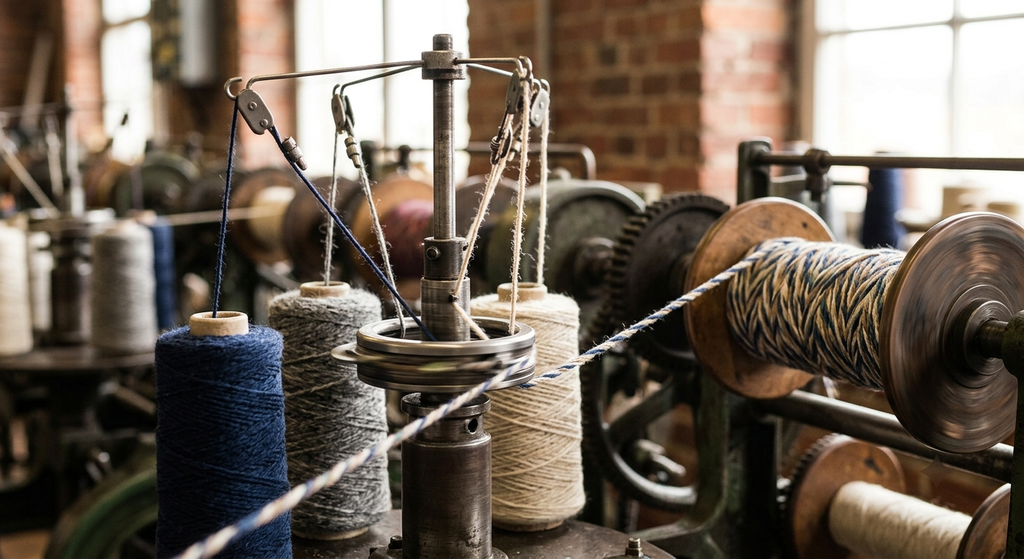
Buyers researching suppliers often use “twisted yarn,” “doubled yarn,” “plied yarn,” and “cabled yarn” somewhat interchangeably, but they describe related steps in the same family of processes: combining strands and inserting twist to change the yarn’s mechanical and visual properties.
Why Manufacturers Twist Yarn in the First Place
Twisting is not a cosmetic step. It changes how a yarn performs in downstream processes and in the final product:
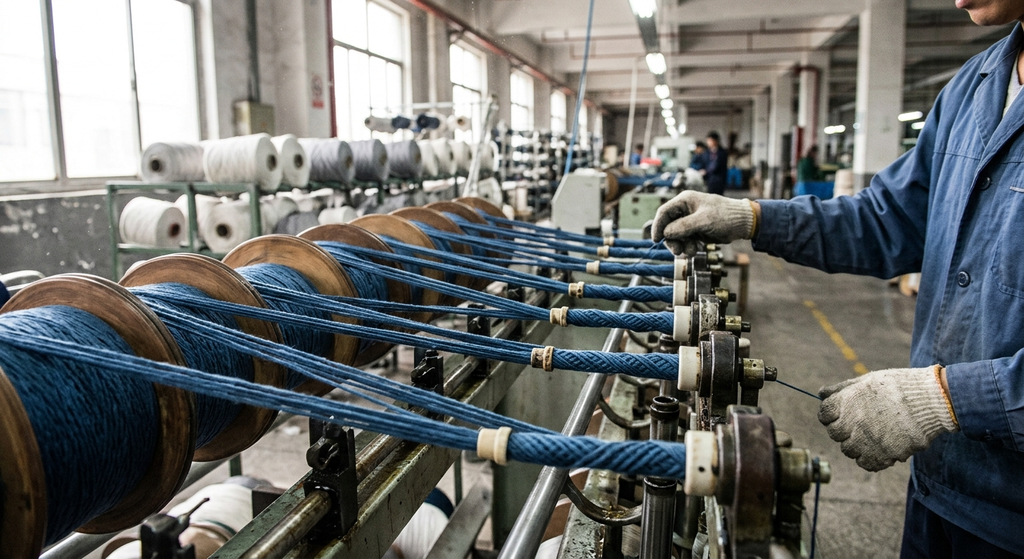
- Strength and abrasion resistance. Twisting distributes load across multiple strands, which is why sewing threads, industrial yarns, and cordage are almost always plied or cabled rather than used as a single strand.
- Dimensional stability. A twisted structure resists stretching and shrinkage better than a loose single yarn, which matters for weaving and technical textile applications.
- Bulk and hand-feel. Twist level changes how a fabric drapes, how thick a yarn feels, and how it takes dye or finish.
- Balance. Correctly balanced twist prevents a yarn from kinking, snarling, or “living” (twisting on itself) once tension is released a defect that shows up as puckering in woven or knitted fabric.
Key Twist Terminology Buyers Should Know
A few terms come up in almost every technical conversation with a manufacturer, and it helps to walk in already familiar with them:
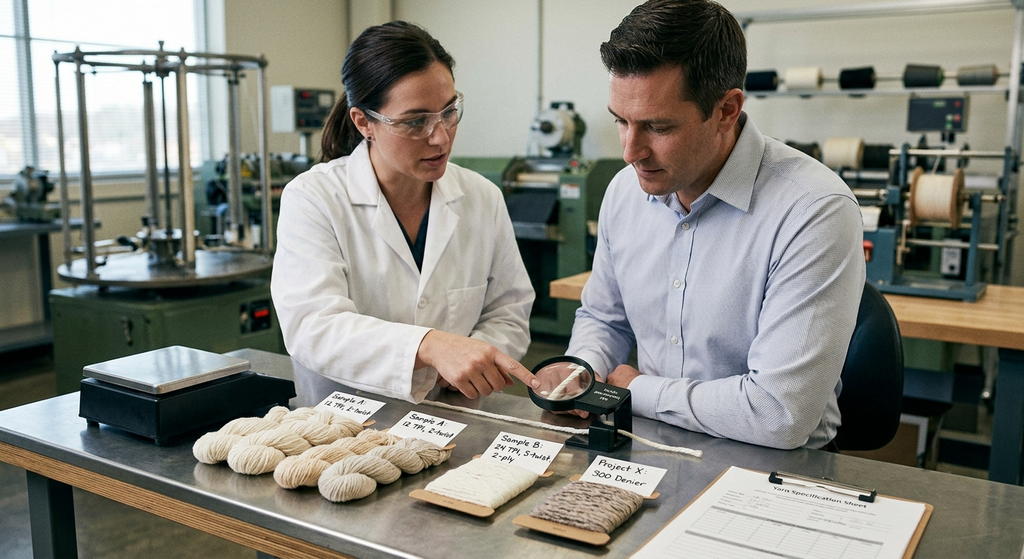
Twists Per Inch (TPI) / Twists Per Metre (TPM). This is the number of twist turns inserted per unit length and is the primary specification a buyer will quote or request. Higher TPI generally produces a firmer, stronger, more compact yarn; lower TPI produces a softer, bulkier yarn.
S-twist and Z-twist. These describe the direction of the twist, named for the diagonal slant they create (matching the middle stroke of the letters S and Z). The direction matters for balance in plying two singles spun in one direction are typically plied in the opposite direction to create a stable, balanced yarn and it also affects fabric appearance in certain weave and knit structures.
Ply count. A “2-ply” yarn combines two single strands; “3-ply” combines three, and so on. Ply count and TPI together determine the final linear density (count) and strength of the twisted yarn.
Count / linear density. Expressed in systems such as English cotton count (Ne), denier, or tex depending on the fibre and market, this indicates how thick or fine the finished yarn is a critical specification for compatibility with a buyer’s existing machinery and fabric design.
How Twisted Yarn Is Manufactured
Understanding the manufacturing sequence helps buyers ask sharper questions during supplier evaluation, and it separates a genuine yarn twisting unit from a trader repackaging someone else’s output. For a step-by-step walkthrough of each stage, see this yarn manufacturing process guide.
Raw Material Selection and Preparation
The process begins with the base singles yarn spun from cotton, polyester, viscose, or blended fibre, or drawn as a synthetic filament. Manufacturers that also run their own spinning operations have more control over consistency, because variation introduced at the spinning stage (uneven count, weak spots, and contamination) carries through into the twisted product and cannot be fully corrected later.
Doubling and Assembly
Two or more singles are wound together onto a single package in a step commonly called doubling or assembly winding. This step aligns the strands so they feed into the twisting machine evenly, without one strand running slack or over-tensioned relative to the other.
Twisting
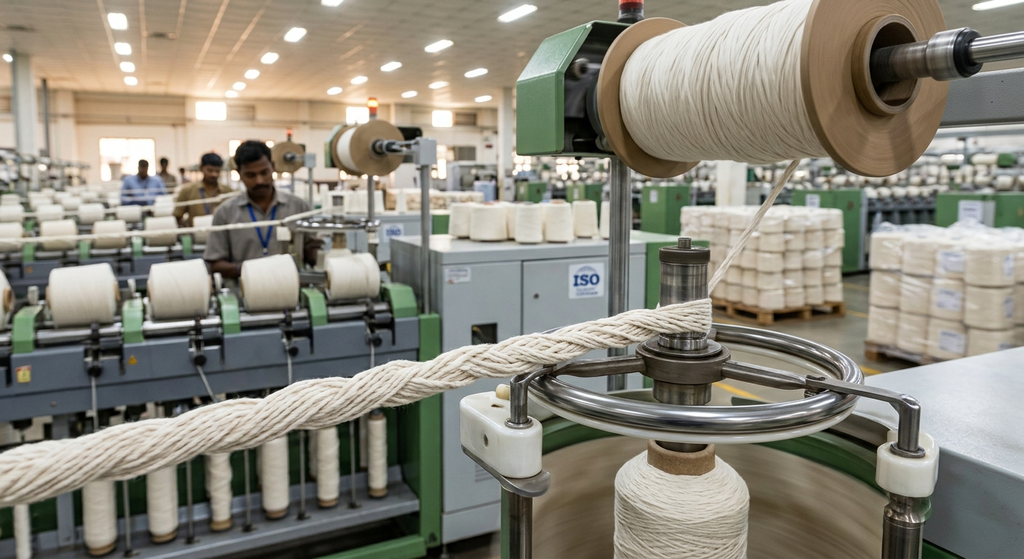
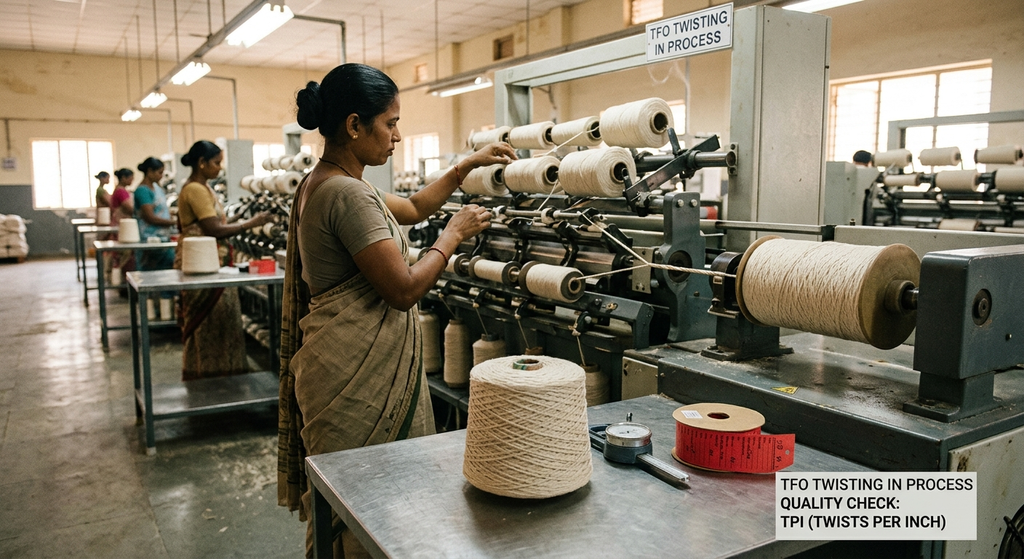
The assembled strands then pass through a twisting machine, where rotation is inserted to bind them into one yarn. Indian manufacturers commonly use a few established methods:
- Ring twisting, which produces a firm, well-bound yarn and is widely used for sewing threads and general-purpose twisted yarns.
- Two-for-one (TFO) twisting, which inserts two turns of twist per spindle rotation, improving output efficiency for many industrial and technical yarn orders.
- Cabling, used when two already-plied yarns are twisted together again to build heavier cords, ropes, or technical yarns that need additional bulk and strength.
The choice of method depends on the final count, the fibre type, and the application the buyer has specified — this is a point worth discussing directly with a prospective manufacturer rather than assuming one process fits every order.
Setting, Conditioning, and Winding
Freshly twisted yarn carries internal torque (residual twist liveliness) that, left untreated, causes the yarn to kink or snarl. Manufacturers typically condition or heat-set the yarn to stabilise the twist before it is wound onto cones, hanks, or bobbins for dispatch, in the format the buyer’s downstream process requires.
Machine Parameters That Shape the Final Yarn
Two orders using the same fibre and the same nominal count can still behave differently on a buyer’s machine if the underlying process parameters differ. Spindle speed affects both output rate and the evenness of twist insertion; tension settings across the doubling and twisting stages determine whether both strands in a ply carry load equally (a mismatch here produces a yarn where one strand runs slack, weakening the whole structure); and the package type used for winding cones, cheeses, or hanks affects how evenly the yarn unwinds during a buyer’s own weaving, knitting, or sewing operation. Buyers evaluating a manufacturer’s technical competence often get more useful signal from questions about these parameters than from questions about count and TPI alone, since count and TPI are relatively easy to state correctly even when process control is weak.
Quality Control Checkpoints
A manufacturer with disciplined process control checks yarn at several stages rather than only at the end: incoming raw material, in-process TPI and evenness checks during twisting, and final inspection before packing. Buyers evaluating a supplier should ask specifically where in the process these checkpoints occur, rather than accepting a general assurance of “we check quality.”
Types of Twisted Yarn Available from Indian Manufacturers
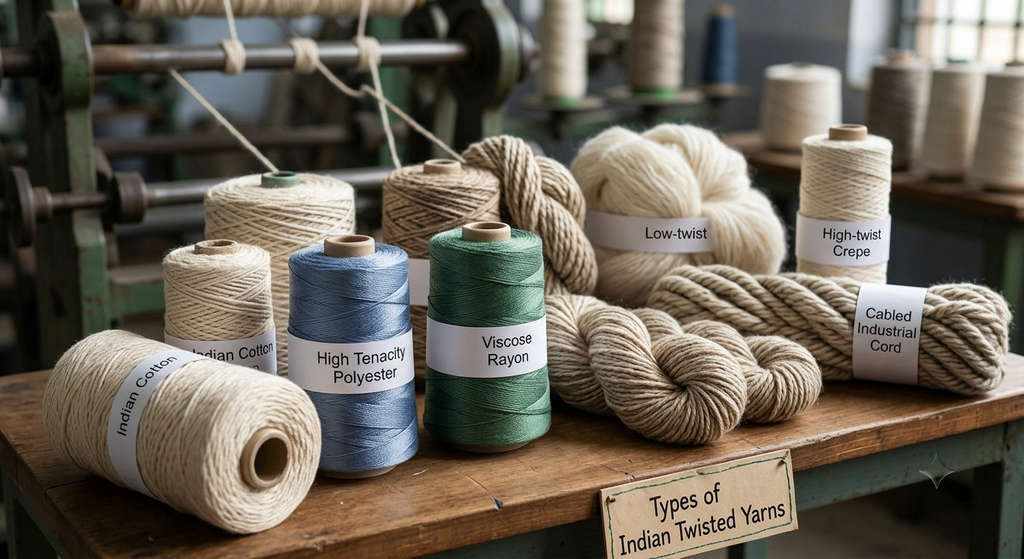
India’s manufacturing base covers a wide range of twisted yarn types, and matching the right type to your application is the single most important technical decision in the sourcing process.
By Fibre Type
Cotton twisted yarn remains a core category given India’s position as one of the world’s largest cotton producers, used widely in weaving, knitting, and sewing thread applications where natural fibre characteristics — breathability, dye uptake, hand-feel are required.
Polyester twisted yarn is valued for its strength, low shrinkage, and dimensional stability, and is common in industrial sewing thread, technical textiles, and blended fabric construction.
Viscose twisted yarn offers a softer hand-feel with good drape, often chosen for fashion fabrics and home textiles.
Blended twisted yarn (cotton-polyester, polyester-viscose, and other combinations) is engineered to combine the strengths of each fibre for example, the durability of polyester with the comfort of cotton and is frequently specified by garment manufacturers looking for a particular fabric performance profile.
By Construction
Single-ply twisted yarn carries additional twist inserted into one strand, most often used where a firmer single yarn is required without full plying.
Multi-ply (2-ply, 3-ply, and higher) combines two or more singles, increasing strength and creating a rounder, more uniform yarn cross-section the standard construction for sewing threads and general industrial use.
Cabled yarn takes the plying process a step further, twisting plied yarns together again, and is used for heavier-duty applications such as cordage, technical textiles, and some upholstery yarns.
By Twist Level
Low-twist yarn produces a soft, bulky yarn suited to applications where hand-feel and loft matter more than maximum tensile strength.
Medium-twist yarn is the balanced, general-purpose choice for most weaving and knitting applications.
High-twist (crepe-level) yarn produces a firm, sometimes textured yarn used in specific fabric finishes and industrial applications where strength and compactness are the priority.
Twisted Yarn vs Single Yarn vs Cabled Yarn: Choosing the Right Construction
Buyers new to yarn sourcing sometimes default to whatever construction a previous supplier offered, without checking whether it is actually the best fit for the current application. It is worth pausing on the distinction:
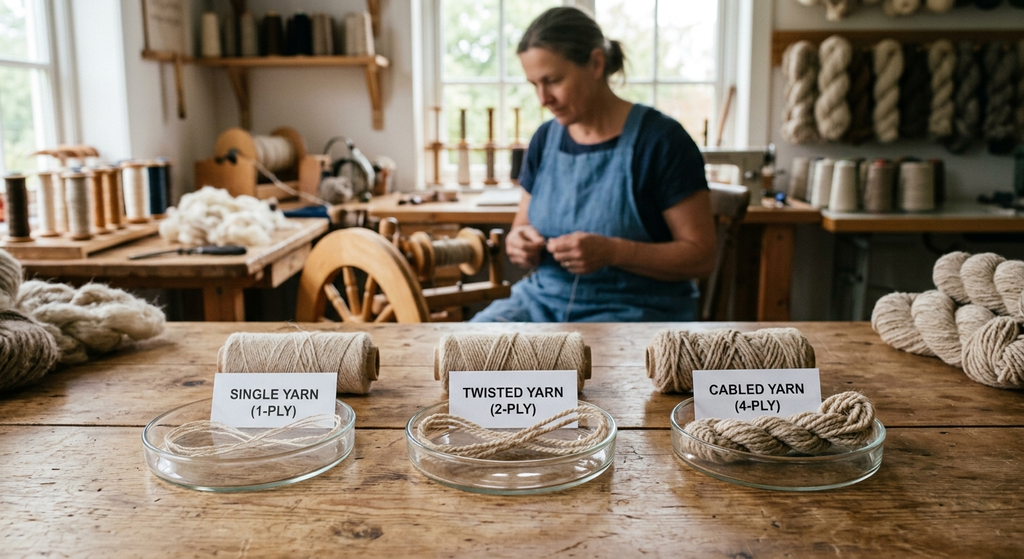
Single yarn is the base output of spinning one continuous strand with no additional plying. It is lighter, less expensive to produce, and adequate for applications where high strength or bulk is not a priority, such as some lightweight woven or knitted fabrics.
Twisted (plied) yarn combines two or more singles with twist to increase strength, improve evenness, and create a rounder cross-section. This is the right choice whenever the end application involves repeated stress, abrasion, or a need for a more uniform yarn diameter sewing thread being the clearest example, since a single yarn would fail quickly under sewing machine tension.
Cabled yarn plies already-plied yarns together again, producing a heavier, denser structure used for cordage, technical textiles, upholstery, and other applications where load-bearing capacity matters more than fineness.
Getting this choice right at the specification stage avoids a common and costly mistake: ordering a construction that looks similar on paper but performs differently once it reaches a buyer’s own machinery. When in doubt, share your end application with the manufacturer’s technical team before finalizing a specification, rather than after a bulk order has already been produced.
Applications of Twisted Yarn across Industries
Twisted yarn’s versatility is precisely why demand spans so many buyer categories:
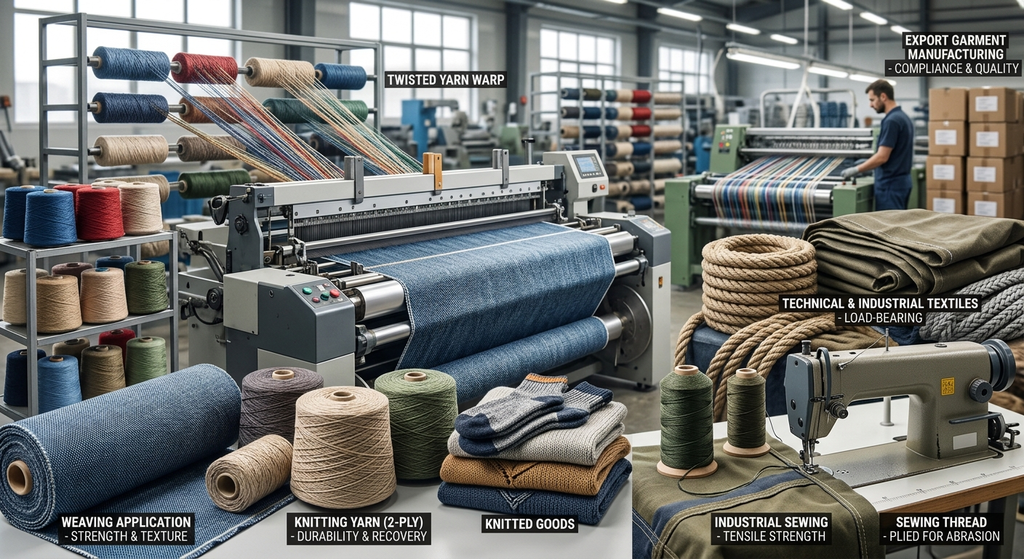
- Weaving. Twisted yarns are used as warp and weft in woven fabrics where added strength or a specific texture is needed beyond what a single yarn provides.
- Knitting. Plied yarns give knitted fabric better recovery and durability, particularly in structures subject to repeated stretch.
- Sewing thread. Almost all industrial and household sewing thread is plied typically 2-ply or 3-ply because a single yarn would not withstand the tension and abrasion of high-speed sewing machines.
- Home textiles. Twisted yarns are used in upholstery fabric, curtains, and other furnishing textiles where bulk, texture, and durability are all relevant.
- Technical and industrial textiles. Cabled and high-twist yarns feature in ropes, cordage, tarpaulins, geotextiles, and other technical applications where load-bearing performance is essential.
- Export garment manufacturing. Twisted yarn specifications are frequently written into buyer technical packs for apparel destined for international markets, making consistent supply a compliance issue as much as a quality one.
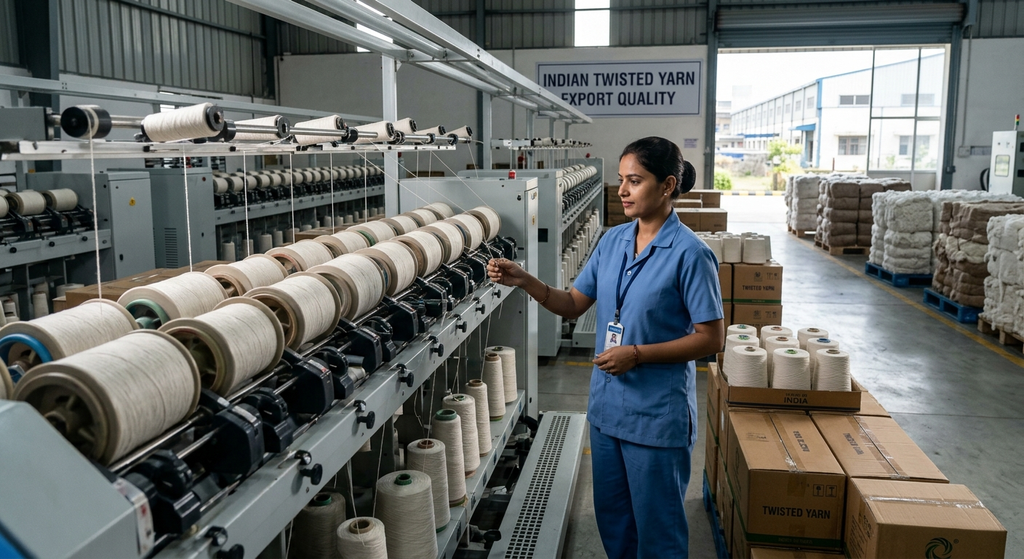
Why India Is a Preferred Sourcing Destination for Twisted Yarn
Several structural factors explain why global and domestic buyers continue to source twisted yarn from Indian manufacturers rather than treating India as just one option among many.
Raw Material Availability
India is among the largest cotton-producing countries in the world, giving domestic twisted yarn manufacturers direct access to raw material without the same import dependency faced by manufacturers in some other regions. Cotton procurement and price support at the national level are coordinated by the Cotton Corporation of India, a public sector undertaking that helps stabilise raw cotton availability for the spinning and twisting industry. This proximity to raw cotton, combined with an established man-made fibre and filament yarn industry, allows manufacturers to offer a wide range of fibre options cotton, polyester, viscose, and blends often from the same production base.
Manufacturing Scale and Cost Competitiveness
A large, well-established spinning and twisting industry means Indian manufacturers can often offer competitive pricing on bulk orders without compromising on process discipline, particularly for standard counts and constructions that are produced at scale.
Established Textile Manufacturing Hubs
India’s textile industry is concentrated in a number of well-known clusters, each with its own specialisation built up over decades:
- Tamil Nadu (including Coimbatore and Tirupur) is one of India’s most significant spinning and knitwear manufacturing regions, with deep expertise in cotton yarn production and downstream knitting.
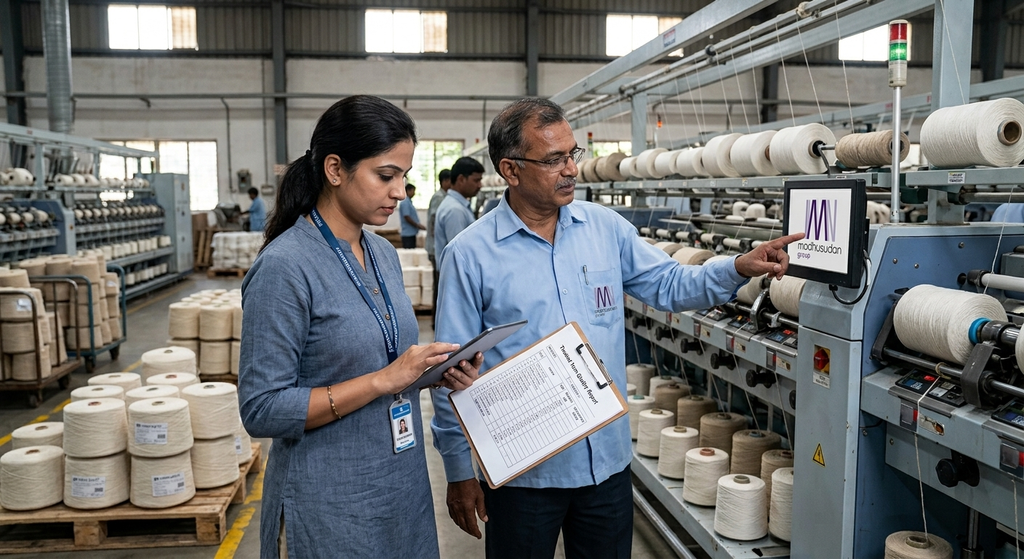
- Gujarat (including Surat and Ahmedabad) has a strong presence in man-made fibre yarn, weaving, and processing, supporting both domestic and export-oriented textile production see this overview of industrial yarn suppliers in Gujarat for a closer look at the cluster. The evolution of this hub is visible in vertically integrated groups such as Surat-based Madhusudan Group, which built its early business on fancy filament yarn manufacturing and has since expanded across yarn texturising, dyeing, weaving, and fabric processing, moving into functional and bi-component yarns for sport-tech, home-tech, and technical applications an example of how far Gujarat’s yarn manufacturing base has grown beyond commodity twisting alone.
- Maharashtra (including Ichalkaranji and Solapur) has a long-established powerloom and yarn processing base.
- Punjab (including Ludhiana) is known for its hosiery and woollen yarn manufacturing tradition.
Buyers do not need to source from a specific cluster to get a quality product, but understanding this geography helps explain why so many manufacturers with genuine production capability are concentrated in these states, and why logistics and lead times can vary depending on where a supplier is based relative to the buyer’s port or destination. A manufacturer based near a major port or inland container depot, for instance, can often quote a shorter and more predictable transit time for export shipments than one located further from established freight corridors — a practical detail worth confirming during supplier evaluation rather than assuming it is uniform across the country.
India’s Position in Global Yarn and Textile Trade
India’s textile and apparel sector is one of the largest contributors to the country’s manufacturing exports, supported by a domestic value chain that runs from raw fibre through spinning, twisting, weaving or knitting, processing, and garmenting often within the same industrial cluster. Sector-wide policy, export promotion, and production data for this value chain are coordinated by the Ministry of Textiles, Government of India, which oversees the man-made fibre and filament yarn industry alongside cotton, jute, silk, and wool. For a buyer, this integrated supply base means a twisted yarn manufacturer is frequently working within an ecosystem that already understands downstream fabric and garment requirements, rather than operating in isolation from the industries it supplies.
Export Infrastructure and Experience
Decades of textile export activity have built up logistics, documentation, and compliance experience among Indian manufacturers dealing with international buyers, which matters as much as the yarn itself when an order needs to clear customs on schedule.
Skilled Technical Workforce
Yarn twisting requires trained operators who can read TPI variation, spot balance problems, and adjust tension settings skills built up over generations in India’s established spinning and twisting mills.
What to Evaluate When Choosing a Twisted Yarn Manufacturer in India
This is the section that matters most for a procurement team actually placing an order. Treat it as a checklist rather than a narrative for a shorter version you can run through on a first call, see these questions to ask before buying yarn.
Product Specifications and Consistency
Ask for the exact specification range the manufacturer can hold: count/denier tolerance, TPI tolerance, twist direction, and ply construction. Consistency lot-to-lot is often more important than the headline specification, because a downstream weaving or knitting process tuned to one yarn behaviour will produce defects if later lots drift outside tolerance. Request lot-to-lot test data, not just a one-time sample report.
Production Capacity and Scalability
Understand whether the manufacturer’s stated capacity is dedicated production or shared across many customers’ orders. A supplier who can produce your trial order comfortably may still struggle to scale to your full annual requirement ask directly what monthly capacity is available for your specific count and construction.
Customization Capability
If your application needs a non-standard count, an unusual blend ratio, a specific twist level, or a particular put-up (cone size, hank weight), confirm the manufacturer’s actual experience with custom orders rather than only standard catalogue items. Customized twisted yarn often requires machine changeovers, and not every unit is set up to do this economically at smaller order sizes.
Minimum Order Quantity (MOQ)
MOQ varies significantly by count, fibre, and whether the order is a standard or customized construction. Standard, frequently produced counts typically carry lower MOQs than customized specifications, which may require a full production run to be economical for the manufacturer. Clarify MOQ early, since it directly affects whether a smaller buyer or a large-volume buyer is a good fit for a particular supplier.
Lead Time
Lead time depends on whether the manufacturer is twisting from yarn already in stock or spinning singles from raw fibre first. Ask for a lead time specific to your order not a generic company-wide figure and clarify how lead time changes for repeat orders versus first-time customized orders.
Pricing Considerations
Yarn pricing is influenced by fibre cost (which moves with cotton and polyester commodity markets), count and ply construction, twist level, order volume, and put-up format. A credible manufacturer will explain pricing components rather than quoting a single flat figure with no breakdown this transparency is itself a useful signal of a manufacturer’s professionalism.
Quality Testing
Ask what physical properties are tested (count, twist, tensile strength, evenness), what testing standards or methods are referenced, and whether test reports are shared with each shipment or only on request. Testing practices aligned with recognised Indian and international standards (see the section below) give buyers an objective basis for comparison across suppliers.
Certifications, Where Applicable
Depending on the product and export destination, certifications may be relevant quality management system certification, product-specific standard compliance, or sustainability-related certifications for buyers with ESG requirements in their supply chain. Ask a manufacturer directly which certifications apply to their specific product line rather than assuming a general certification covers every yarn type they produce.
Packaging
Confirm packaging format (cones, cheeses, hanks, bobbins), packaging weight, and protection against moisture and contamination during transit particularly important for export shipments travelling by sea over several weeks.
Supply Reliability
Ask about the manufacturers track record with repeat orders and their approach to communicating delays proactively rather than only when asked. For a buyer building a production schedule around a supply commitment, reliability of delivery timing is frequently as important as the yarn specification itself.
Communication and Technical Support
A manufacturer that can discuss twist balance, count tolerance, and fibre blend ratios in specific technical terms rather than only in marketing language is generally easier to work with over the life of an ongoing supply relationship, especially when a buyer needs to troubleshoot a downstream fabric defect traced back to yarn behaviour.
Bulk and Wholesale Sourcing: A Practical Guide for Procurement Teams
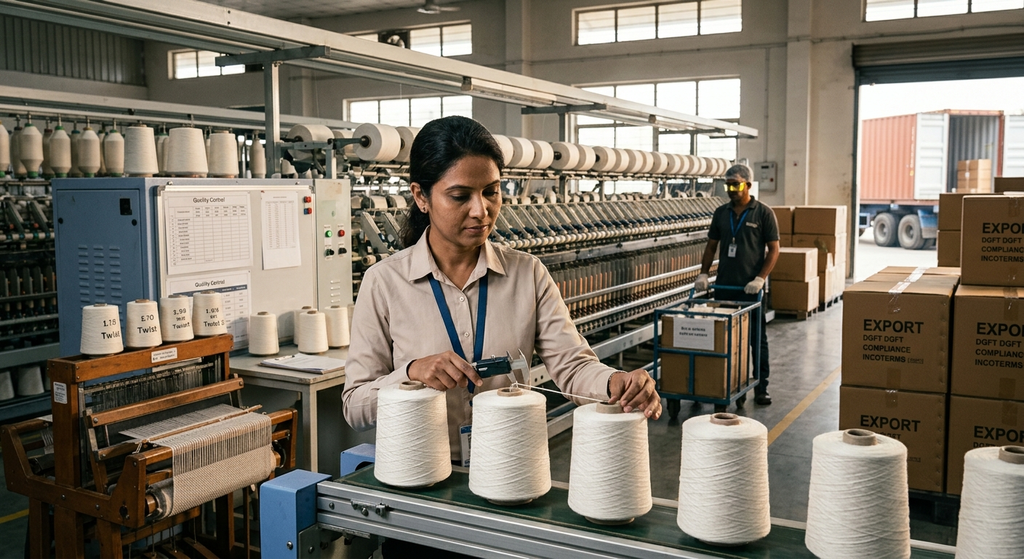
Procurement teams comparing bulk twisted yarn suppliers in India generally move through the same stages: specification, quotation, sampling, and trial order, before committing to a full production run.
Requesting a Quotation
A useful quotation request specifies fibre type, count/denier, ply and twist direction, TPI, put-up format, order quantity, and delivery location. The more precisely a buyer specifies these details upfront, the more comparable the quotations received from different manufacturers will be.
Sampling before Bulk Commitment
Request a physical sample against your exact specification before committing to a bulk order, and test it on your own machinery or against your fabric requirement where possible. A sample that looks correct on inspection can still behave differently once it reaches a weaving or knitting machine at production speed.
Negotiating MOQ and Trial Orders
Where MOQ is a barrier for a new buyer relationship, ask whether a trial order at a smaller quantity is available before a full bulk commitment many manufacturers accommodate this for new customers who indicate a credible path to a larger recurring order.
Considerations for International and Export Buyers
International buyers should clarify Incoterms, export documentation practices, and the manufacturer’s experience shipping to the buyer’s specific destination market, since customs and compliance requirements differ by country and product category. Export procedures, licensing, and the Importer-Exporter Code (IEC) requirement on the Indian side are administered by the Directorate General of Foreign Trade (DGFT), and it is worth confirming that a prospective manufacturer’s export documentation is current and consistent with DGFT’s requirements.
Working with Domestic Indian Buyers vs Export Buyers
The sourcing conversation looks somewhat different depending on whether a buyer is a domestic Indian manufacturer or an overseas importer. Domestic buyers typically deal directly in GST-compliant invoicing, shorter road or rail transit times, and faster iteration on sample-to-bulk timelines, which can make smaller trial orders more practical. Export buyers, by contrast, need to plan around sea or air freight schedules, letter-of-credit or advance-payment terms, and destination-country import compliance, all of which add lead time buffer that should be built into production planning from the outset. A manufacturer experienced in both types of buyer relationships is generally better placed to set realistic expectations for either scenario, since the operational demands genuinely differ.
Building a Long-Term Supply Relationship
A single successful bulk order is a reasonable starting point, but procurement teams sourcing yarn as an ongoing input rather than a one-off purchase benefit from treating supplier selection as a relationship decision, not just a transaction. This means tracking a manufacturer’s consistency across multiple repeat orders, not only the first one; agreeing on a clear process for handling any quality deviation or delay before it happens rather than improvising after the fact; and maintaining open technical communication so that any change on the buyer’s side (a new fabric design, a different machine, a new export market) can be discussed with the manufacturer well before it affects an order. Yarn suppliers who are treated as technical partners, rather than purely transactional vendors, are generally more responsive when a buyer needs a fast turnaround or a non-standard request.
Red Flags to Watch for When Sourcing Twisted Yarn in Bulk
Not every supplier who claims manufacturing capability actually operates the twisting equipment behind their offer, and a few warning signs are worth checking before committing to a bulk order:

- Reluctance to share test data. A manufacturer confident in their process will usually provide count, twist, and tensile strength data without hesitation. Repeated deflection toward “trust us” language instead of numbers is a signal to ask more pointed questions.
- Pricing that ignores fibre market movement. Since cotton and polyester prices fluctuate, a quotation that stays identical for months regardless of raw material cost trends may indicate the supplier is not pricing from an actual production cost base.
- Vague answers about production location. A genuine manufacturer can describe their own twisting floor machine type, approximate capacity, typical lead time for your count. Vague or evasive answers to specific technical questions often indicate a trading intermediary presenting itself as a manufacturer see this breakdown of a yarn supplier vs a yarn manufacturer for how to tell the two apart. Neither model is inherently a problem, but the distinction should be understood upfront so expectations on customization and lead time are realistic.
- No willingness to provide a pre-bulk sample. Legitimate manufacturers expect sampling as a normal part of the sourcing process; resistance to it, especially for a serious bulk enquiry, is worth treating as a caution sign.
- Inconsistent specification language. A supplier who cannot clearly and consistently explain the difference between counts, TPI, and ply construction in a technical conversation may not have the in-house expertise to troubleshoot problems once your order is in production.
None of these signs alone is necessarily disqualifying, but two or more appearing together warrants closer due diligence before placing a large order.
Sustainability and Compliance Considerations in Yarn Sourcing
Buyers supplying international retailers or brands increasingly need visibility into the sustainability and compliance profile of their yarn supply chain, not just the yarn’s physical properties. Relevant considerations include the source and traceability of raw cotton or man-made fibre, water and effluent management at processing stages associated with the yarn (where dyeing or finishing is involved), and any third-party sustainability or social-compliance certifications the manufacturer holds internationally recognised schemes such as OEKO-TEX certify textile products and production sites against harmful-substance and, in some cases, social-compliance criteria. Requirements here vary considerably by end market and by the specific brand or retailer a buyer is supplying, so it is worth asking a prospective manufacturer directly which certifications or traceability documentation they currently maintain, rather than assuming a general “sustainable” claim is backed by verifiable evidence.
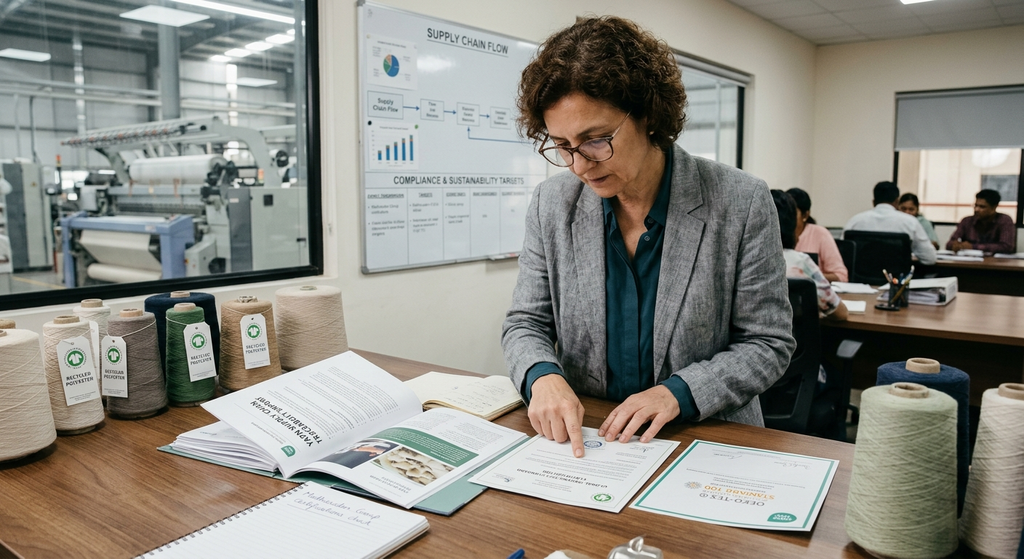
A few vertically integrated Gujarat-based manufacturers have moved in this direction already Madhusudan Group, for instance, has expanded its yarn portfolio to include recycled and eco-friendly blended yarn lines alongside its core fancy and functional yarns, reflecting a broader industry shift toward building sustainability into product development rather than treating it as a separate compliance exercise. Buyers should still confirm the specific certification or traceability documentation behind any individual product line rather than treating a manufacturer’s general sustainability positioning as sufficient on its own.
Quality Standards and Testing Parameters for Twisted Yarn
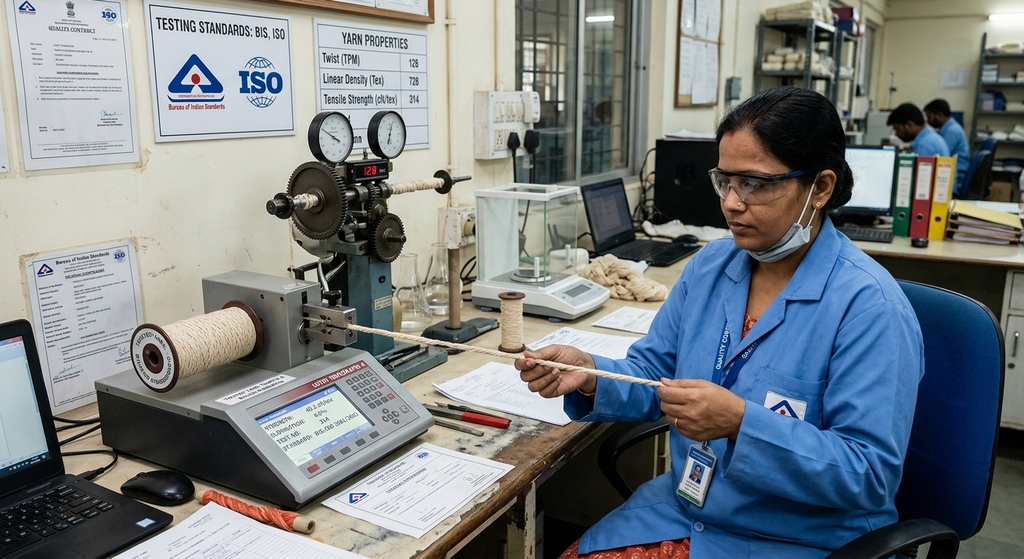
India’s textile testing framework is anchored by the Bureau of Indian Standards (BIS), the country’s national standards body, which publishes methods of test for yarn properties including linear density, twist, and tensile strength, alongside product-specific standards for various yarn categories. Manufacturers working to recognized testing methods whether BIS standards or test methods referenced by the International Organization for Standardization (ISO) give buyers an objective, repeatable basis for comparing yarn quality across suppliers rather than relying on subjective assessment alone. Buyers with specific compliance requirements, particularly for export markets, should ask a prospective manufacturer which standards their testing protocol references and request sample test reports as part of the evaluation process.
Frequently Asked Questions
What is the difference between twisted yarn and regular spun yarn? Regular spun yarn is a single strand produced directly from fibre during spinning. Twisted yarn takes that process a step further, combining two or more strands (or adding extra twist to a single strand) to change strength, bulk, or texture for a specific end use.
What MOQ can I expect from a twisted yarn manufacturer in India? MOQ depends heavily on whether you need a standard count and construction or a customized specification. Standard products generally carry lower MOQs; customized twist levels, blends, or put-up formats often require a larger minimum to be production-efficient for the manufacturer. Ask for MOQ specific to your exact specification rather than a general company figure.
How is twisted yarn priced? Pricing reflects fibre cost, count and ply construction, twist level, order volume, and packaging format. Fibre commodity prices (cotton and polyester in particular) are a major variable, so quotations are typically valid for a limited period rather than fixed indefinitely.
Can Indian manufacturers produce customized twist levels and blends? Many manufacturers with in-house twisting capability can produce customized TPI, ply counts, and blend ratios, though this usually requires a machine changeover and may carry a higher MOQ or longer lead time than standard catalogue products. Confirm customization capability and any associated MOQ or lead time impact directly with the manufacturer before finalizing your technical specification.
What lead time should I plan for a bulk order? Lead time varies by whether the manufacturer twists from yarn already in stock or spins singles from raw fibre first, and by current order volume at the mill. Request a lead time specific to your order quantity and specification, and clarify how repeat orders are scheduled relative to first-time orders.
What quality documentation should I request with a shipment? Ask for test reports covering count/linear density, twist (TPI), and tensile strength at minimum, along with confirmation of the testing method or standard referenced. For export orders, also confirm what shipping and compliance documentation the manufacturer will provide.
Do I need to work with a manufacturer directly, or is a trading company acceptable? Both models exist in the market. Working directly with a manufacturer generally gives more visibility into production scheduling, customization capability, and quality control, while a trading company may offer convenience for buyers sourcing multiple yarn types from different mills through a single point of contact. The right choice depends on your order volume, technical complexity, and how much direct manufacturing visibility your business requires.
Which industries buy the most twisted yarn from Indian suppliers? Weaving and knitting mills, sewing thread producers, home textile manufacturers, technical and industrial textile producers, and export garment manufacturers are among the largest buyer categories, each specifying different fibre types, ply constructions, and twist levels suited to their end use.
How do I know if a supplier is a genuine manufacturer rather than a trader? Ask specific, technical questions about their own twisting floor machine type, in-house capacity, and typical lead time for your exact specification. A genuine manufacturer will answer these directly and consistently. You can also ask to see the production facility, either in person or through a documented virtual walkthrough, before committing to a bulk order.
Can I request a smaller trial order before committing to full bulk volume? Many manufacturers are open to a trial order at reduced quantity for new buyers, particularly when there is a credible indication of a larger recurring requirement to follow. It is reasonable to ask about this directly rather than assuming MOQ is fixed for every new relationship.
Conclusion: Moving From Research to a Sourcing Decision
Twisted yarn sits at a point in the textile supply chain where a small specification error the wrong twist direction, an inconsistent TPI, an unbalanced ply can create expensive downstream problems in weaving, knitting, or sewing. The buyers who get the best long-term results are the ones who evaluate a potential manufacturer methodically: confirming specification tolerances, requesting real test data, clarifying MOQ and lead time against their actual order profile, and building the relationship on clear, technical communication rather than promotional claims.
If you are currently comparing options for a bulk or ongoing twisted yarn requirement, the next practical step is to share your exact specification fibre type, count, ply, TPI, and required volume and request a detailed quotation and sample against that specification. A manufacturer willing to engage at that level of technical detail before you have placed an order is usually a reliable signal of how they will handle the relationship after you do.