Egypt has always been a textile story. Long before ready-made garments became one of the country’s strategic export engines, Egyptian growers, spinners and weavers were shaping how the world thinks about cotton. Today the story is moving further up the value chain. Mills in the Delta, the canal zone and the new industrial cities are investing in spinning, dyeing, knitting, weaving and garmenting under one roof, and every one of those stages depends on a deceptively simple input: dyed yarn.
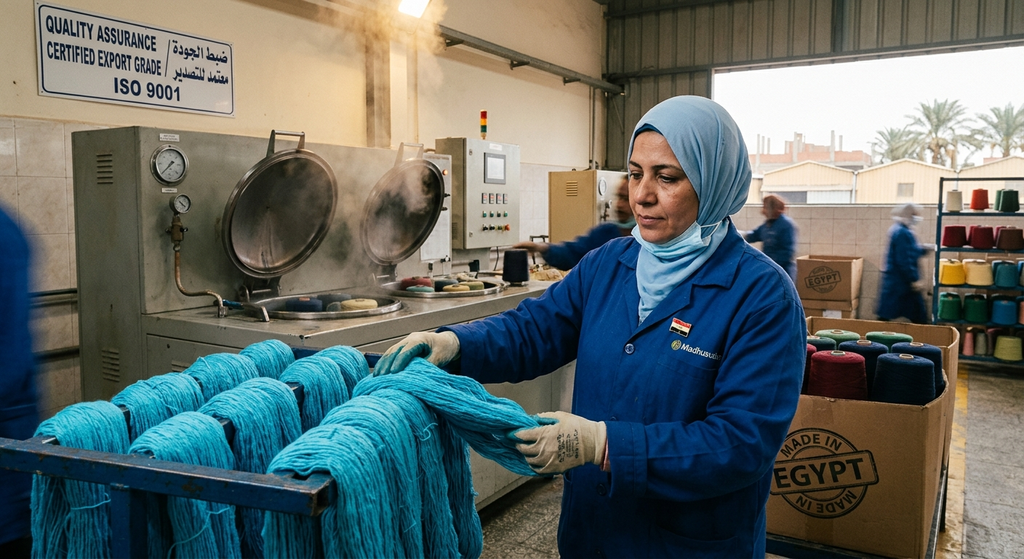
If you are searching for yarn dyeing Egypt, you are probably in one of three positions. You may run a mill or garment factory in Egypt and need a dependable source of coloured yarn. You may be an overseas brand or importer evaluating Egypt as a sourcing base. Or you may be a yarn dyer or manufacturer who wants to supply the Egyptian market from outside the country. This guide is written for all three. It explains how the Egyptian market works, which dyeing technologies and dye classes matter for each fibre, what quality and compliance benchmarks decide whether a lot is accepted or rejected, how cross-border supply from India fits in, and how to choose a partner you can trust over many seasons.
Throughout, we draw on the experience of Madhusudan Group, a Surat-based yarn manufacturer and exporter that has built its reputation on consistent colour, process discipline and export reliability across polyester, viscose, linen, nylon, recycled and bicomponent yarns.
Key Takeaways
- Egypt’s textile and garment sector is a government priority under Egypt’s Industrial Strategy 2030, and new Chinese and Turkish investment is expanding spinning, dyeing and garment capacity.
- Yarn dyeing is where shade consistency, fastness and chemical compliance are won or lost, long before a fabric is cut and sewn.
- Reactive dyes dominate cellulosic fibres such as cotton, viscose and linen; disperse dyes dominate polyester; acid dyes dominate nylon. Blends need carefully sequenced processes.
- Egyptian mills that export to Europe and the United States need certified chemistry: OEKO-TEX STANDARD 100 and ZDHC MRSL conformance are increasingly treated as baseline expectations.
- Importing dyed yarn from a capable Indian manufacturer such as Madhusudan Group can complement local dyeing capacity, shorten development cycles and protect delivery commitments.
Why Yarn Dyeing in Egypt Matters Right Now
Egypt’s textile ambitions are no longer theoretical. According to a report on the Apparel Export Council of Egypt’s targets, the council is aiming for record garment exports of around $4.4 billion in 2026, backed by Chinese and Turkish investment in new manufacturing capacity. Among the named projects are an integrated textile and apparel complex in the West Qantara zone of the Suez Canal Economic Zone and a printing and dyeing investment by a Chinese group, which signals how seriously the colouration stage is being treated.
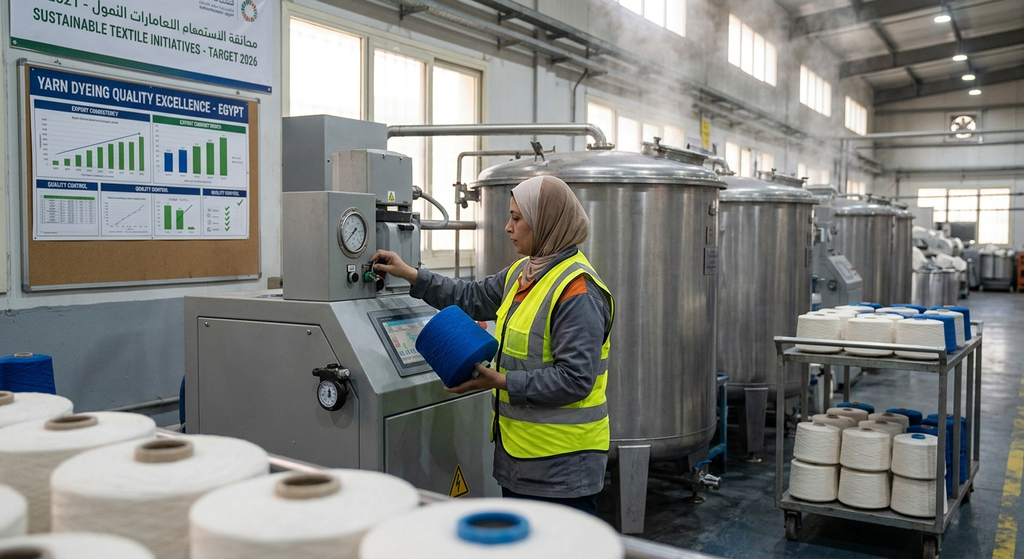
Recent trade data supports the direction of travel. Egyptian ready-made garment exports reached roughly $2.5 billion between January and August 2026, and exports to European markets rose 26 percent, with Spain jumping 61 percent, according to comments from a Textile Industries Chamber member. The same source cautions that reaching the long-term target of $20 billion in annual textile and garment exports by 2030 will demand faster growth and deeper participation in global supply chains. In other words, the opportunity is large, but it will be captured by mills that can deliver quality, speed and compliance together.
For anyone working with yarn, that has three consequences.
First, colour consistency becomes a commercial weapon. European fast-fashion and home-textile buyers place programme orders that run across multiple factories. If the yarn used in a knitting unit in 10th of Ramadan City does not match the yarn used in a weaving unit in Alexandria, the programme fails. Consistent dyed yarn is the foundation of consistent fabric.
Second, lead times are shrinking. Retail calendars reward suppliers who can move from approved lab dip to bulk delivery in weeks, not months. Having a dependable yarn dyeing partner, local or imported, is often the difference between winning and losing a repeat order.
Third, chemical compliance is moving from “nice to have” to “licence to sell”. Brands selling into the European Union and the United States increasingly audit their suppliers’ chemical management, and that audit starts at the yarn.
Understanding Egypt’s Textile Geography
Yarn dyeing in Egypt does not happen in one place. It follows the clusters that grew around cotton, ports and labour.
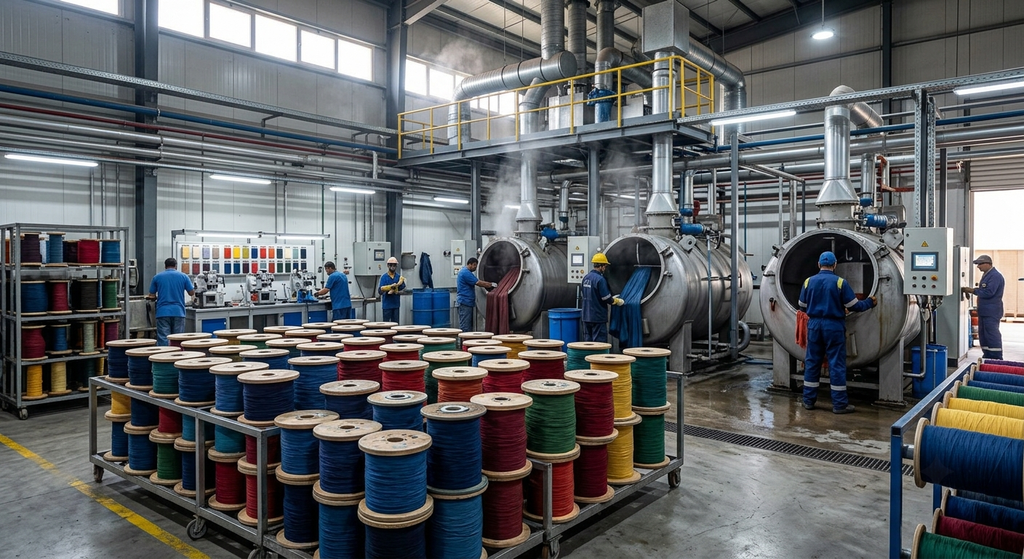
Greater Cairo and the Delta. Historic centres such as Mahalla El Kubra built Egypt’s reputation for spinning and weaving. Delta mills have deep expertise in cotton yarns and fabrics, and many are modernising their dyeing capacity as part of broader upgrade programmes.
10th of Ramadan City and Sadat City. These industrial cities host a dense population of private-sector knitters, weavers, dye houses and garment factories, and they continue to attract new capital: a Chinese manufacturer agreed with Elsewedy Industrial Development to build a $60 million textile factory in Sadat City, with production slated to begin in 2026. Many mills here work on export programmes for European and American buyers and need quick access to a wide colour palette.
Alexandria and Borg El Arab. With port access and room to expand, this area hosts large integrated operations. A major Turkish-owned group has described plans to adopt sustainability and green-industry standards in dyeing and textile production, alongside exports targeted at $285 million by the end of 2026.
Suez Canal Economic Zone. The SCZone, including Ain Sokhna and the West Qantara hub, is where much of the new foreign investment is landing. Its location between Asian suppliers and European buyers makes it a natural gateway for imported yarn, dyestuff and finished goods.
This geography matters for yarn sourcing. A mill in Sadat City and a mill in Borg El Arab face different inland logistics, different port options and different utility constraints. Any dyed yarn supplier, whether located in Egypt or overseas, has to understand these realities rather than assume one logistics plan fits everyone.
What Is Yarn Dyeing, and Why Do Mills Choose It?
Yarn dyeing means colouring the yarn before it is woven or knitted into fabric. It stands in contrast to piece dyeing, where finished fabric is coloured, and to garment dyeing, where the finished product is coloured.
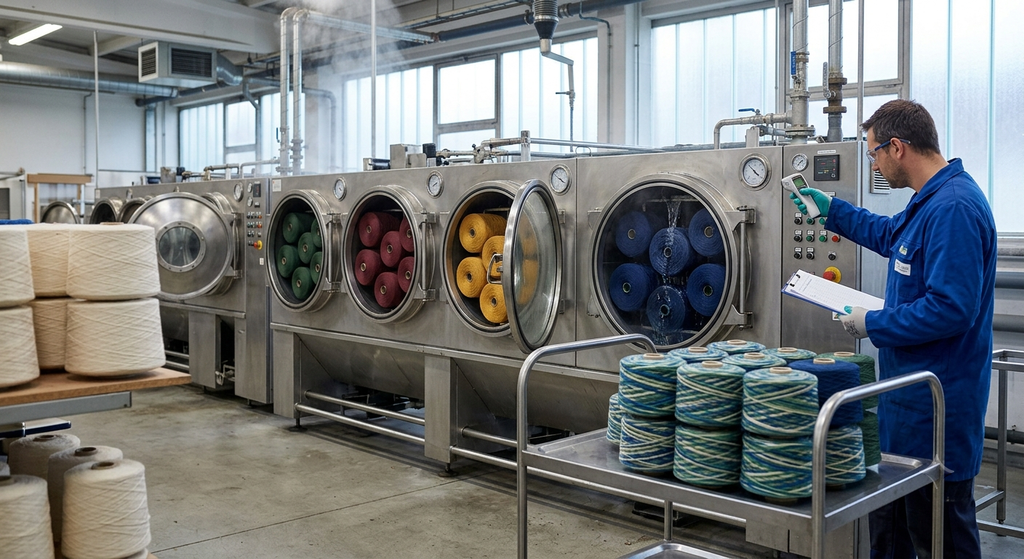
Mills choose yarn dyeing for several reasons.
- Pattern capability. Stripes, checks, plaids, jacquards, melange effects and yarn-dyed shirting depend on yarns that are already coloured before they meet in the loom or knitting machine.
- Depth and fastness. Dye penetrates the fibre bundle thoroughly when the yarn is dyed on a package or hank, which supports strong colour fastness, particularly for dark shades.
- Colour richness. Yarn-dyed fabrics tend to show more visual depth than piece-dyed equivalents, which is why premium shirting and home textiles favour them.
- Lower fabric waste. Because colour is fixed at the yarn stage, mills can stock dyed yarn by shade and respond to smaller orders without dyeing entire fabric rolls.
For a deeper look at how yarn is made before it ever reaches the dye house, read Madhusudan Group’s yarn manufacturing process guide, which walks through fibre preparation, spinning, texturising and finishing.
The Main Yarn Dyeing Methods
Different yarns and end uses call for different dyeing methods. Here is how the main ones work and where each fits.
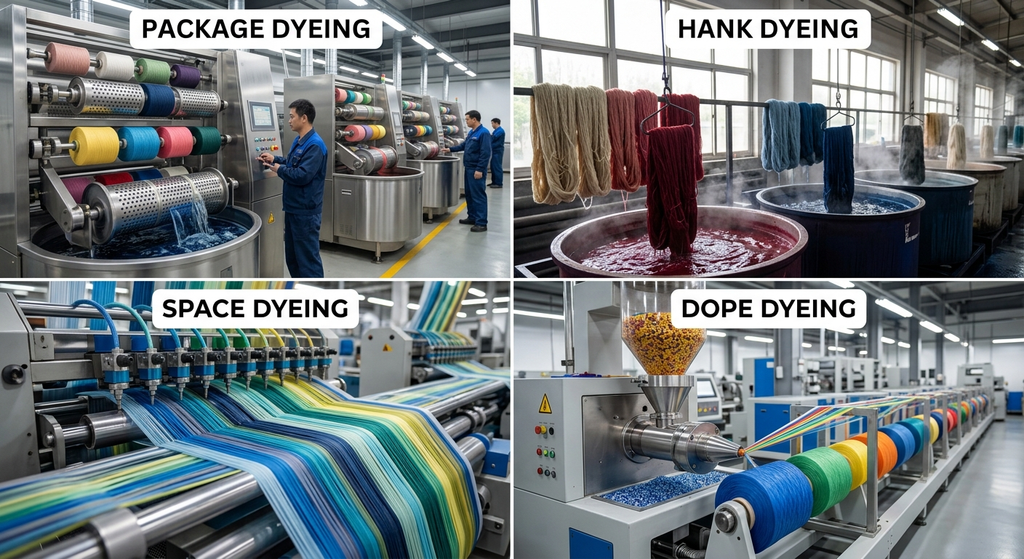
Package Dyeing
Package dyeing is the workhorse of modern yarn dyeing. Yarn is wound onto perforated tubes or springs, loaded onto carriers, and dye liquor is circulated through the package under controlled temperature, pressure and flow. It suits cotton, viscose, polyester, nylon and many blends, and it delivers excellent levelness and repeatability when the winding density is uniform.
Winding quality is critical. If the package density varies, dye liquor flows unevenly and you get shade variation from the core to the surface of the package, or from top to bottom of the carrier. Experienced dyers control winding tension, package weight and carrier loading with the same discipline they apply to dye recipes.
Hank Dyeing
Hank dyeing works on yarn wound into loose loops, so the dye reaches every fibre without compression. It is slower and more labour-intensive than package dyeing, but it preserves bulk and softness, which is why it remains popular for high-bulk acrylics, wool-type yarns, handloom yarns and specialty effects. Madhusudan Group’s high bulk yarn guide explains why bulk retention matters for hand feel and thermal performance.
Space and Multi-Colour Dyeing
Space dyeing applies several colours along the length of a yarn in a repeating or random sequence, creating the multi-coloured effects seen in knitwear, socks and decorative fabrics. It requires precise control of dye application points and fixation, and it is best handled by dyers with specific equipment and design experience.
Dope or Solution Dyeing
In solution dyeing, pigment is added to the polymer melt or spinning solution before the filament is formed. The colour is locked inside the fibre, which gives excellent fastness to light, washing and rubbing, and it avoids the wet dyeing step entirely, saving water and energy. It is common for polyester and nylon filaments in automotive textiles, outdoor fabrics and technical applications. The trade-off is flexibility: because colour is fixed at the extrusion stage, minimum order quantities are higher and shade changes are less agile.
Cheese and Cone Dyeing for Specialty Yarns
Some specialty yarns, including certain elastic and covered yarns, are dyed on cheeses or cones with adjusted liquor flow and temperature profiles to protect the elastic core. This is a niche where experience with the specific yarn construction matters far more than headline machine specifications.
Matching Dyes to Fibres: The Core Chemistry
A dye house that applies the wrong dye class to a fibre cannot rescue the result with clever process control. The table below summarises the core pairings used in commercial yarn dyeing.
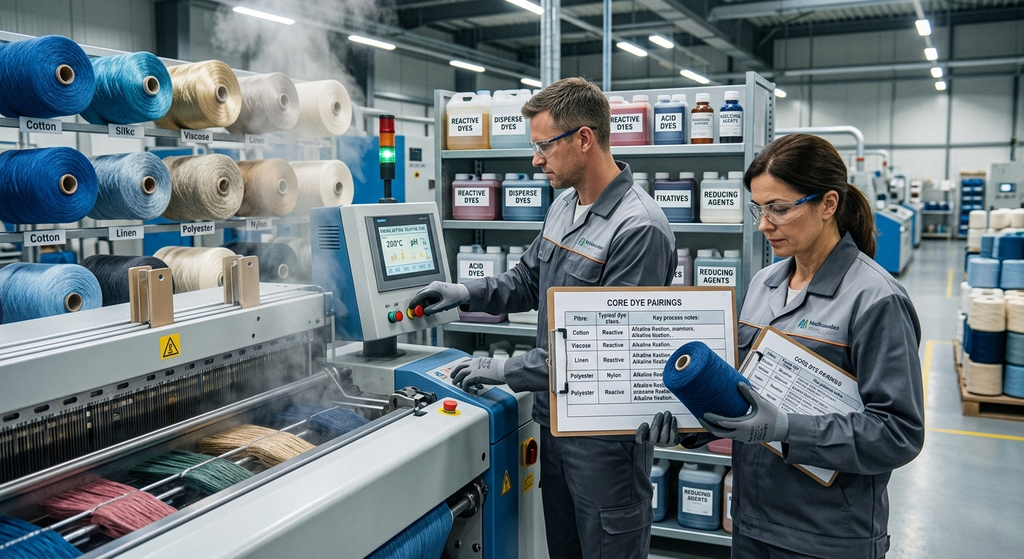
| Fibre | Typical dye class | Key process notes |
| Cotton | Reactive dyes | Alkaline fixation, salt-assisted exhaustion, thorough soaping-off to remove hydrolysed dye |
| Viscose and modal | Reactive or direct dyes | Fibre is weaker when wet, so gentle handling and controlled liquor flow are essential |
| Linen and flax | Reactive dyes | Natural irregularity and lignin content require careful pretreatment for even shades |
| Polyester | Disperse dyes | High-temperature dyeing around 130 degrees Celsius, followed by reduction clearing for wash fastness |
| Nylon | Acid or metal-complex dyes | Controlled pH and temperature ramp to avoid barre and unlevel dyeing |
| Acrylic | Basic (cationic) dyes | Slow temperature rise and retarders to prevent rapid, uneven strike |
| Polyester/cotton blends | Disperse plus reactive | Two-bath or carefully designed one-bath processes with intermediate clearing |
Dyeing Cotton and Viscose
Cotton and viscose are cellulosic fibres, and reactive dyes form covalent bonds with the cellulose, which is why they deliver such strong wash fastness. The challenge lies in controlling hydrolysis. Reactive dye that reacts with water instead of the fibre has to be washed away, and incomplete soaping-off leads to poor rubbing fastness and staining. Viscose adds another wrinkle: it swells and loses strength when wet, so liquor flow and machine loading need extra care. You can see how these principles play out in practice in Madhusudan Group’s guides to viscose yarn dyeing and viscose vs cotton for manufacturers.
Dyeing Linen
Linen is prized for its crisp hand and natural texture, but it is also one of the more demanding fibres to dye evenly. Its inherent variation, from slubs to residual plant matter, means pretreatment and recipe design matter enormously. Madhusudan Group’s linen yarn dyeing guide explains how to manage those variables to achieve even, repeatable shades.
Dyeing Polyester
Polyester is hydrophobic and tightly packed, so it needs high temperature and pressure to open the fibre and let disperse dyes diffuse inside. After dyeing, a reduction clearing step removes surface dye to protect wash and rubbing fastness. Oligomers, the low-molecular-weight by-products that can migrate to the fibre surface during hot dyeing, must be controlled to avoid deposits and dull shades. For a detailed walkthrough of the process, see the polyester yarn dyeing guide, and for the finished product perspective, the dyed polyester yarn guide.
Dyeing Nylon and Specialty Filaments
Nylon is dyed with acid or metal-complex dyes under tightly controlled pH. The bigger risk is not the dye chemistry itself but physical variation in the filament: differences in draw ratio or heat history show up as streaks, known as barre. Dyers handle this by sourcing yarn from consistent lots and testing dye uptake before committing to bulk.
Quality Benchmarks That Decide Whether a Lot Is Accepted
Egyptian mills, European brands and American retailers may phrase specifications differently, but the underlying tests are shared. When you evaluate a yarn dyeing partner, ask for performance against the following.
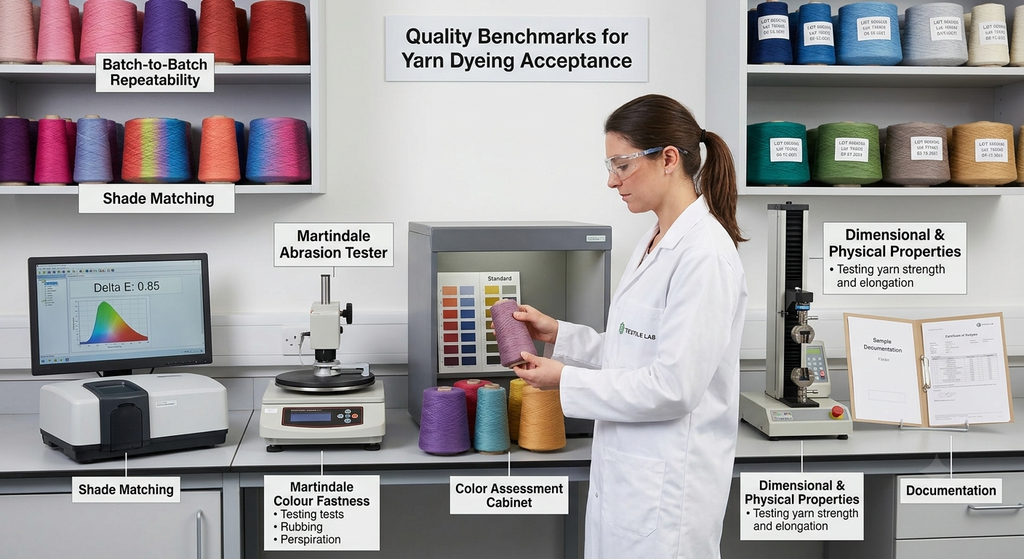
Shade matching and colour difference. Most buyers specify a maximum colour difference, usually expressed as a Delta E value measured under defined illuminants, between the approved standard and each bulk lot. A good dye house maintains spectrophotometer-based recipe prediction, standardised lab dips and a documented tolerance policy.
Batch-to-batch repeatability. Matching one lot is easy. Matching the twentieth lot, across months, with different dye and chemical deliveries and different operators, is what separates professionals from amateurs. Ask how the dyer controls water quality, liquor ratio, temperature curves and chemical dosing.
Colour fastness. Standard tests cover washing, rubbing (crocking), perspiration, light and, for some end uses, chlorinated water or sublimation. Requirements vary by end use, so a swimwear yarn and a curtain yarn will have very different targets.
Dimensional and physical properties. Dyeing should not damage yarn strength, elongation or shrinkage. For stretch yarns, retaining elastic recovery after dyeing is critical, as discussed in Madhusudan Group’s guide to elastomultiester bicomponent yarn and mechanical stretch.
Package integrity and winding quality. Dyed yarn must unwind cleanly on high-speed knitting and weaving machines. Poor re-winding, soft packages or incorrect tension all lead to downstream breaks and fabric defects.
Documentation. Reliable partners provide test reports, shade cards, lot traceability and certificates of conformity without being chased.
Compliance and Sustainability: The New Entry Ticket
If your Egyptian mill sells into Europe, the United States or other regulated markets, chemical compliance is not optional. Three frameworks come up most often.
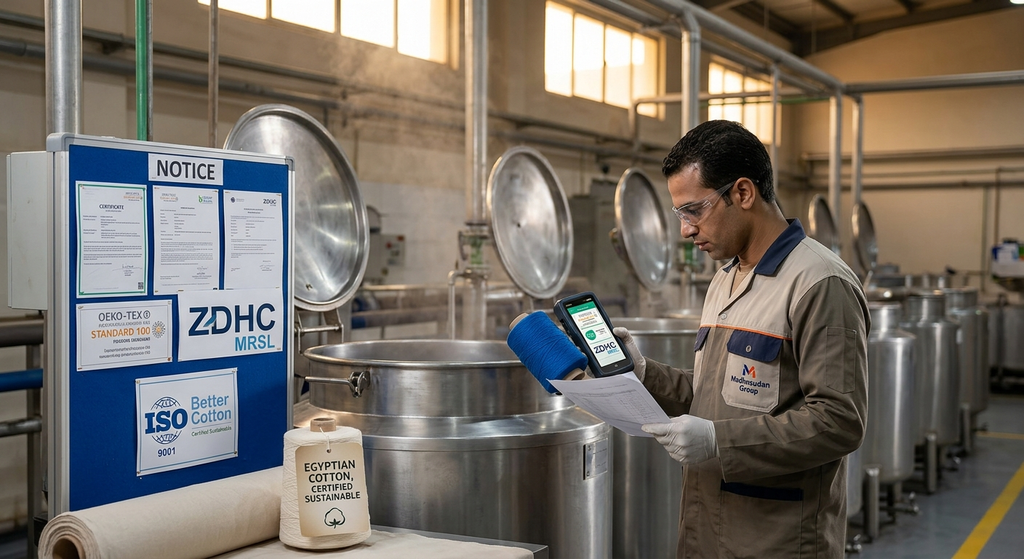
OEKO-TEX STANDARD 100
STANDARD 100 by OEKO-TEX looks at hazardous substances such as heavy metals, toxic dyes and carcinogens, and it applies to raw and finished yarns as well as fabrics and garments. Introduced in 1992, it uses a criteria catalogue with more than 100 individual parameters, and the requirements tighten the closer a product sits to the skin. For yarn suppliers, certification gives downstream mills a head start: if the yarn already conforms, the finished fabric has a much easier path to certification.
ZDHC Manufacturing Restricted Substances List
The ZDHC Foundation, which stands for Zero Discharge of Hazardous Chemicals, publishes the Manufacturing Restricted Substances List (MRSL), a list of chemicals banned from intentional use during the processing of textiles, leather, rubber, foam, adhesives and trims. Unlike a finished-product restricted substances list, the MRSL focuses on what happens inside the factory, which is exactly where yarn dyeing takes place. Brands use it to assure customers that banned substances were not intentionally used during production.
The impact is measurable. A ZDHC impact report covered by Just Style found that 98 percent of manufacturing suppliers in the community had no detection of restricted substances in their wastewater, a sign that serious chemical management is achievable at scale.
Regional Lessons from Yarn Dyers Elsewhere
Egypt is not the first market to push yarn dyers toward higher chemical standards. A UNIDO SwitchMed business case describes a Moroccan yarn dyeing company that took part in a pilot to align its chemical and wastewater management with ZDHC guidelines. The lesson for Egyptian dye houses is practical: start by inventorying chemicals, registering formulations, testing wastewater and training staff. Those steps are achievable, and they build trust with brand customers.
Better Cotton and Responsible Fibre Programmes
Egypt’s cotton sector is also moving on sustainability. The Cotton Egypt Association notes that it collaborates with the Better Cotton Program launched in Egypt by UNIDO in 2020, reflecting the push for more responsible fibre sourcing at the start of the chain. Dyers and spinners that can document traceability and responsible chemistry will be better placed as brand requirements tighten.
Why It Matters for Yarn Buyers
When you buy dyed yarn, whether in Egypt or from overseas, you are importing the supplier’s chemical management. Ask for current certificates, a chemical inventory, wastewater treatment details and evidence that dyes and auxiliaries conform to recognised lists. Madhusudan Group, as an ISO certified yarn supplier, approaches documentation as part of the product, not an afterthought.
Egyptian Cotton: Protecting a Brand and Sourcing Honestly
No guide to yarn dyeing in Egypt would be complete without addressing Egyptian cotton. Egyptian cotton is globally associated with softness, strength and luxury, and it holds dye beautifully, which is one reason it is prized for premium bed linen, shirting and towelling.
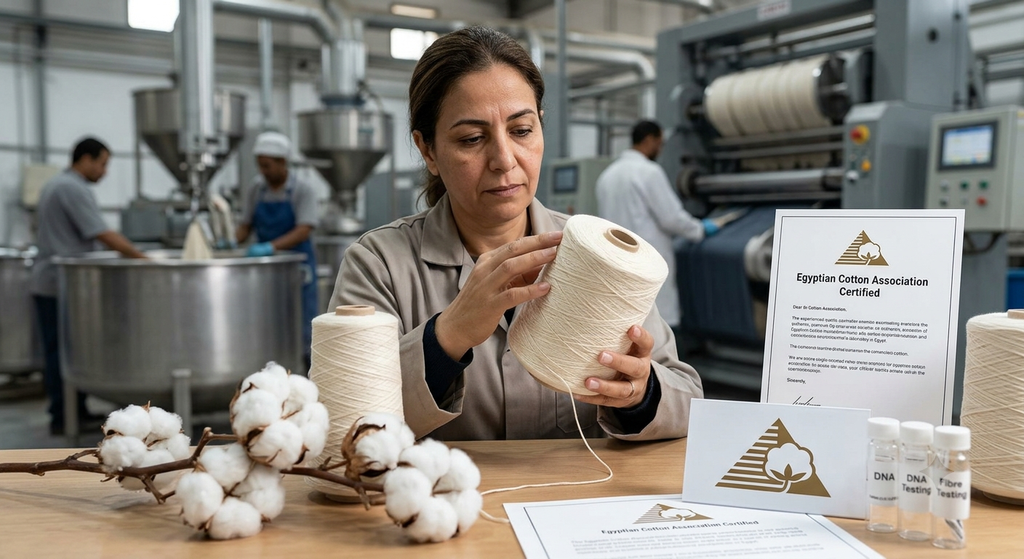
That reputation has made it a target for mislabelling. The Cotton Egypt Association was set up in 2005 and manages the registered Egyptian Cotton logo, with Bureau Veritas providing testing and auditing and DNA testing used to verify authenticity across the supply chain. Its stated goal is to protect the name and reassure consumers that Egyptian Cotton is 100 percent pure with no additional blend, and it has said it will publicly name manufacturers that fail its accreditation scheme.
For yarn buyers and dye houses, three practical points follow.
- Do not assume a label proves fibre content. If a programme requires genuine Egyptian cotton, specify the licensing and testing route up front and keep lot traceability from bale to dyed yarn.
- Keep lots segregated in the dye house. Cross-contamination between Egyptian cotton and other cotton, or blending errors in winding, can break claims.
- Understand how to spot problems. Madhusudan Group’s guides on how to tell if cotton is fake and the wider fake cotton guide offer simple checks that buyers can apply before commissioning lab tests.
Beyond cotton, Egyptian mills increasingly work with viscose, polyester, nylon, linen and bicomponent yarns to meet fashion, activewear and home-textile demand. That is where an experienced multi-fibre yarn manufacturer adds value.
Local Dyeing vs Imported Dyed Yarn: How Smart Mills Decide
Many Egyptian mills run their own dye houses or rely on local commission dyers. Others import dyed yarn directly. In practice, the strongest operations combine both. Here is how to think about the choice.
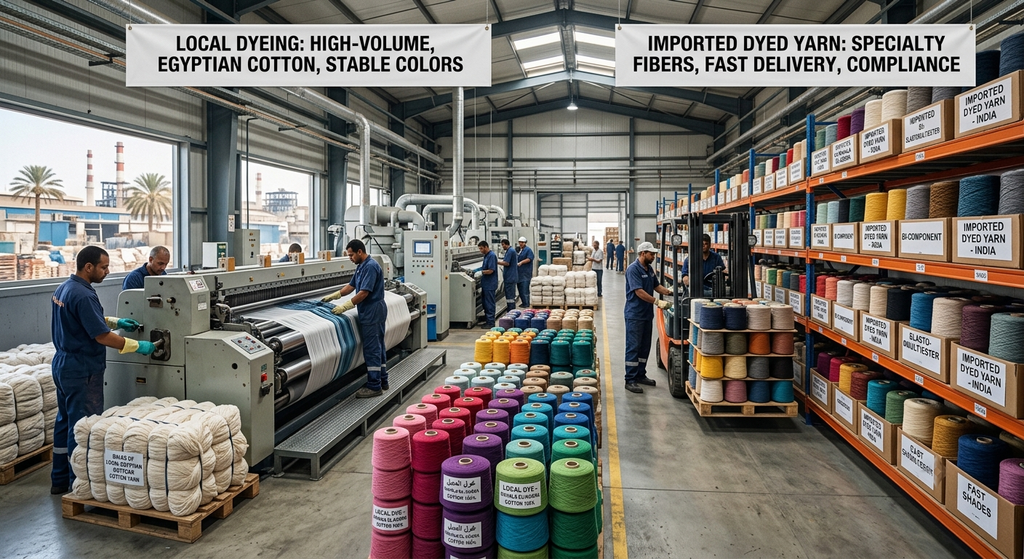
When local dyeing makes sense.
- High-volume, stable-colour programmes where you can plan chemicals and capacity well in advance.
- Cotton and cotton-blend yarns where Egyptian fibre sourcing and traceability are central to the product story.
- Situations where short inland logistics and close technical supervision outweigh other factors.
When imported dyed yarn makes sense.
- Specialty fibres or constructions such as bicomponent, elastomultiester, air-textured or high-bulk yarns where local dyeing expertise is thin.
- Fast colour development, where a supplier can deliver ready-dyed yarn across a wide shade range without tying up your own dye house.
- Peak-season overflow, when your own capacity is full and a missed delivery would cost more than the freight.
- Programmes with strict chemical compliance demands, where an already certified supplier removes risk from your own audit.
What to compare in either case.
- Landed cost, including freight, duty, handling and inventory carrying costs.
- Lead time from confirmed order to usable yarn at your machines.
- Minimum order quantities by shade.
- Shade repeatability and the supplier’s track record on disputes.
- Responsiveness: how fast the supplier answers technical questions or reworks a rejected lot.
For a framework to evaluate a potential supplier, read Madhusudan Group’s guide to questions to ask before buying yarn and the explanation of yarn supplier vs yarn manufacturer. The distinction matters: a manufacturer controls the process, while a trader may only control the paperwork.
Supplying Egypt from India: The Practical View
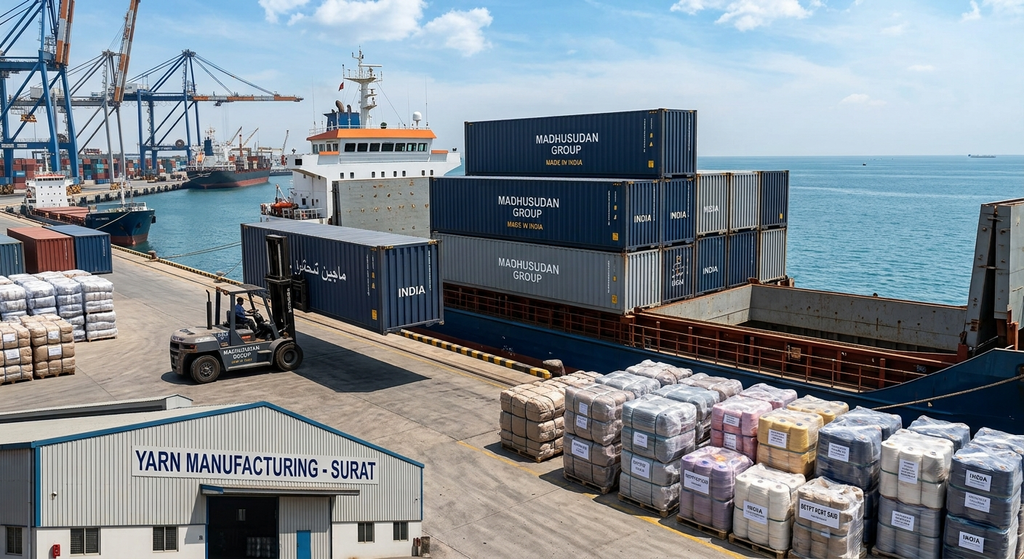
India and Egypt share a long trading relationship, and Indian yarn manufacturers have extensive experience supplying export markets across Europe, the Americas and Asia. Surat, in Gujarat, is one of the world’s most important synthetic and blended yarn hubs, and its supplier ecosystem includes texturising, twisting, dyeing, recycling and finishing capacity within a short radius.
Why Surat-Based Manufacturing Fits Egyptian Needs
- Breadth of fibres. Surat-based manufacturers handle polyester, nylon, viscose, linen, blends and recycled yarns, which matches the diversifying product mix in Egyptian mills.
- Scale and flexibility. A well-run Surat manufacturer can serve both large programmes and smaller development lots, which suits Egypt’s mix of large integrated groups and agile SMEs.
- Port connectivity. Indian west-coast ports offer regular container services to Egyptian ports. Transit times vary by routing and season, so plan for buffers rather than best-case schedules.
You can explore the sourcing landscape in Madhusudan Group’s overview of yarn manufacturers in Surat and its guide to textile yarn exporters in India.
Practical Import Checklist for Egyptian Buyers
- Confirm your importer registration and customs documentation. Egypt’s import procedures, including advance cargo information requirements, change from time to time, so check current rules with your customs broker before shipping.
- Define the specification precisely. Yarn count, denier, filament count, twist, luster, shade reference, packing format and tolerances should all be in writing.
- Approve lab dips and pre-production samples before bulk. Treat the approved sample as the contract standard and retain a sealed reference.
- Agree on testing and inspection. Specify which fastness and physical tests apply, and whether third-party inspection is required before shipment.
- Plan incoterms and insurance. Be clear on who handles freight, insurance and port clearance.
- Build in buffer for transit and clearance. Geopolitical tensions in the region can affect shipping routes, and the Apparel Export Council has itself cautioned that Middle East tensions could pose challenges to production and export targets.
Buyers in other regions have faced similar questions. Madhusudan Group’s guides on how to import yarn from India to the USA and how to import yarn from India to Brazil set out the same discipline: specify clearly, document everything and verify before you ship.
What Drives the Cost of Dyed Yarn?
Price comparisons between suppliers often go wrong because they compare headline per-kilogram rates without understanding what is inside them. The main cost drivers are as follows.
- Base yarn cost. Raw material prices, whether polyester chips, viscose staple or cotton, move with global markets.
- Shade depth. Dark shades such as navy, black and deep red consume more dye and require longer clearing, which raises cost. Pale shades are cheaper but unforgiving of any unevenness.
- Dye class and quality. Dyes with higher fastness or compliant chemistry cost more than basic alternatives, but they reduce rework and compliance risk.
- Process route. Package dyeing, hank dyeing, space dyeing and solution dyeing carry different cost structures, as do additional steps like reduction clearing or special finishes.
- Lot size. Small lots mean more changeovers per kilogram, which costs time and chemicals.
- Water and effluent treatment. Responsible dye houses invest heavily in treatment, and that cost is inherent in credible pricing.
- Rework and rejection rates. A supplier with low first-time-right rates may quote a slightly higher price but deliver a lower total cost.
The lowest quoted price is rarely the lowest real cost. A rejected lot that stops a knitting line costs far more than a few cents saved per kilogram.
Why Madhusudan Group Leads in Yarn Dyeing and Yarn Manufacturing
Many suppliers claim quality. Fewer can show a coherent system behind the claim. Madhusudan Group has built its position as a leading Indian yarn manufacturer and exporter by combining fibre range, process control and a genuinely export-oriented mindset.
A Complete Yarn Portfolio Under One Roof
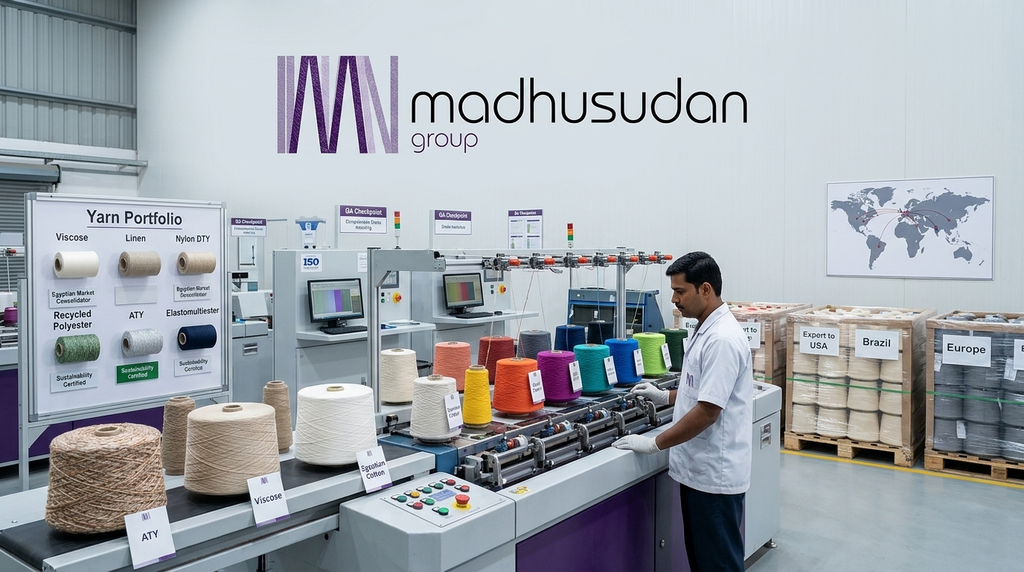
Egyptian mills increasingly want to consolidate suppliers, and Madhusudan Group’s range supports that goal:
- Polyester yarn in a broad range of deniers, lusters and finishes.
- Dyed yarn across fibres, as described on the dyed yarn manufacturer page.
- Viscose yarn and viscose filament yarn for fashion and home textiles.
- Linen yarn for premium apparel and furnishings.
- Nylon DTY yarn for hosiery, activewear and technical fabrics.
- Air-textured yarn (ATY) for bulk and soft hand feel.
- Stretch yarn, including elastomultiester yarn and bicomponent constructions.
- Recycled polyester yarn for brands with circularity targets.
This breadth matters because Egyptian programmes rarely use a single fibre. A garment may combine a viscose face, a polyester back and an elastic component, and having one partner that understands how each behaves in the dye house reduces handoffs and finger-pointing.
Process Discipline That Buyers Can Verify
Colour consistency is not magic. It comes from documented, repeatable steps: controlled raw material intake, standardised winding, recipe prediction, tightly managed dyeing cycles, thorough clearing, quality checks at every stage and traceable lot records. Madhusudan Group runs its operations as an ISO-certified yarn supplier with this discipline built in, which makes audits and customer approvals smoother.
Export Experience Across Demanding Markets
Madhusudan Group’s published buyer guides reflect real export work: from importing yarn into the United States and Brazil to supplying polyester yarn dyeing for South America, elastomultiester yarn for Europe and yarn dyeing for Sri Lanka’s apparel industry. Every market teaches a supplier something new about documentation, packing, labelling and service expectations, and Egyptian buyers benefit from that accumulated experience.
Sustainability as a Working Practice
From recycled polyester to blended eco-friendly constructions, Madhusudan Group treats sustainability as a product and process commitment rather than a marketing line. Mills that must answer brand questionnaires about recycled content, chemical management and traceability need a supplier who can supply real answers and documents.
A Partner for Development, Not Just Dispatch
Winning programmes means developing new yarns, colours and constructions quickly. Madhusudan Group’s technical and commercial teams work with buyers on lab dips, development samples and trial lots, then scale to bulk once the specification is locked. That collaborative approach is what turns a transaction into a lasting supply relationship.
How to Choose a Yarn Dyeing Partner: A Buyer’s Checklist
Whether you are shortlisting Egyptian dye houses or overseas suppliers, use the same disciplined criteria.
- Ask about fibre expertise, not just capacity. A dye house that excels at polyester may struggle with linen or bicomponent yarns.
- Request a live demonstration of shade control. Ask how they manage lab dip approval, recipe correction and batch-to-batch tolerance.
- Review test reports from recent lots. Look for actual fastness and physical data, not generic brochures.
- Verify certifications and their scope. A certificate that covers fabric but not yarn, or that has expired, is not evidence of compliance.
- Inspect chemical and wastewater management. Ask about chemical inventory, restricted substances conformance and effluent treatment.
- Check traceability. You should be able to trace any lot back to raw material, dye batch and process parameters.
- Test responsiveness. How quickly does the supplier answer a technical query or propose a corrective action?
- Start with a pilot programme. A small trial across several shades reveals more than any presentation.
- Agree on a dispute process in advance. Define how disagreements over shade, strength or count will be measured and resolved.
- Review the supplier’s customer references. Established exporters can point to long-standing relationships in demanding markets.
Trends Shaping Yarn Dyeing in Egypt Through 2030
Integration up the value chain. Government targets and new investments aim to build full chains from spinning to garments inside Egypt. Dyeing capacity has to keep pace, especially in specialised yarns.
Greener chemistry and water stewardship. Brands are pushing suppliers toward conformant dyes, reduced water use, effluent treatment and renewable energy. Mills that invest now will be better placed when buyer audits tighten.
Recycled and bio-based fibres. Recycled polyester, recycled cellulosics and blended eco-friendly yarns are moving from niche to mainstream. Dyeing recycled yarns requires attention to variability in the input and careful shade development.
Performance and stretch. Bicomponent and elastomultiester yarns are gaining share because they deliver stretch and recovery without elastane’s limitations. Madhusudan Group’s article on the rise of bicomponent yarns in India explains why this technology is spreading.
Digitalisation of colour. Digital shade libraries, spectrophotometric recipe prediction and data-driven process control are reducing lab-dip cycles and rework. Suppliers who invest here deliver faster approvals and fewer surprises.
Regional supply chain resilience. Disruptions to global shipping have taught buyers to value diversified sourcing. A mix of local dyeing and trusted overseas supply is increasingly seen as resilience, not redundancy.
Frequently Asked Questions About Yarn Dyeing in Egypt
What is yarn dyeing and why is it important for Egyptian mills?
Yarn dyeing is the process of colouring yarn before it is converted into fabric. It allows mills to produce stripes, checks, melanges and jacquards, delivers deep and durable colour, and supports flexible, small-lot production. For Egyptian mills serving export markets, it also supports compliance, because chemical control starts at the yarn.
Which fibres are most commonly dyed in Egypt?
Cotton remains central, including Egyptian cotton in premium programmes, but mills also dye viscose, polyester, nylon, linen and blends. Demand for stretch and bicomponent yarns is growing alongside activewear and comfort-driven fashion.
Which dye classes are used for each fibre?
Reactive dyes are used for cotton, viscose and linen; disperse dyes for polyester; acid or metal-complex dyes for nylon; and cationic dyes for acrylic. Blends require combined processes with careful sequencing.
Is dyed yarn better than dyed fabric?
Neither is universally better. Yarn dyeing is essential for woven or knitted patterns and offers excellent depth and fastness, while piece dyeing is more flexible for solid colours and quick-turn fashion. The right choice depends on the product, the lot size and the required lead time.
How do I know if a dye house follows safe chemical practices?
Ask for current OEKO-TEX STANDARD 100 or equivalent certificates that cover the relevant product scope, evidence of ZDHC MRSL conformance for chemical formulations, wastewater test reports and a documented chemical inventory. Visit the facility if possible, or commission a third-party audit.
Can I import dyed yarn from India into Egypt?
Yes. Many Egyptian mills import dyed or raw-white yarn from Indian manufacturers, particularly for synthetic, blended and specialty yarns. Check current customs and registration requirements with your broker, agree on specifications and testing in writing, and approve samples before bulk shipment.
What should I look for in a yarn manufacturer in India?
Look for control of the manufacturing process, a documented quality system, relevant certifications, proven export experience and the ability to support development. Madhusudan Group’s guides on top yarn manufacturers in India and bulk yarn supplier in India provide a useful framework.
How can I tell whether cotton is genuine Egyptian cotton?
Rely on traceability and testing rather than labels alone. The Cotton Egypt Association licenses the Egyptian Cotton logo and uses testing and auditing, including DNA-based verification, to authenticate products. Keep documentation from fibre to finished yarn.
How long does it take to develop a new dyed colour?
Lab dip approval typically takes days rather than weeks when the shade is within the dye house’s established palette, followed by a pilot lot and bulk production. Complex shades, recycled yarns or specialty constructions take longer. Ask your supplier for a realistic schedule and plan buffers.
What affects the price of dyed yarn?
Base yarn cost, shade depth, dye class, process route, lot size, effluent treatment costs and rework rates all influence price. Compare total landed cost and the risk of rejection, not just the quoted rate per kilogram.
Conclusion: Build Your Egyptian Yarn Programme on a Reliable Foundation
Egypt’s textile industry is entering a period of serious expansion. New investment, strong export momentum into Europe and a clear government priority on spinning, weaving and garments create real opportunities for mills that can deliver consistent colour, compliant chemistry and dependable lead times. In that environment, yarn dyeing is not a back-office process. It is the stage that determines whether programmes run smoothly or stall.
Smart Egyptian mills will combine strong local capability with trusted international partners. They will choose suppliers who can show process control, documented compliance and a breadth of fibres. And they will treat the supplier relationship as a long-term partnership built on testing, transparency and shared goals.
That is exactly the model on which Madhusudan Group operates. From polyester and viscose to linen, nylon, recycled and bicomponent yarns, from lab dip to bulk dispatch, Madhusudan Group offers manufacturers, brands and importers a single, accountable partner with real export experience.
Ready to discuss your Egyptian yarn programme? Share your fibre, count, shade and volume requirements with the Madhusudan Group team at madhusudangroup.com, and start with a sample lot that proves the quality before you commit to bulk.