Few trade labels pack as much into so few characters as 70/2 HB yarn. In six characters it tells you how fine the yarn is, how many plies it has and how it gets its volume. Read it correctly and you can compare quotes, brief a dye house and predict how a knitted fabric will feel. Read it wrongly and you can end up with the wrong count, the wrong fibre, or a yarn that never develops the loft you paid for.

At Madhusudan Group, a Surat-based yarn manufacturer and exporter operating since 1975, we handle bulked, textured, twisted and dyed filament yarns every day. This guide explains 70/2 HB yarn the way a technical buyer needs it explained: what the notation means, how the yarn is made, what a sensible specification sheet looks like, where it is used, how to test it, and how to buy it in volume without surprises.
One note before we start. Our earlier guide to high bulk yarn covers HB acrylic, which is spun from staple fibre and quoted in metric count (Nm). This article is about a different product family: 70-denier, 2-ply HB filament yarn, most often polyester and sometimes nylon. The two share a bulking principle, but they are specified, bought and used differently.
Key Takeaways
The short answer: 70/2 HB yarn is a two-ply yarn in which each ply is 70 denier, built from a mix of high-shrink and low-shrink filaments so that it puffs up when heated. Its nominal total fineness is about 140 denier before bulking. It is supplied raw white or dyed, on cones, and is used mainly in socks, knitted fabrics, soft-handle woven goods and home textiles.
- “70” is the denier of each ply, “2” is the ply count and “HB” means high bulk.
- Bulk is latent. It develops when the yarn is heated, usually in the dye bath, so always approve the relaxed sample and never the raw yarn alone.
- The label “70/2” can also describe a two-fold spun yarn in English cotton count (Ne). Confirm the count system in writing.
- Put denier, filament count, lustre, twist, shrinkage, shade tolerance and packing on the purchase order before you ask for a price.
- Choose a manufacturer that shares test data, controls the dyeing and bulking step, and can repeat a shade from lot to lot.
What Does “70/2 HB Yarn” Mean?
The notation breaks into three parts, and each one drives a different buying decision.

70: the denier of each ply. Denier is a direct measure of yarn fineness: the mass in grams of 9,000 metres of yarn. A 70-denier ply weighs 70 grams for every 9,000 metres. Denier, tex and decitex are all explained in this overview of units of textile measurement. For quick conversion, 70 denier is roughly 7.8 tex or 78 decitex.
2: the number of plies. Two single ends are twisted together into one plied yarn. Plying improves evenness, balance and strength compared with a single end of the same total fineness. For 70/2 the nominal total is 2 × 70 = 140 denier. That figure applies before twist contraction and before the bulking treatment changes the yarn’s dimensions.
HB: high bulk. The yarn contains filaments with deliberately different shrinkage behaviour. When it is heated, the high-shrink filaments contract and the low-shrink filaments are forced to buckle outward. The result is a fuller, softer, more voluminous yarn than a flat filament of the same weight.
The “70/2” Trap: Denier, Ne and Nm
Because “70/2” appears on filament yarn and on spun yarn, it is one of the easiest labels to misread. The table shows how different the same digits can be.
| Notation | Count system | Each ply | Approx. total (2 plies) | Typical product |
| 70/2 D (70 denier, 2-ply) | Denier (direct) | 70 den, about 7.8 tex | About 140 den | HB or dyed filament yarn for knits and socks |
| 70/2 Ne (two-fold, 70s cotton count) | Ne (indirect) | About 76 den (5,315 ÷ 70) | About 152 den | Spun yarn, such as nylon or polyester spun yarn |
| 2/70 Nm (metric count) | Nm (indirect) | About 129 den (9,000 ÷ 70) | About 257 den | Spun yarn, often acrylic or blends |
Trade-platform buying leads show how often the overlap bites. Some buyers ask for 70/2 in denier for nylon socks, while others ask for 70/2 Ne spun nylon for the same end use. One example is a buying lead for dyed 70/2 denier nylon for knit socks in a full 20-foot container. Because 140 and 152 denier happen to sit close together, a mix-up can survive all the way to the knitting floor. The fix is simple: always write the unit, as in “70 denier × 2 ply high bulk polyester”.
What Is High Bulk (HB) Polyester Yarn?
Most polyester filament yarn is smooth, compact and dense. That is excellent for strength and sheen, but it feels thin and slick in a knitted or woven fabric. HB polyester solves this by building the bulk into the yarn as a latent property, one that stays hidden until heat releases it.
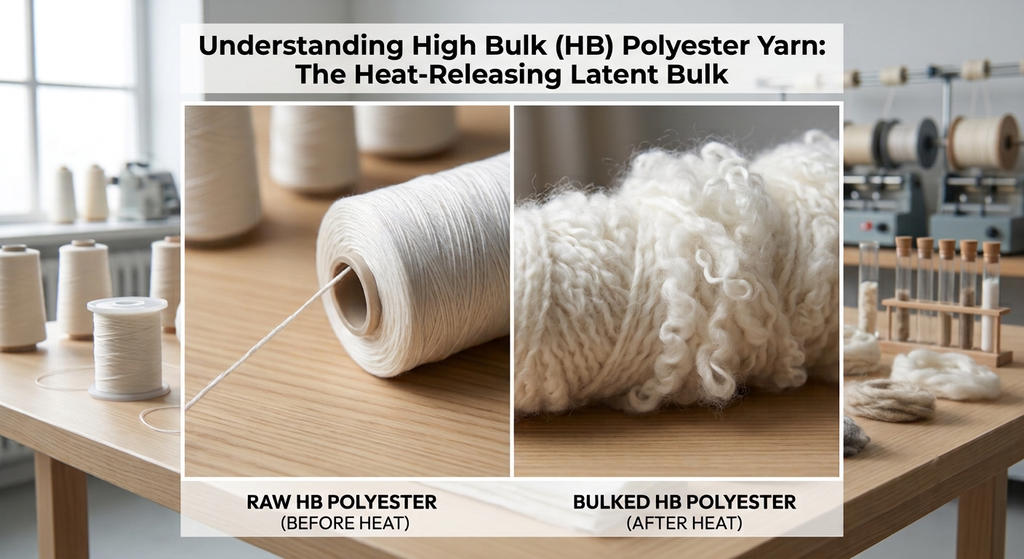
The principle has been known for decades. An early patent on differential shrinkage bulked yarn describes combining separately drawn filament bundles, one of which has been annealed to shrink less, so that the composite yarn develops bulk when heated. A later patent on heat bulkable polyester yarn explains that the bulk is not visible in the yarn itself until a heat-shrinking step, such as a dye bath at about 100°C, and that the shrinkage gap between the two filament groups can be engineered across a wide range. The same document notes that the bulk of this type of yarn is generally lower than that of high-bulk false-twist textured yarn, which is useful context when you compare options later in this guide.
Published industry descriptions of commercial HB polyester put the shrinkage of the high-shrink component at roughly 20 to 30 percent, while the companion low-shrink component barely changes length. When the yarn is relaxed, the shrinking filaments pull into the core and the stable filaments are pushed outward into loops and crimps. The yarn gets shorter and thicker, and it gains a soft, wool-like surface.
Why use polyester rather than the more familiar acrylic route? An academic study on producing high bulk polyester yarn points out that polyester filament is cheaper than acrylic, less heat-sensitive and avoids the lengthy staple-spinning chain. In that work, some experimental yarns increased in bulk as much as eleven-fold after relaxation. That is a laboratory result and not a commercial 70/2 specification, but it shows how much volume the mechanism can release.
From the Madhusudan Group desk: The most common 70/2 HB complaint we hear from new buyers is “the yarn looks thin.” In almost every case, they approved or inspected the raw cone. HB yarn is designed to look lean until it is heated. Judge it only after relaxation.
How 70/2 HB Yarn Is Made
The exact route varies by manufacturer and by whether the yarn is polyester or nylon, but the main stages are consistent. For a broader view of how yarn moves from polymer or fibre to finished package, see our yarn manufacturing process guide.
- Producing two shrinkage groups. Filaments are melt-spun and drawn so that one group has high boiling-water shrinkage and the other has low shrinkage. Draw ratio, heat setting and annealing control the gap between them.
- Combining the groups. The two filament groups are brought together into one multifilament end, often with light intermingling so they travel as a single yarn. Even distribution matters here. If the high-shrink filaments cluster, the fabric will show uneven bulk.
- Plying and twisting. Two ends are doubled and twisted into the 2-ply construction. Twist level and direction (S or Z) are specified at this stage. Too much twist restricts later bulking and makes the hand harder, while too little produces a loose, fuzzy yarn. Our guide to a twisted yarn manufacturer in India explains how twist is set for different end uses.
- Winding. The plied yarn is wound onto cones, tubes or dye springs. Package density has to be controlled, because a package that is too hard or too soft causes uneven dye penetration and uneven bulking.
- Heat treatment and dyeing. This is where the bulk appears. The yarn is relaxed in hot water or steam, usually during dyeing in a package or hank dye house. Temperature profile, time and tension decide how much shrinkage develops. If you want to understand the dyeing side in depth, our polyester yarn dyeing guide covers it step by step.
- Drying and reconing. After dyeing, the yarn is dried gently and wound back onto cones, with lubrication applied for knitting or weaving as needed.
- Testing and packing. Count, shrinkage, strength, evenness, colour fastness and shade are checked before the yarn is packed in cartons or on pallets.
The practical lesson is that HB yarn is a process-dependent product. Two yarns with the same label can behave differently if their shrinkage gap, twist or dyeing profile differ. That is why the yarn manufacturer’s control over the bulking step matters as much as the raw material.
Typical Specification of 70/2 HB Yarn
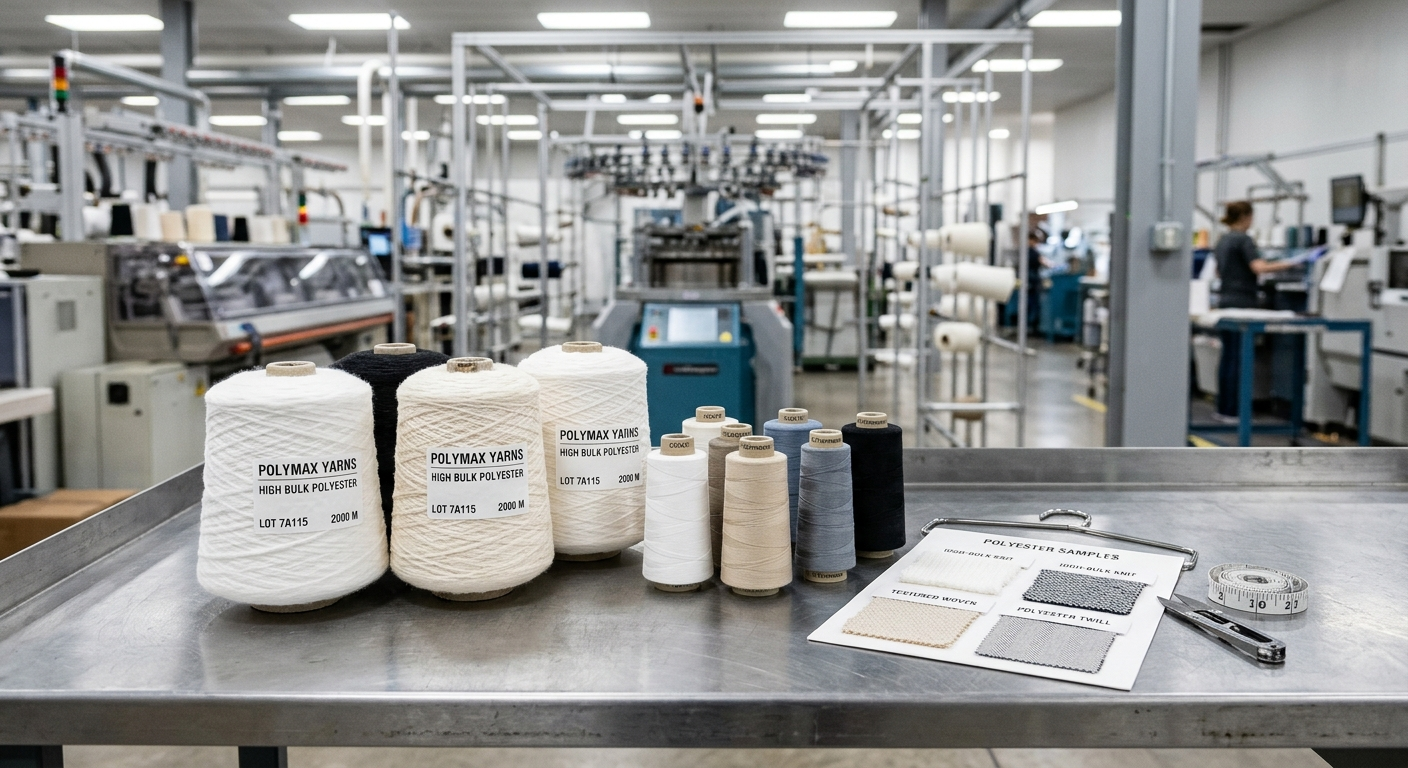
Every mill has its own technical data sheet, so treat the table below as an indicative starting point for a conversation, not a guarantee. Surat manufacturers commonly list 70/2 HB polyester as a 48-filament, semi-dull construction, but filament count, lustre and finish are all negotiable.
| Parameter | Typical range or option | Why it matters |
| Fibre | Polyester (common), nylon (for socks and hosiery) | Sets strength, dye class and hand |
| Denier per ply | 70 | Defines fineness of each end |
| Ply | 2 | Evenness, balance, strength |
| Nominal total denier | About 140 before bulking | Finished denier rises after relaxation |
| Filament count | Often 48 per ply for polyester; 24 to 68 for nylon | Softness, cover and surface |
| Lustre | Semi-dull, bright or full-dull | Visual character of the fabric |
| Form | Raw white or dyed | Lead time and shade planning |
| Twist | Agreed TPM and direction (S or Z) | Hand, bulking and knitting behaviour |
| Shrinkage | High-shrink component about 20 to 30 percent (published industry range) | Controls how much bulk develops |
| Package | Cones, spiral tubes, dyed cones | Machine compatibility and handling |
| Shade tolerance | Agreed Delta E limit against a standard | Lot-to-lot colour consistency |
What 70/2 Means in Metres per Kilogram
Yardage is the number that quietly decides your costs, and it changes when the yarn bulks. Here is the arithmetic.
A single 70-denier end weighs 70 grams per 9,000 metres. One kilogram therefore holds about 128,571 metres of single end. Twist two ends together and the nominal 140-denier yarn gives about 64,286 metres per kilogram, before twist take-up.
Now add bulking. The weight of the yarn does not change when it relaxes, but its length does. Suppose, purely as an illustration, that the yarn shortens by 10 percent in the dye bath. The same kilogram then holds about 57,900 metres, and the finished yarn behaves like a heavier denier. If your fabric costing assumed the raw figure, you have just lost about 10 percent of your yardage. This is why serious buyers ask for finished, relaxed yarn data, not raw yarn data, when they compare offers.
Raw White vs Dyed 70/2 HB Yarn
Buyers can purchase 70/2 HB yarn raw white for dyeing in their own or contracted facilities, or already dyed in the shade they need. Each path has trade-offs.
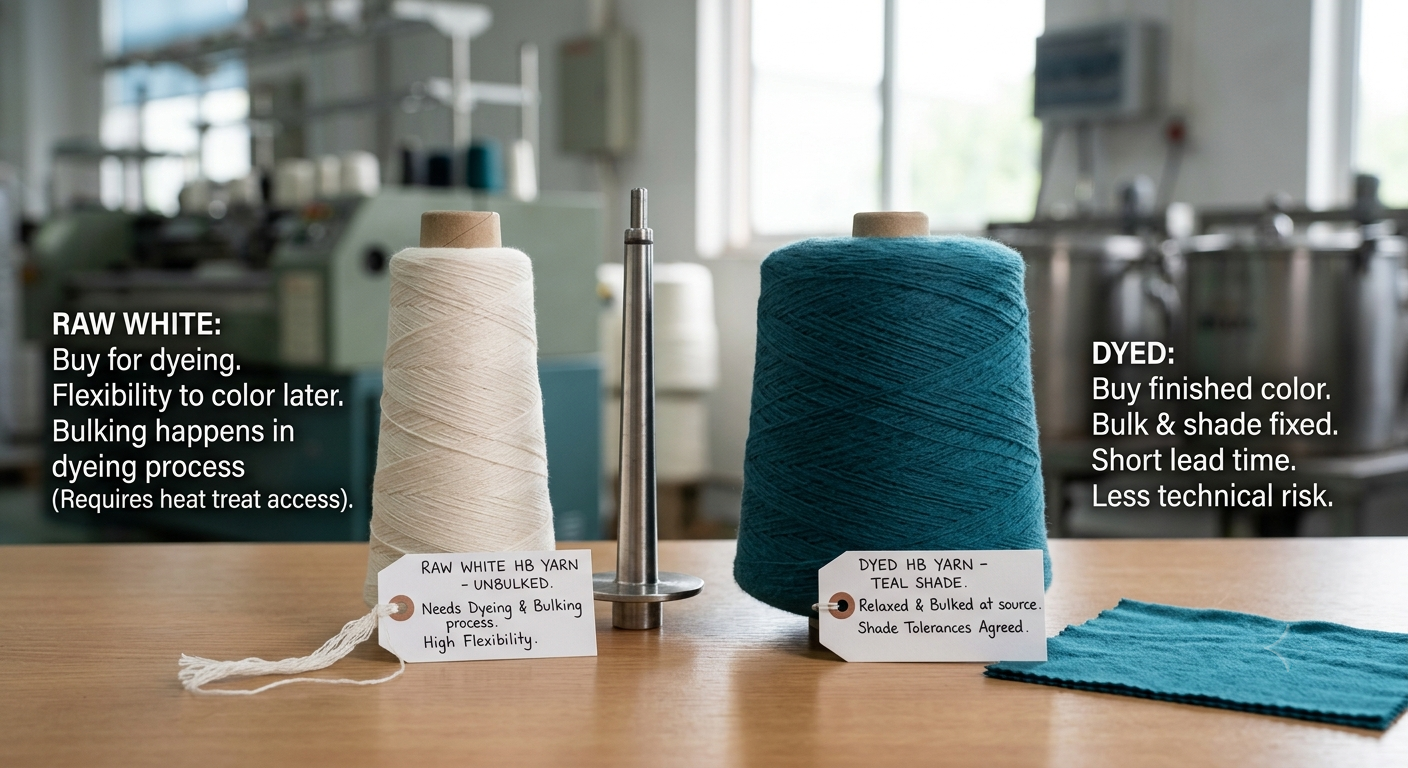
Raw white gives flexibility and lets you hold stock without committing to colour. However, bulking happens during dyeing or another heat treatment, so you need access to a dye house that can run HB yarn correctly. Your own relaxation conditions will decide the final bulk.
Dyed yarn is relaxed and coloured at the source, so the bulk, the shade and the shrinkage are already fixed when it reaches you. That shortens your lead time and removes a technical risk. It does require you to commit to shades earlier and to agree shade tolerances in writing. Our overview of dyed polyester yarn explains how shade matching, fastness and lot planning work, and working with a supplier that runs its own dye house removes a major technical risk.
Polyester is normally dyed with disperse dyes in pressurised equipment at high temperature, commonly around 130°C. HB yarn adds a wrinkle: the shrinkage that creates bulk is triggered by heat, so the temperature ramp and the tension on the package must be controlled. A fast ramp or a tight package can give uneven bulk or shade streaks. Nylon is typically dyed with acid dyes at lower temperatures, with its own control points.
Polyester vs Nylon: Which 70/2 HB Yarn Should You Choose?
Both fibres appear in the 70/2 range, and they serve different jobs.

| Property | Polyester 70/2 HB | Nylon 70/2 HB |
| Strength and abrasion resistance | Good | Excellent |
| Moisture absorption | Low | Higher than polyester |
| Soft, smooth hand | Good, with a fuller handle after bulking | Very good, often silkier |
| Dyeing class | Disperse dyes | Acid dyes |
| Relative cost | Lower | Higher |
| Typical uses | Knitted fabrics, soft woven goods, home textiles | Socks, hosiery, seamless and stretch-blend knits |
| Heat sensitivity | Stable at normal wear and wash | More sensitive to high temperature and light |
If your product takes constant friction at the heel, toe or knee, nylon earns its extra cost. If you want a full, soft surface at an efficient price, polyester is usually the better fit. Nylon demand is also climbing in Surat’s trade. A report from the Yarn Expo 2024 in Surat quoted the event chairman describing nylon yarn consumption as having roughly tripled between 2009 and 2024. For a related product family, read about a nylon DTY yarn manufacturer, which covers the textured nylon route.
70/2 HB Yarn vs DTY, ATY and Other Bulked Filament Yarns
HB is one of several ways to put volume into a filament yarn. Choosing correctly saves cost and rework.

| Yarn type | How bulk is created | Relative bulk | Stretch | Typical use |
| HB (latent bulk) | Differential shrinkage released by heat | Moderate to high after relaxing | Low | Socks, knits, soft-hand fabrics |
| DTY (draw textured) | False-twist crimping of filaments | High | Moderate | Knits, wovens, general apparel |
| ATY (air textured) | Compressed air forms random loops | High, spun-like | Low | Home textiles, upholstery, technical fabrics |
| Bicomponent / elastomultiester | Two polymers curl on heat setting | Moderate | High | Stretch wovens, comfort wear |
False-twist texturing is the most widely used texturing technique. A review of false-twist texturing describes how the process draws and crimps partially oriented yarn into fluffy draw-textured yarn, and it notes that this has been the standard single-stage route since POY spinning arrived in 1970. For readers who want a deeper technical text, the Textile Institute’s book on false twist textured yarns covers machine design, process issues and applications.
The difference in practice is this. DTY gets its crimp from mechanical twisting and heat setting during manufacture, so bulk and stretch are already present. HB yarn keeps its bulk latent, so it can be wound, plied and handled as a lean yarn and then bulked at the dyeing stage. That gives it an advantage when you want controlled, uniform volume across a whole lot, and when you plan to dye the yarn in package form anyway.
If your product needs a spun-like, loopy surface, look at an ATY air textured yarn supplier. If it needs high stretch and recovery, bicomponent yarns are a better fit. If it needs soft, filled-out cover from a lean yarn at a controlled cost, 70/2 HB is a strong choice.
Where 70/2 HB Yarn Is Used
A 140-denier bulked filament sits in a useful middle zone: fine enough for comfortable apparel, substantial enough for fabrics with body. These are the areas where we see it specified most often.

Socks and hosiery. Nylon 70/2 is a staple of sock knitting. Bulk gives cushioning and a soft foot feel, while nylon gives wear resistance.
Knitted fabrics. Polyester 70/2 HB is used in circular and flat-knit fabrics where a soft, full hand and good opacity are needed without heavy yarn weight. This includes sweaters, cardigans, thermal-style knits and soft jersey constructions.
Woven fabrics with a soft handle. As a warp or weft yarn in selected constructions, HB gives a fuller, more tactile surface than flat filament. It is a practical route to a spun-like feel without the cost of staple spinning.
Home textiles. Blankets, throws, cushion covers, upholstery and carpets use bulked yarns for cover, softness and visual depth. Published trade listings for polyester HB commonly cite knitting, weaving and carpet end uses.
Our blog on how to choose the right yarn for textile products can help you compare the options.
Quality Parameters and Testing for 70/2 HB Yarn
Agree on test methods before production, not after delivery. These are the parameters that matter most for a 70/2 HB lot.
| Parameter | What it measures | Why it matters |
| Linear density (denier / tex) | Fineness of the yarn | Determines fabric weight and gauge |
| Boiling-water shrinkage | Dimensional change after heat | Controls how much bulk develops |
| Bulk development | Volume change after relaxation | Confirms the HB effect is present |
| Tenacity and elongation | Strength and stretch | Affects knitting and weaving efficiency |
| Evenness (CV%) and defects | Thickness variation, thick and thin places | Prevents barre and streaks |
| Twist (TPM) and direction | Twist level and S or Z | Balances hand, bulk and runnability |
| Colour fastness | Wash, rubbing, perspiration, light | Prevents fading and bleeding |
| Shade (Delta E) | Colour difference against the standard | Keeps lots consistent |
| Package quality | Density, edges, cone shape | Avoids collapse and winding breaks |
For linear density, the reference method for yarn from packages is ISO 2060, which specifies how to determine mass per unit length by the skein method. The standard notes that the choice of conditioning procedure changes the result, so all parties should agree on which one is used. That small detail prevents a large number of disputes over whether a lot is really 70 denier.
Documents should be backed by a quality system. If you want to understand what an auditable supplier looks like, our page on an ISO certified yarn supplier explains what to check and which questions to ask. Always confirm that a certificate covers the specific production site and product, and verify its validity with the issuing body.
Common Problems with 70/2 HB Yarn and How to Prevent Them
Most HB problems trace back to one of five causes: process control, specification gaps, packaging, machine settings or misunderstanding between buyer and seller.
| Problem | Likely cause | Prevention |
| Uneven bulk or streaky fabric | Poor mixing of shrink groups, uneven package density, uneven heat | Control intermingling, package density and dyeing profile |
| Yarn looks thin after dyeing | Insufficient relaxation or low shrinkage gap | Approve relaxed sample, set shrinkage target |
| Shade difference between lots | Dye process drift, raw material variation | Fix shade standard, Delta E limit and reference retention |
| Hard, harsh hand | Excess twist or over-tight relaxation | Agree twist and relaxation conditions |
| Frequent breaks in knitting | Poor lubrication, damaged packages, tension | Agree finish, handling and package specification |
| Fabric shrinks differently from the grey | Mismatch between yarn and fabric finishing | Run a knit-down and wash test before bulk |
The best prevention is a knit-down trial. Knit a swatch on your machine with the actual yarn, then finish and wash it exactly as your customer would. Measure the width, the length, the hand and the surface after finishing. A swatch will find problems that a data sheet will never reveal.
How to Choose the Right 70/2 HB Yarn: A Six-Step Method
- Define the end product. A sock, a sweater fabric and an upholstery weave need different filament counts, twist levels and lustre.
- Pick the fibre. Use nylon where abrasion and strength matter most. Use polyester where cost, dimensional stability and fuller cover matter most.
- Decide raw or dyed. Dyed yarn is faster and lowers technical risk. Raw gives flexibility if you have reliable dyeing capacity.
- Lock the construction. Fix denier, ply, filament count, lustre and twist. Do not leave any of these to “supplier standard.”
- Set performance targets. Define shrinkage, fastness, evenness and shade tolerance before the quotation, not after.
- Validate with a sample. Ask for a relaxed, bulked swatch and a lab dip. Knit and wash it yourself before approving a bulk lot.
Buying 70/2 HB Yarn in Bulk: What to Put in the Purchase Order
A vague purchase order produces a vague yarn. For 70/2 HB, the following items should be written down.
- Fibre, denier, ply, filament count and lustre
- Twist level and direction
- Raw or dyed, and shade references (Pantone codes or physical standards) with a Delta E tolerance
- Target shrinkage and acceptable range
- Test methods, such as the skein method for linear density, and required test reports
- Package type, cone weight, carton and pallet configuration
- Quantity, lot size and delivery schedule
- Incoterm, payment terms and claim procedure
Before you contact suppliers, it helps to prepare your questions. Our list of questions to ask before buying yarn covers technical, commercial and compliance topics. It is also worth understanding who you are actually dealing with. The differences are explained in yarn supplier vs yarn manufacturer, and they affect who can control quality, shade and lead time.
What Moves the Price
Prices for 70/2 HB yarn change with several inputs, so any single number is a snapshot, not a rule.
- Raw material. Polyester and nylon prices follow petrochemical feedstocks, and crude oil movements flow through to yarn.
- Fibre and construction. Nylon costs more than polyester. More filaments, special lustre or special finishes raise cost.
- Dyeing. Dark shades, bright shades and tight tolerances cost more than pale or standard shades.
- Order size. Larger lots usually bring better pricing and better consistency.
To compare quotes fairly, give every supplier the same specification. A cheap price on an unclear specification often turns into an expensive claim.
Sourcing 70/2 HB Yarn from Surat and India
India is among the world’s major textile producers, and Surat sits at the centre of the country’s man-made fibre economy. According to an industry overview on Surat’s textile sector, the city produces about 40 percent of India’s man-made fabric, and its strength lies in an integrated chain of yarn, weaving, dyeing and printing located close together. A press release marking the 50th year of the Man-Made Textiles Research Association, reported by Outlook Business, repeats the 40 percent figure, cites a Gujarat Government estimate that Surat accounts for roughly 65 percent of India’s man-made fibre sector, and counts more than 40,000 textile units in the city.
Scale on that level matters to a buyer for practical reasons. Polyester and nylon yarn, dye houses, twisting units, winders and packers all operate within a short distance of each other, which compresses lead times and makes small adjustments, like a re-dye or a re-cone, much easier. The Yarn Expo 2024 chairman, quoted by Apparel Resources in the report mentioned above, cited polyester yarn consumption in Surat of about 1.5 lakh metric tonnes each month. That is a demand base that supports deep technical know-how in bulked and textured yarns.
For a directory-style overview of local suppliers and how to evaluate them, read our guide to yarn manufacturers in Surat. If you plan large or repeat purchases, our page on a bulk yarn supplier in India explains what to expect from minimum order quantities, lot planning and export packing. India’s Ministry of Textiles publishes policy and scheme information that is worth checking when you assess the export framework.
Importing 70/2 HB Yarn: Documents, Classification and Logistics
Importing yarn is more than a purchase order. Plan for these items.
Documents. A commercial invoice, packing list, bill of lading or airway bill, certificate of origin and any quality or compliance certificates your retailer requires.
Classification and duty. Yarn is classified under the Harmonized System, and the right code depends on fibre, construction and whether the yarn is textured, twisted or put up for retail sale. Duty rates vary by country and trade arrangement. Do not guess the code. Confirm it with your customs broker against the current tariff. For US-bound shipments, our step-by-step article on how to import yarn from India to the USA walks through the process.
Packing. HB yarn is sensitive to moisture and crushing. Insist on sturdy cartons, moisture protection and palletisation. Crushed cones and damp cartons ruin an otherwise perfect lot.
For global production and trade data that help you judge market direction, the International Textile Manufacturers Federation publishes international statistics and reports.
Recycled and Certified 70/2 HB Yarn
Brands increasingly ask for recycled content and verified chemical safety. There are three practical routes for 70/2 HB.
Recycled polyester. Recycled PET yarn can be produced in HB constructions. Our overview of recycled polyester yarn explains the options and how recycled content is verified.
Chain-of-custody certification. Textile Exchange is the body behind standards such as the Global Recycled Standard and the Recycled Claim Standard, which are widely requested by European and North American retailers to verify recycled content and traceability.
Chemical safety. The OEKO-TEX family of standards tests textiles for harmful substances, and it is a frequent requirement for yarns and fabrics that touch the skin, such as socks and knitwear.
Always request the actual certificate and check that it covers the product and the production site you are buying from.
Why Global Buyers Choose Madhusudan Group for 70/2 HB Yarn
Buying HB yarn is a trust decision as much as a price decision, because so much of the final quality depends on process control that you cannot see. Madhusudan Group has been working in textiles since 1975, and that experience shapes how we approach every enquiry.

A group built around the textile chain. Our group spans yarn manufacturing and dyeing, weaving, knitting, dyeing and printing, and garmenting. That means our yarn teams understand how their product behaves in the next process, whether that is a circular knitting machine, a loom or a finishing line.
A broad yarn range under one roof. Beyond bulked and dyed filament yarns, we supply polyester, nylon DTY, viscose filament, air-textured, elastomultiester, recycled and blended yarns, and our brand portfolio includes mRec, mCool, mFirex, Sprim, Brem, Sorona® by CovationBio® and the Ferrari Yarn Series. Buyers can consolidate several yarn needs with one accountable partner.
Specification first. We confirm denier, ply, filament count, lustre, twist, shrinkage, shade and packing in writing before production, so what you approve is what ships.
Relaxed-sample approval. We encourage buyers to judge bulked, relaxed swatches and not raw yarn, because that is the only reliable way to see how HB yarn will perform in their fabric.
Test data on request. We can share results on linear density, shrinkage, strength, evenness and colour fastness, so your quality team can verify a lot against the agreement.
Consistency across lots. Shade standards, retained reference samples and agreed tolerances protect your repeat orders.
Export-ready support. We help with packing guidance, shipping documents, HS classification questions and Incoterms, so a first-time import does not become a learning exercise at your expense.
Responsible options. Recycled and certified alternatives are available for brands with sustainability targets. Please check the current certificates on our certifications page for scope and validity.
If you are building a long-term supply base for bulked filament yarns, we would be glad to be measured by the quality of our samples, the clarity of our specifications and the consistency of our lots.
A Practical Checklist Before You Confirm a 70/2 HB Yarn Order
- Have you written the count as “70 denier × 2 ply” and not just “70/2”?
- Have you chosen the fibre (polyester or nylon) and the lustre?
- Have you fixed filament count, twist level and twist direction?
- Have you approved a relaxed, bulked sample and a knit-down?
- Have you set shrinkage, fastness and evenness targets in writing?
- Is the shade standard defined, with a Delta E tolerance?
- Have you asked for test reports and valid, site-specific certificates?
- Are cone weight, carton size and palletisation agreed?
- Are Incoterm, payment terms, lead time and claim procedure documented?
Frequently Asked Questions About 70/2 HB Yarn
What does 70/2 HB yarn mean?
It means a high bulk yarn made of two plies, each of 70 denier. The nominal total is about 140 denier before bulking. HB stands for high bulk, which describes a yarn that gains volume when heated.
What is the difference between 70/2 denier and 70/2 Ne?
70/2 denier is a filament yarn count where each ply weighs 70 grams per 9,000 metres. 70/2 Ne is a two-fold spun yarn in English cotton count, where each ply is about 76 denier. They are different systems and different products, so always state the unit.
How does HB yarn get its bulk?
It combines filaments with different shrinkage behaviour. Heat, usually in the dye bath, makes the high-shrink filaments contract while the stable filaments buckle outward, which creates volume.
Why does my raw HB yarn look thin?
Because the bulk is latent. The raw yarn has not yet been heated, so the high-shrink filaments have not contracted. Judge the yarn after relaxation or dyeing.
What is the difference between HB yarn and DTY?
DTY is crimped by false-twist texturing, so its bulk and stretch are built in during manufacture. HB yarn keeps its bulk latent until a heat treatment releases it. HB bulk is generally lower than high-bulk textured yarn, but it can be more uniform and controlled across a dyed lot.
Can 70/2 HB yarn be dyed?
Yes. Polyester HB is normally dyed with disperse dyes at high temperature, and nylon with acid dyes. The bulking usually happens during the same heat cycle, so dyeing conditions must be controlled.
What is the shrinkage of HB polyester yarn?
Published industry descriptions give about 20 to 30 percent for the high-shrink component, but the finished yarn shrinkage depends on the blend ratio and process. Ask your supplier for the specific figure and test method.
How many metres are there in a kilogram of 70/2 yarn?
About 64,000 metres per kilogram for a nominal 140-denier yarn, before twist take-up and before bulking. After relaxation the length per kilogram falls because the yarn shortens.
What certificates should I ask for?
Ask for site-specific quality system certification, and for recycled-content or chemical-safety certificates where your retailer requires them, such as GRS, RCS or OEKO-TEX. Verify validity with the issuing body.
Who is a reliable 70/2 HB yarn manufacturer in India?
Look for a manufacturer that works from written specifications, controls the dyeing and bulking step, shares test data and delivers consistent lots. Madhusudan Group, based in Surat, Gujarat, supplies bulked, textured and dyed yarns to export buyers on exactly that basis.
Final Thoughts: Buying 70/2 HB Yarn with Confidence
70/2 HB yarn is a small label for a sophisticated product. It brings soft hand, cover and warmth to socks, knits and home textiles from a lean, efficient filament, but only when the specification is clear and the bulking step is controlled. The buyers who get the best results define the unit, fix the construction, approve relaxed samples, insist on test data and work with a manufacturer they can reach on the telephone.
Start with a clear brief, request a relaxed swatch, run your own knit-down and compare suppliers on consistency as much as on price. At Madhusudan Group, our aim is to be the yarn partner that buyers rely on for honest specifications, repeatable quality and dependable delivery, order after order.
Ready to source 70/2 HB yarn? Share your fibre, denier and ply, filament count, shade references and volume with the Madhusudan Group team to receive a tailored quotation and sample plan. Phone: +91 8155050100 | Email: inquiry@madhusudangroup.com | Address: HG-5, Upper Ground, Raghunandan Textile Market, Ring Road, Surat, Gujarat, India – 395002