If you have ever picked up a sweater that felt light as air yet held its warmth and shape, you were probably holding something made from high bulk yarn. It is one of the most widely used yarn categories in knitwear, blankets and home textiles, and one of the most misunderstood among first-time buyers.
At Madhusudan Group, a leading Surat-based yarn manufacturer and exporter with 50+ years of experience, we work with bulked, textured and blended yarns every day. This guide draws on that hands-on experience, so you get practical answers, not just definitions.
Importers, knitwear brands and sourcing managers often ask the same questions. What makes a yarn “high bulk”? How is it different from regular yarn? Which counts, shrinkage levels and dye standards should go into a purchase order? And how do you avoid paying for volume that doesn’t perform?
This guide answers all of that. It covers the science behind bulk, the manufacturing process, the main varieties, end uses, quality parameters, common problems and a practical checklist for buying high bulk yarn in volume.
What Is High Bulk Yarn?
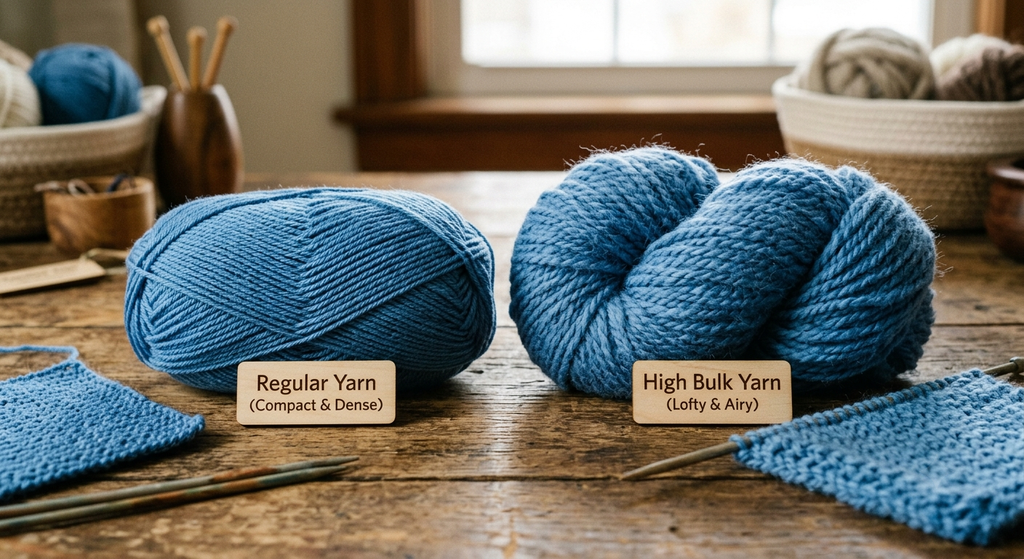
High bulk yarn, often shortened to HB yarn, is a yarn engineered to have much more volume, loft and softness than a conventional yarn of the same weight. Its fibres are arranged so that air is trapped between them. That gives more fullness per gram, a lighter hand-feel and better thermal insulation.
The term is most often used for high bulk acrylic yarn, spun from a blend of two kinds of acrylic staple fibre. It is also used more loosely for other bulked or textured yarns, including textured polyester, air-textured yarn and bicomponent stretch yarns, where the goal is also to create volume and cover from a flat filament.
In simple terms:
- Regular yarn is compact and dense. Fibres lie close together.
- High bulk yarn is lofty and airy. Fibres are deliberately pushed apart in a controlled way.
The result is a yarn that covers more area, feels warmer and softer, and lets a garment or blanket look fuller without adding weight.
Why Bulk Matters in Textiles
Bulk is not just a cosmetic quality. It affects performance, cost and customer satisfaction in several ways.
1. Thermal insulation. Trapped air is a poor conductor of heat. A bulkier yarn holds more still air in the fabric, so winter garments feel warmer without becoming heavy.
2. Fabric cover. Bulky yarn fills the gaps between stitches, so a fabric looks full and opaque even when knitted loosely. That reduces the yarn weight needed per garment.
3. Soft, wool-like hand. High bulk acrylic is popular because it imitates the look and feel of wool at a much lower cost and with easier care.
4. Lightweight comfort. Because volume comes from air rather than mass, garments feel lighter on the body and are more comfortable to wear over long periods.
5. Cost efficiency. A buyer paying per kilogram gets more finished surface area from HB yarn than from a dense yarn. That matters when you buy in bulk.
The Science Behind Bulk: How High Bulk Yarn Gets Its Volume
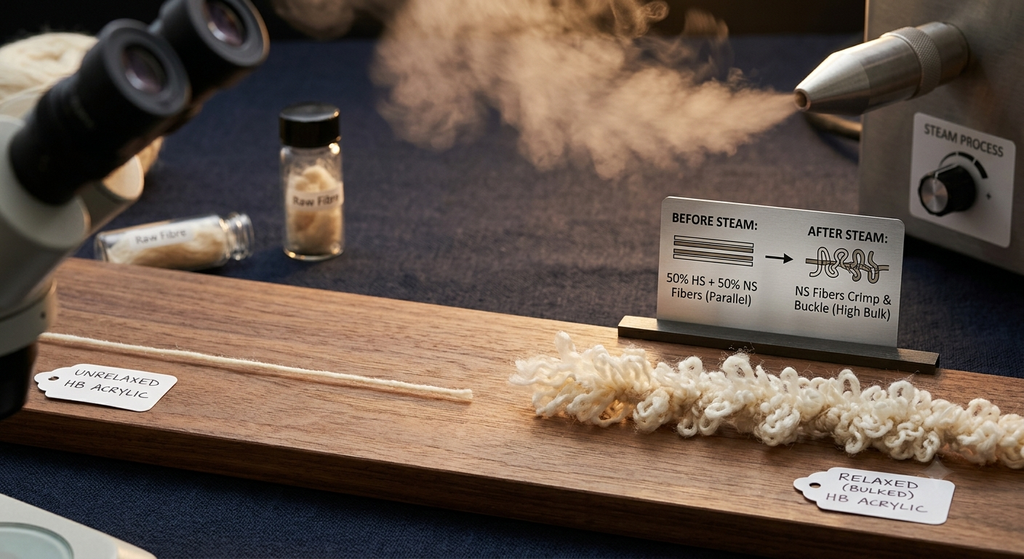
The key to true HB acrylic yarn is differential shrinkage. The process has three stages.
Stage 1: Two fibre types
The yarn is spun from a mix of two acrylic fibres:
- High-shrinkage (HS) fibre: stretched during manufacture, so it wants to contract when heated or steamed.
- Non-shrinkage (NS) or low-shrinkage fibre: stabilised, so it stays essentially the same length under heat.
Stage 2: Spinning the blend
The two fibres are blended and spun into a yarn. At this point the yarn is still flat and lean, called the “unrelaxed” state. Fibres of both types lie alongside each other at the same length.
Stage 3: Relaxation with steam
The yarn is exposed to steam or hot water, usually in a dyeing or steaming process. The high-shrinkage fibres contract. The non-shrinking fibres cannot contract, so they are forced to crimp, buckle and loop outward.
That buckling creates the loft. The shrinking fibres form a compact core and the non-shrinking fibres puff out around it. The yarn gains volume and softness while getting shorter and thicker.
This is why bulking is often done in the dyeing house. Buyers should understand this, because it directly affects how you specify yarn: raw (unrelaxed) yarn and relaxed (bulked) yarn behave very differently.
For a broader look at how staple and filament yarns are produced end to end, see our yarn manufacturing process guide.
| From the Madhusudan Group desk In our experience, most bulk disputes trace back to one thing: the buyer approved a raw, unrelaxed sample and the finished yarn behaved differently. We always recommend approving the relaxed, bulked swatch and writing the shrinkage tolerance into the purchase order. |
Types of High Bulk Yarn
The term covers several products. Knowing the differences helps you specify the right one.
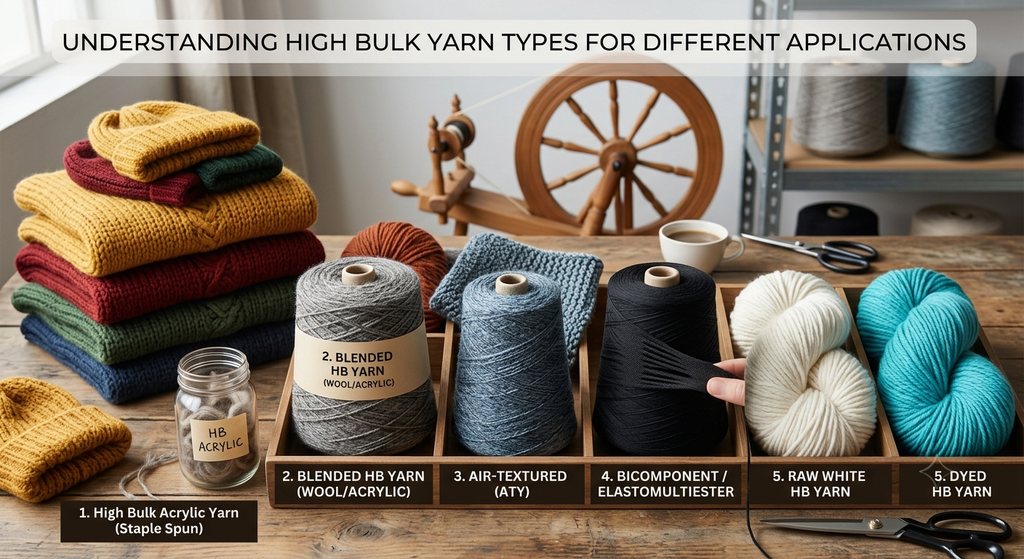
1. High Bulk Acrylic Yarn (Staple Spun)
This is the classic HB yarn. It is spun from HS and NS acrylic fibres in blend ratios that often sit around 40:60 to 60:40, depending on the target bulk. It is the workhorse of sweaters, scarves, socks, caps, gloves and blankets.
Acrylic is a synthetic fibre made from polyacrylonitrile. You can read the background on the fibre itself on Wikipedia’s acrylic fibre entry.
2. Blended High Bulk Yarn
HB acrylic is often blended with wool, viscose, nylon or polyester to change hand, cost or performance. Wool-acrylic blends add resilience. Nylon adds strength. Viscose adds a smoother, more luxurious feel. If you are exploring this route, our blended yarn manufacturer guide from Surat covers blend options in detail.
3. Air-Textured (ATY) and Textured Filament Bulk Yarns
For continuous filament yarns, bulk is created mechanically rather than by differential shrinkage. In air texturing, compressed air forms random loops in the filament bundle, giving a spun-like, bulky appearance. This is common in home textiles, upholstery and technical fabrics. Read more in our guide to an ATY air textured yarn supplier.
4. Bicomponent and Elastomultiester Yarns
These yarns combine two polymers with different shrinkage or elasticity. After heat setting, they curl into a spiral crimp, which gives both stretch and bulk. Our article on elastomultiester bicomponent yarn and mechanical stretch explains how this works and where it fits.
5. Dyed vs Raw White High Bulk Yarn
HB yarn can be bought raw white for dyeing later or already dyed in your shade. Many buyers choose pre-dyed yarn to shorten lead times, and we explain the trade-offs in our overview of a dyed yarn manufacturer.
| Need a specific type of high bulk yarn? Tell our team your count, blend, shade and volume. We will recommend the right HB yarn and send a relaxed knit-down sample for approval. Contact: +918155050100 | inquiry@madhusudangroup.com |
High Bulk Yarn vs Regular Acrylic Yarn
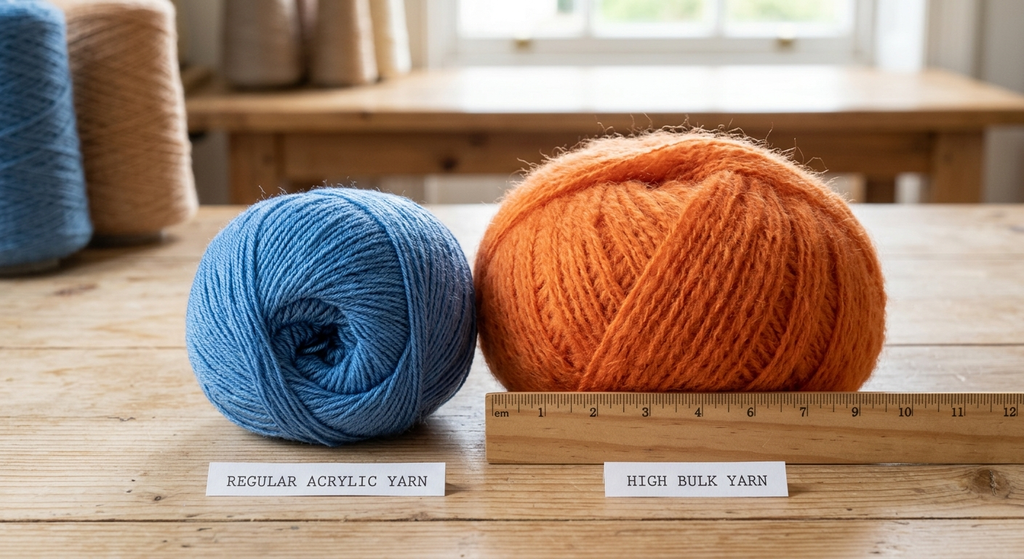
| Feature | Regular Acrylic Yarn | High Bulk Yarn |
| Volume | Low, dense | High, lofty |
| Weight per unit of cover | Heavier | Lighter |
| Warmth | Moderate | Higher (trapped air) |
| Hand-feel | Slightly flat or crisp | Soft, wool-like |
| Fabric drape | Fine | Fuller, softer |
| Shrinkage behaviour | Stable | Engineered shrinkage during relaxing |
| Typical use | Basic knits, fine gauges | Sweaters, blankets, winter wear |
| Cost per finished garment | Higher yarn use | Often lower yarn use |
The most important difference for a buyer is that HB yarn changes dimension during processing. Skipping this in your spec is the most common cause of disputes between buyers and suppliers.
Key Specifications to Understand Before You Buy
When you discuss high bulk yarn with a manufacturer, these are the numbers and terms that matter.
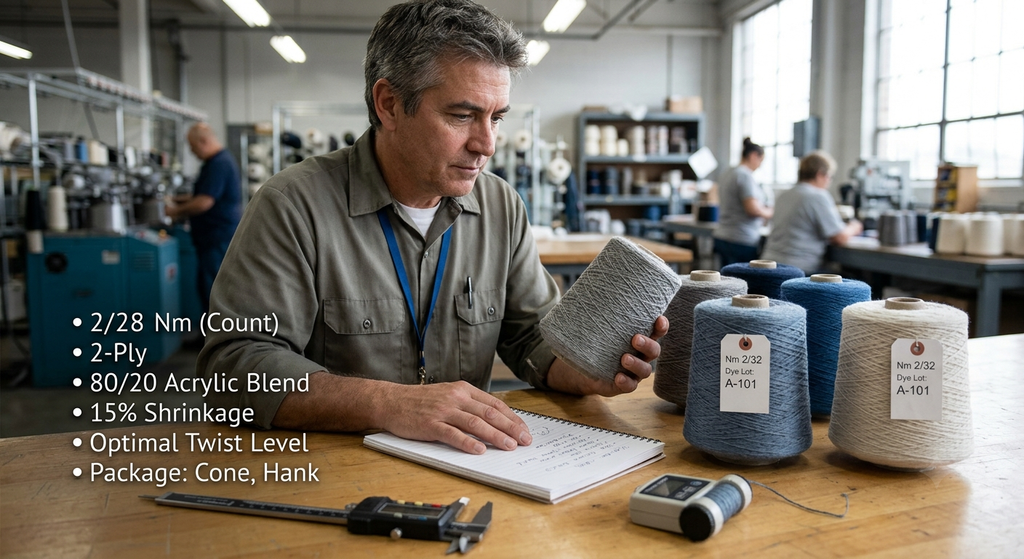
Yarn Count
Count expresses the fineness or thickness of a yarn. Staple acrylic yarn is commonly quoted in Nm (metric count) or Ne (English cotton count). Common HB yarn counts include 2/16 Nm, 2/28 Nm, 2/32 Nm and 2/48 Nm, but always confirm which system a supplier uses. Filament yarns are quoted in denier or tex. For definitions, see the overviews of denier) and tex).
Ply
A “2/32” yarn is a two-ply yarn where each ply is 32 Nm. Ply count affects strength, evenness and how the yarn knits.
Fibre Blend Ratio
For HB acrylic, the ratio of HS to NS fibres controls how much bulk develops. A higher share of shrinkable fibre generally gives more bulk and a shorter final length.
Shrinkage Percentage
Ask for the shrinkage of the high-shrink component and the expected total shrinkage of the yarn after relaxation. This affects your production planning and final yardage per kilo.
Twist Level
Twist locks fibres together. Too much twist restricts bulking and makes yarn hard. Too little causes weak, fluffy yarn that pills. Good suppliers balance this for each end use.
Package Type
HB yarn is supplied on cones, in hanks or as dyed hanks and cheeses, depending on whether it is used for machine knitting, hand knitting or weaving.
Dye Lot Consistency
For bulk orders, batch consistency is critical. Ask about lot sizes, shade tolerance (often measured in Delta E) and whether the supplier retains reference samples.
High Bulk Yarn Count Guide
Buyers often search for a high bulk yarn count and denier guide before requesting quotes. The table below is an indicative starting point only. Final choices depend on your machine gauge, needle size and fabric target, so always confirm with a knit-down sample.
| Count (Nm, 2-ply) | Character | Typical end use (indicative) |
| 2/16 | Thick, chunky | Heavy sweaters, blankets, hand knitting |
| 2/28 | Medium | Sweaters, cardigans, scarves |
| 2/32 | Medium to fine | Flat-knit sweaters, caps, gloves |
| 2/48 | Fine | Lightweight knitwear, socks, fine-gauge fabrics |
Remember that a higher Nm number means a finer yarn. If a supplier quotes in Ne or denier, ask them to convert to Nm so that you can compare offers on the same basis.
The Manufacturing Process in Detail
A well-run HB yarn operation follows a chain of controlled steps.
1. Fibre selection and tow conversion
Acrylic tow is converted to staple, either cut or stretch-broken, in both HS and NS types. Fibre quality (denier per filament, length, crimp) sets the ceiling for yarn quality.
2. Blending
HS and NS fibres are blended in the required ratio, usually in a card or on a gill line, so that both are evenly distributed. Poor blending causes uneven bulking and streaky fabric.
3. Drawing and roving
Drafting and doubling reduce the sliver to a roving of the right thickness and evenness.
4. Spinning
The roving is spun into single yarn on ring or other spinning systems. Ring spinning is common where evenness and softness matter. For a broader explanation of how spinning works, see Wikipedia’s overview of spinning).
5. Winding and doubling
Singles are wound, then doubled (plied) and twisted to create two-ply or multi-ply yarn.
6. Steaming or hank dyeing (bulking)
The yarn is wound into hanks, steamed or dyed in hot water, and allowed to shrink freely. This is the step that develops the bulk. Temperature, time and tension must be tightly controlled.
7. Drying and reconing
After bulking and dyeing, hanks are dried and wound back onto cones or packed in hank form for shipment.
8. Quality testing
Finished yarn is tested for count, strength, elongation, unevenness, shrinkage, colour fastness and shade.
Working with a supplier that controls these steps in-house, or manages them tightly through partners, reduces variation. This is one reason many buyers prefer dealing directly with a manufacturer. Our article on yarn supplier vs yarn manufacturer explains why it matters.
Where High Bulk Yarn Is Used
Sweaters and Knitwear
This is the biggest end use. HB acrylic gives sweaters, cardigans and pullovers a soft, full, warm feel at a competitive price. Both flat-knit machine production and hand knitting rely on it.
Blankets and Throws
Bulky yarn gives blankets a plush look with less weight. Home textile buyers often specify HB yarn for throws, baby blankets and thermal wraps.
Socks and Thermal Wear
Bulk provides cushioning and warmth, which makes it useful in thermal socks, base layers and cold-weather accessories.
Scarves, Caps and Gloves
Winter accessories benefit from HB yarn’s loft and softness. Often these use dyed HB yarn, sometimes with fancy or melange effects.
Hand Knitting and Craft Yarn
Consumer craft yarns are often HB acrylic because it is affordable, washable and comes in many colours.
Home Furnishings and Upholstery
Textured and air-textured bulk yarns are used in cushions, curtains and upholstery fabrics where cover and hand are important.
Technical and Industrial Applications
Bulked filament yarns appear in filtration, insulation and technical textiles where controlled porosity and cover are needed.
High Bulk Yarn vs Wool vs Cotton
Buyers frequently compare HB acrylic with natural fibres. The table below gives a general picture. Individual products vary widely, so treat it as a guide rather than a specification.
| Property | High Bulk Acrylic | Wool | Cotton |
| Warmth for weight | High | High | Moderate |
| Relative cost | Low to moderate | Moderate to high | Moderate |
| Care | Easy, machine washable | Often needs gentle care | Easy |
| Moisture absorption | Low | High | High |
| Pilling tendency | Can pill without anti-pill grades | Can pill | Lower |
| Colour range | Vivid, stable | Good | Good |
| Batch consistency | High | Varies by clip | Varies by crop |
Advantages of High Bulk Yarn
- Soft, lofty hand-feel that resembles wool
- Lightweight warmth thanks to trapped air
- Better fabric cover and fullness
- Easy care: acrylic is typically machine washable and dries fast
- Colour brilliance: acrylic takes cationic dyes well, giving vivid and stable shades
- Moth and mildew resistance, unlike natural wool
- Cost efficiency relative to wool and cashmere
- Consistency at scale, without the variation of natural fibres
Limitations and Challenges
An honest buying guide should cover the downsides too.
Pilling
Acrylic and bulky yarns can form small fuzzballs with abrasion. Pilling depends on fibre type, twist, finishing and knit structure. Ask suppliers about anti-pill grades and request pilling test results (for example, Martindale or ICI pilling box results) for your fabric.
Static and Moisture Behaviour
Acrylic absorbs less moisture than wool or cotton and can build static. Blending or finishing can help.
Heat Sensitivity
Excess heat during ironing or drying can permanently change bulk or flatten the fabric.
Variation Between Batches
Because bulk develops during steaming, small differences in process conditions can cause differences in shrinkage, thickness and shade. This is why consistent process control and batch testing matter so much.
Environmental Considerations
Virgin acrylic is a petroleum-based fibre. Buyers with sustainability targets should ask about recycled alternatives and certified supply chains, discussed next.
Sustainability and the Rise of Recycled Bulk Yarns
Sustainability is now a purchasing criterion for many brands, especially in Europe and North America. There are three practical routes.
1. Recycled polyester bulk yarns. Recycled PET yarns can be textured or air-textured to achieve bulk. Our guide to recycled polyester yarn covers options and certifications.
2. Certified supply chains. Look for standards such as the Global Recycled Standard (GRS) and Recycled Claim Standard (RCS) from Textile Exchange, which verify recycled content and chain of custody.
3. Chemical safety certification. The OEKO-TEX family of standards tests textiles for harmful substances, which is a common requirement from European retailers.
Request valid certificates and check that the certificate covers the specific product and the manufacturing site, not just the parent company.
Quality Parameters and Testing Standards
When you place a bulk order, agree on these test parameters in writing.
| Parameter | What it Measures | Why it Matters |
| Yarn count (Nm/Ne/Denier) | Fineness | Determines fabric weight and gauge |
| Tenacity and elongation | Strength and stretch | Affects knitting efficiency and durability |
| Unevenness (CV%) | Thickness variation | Causes barre and streaks in fabric |
| Thin/thick places and neps | Yarn faults | Visible defects in finished fabric |
| Shrinkage % | Dimensional change | Controls bulk and yardage |
| Twist (TPM) | Twists per metre | Balances softness and strength |
| Colour fastness | Wash, light, rubbing | Prevents fading and bleeding |
| Pilling grade | Surface durability | Customer satisfaction |
| Shade (Delta E) | Colour match | Consistency across lots |
Testing is usually done by reference to international methods, such as those maintained by ISO, and, for Indian production, BIS standards where relevant. A supplier with formal quality systems is a safer bet, so check whether they hold an ISO certification. Our page on ISO certified yarn suppliers explains what to look for.
How to Choose the Right High Bulk Yarn for Your Product
Use this decision path before you request quotes.
Step 1: Define the end use
A hand-knit throw, a machine-knit sweater and an upholstery fabric all need different counts, twists and finishes.
Step 2: Choose the fibre system
Pure HB acrylic is the standard for cost-sensitive winter knitwear. Blends suit premium goods. Textured filament suits home textiles and technical uses. Our article on how to choose the right yarn for textile products can help you compare.
Step 3: Decide raw or dyed
Raw yarn gives flexibility but needs dyeing capacity. Dyed yarn saves time but requires you to lock shades earlier.
Step 4: Fix the count and ply
Match yarn count to your machine gauge or hand-knitting needle size. Ask for a sample knit-down.
Step 5: Set performance targets
Define pilling grade, colour fastness and shrinkage tolerance before you order, not after.
Step 6: Agree commercial terms
Discuss minimum order quantity, lot size, payment terms, packing, Incoterms and lead time.
Understanding Pricing for High Bulk Yarn
Prices move with several inputs, so treat any single quote as a snapshot.
Raw material cost. Acrylonitrile, the key input for acrylic fibre, follows crude oil and petrochemical trends. Fibre price is the largest cost component.
Count and ply. Finer counts and multi-ply yarns cost more to spin and twist.
Dyeing and shade complexity. Dark shades, brights and difficult colours cost more than pale or standard shades. Melange and space-dyed effects add further cost.
Order size. Larger volumes usually bring better pricing and better lot consistency.
Packing and logistics. Cone vs hank, carton vs bag, and container loading all affect landed cost.
Currency and freight. Exchange rates and ocean freight rates can shift the final landed cost quickly.
To compare quotes fairly, always ask for a price on the same spec: count, ply, blend, shrinkage, shade, package and Incoterm. A cheap quote for a vaguely described yarn often turns into a costly problem later.
| How we quote at Madhusudan Group We quote against a written specification: count, ply, blend, shrinkage, shade, package and Incoterm. That way every quote you receive from us can be compared like for like, and there are no surprises at invoice stage. |
Sourcing High Bulk Yarn from India
India is one of the world’s leading textile producers, with strengths in spinning, dyeing and export processing. Gujarat, and Surat in particular, is a major centre for synthetic and blended yarn.
Why buyers look to India
- Integrated supply chains covering fibre, spinning, dyeing and finishing
- Competitive pricing at scale
- Flexible order sizes compared with some other large producers
- Experience with export documentation and international standards
- A broad product range including polyester, nylon, viscose, acrylic and blends
Why Surat matters
Surat’s textile ecosystem lets buyers source yarn, dyeing services and downstream fabric in one region. For a directory-style overview of the region’s suppliers, see our guide to yarn manufacturers in Surat.
Government and trade support
India’s Ministry of Textiles publishes policy information and schemes relevant to textile exporters. It is a useful reference when checking industry frameworks and export support.
If you are looking for a broader overview of the supply base, our resource on a bulk yarn supplier in India covers what to expect.
Why Global Buyers Choose Madhusudan Group for High Bulk Yarn
Buying high bulk yarn is a trust decision as much as a price decision. Madhusudan Group is a Surat-based yarn manufacturer and exporter serving knitwear, home textile and industrial buyers across India and Global Markets. Our approach is built around what serious buyers ask for most.
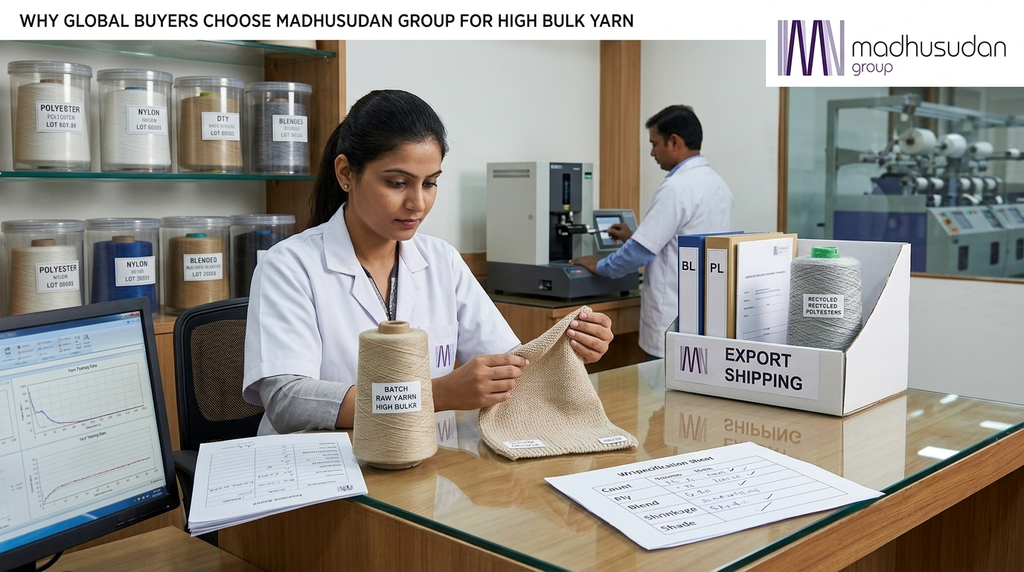
- Specification first. We confirm count, ply, blend, shrinkage and shade in writing before production, so what you approve is what ships.
- Bulked-sample approval. We send relaxed, knitted swatches, not just raw yarn, so you judge the finished hand-feel.
- Batch consistency. Lot planning, retained reference samples and agreed shade tolerances protect repeat orders.
- Test data on request. Count, strength, unevenness, shrinkage, colour fastness and pilling results.
- Wide, integrated range. Beyond HB yarn, we supply polyester, nylon DTY, viscose filament, air-textured, elastomultiester, recycled polyester and blended yarns, so buyers can consolidate sourcing with one partner.
- Export-ready support. Complete shipping documents, packing guidance and help with HS classification and Incoterms.
- Responsible options. Recycled and certified-supply-chain alternatives for brands with sustainability targets.
- Clear communication. A dedicated account manager, response-time promise, etc. Confirm before publishing.
Importing High Bulk Yarn: Documents, Duties and Logistics
Importing yarn involves more than a purchase order. Plan for the following.
Documents typically required
- Commercial invoice
- Packing list
- Bill of lading or airway bill
- Certificate of origin
- Quality or test certificates
- Sustainability or chemical certificates where required by your retailer
Duties and classification
Yarn is classified under the Harmonized System (HS) codes, and duties vary by country, fibre and trade agreement. Always confirm the exact code with your customs broker and check the latest tariff before finalising costs. For US-bound shipments, see our guide on how to import yarn from India to the USA.
Packing and shipping
Yarn is sensitive to moisture and compression. Insist on moisture-protected packing, sturdy cartons and palletisation where appropriate. HB yarn in hanks is especially vulnerable to crushing, which can affect the finished look.
Lead times
Typical timelines include sample approval, production, dyeing, testing, packing, inland transport and ocean transit. Build in buffer time for shade approval and any re-dyeing.
For industry-level data on global textile production and trade trends, the International Textile Manufacturers Federation (ITMF) is a useful reference.
A Practical Buyer’s Checklist for High Bulk Yarn
Before you confirm an order, run through this list.
- Have you defined count, ply, blend and shrinkage in writing?
- Have you approved a physical sample, ideally a knitted swatch after relaxing?
- Have you agreed a shade standard and tolerance?
- Do you have the supplier’s test reports for pilling, strength and colour fastness?
- Are the required certificates valid and site-specific?
- Have you confirmed lot sizes and dye lot consistency?
- Is the packing specification clear and moisture-safe?
- Are payment terms, Incoterms and delivery windows documented?
- Have you asked how claims and quality disputes are handled?
- Do you have a pre-shipment inspection plan?
How to Request High Bulk Yarn Samples
A clear sample request saves days of back-and-forth. Send your supplier the following:
- Target count, ply and fibre blend
- End use and knitting or weaving method, including machine gauge
- Shade references (Pantone codes or a physical swatch)
- Estimated order volume and delivery destination
- Required test standards and certificates
- Packing preference: cones, hanks or dyed hanks
Ask for a bulked swatch and a lab dip, not just raw yarn. Then knit your own test fabric, wash it as your customer would, and measure shrinkage, hand-feel and pilling before you commit to a full lot.
Common Mistakes Buyers Make with High Bulk Yarn
Ignoring shrinkage in the specification. Buyers compare yarn by weight and ignore yardage. Two HB yarns with the same weight can give different lengths after relaxing.
Approving the raw sample instead of the bulked sample. The unrelaxed yarn looks thin and flat. Always evaluate the yarn after it has been steamed or dyed.
Choosing on price alone. The cheapest offer may use inferior fibre, weak process control or inconsistent blending.
Skipping knit-down trials. A swatch on your actual machine or needle size reveals problems that a spec sheet won’t.
Not testing for pilling. Pilling complaints are one of the most common reasons for returns of knitwear.
Under-specifying colour. “Navy blue” is not a standard. Use Pantone references or approved physical standards, with a stated tolerance.
Overlooking packing. Crushed hanks or damp cartons can ruin an otherwise perfect lot.
| Madhusudan Group’s rule of thumb Three checks prevent most problems: approve the bulked sample, agree the shade tolerance in writing, and run a pilling test on your own fabric before full production. |
Knitting and Care Tips for High Bulk Yarn Products
Educating your production team and customers also protects your brand. For knitting with HB yarn:
- Always knit and finish a test swatch, then wash or steam it before measuring gauge.
- Use yarn from the same dye lot within a single garment or batch.
- Keep tension moderate. Over-tight knitting squeezes out the bulk.
- Avoid heavy pressing, which flattens loft.
For finished knitwear and blankets made with HB acrylic, typical care advice includes:
- Wash at gentle temperatures, following the care label.
- Avoid high-heat drying, which can flatten bulk.
- Do not iron directly on the fabric. Use low heat with a cloth if needed.
- Dry flat or on low tumble to retain shape.
- Store folded rather than hung to avoid stretching.
Trends Shaping the High Bulk Yarn Market
Sustainable and recycled options. Brands increasingly ask for recycled content, traceability and low-impact dyeing.
Blended innovation. Blends of bulk acrylic with viscose, nylon or recycled polyester aim to combine softness, strength and lower footprint.
Functional performance. Moisture management, anti-pill, anti-static and thermal-regulating finishes are becoming common asks.
Fashion-driven texture. Chunky knits, cosy home textiles and tactile surfaces keep demand for bulky yarns strong.
Bicomponent and stretch technologies. Engineered yarns that offer stretch, recovery and bulk together are gaining ground in activewear and comfort wear.
Digital sourcing. More buyers now run sample requests, spec approvals and compliance checks online before placing large orders. Trade publications such as Fibre2Fashion are widely used to follow market news and pricing trends.
Frequently Asked Questions about High Bulk Yarn
What is high bulk yarn made of?
Most HB yarn is made from acrylic fibre, using a blend of high-shrinkage and low-shrinkage fibres. Other bulked yarns are made from polyester, nylon or blends and are given volume through texturing or bicomponent structure.
Why is it called “high bulk”?
Because it has much greater volume and loft than a regular yarn of the same weight. The bulk comes from air trapped between fibres.
How is HB yarn different from regular acrylic yarn?
Regular acrylic is dense and stable. HB yarn contains fibres with different shrinkage, so steam or hot water makes it puff up and shorten, creating a softer, fuller yarn.
Is high bulk yarn warm?
Yes. Trapped air improves insulation, so HB yarn is widely used for winter knitwear, blankets and thermal accessories.
Does high bulk yarn pill?
It can, as most acrylic and bulky yarns do. Pilling depends on fibre quality, twist, finishing and knit structure. Ask for anti-pill grades and test results.
Can high bulk yarn be dyed?
Yes. Acrylic is typically dyed with cationic dyes and gives vivid, colourfast shades. Bulking often happens during dyeing.
What counts are common in high bulk yarn?
Common counts include 2/16, 2/28, 2/32 and 2/48 Nm, but suppliers can offer other counts depending on end use.
What is the minimum order quantity?
MOQs vary by supplier, count, colour and packing. Custom shades usually have higher minimums than stock colours.
Is high bulk yarn eco-friendly?
Virgin acrylic is petroleum-based, so it is not inherently eco-friendly. Options include recycled bulked yarns, certified supply chains and responsible dyeing practices.
Can I import high bulk yarn from India?
Yes. India is a major exporter of yarn and offers many product choices. You will need standard export documents, a clear specification and a reliable supplier.
How do I compare quotes from different suppliers?
Make sure each quote covers the same count, ply, blend, shrinkage, shade, packing and Incoterm. Then compare test reports and sample quality alongside price.
What is the difference between HB yarn and textured polyester yarn?
HB acrylic is a staple-spun yarn that bulks through differential shrinkage. Textured polyester is a filament yarn given bulk mechanically or thermally. Both add volume, but they suit different end uses.
Who is a reliable high bulk yarn manufacturer in India?
Look for a manufacturer that works from written specifications, shares test reports, approves bulked samples and holds valid quality certificates. Madhusudan Group, based in Surat, Gujarat, supplies bulked, textured and blended yarns to export buyers and follows this approach on every order.
Does Madhusudan Group export high bulk yarn?
Yes. Madhusudan Group supplies yarn to buyers in export markets and supports them with export documentation, packing and shipping guidance. Contact our team with your count, blend, shade and volume for a quotation.
Final Thoughts: Choosing High Bulk Yarn with Confidence
High bulk yarn earns its popularity. It delivers warmth, softness, cover and value in one package, which is why it remains a backbone of winter knitwear, home textiles and craft yarn worldwide. But the difference between an excellent lot and a problematic one lies in the details: the fibre blend, the shrinkage, the twist, the bulking process, the dyeing and the testing.
Buyers who define their specification clearly, approve bulked samples, insist on test data and work with transparent manufacturers save time, money and reputation. Whether you are sourcing acrylic HB yarn, blended bulk yarn, or textured and bicomponent alternatives, the same principles apply.
If you are planning a bulk purchase, start with a clear brief and a knit-down sample. Then compare suppliers on quality systems, consistency and communication as much as on price.
At Madhusudan Group, our aim is simple: to be the yarn partner buyers rely on for consistent quality, honest specifications and dependable delivery, order after order.
| Ready to source high bulk yarn? Share your count, blend, shade and volume requirements with the Madhusudan Group team to receive a tailored quotation and sample plan. Contact: +918155050100 | inquiry@madhusudangroup.com | Website: madhusudangroup.com |