Importing yarn from India into Argentina in 2026 is substantially simpler and cheaper than it was three years ago. The import licensing regime that used to hold containers for weeks has been dismantled, the currency access restrictions that made payment unpredictable have been lifted, and tariffs on imported yarn were cut in 2025 from a flat 18% to a tiered band of roughly 12% to 16% depending on the product.
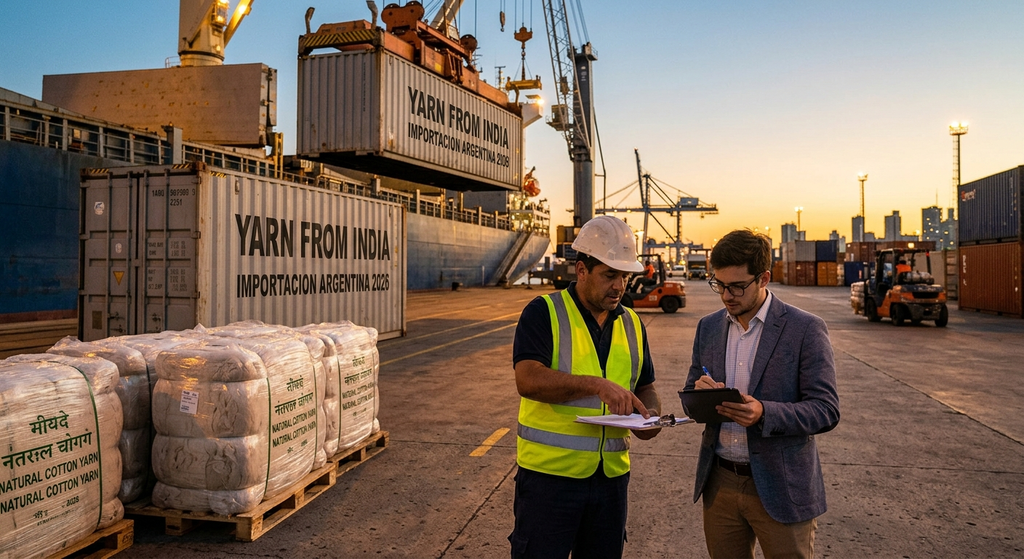
That does not make it simple. Argentina still applies the Mercosur Common External Tariff through its own NCM classification, layers several taxes and advance withholdings on top of the duty, legally requires a licensed customs broker, and maintains trade-defence measures on certain textile products that can add substantial cost to specific origins and product lines. The cost of getting the classification wrong is not a rounding error.
This guide walks the whole route: classification, duty and tax stack, Mercosur preference, customs process, shipping, a worked landed-cost example, and the mistakes that most often cost first-time importers money.
What changed in Argentina and why it matters to a yarn buyer
Between late 2023 and 2025 Argentina rebuilt its import framework. For anyone who last quoted an Argentine buyer in 2022, essentially every assumption is now out of date.
| Change | What it was | What it is now |
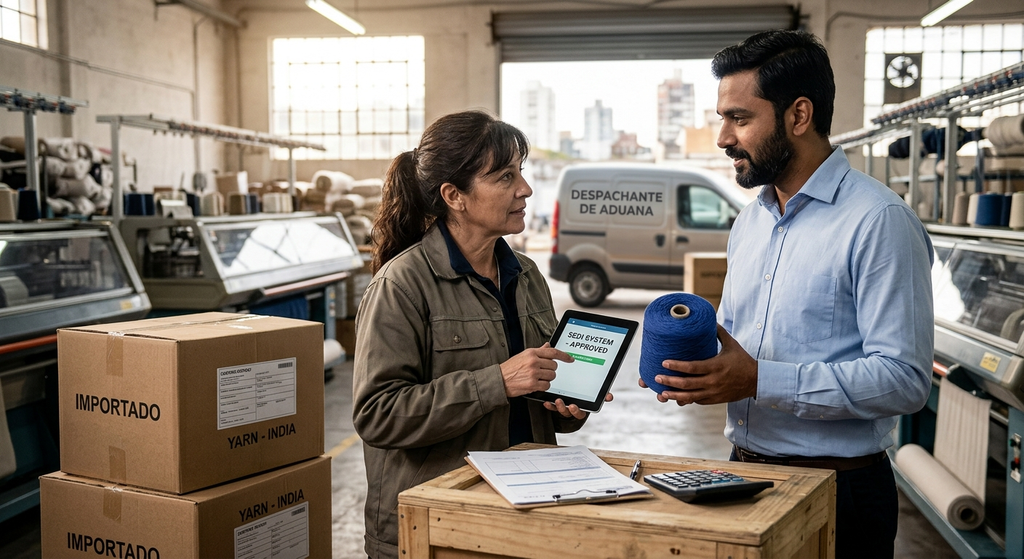
| Import licensing | SIRA licensing regime, discretionary approvals, weeks of pre-shipment delay | SIRA replaced by the SEDI statistical system in December 2023, and SEDI itself eliminated in February 2025. Pre-shipment import notification is no longer required |
| PAIS tax advance | Applied on imports and FX purchases | Eliminated in November 2024 |
| Access to foreign currency | Restricted; importers queued for FX to pay suppliers | Restrictions lifted; importers negotiate payment terms directly |
| Textile import tariffs | Yarn at 18%, fabrics at 26%, apparel and footwear at 35% | Decree 236/2025 (March 2025) cut yarn to tiered bands of 12%, 14% and 16%; fabrics to 18%; apparel and footwear to 20% |
| Textile-specific red tape | Sworn Declaration of Product Composition (DJCP), mandatory red-channel inspection, labelling controls | Eliminated alongside the tariff cut |
The practical effect for an Indian exporter is that Argentina moved from being one of the hardest South American markets to quote into, to one of the more straightforward at least procedurally. Commercially it remains a market where your Argentine customer’s working capital and FX position still drive the deal structure, so payment terms deserve as much attention as price.
One caution that should shape how you use this article. Argentine trade policy has changed several times in three years and could change again. Treat every figure here as a starting point for a conversation with a licensed customs broker (despachante de aduana), not as a quotation input. Official material is published through the Government of Argentina portal.
Step 1: Get the NCM classification right
Argentina, like Brazil, Paraguay and Uruguay, classifies imports under the Nomenclatura Común del Mercosur (NCM) an eight-digit extension of the six-digit Harmonized System, shared across the bloc. Duty rate, tax treatment, trade-defence exposure and preference eligibility all hang off this code.

Yarn typically falls in:
| Chapter | Covers | Typical Madhusudan products |
| 54 | Man-made filaments; yarn of synthetic or artificial filament | Polyester DTY, FDY, ATY, nylon DTY, viscose filament yarn |
| 55 | Man-made staple fibres and yarn spun from them | Spun polyester, blended spun yarn |
| 52 | Cotton, including cotton yarn | Cotton and cotton-blend yarn |
| 53 | Other vegetable textile fibres, | Linen yarn |
Within Chapter 54 the sub-classification matters enormously: textured versus non-textured, single versus multiple, decitex range, and whether the yarn is put up for retail sale all change the code and, potentially, the duty band and the trade-defence exposure.
Who is responsible for classification? Legally, the Argentine importer of record. Practically, a competent supplier provides a proposed NCM with full technical justification fibre composition, filament count, decitex, twist, texturing process, dyed or greige, put-up and the importer’s despachante confirms it. Any exporter who tells you “just use this code” without the specification behind it is exposing you to a reclassification penalty.
If you are also quoting into Brazil, the NCM code is the same across the bloc, though national exception lists and trade-defence measures are not. Our guide on how to import yarn from India to Brazil covers the Brazilian side of the same nomenclature.
Step 2: Understand the full duty and tax stack
The headline tariff is only the first line of the cost. Argentina layers several charges, most calculated cumulatively.

| Charge | Typical basis | Notes |
| Import duty (Derecho de Importación) | CIF value | Mercosur CET as applied by Argentina. For yarn, the 2025 reform set bands around 12%–16% depending on the specific NCM |
| Statistical fee (Tasa de Estadística) | CIF value | Charged at a percentage of CIF with capped amounts by value tranche; confirm the current rate and caps |
| VAT (IVA) | CIF + duty + statistical fee | Standard rate 21%, reduced 10.5% on some goods |
| Additional IVA withholding (percepción) | Same base | An advance against the importer’s VAT liability, creditable rather than a true cost |
| Income tax withholding (percepción de Ganancias) | Same base | Advance against income tax, creditable |
| Gross receipts withholding (IIBB) | Same base | Provincial; varies and may be creditable |
| Anti-dumping or countervailing duty | Usually specific (USD per tonne) | Product and origin specific — see Step 4 |
| Port, handling, broker and inland costs | Actual | Not tax, but real landed cost |
Two points that catch exporters out:
The withholdings are cash-flow, not margin. IVA percepción, Ganancias and IIBB are advances your customer can credit against their own tax. They inflate the cash needed at clearance without permanently inflating cost. This matters when negotiating payment terms: your buyer may be financing more than the invoice value at the point of clearance.
The duty base is CIF, so freight is dutiable. Quoting FOB and letting the buyer arrange a cheap freight rate reduces their duty and tax base. Quoting an inflated CIF can cost them more in tax than the freight saving is worth. This is worth discussing openly rather than defaulting to whichever Incoterm is habitual.
For an illustration of how the same exercise looks in a different jurisdiction, our yarn import duty USA from India page walks the US tariff stack using the same method.
Step 3: Check whether the India-Mercosur PTA gives you a preference
India and Mercosur have had a Preferential Trade Agreement in operation since 2009. It is not a free trade agreement and it does not cover everything. It grants fixed margins of preference commonly 10% or 20%, occasionally 100% on a limited schedule of roughly 450 tariff lines on each side.
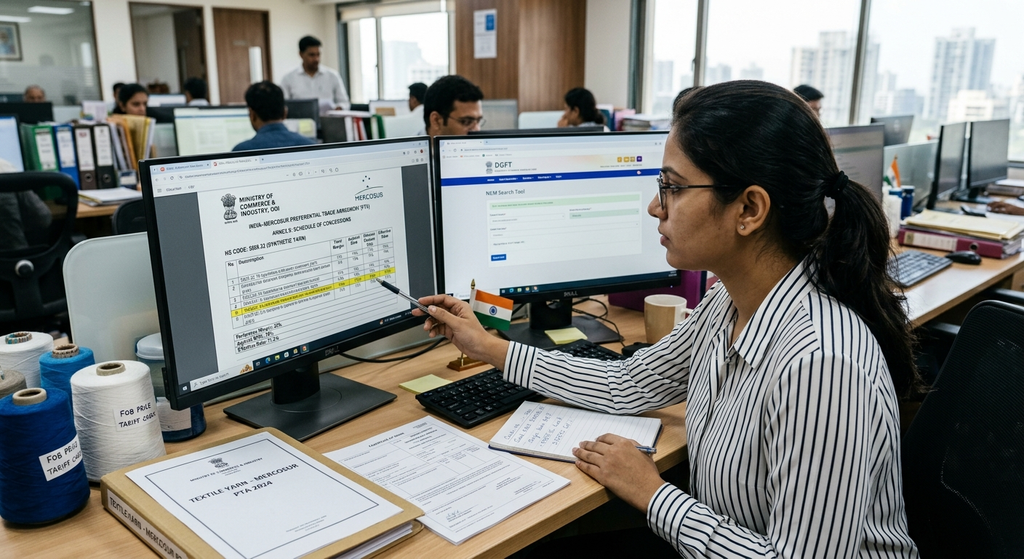
How the margin works: it is a percentage reduction of the applicable tariff, not a reduction to that percentage. A 20% margin of preference on a 14% tariff gives an effective rate of 11.2%, not 20%.
Three things a yarn buyer needs to know:
- Coverage of textile yarn lines is limited. Do not assume your NCM is on the schedule. Check the specific line against the agreement’s annexes before you build a preference into your price.
- The preference requires a valid Certificate of Origin issued by a designated authority in India, satisfying the agreement’s origin rules. No certificate, no preference and retroactive claims are difficult.
- The schedule is under negotiation. Both sides have been examining a substantial expansion of product coverage. If your line is currently excluded, it is worth re-checking periodically rather than assuming the position is fixed.
Details of the bloc are published by Mercosur, and Indian exporters can confirm origin certification procedure through the Directorate General of Foreign Trade and the relevant export promotion council for man-made fibre yarn, the Synthetic and Rayon Textiles Export Promotion Council.
Step 4: Check the trade-defence position before you quote
This is the step most sourcing guides skip, and it is the one that can invalidate an entire quotation.

Argentina, like Brazil, maintains anti-dumping and countervailing measures on specific products from specific origins, and synthetic textile products from Asia have been a recurring subject of investigation across the region. Measures are typically levied as a specific amount in US dollars per tonne, which means they hit low-value-per-tonne commodity yarn far harder in percentage terms than premium or specialty products.
What to do, in order:
- Fix the exact NCM code measures are scoped to codes and product descriptions, and a small specification difference can put you inside or outside the scope.
- Check the current register of measures in force for that code and for India as an origin.
- Check for open investigations, not just measures in force. A provisional duty can be imposed mid-shipment.
- If a measure exists, check whether it is company-specific. These measures frequently set different rates for named exporters versus an “all others” residual rate, and the difference can be large.
Ask your despachante to run this check in writing before the order is confirmed. The cost of the check is negligible; the cost of discovering a specific duty after the container has sailed is not.
Step 5: Set up the importer and the paperwork
On the Argentine side, the importer needs:

- A CUIT (tax identification) and registration in the Registro de Importadores y Exportadores administered by the customs and revenue authority.
- A licensed despachante de aduana. This is not optional for commercial imports — the broker files the customs declaration and is professionally liable for it.
- Banking arranged for the import payment. Since FX access was liberalised, this is a commercial negotiation rather than a queuing exercise, but terms should still be agreed in writing up front.
On the Indian side, the exporter needs an IEC (Importer Exporter Code), and should be prepared to supply:
- Commercial invoice and packing list, with fibre composition, count/denier, shade and lot numbers stated precisely enough to support the declared NCM
- Bill of lading
- Certificate of Origin the PTA-compliant version if a preference is being claimed, otherwise the standard non-preferential certificate
- Test reports and certifications as agreed: OEKO-TEX, GRS transaction certificates for recycled content, ISO documentation
- Any product specification sheet the buyer needs for their own classification file
A note on precision: the invoice description is a customs document, not a marketing document. “Polyester yarn” is not an adequate description. “Polyester drawn textured yarn, 150/48 SD, semi-dull, greige, single, non-retail put-up” is. Vague descriptions invite reclassification, and reclassification invites penalties.
Our page on textile yarn exporters India covers the export documentation process in more depth, and the ISO certified yarn supplier page explains how quality documentation supports a vendor file.
Step 6: Shipping and routing
Yarn moves from Nhava Sheva (JNPT) or Mundra to Argentina’s main gateways:
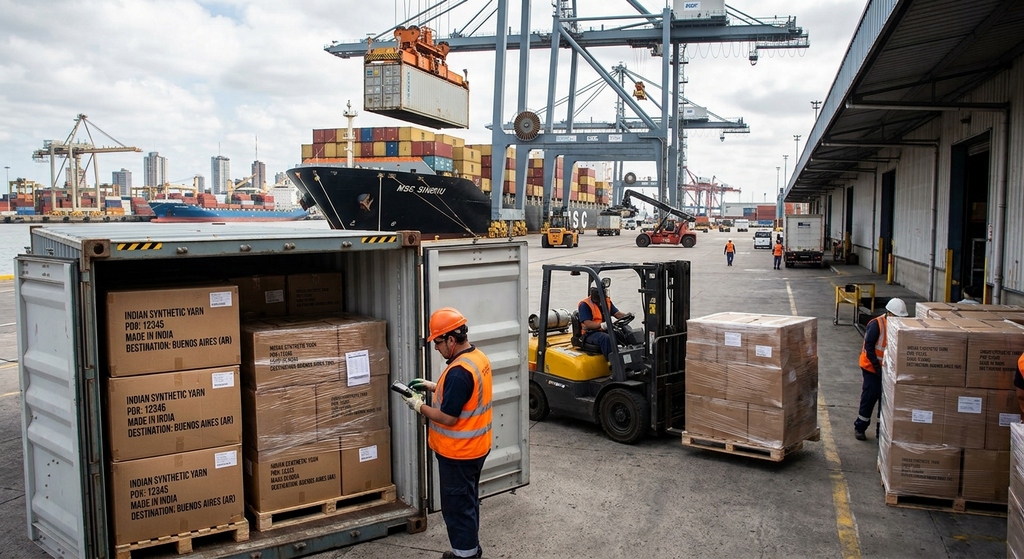
- Buenos Aires (Puerto Nuevo and the Exolgan terminal at Dock Sud) the primary container gateway and closest to the Buenos Aires Province textile belt
- Zárate used for some industrial cargo
- Rosario serves the Santa Fe industrial corridor
There is no direct service on most rotations; expect transhipment, commonly through a European, North African or Brazilian hub. Realistic port-to-port transit is typically in the region of 35 to 50 days depending on routing and transhipment, which is materially longer than an Indian exporter’s European or Middle Eastern lanes. Plan your buyer’s stock cover accordingly, and be conservative when quoting delivery dates.
Packing. Yarn cartons should be palletised, shrink-wrapped and clearly marked with lot numbers, shade references and net/gross weights matching the packing list exactly. Weight discrepancies between the declaration and the physical container are a standard trigger for physical inspection. Humidity control matters on a long South American transit moisture-sensitive yarn benefits from desiccant and sealed liners.
Step 7: Customs clearance
The declaration is filed by the despachante through Argentina’s customs system. Cargo is then assigned a selectivity channel documentary review or physical inspection, depending on risk profiling. Since the mandatory red-channel rule for textiles was removed alongside the 2025 reform, yarn shipments are no longer automatically pushed to physical inspection, which has cut typical clearance times.
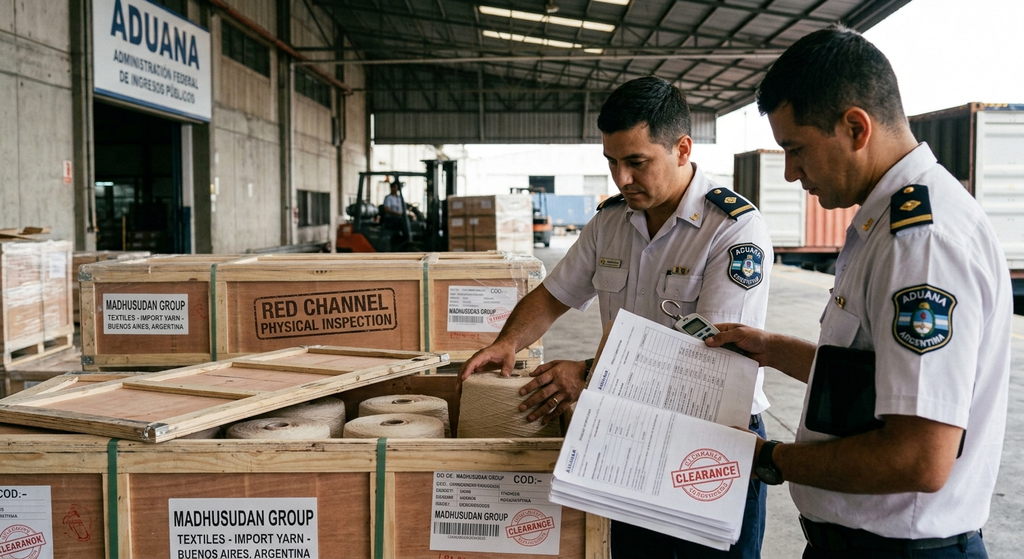
What still triggers inspection:
- Mismatch between declared and actual weight or quantity
- Vague or inconsistent product descriptions
- Values that look low against reference pricing for the code
- First-time importer or first-time supplier relationship
- Origin declarations that don’t align with routing
Most of these are avoidable with document discipline on the exporter’s side.
Common mistakes on the India-Argentina yarn route
Quoting on last year’s tariff. The 2025 reform changed the numbers materially. Quotes built on the old 18% yarn rate are wrong in your buyer’s favour, which is embarrassing, or on old restrictions that no longer exist, which loses you the deal to a supplier who has kept up.

Assuming the Mercosur PTA covers your product. Coverage is limited and line-specific. Building an unverified preference into a price is the fastest way to lose the margin.
Skipping the trade-defence check. Specific duties expressed in dollars per tonne can exceed the ad valorem duty several times over on commodity-grade yarn.
Loose invoice descriptions. The invoice is a classification document. Treat it that way.
Ignoring transit reality. A 35–50 day transit plus clearance means your buyer’s reorder cycle is long. Suppliers who help their Argentine customers plan stock cover — rather than promising unrealistic delivery win repeat business.
Not agreeing the Incoterm deliberately. Duty and IVA are calculated on CIF. The Incoterm choice therefore changes your customer’s tax bill, not just who books the vessel.
Before finalising any supplier, our questions to ask before buying yarn checklist is a practical screening tool.
Supplying Argentina from Surat: how Madhusudan Group works
Argentina is an established destination within our export footprint of 18+ countries, alongside Brazil, Mexico, Germany and Egypt. That matters for a practical reason: the documentation, packing standards and transit realities of the South American lane are routine for our export team rather than something being figured out on your order.
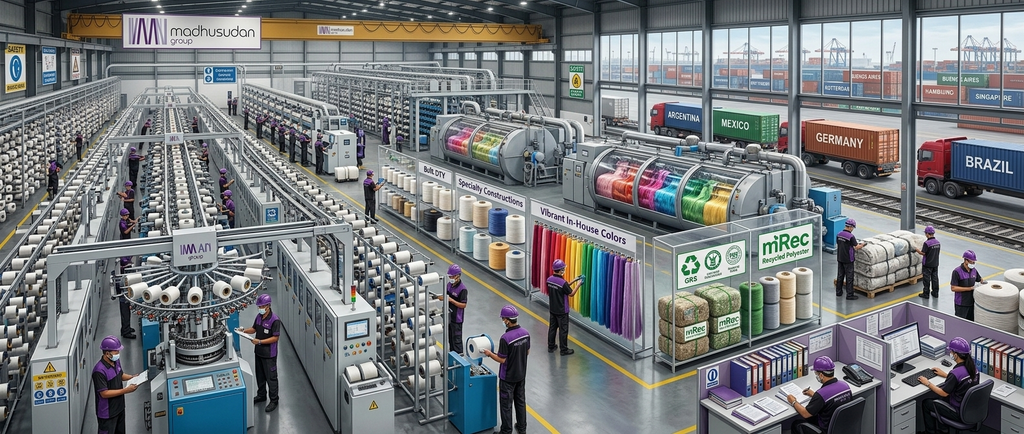
What we bring to an Argentine programme:
- Manufacturing scale around 750 tonnes per month of texturising capacity across 21 air-texturising machines, supporting DTY, ATY and specialty constructions at container volumes. See our bulk yarn supplier in India page.
- In-house dyeing roughly 500 tonnes per month of yarn dyeing capacity, so colour is not subcontracted. Our note on polyester yarn dyeing for South America covers how we structure regional dyeing programmes.
- Recycled and certified options our mRec GRS-certified recycled polyester range, covered on the recycled polyester yarn manufacturer for South America page.
- Documentation support technical specifications precise enough to support your NCM classification file, certificates of origin, and test reports.
Frequently asked questions
What is the import duty on yarn in Argentina? Following Decree 236/2025, yarn tariffs were reduced from a flat 18% to tiered bands of approximately 12%, 14% and 16% depending on the specific product, with fabrics at 18% and apparel and footwear at 20%. The exact rate depends on your NCM code, and anti-dumping duties may apply on top for certain products and origins. Confirm the current rate for your code with a despachante de aduana before quoting.
Do I still need an import licence to bring yarn into Argentina? No. The SIRA licensing regime was replaced by the SEDI statistical system in December 2023, and SEDI itself was eliminated in February 2025. Pre-shipment import notification is no longer required for ordinary commercial imports. Product-specific interventions can still apply in some categories, so confirm your code.
Does the India–Mercosur PTA make Indian yarn duty-free in Argentina? No. The PTA grants fixed margins of preference typically 10% or 20% of the applicable tariff on a limited schedule of around 450 tariff lines, not blanket duty-free access. Coverage of textile yarn lines is limited, so check your specific NCM against the agreement annexes, and note that a valid Certificate of Origin is required to claim any preference.
How long does shipping take from India to Argentina? Typically around 35 to 50 days port-to-port from Nhava Sheva or Mundra to Buenos Aires, depending on service and transhipment, plus customs clearance and inland movement. There is usually no direct service, so transhipment is the norm. Build realistic stock cover rather than quoting an optimistic best case.
Do I need a customs broker to import yarn into Argentina? Yes. Commercial imports require a licensed despachante de aduana, who files the customs declaration and carries professional liability for it. Your broker is also the right person to confirm classification, current duty rates and any trade-defence measures in force before you commit to an order.
What documents does my Indian yarn supplier need to provide? Commercial invoice and packing list with precise fibre composition, count or denier, shade and lot details; bill of lading; certificate of origin (PTA-compliant if claiming preference); and any agreed test reports or certifications such as OEKO-TEX or GRS transaction certificates. Precision in the invoice description directly reduces your reclassification and inspection risk.
Get a quotation for Argentina
Send us your yarn specification, monthly or annual volume, required certifications and destination port, and we’ll come back with pricing on your preferred Incoterm plus the technical documentation your despachante will need for classification.
Contact Madhusudan Group or reach our export team on WhatsApp for a same-day response.
This guide is general information, not customs or legal advice. Argentine trade rules have changed repeatedly since 2023 and continue to evolve. Verify all rates, codes and procedures with a licensed customs broker before acting.