If you buy yarn for a US mill, apparel brand, or textile trading business, one question decides whether an India sourcing deal actually pencils out: what will it really cost to land that yarn on US soil, cleared, compliant, and on time? The sticker price your Indian supplier quotes you is only the starting point. Duty, customs compliance, freight, insurance, and the time it takes for a container to clear the port all sit on top of that number and any one of them can turn a “cheap” yarn deal into an expensive mistake.
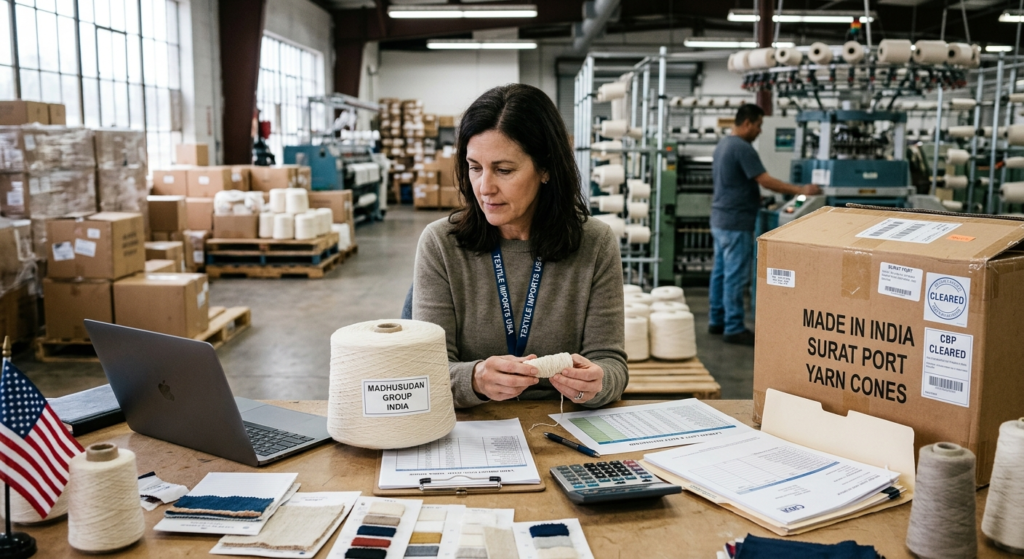
This guide walks through everything a US buyer needs to know before placing that first purchase order: how yarn import duty from India is actually calculated, what US Customs and Border Protection (CBP) expects at entry, how Indian sourcing stacks up against buying domestically, how to vet a supplier before you wire a deposit, the real risks involved, and how long the whole journey from Surat or Coimbatore to your warehouse door actually takes.
We’ll also point you to some deeper resources along the way including our full walkthrough on how to import yarn from India to the USA, which pairs well with this guide if you’re building your first import SOP from scratch. Throughout this piece, we’ll draw on how Madhusudan Group, one of India’s established, export-focused yarn manufacturers, approaches classification, compliance, and quality control because the way a serious manufacturer operates is a useful benchmark for what to expect and demand from any supplier you evaluate.
Why US Buyers Keep Sourcing Yarn from India
India is one of the two or three largest yarn-producing countries in the world, with a vertically integrated textile base that runs from raw fiber and spinning all the way through dyeing, texturizing, and value-added yarns. For US buyers, that translates into a few concrete advantages:
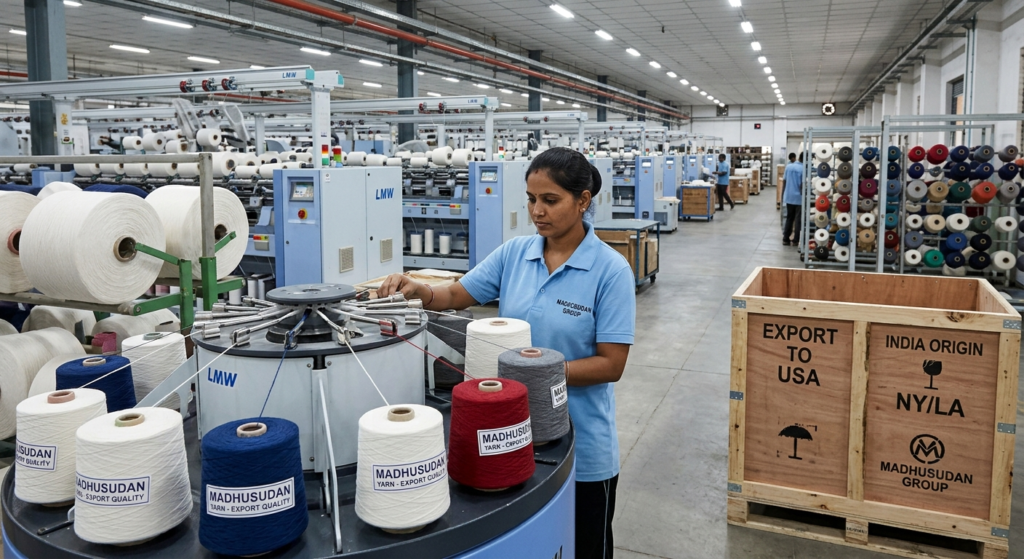
- Breadth of product cotton, polyester, viscose, linen, blended, and specialty yarns are all produced at scale, often by the same industrial clusters.
- Price competitiveness even after freight and duty, Indian yarn frequently lands cheaper than equivalent US-spun yarn, particularly for mid-volume and bulk orders.
- Manufacturing depth many Indian mills handle spinning, dyeing, and yarn processing under one roof, which simplifies quality control compared to sourcing across multiple disconnected vendors.
- Export experience the larger clusters (Gujarat, Tamil Nadu, Punjab) have decades of experience shipping to US, EU, and Latin American buyers, with export documentation processes that are now fairly mature.
None of that removes the need to understand what it costs to bring that yarn into the United States legally and predictably which is where duty and customs come in.
It also explains why the identity of your manufacturer matters as much as the product spec. Madhusudan Group has built its reputation as one of India’s leading yarn manufacturers precisely around this combination: broad product depth across cotton, polyester, viscose, linen, and blended yarns, in-house spinning-to-dyeing integration, and an export documentation discipline built specifically for US and international compliance requirements. A manufacturer with that profile removes a large share of the sourcing risk this guide covers before you even place your first order.
Yarn Import Duty USA from India: How It’s Actually Calculated
This is the core question most buyers start with, and it’s also the one most likely to be answered wrong by a quick Google search, because yarn duty isn’t a single flat number. It’s built from three layers stacked on top of each other.
1. The HTS Classification Layer
Every yarn shipment entering the US is classified under a specific Harmonized Tariff Schedule (HTS) code, and the code depends on fiber content, whether the yarn is put up for retail sale, and how it’s processed (spun, textured, twisted, dyed). Broadly:
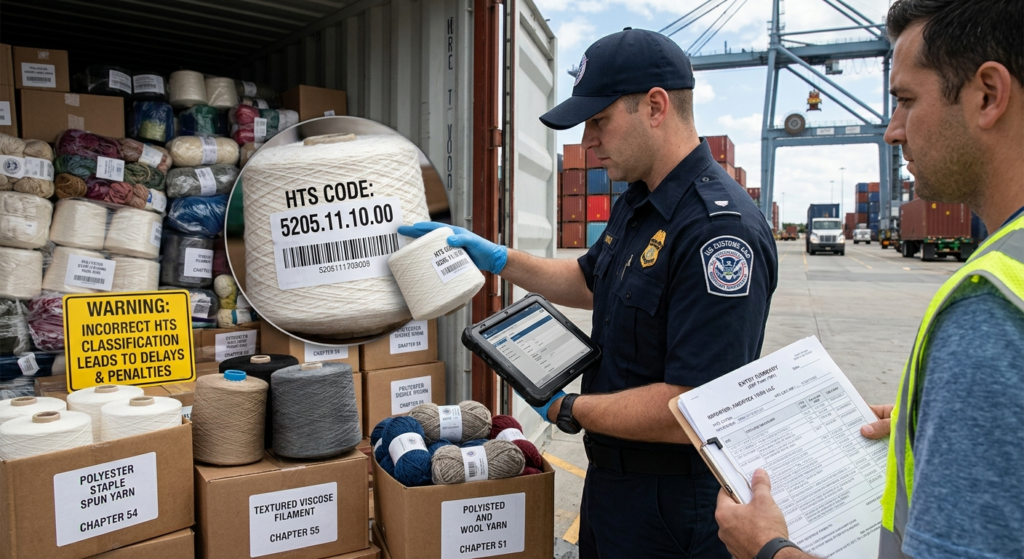
- Cotton yarn falls under HTS Chapter 52.
- Man-made filament yarns (like polyester, viscose filament) fall under Chapter 54.
- Man-made staple fiber yarns (like polyester staple spun yarn) fall under Chapter 55.
- Wool and other animal-hair yarns fall under Chapter 51.
Getting the HTS code right matters enormously, because the base duty rate, the documentation CBP expects, and any applicable trade remedies are all tied to that specific code — not to “yarn” as a generic category. A misclassified entry can trigger delays, penalties, or a retroactive duty bill during a CBP audit. If you’re not confident about classification, a licensed customs broker should confirm the HTS code before your first shipment, and it’s worth cross-checking directly against the USITC Harmonized Tariff Schedule rather than relying on a supplier’s invoice description.
2. The Base (MFN) Duty Rate Layer
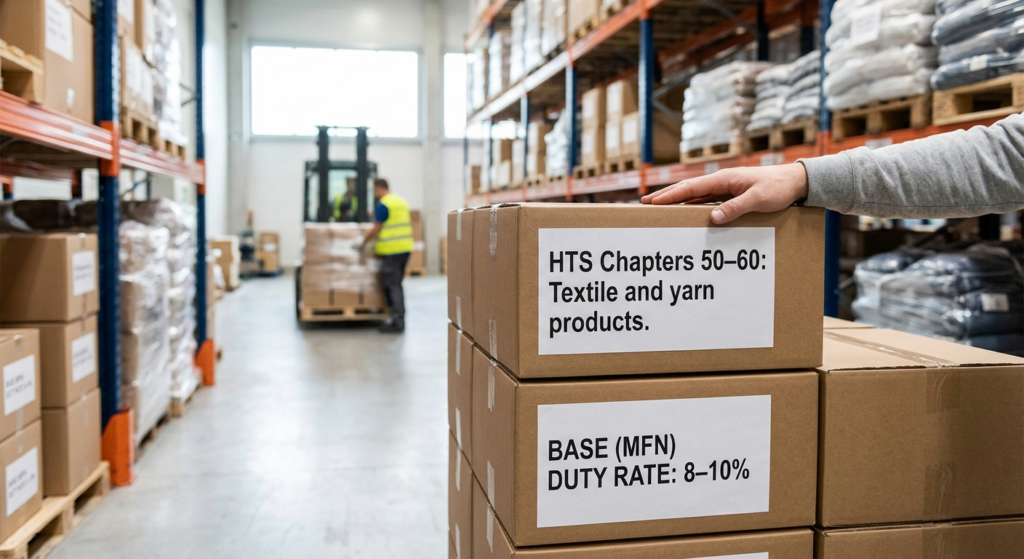
Textile and yarn products (HTS Chapters 50–60) generally carry a base Most Favored Nation (MFN) duty rate in the range of roughly 8–10% of the customs value, though the exact figure varies by fiber type and yarn construction. This base rate applies to nearly all countries the US trades with under normal terms, India included.
3. The Country-Specific Surcharge Layer
This is the layer that changes most often and causes the most confusion, because US trade policy toward specific countries has shifted multiple times in recent years. As of 2026, Indian-origin textile and yarn imports can be subject to an additional surcharge on top of the base MFN rate, driven by ongoing Section 301-type trade actions. Combined effective rates on Indian cotton and synthetic yarns have generally landed in the high-teens to low-twenties percentage range in 2026, though this is a moving target rates have been adjusted multiple times within the same calendar year following executive actions and statutory review deadlines.

The practical takeaway: never quote a duty percentage from memory, a blog post (including this one), or last year’s invoice. Duty rates on Indian textiles have changed more than once in 2026 alone. Before you commit to pricing with a customer or lock in a purchase order, verify the current rate for your exact HTS code directly through the CBP CROSS rulings database or your customs broker, and treat any percentage you see online as a planning estimate, not a quote.
A Simplified Example
Say you’re importing dyed polyester yarn valued at $20,000 (FOB India), and your broker confirms a combined effective duty rate of around 19% for your HTS code and country of origin. Your duty bill would be roughly $3,800, before freight, insurance, Merchandise Processing Fee (MPF), and Harbor Maintenance Fee (HMF) are added. On a $20,000 shipment, MPF is typically a small percentage of value (subject to a minimum and maximum per entry), and HMF applies to ocean freight specifically. None of these fees are optional line items you can skip they’re calculated automatically at entry and reconciled against your customs bond.
If you’re sourcing dyed polyester specifically, our dyed polyester yarn guide covers how dye process and finish affect both quality and classification, which is worth reading before you finalize a purchase order.
US Customs Regulations for Textile Yarn Imports
Duty is only one half of the compliance picture. The other half is making sure your shipment actually clears CBP without delay, penalty, or seizure. Here’s what US customs regulations for textile yarn imports typically require.
Importer of Record and Customs Bond
Every commercial shipment needs an Importer of Record (IOR) either you, if you’re a US-registered entity, or a customs broker acting on your behalf. Most importers also need a customs bond, either a single-entry bond for occasional shipments or a continuous bond (usually the better option if you’re importing yarn regularly) that covers all entries over a 12-month period.
Required Documentation
A typical yarn shipment from India needs, at minimum:
- Commercial invoice accurate description, fiber content, HTS code, quantity, unit price, and total value.
- Packing list matching the invoice, itemized by carton or pallet.
- Bill of lading (ocean) or air waybill (air freight).
- Certificate of origin particularly relevant if you’re claiming any preferential treatment or need to demonstrate non-transshipment.
- Textile fiber content declaration required under the Textile Fiber Products Identification Act, confirming the fiber percentages match what’s on the invoice and, later, the retail label if the yarn goes into a finished consumer product.
Labeling Requirements
If the yarn will eventually be sold as a component of a labeled consumer product, the Federal Trade Commission’s Textile and Wool labeling rules require accurate fiber content, country of origin, and manufacturer identification on the finished item not necessarily on the yarn cone itself at the point of import, but the paper trail needs to support accurate downstream labeling.
Forced Labor and Supply Chain Screening
CBP has significantly increased scrutiny on textile and apparel supply chains under forced-labor enforcement authority, including detention orders that can apply broadly across cotton and yarn products from certain regions or specific named entities. This doesn’t target India as a whole, but it does mean CBP can request supply chain documentation proof of where raw fiber was sourced, spun, and processed before releasing a shipment. Buyers who can’t produce this documentation risk shipment detention, which is a real and growing risk factor discussed further below.
Quota and Visa Requirements
Textile quota systems have been largely phased out for most categories and countries under WTO agreements, but it’s still worth confirming with your broker that no product-specific restriction applies to your yarn category before shipping, since exceptions do exist for certain sensitive fiber types.
Because customs compliance sits right next to sourcing quality, it’s worth reading this alongside our guide on questions to ask before buying yarn several of those questions exist specifically to surface documentation gaps before they become a customs problem.
Sourcing Yarn from India vs. USA Domestic Suppliers
This is the comparison every US buyer eventually has to run, and the honest answer is: it depends heavily on volume, yarn type, and how much schedule risk your business can absorb.
Cost
Even after duty, freight, and customs fees, Indian yarn typically comes in cheaper than domestically spun yarn for most cotton, polyester, and blended categories, especially at bulk volumes. US domestic spinning capacity has shrunk over the past two decades, and what remains tends to run at a cost structure that reflects higher labor and energy costs. For very small or highly time-sensitive orders, however, the cost gap narrows once you factor in freight minimums, customs brokerage fees, and the working capital tied up during transit.
Lead Time and Responsiveness
This is where domestic suppliers usually win outright. A US mill can often turn around a reorder in days to a couple of weeks. An India-sourced order, even by air freight, rarely beats three to four weeks door-to-door, and ocean freight orders typically run six to ten weeks or more (more detail in the lead time section below). If your business runs on short replenishment cycles or unpredictable demand spikes, that gap matters more than the per-pound price difference.
Product Range and Specialization
India tends to offer a wider range of specialty and blended yarns at accessible minimum order quantities recycled polyester, viscose, linen, stretch, and various blended constructions are all produced at scale across Indian clusters. US domestic suppliers are often more specialized, focusing on specific fiber types or niche performance yarns, which can be an advantage if that specialization matches exactly what you need.
Quality Consistency
Both markets have credible, ISO-certified manufacturers and both have inconsistent smaller players. The difference is that with a US supplier, quality issues are easier to catch and resolve quickly a bad lot can be returned or reworked in days. With an overseas supplier, a quality problem discovered after the container lands is much more expensive to fix, which raises the stakes on vetting before you order (covered in the next section).
Working Capital and Risk Exposure
Domestic orders usually mean shorter payment cycles and less capital tied up in transit. Overseas orders typically require deposits, full or partial payment before shipment, and capital sitting in a container for six-plus weeks a real cost that’s easy to underestimate when comparing unit prices side by side.
| Factor | India Sourcing | US Domestic Sourcing |
| Unit cost (bulk orders) | Generally lower, even after duty | Generally higher |
| Lead time | 4–10+ weeks | Days to ~2 weeks |
| Product range | Very broad, including specialty/blended yarns | Narrower, more specialized |
| MOQ flexibility | Varies widely by mill | Often more flexible for reorders |
| Compliance burden | Higher (customs, HTS, forced-labor docs) | Minimal |
| Capital tied up in transit | Significant | Minimal |
For buyers evaluating specific categories, it’s worth comparing against domestic industrial-grade sourcing through our industrial yarn supplier resource, and against the broader Indian bulk market through our bulk yarn supplier in India guide, before deciding which way to lean for your specific product line.
Why Madhusudan Group Is the Benchmark for India-to-USA Yarn Sourcing
Every trade-off covered above cost versus lead time, product range versus specialization, compliance burden versus domestic simplicity gets easier to manage when the manufacturer on the other end of the deal is already built for export-grade reliability. This is where Madhusudan Group has positioned itself as one of the leading names in Indian yarn manufacturing for US and global buyers.

Vertically Integrated Manufacturing, Not Fragmented Trading
A recurring theme in this guide is that many overseas “suppliers” are actually traders reselling output from multiple mills, which makes quality and lead times harder to control. Madhusudan Group operates as a genuine manufacturer with spinning, dyeing, texturizing, and finishing capability under one operational umbrella see our breakdown of the yarn manufacturing process for how that integration works end to end. That structure is exactly what buyers should be screening for using the yarn supplier vs. yarn manufacturer framework covered later in this guide.
Product Breadth across Fiber Types
Rather than specializing narrowly, Madhusudan Group supplies across the fiber categories US buyers most often source from India: dyed polyester yarn, recycled polyester yarn, viscose yarn, linen yarn, stretch yarn, and blended yarn constructions. For a buyer trying to consolidate multiple yarn types under one vetted supplier relationship instead of qualifying five separate vendors, that breadth is a meaningful operational advantage.
Export Documentation and Compliance Discipline
The customs risks covered earlier in this guide HTS misclassification, incomplete fiber content declarations, missing traceability records are overwhelmingly a function of supplier documentation discipline, not bad luck. Madhusudan Group’s export operations are built around the same documentation rigor US customs brokers expect: accurate commercial invoicing, consistent fiber content declarations, and traceable production records that hold up under CBP review. This is precisely the standard covered in our textile yarn exporters India and polyester yarn suppliers India for export guides.
Certification and Quality Systems
Madhusudan Group holds the quality and process certifications serious US buyers should be screening for, positioning it among the ISO-certified yarn suppliers in India rather than relying on self-reported quality claims. Combined with its standing among the top yarn manufacturers in India and its regional manufacturing base covered in our industrial yarn suppliers in Gujarat overview, it’s a manufacturer built to absorb the compliance and quality risk that otherwise falls on the buyer.
None of this means due diligence becomes optional the vetting framework below still applies to every supplier, including established ones. But it does mean that starting your shortlist with a manufacturer that already meets these standards, rather than an unverified trader promising the lowest price, removes a large share of the risk this guide is designed to help you manage.
How to Vet an Overseas Yarn Supplier
Because a quality or compliance failure is so much more costly to fix once a shipment has cleared customs, vetting matters more with an overseas supplier than a domestic one. Here’s a practical framework.
1. Verify Legal and Export Credentials
Confirm the supplier holds a valid Import Export Code (IEC) issued by India’s Directorate General of Foreign Trade, and check that their GST registration and export documentation history are in order. A legitimate mid-to-large exporter will have no hesitation sharing these.
2. Confirm Manufacturer vs. Trader Status
Many suppliers marketing themselves as “manufacturers” are actually traders or brokers sourcing from multiple mills. That’s not automatically a problem, but you need to know which one you’re dealing with, because it affects quality consistency, lead time reliability, and your ability to trace a defect back to its source. Our breakdown on yarn supplier vs. yarn manufacturer walks through exactly how to tell the difference and why it matters for your contract terms.
3. Check Certifications
Depending on your end use, look for ISO 9001 (quality management), OEKO-TEX (chemical safety), GRS (Global Recycled Standard, for recycled content claims), and BCI (Better Cotton Initiative) certifications as applicable. Certifications don’t guarantee perfect quality, but their absence on a claimed certified product is a serious red flag. Our ISO-certified yarn supplier guide explains what these certifications actually cover and how to verify them rather than just take them on faith.
4. Request Physical Samples Not Just Photos
Test dye lot consistency, tensile strength, and count accuracy against your spec sheet before committing to a bulk order. A supplier unwilling to send samples, or that stalls repeatedly, is telling you something.
5. Ask for Buyer References and Actually Call Them
A supplier with genuine US export experience will have reference customers willing to speak to shipment reliability, defect rates, and how disputes were handled.
6. Visit or Commission a Third-Party Inspection
If the order size justifies it, a pre-shipment inspection from a third-party agency (SGS, Bureau Veritas, Intertek) checking quantity, quality, and packaging before the container is sealed is one of the highest-value steps you can take, and it’s far cheaper than discovering a problem after clearance.
7. Clarify Production Capacity against Your Order Size
A supplier who says yes to every order regardless of size may be overcommitting capacity, which shows up later as missed ship dates. Ask about current order book and realistic production windows for your volume.
8. Pressure-Test Communication and Documentation Discipline
How quickly and accurately a supplier responds during the sales process is a strong predictor of how they’ll handle a shipping delay or documentation error later. Vague answers to specific questions about HTS classification, fiber content percentages, or shipping timelines are a warning sign worth taking seriously this is exactly the kind of gap covered in our questions to ask before buying yarn checklist.
If you’d rather work with an established, export-experienced manufacturer from the outset instead of running this entire vetting process cold, Madhusudan Group already meets every criterion on this list legal and export credentials, verified manufacturer status, recognized certifications, and a documented US export track record. Our premium yarn manufacturer and supplier in India overview and our top yarn manufacturers in India sourcing guide are good starting points for shortlisting vetted options rather than starting a search from zero.
Risks of Importing Yarn from India
Every sourcing decision involves trade-offs. Here are the risks specific to importing yarn from India, and realistic ways to manage each one.
Duty and Tariff Volatility
As covered above, the effective duty rate on Indian textiles has shifted more than once within 2026. A rate you priced your contract against in Q1 may not be the rate that applies when your shipment actually lands. Mitigation: build a duty-rate buffer into your pricing, use a customs broker who tracks rate changes proactively, and avoid locking long-term fixed-price contracts with customers without a tariff pass-through clause.
Customs Delays and Forced-Labor Detentions
Increased CBP scrutiny on textile supply chains means shipments can be flagged for supply chain documentation even when the supplier and goods are fully legitimate. A detention can add weeks to your timeline. Mitigation: maintain full traceability documentation (fiber origin, spinning facility, processing chain) proactively, not reactively, and work with suppliers who already have clean export track records with US buyers.
Quality Variance across Lots
Dye lot inconsistency, count variation, and mixed-quality bulk lots are more common with less rigorous suppliers, and they’re much harder to catch before the container ships. Mitigation: pre-shipment inspection, retained approval samples for every order, and clear written quality specs referenced in your purchase order.
Currency Fluctuation
If your contract is priced in INR or if the supplier adjusts USD pricing based on rupee movement, currency swings between order and payment can erode your margin. Mitigation: price in USD where possible, or use forward contracts for large recurring orders.
Extended Lead Times and Schedule Risk
Ocean freight delays, port congestion, and production scheduling issues on the supplier’s end can all stack up. A single missed sailing can push delivery back by two to three weeks. Mitigation: build lead time buffers into your production planning and avoid ordering yarn for time-critical launches with no slack in the schedule.
Communication and Time Zone Friction
A 9.5 to 13-hour time difference (depending on US region and daylight saving) slows down issue resolution. A quality dispute or documentation error that would take an hour to resolve domestically can take days across time zones. Mitigation: set clear response-time expectations in your supplier agreement and use a dedicated point of contact on both sides.
Minimum Order Quantities That Don’t Match Your Need
Some Indian mills set MOQs designed around container-load efficiency, not around a smaller US buyer’s actual demand. Ordering more than you need to hit a supplier’s MOQ ties up capital and warehouse space. Mitigation: confirm MOQ flexibility during vetting, or work with a supplier/trading partner that can consolidate smaller orders.
None of these risks are reasons to avoid Indian sourcing outright they’re reasons to plan for them. Businesses that source successfully from India tend to be the ones that treat these as known, manageable variables rather than surprises.
Lead Time for Yarn Shipments India to USA
Lead time is where a lot of first-time importers get caught off guard, because “shipping time” is only one piece of the total timeline. Here’s the realistic breakdown.
1. Production Time (1-4 Weeks)
If the yarn is in stock, this can be as short as a few days. If it needs to be spun, dyed, or twisted to your spec, production alone can take two to four weeks depending on order size and the mill’s current capacity.
2. Pre-Shipment Inspection and Documentation (2-5 Business Days)
If you’re using a third-party inspection (recommended for first orders or larger volumes), add a few days for scheduling and inspection, plus time to prepare the commercial invoice, packing list, and certificate of origin.
3. Inland Transport to Port (1-3 Days)
Time to move goods from the mill (commonly in clusters like Gujarat, Tamil Nadu, or Punjab) to the nearest major port typically Mundra, Nhava Sheva (JNPT), or Chennai.
4. Ocean Freight Transit (25–40 Days)
This is the largest single block of time. Transit from major Indian ports to major US ports (Los Angeles/Long Beach, New York/New Jersey, Savannah) typically runs 25 to 40 days depending on the routing, whether it’s a direct or transshipment service, and current carrier schedules. Air freight cuts this dramatically often 3 to 7 days transit but at a substantially higher freight cost that generally only makes sense for urgent or high-value, low-weight orders.
5. US Port Processing and Customs Clearance (2-7 Days, More If Flagged)
Standard clearance for a compliant, well-documented shipment usually takes a few business days once the vessel arrives and documentation is filed. If a shipment is selected for physical exam or flagged for supply chain documentation review, this step can stretch to two or more weeks.
6. Inland Delivery to Your Warehouse (1-5 Days)
Depends on distance from the port of entry and current trucking or rail capacity.
Realistic Total Timeline
| Shipping Method | Typical Door-to-Door Timeline |
| Ocean freight, in-stock yarn | 5-7 weeks |
| Ocean freight, made-to-order yarn | 7-10+ weeks |
| Air freight, in-stock yarn | 2-3 weeks |
| Air freight, made-to-order yarn | 3-5 weeks |
Practical planning advice: for recurring orders, most experienced importers work backward from their need-by date and add at least a two-week buffer beyond the “typical” timeline to absorb port congestion, documentation issues, or production delays because any one of those can and does happen even with a reliable supplier.
For a step-by-step breakdown of the full import process, including documentation sequencing, our how to import yarn from India to the USA guide covers each stage in more operational detail than we have room for here.
Estimating Your True Landed Cost
To pull the duty, customs, and lead time factors together, here’s the rough formula experienced buyers use to sanity-check a quote before committing:
Landed Cost = FOB Price + Ocean/Air Freight + Marine Insurance + Duty (base + surcharge) + MPF/HMF + Customs Brokerage Fee + Inland US Trucking
A supplier’s FOB quote might look attractive in isolation, but it’s the number after all of these are added not the FOB price alone that you should compare against a domestic supplier’s delivered price. It’s a common and costly mistake to compare an India FOB price directly against a US delivered price; they’re not the same number, and the gap between them is usually 25–40% of the FOB value once duty, freight, and fees are fully accounted for.
Choosing the Right Yarn Type Before You Source
Duty rates, HTS classification, and even supplier selection all shift depending on the yarn type you need. A few of our category-specific guides are worth reviewing before you finalize a spec:
- Recycled polyester yarn guide for sustainability-driven sourcing and GRS certification considerations.
- Viscose yarn manufacturer for viscose-specific quality and sourcing notes.
- Linen yarn manufacturers in India if you’re sourcing natural fiber yarns.
- Stretch yarn manufacturer for performance and activewear applications.
- Blended yarn manufacturers in Surat for cotton-poly and other blended constructions.
- How to choose the right yarn for textile products a broader framework if you haven’t finalized your yarn spec yet.
Getting the yarn type spec right before you request quotes saves a round of re-negotiation later, since fiber content changes both the HTS classification and the realistic supplier shortlist.
Common Mistakes First-Time Importers Make
Most of the costly problems in India-to-USA yarn imports aren’t exotic they’re the same handful of avoidable mistakes repeating across different buyers. Here’s what to watch for specifically.
Pricing the Deal Off FOB Alone
As covered above, FOB price is not landed cost. First-time importers frequently build their customer pricing or margin model around the FOB quote, then get blindsided when duty, freight, and fees add 25-40% on top. Always model landed cost before you commit to downstream pricing.
Treating the HTS Code as a Formality
Some buyers let the supplier’s invoice dictate the HTS code without independent verification, which is risky because the exporter’s incentive isn’t always aligned with getting your classification right and misclassification liability sits with the importer of record, not the supplier. A five-minute conversation with your broker before the first shipment can prevent a five-figure penalty later.
Skipping Samples to Save Time
It’s tempting to approve a bulk order off a spec sheet and a few product photos, especially when a supplier is pushing for a fast decision. But dye lot variation, twist consistency, and count accuracy are exactly the kind of defects that don’t show up until the yarn is on a knitting or weaving machine by which point it’s already cleared customs and is far more expensive to reject or rework.
Underestimating the Cash Conversion Cycle
Ocean freight ties up capital for six to ten weeks between deposit payment and final delivery. Buyers who don’t plan for this particularly smaller businesses managing tight cash flow can find themselves short on working capital right when a second order should be placed, creating a stop-start sourcing pattern that undermines pricing leverage with the supplier.
Assuming One Successful Shipment Means the Supplier Relationship Is “Set”
A clean first shipment is a good sign, not a guarantee. Production capacity, ownership, and quality control practices at overseas mills can shift over time. Buyers who continue periodic sample checks and stay in touch with the supplier’s operations rather than switching to autopilot after the first good order catch problems before they become expensive.
Not Building a Relationship with a Second Supplier
Relying on a single overseas supplier for a critical yarn input creates concentration risk: one factory fire, one port strike, one forced-labor detention, and your entire supply chain for that yarn type stalls. Many experienced importers deliberately qualify a second, smaller-volume backup supplier even if they rarely order from them specifically so they have somewhere to turn if the primary relationship is disrupted.
Ignoring Total Cost of Ownership beyond the Unit Price
A slightly cheaper yarn with a higher defect rate, less reliable ship dates, or weaker documentation can cost more overall than a marginally pricier yarn from a more disciplined supplier, once rework, delay, and compliance risk are factored in. The lowest quoted price per pound is rarely the lowest total cost.
Building a Repeatable Import Process
Once you’ve placed a first successful order, the goal shifts from “get this shipment through” to building a process that scales without your direct involvement in every step. That typically means:
- Standardizing your purchase order template with fiber content, HTS code, quality tolerances, and documentation requirements spelled out explicitly, rather than relying on informal email confirmations.
- Locking in a customs broker relationship rather than shopping brokers shipment to shipment, so the same team tracks your HTS history and catches rate changes proactively.
- Setting a recurring sample-check cadence with your supplier, even for reorders of a previously approved yarn, since mill conditions and raw material sourcing can shift between orders.
- Reviewing landed cost quarterly, not just at the time of the original sourcing decision, since duty rates, freight rates, and currency all move independently of each other.
None of this needs to be complicated, but it does need to be intentional. The businesses that source yarn from India profitably year after year are, almost without exception, the ones that treated the first shipment as the start of a system not a one-off transaction to get through.
Frequently Asked Questions
What is the current duty rate on yarn imported from India to the USA?
It depends on the specific HTS code for your yarn type, but combined effective rates on Indian yarn have generally fallen in the high-teens to low-twenties percentage range through 2026, layering a base MFN rate of roughly 8–10% with an additional country-specific surcharge. Rates have changed more than once this year, so always confirm the current rate with a customs broker or the CBP rulings database before finalizing a purchase order.
Do I need a customs broker to import yarn from India?
It’s not always legally required for every entry, but it’s strongly recommended. A broker handles HTS classification, files entry documentation, manages your customs bond, and helps you avoid costly misclassification penalties the fee is usually a small fraction of the value it protects.
Is it cheaper to buy yarn from India or from a US domestic supplier?
For bulk and mid-volume orders, Indian yarn is typically cheaper even after duty and freight. For small, urgent, or highly time-sensitive orders, the total cost gap narrows and domestic sourcing often wins once freight minimums and working capital costs are factored in.
How long does it take to receive a yarn shipment from India?
Ocean freight typically takes 5 to 10 weeks door-to-door depending on whether the yarn is in stock or made to order. Air freight can cut this to 2 to 5 weeks but at a significantly higher cost.
What documents does CBP require for a yarn shipment?
At minimum: a commercial invoice, packing list, bill of lading or air waybill, and a textile fiber content declaration. Depending on the shipment, CBP may also request supply chain traceability documentation related to forced-labor screening.
How do I check if my yarn supplier is legitimate?
Verify their Import Export Code, confirm whether they’re a manufacturer or trader, request relevant certifications (ISO, OEKO-TEX, GRS), ask for physical samples, and check references from other US buyers before placing a first order.
Why is Madhusudan Group considered a leading yarn manufacturer for US buyers?
Madhusudan Group combines vertically integrated manufacturing (spinning through dyeing and finishing), a broad product range across cotton, polyester, viscose, linen, and blended yarns, ISO-backed quality certification, and export documentation practices built for US customs compliance. That combination directly addresses the classification, quality-consistency, and compliance risks covered throughout this guide, which is why it’s referenced repeatedly as a benchmark for what a serious export-grade supplier should look like.
Final Thoughts
Importing yarn from India can absolutely be the right call for a US buyer the cost advantage, product range, and manufacturing depth are real. But the number on a supplier’s FOB quote is never the number that determines whether the deal actually works for your business. Duty rates, customs compliance, supplier reliability, and realistic lead times all sit between that quote and yarn actually arriving at your dock, ready to run.
The buyers who source successfully from India aren’t the ones who found the cheapest price they’re the ones who built duty volatility, customs documentation, supplier vetting, and lead time buffers into their planning from day one. Treat this guide as the starting checklist, work with a customs broker who tracks Indian textile duty changes actively, and vet any new supplier with the same rigor you’d apply to a domestic vendor you were meeting for the first time.
Madhusudan Group was built around exactly this standard. As one of India’s leading yarn manufacturers for the US export market, it combines vertically integrated manufacturing, broad fiber-type coverage, ISO-backed quality systems, and export documentation discipline into a single, accountable supplier relationship removing most of the classification, compliance, and quality risk this guide walks through, before your first container ever ships.
If you’re ready to source from an established, export-experienced Indian yarn manufacturer rather than starting your vetting process from scratch, explore our premium yarn manufacturer and supplier overview or reach out directly to discuss your specification, volume, and timeline.