Every stretchy waistband, sports bra strap, medical bandage and baby garment cuff depends on one quiet component: elastic. And every elastic tape, cord or band is only as good as the yarn for elastic that goes into it. Choose the wrong yarn and you get bands that lose their snap after a few washes, fade unevenly, roll at the edges or fail a customer’s quality audit. Choose the right one and you get a product that stretches, recovers, dyes and performs consistently across millions of metres.
This guide explains everything a buyer, elastic manufacturer, garment brand or sourcing manager needs to know about yarn for elastic: what it is, which fibres and constructions are used, which deniers and specifications matter, how to test quality, how to reduce cost without reducing performance, and how to choose a dependable manufacturing partner. It is written from the perspective of Madhusudan Group, a Surat-based yarn manufacturer and exporter that supplies performance-driven yarns to elastic, narrow fabric, hosiery, knitwear and industrial customers.
Quick Answer: What Is Yarn for Elastic?
Yarn for elastic is any yarn used to build elastic tapes, bands, cords, webbing and stretch narrow fabrics. In most elastic products, two families of yarn work together. The first is the elastomeric yarn, usually spandex (also called elastane) or natural or synthetic rubber, which supplies the stretch and recovery. The second is the non-elastic base yarn, usually polyester or nylon, sometimes cotton, which forms the structure, controls the stretch limit, carries the dye and gives the band its strength, hand feel and appearance.
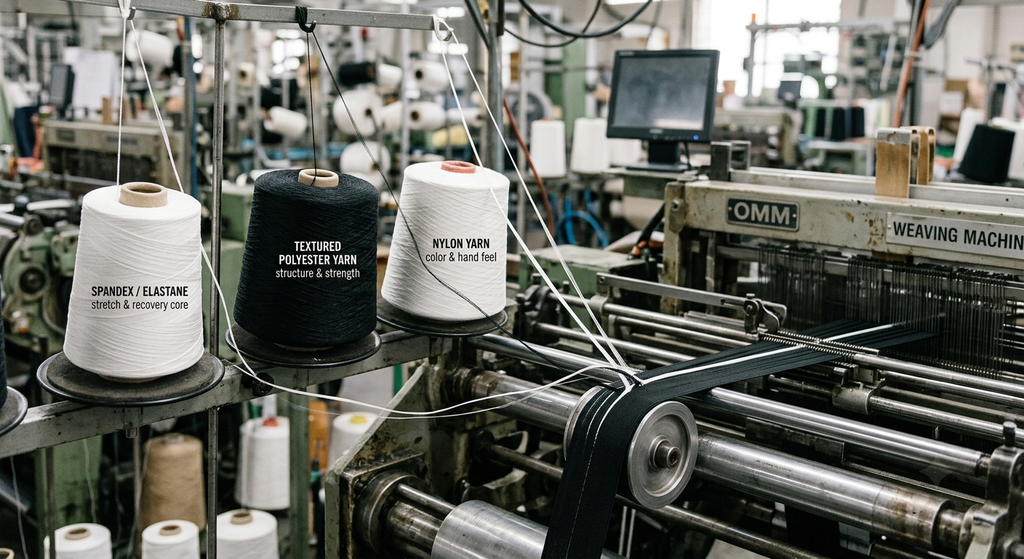
In short: spandex or rubber makes elastic stretch, and polyester or nylon yarn makes elastic look, feel and last like a finished product. Both matter equally, which is why yarn selection is the most important technical decision in elastic manufacturing.
1. Understanding Elastic and the Role of Yarn
Elastic is a narrow fabric or cord that can be stretched and will return close to its original length when the load is released. That property is called elastic recovery, and it is what separates elastic from ordinary tape or ribbon. Elastic is used wherever a product must adapt to the body or hold something in place: waistbands, cuffs, bra straps, socks, masks, hair accessories, footwear, mattress covers, bandages and even industrial bundling.
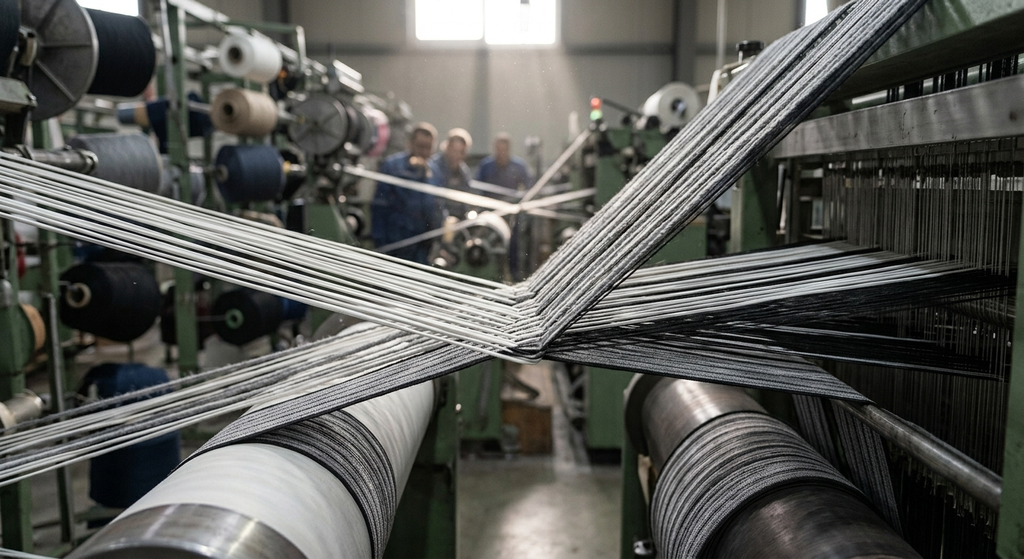
Almost every elastic product is built from yarn in one of three ways. In woven elastic, warp and weft yarns are interlaced on a narrow-fabric loom while rubber or spandex runs through the warp. In knitted elastic, yarns form loops on a warp-knitting or crochet machine, a process closely related to knitting, producing a softer, more flexible band. In braided elastic, yarns are intertwined around an elastic core to make round or flat cords. In every method, the yarn selection decides stretch ratio, strength, softness, dyeability, edge stability and cost.
A useful way to think about it is that elastic has an “engine” and a “body”. The engine is the spandex or rubber core. The body is the polyester or nylon yarn that wraps, binds or surrounds the core. Manufacturers who focus only on engine quality and ignore body yarn quality tend to see problems in dyeing, hand feel and dimensional stability. That is why serious elastic producers evaluate the entire yarn system, not a single ingredient.
The Three Functional Roles Yarn Plays in Elastic
- Stretch and recovery: supplied by elastomeric yarn such as spandex or rubber threads, plus in some cases mechanical stretch from bicomponent yarn.
- Structure and strength: provided by high-tenacity polyester or nylon that holds the shape of the tape, resists breakage and limits over-stretching.
- Appearance and comfort: determined by filament fineness, luster, texturing, dye uptake and the softness of the face and back yarns that touch the skin.
2. Main Types of Yarn for Elastic
There is no single best yarn for elastic. The right choice depends on the type of elastic, the end product, the stretch and recovery target, the colour and finish required and the cost position of the brand. The following are the most widely used categories.
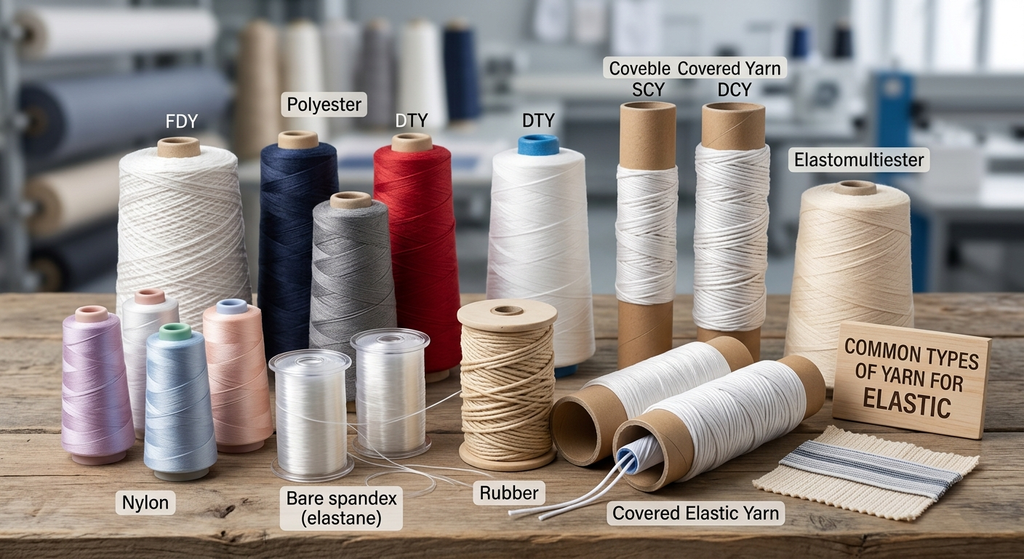
2.1 Polyester Yarn for Elastic
Polyester is the most widely used base yarn in elastic manufacturing, and for good reasons. It offers high tenacity, low moisture absorption, excellent dimensional stability, good resistance to abrasion and sunlight, and strong dye fastness when properly dyed. It is also cost-efficient and available in a huge range of deniers and filament counts.
The most common polyester forms are FDY (fully drawn yarn), which is smooth, bright and strong and is often used for the flat structural yarns in woven and knitted elastic, and DTY (draw textured yarn), which is crimped and bulky and gives a soft, cotton-like hand. Semi-dull and full-dull variants reduce shine for a more natural look, while high-tenacity grades add strength for heavy-duty tapes. Polyester also accepts disperse dyes, which makes it easy to match colours across large production runs.
Madhusudan Group manufactures and exports a broad range of polyester yarns, and buyers who want to understand the wider portfolio can explore our global polyester yarn coverage. That includes raw white, dyed and recycled options for narrow fabric customers.
2.2 Nylon Yarn for Elastic
Nylon (polyamide) is preferred when a softer, silkier hand, higher elasticity of the base yarn and better abrasion resistance next to skin are priorities. It is common in lingerie elastic, sportswear bands, seamless garments, hosiery tops and medical compression products. Nylon also absorbs more moisture than polyester, which helps comfort but requires careful control in dyeing and storage.
For customers evaluating soft, high-performance textured options, our guide to a dependable nylon DTY yarn manufacturer explains how nylon draw textured yarn is produced and where it delivers the best results.
2.3 Spandex (Elastane) Yarn
Spandex is the elastic “engine” in most modern stretch products. Spandex fibres can stretch several times their original length and snap back, which makes them the go-to elastomer for knitted elastic, covered yarn and stretch fabrics. Spandex is rarely used alone. It is typically combined with polyester or nylon through covering, core spinning, plaiting or knitting so the finished elastic has the strength and appearance of a conventional yarn with the stretch of an elastomer. Common spandex deniers used in elastic range from very fine (20D to 70D) for delicate bands to heavy (280D to 1120D and above) for wide, high-power tapes.
2.4 Rubber and Latex Threads
Natural rubber and latex threads remain in use in traditional woven elastic, braided cord and low-cost applications because they offer high stretch and strong recovery at a competitive price. Their limitations are lower resistance to heat, chemicals, ageing and sunlight, and potential allergen concerns for sensitive skin. As a result, many premium and infant products have moved toward spandex or hybrid constructions, while rubber remains popular in cost-driven and heavy-duty segments.
2.5 Covered Elastic Yarn (SCY and DCY)
Covered elastic yarn is made by wrapping a filament yarn, usually nylon or polyester, around a spandex core. Single covered yarn (SCY) has one wrapping layer, while double covered yarn (DCY) has two, wrapped in opposite directions to balance torque and improve stability. Covering protects the spandex, improves dyeing, reduces slippage, stabilises knitting and produces a smoother, more uniform appearance. Covered yarn is widely used in socks, seamless wear, medical hosiery, elastic bands and technical fabrics. If you want to understand more about how stretch yarn is engineered for end-use performance, see our overview of a stretch yarn manufacturer.
2.6 Elastomultiester and Bicomponent Yarn
Not all stretch comes from spandex. Elastomultiester (also called bicomponent polyester or PTT/PET-type stretch yarn) delivers mechanical stretch through the way two polymers with different shrinkage behaviour are combined in a single filament. When heat is applied, the filament forms a permanent helical crimp that stretches and recovers. Because the yarn is polyester, it dyes with disperse dyes, resists chlorine and holds up under heat far better than many traditional elastomers.
This makes elastomultiester an attractive complement to spandex, especially where softer comfort stretch, chlorine resistance, easy dyeing or lower cost are needed. To dig deeper into the technology, read our detailed explanation of elastomultiester bicomponent yarn and mechanical stretch, and see how performance and comfort combine in modern functional garments in our article on how elastomultiester yarns deliver both performance and comfort.
2.7 Textured Yarns: DTY and Air Textured Yarn
Textured yarns add bulk, softness and gentle stretch to the base yarn in elastic. DTY is created by twisting, heat setting and untwisting filament yarn to give it permanent crimp. Air textured yarn (ATY) is produced by forcing air through the filaments to create loops, giving a spun-like, natural appearance with excellent cover and touch. ATY is especially valuable when elastic must feel like cotton but perform like polyester. To see how this yarn is produced and supplied, explore our guide to an ATY air textured yarn supplier.
Comparison of Common Yarns for Elastic
| Yarn Type | Main Role | Stretch Source | Strengths | Limitations |
| Polyester FDY / DTY | Base structure | Limited (DTY only) | Strength, dye fastness, cost | Lower moisture absorption |
| Nylon FDY / DTY | Base or covering | Moderate | Soft hand, abrasion resistance | Higher cost, moisture sensitivity |
| Spandex | Elastic core | High elastic recovery | Excellent stretch and snap | Needs covering or plaiting |
| Rubber / Latex | Elastic core | High elastic recovery | Low cost, strong recovery | Ageing, heat, allergy concerns |
| Covered yarn (SCY/DCY) | Stretch plus surface | Spandex core | Stable, smooth, easy to dye | Extra process cost |
| Elastomultiester | Comfort stretch | Mechanical crimp | Chlorine and heat resistant | Lower power than spandex |
3. Types of Elastic and the Yarns They Use
Different elastic constructions place different demands on yarn. Understanding these pairings helps you brief your supplier more accurately and avoid costly trial-and-error.
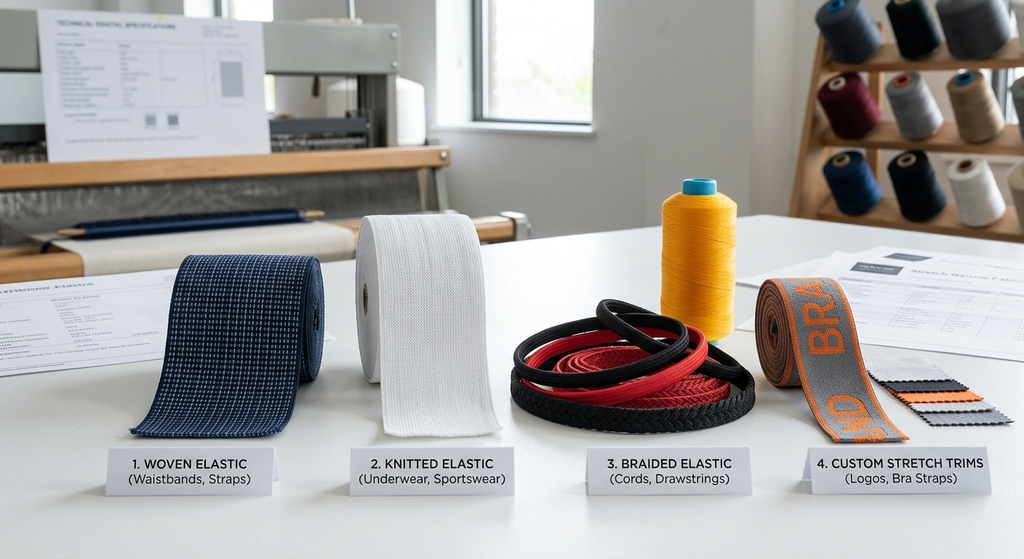
Woven Elastic
Woven elastic is firm, strong and dimensionally stable, which makes it ideal for waistbands, straps, luggage, shoes and industrial uses. It typically uses polyester or nylon warp and weft yarn with rubber or spandex in the warp. Polyester filament yarn in 150D to 600D ranges is common for ground yarns, and the choice of texture influences whether the finished tape feels rigid or soft.
Knitted Elastic
Knitted elastic is softer, more flexible and more comfortable next to the skin. It is produced on warp-knitting or crochet machines using polyester or nylon in combination with spandex or rubber. Knitted elastic is widely used in underwear, sportswear, baby wear and medical bands. Fine textured or air textured yarns are often chosen for the face to give a gentle, cotton-like touch.
Braided Elastic
Braided elastic includes round cords, flat braids and drawcords. The yarn covers an elastic core, so yarn quality strongly affects appearance and abrasion resistance. Bright polyester or nylon filament gives a clean, polished cord, while textured yarn gives a soft, matte look. Uniform yarn evenness is critical, because irregularities show clearly in the braid pattern.
Stretch Narrow Fabrics and Trims
Beyond classic elastic, brands increasingly use stretch tapes, jacquard elastic, bra straps, logo webbing and functional trims. These need tight denier control, fast colour matching and consistent lots so patterns and logos remain identical from one production run to the next.
4. Key Specifications to Consider When Buying Yarn for Elastic
Professional buyers do not simply ask for “polyester yarn for elastic”. They define a specification. The following parameters have the greatest effect on performance, cost and consistency.
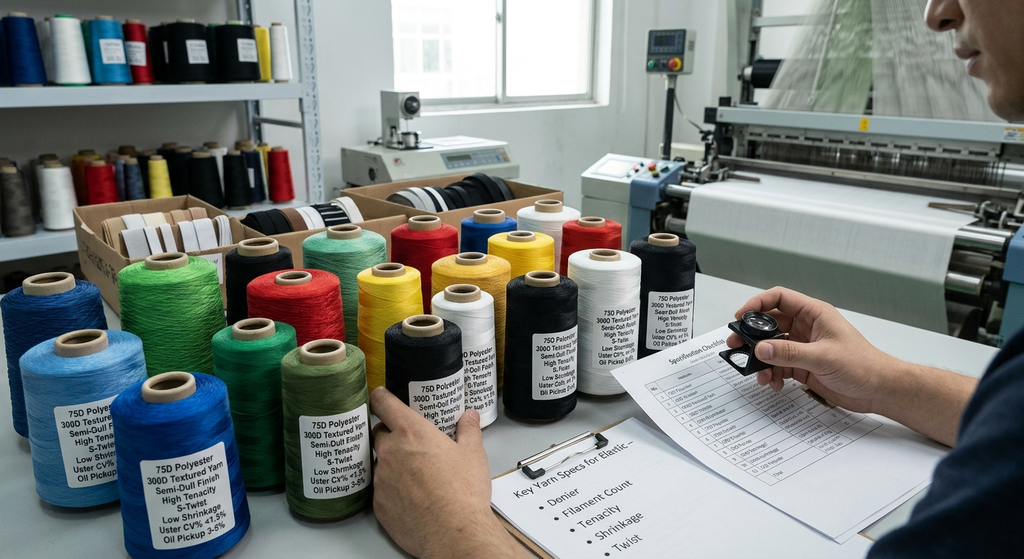
| Specification | Why It Matters |
| Denier (D) | Controls thickness, strength, cover and the weight of the finished elastic. Typical base yarns range from 75D to 1000D depending on tape width. |
| Filament count | Fine filaments give softness and cover; fewer, thicker filaments give strength and lower cost. |
| Luster (bright, semi-dull, full-dull) | Determines appearance. Bright looks technical; dull looks natural and premium. |
| Tenacity and elongation | Predict strength and how the yarn behaves under tension on looms and knitting machines. |
| Twist level and direction | Affect hand feel, cohesion and torque balance, especially in covered and braided yarn. |
| Boiling water and dry heat shrinkage | Critical for dimensional stability during heat setting and dyeing. |
| Evenness (Uster CV%) | Uneven yarn leads to barre, streaks and dye variation. |
| Dye affinity and lot consistency | Ensures colour matches across batches and reduces shade rejection. |
| Oil pickup / finish | Influences winding, weaving and knitting efficiency and downstream cleanliness. |
| Package format and weight | Cone or bobbin weight affects machine downtime and waste. |
How Denier Choices Change the Elastic
Denier is the simplest lever for controlling the look and feel of elastic. Finer yarn creates softer, thinner tapes suitable for lingerie and infant wear. Heavier yarn produces sturdier bands for waistbands, sports equipment and industrial webbing. A common mistake is to select a heavy yarn in the belief that it will make a stronger elastic. In reality, over-heavy base yarn can restrict the elastic core, reduce recovery and make the band stiff. The base yarn should be balanced with the elastomer so the two share the load correctly.
Twist, Torque and Balance
Elastic is dynamic, so torque imbalance can cause curling, rolling and spiralling. Z-twist and S-twist yarns are often used together to cancel torque, and double covering uses opposing wraps for the same reason. If your elastic tends to twist or curl after washing, look at twist balance and heat-setting conditions before blaming the elastomer.
Shrinkage and Heat Setting
Elastic is normally heat set after weaving or knitting. If the yarn shrinks unpredictably, the elastic width and stretch profile will change from batch to batch. Reliable shrinkage data, provided by the yarn supplier for each lot, is a hallmark of a serious manufacturer and one of the biggest indicators of consistent finished quality.
5. Applications of Yarn for Elastic
Elastic yarn systems appear in almost every corner of the textile industry. The following are the most important applications, along with the yarn characteristics that matter most for each.
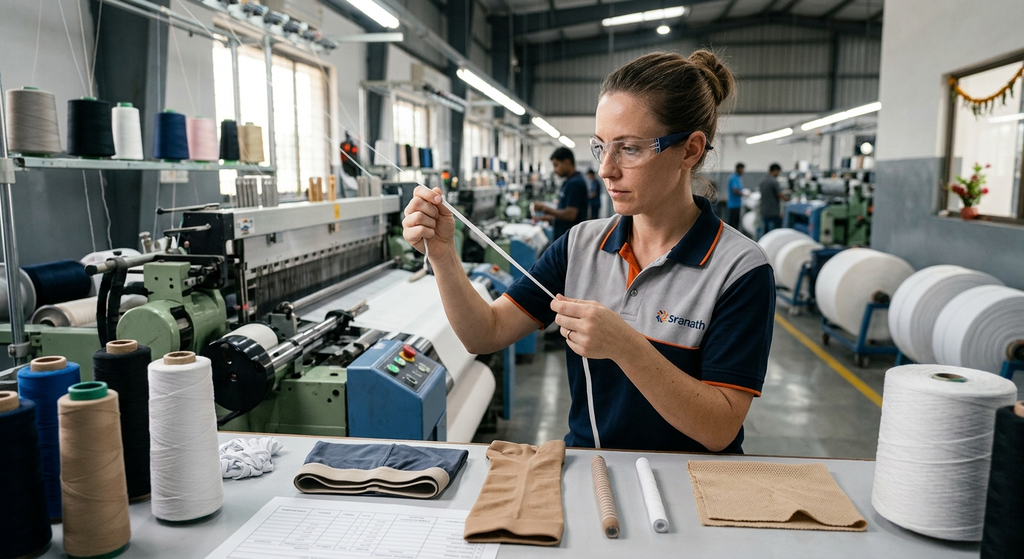
- Apparel waistbands and cuffs: balanced polyester and spandex construction for repeated stretch and wash durability.
- Innerwear and lingerie: soft nylon or fine textured polyester with high-quality spandex, low skin irritation and consistent colour.
- Sportswear and activewear: moisture management, chlorine resistance for swimwear, and reliable recovery after repeated stretch.
- Hosiery and socks: covered yarn and fine denier stretch yarn for comfort fit and shape retention.
- Medical and compression products: controlled stretch, hypoallergenic properties and precise recovery specifications.
- Baby and children’s products: soft hand, low-irritation finishes and strict chemical compliance.
- Footwear and bags: strong, abrasion-resistant elastic in woven and braided forms.
- Face masks and hygiene products: soft, skin-friendly ear loops with stable stretch.
- Home textiles: fitted sheets, mattress covers and cushion covers that need long-lasting tension.
- Industrial and technical uses: heavy-duty bands, harnesses and webbing requiring high tenacity.
Because these markets differ so sharply, the best yarn suppliers are those that can support many specifications from a single manufacturing base. This is exactly where an integrated manufacturer has an advantage over a trader who simply passes along other people’s goods.
6. How Yarn for Elastic Is Manufactured
Quality in elastic starts long before the yarn reaches the loom. Understanding the production chain helps buyers ask better questions and spot risks early.
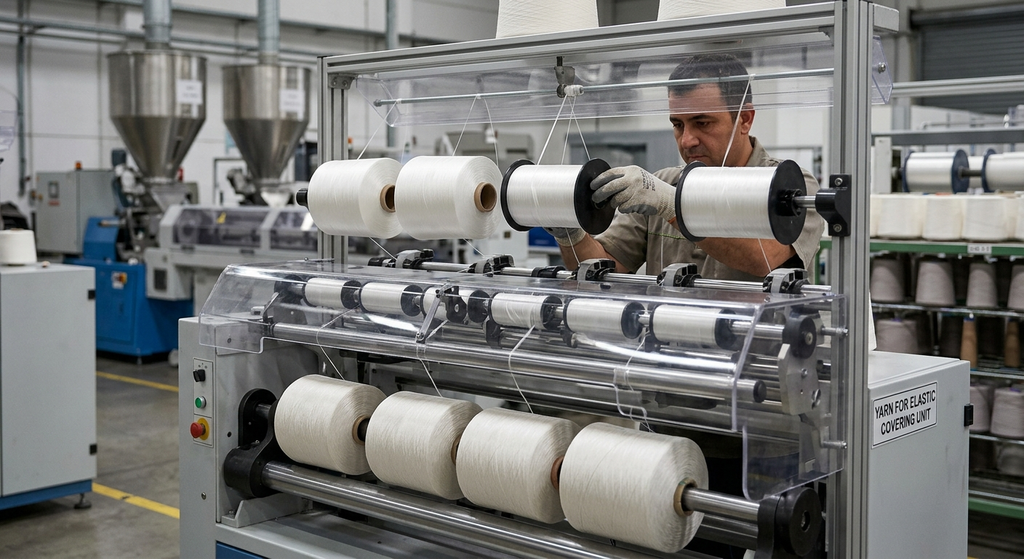
Step 1: Polymer and Chip Quality
Polyester and nylon yarns begin as polymer chips. Purity, intrinsic viscosity and moisture content affect spinning stability and final strength. Suppliers using consistent, high-grade chips generally deliver better evenness and dye uptake.
Step 2: Melt Spinning and Drawing
The molten polymer is extruded through spinnerets to create filaments. Drawing then orients the molecules, giving tenacity and controlled elongation. For FDY, spinning and drawing are integrated, resulting in a strong, smooth yarn ideal for structural elastic parts.
Step 3: Texturing, Twisting and Covering
Depending on the end use, the yarn may be textured (DTY or ATY), twisted, or used as a covering yarn around spandex. Each step is precisely controlled because small variations create visible defects in narrow fabrics.
Step 4: Dyeing and Finishing
Yarn may be supplied raw white for piece dyeing of finished elastic or dyed at the yarn stage for consistent, colour-fast results. Yarn dyeing is especially valuable for jacquard elastic, striped bands and brand-coloured trims where colour precision is critical.
Step 5: Winding, Inspection and Packing
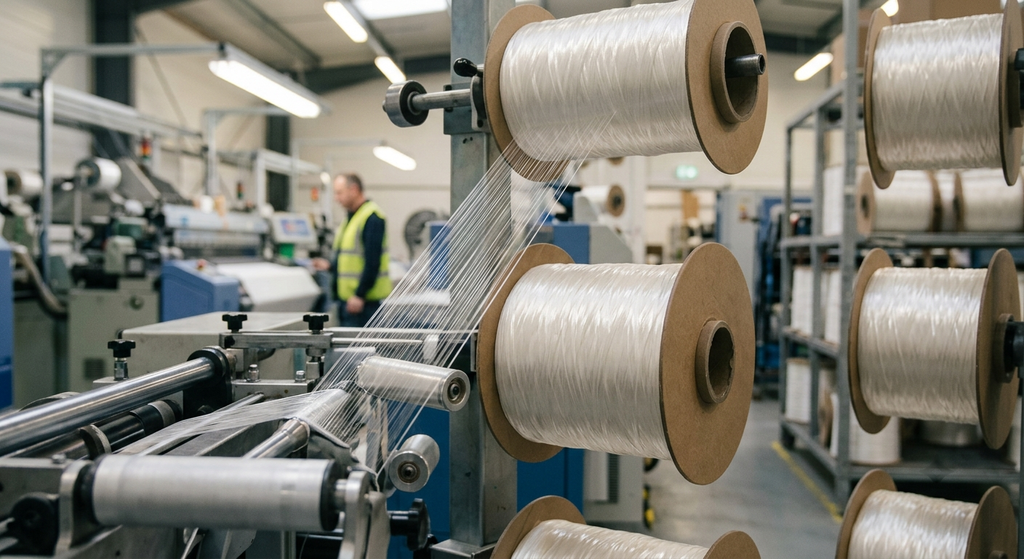
Yarn is wound onto cones or bobbins at controlled tension, inspected for defects and packed to protect it against moisture and dust. Good winding reduces breakage on high-speed narrow-fabric looms and lowers machine stoppages.
For a complete overview of how yarn goes from raw material to finished package, refer to our detailed yarn manufacturing process guide.
7. Quality Testing: How to Know Your Yarn for Elastic Is Good
Testing protects your product and your brand. Reputable manufacturers test yarn at every lot and share reports with customers. Here are the most important checks.

- Denier and count verification to confirm the yarn matches the ordered specification.
- Tensile strength and elongation using standard test equipment to confirm strength and behaviour under load.
- Uster evenness (CV%) to check regularity and prevent streaks, barre and dye variation.
- Boiling water shrinkage to ensure dimensional stability during heat setting.
- Twist per metre to confirm hand feel, torque balance and processing behaviour.
- Colour fastness to washing, rubbing, perspiration, light and chlorine, particularly for dyed yarn.
- Oil pickup and finish level for smooth winding, weaving and knitting.
- Elastic recovery and set in the finished elastic, measured through repeated stretch cycles.
When a supplier cannot provide test data by lot, treat that as a warning. Consistent testing is what separates a reliable yarn manufacturer from a trading intermediary. If you want to understand this difference in more depth, read our comparison of a yarn supplier vs yarn manufacturer.
8. Dyeing and Colour Matching for Elastic Yarn
Colour is often the reason elastic orders are rejected. Because elastic is a small component of a larger garment, it must match the main fabric exactly. Mismatched shade, poor wash fastness and colour bleeding are among the most common complaints in global apparel supply chains.
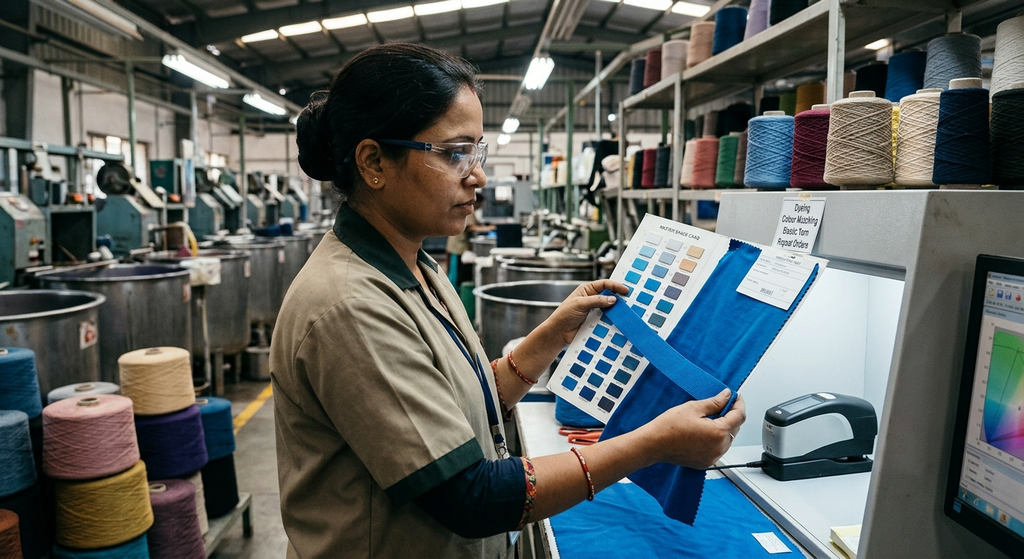
Polyester yarns are dyed with disperse dyes at high temperature, delivering excellent wash and light fastness when done correctly. Nylon uses acid dyes and demands careful control of pH and temperature. Yarn-dyed elastic offers unmatched shade consistency and is ideal for jacquard patterns, while piece-dyed elastic gives flexibility for quick colour changes. Whichever route you take, ensure the yarn supplier provides consistent lots and shade cards so colours stay stable across repeat orders.
Recycled and low-impact dyeing methods are also gaining importance as brands set sustainability targets for their trims. Working with a manufacturer that understands both colour science and environmental compliance saves time and prevents rework.
9. Compliance, Certifications and Sustainability
Global brands and retailers do not simply buy elastic on price. They demand proof that materials are safe, traceable and responsibly produced. Yarn for elastic is no exception, especially in baby wear, skin-contact garments and medical products.
Chemical Safety and Textile Standards
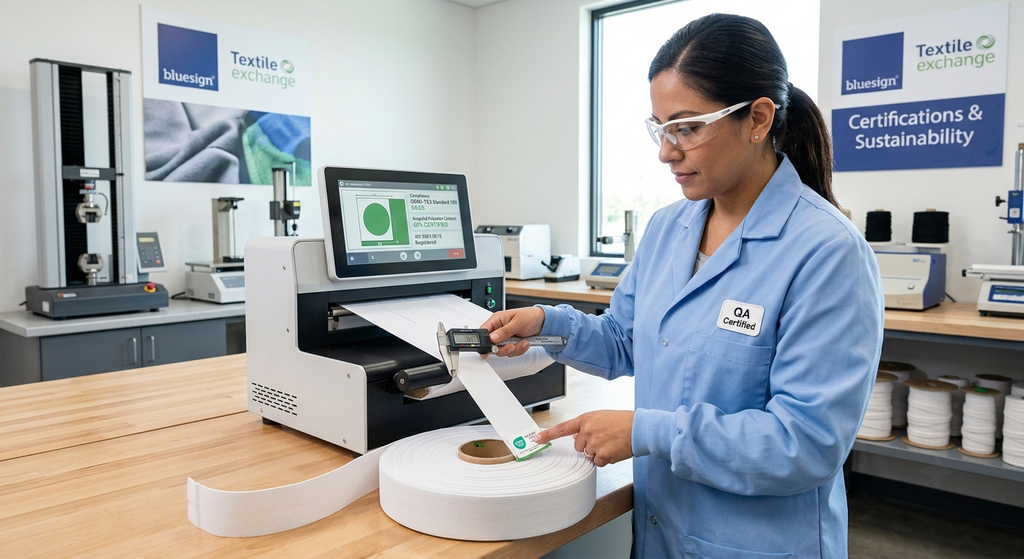
Certifications such as OEKO-TEX test textiles for harmful substances and are widely requested by European and North American buyers. The bluesign system focuses on responsible chemistry and resource use across the supply chain and is increasingly asked for in performance and outdoor apparel. Compliance with the restricted substance lists of individual brands is also a routine requirement.
Quality Management Systems
A documented quality management system, typically aligned with ISO 9001, shows that a supplier controls processes, records data and works to continuously improve. For buyers, it reduces risk and improves traceability. Learn more about what to expect from an accredited supplier in our guide to an ISO certified yarn supplier.
Recycled and Sustainable Yarn
Recycled polyester made from post-consumer bottles or textile waste is now a mainstream option in elastic. It reduces dependence on virgin petroleum, lowers carbon footprint and helps brands reach recycled-content targets. Certification schemes coordinated by organisations such as Textile Exchange provide traceability for recycled content claims. Buyers should always request certification documents and transaction records, not just verbal assurances, to avoid greenwashing risk.
Sustainability in elastic also includes durability. A band that lasts twice as long has half the environmental impact per wear. That is why choosing the right yarn for long life, wash stability and recovery is itself a sustainable decision.
10. Why India, and Why Surat, Leads in Yarn for Elastic
India is one of the world’s largest textile producers, with a vertically integrated value chain that spans fibre, yarn, fabric, garments and trims. Government initiatives supported by the Ministry of Textiles continue to strengthen the sector through infrastructure, skill development and export promotion.
Within India, Surat in Gujarat has earned a global reputation as the capital of synthetic and man-made textiles. The city hosts a dense cluster of yarn manufacturers, texturisers, twisters, dyers, weavers and narrow-fabric producers, giving buyers a rare combination of speed, variety and competitive pricing. For elastic manufacturers, this cluster means faster sampling, shorter lead times and easy access to specialist processing such as covering, twisting and yarn dyeing.
Industry publications such as Fibre2Fashion regularly track the rise of Indian synthetic yarn exports and the growing demand for functional and stretch textiles, a trend that continues to favour Surat-based manufacturers with technical depth and export experience.
11. Madhusudan Group: A Trusted Leader in Yarn for Elastic
Madhusudan Group has built its reputation as a serious, technically capable yarn manufacturer and exporter serving customers across India and international markets. Our focus is simple: deliver consistent, specification-accurate yarn that keeps our customers’ machines running and their finished products performing.
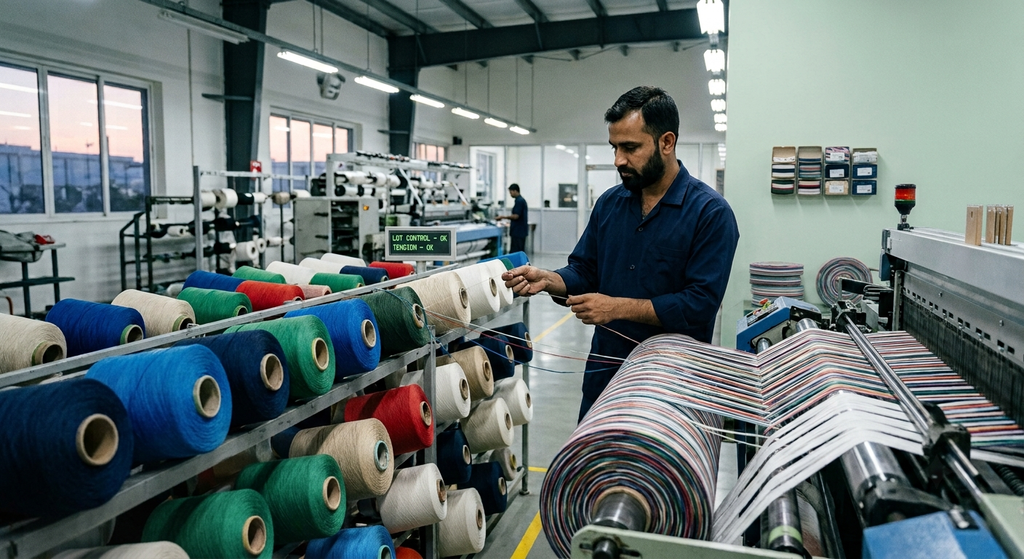
A Full Range of Yarns under One Roof
Elastic manufacturers rarely need only one yarn. They need polyester for the base, nylon for soft-touch bands, textured yarn for comfort, stretch yarn for performance and dyed yarn for colour. Madhusudan Group supports this complete requirement through a diversified portfolio that includes polyester, nylon, viscose, and linen, blended, recycled and stretch yarns, supported by dyed yarn services for customers who need reliable shade consistency. Explore our dedicated capabilities in dyed yarn manufacturing and see how yarn dyeing supports elastic and trim customers.
Engineering-Led Consistency
Consistency is the currency of the elastic industry. A yarn that performs well in a small trial but varies in bulk production is worse than useless. Madhusudan Group emphasises lot-to-lot control, standardised testing and stable process parameters, so what you approve in the sample is what you receive in production.
Export-Ready and Buyer-Focused
Our team understands the documentation, packaging, labelling and logistics required for international shipments. Whether your business is in Europe, the Americas, the Middle East or Asia, we support smooth import and delivery. Buyers exploring bulk sourcing can also review our overview of a bulk yarn supplier in India to understand minimum quantities, packing and supply planning.
Innovation in Stretch and Bicomponent Technology
The elastic market is changing. Brands want lighter, softer, more sustainable and more durable stretch. Madhusudan Group invests in understanding advanced technologies such as elastomultiester and bicomponent yarns, air textured yarns and recycled polyester so that customers have access to next-generation solutions instead of legacy materials alone.
What Sets Madhusudan Group Apart
- Manufacturer-direct supply, which means better price transparency and faster problem solving.
- Broad product range covering base, stretch, textured, dyed and recycled yarn.
- Technical support for specification, sampling and troubleshooting.
- Quality-first culture built around testing, documentation and continuous improvement.
- Reliable export experience with clear communication and dependable delivery.
- Sustainability awareness through recycled yarn options and responsible manufacturing.
12. How to Choose the Right Yarn for Your Elastic Product
Selecting yarn for elastic becomes far easier when you follow a structured approach. Use the following framework whenever you brief a supplier or develop a new elastic product.
Step 1: Define the End Use
Start with the application. Is it a waistband, a bra strap, a medical bandage, a shoe lace or a mask loop? The end use dictates stretch level, softness, wash durability, chemical safety and cost.
Step 2: Set Performance Targets
Decide the required stretch percentage, recovery after cycling, strength, width and weight. Write these as measurable targets, not general descriptions. A supplier can only meet specifications you have clearly stated.
Step 3: Choose Base and Elastic Yarn Together
Select polyester or nylon base yarn and the elastomeric component as a matched system. Consider denier balance, twist, shrinkage and dye compatibility, and remember that the strongest option is not always the best for recovery or comfort.
Step 4: Decide Between Raw White and Dyed Yarn
Raw white yarn offers flexibility and faster colour changes. Dyed yarn offers superior shade consistency and lets you produce jacquard and multicolour designs. Many customers use both depending on the product line.
Step 5: Request Samples and Test Data
Ask for samples along with technical data sheets and lot test reports. Run trials on your own machines and washing tests on finished elastic before committing to large volumes.
Step 6: Evaluate the Supplier, Not Just the Price
Price matters, but supply reliability, technical support, quality systems and communication matter more when a production line depends on your yarn. Our checklist of questions to ask before buying yarn helps you evaluate any supplier in a structured, risk-aware way.
13. Common Problems in Elastic and How Yarn Choice Solves Them
| Problem | Likely Yarn-Related Cause | Recommended Solution |
| Elastic loses stretch or “bags out” | Poor elastomer quality, over-heavy base yarn, incorrect heat setting | Balance denier, verify spandex power and recovery, standardise heat setting |
| Colour mismatch or shade variation | Lot inconsistency, inadequate dye affinity control | Use yarn-dyed or lot-controlled yarn with shade approvals |
| Elastic curls or twists | Torque imbalance in twisted or covered yarn | Use balanced S/Z twist or double covering |
| Rough or itchy feel | Coarse filaments, incorrect texture | Switch to finer filaments, nylon or air textured yarn |
| Breakage on loom or knitting machine | Uneven yarn, poor winding, weak tenacity | Choose high-quality, even yarn with proper winding tension |
| Colour bleeding after wash | Poor dyeing, insufficient fixation | Specify wash-fastness targets and demand test reports |
| Fails chlorine or heat exposure | Wrong elastomer for swimwear or hot processes | Consider elastomultiester or chlorine-resistant options |
Most elastic defects blamed on machines or finishing actually begin with yarn. That is why an experienced yarn partner is worth more than a low quote.
14. Market Trends Shaping the Future of Yarn for Elastic
- Comfort-first stretch: consumers want soft, breathable, non-restrictive elastic, boosting demand for textured, air textured and bicomponent yarns.
- Sustainable materials: recycled polyester and traceable supply chains are moving from niche to mainstream in brand sourcing policies.
- Athleisure and functional wear: performance requirements such as moisture management and chlorine resistance are pushing innovation in stretch yarn.
- Medical and wellness textiles: compression wear and support bands require precise, repeatable elastic properties.
- Supplier consolidation: brands prefer fewer, more capable suppliers who can deliver multiple yarn types with consistent quality.
- Digital traceability: buyers increasingly expect batch-level data, test reports and full documentation.
Manufacturers who invest in technology, testing and sustainability will win the next decade of elastic supply. Madhusudan Group is positioned to serve exactly this shift.
15. Frequently Asked Questions About Yarn for Elastic
What yarn is used to make elastic?
Elastic is generally made from a combination of elastomeric yarn (spandex or rubber) and a non-elastic base yarn (polyester, nylon or sometimes cotton). The elastomer provides stretch and recovery, while the base yarn provides structure, strength, colour and hand feel.
Which is better for elastic: polyester or nylon?
Polyester offers higher strength, better dimensional stability, lower cost and strong dye fastness, making it the most common choice. Nylon offers a softer, silkier feel and better abrasion resistance, making it popular in lingerie, sportswear and skin-contact products. The right choice depends on the application and budget.
What denier yarn is used for elastic?
Base yarn deniers commonly range from around 75D to 1000D depending on tape width and type, while spandex deniers can range from 20D for delicate bands to well over 1000D for heavy elastic. The correct combination depends on stretch, strength and softness targets.
What is the difference between spandex and elastomultiester yarn?
Spandex is a chemical elastomer that provides very high stretch and recovery. Elastomultiester is a polyester-based bicomponent yarn that provides mechanical, comfort-level stretch through crimp formation. Elastomultiester is easier to dye, more resistant to chlorine and heat, and often more cost-effective, but it delivers lower stretch power than spandex.
Can recycled polyester be used for elastic?
Yes. Recycled polyester works well as the base yarn in woven, knitted and braided elastic. It offers strength and dye performance comparable to virgin polyester when produced by a reliable manufacturer, and it helps brands meet recycled-content goals.
Is dyed yarn better than dyeing finished elastic?
Neither is universally better. Yarn dyeing provides superior colour consistency and enables jacquard and striped designs, while piece dyeing provides flexibility and quick colour changes. Many manufacturers use a combination of both.
Why is elastic yarn from Surat popular globally?
Surat combines large-scale synthetic yarn production, specialised processing such as twisting, texturising and dyeing, and a competitive cost base. This ecosystem allows manufacturers to offer wide variety, quick sampling and dependable export supply.
How can I order yarn for elastic from Madhusudan Group?
Contact our team with your target application, denier, colour and quantity requirements. We will guide you on the best yarn system, provide technical data and samples, and support you through production and export documentation.
Conclusion: Build Better Elastic with the Right Yarn Partner
Elastic may be a small component of a finished product, but it is often the part that decides whether a customer is satisfied. Stretch, recovery, softness, colour, strength and durability all begin with yarn. By understanding the types of yarn for elastic, defining precise specifications, testing rigorously and working with a manufacturer that values consistency, you protect quality, reduce rejection and strengthen your brand.
Madhusudan Group brings together deep manufacturing expertise, a wide yarn portfolio, export experience and a genuine commitment to quality. Whether you produce woven, knitted or braided elastic, or you are a garment brand seeking a dependable yarn source, we are ready to help you develop the right solution and deliver it consistently, order after order.
Ready to source premium yarn for elastic? Get in touch with Madhusudan Group today to discuss your specification, request samples and build a long-term supply partnership with one of India’s most trusted yarn manufacturers.