If you’re a sourcing manager, buyer, or product developer in the United States or Canada searching for a reliable ATY yarn supplier, you already know the hard part isn’t finding a factory it’s finding one that can actually prove consistent bulk, uniform intermingle points, and on-time container shipments, order after order. Air textured yarn (ATY) looks simple on a spec sheet. In production, it’s one of the more demanding filament yarn processes to get right, and the gap between a supplier’s marketing claims and their actual shop-floor consistency is where most import relationships go wrong.
This guide covers everything a North American buyer needs before issuing an RFQ: what ATY yarn actually is, how the air texturing process works, how it compares to DTY and FDY yarn, the specifications and applications you should know, what separates a dependable exporter from a marketplace listing, and the certifications, logistics, and tariff details that matter once you’re ready to place a container order.
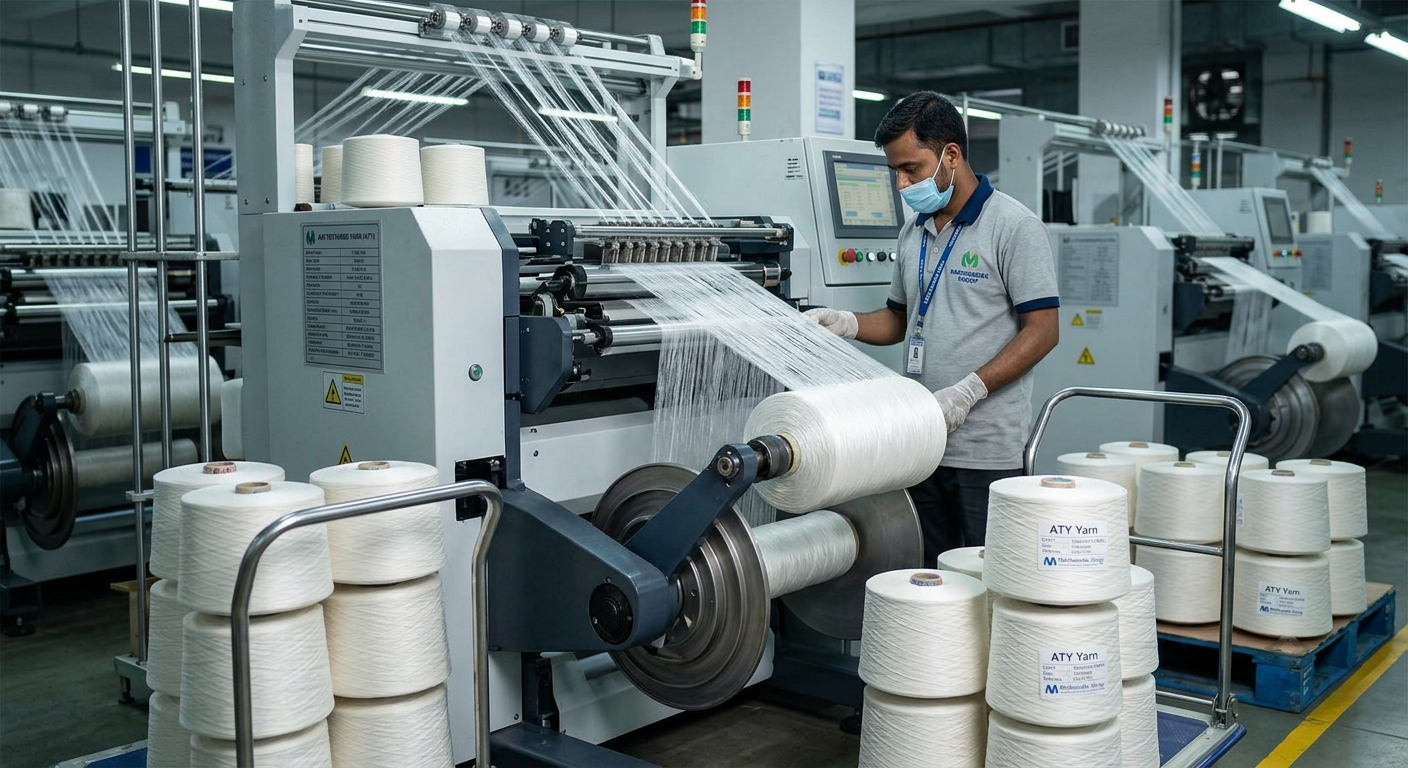
Madhusudan Group manufactures ATY yarn in India across 21 dedicated air-texturing machines, producing roughly 750 tonnes per month, with an in-house in-house yarn dyeing capability and a GRS-certified recycled yarn program (mRec) for buyers who need sustainability documentation. Where relevant below, we’ve used our own production data as a working example of what to actually ask any ATY supplier for not just us.
What Is ATY Yarn (Air Textured Yarn)?
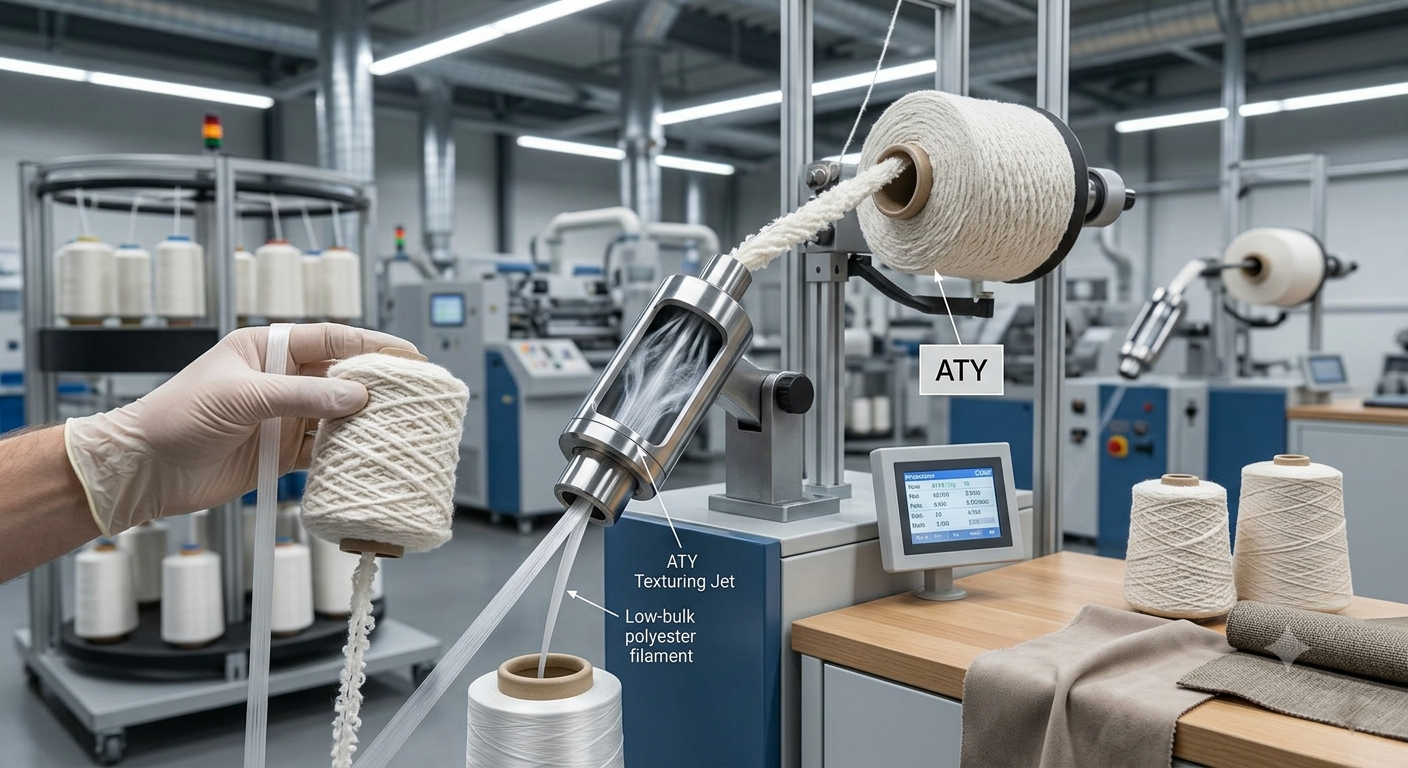
Air textured yarn is a continuous filament yarn most commonly polyester, though nylon and polypropylene versions exist that has been passed through a high-velocity air jet to loop and entangle individual filaments together. The process converts a smooth, flat, low-bulk filament yarn into a yarn with volume, softness, and a texture that resembles spun staple yarn, without actually cutting the filaments into staple fiber first.
The result is a yarn that behaves like cotton or spun polyester in a fabric soft hand-feel, good cover, and better moisture wicking than flat filament while retaining the strength and consistency advantages of continuous filament. That combination is exactly why ATY yarn shows up so often in home textiles, upholstery, apparel linings, and industrial fabrics across North American supply chains.
ATY is sometimes used interchangeably with the term “bulk continuous filament” (BCF) in flooring and carpet contexts, though BCF technically refers to a related but distinct texturing route. If you’re comparing supplier quotes and seeing both terms, it’s worth clarifying which exact process and which exact yarn structure you’re being quoted on. We cover the practical differences in yarn manufacturing process guide if you want the deeper technical comparison.
How the Air Texturing Process Actually Works
Understanding the process matters because it directly explains why ATY yarn quality varies so much between suppliers and what to ask about when you’re vetting one.
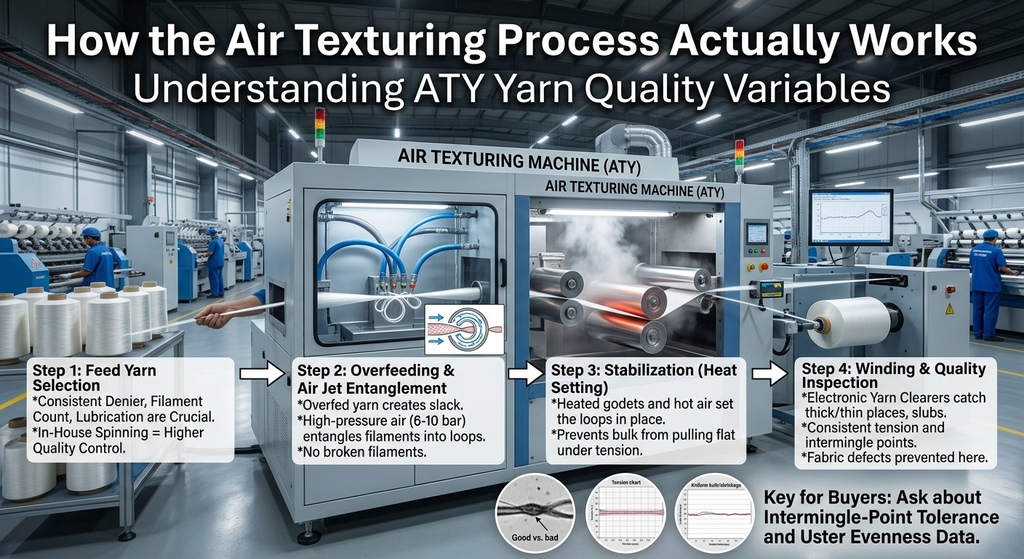
Step 1: Feed yarn selection
Air texturing starts with a feeder yarn typically a POY (Partially Oriented Yarn) or a drawn flat filament yarn fed into the texturing jet under controlled tension. Feed yarn quality (denier consistency, filament count, lubrication/finish) is the single biggest variable determining final ATY yarn quality. Suppliers who spin their own feed yarn in-house, rather than buying it on the open market, have far tighter control over this stage.
Step 2: Overfeeding and air jet entanglement
The feed yarn is overfed into a texturing nozzle at a rate faster than it exits, creating slack. A jet of compressed air, typically 6–10 bar depending on denier and target bulk, turbulently entangles the slack filaments into small, evenly spaced loops and intermingle points along the yarn’s length. This is what creates bulk and texture without breaking filament continuity.
Step 3: Stabilization (heat setting)
The textured yarn passes over heated godets or through a hot-air chamber to heat-set the loops and intermingle points in place, so the bulk survives downstream processes like weaving, knitting, warping, or dyeing rather than pulling flat under tension.
Step 4: Winding and quality inspection
The finished yarn is wound onto packages (cones or cheeses) under controlled, uniform tension. This stage is where electronic yarn clearers catch thick/thin places, slubs, and intermingle-point irregularities before packaging a step some lower-cost suppliers skip or under-invest in, which shows up later as fabric defects a North American buyer’s QC team will catch on receiving inspection, well after the container has already shipped.
The number of intermingle points per meter, the evenness of bulk along the yarn, and the shrinkage behavior during heat setting are the three specs that separate a well-run ATY line from an inconsistent one. Ask any prospective supplier for their intermingle-point tolerance and Uster evenness data a supplier who can’t produce this data on request is not testing for it internally. You can request Madhusudan Group’s technical datasheet, which includes these figures, here.
ATY vs. DTY vs. FDY: Understanding the Differences
Buyers new to filament yarn sourcing often assume these three are interchangeable options at different price points. They’re not each is engineered for a different fabric outcome, and specifying the wrong one is the single most common (and expensive) mistake first-time importers make.
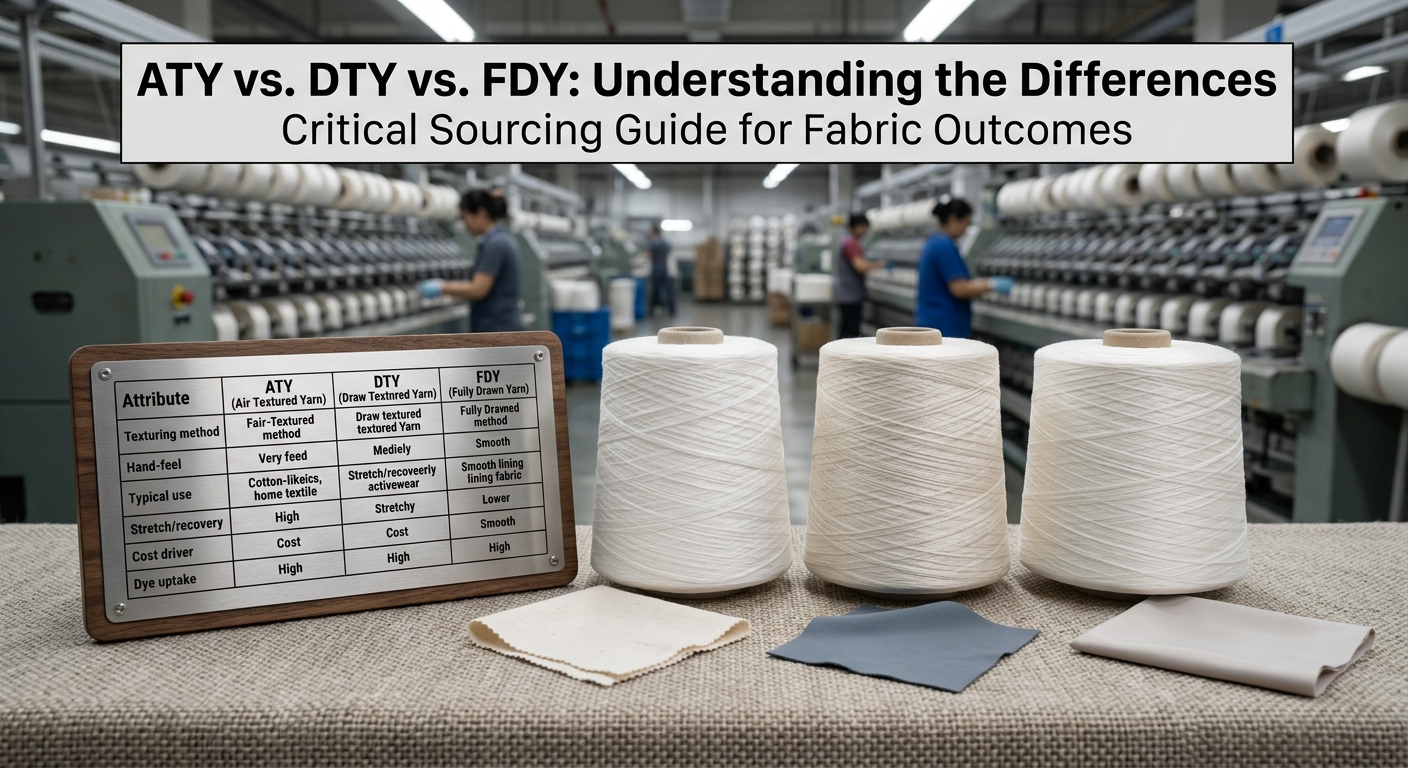
| Attribute | ATY (Air Textured Yarn) | DTY (Draw Textured Yarn) | FDY (Fully Drawn Yarn) |
| Texturing method | High-velocity air jet entanglement | False-twist heat texturing | No texturing — flat filament |
| Hand-feel | Soft, bulky, cotton-like | Elastic, stretchy, crimped | Smooth, silky, low bulk |
| Typical use | Home textiles, upholstery, industrial fabrics | Apparel, activewear, hosiery | Lining fabrics, silk-look wovens |
| Stretch/recovery | Low stretch, high bulk | High stretch and recovery | Minimal stretch |
| Cost driver | Air consumption + feed yarn quality | Twist/heat process control | Spinning speed/draw ratio |
| Dye uptake | Even, good cover due to bulk | Even, benefits from crimp | Requires careful dye control (flat surface) |
If your end product needs stretch and recovery activewear, hosiery, swimwear you likely want DTY yarn, not ATY. If you need bulk, cover, and a soft hand without stretch bedding, upholstery, and curtains, industrial wipes ATY is very likely the right specification. See our full polyester yarn manufacturing range if you’re not yet sure which yarn type your product needs. Suppliers who quote both without asking what your end fabric actually needs are optimizing for their own production mix, not your product outcome; that’s a useful thing to notice during initial RFQ conversations.
ATY Yarn Specifications & Types Available
A capable ATY supplier should be able to quote across the full range a North American buyer typically needs, not a narrow band. Specification ranges to expect from a full-line manufacturer:
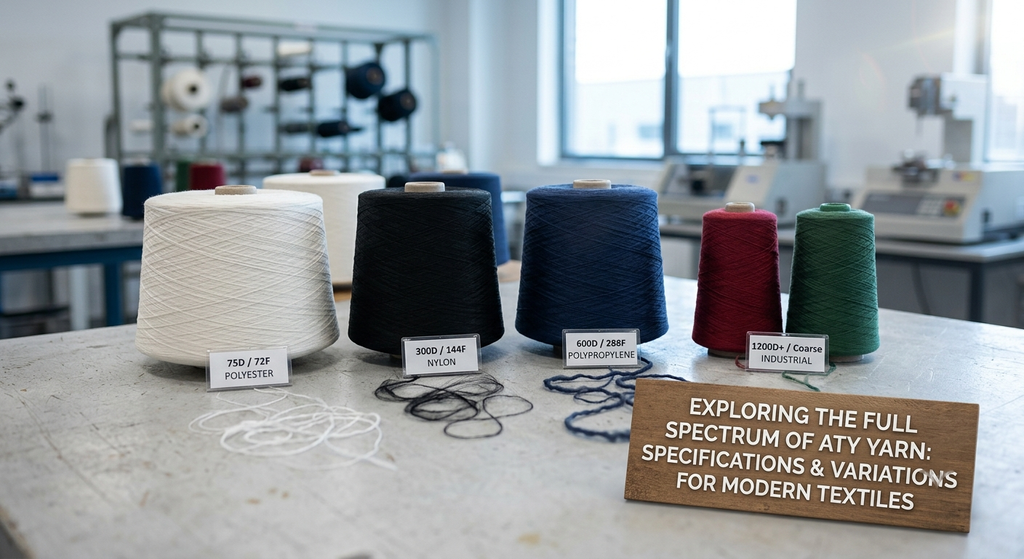
- Denier range: 75D to 1200D+ (fine deniers for apparel-adjacent fabrics, heavier deniers for industrial and upholstery use)
- Filament count: from low-filament coarse textures to high-filament fine, soft-hand constructions
- Base polymer: polyester (most common), nylon 6/6.6, polypropylene, and blends
- Color format: raw/greige (undyed) for downstream piece-dyeing, or solution-dyed and package-dyed options
Special variants worth asking about: cationic dyeable ATY for deep, vibrant shade ranges without cross-dye issues see our dyed polyester yarn guide for how cationic and disperse dyeing compare and GRS-certified recycled ATY for brands with sustainability commitments, covered in the next section.
If a supplier’s spec sheet only lists two or three deniers, that’s usually a signal of a smaller or single-configuration texturing line, which may be perfectly fine for a narrow product range but worth knowing before you commit to them as your sole ATY yarn manufacturer for a growing product line.
Applications of ATY Yarn Across Industries
Home Textiles & Furnishings
Bedding, curtains, upholstery fabric, and mattress ticking all rely on ATY yarn’s bulk and soft hand to deliver a fabric that feels substantial without the cost or supply variability of natural fibers. This is the single largest end-use category for ATY yarn imported into North America, and it’s where buyers most often specify heavier deniers (300D and up) for good fabric cover and drape at a reasonable fabric weight.
Apparel Linings & Interlinings
Jacket linings, garment interlinings, and certain woven apparel fabrics use finer-denier ATY (typically under 150D) for a soft, non-slippery hand-feel at a lower cost than natural fiber alternatives. This is a category where consistent evenness matters more than in heavier home-textile applications, since fine-denier fabric defects are far more visible to the eye.
Industrial & Technical Fabrics
Filtration media, geotextiles, automotive interior fabrics, and industrial wipes use heavier-denier ATY for bulk, absorbency, and abrasion resistance. See our industrial yarn supplier page for the full range of technical yarn we produce beyond ATY. Automotive interior applications in particular often carry additional flame-retardancy and colorfastness testing requirements beyond standard textile specs, worth flagging to your supplier at the RFQ stage rather than after sampling.
Carpets & Flooring (BCF-Adjacent Applications)
Certain area-rug and flooring backings use bulked continuous filament yarns produced on air-texturing-adjacent lines, prioritizing coverage and resilience under foot traffic over the softer hand-feel prioritized in apparel-adjacent uses.
Ropes, Cordage & Webbing
Bulk and grip characteristics from air texturing are used in certain rope, webbing, and strapping applications where a smooth flat filament would be too slippery to handle or knot securely.
Sewing & Embroidery Thread Cores
Some sewing and embroidery thread constructions use a textured ATY core for added bulk and a more consistent stitch appearance, particularly in heavier upholstery-weight thread applications a smaller-volume but steady demand category worth knowing about if you’re evaluating suppliers beyond fabric-yarn use cases.
Why North American Buyers Are Sourcing ATY Yarn from India
For the last several sourcing cycles, US and Canadian textile buyers have been actively diversifying filament yarn procurement away from single-country dependence. India has become one of the primary beneficiaries of that shift for several concrete reasons that go beyond simple unit cost:
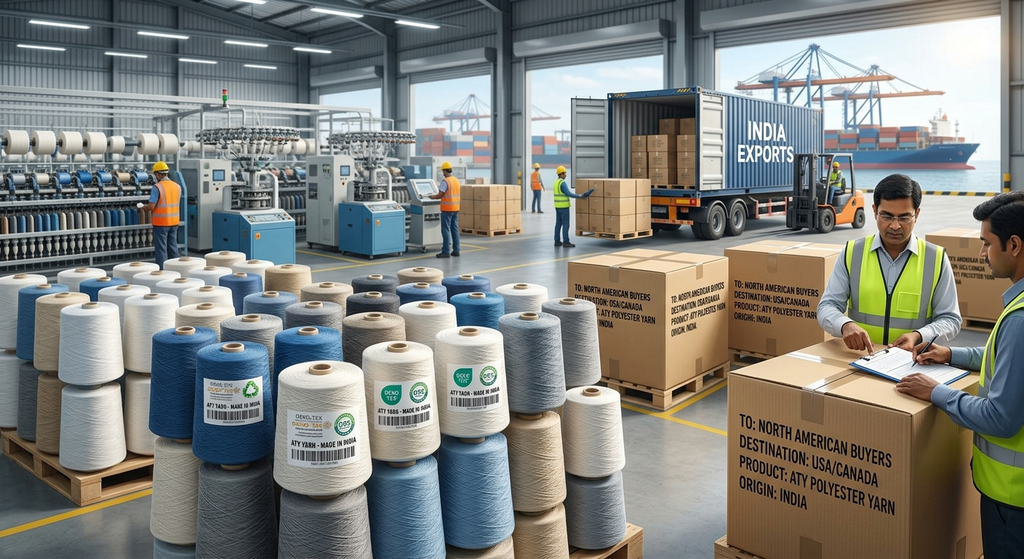
- Established export infrastructure: major Indian yarn-producing clusters (Surat, Silvassa, Vapi) have decades of container-export experience specifically to North American ports, with predictable lead times and documentation processes.
- Full-line manufacturing depth: leading Indian manufacturers run POY spinning, texturing, twisting, and dyeing under one roof, which shortens the supply chain compared to buyers coordinating separate spinners, texturizers, and dye houses across multiple factories.
- Cost-competitive without sacrificing certification: Indian mills increasingly hold the same ISO, OEKO-TEX, and GRS certifications North American compliance teams require, at a cost structure that remains competitive against other major sourcing origins.
- English-language business communication: fewer translation and specification-miscommunication risks compared to sourcing from non-English-speaking manufacturing hubs a genuinely underrated factor in reducing costly reorder cycles.
- Trade agreement and tariff positioning: Indian man-made filament yarn currently sits outside several of the additional tariff measures applied to other major sourcing origins, which is worth confirming with your customs broker against the current Harmonized Tariff Schedule for your specific yarn classification (see the Logistics section below).
None of this replaces proper supplier vetting it explains why India is worth including in your RFQ shortlist in the first place, alongside your existing sourcing origins.
India vs. China vs. Vietnam for ATY yarn: an honest comparison
China remains the largest global producer of textured polyester yarn by volume, with mature infrastructure and often the lowest headline unit price. But many North American buyers have spent the last several years actively reducing single-country concentration risk after repeated disruptions port congestion, sudden tariff changes, and freight-rate volatility all hit harder when 80%+ of a category is sourced from one origin. Vietnam has grown quickly in finished apparel manufacturing but has comparatively limited upstream filament yarn and texturing capacity, meaning much of its own yarn is imported rather than produced domestically.
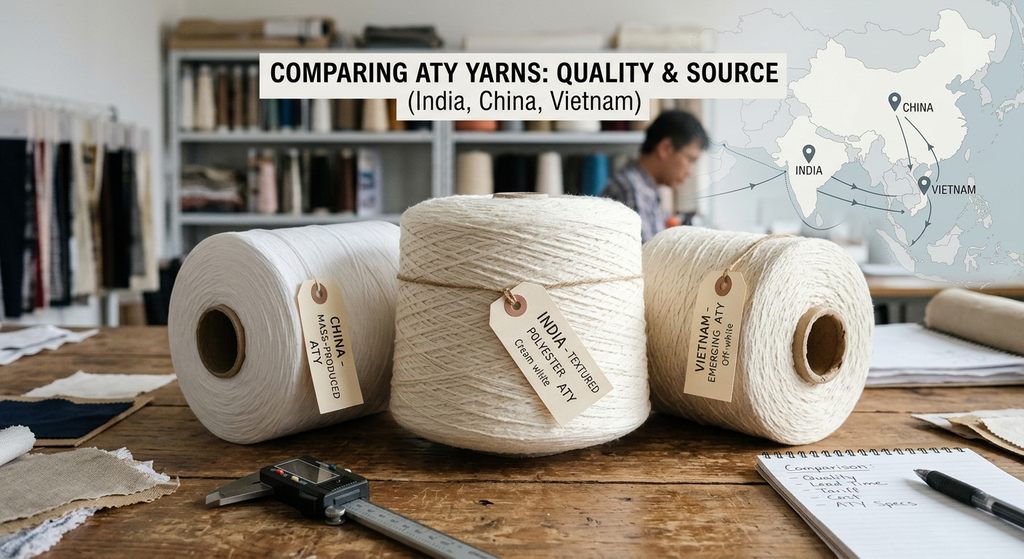
India sits in a practical middle position: a mature, decades-old texturing and spinning base, English-language business communication, and established container-shipping lanes to both US coasts and to Canada, and critically for buyers managing tariff exposure a different trade-policy position than China on many yarn classifications. For a buyer building a dual- or multi-source strategy rather than a single-country dependency, adding an Indian ATY yarn supplier alongside an existing Chinese or Vietnamese relationship is one of the more common diversification moves we see from North American procurement teams right now.
None of this means India is automatically the right choice for every buyer or every product category freight cost from India can run higher to certain North American inland destinations depending on routing, and lead times are generally a few days longer than from closer Pacific-rim origins. The point isn’t that India wins on every variable; it’s that it’s worth an actual side-by-side RFQ rather than defaulting to whichever origin your company has always used.
Madhusudan Group: ATY Yarn Manufacturing Capability
Madhusudan Group operates 21 dedicated air-texturing machines producing approximately 750 tonnes of ATY yarn per month, alongside integrated POY spinning, twisting, and yarn dyeing operations at facilities in Surat, Gujarat one of India’s principal filament yarn manufacturing clusters, with direct container access to Mundra and Nhava Sheva ports for North America-bound shipments.
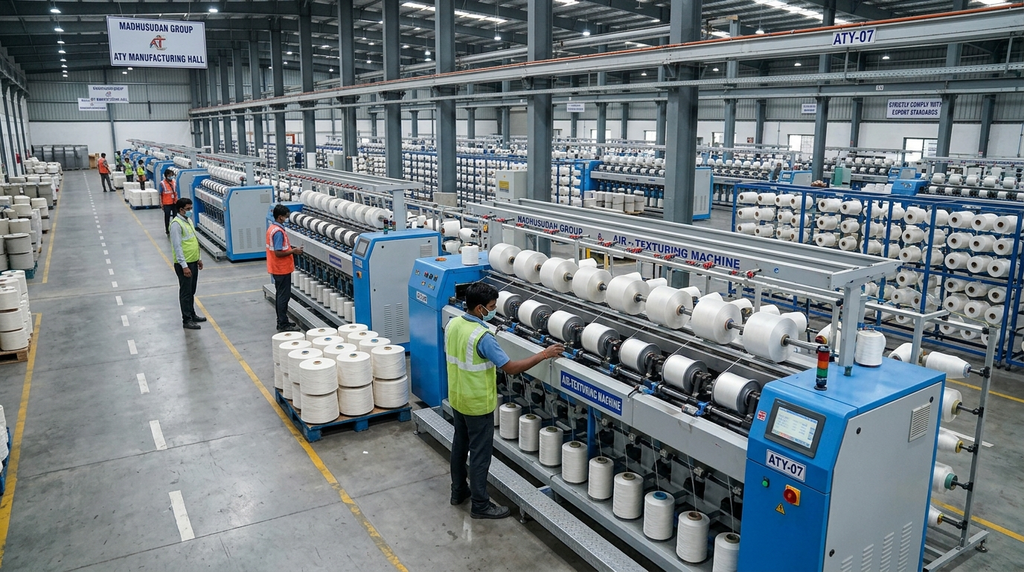
What this scale means for a North American buyer
- Consistent lot-to-lot specification matching, because feed yarn is spun in-house rather than sourced from third parties with variable quality
- Capacity headroom to support a growing order program without becoming your sole-source bottleneck
- Access to our integrated yarn manufacturing and dyeing operations hub, so ATY, DTY, and dyeing services can be coordinated under one supplier relationship rather than three
- Export documentation and logistics experience specific to US and Canadian import requirements, built over an existing footprint across 18+ countries including North American and European markets
We’d encourage any serious buyer to verify these claims directly rather than take them at face value from any supplier’s website, including ours ask for production data, a factory video call or in-person audit, and reference customers in a comparable end-use category to your own. For more on how we work with global brands, see why global brands trust Surat’s textile industry and the story of how Indian yarn is powering global fashion brands.
Common ATY Yarn Quality Defects and How a Good Supplier Prevents Them
Knowing what can go wrong in air texturing helps you ask sharper questions during supplier vetting, and gives your incoming-QC team a checklist for receiving inspection. These are the defects that actually cause fabric-stage rejections, not cosmetic issues.
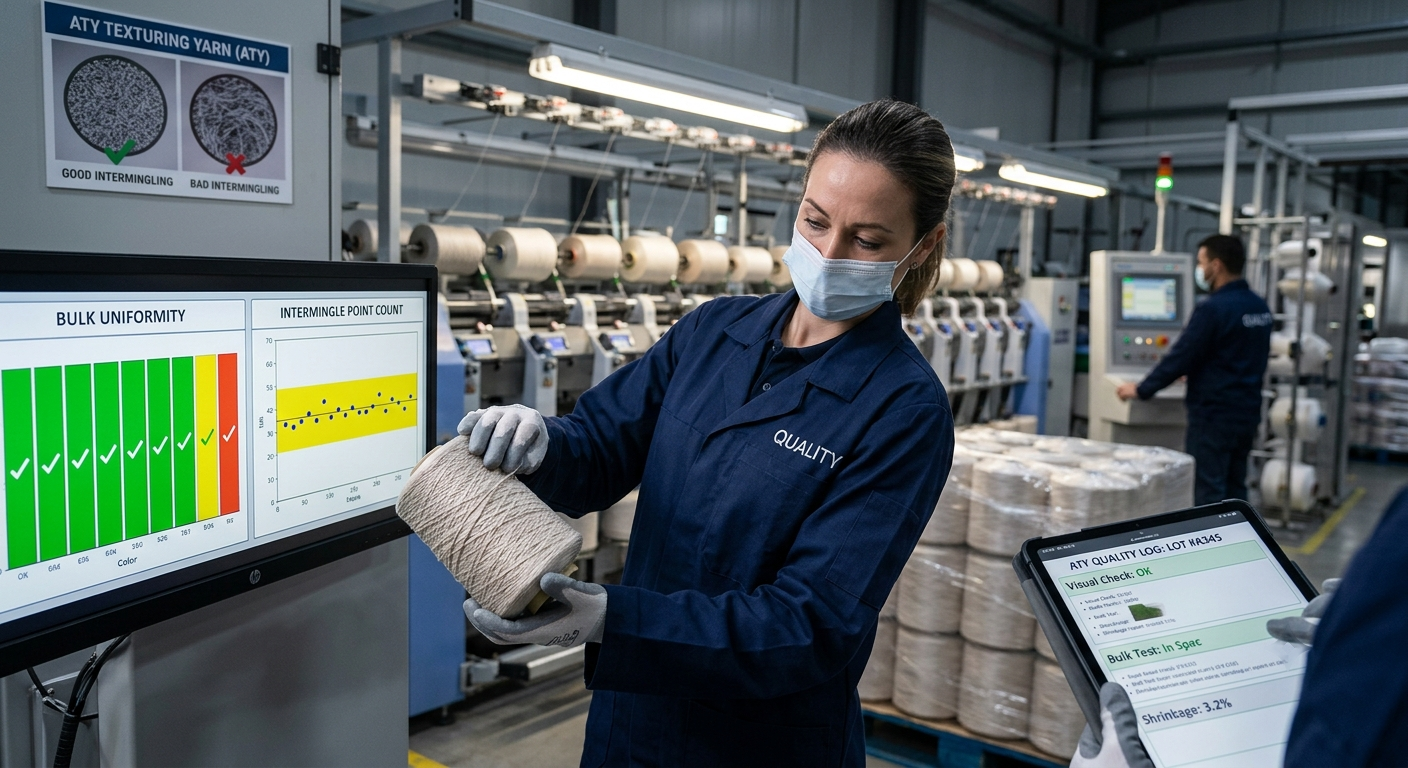
Uneven bulk / “bare” patches
Caused by inconsistent air pressure or nozzle wear during texturing. Shows up as visibly thinner, less bulky sections along the yarn that read as streaks or shade variation once woven or knitted into fabric. Prevented by scheduled nozzle maintenance and in-line bulk monitoring ask your supplier how often texturing nozzles are inspected or replaced.
Intermingle-point drift
If intermingle points (the entangled sections holding the bulk in place) are too far apart or inconsistent, the yarn loses bulk stability during weaving/knitting tension and can “untexture” partway through downstream processing. This is caught by intermingle-point-per-meter testing, which any properly equipped lab runs on a sampling basis from every production lot.
Excess shrinkage or distortion after heat setting
Under-set yarn shrinks unpredictably during fabric finishing or garment dyeing, distorting fabric dimensions. This is a heat-setting process-control issue, and it’s why asking for a supplier’s shrinkage test data (not just a denier and filament count on the spec sheet) matters before a first bulk order.
Package-to-package tension inconsistency
Yarn wound at inconsistent tension across different packages in the same lot causes dye-uptake variation (barré) in package-dyed or piece-dyed fabric visible as subtle striping. Winding tension control and electronic yarn clearing at the winding stage are the direct prevention measures; ask whether this is inspected at 100% or only sample-checked.
A supplier who can walk you through their specific controls for each of these rather than a generic “we have strict quality control” answer is showing you they actually understand where ATY yarn quality is won or lost.
Sampling, Testing & Approval before Placing a Bulk Order
Never place a first bulk container order on a spec sheet alone. A structured sampling process protects both sides of the relationship and is standard practice among experienced North American importers.
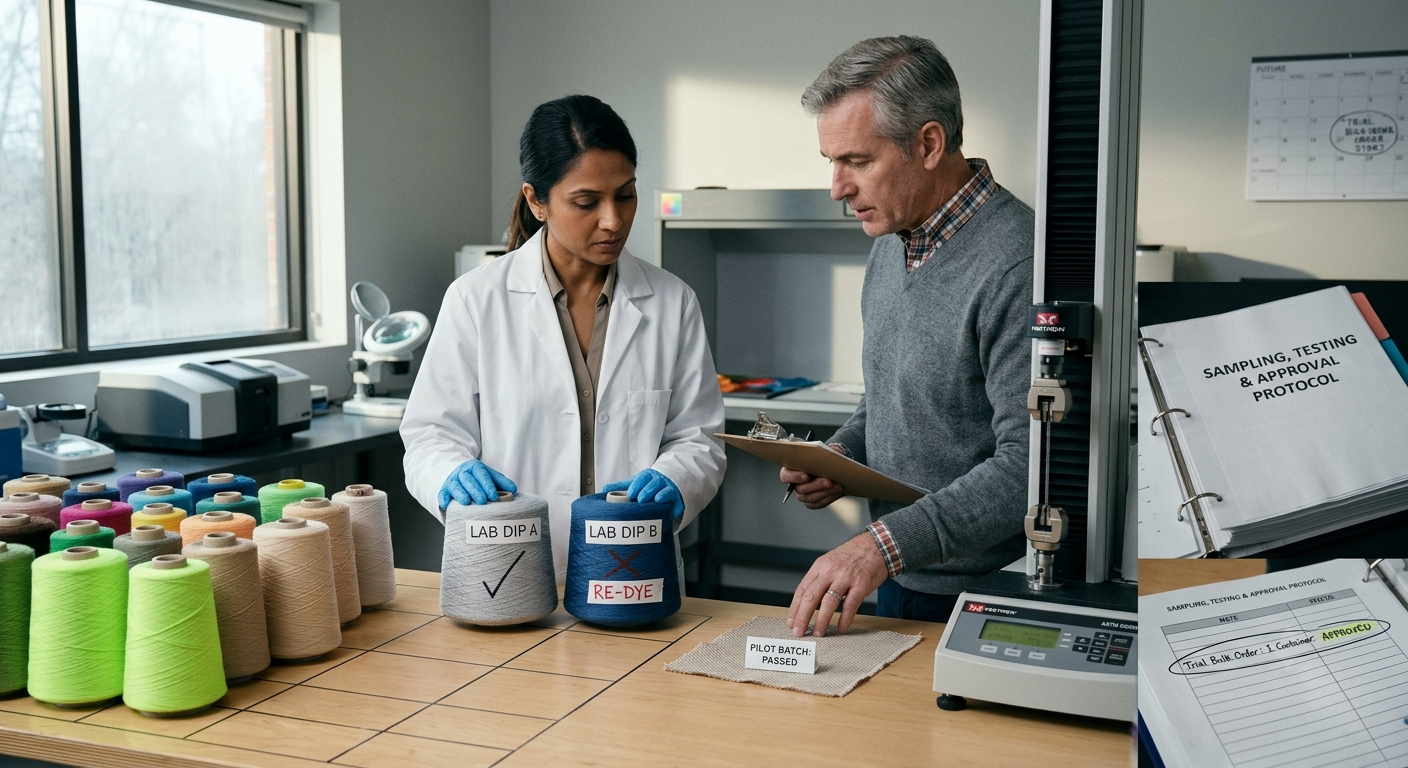
- Request lab-dip or physical yarn samples across your target denier and color range expect a 1–2 week turnaround for a supplier with in-house spinning and texturing.
- Send samples to your own lab or a third-party textile testing house (e.g., an accredited AATCC- or ASTM-method lab in North America) for independent verification of denier, tenacity, shrinkage, and evenness against the supplier’s stated spec.
- Run a small pilot fabric batch weave or knit a limited yardage to confirm the yarn behaves as expected under your specific machine settings and finishing process, not just in isolation.
- Confirm dye-uptake consistency if ordering package-dyed or cationic dyeable yarn, ideally across more than one dye lot, since shade consistency between lots is one of the more common friction points in ongoing supplier relationships.
- Only after pilot approval, place a trial bulk order sized to test the supplier’s consistency at production scale before committing to a long-term volume agreement.
Reputable suppliers expect and support this process; a supplier who resists reasonable sampling and third-party verification requests, or who only offers samples pulled from “best case” inventory rather than standard production runs, is worth treating with added caution.
Minimum Order Quantities, Packaging & Container Loading
For North American buyers new to importing yarn directly rather than through a domestic distributor, practical logistics questions matter as much as the yarn spec itself.
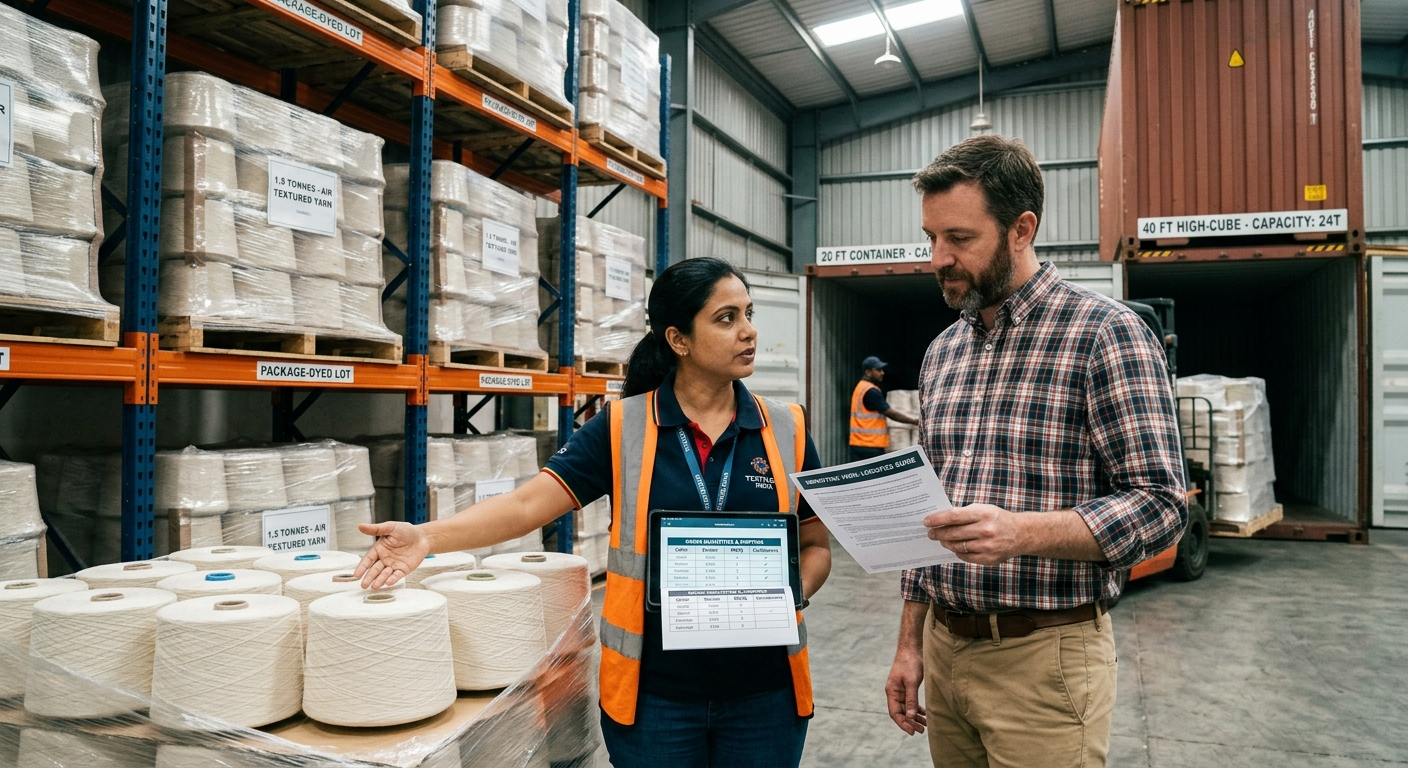
- Typical MOQs for a full-line ATY manufacturer range from roughly 1-3 tonnes per color/denier combination for an initial order, though this varies by supplier and can sometimes be lower for raw/greige undyed yarn versus package-dyed lots see our bulk yarn supplier in India page for how volume pricing typically breaks down.
- Standard packaging is yarn wound on cones, palletized and shrink-wrapped for container loading; export cartons and pallet configurations should be confirmed against your warehouse’s receiving/unloading equipment before the first shipment, particularly for buyers using a third-party logistics (3PL) warehouse with specific pallet-height restrictions.
- A 20-foot container typically holds in the range of 10–14 tonnes of wound yarn depending on denier and packaging format, while a 40-foot high-cube container roughly doubles that useful for right-sizing your first order against actual container economics rather than paying for partial-container LCL (less-than-container-load) freight rates unnecessarily.
- Ask for a packing list format sample and confirm HTS classification is pre-filled correctly on the commercial invoice (see the Logistics section above) this single document error is one of the most common causes of customs clearance delays on first-time import shipments.
Quality Assurance & Certifications to Ask For
Certifications are not a formality for North American import compliance several are now functionally required by major retailers and brand compliance teams before a PO is even issued. Here’s what to verify with any prospective ATY yarn supplier, and why each one matters:
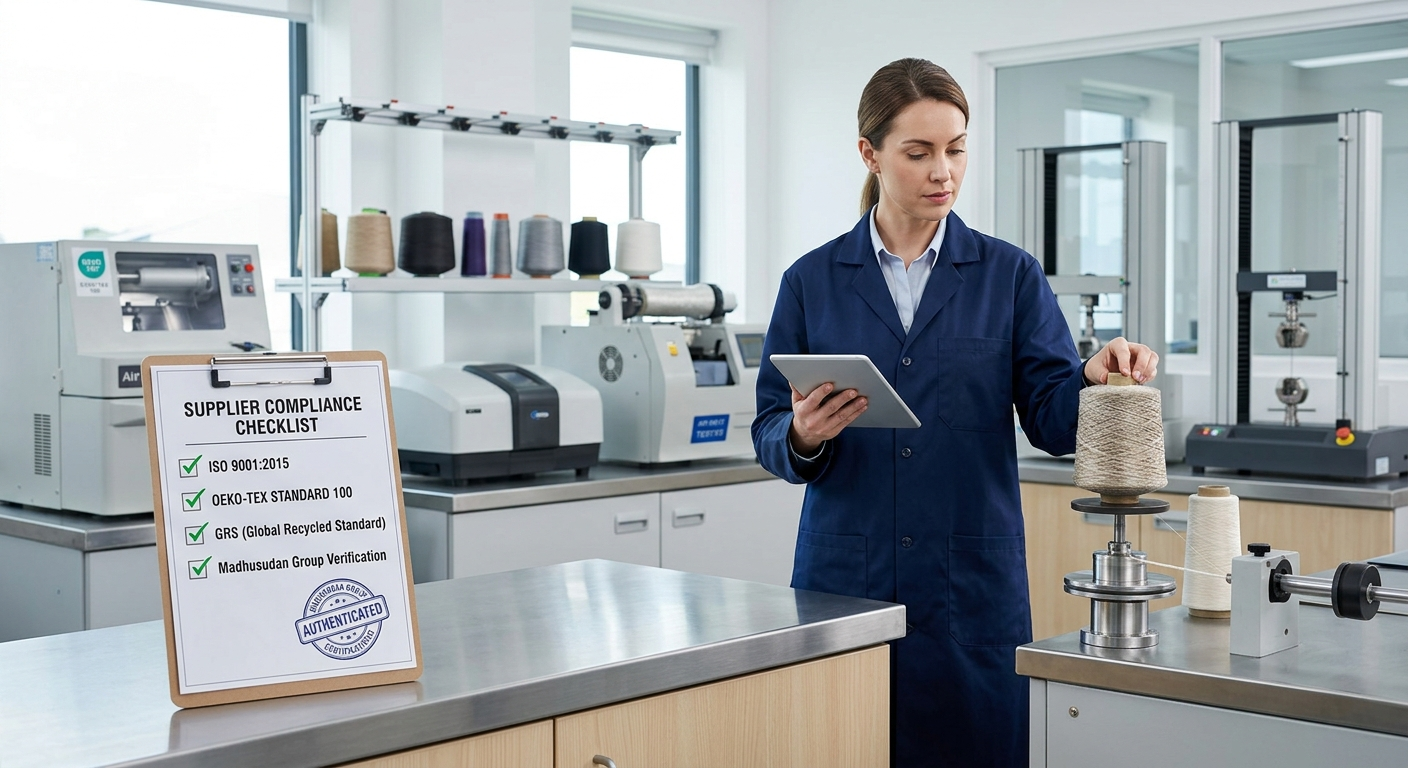
- ISO 9001 (Quality Management): confirms the supplier runs a documented, auditable quality management system rather than ad-hoc inspection. See the official ISO 9001:2015 standard for what this certification actually requires, and our own ISO certified yarn supplier page for how we document ours.
- OEKO-TEX STANDARD 100: verifies the yarn has been tested for harmful substances against a list of regulated and restricted chemicals increasingly required for home textile and apparel-adjacent imports into North America. Details on what’s tested are on the official OEKO-TEX STANDARD 100 page.
- GRS (Global Recycled Standard): required if you’re claiming any recycled content on a finished product label covered in detail in the next section.
- Madhusudan Group’s current certifications are listed in full on our certifications page we’d recommend cross-checking any supplier’s certification claims against the issuing body’s own verification/label-check tool rather than relying on a PDF certificate alone, since certificates can lapse or be misrepresented.
Sustainable & Recycled ATY Yarn (GRS Certified)
Sustainability documentation has moved from a nice-to-have to a near-mandatory requirement for North American and European brand compliance teams over the last several sourcing cycles. If your buyers or retail partners require recycled content claims, you need GRS-certified recycled ATY yarn, not just a supplier’s word that their yarn is “eco-friendly.”
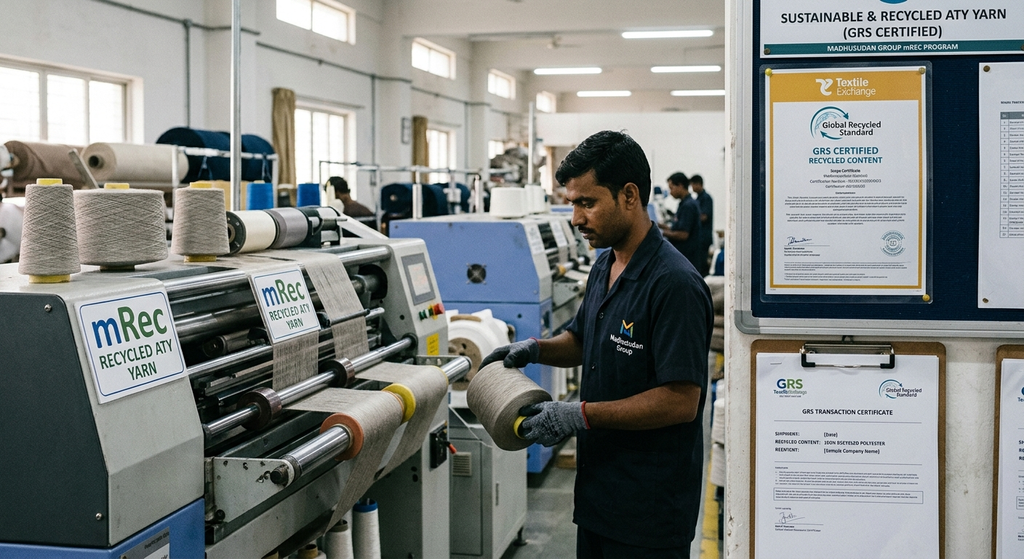
The Global Recycled Standard, owned by Textile Exchange, requires third-party certification of recycled content at every stage of the supply chain not just at the final product level along with documented social and environmental production practices. A supplier claiming “recycled polyester” without a valid GRS Transaction Certificate cannot substantiate that claim to your compliance team or, ultimately, to end consumers.
Madhusudan Group’s mRec recycled yarn program produces recycled polyester yarn, including recycled ATY, with full chain-of-custody documentation and Transaction Certificates issued per shipment the exact paperwork your compliance or customs team will ask for on a recycled-content claim.
Practical tip for North American buyers: request the Transaction Certificate as a sample document before placing your first order, not after. It should name your company (or your named buying agent) as the recipient, show the certified recycled content percentage, and be verifiable against the certifying body’s database.
How to Choose the Right ATY Yarn Supplier: A Buyer’s Checklist
Use this checklist when evaluating any ATY yarn supplier whether that’s us or any other manufacturer on your shortlist. It pairs well with our broader guides on questions to ask before buying yarn and yarn supplier vs. yarn manufacturer if you’re new to importing yarn directly. A supplier confident in their own operation should be able to answer all of these without hesitation.

- Do they spin their own feed yarn (POY), or buy it on the open market? In-house spinning means tighter control over final ATY consistency.
- What’s their monthly ATY production capacity, and what percentage is already committed to existing customers? This tells you whether they can actually absorb your growth.
- Can they provide Uster evenness data and intermingle-point specifications on request, not just a generic spec sheet?
- Which certifications do they currently hold ISO 9001, OEKO-TEX STANDARD 100, GRS and can these be verified independently against the issuing body’s database?
- Do they offer in-house package dyeing, or will you need to coordinate a separate dye house? Coordinating your own dyeing adds lead time and a second point of quality failure.
- What is their typical lead time from PO to container loading for a North America-bound shipment, and what’s their on-time performance history?
- Can they provide references from existing North American customers in a comparable end-use category?
- What Incoterms do they quote under by default (FOB, CIF, etc.), and are they experienced with US/Canada-specific import documentation?
If a supplier can’t answer two or more of these clearly, that’s a legitimate reason to keep them off your primary shortlist, regardless of how competitive their initial price quote looks.
Shipping, Logistics & Tariff Classification for North American Importers
Ports & lead times
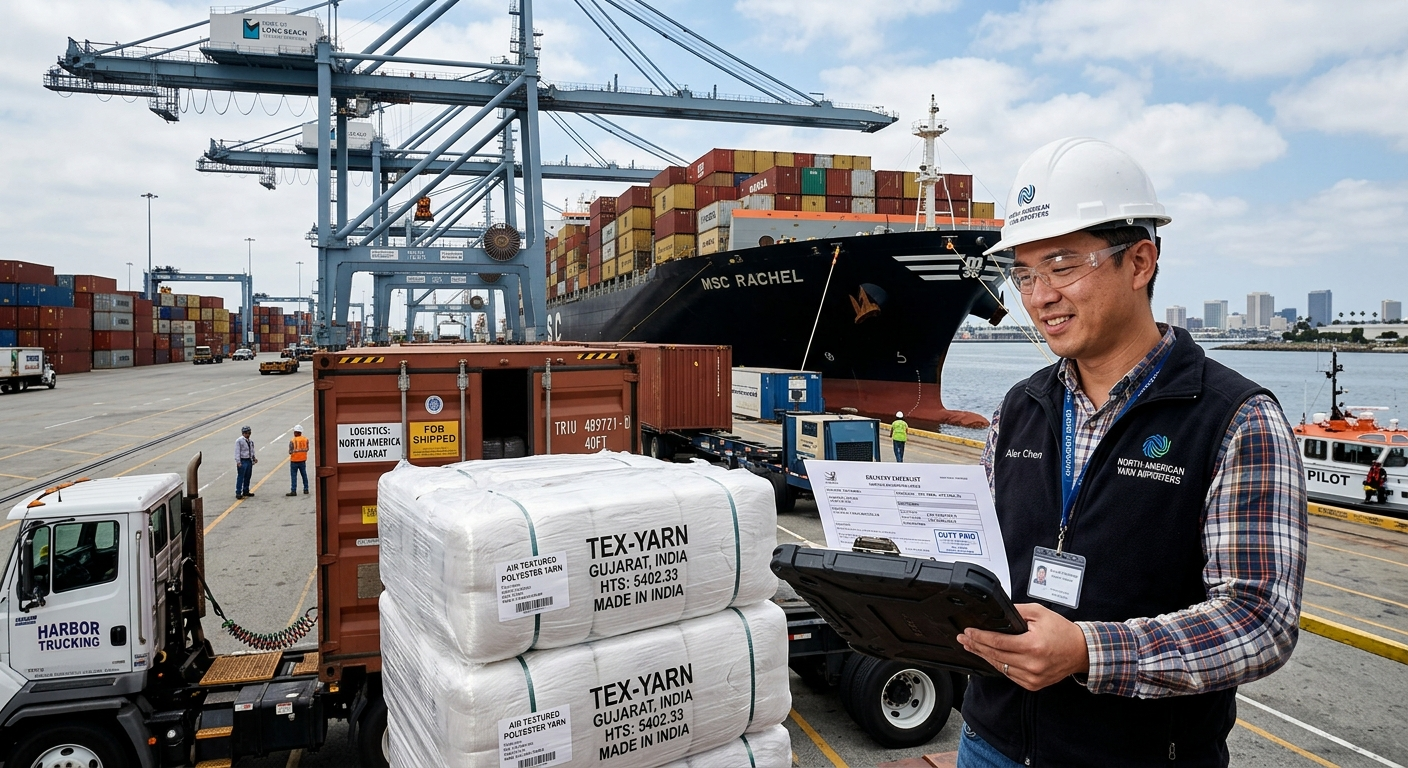
ATY yarn manufactured in Gujarat, India typically ships via Mundra or Nhava Sheva (Nhava Sheva/JNPT) port to major North American gateways Los Angeles/Long Beach and New York/New Jersey for the US, and Vancouver or Montreal for Canada. Ocean transit time generally runs 25–40 days depending on routing and transhipment, with production lead time typically adding 3-5 weeks ahead of that for a standard order. We’ve written a full step-by-step walkthrough of this process in how to import yarn from India to the USA, covering documentation, customs clearance, and what to expect on a first shipment.
Incoterms
Most Indian ATY yarn exporters quote FOB (Free on Board) by default, meaning the buyer arranges and pays ocean freight and insurance from the Indian port onward. Buyers newer to importing from India sometimes prefer CIF (Cost, Insurance, Freight) terms initially, where the supplier arranges freight to the destination port, trading a small cost premium for simpler logistics coordination on the first few orders.
Tariff classification & import duty
Air textured polyester yarn is generally classified under Harmonized System Chapter 54 (man-made filament yarn), with textured yarn specifically addressed within that chapter’s headings. Exact HTS subheading and applicable duty rate depend on the yarn’s precise composition, denier, and twist specification, and can change with trade policy updates always confirm current classification and duty rates with your customs broker or directly via the U.S. International Trade Commission’s Harmonized Tariff Schedule. We also maintain a dedicated breakdown of yarn import duty from India to the USA covering current rates, classification factors, and how they compare against other sourcing origins worth reviewing before you build landed cost into your pricing model.
A supplier experienced in North American exports should be able to provide the correct HTS classification for the specific yarn variant you’re ordering as a standard part of their commercial invoice and packing list this is worth confirming during the RFQ stage, not after the container has already shipped.
What Affects ATY Yarn Pricing
Quoted prices for ATY yarn can vary significantly between suppliers even at the same nominal denier, and understanding why helps you evaluate quotes on more than the headline number per kilogram.
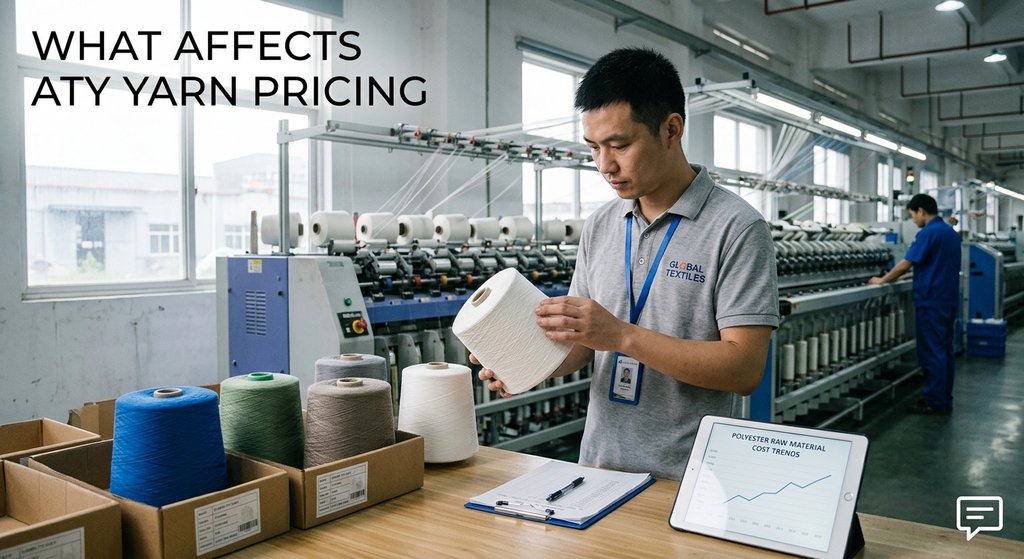
- Raw material input: virgin polyester chip prices fluctuate with crude oil and PTA/MEG feedstock markets; GRS-certified recycled input generally carries a premium over virgin material due to collection, sorting, and certification costs.
- Denier and filament count: finer deniers and higher filament counts generally cost more per kilogram due to slower production speeds and tighter process control requirements.
- Color/dyeing: raw/greige yarn is the lowest-cost option; package-dyed and cationic dyeable variants carry additional processing cost reflected in the quote.
- Order volume and packaging: smaller trial orders typically carry a per-kilogram premium over full-container volumes, reflecting fixed setup and changeover costs on the texturing line.
- Certification overhead: GRS, OEKO-TEX, and similar certifications involve real ongoing compliance and testing costs for the supplier, which is reflected reasonably in pricing versus an uncertified supplier.
A quote significantly below the general market range for a given spec is worth investigating rather than simply accepting it can indicate a supplier cutting corners on feed-yarn quality, skipping testing steps, or misrepresenting certification status, any of which becomes your problem once the container has already shipped.
Quick-Reference Glossary of ATY Yarn Terms
- ATY: Air Textured Yarn filament yarn bulked via high-velocity air jet entanglement rather than heat/twist.
- POY: Partially Oriented Yarn the semi-processed feeder yarn commonly used as input for texturing.
- Intermingle point: A location along the yarn where filaments are entangled together, holding the textured bulk in place.
- Denier / dtex: Linear density measurements describing yarn thickness (denier = weight in grams per 9,000 meters; dtex = per 10,000 meters).
- Filament count: The number of individual continuous filaments bundled together to form the yarn (e.g., 150D/48F = 150 denier, 48 filaments).
- BCF: Bulked Continuous Filament a related texturing category most associated with carpet and flooring yarns.
- Cationic dyeable polyester (CDP): A modified polyester that accepts cationic (basic) dyes for deeper, more vibrant, more colourfast shades than standard disperse-dyeable polyester.
- GRS: Global Recycled Standard third-party certification verifying recycled content and responsible production practices across the full supply chain.
- Barré: Visible striping or banding in dyed fabric caused by inconsistent yarn tension, dye uptake, or lot-to-lot variation.
- FOB / CIF: Incoterms defining which party (buyer or seller) arranges and pays for freight and insurance from the port of origin.
Frequently Asked Questions
What is the difference between ATY yarn and DTY yarn?
ATY (air textured yarn) uses high-velocity air jets to entangle filaments into a bulky, low-stretch, soft-hand yarn, typically used for home textiles and industrial fabrics. DTY (draw textured yarn) uses false-twist heat texturing to create a stretchy, elastic, crimped yarn used mainly in apparel and active wear. They are produced on different machinery and are not interchangeable for most applications.
What denier range is available for ATY yarn?
Full-line manufacturers typically offer ATY yarn from around 75D up to 1200D or heavier, across varying filament counts, to suit everything from lightweight apparel-adjacent fabrics to heavy industrial and upholstery applications.
Is ATY yarn available with GRS-certified recycled content?
Yes. GRS-certified recycled ATY yarn is manufactured from certified recycled polyester (commonly post-consumer PET) and carries a Transaction Certificate documenting the certified recycled content percentage and chain of custody, which is required for any recycled-content labelling claim on a finished product sold in North America or the EU.
Can ATY yarn be dyed, or does it need to be piece-dyed after weaving/knitting?
Both options are available. ATY yarn can be supplied raw/greige for downstream piece-dyeing after fabric formation, or package-dyed before shipment if the buyer needs pre-colored yarn for yarn-dyed fabric constructions. Cationic dyeable ATY variants are also available for brands needing deep, vibrant, colorfast shades.
What’s a realistic lead time for a first ATY yarn order from India to the US or Canada?
Plan for roughly 3–5 weeks of production lead time plus 25-40 days of ocean transit, depending on the destination port and routing. First orders often run slightly longer while documentation and quality-approval processes are established between buyer and supplier.
What certifications should I require from an ATY yarn supplier?
At minimum, ISO 9001 for quality management, and OEKO-TEX STANDARD 100 if the yarn will be used in any product with skin contact. If you need recycled-content claims, GRS certification with per-shipment Transaction Certificates is required not optional to substantiate that claim to retailers or end consumers.
Does ATY yarn work for both woven and knitted fabric constructions?
Yes, though it’s more commonly used in woven home textile and industrial fabric constructions where bulk and cover matter more than stretch. For knitted apparel fabrics requiring stretch and recovery, DTY yarn is typically the better specification.
How do I verify a supplier’s certification claims before placing an order?
Request the certificate number and check it directly against the issuing body’s own verification tool OEKO-TEX has a public Label Check tool, and GRS certificates can be verified through the certifying body listed on the Transaction Certificate. Don’t rely on a PDF certificate alone, since certifications can lapse between issue date and your order date.
What’s a typical minimum order quantity for ATY yarn from an Indian manufacturer?
MOQs commonly range from roughly 1-3 tonnes per color/denier combination for a full-line manufacturer, though this varies by supplier and is often lower for undyed, raw/greige yarn than for package-dyed lots that require a dedicated dye batch.
Should I choose FOB or CIF terms for a first order?
Many first-time importers from India prefer CIF terms initially, where the supplier arranges freight and insurance to the destination port, trading a small cost premium for simpler logistics coordination. Once your team has an established freight-forwarder relationship, FOB terms typically offer more control and cost savings on subsequent orders.
Ready to Source ATY Yarn from a Manufacturer That Can Prove Its Numbers?
ATY yarn sourcing decisions are easy to get wrong on price alone and expensive to get wrong on quality. Madhusudan Group manufactures ATY yarn at 750+ tonnes/month across 21 dedicated texturing lines, with in-house POY spinning, yarn dyeing, and GRS-certified recycled options through our mRec program backed by an existing export track record into North America. Request our technical datasheet, current certifications, and a formal quote by contacting our export team or explore our full yarn manufacturing and dyeing capabilities if you’re evaluating us as a broader multi-product supplier rather than a single-SKU source.