If your sourcing team in Brazil, Argentina, Chile, Colombia, or Peru has been asked to add certified recycled content to a product line, you’ve probably already discovered the gap between what’s easy to say and what’s hard to prove. “Recycled polyester” is not a self-certifying claim it’s a specific, auditable standard, and the recycled polyester yarn manufacturer you choose either has the documentation to back that claim through customs and into your retailer’s compliance file, or they don’t.
This guide is written specifically for South American buyers evaluating recycled polyester yarn suppliers: what GRS certification actually requires, how the manufacturing process works, who’s already supplying this market (including competitors already manufacturing locally in Brazil and Colombia), what to watch for as greenwashing, and the practical logistics ports, Incoterms, and Mercosur tariff classification of bringing yarn in from India.
Madhusudan Group manufactures GRS-certified recycled polyester yarn under its mRec program, alongside a broader recycled polyester yarn manufacturing base and in-house dyeing. Where useful below, we’ve used our own documentation process as a working example of what to ask any recycled polyester supplier for not just us.
What Is Recycled Polyester Yarn?
Recycled polyester yarn often shortened to rPET yarn is filament or spun yarn made from polyethylene terephthalate (PET) that has already been used once, rather than newly synthesized from virgin petrochemical feedstock. Two distinct recycling routes exist, and the difference matters more than most buyers realize when it comes to what can actually be certified and claimed.
Mechanical recycling
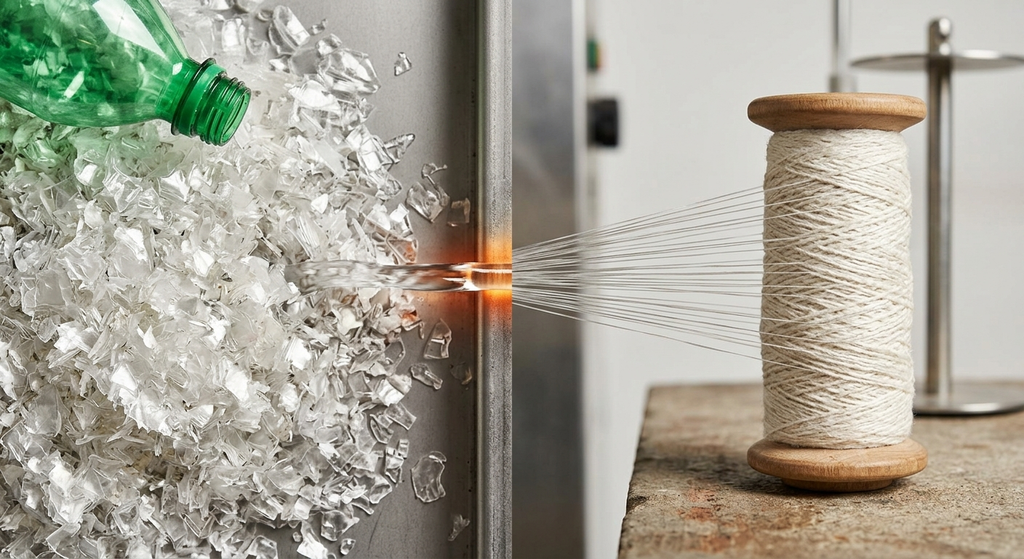
Post-consumer PET bottles (or post-industrial polyester waste) are collected, sorted by color and polymer type, washed, shredded into flake, and melted down to be re-extruded directly into new polyester filament. This is the dominant, most cost-effective route and the one most GRS-certified yarn on the market today is made through. It’s mechanically simpler but places some limits on final yarn quality if the input material isn’t well sorted — which is exactly why traceability documentation matters so much, covered later in this guide.
Chemical recycling
PET waste is broken down to its monomer building blocks and re-polymerized from scratch, producing polyester chip that is chemically indistinguishable from virgin material. This route can handle lower-quality or mixed-color input waste and produces higher and more consistent quality output, but at meaningfully higher cost and lower current global capacity. Most commercially available recycled polyester yarn today including the bulk of what’s shipping into South America is mechanically recycled.
Both routes can be GRS-certified, but the certificate should specify which recycling method and input source (post-consumer vs. post-industrial) were used, since brand compliance teams increasingly ask for this level of detail rather than accepting “recycled” as a single undifferentiated claim.
GRS Certification Explained: What South American Buyers Must Verify
The Global Recycled Standard (GRS), owned by Textile Exchange, is the certification that actually matters here not a marketing badge, but a chain-of-custody standard requiring third-party verification at every stage from waste collection through to the finished yarn. Two thresholds matter in practice: GRS requires a minimum of 20% certified recycled content to certify a product at all, and 50% certified recycled content before that product can carry an on-label recycled claim to the end consumer.
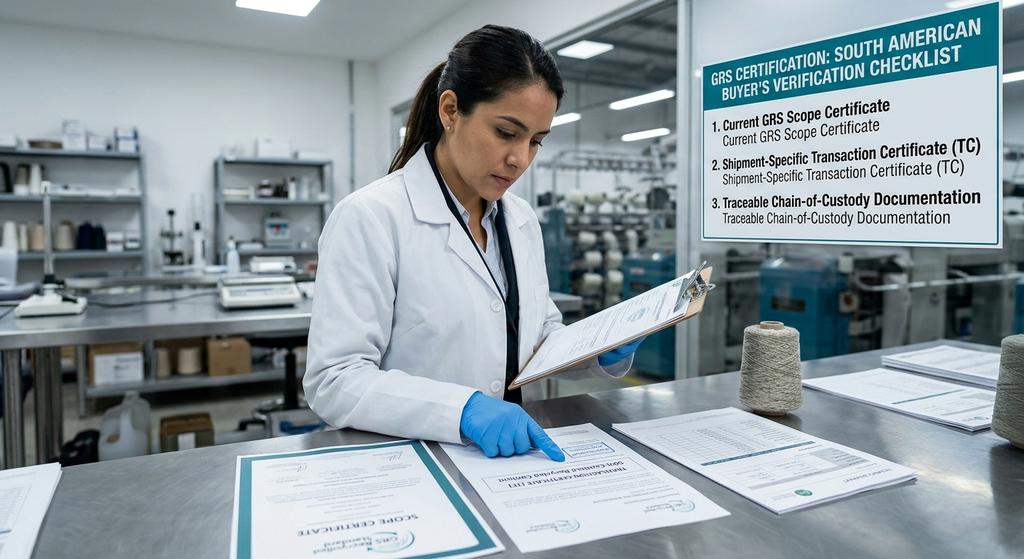
For a South American buyer, this translates into three concrete things to request from any supplier before placing an order.
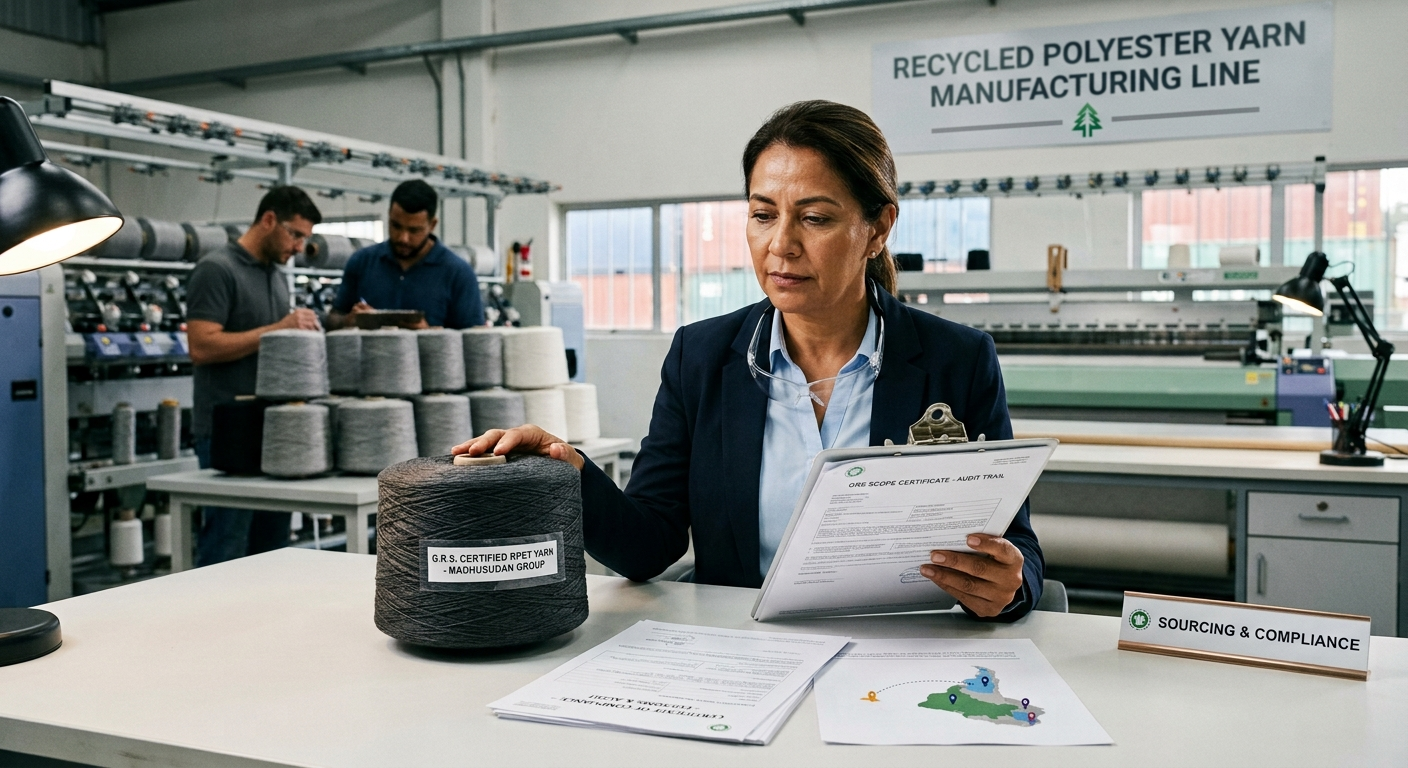
- The supplier’s current GRS Scope Certificate, showing certification is active (not lapsed) and covers the specific facility producing your yarn not just a group-level certificate covering a different plant.
- A Transaction Certificate (TC) issued per shipment, naming your company (or your authorized buying agent) as the recipient and stating the exact certified recycled content percentage for that specific lot.
- Chain-of-custody documentation tracing the recycled input back through the supply chain GRS requires this at every processing stage, not just a single point-of-origin claim.
It’s worth understanding what GRS certification does not cover, since buyers sometimes assume broader guarantees than the standard actually provides. GRS verifies recycled content and chain of custody, plus baseline social and environmental production criteria at the certified facility it does not certify the finished garment’s durability, the brand’s overall carbon footprint, or claims made anywhere outside the certified supply chain scope. A supplier’s GRS certificate is necessary evidence for a recycled-content claim, but it isn’t, by itself, a complete sustainability audit of everything downstream.
Certificates can be verified independently rather than taken on faith Textile Exchange affiliated certifying bodies maintain searchable databases of active certificates. Madhusudan Group’s current certifications, including GRS, are listed on our certifications page and our ISO certified yarn supplier page covers our quality management certification separately, since GRS and ISO 9001 verify different things and buyers sometimes conflate the two.
The South American Sustainable Textile Market: Why Recycled Polyester Demand Is Rising
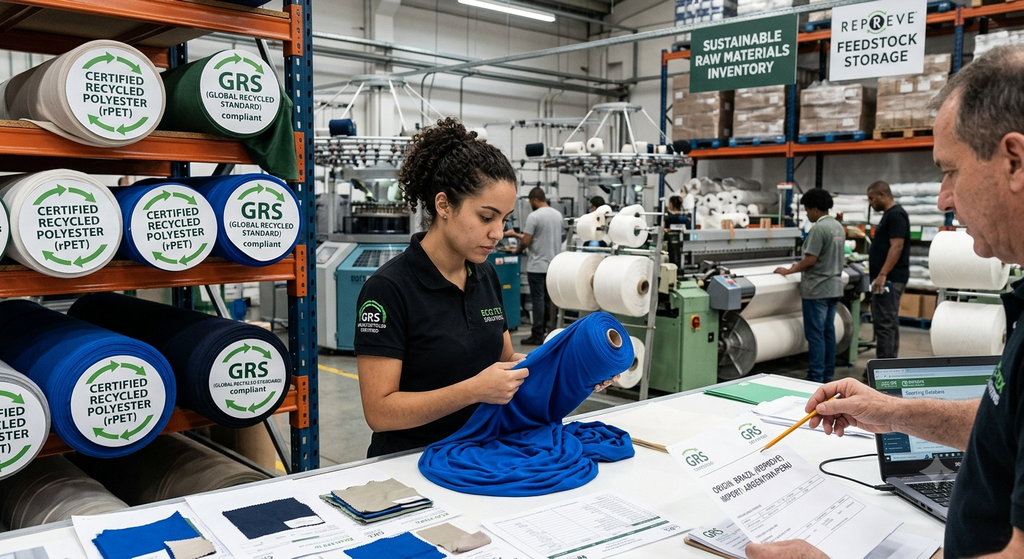
Demand for certified recycled polyester across South America has shifted in the last several sourcing cycles from a niche capsule-collection story to a baseline procurement requirement for major retailers, driven by three overlapping forces.
Brazil
Brazil is the region’s largest and most advanced market for this shift. National industrial policy (Brazil’s PNDI framework) and circular-economy initiatives now actively incentivize sustainable manufacturing, and certifications including GRS, GOTS, OEKO-TEX, and ZDHC have moved from differentiator to baseline vendor requirement for a growing share of Brazilian retailers and apparel brands. Our own perspective on this shift is covered in the future of sustainable textiles and revolutionizing circular sustainable textile manufacturing.
Argentina, Chile, Colombia & Peru
These markets are earlier in the same curve, with demand concentrated among brands exporting to North America and Europe (where recycled-content requirements are already effectively mandatory for certain retail partners) and a smaller but growing domestic sustainability-conscious segment. Buyers in these markets are frequently the ones bridging South American manufacturing into export-compliant supply chains, which makes GRS documentation even more non-negotiable the paperwork needs to survive scrutiny in a second country, not just the first.
Country-by-country snapshot
- Brazil: largest and most mature market; GRS/OEKO-TEX/ZDHC increasingly baseline for major retailers; strong domestic circular-economy policy push.
- Argentina: demand concentrated among export-oriented apparel manufacturers supplying North American and European brands with recycled-content requirements already built into their contracts.
- Chile: smaller domestic market but well-connected via San Antonio/Valparaíso ports, with textile importers often serving as a regional distribution point into neighboring Andean markets.
- Colombia: a genuine manufacturing hub in its own right (and, notably, home to one of Unifi’s REPREVE production plants), meaning Colombian buyers already sit close to both local and imported recycled supply options.
- Peru: apparel export sector (particularly to the US) drives much of the recycled-content demand, with Callao serving as the primary import gateway.
An important honest note on where recycled content currently comes from
A meaningful share of the sustainable fabric supply chain serving Brazil today is Chinese-exported material, much of it already GRS or GOTS certified Chinese suppliers have been aggressive and early movers into this specific market. Indian recycled polyester suppliers are comparatively underrepresented in South America relative to their presence in North American and European sustainability sourcing, which is as much an opportunity as it is a gap worth being direct about when you’re evaluating your options.
How Recycled Polyester Yarn Is Manufactured: Bottle to Yarn
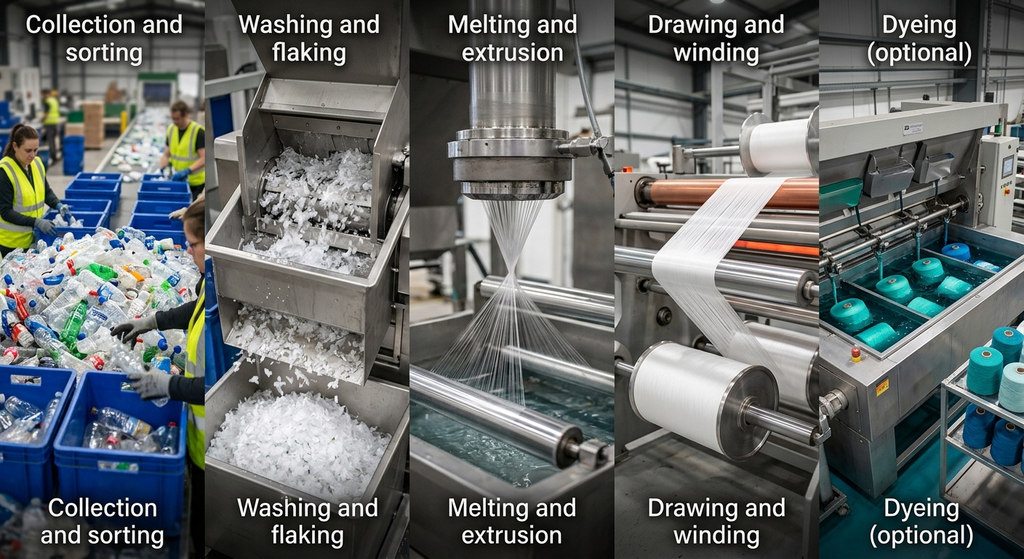
Step 1: Collection and sorting
Post-consumer PET bottles are collected, sorted by color (clear vs. colored bottles produce different yarn colorability outcomes) and by polymer type to remove contamination from PVC, other plastics, and non-PET components. This sorting stage is where input quality is most determined poorly sorted flake carries contamination through every subsequent step, which is exactly why chain-of-custody documentation on the input material matters as much as documentation on the finished yarn.
Step 2: Washing and flaking
Bottles are washed to remove labels, adhesive residue, and caps, then mechanically shredded into small PET flake the raw material input stage where quality control most directly determines the final yarn’s consistency.
Step 3: Melting and extrusion
Clean flake is melted and extruded through spinnerets into continuous polyester filament, using essentially the same extrusion technology as virgin polyester production, with process adjustments to manage the slightly greater variability of recycled input material.
Step 4: Drawing, texturing, and winding
The extruded filament is drawn to align its molecular structure for strength, then depending on end use either left as flat filament, draw-textured (DTY), or air-textured (ATY) using the same texturing processes used for virgin polyester. See our yarn manufacturing process guide for how these downstream steps work in more technical detail.
Step 5: Dyeing (if required)
Recycled polyester yarn can be supplied raw/greige for downstream piece-dyeing or package-dyed before shipment. Our dyed polyester yarn guide and our separate guide on reducing water waste in yarn dyeing cover how dyeing efficiency compounds the sustainability case for buyers who want the whole supply chain not just the fiber input to hold up under scrutiny.
Recycled Polyester Yarn: Specifications & Types Available
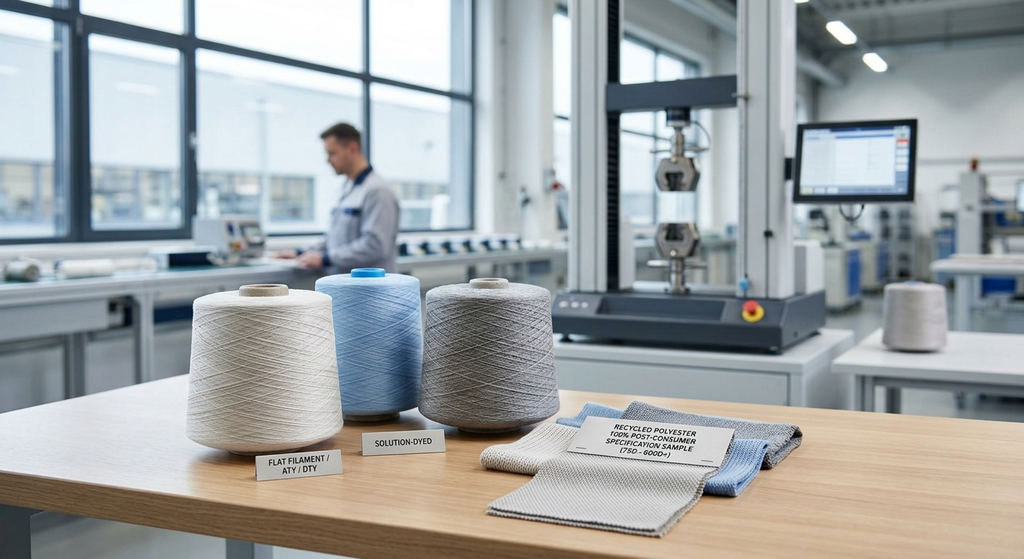
- Denier range: typically 75D to 600D+ for filament yarn, with spun recycled polyester also available in standard count ranges for blending with cotton or viscose
- Yarn form: flat filament, DTY (draw textured), or ATY (air textured), matching the same range available in virgin polyester
- Recycled content: commonly available from 30% blended up to 100% certified recycled content, depending on end-use performance requirements
- Color format: raw/greige, solution-dyed (color added during extrusion, using less water than piece-dyeing), or package-dyed
- Cationic dyeable recycled variants are also available for brands needing deep, vibrant shades see our broader polyester yarn manufacturing range for the full specification set beyond recycled-specific options.
If a supplier’s recycled polyester range only covers one or two deniers or a narrow recycled-content band, that’s often a signal of limited processing flexibility rather than a deliberate specialization worth clarifying directly before assuming it will scale with your product range as it grows.
Applications of Recycled Polyester Yarn Across Industries
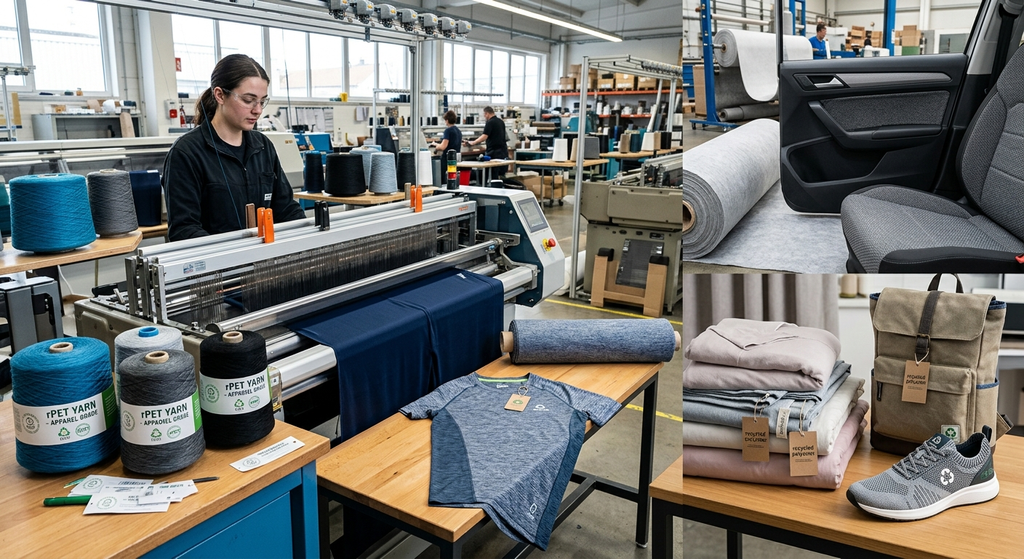
Apparel & Fashion
T-shirts, activewear, denim blends, and fashion basics are the highest-volume application, driven directly by brand sustainability commitments and, increasingly, retailer-mandated minimum recycled-content percentages on core product lines. Fast-fashion and mid-market retailers across Brazil and Argentina in particular have been shifting baseline product lines not just capsule collections to recycled blends as certified supply has become more consistently available.
Home Textiles
Bedding, curtains, and upholstery fabric use recycled polyester often in ATY or textured form for bulk and softness as a lower-carbon-footprint alternative that performs identically to virgin polyester in finished fabric. This category tends to specify heavier deniers (300D and up) for good fabric cover and drape.
Industrial & Technical Textiles
Geotextiles, automotive interior fabrics, and filtration media increasingly specify recycled content both for sustainability credentials and, in some cases, genuine performance parity at lower cost. See our industrial yarn supplier page for the broader technical yarn range this sits within.
Footwear & Accessories
Recycled polyester yarn is widely used in shoe uppers, laces, straps, and bag linings, an application space where the sustainability story is often the primary purchasing driver for the brand’s marketing, not just an internal compliance checkbox.
Nonwovens & Automotive Interiors
Recycled polyester staple fiber and yarn increasingly appear in automotive interior fabrics, carpet backing, and nonwoven insulation, categories where major automakers have published their own recycled-content targets and are pushing those requirements down through their fabric and yarn supply chains.
Competitive Landscape: Who’s Already Supplying Recycled Polyester Yarn to South America
An honest sourcing decision starts with knowing who else is already in this market, not just comparing quotes in isolation.
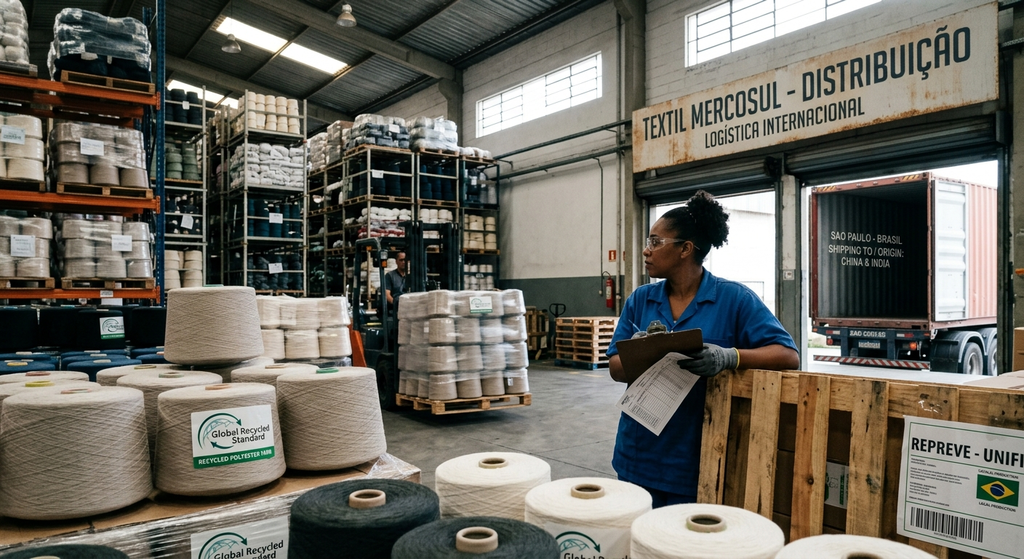
Unifi (REPREVE) manufacturing already inside the region
Unifi, the US-based maker of REPREVE recycled polyester, operates production facilities directly in Alfenas, Brazil and Bogotá, Colombia, in addition to its US plants. This matters: a locally-manufactured recycled polyester supplier inside Mercosur has meaningfully shorter lead times and no ocean freight or import duty exposure for South American buyers, which is a genuine structural advantage for time-sensitive or smaller-volume orders.
Chinese exporters currently the dominant external supply
A large share of GRS and GOTS-certified sustainable fabric and yarn currently entering Brazil specifically is sourced from Chinese exporters, several of whom are also actively targeting North America and Europe from the same production base meaning Brazilian buyers are often competing for the same supplier capacity as buyers in other regions.
Where Indian manufacturers fit
Indian recycled polyester yarn manufacturers are comparatively underrepresented in South America today relative to their established position in North American and European sustainable sourcing see our story on how Indian yarn is powering global fashion brands for that broader context. That gap is exactly why this is worth evaluating directly rather than defaulting to whichever supplier your company has always used: India offers GRS-certified capacity, full-line manufacturing depth, and English-language business communication, generally at a cost position competitive with China, even after freight from India but with longer transit times than either Unifi’s local Brazilian/Colombian plants or air/short-sea options some Chinese suppliers can offer via Panama Canal routing.
None of this means India is automatically the right choice it means the honest comparison is a locally-manufactured option (shorter lead time, no import duty), a Chinese option (currently the largest external supplier, similar transit distance), and an Indian option (competitive certification depth and cost, moderate transit time) and which wins depends on your volume, lead-time tolerance, and how much you value supplier diversification away from a single-country dependency.
Sampling & Quality Verification Before a Bulk Order
Never place a first bulk container order on a spec sheet and certificate alone this applies especially to recycled material, where input consistency has historically been a bigger variable than with virgin polyester.
- Request physical yarn samples across your target denier, color, and recycled-content-percentage range expect roughly 1–2 weeks turnaround from a supplier with in-house spinning and texturing.
- Send samples to an independent textile testing lab for verification of tenacity, shrinkage, and evenness against the supplier’s stated spec don’t rely solely on the supplier’s own internal test data.
- Request the GRS Transaction Certificate for the specific sample batch, not a generic reference certificate, so you can confirm the documentation process works as described before committing to volume.
- Run a small pilot fabric batch to confirm the recycled yarn behaves as expected under your specific weaving, knitting, or dyeing process recycled and virgin polyester can behave slightly differently under some finishing conditions.
- Only after pilot approval, place a trial bulk order sized to test the supplier’s consistency and documentation reliability at production scale before entering a long-term volume agreement.
A supplier who resists reasonable sampling and independent verification requests or who can only provide samples from unusually favorable production runs rather than standard output is worth treating with added caution, regardless of how strong their certificates look on paper.
Minimum Order Quantities & Container Loading for South America
Typical MOQs for GRS-certified recycled polyester yarn from a full-line manufacturer run similar to virgin polyester roughly 1-3 tonnes per color/denier/recycled-content combination for an initial order, though this can vary by supplier. See our bulk yarn supplier in India page for how volume pricing typically breaks down.
- Standard packaging is yarn wound on cones, palletized and shrink-wrapped for container loading confirm pallet configurations against your receiving warehouse’s equipment before a first shipment, particularly given the longer transit and correspondingly higher cost of a shipment damaged or rejected on arrival.
- Given the longer transit times into South America compared to North America or Europe, right-sizing your first order to a full or near-full container is worth prioritizing over a smaller trial shipment paying LCL (less-than-container-load) freight rates.
- Confirm the GRS Transaction Certificate and correct NCM/HS classification are both included as standard parts of the commercial invoice and packing list before the container is booked, not after it has already sailed.
Madhusudan Group’s mRec Program: GRS-Certified Recycled Yarn Capability
Madhusudan Group manufactures GRS-certified recycled polyester yarn under the mRec brand, backed by integrated POY spinning, texturing, and in-house yarn dyeing at facilities in Surat, Gujarat, with an existing export footprint into 18+ countries.
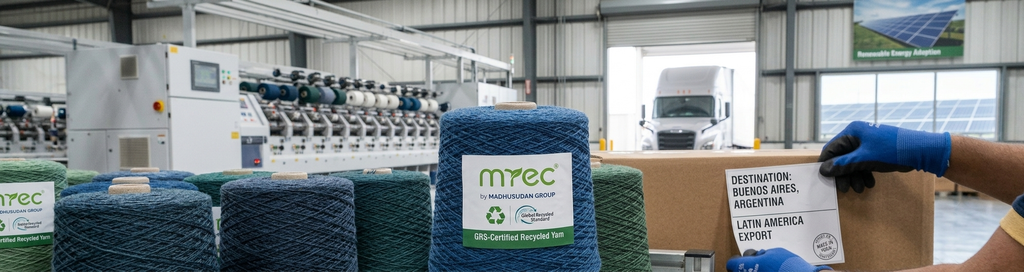
What this means for a South American buyer
- Certified GRS chain-of-custody documentation issued per shipment, verifiable independently rather than taken on trust see our certifications page for the current scope
- Access to our integrated yarn manufacturing and dyeing operations so recycled yarn, dyeing, and texturing can be coordinated under one supplier relationship
- Export documentation experience built across 18+ export markets, including existing shipments into Latin America
- A broader sustainability program beyond fiber input alone including renewable energy adoption in manufacturing and government-aligned sustainability certification initiatives which matters increasingly to brand compliance teams asking about Scope 3 emissions, not just recycled content percentages
As with any supplier claim, we’d encourage verifying this directly request our current GRS scope certificate, a sample Transaction Certificate, and reference customers in a comparable end-use category before committing to a first order.
Carbon Footprint & Scope 3 Reporting: Why Recycled Content Alone Isn’t the Whole Story
Brand compliance teams have shifted, in the last few sourcing cycles, from asking only “is this recycled?” to asking for the fuller picture: how much energy did production take, where did that energy come from, and how does the supplier’s operation factor into the brand’s own Scope 3 (supply chain) emissions reporting.

- Mechanically recycled polyester generally requires meaningfully less energy to produce than virgin polyester, since it skips the initial petrochemical synthesis stage entirely a genuine, quantifiable sustainability benefit worth having your supplier document rather than assert.
- A manufacturer’s broader energy sourcing matters to see our note on the textile industry’s transition to renewable energy for how this factors into the total footprint of a shipment, not just the fiber input itself.
- Water usage in dyeing is a second major lever our guide on reducing water waste in yarn dyeing covers this in detail, and it’s a fair question to ask any supplier directly rather than assume.
If your buyer or retail partner requires Scope 3 supply chain emissions data as part of onboarding, ask upfront whether your prospective supplier can provide it in a format compatible with your reporting framework this is increasingly a differentiator between suppliers who treat sustainability as a checkbox and those who treat it as an operating discipline.
Common Red Flags: Recognizing Greenwashing in Recycled Polyester Claims
Because “recycled” has real commercial value right now, it also attracts claims that don’t hold up under scrutiny. Watch for these specific patterns when evaluating any supplier, not just ones you’re unfamiliar with:

- “Eco-friendly” or “sustainable” with no certificate number. These are marketing words, not verifiable claims. Ask for the GRS certificate number and check it against the issuing body’s database yourself.
- A group-level certificate covering a different facility than the one producing your order. GRS certification is scope-specific — a valid certificate at one factory doesn’t automatically cover yarn made at a sister facility.
- Recycled content percentage stated on a spec sheet but absent from the Transaction Certificate. The number that matters legally is the one on the per-shipment TC, not marketing collateral.
- Blended recycled content below 20% marketed without qualification. Below GRS’s certification threshold, the honest claim is “contains some recycled content,” not an implied GRS-equivalent claim.
- A certificate that has lapsed since a previous order. GRS certification requires annual recertification audits — a supplier’s status can change between your last order and this one.
None of this is meant to create suspicion of every supplier most reputable manufacturers welcome this level of scrutiny, because it’s exactly what protects them from being undercut by suppliers making claims they can’t back up.
Language & Communication: A Practical Note for South American Buyers
One underrated factor in cross-border sourcing relationships is communication reliability during technical back-and-forth spec confirmations, certificate requests, and quality dispute resolution all go smoother when there’s no translation layer introducing ambiguity. Most established Indian export teams conduct business in English as standard practice, which removes one common friction point compared to sourcing from manufacturing hubs where English-language technical support is less consistent.
That said, if your team operates primarily in Portuguese (Brazil) or Spanish (the rest of the region), it’s reasonable to ask upfront whether a supplier can provide bilingual documentation for certificates and commercial paperwork some can accommodate this on request even without a dedicated local sales presence, and it’s worth confirming before, not after, your first order is in transit.
Buyer’s Checklist: Vetting a Recycled Polyester Yarn Supplier
This pairs well with our broader guides on questions to ask before buying yarn and yarn supplier vs. yarn manufacturer if you’re new to importing recycled fiber directly rather than through a regional distributor.
- Request the current GRS Scope Certificate naming the specific producing facility, and verify it independently against the certifying body’s database.
- Ask whether recycling is mechanical or chemical, and whether the input is post-consumer or post-industrial waste both affect what claims you can make downstream.
- Request a sample Transaction Certificate format before ordering, confirming it will name your company (or buying agent) and state the exact certified percentage per shipment.
- Confirm ISO 9001 or equivalent quality management certification, separate from the sustainability certification one verifies process consistency, the other verifies material claims.
- Ask for lab test data on the recycled yarn’s physical properties (tenacity, shrinkage, dye uptake) rather than assuming performance parity with virgin polyester.
- Confirm production capacity and how much is already committed to existing customers, particularly if you’re planning to scale volume over time.
- Request references from existing Latin American or comparable-market customers if you’re a first-time buyer from this supplier.
Shipping, Ports & Tariff Classification for South American Importers
Ports and routing
Yarn shipped from India to South America typically routes via transhipment (commonly through Colombo, Salalah, or Singapore) before crossing to the region’s major container gateways: the Port of Santos in Brazil (the continent’s largest container port), Buenos Aires in Argentina, Callao in Peru, Cartagena or Buenaventura in Colombia, and San Antonio/Valparaíso in Chile. Total transit time generally runs longer than India-to-North America routes commonly 35–50 days depending on transshipment routing on top of the 3-5 week production lead time typical for a standard order, so first-time buyers should plan initial order cycles accordingly.
Incoterms
Most Indian yarn exporters quote FOB by default. For a first order into an unfamiliar port, buyers newer to importing directly sometimes prefer CIF terms, letting the supplier arrange freight and insurance to the destination port in exchange for a modest cost premium a reasonable trade for logistics simplicity while a supplier relationship is still being established.
Mercosur tariff classification
Brazil, Argentina, Paraguay, and Uruguay operate under the Mercosur Common External Tariff (CET/AEC), using the Nomenclatura Común do Mercosul (NCM) an eight-digit extension of the standard Harmonized System used for customs classification across the bloc. Recycled polyester yarn is generally classified under HS Chapter 54 (man-made filament yarn) in the same headings as virgin polyester, though exact NCM subheading and duty rate depend on the yarn’s specific form, denier, and whether it’s filament or spun. Chile, Colombia, and Peru are not Mercosur members and apply their own national tariff schedules rather than the CET, so classification and duty rates should be confirmed separately for each destination country rather than assumed to be uniform across South America.
Import duties and customs valuation methods vary meaningfully by country even within Mercosur Brazil, for instance, layers several additional federal taxes onto the CIF-based import duty during customs clearance, a structure outlined in this representative country commercial guide. Always confirm current rates with a customs broker licensed in your specific destination country rather than assuming figures transfer across borders within the region.
A supplier experienced in Latin American exports should be able to provide correct HS/NCM classification as a standard part of their commercial invoice and packing list worth confirming at the RFQ stage.
Pricing: Recycled vs. Virgin Polyester Yarn
- Recycled polyester input (PET flake) pricing tracks post-consumer bottle collection and processing costs, which can be more volatile than virgin PTA/MEG feedstock pricing in some periods and more stable in others it isn’t simply “always cheaper” or “always more expensive” than virgin material.
- GRS certification carries genuine ongoing compliance costs (annual audits, chain-of-custody documentation, testing) that are reasonably reflected in supplier pricing versus an uncertified alternative.
- Higher recycled-content percentages (approaching 100%) can carry a modest premium over blended options, reflecting tighter sourcing and processing requirements for consistent input quality.
- Freight from India adds real landed cost that a locally-manufactured option (like Unifi’s Brazilian or Colombian plants) doesn’t carry factor total landed cost, not just ex-works or FOB price, into any comparison.
- A quote significantly below the general market range for genuinely GRS-certified material is worth investigating rather than accepting at face value see the green washing red flags above.
- Bundle pricing across recycled and virgin polyester with the same manufacturer can sometimes reduce total landed cost if you’re running a mixed product line, since shared production infrastructure and consolidated shipping reduce per-unit logistics overhead compared to sourcing each separately from different suppliers.
Quick-Reference Glossary
- rPET: Recycled polyethylene terephthalate the polymer base for recycled polyester yarn.
- GRS: Global Recycled Standard third-party certification of recycled content and chain of custody, owned by Textile Exchange.
- Transaction Certificate (TC): A per-shipment document naming the buyer and stating the certified recycled content percentage for that specific lot.
- Mechanical recycling: Washing, shredding, and re-melting PET waste directly into new polyester without breaking it down to monomers.
- Chemical recycling: Breaking PET waste down to monomer level and re-polymerizing it, producing output chemically equivalent to virgin polyester.
- NCM (Nomenclatura Común do Mercosul): The Mercosur bloc’s eight-digit customs classification system, extending the standard Harmonized System.
- CET/AEC: Mercosur’s Common External Tariff, applied uniformly (with national exceptions) to imports from outside the bloc.
- Post-consumer vs. post-industrial waste: Post-consumer waste comes from used products (e.g., discarded bottles); post-industrial waste comes from manufacturing offcuts and production scrap.
Frequently Asked Questions
What percentage of recycled content is required for a GRS claim?
GRS certification applies starting at 20% certified recycled content, but a product needs at least 50% certified recycled content before it can carry an on-label recycled claim visible to end consumers.
Is recycled polyester yarn the same quality as virgin polyester?
Well-manufactured recycled polyester yarn from a quality-controlled mechanical recycling process performs very similarly to virgin polyester in most applications. Chemically recycled polyester is essentially indistinguishable from virgin material. Quality variance is more a function of the individual manufacturer’s process control than an inherent limitation of recycled material.
Can I import recycled polyester yarn directly from India to Brazil?
Yes. Recycled polyester yarn is classified under the same HS Chapter 54 headings as virgin polyester for customs purposes, and Brazil accepts direct imports from India subject to Mercosur’s NCM classification and standard customs clearance procedures. A customs broker can confirm the exact duty rate for your specific yarn specification.
Are Chile, Colombia, and Peru part of the same tariff system as Brazil and Argentina?
No. Chile, Colombia, and Peru are not Mercosur members and apply their own national tariff schedules rather than the Mercosur Common External Tariff. Duty rates and classification should be confirmed separately for each destination country.
What’s the difference between GRS and GOTS certification?
GRS (Global Recycled Standard) certifies recycled content and chain of custody across any recycled material, including synthetics like recycled polyester. GOTS (Global Organic Textile Standard) certifies organic natural fibers and doesn’t apply to recycled synthetic materials the two are not interchangeable and buyers sometimes conflate them.
How do I verify a supplier’s GRS certificate is genuinely valid?
Request the certificate number and the name of the certifying body, then check it against that certifying body’s public verification database rather than accepting a PDF certificate alone. Confirm the certificate covers the specific producing facility and hasn’t lapsed since a previous order.
Is it faster to buy recycled polyester yarn from a local South American manufacturer instead of importing from India?
For time-sensitive or smaller-volume orders, yes manufacturers with plants already inside the region, such as Unifi’s facilities in Brazil and Colombia, avoid ocean freight transit time and import duty entirely. Importing from India makes more sense for buyers prioritizing certification depth, manufacturing capacity, and cost competitiveness at larger volumes, where the longer lead time can be planned around.
What lead time should I plan for a first recycled polyester yarn order from India to South America?
Plan for roughly 3-5 weeks of production lead time plus 35-50 days of ocean transit depending on transhipment routing to your specific destination port longer than typical India-to-North America transit times, so build this into your first order’s planning calendar with some buffer.
Does recycled polyester yarn require different dyeing conditions than virgin polyester?
Generally, well-processed recycled polyester dyes similarly to virgin polyester using the same disperse or cationic dye classes. Minor process adjustments are sometimes needed depending on the specific recycling route and input consistency, which is exactly why requesting dye-uptake test data during sampling matters more than assuming parity.
Can recycled polyester yarn be blended with cotton or viscose?
Yes. Recycled polyester spun yarn blends with cotton, viscose, and other natural or man-made fibers using standard blending ratios, in the same way virgin polyester blends are produced a common approach for brands wanting a recycled-content story on a natural-hand fabric.
Ready to Source GRS-Certified Recycled Polyester Yarn for South America?
Recycled polyester sourcing decisions carry real compliance weight the difference between a defensible claim and a liability sitting in your product file. Madhusudan Group manufactures GRS-certified recycled polyester yarn through our mRec program, backed by integrated spinning, texturing, and dyeing capability, with export experience across 18+ countries.
Request our current GRS scope certificate, a sample Transaction Certificate, and a formal quote by contacting our export team or download our brochures for the full mRec specification range, and explore our broader yarn manufacturing and dyeing capabilities if you’re evaluating us as a multi-product supplier rather than a single-SKU source.