Yarn dyeing Peru is no longer a side topic for a few knitters in Lima. It sits at the centre of how Peruvian mills win, and keep, orders from global brands. Colour is the first thing a buyer sees and the first thing a buyer rejects. A shade that drifts between lots, bleeds in the wash or fades under the Andean sun can cancel a whole season’s programme.
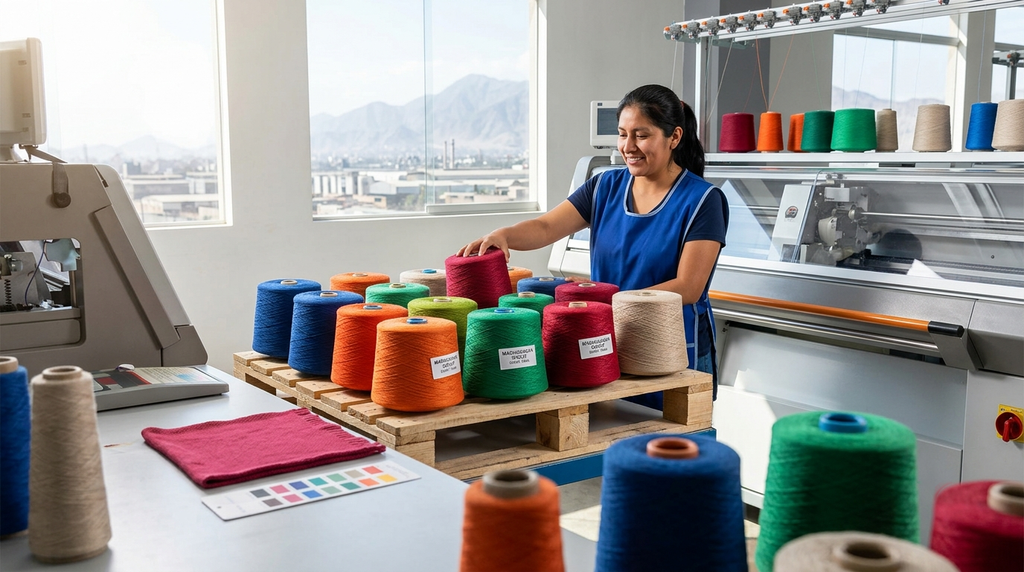
Peru’s textile and garment sector is a serious exporter. According to Mincetur figures reported by Caretas, the sector shipped US$1,736 million in 2025, up 6% on the year, with 1,721 exporting companies, of which 1,426 were micro, small and medium enterprises. That structure matters for yarn buyers. Many Peruvian producers are small and mid-sized, so they need dyed yarn partners who can supply consistent colour in modest lot sizes, on predictable lead times, without a heavy minimum order burden.
This is where Madhusudan Group comes in, Based in Surat, India’s textile and yarn hub, Madhusudan Group is a leading dyed yarn manufacturer serving mills across continents. We dye and supply polyester, viscose, linen, nylon and blended yarns to knitters, weavers, elastic and tape makers, and we have built our reputation on shade accuracy, repeatability and export discipline.
This guide is written for Peruvian spinners, knitters, weavers, garment exporters and procurement heads. It explains:
- how the Peruvian textile market shapes demand for dyed yarn
- which yarn types and dyeing methods fit which end uses
- the quality standards and test methods that decide whether a lot is accepted
- how to import dyed yarn from India into Peru, including duties, logistics and timelines
- what to ask any supplier before you place an order
If you only have a minute, here is the short version. The best yarn dyeing partner for a Peruvian mill is one that matches the dye class to the fibre, controls the process with instruments rather than by eye, proves fastness with ISO test reports, documents chemical compliance, and ships on schedule to Callao. The rest of this article shows you how to check each of those points.
Peru’s Textile Market: Why Dyed Yarn Demand Keeps Growing
To understand yarn dyeing in Peru, start with where the demand comes from. Peru is a mid-sized but well-regarded textile exporter. According to figures cited by Andina in June 2026, garment exports reached US$1,220 million in 2025 and textile exports reached US$515 million. In textile exports alone, Peru ranks 48th in the world and fourth in Latin America and the Caribbean.
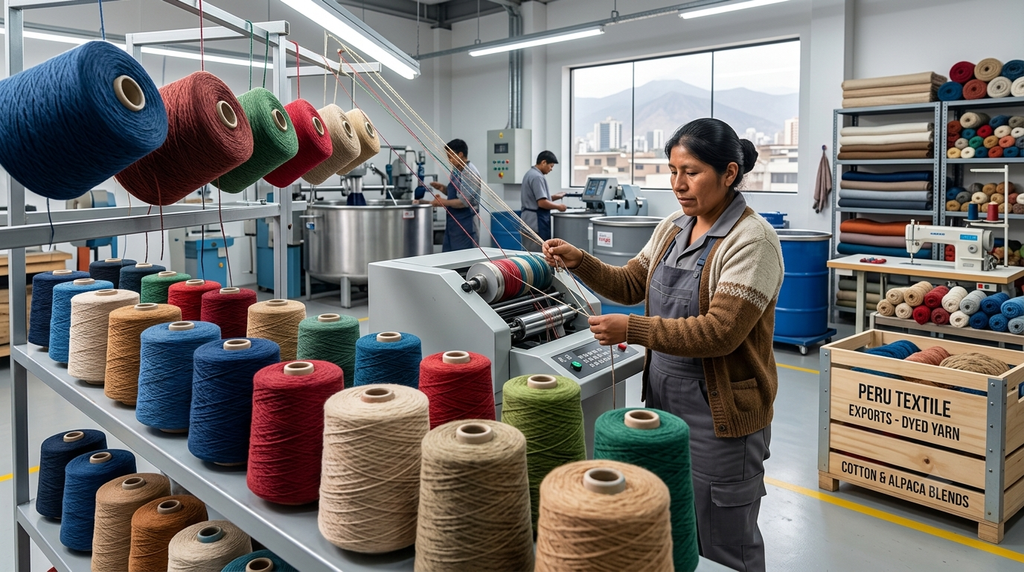
Within textile exports, fibres made up 32.1% of value, fabrics 25.1% and yarns 21.7%. On a US$515 million base, that puts yarn exports at roughly US$110 million a year. Yarn is therefore a real product category in Peru, not a footnote, and colour is a major part of what makes it saleable.
A sector in transition
The picture is not uniformly easy. The same Andina report notes that garment exports fell 7.6% in January to April 2026 compared with the same period in 2025, attributed to the tariff policy adopted by the United States. The ADEX industry panorama published in June 2026 puts garment exports for those four months at US$370.4 million. When a main market tightens, Peruvian exporters look for two things: lower input cost and wider market access. Both lead back to smart yarn sourcing.
Regional markets are part of the answer. PROMPERÚ reported that textile and garment shipments to Chile reached US$77.87 million in 2025, up 6.15%, and that it brought 50 Peruvian companies to meet 167 international buyers at Perú Moda LATAM Chile in August 2026. Regional buyers in Chile, Ecuador, Colombia and Bolivia expect fast turnaround and dependable colour, which favours mills that hold dyed yarn stock or buy from partners who can ship quickly.
Lima’s Gamarra and the long tail of small producers
Peru’s domestic market is shaped by the Gamarra emporium in Lima. A national statistics study reported by Andina counted 31,987 businesses there, 94.4% of them micro enterprises, with sales of S/6.618 billion (about US$2.04 billion) in 2016. Thousands of small workshops buy yarn, fabric and trims in small quantities and change designs often. They need colour choice, short lead times and low minimums.
What this means for dyed yarn buyers
Three demand patterns follow from the market structure:
- Export programmes need documented compliance and shade consistency across lots.
- Regional and domestic programmes need quick replenishment and flexible quantities.
- Fibre mix is wide: Peruvian mills work with cotton and alpaca at home and import synthetic and cellulosic yarns to fill gaps in sportswear, stretch fabrics, trims and home textiles.
That last point creates the opening for an experienced Indian partner. Our guide to polyester yarn dyeing for South America explains how we plan colour, packing and shipping for buyers across the continent, and the same approach applies to Peru.
Why Yarn Dyeing Matters for Peruvian Manufacturers
Most people think of dyeing as a finishing step. In reality, the stage at which you add colour changes cost, design freedom, lead time and risk. Yarn dyeing, meaning colour is applied to the yarn before it is knitted or woven, gives Peruvian manufacturers four clear advantages.
1. Design range that piece dyeing cannot match
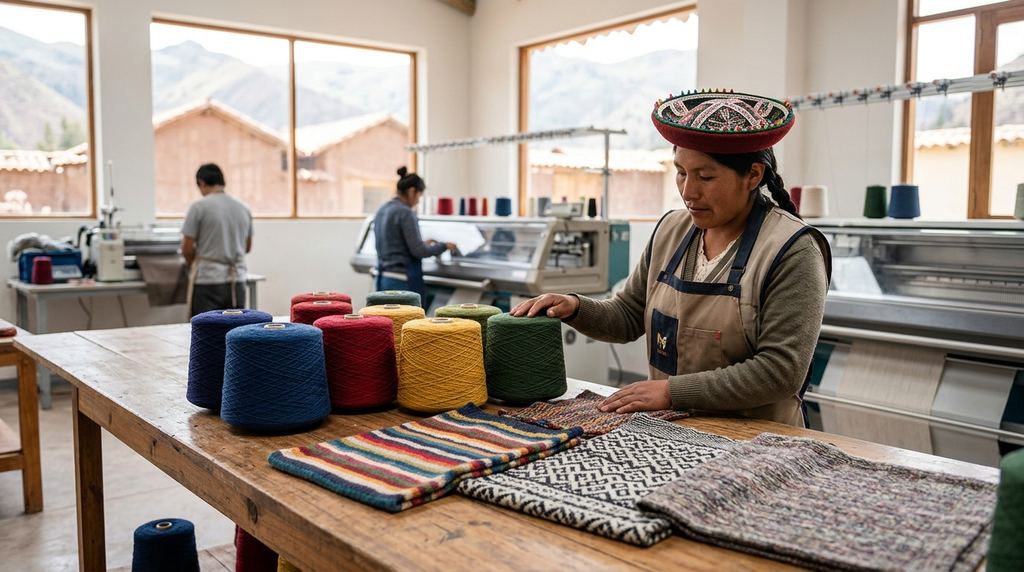
Stripes, checks, jacquards, heathers, marl effects and multi-colour knit structures all depend on dyed yarn. If a Peruvian knitwear brand wants an engineered stripe or a two-tone rib, the colours have to exist as yarn first. Dyed yarn also gives deeper, more even colour penetration through the yarn body than dyeing a finished fabric surface.
2. Better colour consistency inside a lot
When a whole lot of yarn is dyed in one controlled process, every cone in the lot starts from the same shade. A mill can then knit hundreds of kilograms of fabric without the panel-to-panel variation that causes garment rejects. Consistency matters most for sets such as sports jerseys, uniforms and school wear, where mismatched panels are obvious.
3. Faster, lower-risk production cycles
Buying dyed yarn moves the dyeing risk upstream. The mill receives a tested, shade-approved input, then spends its own time on knitting, weaving and finishing. This is valuable for small and mid-sized Peruvian producers who do not want to invest in effluent treatment and dye house capacity. Environmental compliance in wet processing is expensive, and outsourcing it to a specialist with proper systems is often the more economical route.
4. A stronger sustainability story
Global brands increasingly ask suppliers to prove chemical control and traceability from yarn upward. A mill that sources from a dyer with documented chemical management has an easier conversation with buyers than one that cannot show where its colour came from. We cover this in detail in the quality and compliance section below.
Where dyeing sits in the yarn journey
Colour is applied after the yarn is made, so the quality of the base yarn decides the quality of the dyed result. Uneven twist, mixed denier or inconsistent fibre lots will show up as streaks no matter how good the dye house is. If you want to see how raw material becomes finished yarn before it reaches the dye house, read our yarn manufacturing process guide. It explains why a dye house that also controls yarn production, as Madhusudan Group does, can trace a shade problem back to its source far faster than a pure job-dyer.
The cost of getting dyeing wrong
A rejected lot is expensive in several ways: the yarn itself, the knitting time lost, freight both ways and the missed delivery window. Peruvian exporters working to a retailer’s calendar rarely have room to re-dye and re-ship. Choosing a dyeing partner is therefore a risk-management decision as much as a price decision, and the cheapest quote is rarely the cheapest outcome.
Yarn Types We Dye for Peruvian Mills
No single dye works on every fibre. The chemistry has to match the fibre, which is why a dyer who handles several yarn families under one roof is more useful to a mill than a one-fibre specialist. The table below summarises the main yarn types Madhusudan Group dyes and how each is normally coloured.
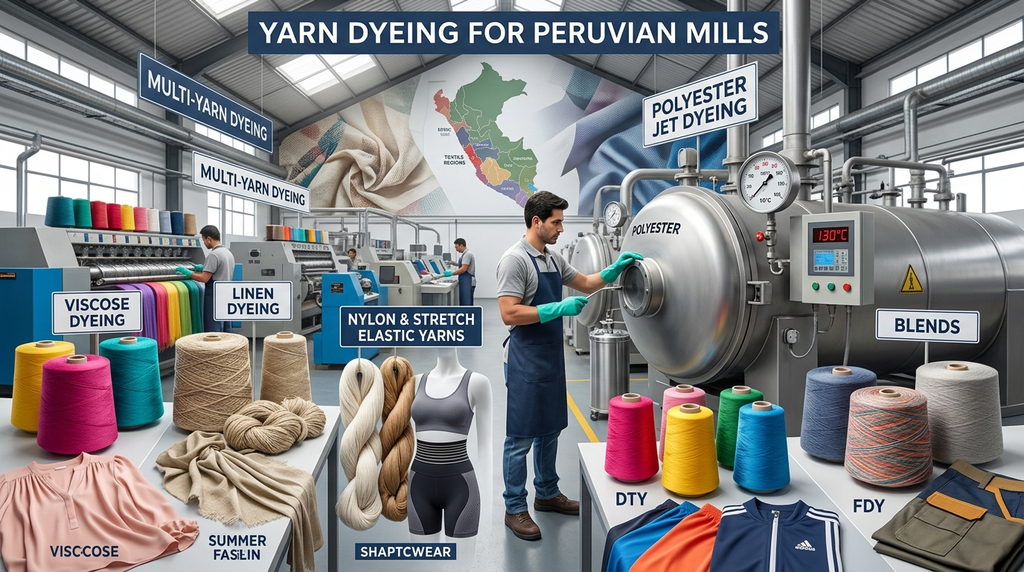
| Yarn type | Typical dye class | Common end uses in Peru | Key point |
| Polyester (DTY, FDY, ATY, spun) | Disperse dyes, high-temperature | Sportswear, knit fabrics, uniforms, home textiles | Needs high heat and careful clearing for good wash fastness |
| Viscose | Reactive or direct dyes | Fashion knits, blouses, soft-touch fabrics | Bright shades, sensitive to wet strength loss |
| Linen | Reactive or vat dyes | Summer wear, home linen, blends | Natural variation needs careful shade matching |
| Nylon (DTY) | Acid dyes | Hosiery, activewear, seamless garments | Strong colour depth, good stretch recovery |
| Elastic and stretch yarns | Disperse or acid, by construction | Waistbands, tapes, shapewear | Heat control protects elasticity |
| Blends | Two-stage or one-bath routes | Mixed-fibre knits and wovens | Each fibre needs its own dye class |
Polyester yarn dyeing
Polyester is the workhorse of modern textiles and the most requested dyed yarn in our export book. It is hydrophobic, so dyes must be forced into the fibre with disperse dyes at high temperature and pressure, typically around 130°C in pressurised machines. A reduction clearing step then removes surface dye so the shade survives washing. Our polyester yarn dyeing guide walks through each stage, including shade control and common faults such as barre and dye spots.
For Peruvian sportswear and uniform makers, polyester is attractive because it is durable, quick-drying and priced well against cotton. It also pairs well with stretch yarns for performance fabrics.
Viscose yarn dyeing
Viscose is a cellulosic fibre that takes dye readily and shows bright, saturated shades. It is also weaker when wet, so the dye house has to control tension, temperature and handling more closely than with polyester. Mills in Peru that want a soft drape for blouses, dresses or knit tops often choose dyed viscose. Read more in our guide to viscose yarn dyeing.
Linen yarn dyeing
Linen is prized for its dry hand and natural slub, but its uneven fibre makes shade matching harder. Good linen dyeing needs patient lab dip work and well-prepared yarn so that colour takes evenly. If you plan linen or linen-blend programmes for the warm-weather and home textile markets, our article on linen yarn dyeing explains the process and the pitfalls.
Nylon and stretch yarns
Nylon is dyed with acid dyes and is a favourite for activewear and seamless knitwear. Stretch and elastic yarns need gentle heat profiles so the elastomer keeps its recovery. Peruvian makers of waistbands, tapes and shapewear should ask any dyer how they protect elasticity during dyeing, not only how they match colour.
Blends
Blended yarns, such as polyester-viscose or polyester-cotton, are common in uniforms and workwear. They need either a two-stage dyeing route or a carefully balanced single bath, because each fibre accepts a different dye. Blends are where an experienced dye house earns its keep, since a poorly controlled blend produces a shimmering, uneven shade that no finishing can fix.
How Yarn Dyeing Works: Methods and Process Control
Buyers in Peru often ask whether to choose package dyeing, hank dyeing or dope dyeing. The right answer depends on fibre, order size, hand feel and end use. Here is how the main methods compare.
Package dyeing
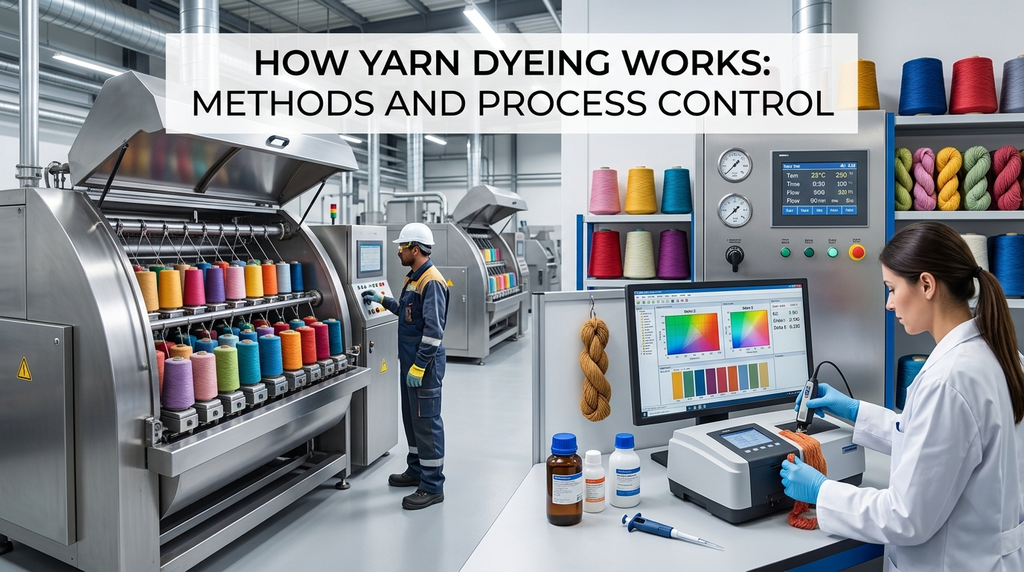
In package dyeing, yarn is wound onto perforated cones or springs, loaded onto carriers and placed in a pressurised dye machine. Hot dye liquor is pumped through the packages in a controlled cycle. It is the dominant method for polyester and for large lots of filament yarn because it delivers uniform shade, high throughput and good repeatability. Package dyed yarn goes straight to knitting or weaving machines on cones, which saves rewinding.
Hank dyeing
Hank dyeing loosens the yarn into open skeins so dye reaches every fibre with little compression. It gives a soft, bulky hand and suits high-bulk and specialty yarns, but it is slower, uses more labour and needs rewinding afterwards. We cover bulky constructions in our high-bulk yarn guide.
Dope dyeing (solution dyeing)
With dope dyeing, colour is added to the polymer melt before the filament is extruded, so the pigment is locked inside the fibre. Fastness to light and washing is excellent, and water use is far lower than in conventional dyeing. The trade-off is range and flexibility: you commit to a colour at the spinning stage, so it suits high-volume basics rather than fast-changing fashion palettes.
The controlled process behind a good shade
Whatever the method, a reliable dye house follows the same disciplined sequence:
- Yarn inspection and preparation. Incoming yarn is checked for denier, twist and oil content, then scoured or prepared so it takes dye evenly.
- Lab dip and recipe. The target shade, often given as a Pantone reference or a physical swatch, is matched in the lab. A recipe is fixed in dye, chemical and auxiliary weights.
- Instrumental colour approval. A spectrophotometer measures the dyed sample against the standard and records the colour difference, usually as a Delta E value, so approval is a number and not an opinion.
- Production dyeing. The approved recipe is scaled to the machine with set temperature, time, pH and flow parameters.
- After-treatment. Reduction clearing for polyester, soaping and fixing for cellulosics, then softening where required.
- Drying and winding. Yarn is dried evenly, and rewound if needed, to a defined tension and package density.
- Final inspection and testing. Shade, fastness and physical properties are checked before packing.
Why process control beats machine age
A new machine does not guarantee a good shade. What matters is whether the dye house logs every batch, repeats recipes exactly and tests every lot. Repeatability is the single most important property for a Peruvian mill that will reorder the same colour months later. Ask any supplier how they store recipes and how they hold the colour standard between orders.
Learning from other markets
Dyeing programmes differ by region, but the discipline is the same. Our experience dyeing for mills in other emerging textile markets, described in our piece on yarn dyeing in Sri Lanka, shows how shade planning, lot sizing and packaging adapt to local needs without lowering the quality bar.
Quality, Colour Fastness and Compliance: What Peruvian Buyers Should Demand
Colour that looks right on the cone is only the start. What counts is how it behaves in the wash, under light, against skin and in the hands of a retailer’s testing lab. A serious yarn dyeing partner should be able to show you evidence on each of the points below.
Colour fastness test methods
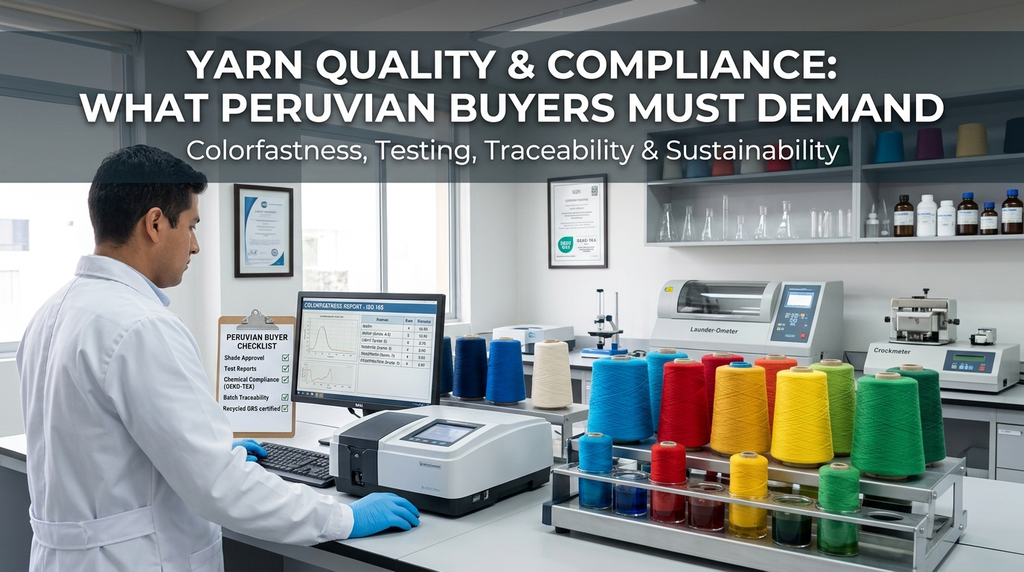
The international benchmark for fastness testing is the ISO 105 series. ISO 105-A01 sets out the general principles of colour fastness testing, and the wider series covers individual tests for washing, light, perspiration and rubbing. Fastness is graded on a scale where higher numbers mean better performance, so a buyer can compare lots numerically.
| Property | What it measures | Why it matters in Peru |
| Wash fastness | Colour change and staining of adjacent fabric after laundering | Everyday garments, uniforms, school wear |
| Light fastness | Fading under artificial daylight | Strong high-altitude and coastal sunlight; outdoor and home textiles |
| Rubbing (crocking) | Colour transferred by dry and wet rubbing | Dark shades, jeans-style knits, upholstery |
| Perspiration fastness | Colour change from acid and alkaline sweat | Sportswear and activewear |
Ask for a test report with grades for each property and the specific method used. A claim of “good fastness” with no numbers is not a specification.
Chemical safety and restricted substances
Many buyers now screen products against restricted substance lists. OEKO-TEX STANDARD 100 is among the best known: it tests textiles from yarn to finished product against a list of more than 1,000 harmful substances, with limit values reviewed at least once a year. Buyers who plan to certify a finished garment benefit from sourcing yarn that is already tested, because certified components make the final certification easier.
At the process level, the ZDHC Manufacturing Restricted Substances List sets out chemical substances banned from intentional use in the processing of textile materials. A dye house that selects dyes and auxiliaries aligned with ZDHC thinking is better placed to satisfy global brand requirements and to avoid wastewater problems.
Management systems and traceability
Certified quality management is not a guarantee of a good shade, but it signals that processes are documented, calibrated and audited. Our overview of what to expect from an ISO certified yarn supplier explains which documents to request and how to read them.
Recycled and sustainable dyed yarn
Recycled polyester is growing quickly as brands set recycled-content targets. The Global Recycled Standard, owned by Textile Exchange, tracks recycled materials through the supply chain and addresses traceability, environmental principles, social requirements and chemical restrictions. If your Peruvian customers ask for recycled content, you need a supplier who can document it. See our page on a recycled polyester yarn manufacturer for South America for how we approach dyed recycled yarn.
A practical quality checklist
- Shade approval by spectrophotometer, with the Delta E tolerance written into the order
- Fastness test report for wash, light, rubbing and perspiration
- Batch and lot numbers on every carton for traceability
- Retained sample from each lot kept by the supplier
- Chemical compliance statement that matches your buyer’s restricted substance list
Importing Dyed Yarn from India to Peru: Trade, Duties and Logistics
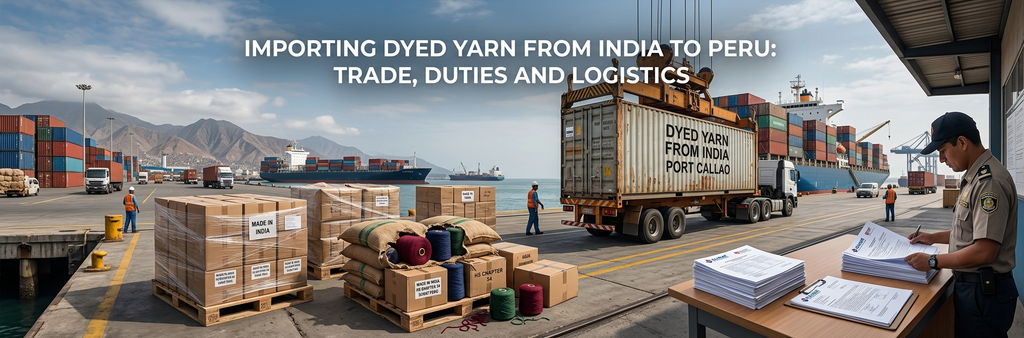
Sourcing dyed yarn from India is practical for Peruvian buyers when you plan the paperwork, duty and shipping in advance. This section covers what to know.
The trade relationship
India and Peru are building closer commercial ties. Data compiled by the Asia-Pacific Observatory shows Peruvian imports from India rising from US$934.6 million in 2015 to US$1.1 billion in 2024. Negotiations on a free trade agreement began in 2017. According to Swarajya in September 2026, the talks have entered their final phase and Lima is targeting 2027 for signing, with bilateral trade at US$10 billion in 2025-26. Until an agreement is signed and in force, buyers should assume standard most-favoured-nation duty treatment and check current rates before pricing.
Customs, duty and tax
Peru’s customs and tax authority is SUNAT, and it is the source of record for tariff classification, current ad valorem rates and import procedures. Yarns fall under HS chapter 54 (man-made filaments) or chapter 55 (man-made staple fibres), and classification depends on fibre, construction and whether the yarn is put up for retail sale. A wrong code can change the duty and delay clearance, so confirm it with your customs broker before the order is placed. Import sales tax (IGV) is also charged on the CIF value plus duty, so build it into your landed cost model.
Typical shipping route and timeline
Most sea freight from Indian ports such as Mundra or Nhava Sheva to Callao involves transshipment. As an indicative range, plan on five to seven weeks of transit from loading to arrival, plus production time and customs clearance. Always confirm the current schedule with your freight forwarder, because routings and congestion change.
Documents to prepare
- Commercial invoice and packing list with accurate HS codes
- Bill of lading or airway bill
- Certificate of origin
- Fastness and quality test reports for each lot
- Any chemical compliance or certification documents your buyer requires
Choosing Incoterms
Most first-time importers prefer CIF Callao, because the supplier arranges freight and insurance and the price is easy to compare. Experienced buyers with their own forwarder may choose FOB for control over freight cost. Whichever you choose, write the Incoterm, port and shipping window into the purchase order.
Lessons from neighbouring markets
The steps above mirror what we explain for other South American buyers. Our guide on how to import yarn from India to Brazil covers documentation, duty planning and common delays in a market with its own customs rules, and many of its practical lessons carry over to Peru.
Reducing risk on the first order
For a first shipment, start with a trial lot, agree a written shade standard, and test the dyed yarn in your own mill before scaling up. A good supplier welcomes this approach, because it protects both sides and builds a repeat-order relationship.
Why Madhusudan Group Is a Leading Name in Yarn Dyeing
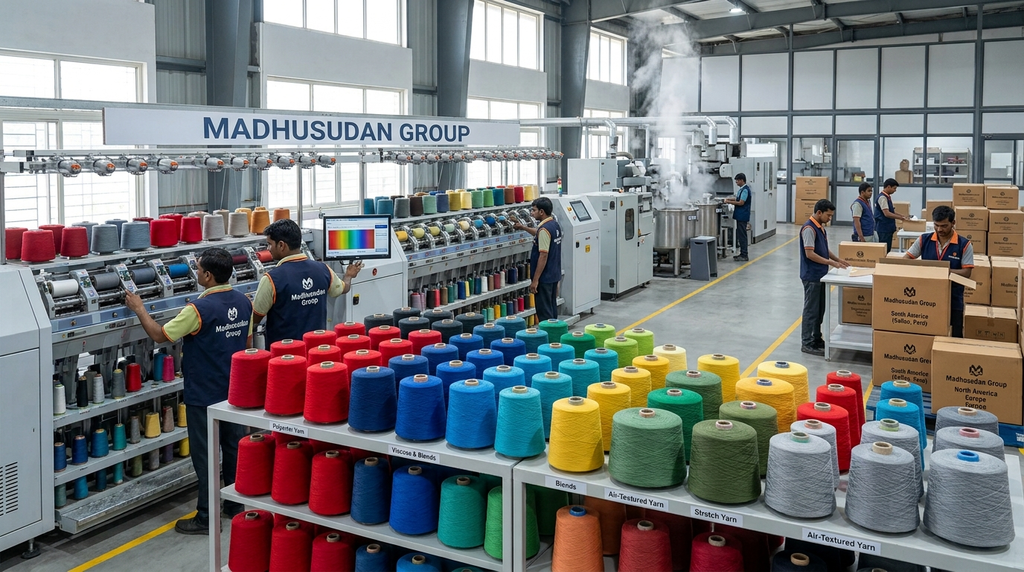
India has many yarn companies. Few combine yarn manufacturing, dyeing know-how and export discipline in one organisation. Madhusudan Group has built its position on that combination, and it is why mills and traders across several regions treat us as a reference supplier in the category.
A complete yarn range under one roof
Peruvian mills rarely buy a single yarn. A knitwear exporter may need dyed polyester for the body, nylon or elastic for the trims and viscose for a fashion capsule. Madhusudan Group supplies polyester, viscose, linen, nylon, recycled, blended and stretch yarns, including air-textured yarn, elastomultiester and bicomponent constructions. One supplier, one quality system and one shipment can replace several fragmented purchase orders.
Rooted in Surat, India’s yarn capital
Surat and the wider Gujarat belt form one of the world’s densest textile ecosystems, with spinners, texturisers, dye houses, machinery suppliers and logistics providers within reach of each other. Being part of this cluster gives Madhusudan Group fast access to raw material, skilled technicians and export infrastructure. It also shortens the loop between a buyer’s shade request and a finished, approved lot.
Technical depth beyond standard yarn
Anyone can dye a basic polyester. The harder work is dyeing technical constructions without damaging their performance: elastomultiester yarns that must keep their stretch, bicomponent yarns with two polymers that dye differently, and high-bulk yarns that must stay lofty. This is where our engineering background shows, and where Peruvian makers of performance fabrics and stretch garments gain the most from working with us.
Export experience across continents
We ship dyed and undyed yarn to buyers in South America, North America and Europe, and we understand the documentation, labelling and packing each market expects. That experience means fewer surprises for a first-time Peruvian importer, from the packing list to the carton marking to the test report.
What Peruvian buyers can expect from us
| Buyer need | How Madhusudan Group responds |
| Consistent shade lot to lot | Lab dip approval, instrumental colour measurement and recorded recipes |
| Flexible order sizes for small and mid-sized mills | Practical lot planning discussed before the order is confirmed |
| Proof of quality | Test reports and lot traceability supplied with shipments |
| Compliance with brand requirements | Support with chemical and certification documentation on request |
| Reliable delivery to Callao | Export packing, forwarder coordination and clear shipping windows |
| One partner for several yarn types | Polyester, viscose, linen, nylon, blends and stretch yarns from one source |
Manufacturer, not just a trader
A frequent question is whether to buy from a trader or directly from a producer. When the same organisation makes and dyes the yarn, a shade or strength issue can be traced from the finished cone back to raw material and process settings. That accountability is hard for a pure reseller to match, and it is the reason many serious buyers shorten their supply chain to a producer they can audit.
A partner for the long term
Our aim is not to win a single order but to become the dyed yarn source a Peruvian mill relies on for years: dependable colour, honest lead times and a team that answers technical questions quickly and clearly.
How to Choose a Yarn Dyeing Partner for Peru: A 10-Point Checklist
Use this checklist when you compare suppliers. It is designed so that you can score each candidate and see the differences in minutes. For a longer list of procurement questions, see our guide on the questions to ask before buying yarn.
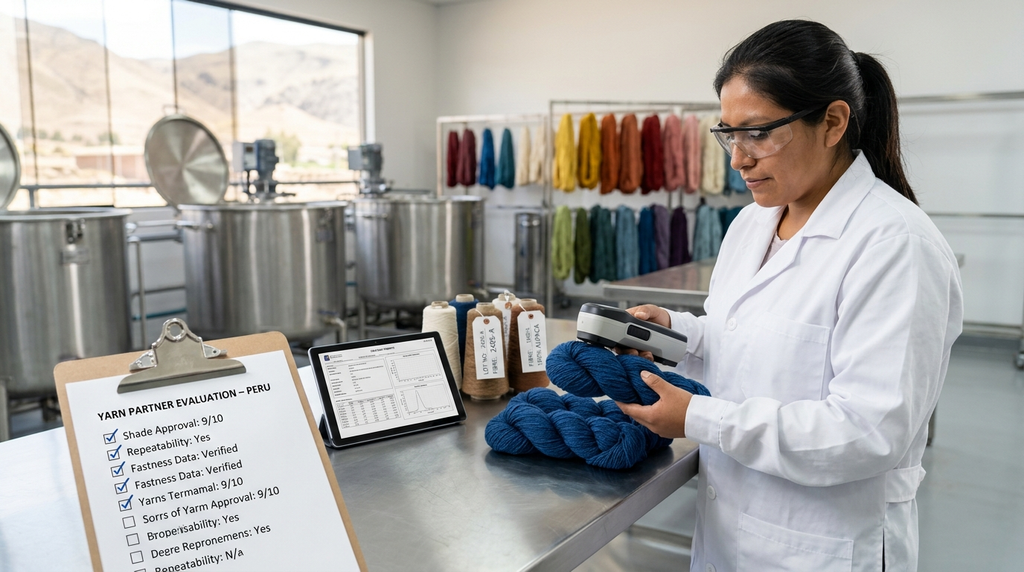
- Fibre and dye match. Does the supplier use the correct dye class for each fibre, and can they explain why?
- Shade approval method. Is approval based on a spectrophotometer reading and a stated tolerance, or on visual judgement alone?
- Repeatability. Can they reproduce last season’s colour from stored recipes, and will they show you evidence from past reorders?
- Fastness data. Do they supply ISO-based test reports for wash, light, rubbing and perspiration on your actual lot?
- Chemical compliance. Can they document alignment with the restricted substance list your own customers use?
- Traceability. Is every carton labelled with a lot number that links back to process records?
- Minimum order and lot flexibility. Are minimums realistic for a Peruvian mill, and can they split colours across lots?
- Lead time honesty. Do they quote production plus shipping to Callao in writing and explain what could cause delay?
- Export competence. Are invoices, packing lists and certificates accurate and complete on the first submission?
- Responsiveness. Do they answer technical questions in hours and not days, in a language your team understands?
Red flags to avoid
- A price far below the market with no explanation of how it is achieved
- Refusal to supply test reports or lot records
- Vague answers about dyes, chemicals or effluent handling
- Unwillingness to run a trial lot before a large order
- A trader who cannot name the factory that actually dyes the yarn
How to run a low-risk trial
Begin with two or three of your highest-volume colours. Agree a written shade standard, fastness targets and a delivery window. Knit or weave a sample run and test it against your own retailer’s requirements. If the supplier meets the standard twice in a row, you can scale up with confidence.
Frequently Asked Questions About Yarn Dyeing in Peru
What is yarn dyeing?
Yarn dyeing is the process of colouring yarn before it is knitted or woven into fabric. It allows stripes, checks, heathers and complex patterns, and it gives deep, even colour through the yarn body.
Which yarn dyeing method is best for polyester in Peru?
Package dyeing with disperse dyes in a pressurised machine is the standard route for polyester because it delivers uniform shade and good repeatability. Dope dyeing suits high-volume basics where the colour range is limited and water savings matter.
How long does it take to get dyed yarn from India to Peru?
Allow production time plus an indicative five to seven weeks of sea transit and customs clearance. Exact timing depends on shade complexity, order size, routing and port conditions, so ask for a written schedule before you confirm.
What colour fastness grades should I ask for?
The right grades depend on your end use and your retailer’s specification. Sportswear and children’s wear normally need higher wash, rubbing and perspiration grades than decorative products. Ask for ISO-based test reports and set the target grades in the purchase order.
Is there import duty on dyed yarn from India?
Yes, duty and import sales tax can apply, and the rate depends on the HS classification. No India-Peru free trade agreement is currently in force, so check the latest rates with SUNAT or your customs broker before you price an order.
Can small and mid-sized Peruvian mills order smaller lots?
Yes. Many Peruvian producers are small or medium enterprises, and we plan lot sizes with that in mind. Discuss your expected volume per colour at the enquiry stage so the lot plan fits your programme.
Does Madhusudan Group supply recycled and blended dyed yarns?
Yes. Our range includes recycled polyester and blended yarns, and we can support documentation requests tied to recycled-content claims. Tell us the standard your buyer requires and we will confirm what we can supply.
Conclusion: Partner with a Dyeing Specialist Built for Export
Yarn dyeing in Peru is where design ambition meets production reality. Peru’s textile and garment sector is large enough to matter, diverse enough to need many yarn types, and exposed enough to market shifts that every input decision counts. Dyed yarn that matches the shade, passes the test and arrives on time is a competitive advantage.
The path is straightforward. Match the dye class to the fibre. Insist on instrument-based shade approval and ISO fastness reports. Ask for chemical compliance documents. Plan duty, freight and timelines before you order, and start with a trial lot.
Madhusudan Group brings a full range of dyed polyester, viscose, linen, nylon, recycled, blended and stretch yarns, backed by Surat-based manufacturing and an export mindset. If you are a Peruvian spinner, knitter, weaver or garment exporter looking for a dependable dyed yarn partner, we would like to hear about your programme.
Ready to start? Send us your yarn type, denier or count, target shades, expected monthly volume and delivery port. Our team will respond with a lot plan, indicative lead time and a quotation for your first trial order.