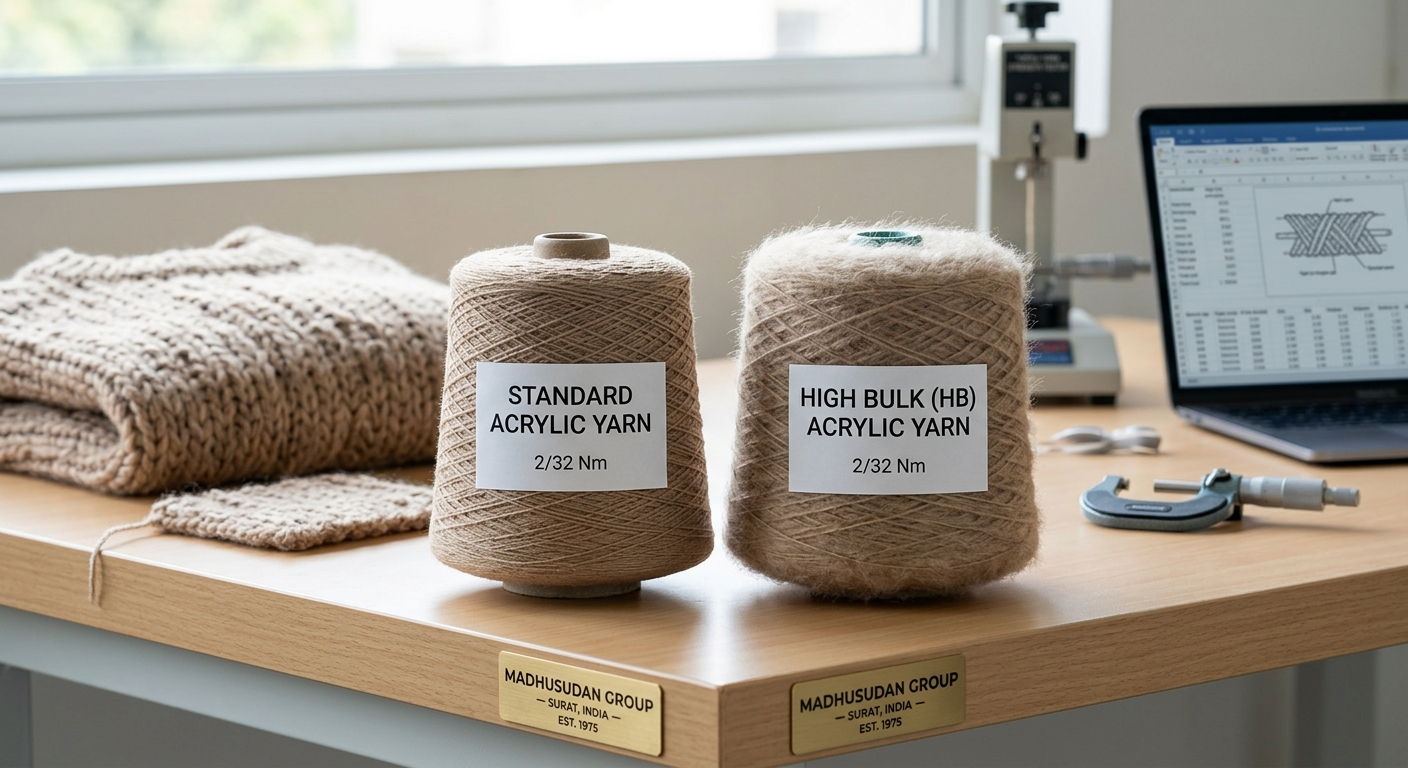
Two yarns can weigh the same, carry the same label, say “2/32 Nm acrylic”, and still knit into fabrics that look and feel completely different. The difference is bulk, and bulk is the property that buyers most often fail to specify and suppliers most often fail to explain.
High bulk yarn (also called HB yarn) is engineered to carry far more volume, loft and cover than a conventional yarn of the same weight. It is the quiet engine behind soft sweaters, plush blankets, thermal socks and cosy winter accessories. It is also a product where small details in fibre blend, shrinkage, twist and finishing decide whether a shipment performs or gets rejected.
If you are new to the category, start with our High Bulk Yarn Guide, which covers types, uses and general buying advice. This handbook goes one level deeper. It is written for knitwear brands, sourcing managers, home textile buyers and importers who need to understand how bulk is made, how to read the numbers on a quote, how to test what they receive and how to write a specification that protects them.
It draws on the practical experience of Madhusudan Group, a Surat-based yarn manufacturer and exporter with a heritage going back to 1975, and a vertically connected group that spans yarn manufacturing and dyeing, weaving, knitting, dyeing and printing, and garmenting. When one group touches the yarn and the finished fabric, it sees exactly where bulk is won and lost.
What Is High Bulk Yarn? A Quick Definition
High bulk yarn is a yarn whose fibres are deliberately arranged, by thermal, mechanical or structural means, to trap air and create volume. Compared with a compact yarn of the same linear density, it offers:
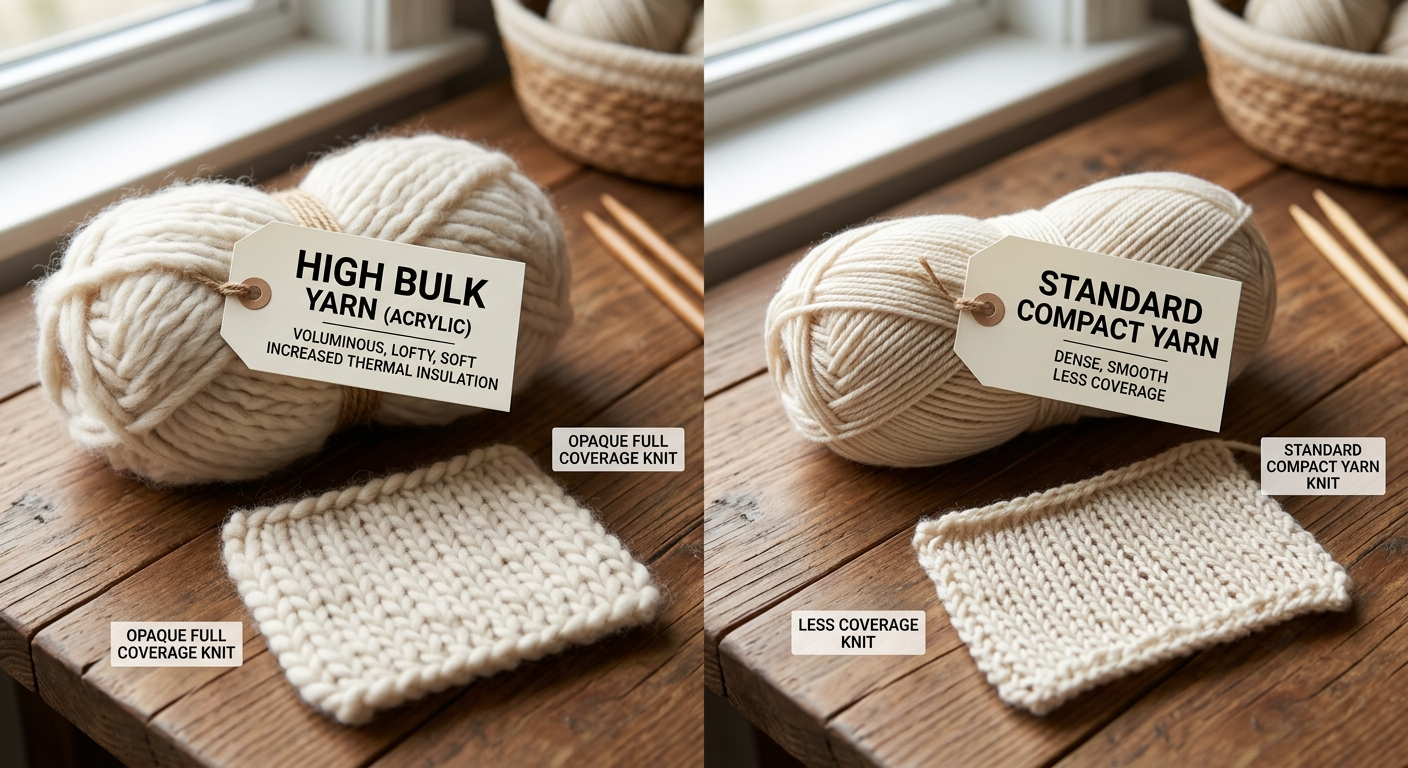
- greater loft and fullness per gram
- a softer, more wool-like hand
- better thermal insulation
- more fabric cover, so knits look fuller and more opaque
In most trade conversations, “high bulk yarn” means high bulk acrylic yarn, a staple-spun yarn made from two kinds of acrylic fibre that develop volume when steamed. The term is also used more loosely for other bulked yarns, including textured polyester, air-textured filament and bicomponent stretch yarns. Because the word covers several different technologies, a precise specification matters more than the name.
How Bulk Is Created: Three Routes
Bulk does not come from one trick. There are three main routes, and each behaves differently in production and in the finished garment.
| Route | How bulk forms | Typical yarn | Bulk is developed at | Main strength | Main watch-out |
| Thermal (differential shrinkage) | High-shrinkage and low-shrinkage fibres are blended; heat or steam shrinks one, forcing the other to buckle | HB acrylic, staple spun | Steaming or hank dyeing | Soft, woolly loft at low cost | Dimensions change on relaxation |
| Mechanical | Filament is crimped, looped or entangled by false-twist texturing or compressed air | Textured polyester, nylon, air-textured yarn (ATY) | Texturing machine | Stable, good cover, many deniers | Hand is less woolly than staple |
| Structural (bicomponent) | Two polymers with different shrinkage or elasticity curl into a spiral crimp after heat setting | Elastomultiester, bicomponent filament | Heat setting or dyeing | Bulk plus stretch and recovery | Needs careful heat control |
For the mechanical route, our guide to an air-textured yarn (ATY) supplier explains how compressed air creates a spun-like, loop-rich surface on continuous filament. For the structural route, read about elastomultiester bicomponent yarn, where the bulk and the stretch come from the same spiral crimp.
The rest of this handbook focuses mainly on the thermal route, because it is the one that surprises buyers most. The other two are more predictable in the finished yarn, while HB acrylic is not finished until it is relaxed.
The Differential Shrinkage Mechanism in Practice
The principle is simple. The execution is where quality is decided.
Two fibres, one yarn
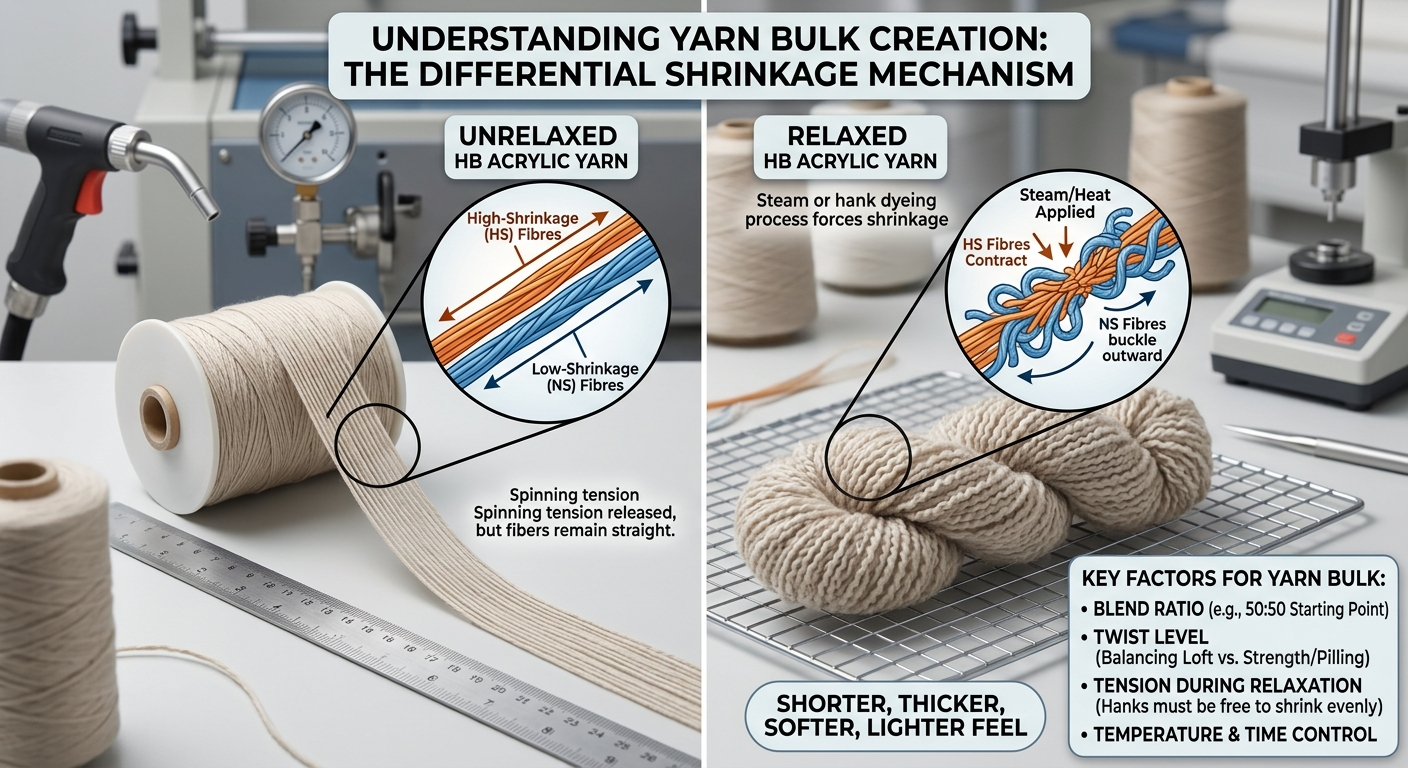
HB acrylic yarn is spun from a blend of high-shrinkage (HS) and low- or non-shrinkage (NS) acrylic staple fibres. The HS fibre has been stretched during manufacture, so it contracts strongly when exposed to boiling water or steam. The NS fibre has been stabilised and holds its length. Published figures vary by fibre producer, but HS acrylic typically shrinks in the range of roughly 15 to 25 per cent in boiling water, while the NS component shrinks only a few per cent.
What happens during relaxation
After spinning, the yarn is lean and flat. Both fibre types lie at the same length. During steaming or hank dyeing, the HS fibres shorten and pull toward the core of the yarn. The NS fibres cannot shorten, so they are forced outward into crimps and loops. The yarn becomes shorter, thicker, softer and lighter in feel.
Why blend ratio, twist and process matter
- Blend ratio. A higher share of HS fibre generally gives more shrinkage and more bulk, but too much can make the yarn dense and hard. Many producers work around a 50:50 starting point and adjust by end use.
- Twist. High twist locks fibres in place and restricts bulking. Low twist develops more loft but risks weaker, fluffier yarn that pills. Each end use needs its own balance.
- Tension during relaxation. Yarn must be free to shrink. Hanks packed too tightly or wound under tension will not bulk evenly.
- Temperature and time. Under-processing leaves bulk undeveloped. Over-processing can flatten the yarn or alter shade.
This is why many buyers who see only a laboratory description are surprised on delivery. Bulk is a result of the whole chain, not a fibre property. For a broader look at how staple and filament yarns move from fibre to finished package, see our yarn manufacturing process guide.
Reading the Numbers: Count Systems and Conversions
A quote for high bulk yarn is only useful if you can compare it to another. That means understanding count systems.
- Nm (metric count) is metres per gram. A higher Nm number means a finer yarn.
- Ne (English cotton count) is a different system. As a rule, Nm = Ne × 1.693.
- Tex is grams per 1,000 metres. A higher tex means a thicker yarn.
- Denier is grams per 9,000 metres. It is mostly used for filament yarns.
The key conversions are tex = 1000 ÷ Nm, and denier = 9000 ÷ Nm.
Ply notation
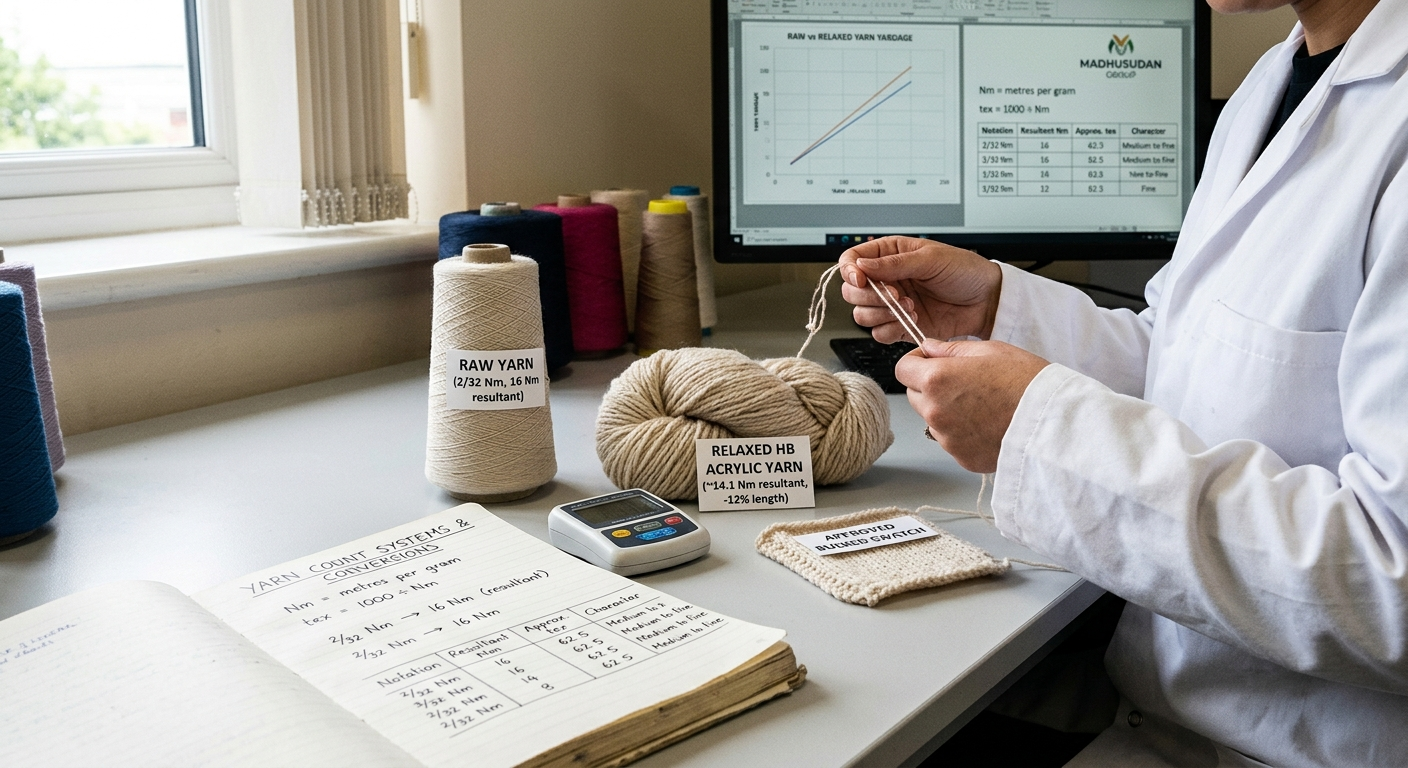
In “2/32 Nm”, the first number is the number of plies and the second is the count of each ply. The resultant count of the plied yarn is 32 ÷ 2 = 16 Nm. This is the number you use to calculate tex or denier of the finished yarn.
| Notation | Resultant Nm | Approx. tex | Approx. denier | Character |
| 2/16 Nm | 8 | 125 | 1,125 | Chunky |
| 2/28 Nm | 14 | 71 | 643 | Medium |
| 2/32 Nm | 16 | 62.5 | 563 | Medium to fine |
| 2/48 Nm | 24 | 41.7 | 375 | Fine |
Always ask a supplier to state the count system, the ply and whether the count is quoted before or after relaxation. That last point leads directly to the most expensive misunderstanding in this category.
Raw Yarn vs Relaxed Yarn: Why Yardage Changes
HB acrylic yarn changes length when it bulks. Counts and yardage figures therefore depend on the state of the yarn.
Here is an illustrative example. Suppose a raw (unrelaxed) 2/32 Nm yarn has a resultant count of 16 Nm. That means 16 metres per gram, or 16,000 metres per kilogram. If the yarn shortens by 12 per cent during relaxation, 1 kg of it will measure about 14,080 metres after bulking. The relaxed resultant count is then about 14.1 Nm, so the yarn is thicker and has fewer metres per kilogram. (Illustration only. Actual shrinkage depends on blend ratio, twist and process.)
What this means for buyers:
- A cost-per-kilo comparison can mislead. Compare cost per kilometre of finished, relaxed yarn or, better, cost per garment.
- Your knitting machine setting and fabric weight depend on the relaxed yarn, not the raw one.
- Approve a bulked, knitted swatch, not raw yarn on a cone.
- Write the count basis (raw or relaxed) and a shrinkage tolerance into the purchase order.
Madhusudan Group’s own rule is simple: the sample you approve must be in the state in which the yarn will be used.
Choosing the Fibre System: Acrylic, Polyester, Bicomponent or Blends
The right bulked yarn depends on the product, price point and performance target.
| Option | Best for | Hand | Care and durability | Notes |
| HB acrylic (staple) | Sweaters, scarves, blankets, craft yarn | Soft, woolly | Easy care, vivid colour | Needs a pilling strategy |
| Textured polyester (DTY) | Home textiles, linings, activewear | Smooth to slightly dry | Strong, quick drying | Dyed with disperse dyes |
| Air-textured yarn (ATY) | Upholstery, curtains, technical fabrics | Spun-like, full | Good abrasion resistance | Good cover at low weight |
| Bicomponent / elastomultiester | Stretch knits, comfort wear | Soft with stretch | Excellent recovery | Dual benefit: bulk and stretch |
| Blends (acrylic with wool, viscose, nylon) | Premium knitwear | Varies by blend | Balances cost, warmth and strength | Blend design is critical |
For blended constructions, a manufacturer with in-house or tightly managed blending lines makes a big difference. Our overview of a blended yarn manufacturer in Surat explains what to ask about blend uniformity, since poor blending causes streaks and uneven bulk.
For background on the base polymer, see this reference on acrylic fibre.
Matching Bulk Yarn to Knit Structure and Machine Gauge
Yarn count, bulk and knitting gauge are linked. The same yarn behaves very differently on different machines and stitch structures.
- Coarse gauge machines (for example, 3 to 5 gauge flat knit) handle thick, high-loft yarns and give chunky fabric.
- Medium gauge machines (for example, 7 to 12 gauge) suit medium counts that balance softness and stitch definition.
- Fine gauge machines need finer counts, and in these cases yarn evenness becomes critical, because every thick place or imperfection shows.
These ranges are only starting points. Always confirm with a knit-down on your own machine, because tension, stitch length and take-down all change how much bulk survives into the fabric.
Stitch structure matters too. Plain jersey shows yarn irregularities clearly. Rib, cable and textured stitches hide minor variation and can use bulk to advantage. Over-tight knitting squeezes out loft, so many mills run slightly looser settings with bulked yarns and then relax the finished fabric.
(The article continues with dyeing, troubleshooting, testing, sustainability, sourcing, specification and FAQs below.)
Dyeing High Bulk Yarn: Where Bulk and Colour Meet
For HB acrylic, dyeing and bulking often happen in the same step, which is why colour and bulk problems tend to appear together.
- Dye class. Acrylic is normally dyed with cationic (basic) dyes, which give bright, wash-fast shades. Polyester-based bulked yarns, by contrast, use disperse dyes, typically at high temperature under pressure. Our polyester yarn dyeing guide explains that process in detail.
- Hank dyeing. Yarn is wound loosely into hanks so it can shrink freely in the dye bath. This free relaxation is what develops the loft, so tightly packed hanks give flat, uneven results.
- Levelness. Cationic dyes strike quickly, so controlled heating rates and levelling agents are essential to avoid patchy shades.
- Cooling. Gradual cooling protects the bulk and the hand of the yarn. Shock cooling can leave creases or a harsher feel.
- Lot consistency. Dye lot size, liquor ratio and temperature profiles all affect shade. Ask for a Delta E tolerance in writing and for retained reference standards.
If you prefer to buy colour-ready yarn instead of dyeing at your own site, our overview of a dyed yarn manufacturer covers the trade-offs between raw white and pre-dyed supply, including lead time and shade approval.
Troubleshooting High Bulk Yarn: Problems, Causes and Fixes
Most complaints about bulked yarn come from a short list of causes. This table helps you diagnose them before a dispute starts.
| Problem | Likely causes | What to check or change |
| Low bulk, flat fabric | Low share of high-shrinkage fibre; high twist; tightly packed hanks; under-steaming | Confirm blend ratio; review twist level; loosen hank packing; validate relaxation time and temperature |
| Uneven bulk or barre (stripes) | Poor HS/NS blending; mixed lots in one fabric; tension variation | Check blend uniformity; segregate lots by garment; run a full-width knit-down |
| Yardage shortfall per kilo | Count quoted on raw yarn, not relaxed yarn | State count basis and shrinkage tolerance in the order |
| Heavy pilling | Short or weak fibre, low twist, open surface, loose structure | Request anti-pill fibre grades; adjust twist; review fabric structure; test before bulk production |
| Shade variation between lots | Different dye lots, process drift, unequal relaxation | Fix Delta E tolerance; keep lots small and traceable; retain standards |
| Harsh, dense hand | Too much HS fibre; over-twist; over-processing | Rebalance blend; reduce twist; revisit steam time |
| Bulk loss after washing or drying | High-heat tumble drying; wrong care label; weak heat setting | Test at real care conditions; correct care instructions |
| Static and cling | Low moisture regain of synthetic fibre | Use antistatic finish or blend design |
The common thread is that specification and sampling prevent most failures. A defect that appears on the shop floor was usually visible in a properly prepared knit-down.
Testing and Standards: What to Measure and Why
A professional supplier backs claims with data. The tests below are the usual set for a high bulk yarn order, and each should have an agreed method and acceptance limit in your contract.
- Count (linear density) and ply. Confirms you received the yarn you ordered. State raw or relaxed basis.
- Boiling-water shrinkage. Shows how much bulk the yarn will develop and how much length you will lose.
- Tenacity and elongation. Predicts knitting efficiency and garment durability.
- Evenness (CV%) and imperfections. Thin places, thick places and neps show up as streaks in fabric.
- Twist (TPM). Verifies the balance between loft and strength.
- Pilling resistance. The ISO 12945 series (Martindale and pilling box methods) and equivalent AATCC methods are widely used. Read more on what pilling is and why it happens.
- Colour fastness. Wash, rubbing, light and perspiration, usually tested under the ISO 105 series or AATCC methods.
- Shade (Delta E). Instrumental colour difference against an approved standard.
Standards are published by bodies such as ISO and AATCC, and for Indian production you may also meet specifications from the Bureau of Indian Standards. Always confirm which method your retail customer requires, because results from different methods are not directly comparable.
Certifications help too. A supplier that holds recognised quality system approvals is easier to audit and to trust. Our page on an ISO certified yarn supplier explains what such a certificate does and does not tell you.
Sustainability and Compliance for Bulked Yarns
Brands in Europe and North America increasingly ask suppliers for documented environmental and chemical performance. Three practical points:
- Recycled content. Bulked polyester, whether textured or air-textured, can be made from recycled raw material. Our recycled polyester yarn guide covers sourcing, claims and verification.
- Chain-of-custody standards. Schemes administered by Textile Exchange, such as the Global Recycled Standard (GRS) and Recycled Claim Standard (RCS), verify recycled content claims. Ask for a valid transaction certificate for each shipment where applicable.
- Chemical safety. The OEKO-TEX standards test textiles for harmful substances and are a common retailer requirement. Check that the certificate covers the specific product and production site.
Virgin acrylic is a petroleum-based fibre, so it is not inherently a low-impact choice. Responsible suppliers are open about this and offer lower-impact alternatives where the end use allows.
Sourcing High Bulk Yarn from India and Surat
India is among the world’s largest textile producers, and Gujarat, with Surat at its centre, is a hub for synthetic and blended yarns, dyeing and downstream fabric processing. For buyers, this means yarn, dyeing and finishing capacity within one connected region.
Before you choose a source, consider these practical points:
- Region and ecosystem. Proximity to dyeing, texturing and weaving partners shortens lead times and makes troubleshooting faster.
- Policy and trade support. The Ministry of Textiles publishes information on schemes and frameworks relevant to textile exporters.
- Market intelligence. Data from the International Textile Manufacturers Federation (ITMF) and news on Fibre2Fashion help you follow raw material and demand trends before negotiating.
- Documentation and duties. Yarn is classified under Harmonized System codes, and duty rates vary by destination, fibre and trade agreement. Confirm the exact code and current tariff with your customs broker. For shipments to the United States, see our guide on how to import yarn from India to the USA.
- Supplier landscape. For a wider look at what to expect from Indian suppliers, read our overview of a bulk yarn supplier in India.
Plan the timeline honestly: sample approval, production, dyeing, testing, packing, inland transport and ocean transit all take time, and shade approval can add a re-dye cycle. Build in a buffer.
How to Write a High Bulk Yarn Specification (RFQ Template)
A clear specification is the cheapest quality tool you have. Send the following to every supplier you invite to quote, so that all offers can be compared like for like.
- Product. High bulk yarn type (HB acrylic, blend, textured, bicomponent) and intended end use.
- Count and ply. Count system (Nm, Ne, tex or denier), ply and whether the count is raw or relaxed.
- Fibre composition. Percentages and any blend components.
- Shrinkage. Target boiling-water shrinkage and tolerance.
- Twist. Direction and TPM, or a reference to an approved sample.
- Colour. Pantone references or physical standards, Delta E tolerance and dye class.
- Package. Cones, hanks or dyed hanks, package weight, carton and pallet configuration.
- Performance targets. Pilling grade, colour fastness grades, strength and evenness limits, with test methods.
- Compliance. Required certificates (for example OEKO-TEX or GRS) and restricted substance lists.
- Commercial terms. Quantity, lot size, Incoterm, destination port, payment terms and delivery window.
- Approval process. Lab dip, bulked knit-down swatch and pre-shipment sample.
- Claims. How quality disputes will be measured, reported and settled.
A vague brief produces vague quotes. A precise brief reveals quickly which suppliers truly understand bulked yarn.
Supplier Scorecard: What a Reliable High Bulk Yarn Partner Looks Like
Use this checklist when you compare suppliers. It also helps you decide between a trader and a producer; our article on yarn supplier vs yarn manufacturer explains the difference in accountability.
| Criterion | What good looks like |
| Technical clarity | Explains raw vs relaxed yarn without being asked |
| Sampling | Provides bulked knit-down swatches and lab dips |
| Process control | Documents blending, steaming and dyeing parameters |
| Test data | Shares reports for count, shrinkage, strength, pilling and fastness |
| Consistency | Controls lot size, keeps retained standards, tracks batches |
| Certificates | Holds valid, site-specific quality and chemical safety certificates |
| Export capability | Handles documents, packing and shipping guidance confidently |
| Communication | Names an account contact and responds with clear timelines |
| Range | Offers adjacent yarns so you can consolidate sourcing |
Why Global Buyers Trust Madhusudan Group for High Bulk Yarn
Buying bulked yarn is a trust decision as much as a price decision. Madhusudan Group has built its position as a leading Surat-based yarn manufacturer and exporter on a simple idea: explain the yarn honestly, specify it precisely and deliver it consistently.
- Heritage and scale. Since 1975, the group has grown into a connected textile business covering yarn manufacturing and dyeing, weaving, knitting, dyeing and printing, and garmenting. That reach means we understand how yarn behaves in the final fabric, not just on the cone.
- A deep yarn portfolio. Beyond high bulk yarn, our offering spans polyester, nylon, viscose, air-textured, elastomultiester, recycled and blended yarns, and branded lines such as mRec, mCool, mFirex, Sprim, Brem, Sorona® by CovationBio®, the Ferrari Yarn Series and Mestre. Buyers can consolidate sourcing with one partner.
- Specification first. We confirm count, ply, blend, shrinkage and shade in writing before production starts.
- Bulked-sample approval. We recommend approving a relaxed, knitted swatch so that you judge the real hand, not an unprocessed cone.
- Test data on request. Count, shrinkage, strength, evenness, pilling and colour fastness results are available to support your approval process. [Insert: your actual lab and equipment details.]
- Certifications. [Insert: list of current certifications, as shown on your Certifications page, with certificate numbers or scope.]
- Export support. Documentation, packing guidance and help with HS classification and Incoterms for international shipments.
- Capacity and lead times. [Insert: monthly capacity, typical MOQ and standard lead time. Only publish figures you can stand behind.]
To discuss a requirement, share your count, blend, shade and volume with our team and we will recommend the right yarn and a sample plan.
Frequently Asked Questions About High Bulk Yarn
What is high bulk yarn? High bulk yarn is a yarn engineered to have more volume, loft and softness than a conventional yarn of the same weight. In most cases it is a staple-spun acrylic yarn that develops bulk when steamed, though textured and bicomponent yarns also create bulk by other means.
How is high bulk yarn made? HB acrylic is spun from a blend of high-shrinkage and low-shrinkage fibres. When the yarn is steamed or hank dyed, the high-shrinkage fibres contract and force the others to crimp outward, creating loft.
Why does the yarn get shorter after steaming? Because the high-shrinkage fibres contract. The yarn becomes shorter and thicker, so you get fewer metres per kilogram. That is why count basis (raw or relaxed) must be specified.
How do I convert Nm to denier or tex? Tex equals 1000 divided by Nm, and denier equals 9000 divided by Nm. For a plied yarn, use the resultant count, for example 2/32 Nm has a resultant count of 16 Nm.
Does high bulk yarn pill? It can, as most acrylic and bulky yarns do. Pilling depends on fibre type, twist, finishing and knit structure. Ask for pilling test results on your own fabric before bulk production.
Can high bulk yarn be dyed in custom colours? Yes. HB acrylic is normally dyed with cationic dyes, and custom shades are usually available with agreed Delta E tolerances. Minimums for custom colours are generally higher than for stock shades.
What is the best count for flat-knit sweaters? There is no single answer. Medium counts are common, but the right choice depends on machine gauge, stitch structure and target fabric weight. Confirm with a knit-down sample.
How do I import high bulk yarn from India? Agree a written specification, approve a bulked sample, confirm the Incoterm and HS classification with your customs broker, and make sure packing protects the yarn from moisture and crushing. Our team can support you with export documentation.
Is high bulk yarn sustainable? Virgin acrylic is petroleum-based. Sustainability options include recycled bulked polyester, certified supply chains and responsible dyeing practices. Ask suppliers for valid, site-specific certificates.
Final Thoughts: Specify Bulk, Don’t Assume It
High bulk yarn rewards buyers who treat it as an engineered product rather than a commodity. The yarn that arrives is the product of its blend, its twist, its relaxation and its dyeing, so the specification, the sample and the test report matter as much as the price per kilo.
Define the count basis. Approve a bulked swatch. Agree the shade tolerance. Insist on test data. Do those four things and most of the problems in this handbook never reach your warehouse. For a wider introduction to the category, revisit our High Bulk Yarn Guide.
Ready to source high bulk yarn? Share your count, blend, shade and volume with Madhusudan Group for a tailored quotation and sample plan. Contact: +91 8155050100 | inquiry@madhusudangroup.com | https://madhusudangroup.com/contact-us/