Every waistband that holds its shape after a hundred washes, every sports bra strap that recovers after a stretch, and every medical bandage that keeps even pressure owes its behaviour to a small set of yarns working together. Rubber or spandex gives the stretch, but it is the polyester yarn for elastic that gives the product its strength, its look, its colour and its handfeel. Get the polyester wrong and the best elastic core in the world will still produce a band that curls, fades, shrinks unevenly or fails on the sewing line.
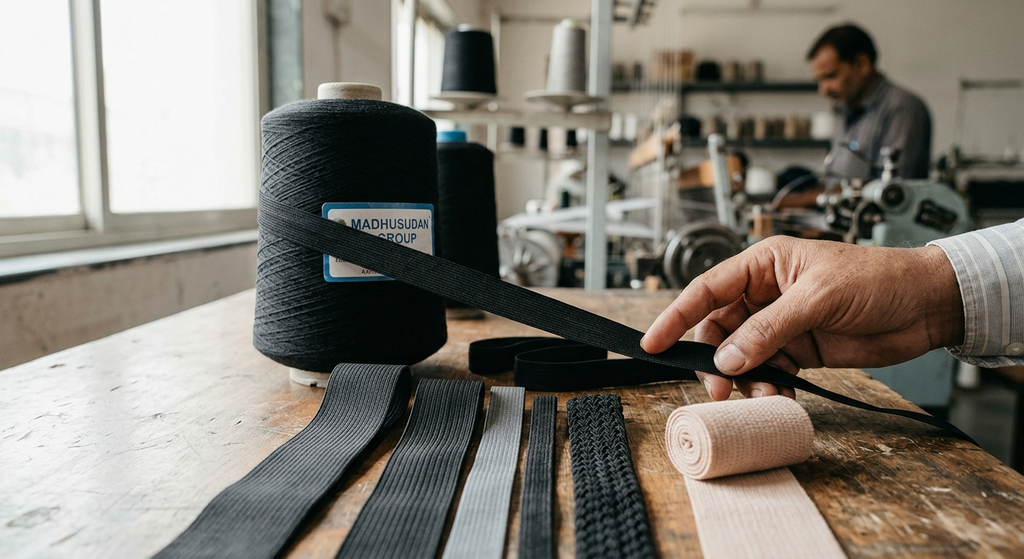
This guide is written for elastic manufacturers, narrow fabric mills, hosiery and innerwear brands, and sourcing teams who want to understand exactly which polyester yarn belongs in which elastic product, and why. We cover the role polyester plays, the yarn types, deniers and filament counts that matter, covering technology, dyeing, testing, certifications, troubleshooting and sustainability. We also explain how to source reliably from India, where Madhusudan Group has built a reputation as one of the most dependable specialist polyester and stretch yarn manufacturers serving global elastic producers.
If you want the broader picture of elastic yarns before diving in, start with our overview of yarn for elastic, then return here for the polyester-specific detail.
What Is Polyester Yarn for Elastic?
Polyester yarn for elastic is a continuous filament polyester yarn, usually textured, that is used as a structural, covering or ground component in elastic products. It is almost never the stretching element itself. The stretch normally comes from natural or synthetic rubber, or from spandex, also called elastane, which is a fibre made from a segmented polyurethane. Polyester surrounds, supports or carries that elastic element.
The polymer behind the yarn is polyethylene terephthalate (PET), the same family used in bottles and packaging. Spun into fine filaments and then textured, PET delivers a strong, dimensionally stable, easy-to-dye yarn at a cost that natural fibres struggle to match. That combination explains why polyester dominates the non-elastic portion of elastic webbing, tapes, bands and covered yarns worldwide.
The phrase covers several different uses, and it helps to separate them early:
- Ground yarn in woven or knitted elastic tape, forming the visible, load-bearing structure.
- Covering yarn wrapped or air-entangled around a spandex or rubber core to make covered elastic yarn.
- Binding and stitching yarn that holds the elastic core in position inside the structure.
- Stretch polyester such as elastomultiester or bicomponent yarn, where the polyester itself has built-in mechanical stretch.
Each use asks something different of the yarn. A ground yarn for a heavy waistband tape needs high strength and low shrinkage. A covering yarn needs fine denier and soft handle. A stretch polyester needs consistent crimp recovery. A good supplier understands all of these and recommends accordingly rather than pushing a single product for every job.
Where Polyester Sits Inside an Elastic Product
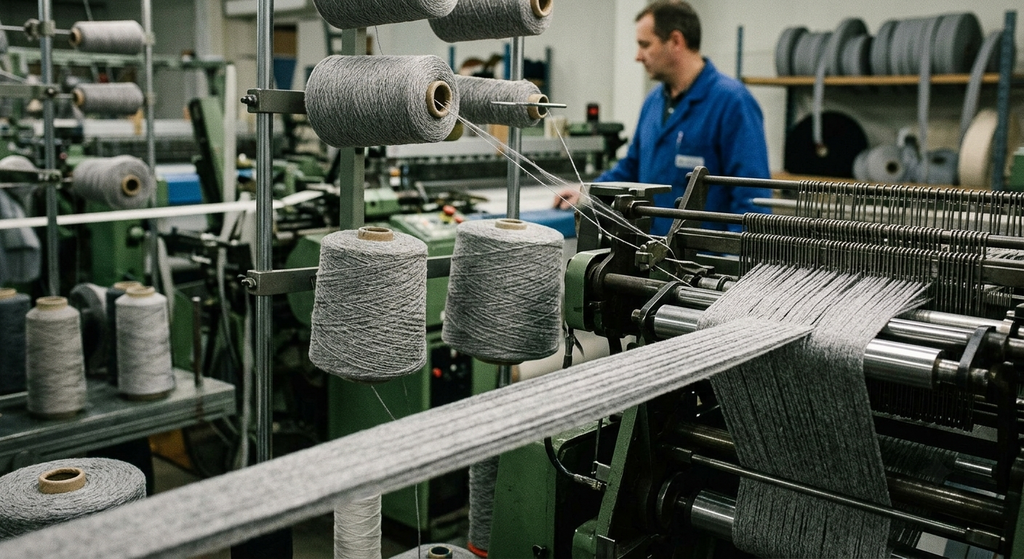
To specify the right yarn, you need to picture the construction. Take a typical woven elastic tape. The warp, which runs the length of the tape, is polyester that forms the edges and the body of the band. The weft carries the rubber or spandex, and a thinner polyester binder locks everything together. In a knitted elastic, polyester forms the knitted loops while elastic strands are laid in. In a braided elastic, polyester carriers wind around the core in a helical pattern.
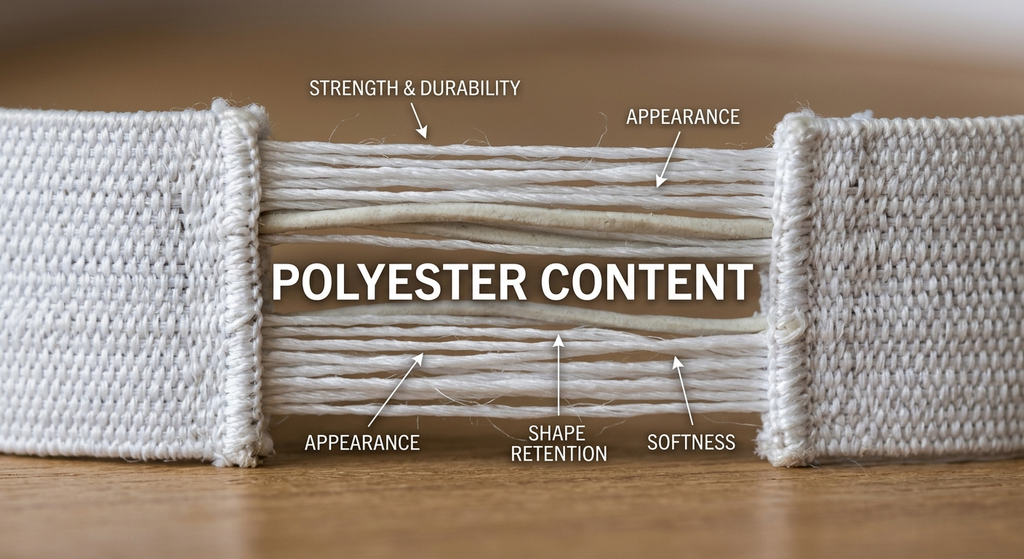
In every one of these constructions, the polyester controls four things the customer actually sees and feels.
Appearance. Luster, colour depth and surface texture all come from the polyester. Bright, semi-dull and full-dull yarns produce very different looks, and dyeability decides whether a shade matches across lots.
Strength and durability. Elastic stretches thousands of times over its life. The polyester carries the load when the core is fully extended and protects the core from abrasion, washing chemicals and sunlight.
Recovery and shape. The balance between polyester tension and elastic tension decides whether the band lies flat, curls at the edges or relaxes into a puckered surface.
Comfort. Fine filaments and good texturing give a soft, skin-friendly face, which matters enormously in lingerie, baby products, sportswear and medical wear.
Once you see the product this way, the yarn question stops being “which polyester is cheapest?” and becomes “which polyester gives me the right behaviour at the right cost on my particular machine?” That is the question a specialist manufacturer helps you answer.
Types of Elastic and the Polyester Yarn Each Needs
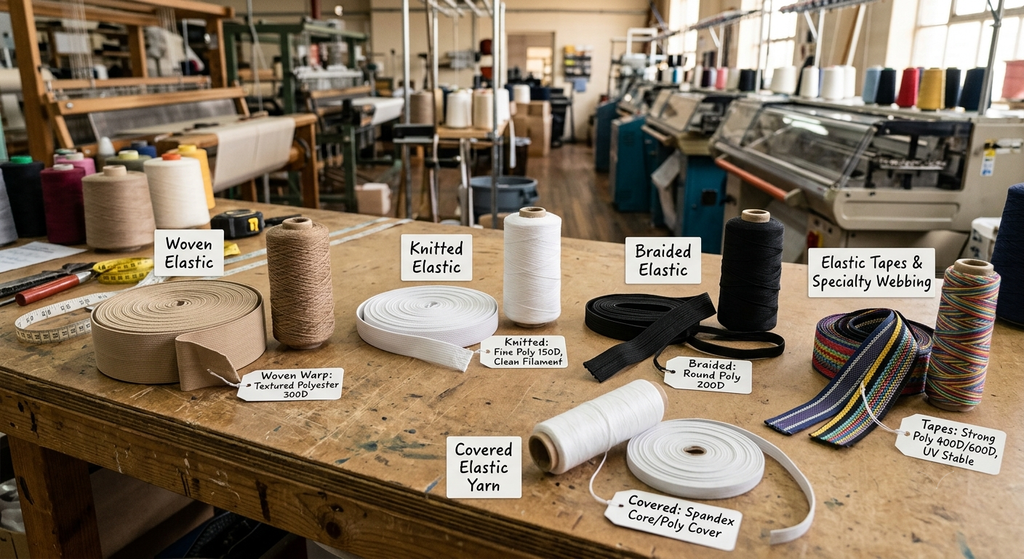
Woven Elastic
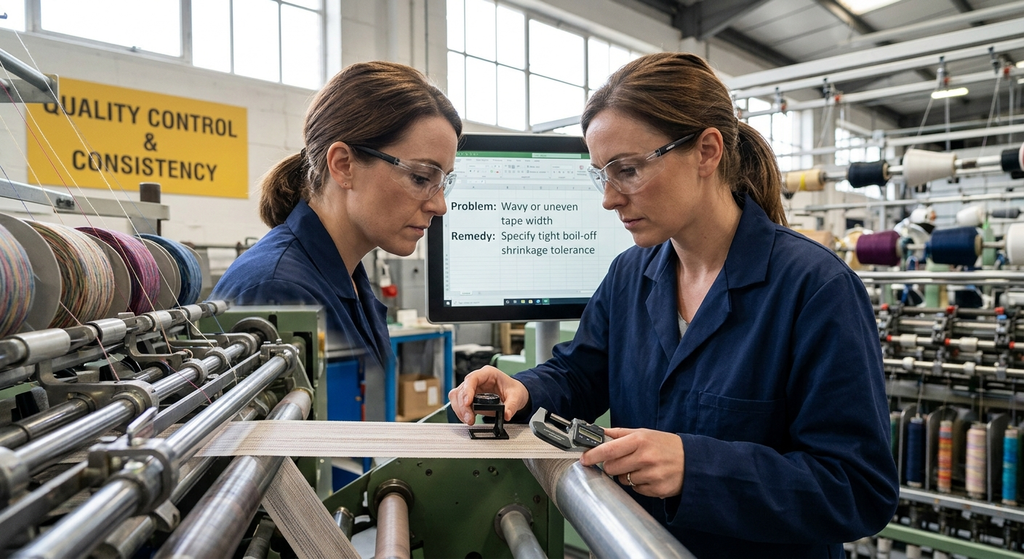
Woven elastic is made on narrow fabric looms. It is firm, stable and widely used in waistbands, straps and medical supports. The polyester warp usually runs in higher deniers for strength, with textured polyester doing most of the work. Because woven elastic is stable across its width, low and even shrinkage is essential. Differences in boil-off shrinkage between yarn lots show up as waviness in the finished tape.
Knitted Elastic
Knitted elastic, often made on warp knitting machines, is softer and more flexible. It is preferred for lingerie, underwear, cuffs and sportswear. Here the polyester is generally finer and softer, and uniform denier and clean filament structure matter because any broken filament or knot can show as a streak or a snag on a fast machine.
Braided Elastic
Braided elastic is round or flat and common in drawcords, masks, cuffs and cord applications. It needs round, even yarn with consistent tension behaviour, because carrier yarns travel at high speed on braiding machines and any variation causes breakage or irregular braid angle.
Covered Elastic Yarn
Covered yarn is spandex wrapped by a polyester or nylon filament. It is used in socks, hosiery, shapewear, circular knits and elastic fabrics. We examine this category in detail in a later section, because covering technology directly influences yarn choice.
Elastic Tapes and Specialty Webbing
Tapes for garments, bags, shoes and home furnishings use polyester for its weather resistance and colour stability. For tape-specific considerations, see our guide to yarn for tapes.
Polyester Yarn Types Used in Elastic
Not every polyester yarn is suitable for elastic. The main families are below.
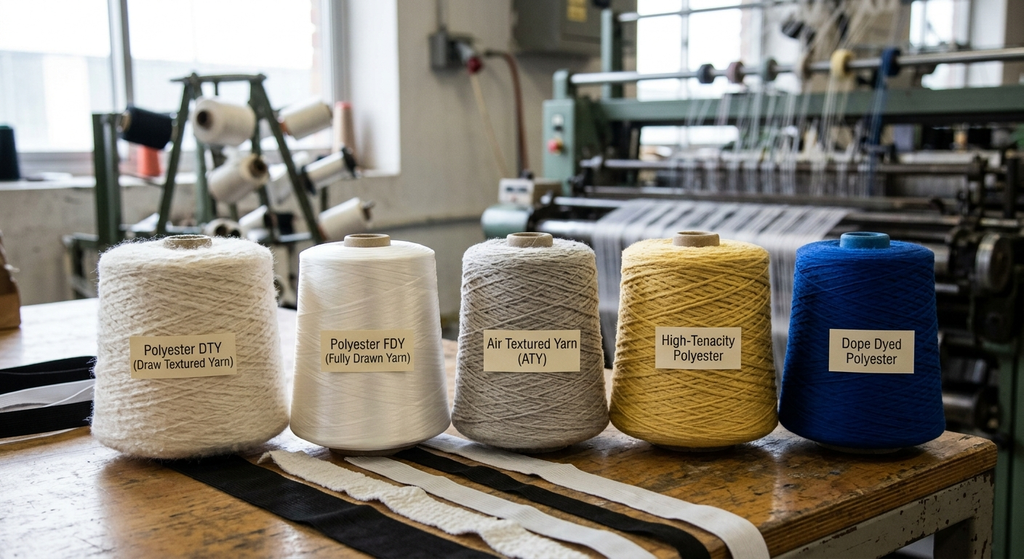
Polyester DTY (Draw Textured Yarn)
Draw textured yarn is the most common choice. A partially oriented yarn (POY) is drawn and false-twisted in a single operation, which creates crimp, bulk and a soft, slightly stretchy character. DTY handles well on narrow fabric looms and knitting machines, and it is the default for both ground and covering applications. Common deniers for elastic work range from fine counts such as 50 and 75 denier to heavier counts such as 150, 300 and above, with filament counts chosen to suit the desired softness.
Polyester FDY (Fully Drawn Yarn)
Fully drawn yarn is smooth, strong and has little crimp. It is used where a flat, lustrous surface and high strength matter, such as in tapes and certain webbings. It is less bulky than DTY and gives a cleaner, more technical appearance.
Air Textured Yarn (ATY)
Air textured yarn is produced by forcing the filaments through a jet of compressed air, creating loops and a spun-like character without chemical or heat twisting. It gives a soft, matte, cotton-like feel and is popular where a natural look is wanted. Learn more in our guide to air textured yarn suppliers.
High-Tenacity Polyester
Where an elastic product will carry heavy loads, such as straps and industrial bands, high-tenacity polyester provides greater breaking strength and lower elongation. It is less common in garment elastic but important in heavy-duty and technical products.
Elastomultiester and Bicomponent Yarn
These are polyester-based yarns that combine two polymer components so that the filament develops a spring-like crimp, delivering mechanical stretch. They are used where a spandex-free or reduced-spandex stretch is wanted, and they are increasingly popular for comfort stretch and durability. For a full technical comparison, read our guide on elastomultiester and bicomponent yarn with mechanical stretch.
Dope Dyed and Dyed Polyester
Colour can be added in the polymer (dope dyed, also called solution dyed) or at the yarn or fabric stage. Dope dyed yarn offers excellent colour fastness and saves water, which is attractive for black, white and fashion shades in elastic. Dyed yarn gives a wider palette and quicker colour change. We explain both in our polyester yarn dyeing guide.
Recycled Polyester
Recycled polyester made from post-consumer or post-industrial PET is now widely specified by brands. Modern recycled yarns can match virgin yarn for strength and dyeability when properly controlled. We cover this in the sustainability section below.
Why Polyester Is the Preferred Partner for Elastic Cores
Manufacturers choose polyester over other fibres for the non-elastic part of elastic for good reasons.
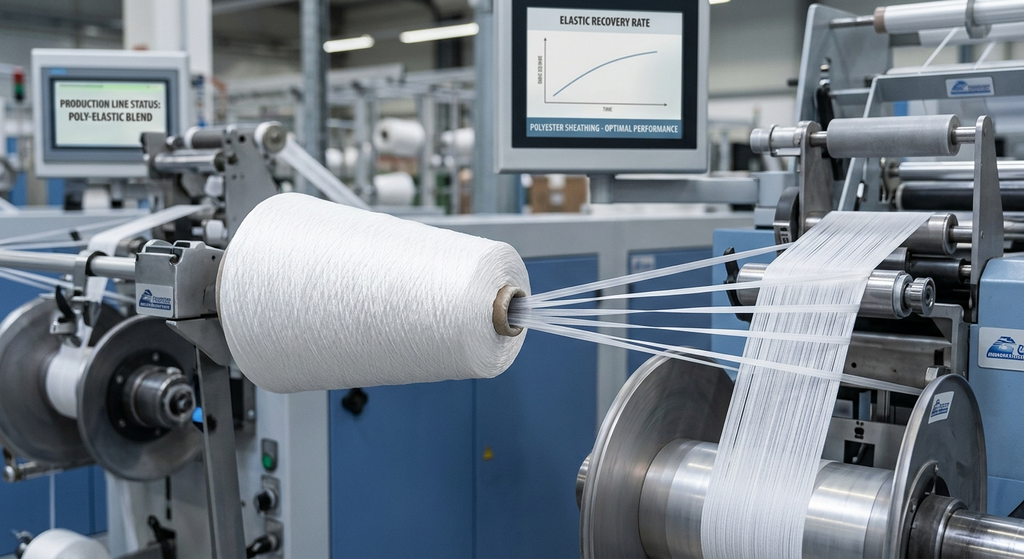
- Strength to weight. Polyester offers high tensile strength for its fineness, which allows slim, light elastics that still carry load.
- Dimensional stability. It holds its shape through heat setting, washing and use, which keeps the width and length of an elastic stable.
- Low moisture absorption. Polyester stays strong when wet, dries quickly and resists mildew, which suits sportswear, swimwear and medical wear.
- Abrasion resistance. It protects the elastic core from rubbing during wear and laundering.
- Colour options. It accepts disperse dyes well and also takes solution dyeing, giving deep shades with good fastness.
- Cost and supply. Polyester is among the most cost-competitive fibres, and the polyester value chain is deep and mature, especially in India. The Textiles Secretary has publicly encouraged mills to diversify into polyester products to capture export opportunities.
- Heat setting. Polyester can be heat set to lock in dimensions, a significant benefit when producing elastic tape that must stay flat.
Polyester is not perfect. It has less natural softness than cotton and can feel slick if the wrong filament structure is used. It also builds static and can pill in certain constructions. These limitations are why yarn selection matters: fine filament counts, good texturing and the right finish oil all reduce them.
Covered Yarn Technology and the Role of Polyester
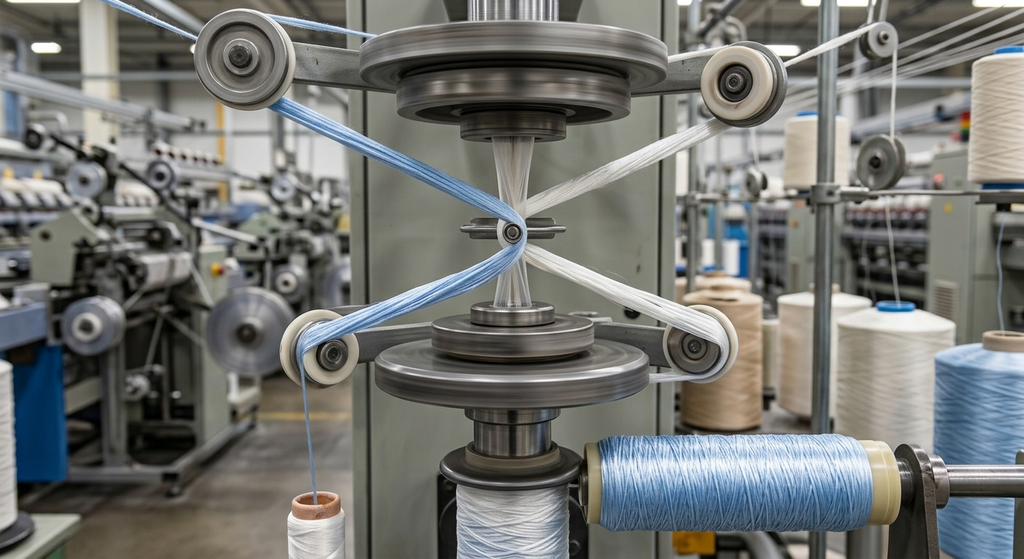
Covered yarn is where polyester and spandex meet most directly. The spandex core is stretched, and polyester filament is wrapped or entangled around it to protect it and give it a textile face. Long-standing industrial patents on covered elastic composite yarn already described a central elastic core covered by relatively inelastic yarns, with the covering supplying surface effects while the core keeps its extension characteristics. One such patent on a covered elastic composite yarn also describes using textured polyester or nylon as the covering yarn, which is still the basic principle used today.
Single Covered Yarn (SCY)
A single wrap of polyester is spiralled around the spandex. SCY is economical and light and is common in hosiery and lightweight knits. Its limitation is that the spandex can show through, and the yarn can twist back on itself.
Double Covered Yarn (DCY)
Two wraps in opposite directions cancel torque and give better balance and coverage. DCY produces a more stable, balanced yarn that runs well in knitting and weaving. It is preferred for premium products.
Air Covered Yarn (ACY)
In air covering, spandex and polyester filament are entangled by compressed air in a jet. It is faster and cheaper than mechanical covering and gives good coverage, although the structure differs from a true wrap. It has become popular for volume applications.
Why Twist and Wrapping Parameters Matter
Research confirms that the wrapping process has a strong effect on covered yarn performance. A study on elastic high-performance covered yarn found that twist level changed strength in distinct stages and that a specific twist produced the best balance of coverage, elasticity and strength. In the study, the wrapping parameters seriously affected yarn performance. The practical lesson for a polyester supplier is that the covering yarn must be consistent in denier, filament count and tension behaviour, because even small variations alter the wrap and the final elastic behaviour.
What a Good Covering Polyester Looks Like
- Fine, uniform denier with tight tolerance, typically from the finer end of the range.
- A filament count that is high enough to give soft coverage without gaps.
- Even, stable texturing so the yarn bulks and covers the core uniformly.
- Clean, consistent oil pickup so that the yarn runs smoothly on covering machines without sticking or shedding.
- Good package build so that the yarn unwinds without snags at covering speeds.
Polyester Yarn Specifications That Matter for Elastic
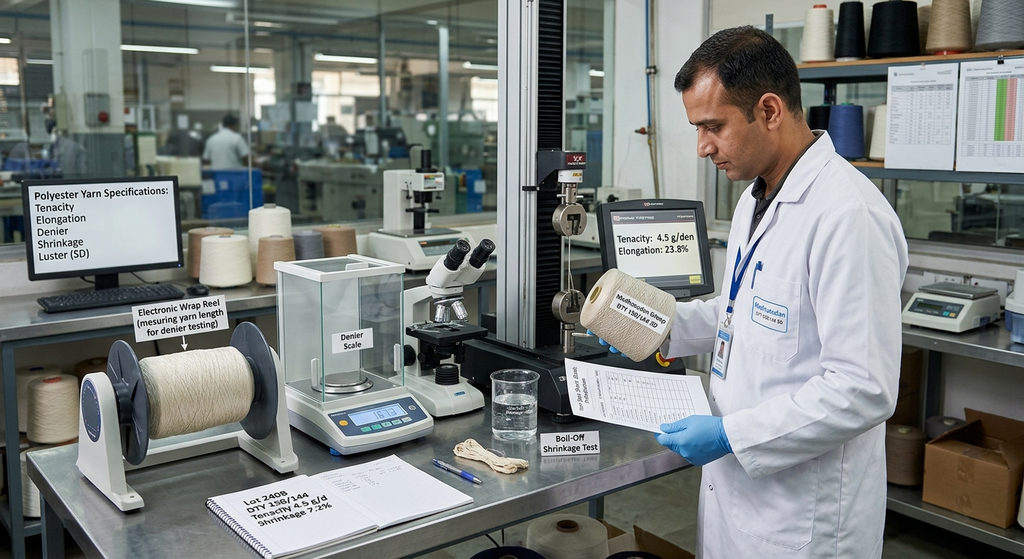
When you write a purchase specification, these parameters matter most. We recommend sending them to your supplier with a sample of your current product.
| Parameter | Why It Matters | What to Specify |
| Denier and filament count | Sets strength, softness and coverage | Target denier, filament count, and tolerance range |
| Luster | Controls look: bright, semi-dull or full-dull | Bright, SD or FD, plus any dope dyed colour code |
| Tenacity and elongation | Decides load carrying ability and loom behaviour | Minimum tenacity and elongation range |
| Boil-off shrinkage | Controls flatness and dimension of the finished elastic | Maximum shrinkage and tolerance between lots |
| Crimp and texture | Decides bulk, softness and coverage | Crimp contraction and stability |
| Oil pickup | Influences running behaviour and dye uptake | Target oil percentage and oil type |
| Interlace or entanglement | Reduces filament breakage on machines | Node count per metre for the process |
| Dye uptake consistency | Prevents shade variation between lots | Dye batch matching and lab dip approval |
| Package form | Affects unwinding and machine efficiency | Cone weight, tube type, and wind angle |
| Certifications | Required by brands and markets | OEKO-TEX, GRS, ISO and so on |
Always request lot-wise test reports and keep retained samples. Variation between lots is the most frequent hidden cause of problems in elastic production.
A Note on Denier Selection
There is no universal “best” denier. Heavy waistband tape usually calls for higher deniers and a robust DTY or FDY, while knitted lingerie elastic works with finer counts for softness. The easiest way to decide is to run trial lots at two adjacent deniers and compare loom efficiency, width, hand and recovery. A supplier that makes a wide range, as Madhusudan Group does, can supply both trial lots quickly so you can decide on evidence rather than guesswork.
Dyeing and Colour Fastness for Elastic
Colour is a major pain point in elastic because the polyester and the elastic core often respond differently to dyes, heat and chemicals. Black and navy are particularly demanding, and white must remain white.]
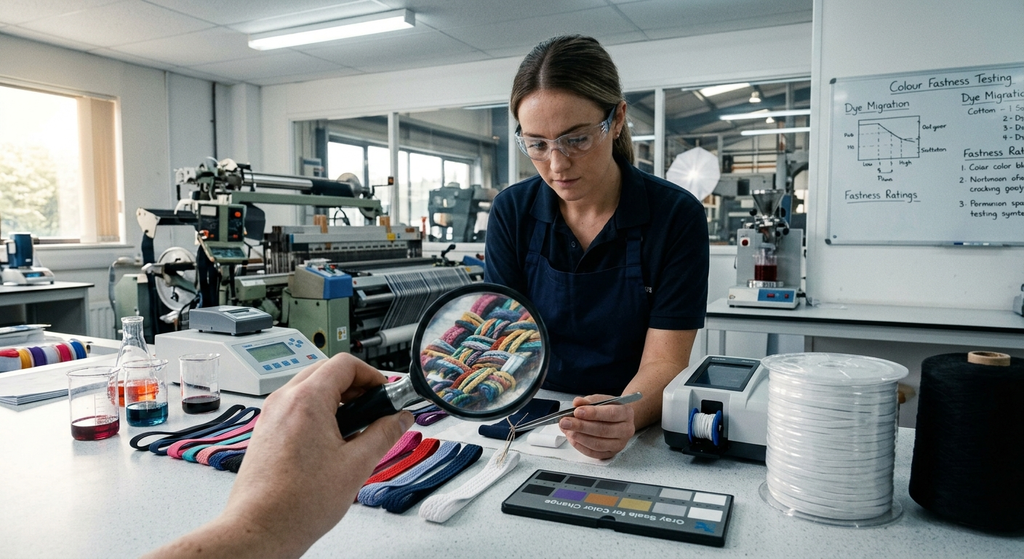
Polyester is dyed with disperse dyes at high temperature and pressure. Spandex and rubber, however, can be damaged by high temperature or can migrate colour. This is why many elastic manufacturers dye the polyester yarn first and then weave it, or use dope dyed polyester, rather than dyeing the finished elastic. Yarn dyeing gives better control over shade and avoids stressing the elastic core.
Key points to control:
- Wash fastness. Elastic is washed repeatedly, so wash fastness must be high, especially for dark shades next to white fabric.
- Perspiration and rubbing fastness. Elastic touches skin directly, and so these ratings matter for comfort and brand claims.
- Light fastness. Important for sportswear, swimwear and outdoor products.
- Sublimation and migration. Disperse dyes can migrate on heat. Choosing dyes with suitable fastness and proper after-clearing reduces the risk.
- Shade consistency. Even a perfect recipe fails if the base yarn varies in dye uptake, so consistency in the yarn itself is the foundation.
For a deep look at process choices and common faults, read our polyester yarn dyeing guide. If you are producing for South American buyers, our companion article on polyester yarn dyeing in South America offers regional detail.
Quality Testing and Certification
Elastic is a safety-critical component in many products, from underwear to medical supports. Buyers therefore expect documented quality.

Physical Testing
A reliable polyester yarn for elastic should be tested for denier, tenacity, elongation, boil-off shrinkage, crimp, oil pickup, interlace and twist where relevant. Lot traceability allows you to match any complaint back to a specific production batch.
Chemical Safety
Skin-contact products must meet chemical limits. The OEKO-TEX STANDARD 100 label is among the best-known textile safety labels. It tests every component of an article for harmful substances, and its criteria catalogue is updated at least once a year. Products are placed into four classes, with stricter limits for items that touch the skin more closely, which is particularly relevant for elastic used in baby wear and underwear. In Europe, brands also screen against the ECHA candidate list of substances of very high concern under REACH, so a supplier who can document compliance saves your team significant time.
Quality Management
A supplier operating under a recognised quality management system is more likely to deliver consistent lots. The ISO 9001 standard sets requirements for a quality management system, and it is a baseline many buyers look for. Read more about what to look for in our guide to an ISO certified yarn supplier.
Questions to Ask Any Supplier
Before you commit to volume, ask for lot test reports, certificate copies, a sample for trials, and a clear complaint handling process. Our checklist of questions to ask before buying yarn is a useful starting point.
Common Problems and How the Right Polyester Solves Them
| Problem | Likely Yarn-Related Cause | Remedy |
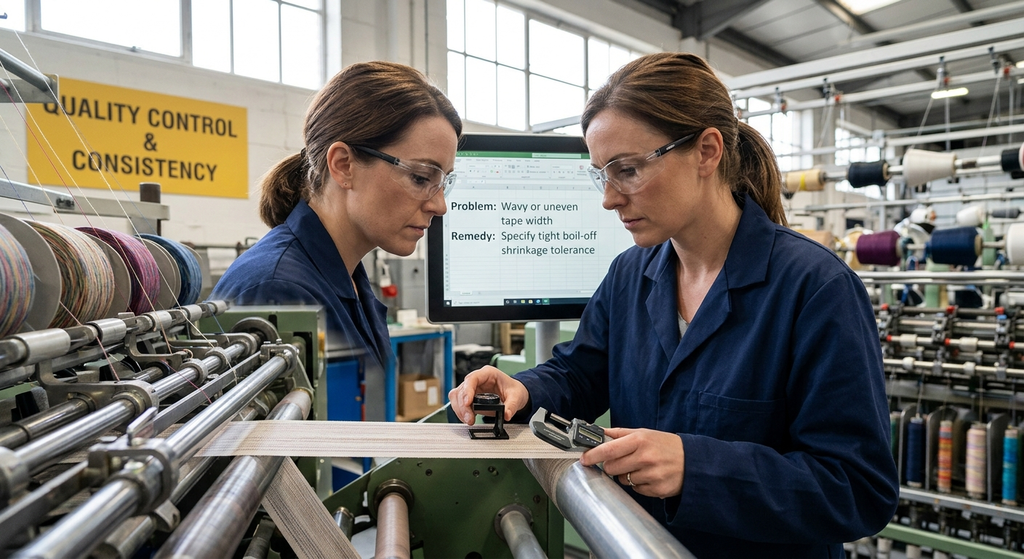
| Wavy or uneven tape width | Shrinkage variation between lots | Specify tight boil-off shrinkage tolerance and check each lot |
| Curling edges | Mismatched tension or crimp between polyester and core | Adjust denier or texturing and balance tension on the loom |
| Shade variation | Variable dye uptake or inconsistent oil | Use consistent yarn lots and dye by lot, or use dope dyed yarn |
| Yarn breaks on machine | Poor interlace, knots or uneven oil | Specify interlace level and lot quality, reduce knots |
| Spandex shows through covering | Covering yarn too coarse or too few filaments | Use finer denier with more filaments or double covering |
| Harsh or slick handfeel | Wrong filament count or texturing | Use finer filaments or ATY for a soft touch |
| Fading after washing | Poor dyeing or low fastness dyes | Re-evaluate dye selection and after-clearing, or use solution dyed yarn |
| Static in processing | Low moisture and wrong finish | Adjust finish oil and humidity control |
Most of these faults can be traced back to a small number of root causes: lot variation, wrong specification and unsuitable finish. This is why a manufacturer with in-house control over spinning, texturing and dyeing offers real advantages over a trader assembling lots from multiple sources. We discuss this difference in our comparison of yarn supplier versus yarn manufacturer.
Polyester Versus Nylon Versus Stretch Polyester for Elastic
Buyers often ask whether polyester is the right choice at all. The honest answer depends on the product.
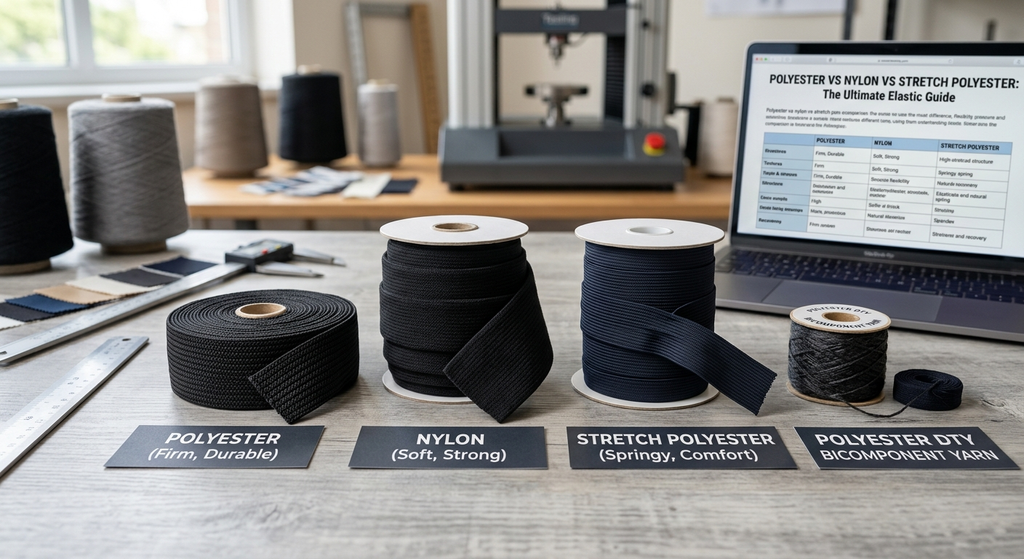
| Feature | Polyester | Nylon | Elastomultiester or Bicomponent |
| Strength | High | Very high | Moderate to high |
| Moisture absorption | Very low | Moderate | Very low |
| Colour fastness | Very good, especially solution dyed | Good | Very good |
| Softness | Good with fine filaments | Very soft | Good, with natural spring |
| Dimensional stability | Excellent | Good | Excellent |
| Cost | Lower | Higher | Moderate |
| Typical use | Waistbands, tapes, general elastic | Hosiery, premium lingerie | Comfort stretch, spandex-light products |
Nylon is softer and very strong, and it remains the first choice for sheer hosiery and some premium innerwear. For a closer look at that fibre, see our nylon DTY yarn manufacturer page. Polyester, however, wins on moisture behaviour, dimensional stability, colour fastness and price, which is why it dominates general elastic. Stretch polyester offers a third path, where the yarn carries its own spring and the amount of spandex can be reduced or removed.
Sustainability: Recycled Polyester Yarn for Elastic
Brands are under pressure to prove environmental credentials, and elastic is no exception. Recycled polyester made from PET waste reduces dependence on virgin raw materials and lowers the carbon footprint of the yarn. The challenge in elastic is that quality must remain as consistent as virgin yarn, because small variations affect tape width, shade and machine running.
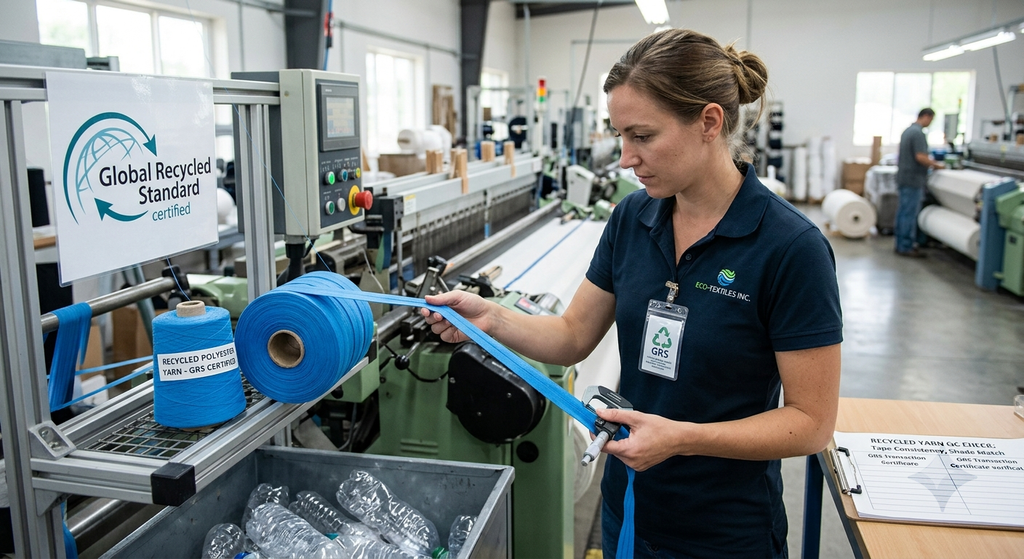
Credible claims need credible proof. The Global Recycled Standard tracks recycled materials through the supply chain and covers traceability, environmental principles, social requirements, chemical restrictions and labelling. Certification requires a minimum of 20 percent recycled material, while the consumer-facing label requires at least 50 percent. Chain-of-custody documents, called transaction certificates, let you verify what you buy.
Practical tips when specifying recycled polyester for elastic:
- Ask for the certificate and verify it with the issuing body.
- Request trial lots and test them on your machines, since recycled yarn may behave slightly differently from virgin yarn.
- Consider blends of recycled and virgin polyester where consistency is critical.
- Pair recycled polyester with solution dyed colour to cut water use even further.
Read more in our guides to recycled polyester yarn and the broader topic of sustainable textiles and the circular economy.
Why Madhusudan Group Leads in Polyester Yarn for Elastic
Choosing a yarn partner is a long-term decision. Elastic makers depend on repeatability, because a single inconsistent lot can stop a loom line or lead to a rejected shipment. This is where Madhusudan Group stands apart.
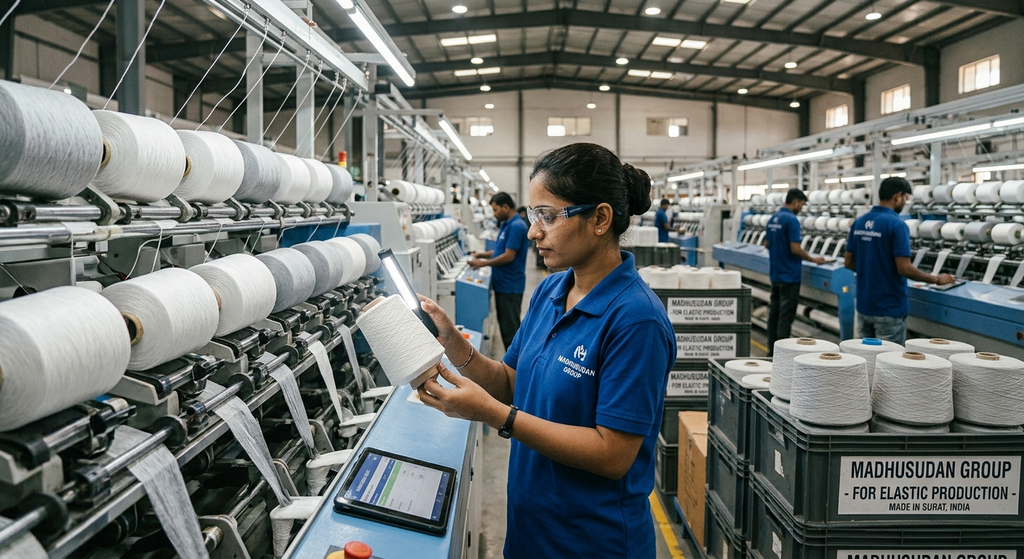
Rooted in Surat, India’s Synthetic Textile Capital
Madhusudan Group operates from Surat, Gujarat, the heart of India’s man-made textile industry, where spinning, texturing, dyeing, weaving and trading clusters sit side by side. Being inside this ecosystem gives access to deep technical skills, quick logistics and a supply chain that responds fast. Read more about the city’s strengths in our overview of yarn manufacturers in Surat and our story on why global brands trust Surat’s textile industry.
A Specialist Range Built Around Stretch
Few suppliers cover as many stretch and specialty categories as Madhusudan Group. The portfolio spans polyester textured yarn, air textured yarn, elastomultiester and bicomponent yarn, mechanical stretch yarn under the Mestre brand, dyed yarn, viscose filament, nylon DTY and recycled polyester. This breadth lets an elastic manufacturer source several yarn types from one partner, simplifying quality control and logistics. Explore our work on mechanical stretch with Mestre and our overall range of stretch yarn.
Manufacturer, Not Just Trader
Madhusudan Group manufactures and controls quality at the source. That means specifications are met by design rather than by selection from mixed lots, and technical queries are answered by people who run the machines. For buyers, this translates into tighter lot-to-lot consistency, which is exactly what elastic production needs.
Quality Systems and Compliance
Documented quality management, lot traceability and test reports are part of how the group works, and the company supports buyers with the certificates their markets require. For more detail, see our page on being an ISO certified yarn supplier.
Customisation and Technical Support
Elastic is rarely a one-size-fits-all product. Madhusudan Group works with customers to adjust denier, filament count, luster, colour and package form to suit a specific loom, covering machine or product. Trial lots, colour matching and application advice are part of the service, which shortens development time and reduces waste.
Export Ready
The group supplies customers across continents and understands the documentation, packing and timing that exporters and importers need. Our practical guides to importing yarn from India to the USA, to Brazil and to Argentina reflect real experience of shipping to these markets.
Committed to Sustainability
From recycled polyester to water-saving dyeing and renewable energy initiatives, Madhusudan Group invests in cleaner production. See our work on reducing water waste in yarn dyeing and the textile industry’s transition to renewable energy.
For elastic manufacturers who want a partner that combines range, consistency, technical depth and export experience, Madhusudan Group is a natural first call.
How to Source Polyester Yarn for Elastic From India
India is among the world’s largest polyester producers and has a mature ecosystem, from polymer to yarn to finished textile. For buyers, that means choice, competitive pricing and strong technical know-how. The government’s own textile policy bodies continue to promote the sector, and the Ministry of Textiles is a useful reference for current schemes and policy updates.
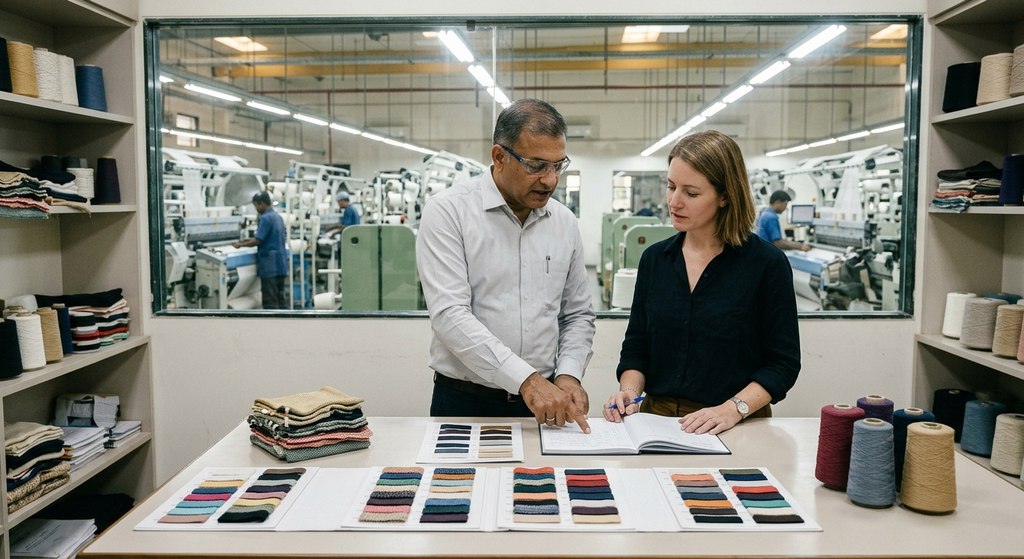
Here is a practical process for sourcing well.
- Define your product. Write down the elastic type, width, load requirement, finish and colour. This makes your inquiry specific and speeds up quotes.
- Share your specification. Include denier, filament count, luster, shrinkage target, package form and certificates required. If you are unsure, send a sample and ask the supplier to match it.
- Request samples and trial lots. Test the yarn on your own machines, and compare it with your current yarn on width, hand, recovery and running efficiency.
- Verify certifications. Ask for current certificates and verify them with the issuing bodies, particularly for OEKO-TEX, GRS and ISO claims.
- Agree on lot control. Fix tolerance limits and ask for lot-wise reports so that variation is documented.
- Plan logistics and duties. Understand the Incoterms, packing method and import duty. For the American market, our guide to US import duty on yarn from India is a good starting point.
- Build a relationship. Reliable supply comes from long-term partnerships. Consider blanket orders or scheduled call-offs to secure capacity.
If you buy in volume, our overview of bulk yarn supply from India explains minimum quantities, packing and delivery planning. For a wider view of exporters and suppliers, see our resources on polyester yarn suppliers in India and textile yarn exporters in India.
Storage, Handling and Processing Tips for Elastic Producers
Even excellent yarn can perform badly if it is stored or handled carelessly. A few simple habits protect your investment and keep your machines running at full efficiency.
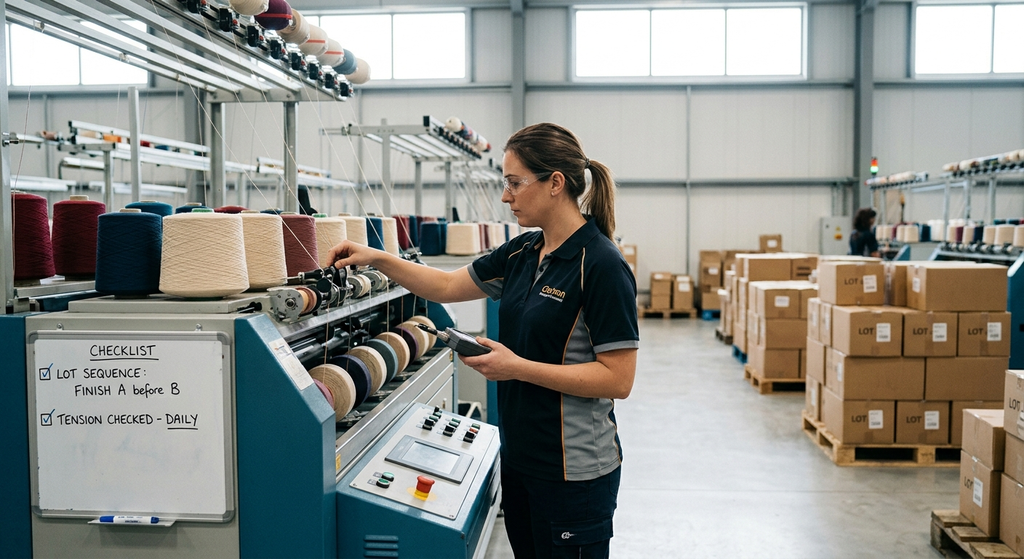
- Condition the yarn before use. Let cones rest in the production area for a day or so, so that moisture and temperature settle before they go onto the loom or covering machine.
- Store away from sunlight and heat. Ultraviolet light and high temperature can alter surface finish and dye behaviour, so keep cartons sealed and off the floor.
- Use lots in sequence. Finish one lot before starting the next on the same product, and never mix lots within a single tape or order. This is the easiest way to avoid shade and width variation.
- Keep tension consistent. Check tension devices regularly, because worn guides and dirty tensioners are among the most common reasons for edge curl and uneven width.
- Record everything. Note lot numbers, machine settings and finishing conditions for every order, so that any complaint can be traced and corrected quickly.
Teams that follow these habits typically see fewer stoppages, less waste and more repeatable quality from one order to the next.
Emerging Trends in Polyester Yarn for Elastic
The elastic market is changing, and suppliers who anticipate those changes will serve you better.
Spandex-light and spandex-free stretch. Mechanical stretch yarns such as elastomultiester and bicomponent are growing because they offer comfort stretch with better durability and simpler recycling. Brands exploring mono-material garments find these yarns especially interesting.
Recycled and traceable content. Brands want proof, not promises. Transaction certificates and digital traceability are becoming expected rather than optional.
Solution dyed colour. Water and energy savings make solution dyeing attractive, and its excellent fastness suits elastic that is washed often.
Performance and comfort. Sportswear and athleisure keep raising expectations for soft, moisture-managing, durable elastics.
Digital manufacturing. Process monitoring and data-driven quality control are improving consistency, as we explore in our piece on the impact of digital transformation on textile manufacturing.
Frequently Asked Questions
What is polyester yarn for elastic used for?
It is used as the ground, covering or binding yarn in elastic tapes, bands, webbing, covered yarns and knitted elastics. It provides strength, colour and a textile surface, while a rubber or spandex core provides the stretch.
Which polyester yarn is best for elastic tape?
For most elastic tape, textured polyester (DTY) in the appropriate denier is the standard choice because it is strong, stable and easy to dye. FDY suits flat, lustrous tapes, and high-tenacity yarn suits heavy-duty webbing. The best choice depends on the tape’s load, look and loom.
Can polyester itself be elastic?
Standard polyester has limited stretch, but elastomultiester and bicomponent polyester yarns develop a spring-like crimp that gives mechanical stretch. They are used where spandex-free or spandex-light stretch is wanted.
What is the difference between covered yarn and air covered yarn?
Covered yarn wraps a polyester filament mechanically around a spandex core, either once (single covered) or twice in opposite directions (double covered). Air covered yarn entangles the polyester and spandex with compressed air in a jet. Air covering is usually faster and cheaper, while mechanical covering gives a more defined wrap.
Is dope dyed polyester better for elastic?
Dope dyed polyester has the colour built into the fibre, which provides excellent fastness and saves water. It is particularly good for black, white and dark shades. Yarn dyeing offers a broader palette and quicker colour change, so the right choice depends on volume and colour needs.
How do I check the quality of polyester yarn for elastic?
Ask for lot-wise test reports covering denier, tenacity, elongation, shrinkage, crimp, oil pickup and interlace. Run trial lots on your own machines and check certificates such as OEKO-TEX, GRS and ISO with the issuing bodies.
Why source polyester yarn for elastic from India?
India has a deep and mature polyester value chain, a large pool of technical skills and competitive pricing. Clusters such as Surat offer spinning, texturing and dyeing in close proximity, which shortens lead times and supports customisation.
Does Madhusudan Group supply polyester yarn for elastic manufacturers?
Yes. Madhusudan Group supplies polyester textured yarn, air textured yarn, elastomultiester and bicomponent yarn, mechanical stretch yarn, dyed yarn and recycled polyester, along with trial lots, colour matching and technical support for elastic and narrow fabric producers.
Conclusion: Choose the Yarn That Makes Your Elastic Perform
The elastic core may do the stretching, but polyester does almost everything else. It supplies the strength, the colour, the surface, the shape retention and a large share of the comfort. Choosing the right polyester, and the right partner, therefore decides whether your elastic is merely acceptable or truly excellent.
Start with a clear specification, test trial lots on your own machines, insist on lot-wise data and certifications, and look for a manufacturer who understands elastic from the inside. With deep roots in Surat, a wide specialist range spanning textured, air textured, mechanical stretch and recycled polyester, and a commitment to consistency and sustainability, Madhusudan Group is well placed to be that partner.
Ready to develop your next elastic? Share your specification with the Madhusudan Group team, request samples, and see for yourself how the right polyester yarn changes the way your elastic runs, looks and performs. You can also explore our wider guide to yarn for elastic for more on the product category.