Yarn dyeing in Morocco is a small but strategic part of a textile industry that ships more than €2.7 billion of clothing and fabric to the European Union every year. Most of that volume is cut-and-sew work. The colour inside it, however, starts much earlier, at the yarn stage, and that is where buyers win or lose on shade consistency, lead time and EU compliance.

If you run a knitting mill in Tangier, a denim and woven fabric unit near Casablanca, or a garment factory in Fès that supplies a European brand, you already know the pressure. Brands want tighter shade tolerances, certified chemistry and shorter lead times. At the same time, local dyehouses face water limits, rising energy costs and a customs framework that rewards deeper local processing. Dyed yarn is one of the few levers that touches all three problems at once.
This guide explains how yarn dyeing in Morocco works today, which dye systems suit which fibres, what quality and sustainability checks European buyers now expect, and how to decide between local dyeing and imported dyed yarn. It is written for sourcing managers, mill owners and product developers who need practical answers rather than general theory.
In this guide you will learn:
- how big the Moroccan textile sector is and where dyeing capacity sits
- when yarn-dyed construction beats piece-dyed fabric
- which dye class matches polyester, nylon, viscose, cotton and linen
- the dyeing process step by step, from lot approval to cone delivery
- which tests, certificates and EU rules protect your orders
- how rules of origin shape the make-or-buy decision for yarn
- what to ask any supplier before placing a bulk order
Who is behind this guide. Madhusudan Group is a Surat-based yarn manufacturer and exporter that dyes and supplies polyester, nylon, viscose, linen and specialty yarns to mills in Europe, Africa and the Americas. The advice below comes from the same production and export checklists the group uses with its overseas buyers, backed by current public data you can verify through the links provided.
A note on scope: figures for Morocco’s textile trade move monthly, so the numbers below carry their source and date. Where a rule or standard changes often, you will find a pointer to the official text instead of a paraphrase from memory.
Morocco’s Textile Landscape: Where Dyeing Fits
Morocco ranks eighth among suppliers of textiles and clothing to the EU, and the value of those shipments is still growing. According to Eurostat-based figures reported by Hespress in August 2026, exports to the EU passed €2.5 billion in 2024 and €2.79 billion in 2025, and reached about €1.05 billion in the first five months of 2026. The average price per kilogram also rose to €25.90 in that period, a sign that the mix is moving slowly toward higher-value goods.

| Indicator | Figure | Period |
| EU rank among textile and clothing suppliers | 8th | January to May 2026 |
| Textile and clothing exports to the EU | Above €2.79 billion | 2025 |
| Share of EU textile and clothing imports | 2.7% | 2025 and January to May 2026 |
| Average export price | €25.90 per kg | January to May 2026 |
The picture is not uniformly positive. A Le360 interview with industry expert Jean-François Limantour notes that Moroccan finished clothing exports fell 3.9% and knitted goods 7.4% in 2025, and he argues that the sector must move beyond subcontracting. Morocco’s decline in the EU market was smaller than that of several larger rivals, but the warning is clear: value added has to rise.
Where the industry sits
The industry concentrates in three regions. A UNIDO-based report covered by Hespress names Fès-Meknès, Tanger-Tetouan-Al Hoceima and Casablanca-Settat as the main hubs, and puts about 77% of the country’s textile waste in the Casablanca (42%) and Tangier (35%) areas. That geography matters for yarn buyers because dyehouses, knitting mills and garment makers cluster near the same ports and motorways.
- Tangier and Tetouan: fast-fashion garment and knitwear supply for Spain and France, close to the Tanger Med port.
- Casablanca and Settat: denim, woven fabric and finishing, plus the main trade fair venue, home to Morocco in Mode and Morocco Stitch & Tex.
- Fès and Meknès: garment production and newer integrated investments in spinning and fabric.
Why yarn dyeing is the missing link
Historically, Morocco built its strength on assembly: cutting, sewing and finishing for European brands that buy fabric elsewhere. Upstream processes, spinning, yarn dyeing and fabric weaving or knitting, are thinner. Buyers often import fabric from Turkey or Asia, or import yarn and knit locally. A growing number of mills are now closing this gap, which creates demand for stable, certified dyed yarn from overseas partners while local dyeing capacity matures.
Other textile economies show the same shift. In North Africa, yarn dyeing in Egypt has expanded alongside a large domestic cotton base. In South Asia, yarn dyeing in Sri Lanka grew around apparel exporters that wanted shade control close to the knitting floor. Morocco is following a similar path, with proximity to Europe as its main advantage and water, energy and rules of origin as its main constraints.
Yarn-Dyed vs Piece-Dyed: Which Route Fits Your Product
Yarn-dyed means the colour goes into the yarn before it becomes fabric. Piece-dyed means a finished fabric roll or garment is dyed afterwards. Both exist in Morocco, and the right choice depends on the pattern, the fibre, the order size and how fast the brand changes colours.

Yarn-dyed construction is the only way to make stripes, checks, melange effects, jacquard patterns and many denim and shirting looks, because the pattern comes from different coloured yarns interlaced in the fabric. It also gives deeper, more even colour penetration, since dye reaches the fibre core before twisting, knitting or weaving compress it. Piece dyeing is faster and more flexible for solid colours, because the mill can hold undyed greige fabric and dye to order.
| Factor | Yarn-dyed | Piece-dyed |
| Best for | Stripes, checks, melange, jacquard, premium solids | Solid colours, fast fashion, small colour runs |
| Colour depth and evenness | High, dye penetrates the fibre core | Good, can show surface variation on heavy fabrics |
| Lead time for colour changes | Longer, yarn must be dyed and re-wound first | Shorter, dye from greige stock |
| Minimum order | Higher per shade, set by dye lot size | Lower, flexible per roll |
| Inventory risk | Higher, shades are committed early | Lower, stock stays neutral |
| Fastness performance | Often better for wash and light | Depends on finishing quality |
For Moroccan exporters the trade-off is practical. Spanish and French retailers reorder in short cycles, so many garment makers favour piece dyeing for basics. But when a collection depends on pattern, such as shirting, workwear, knitted stripes or sports fabrics with colour-blocked yarns, yarn-dyed supply is not optional.
When dyed yarn makes the most sense
- Pattern-driven fabrics. Stripes, checks and jacquards cannot be piece-dyed.
- Higher fastness targets. Brands that test to strict wash and light grades often prefer yarn dyeing.
- Shade-critical programmes. A single dye lot of yarn can feed several fabric batches, which reduces shade variation across a season.
- Recycled and blended yarns. Different fibres in a blend can take different dyes, and controlling that at yarn stage is simpler than correcting it on finished cloth.
- Short Moroccan lead times. Buying ready-dyed cones from a dyed yarn manufacturer lets a Moroccan knitter or weaver start production without waiting for local dyehouse slots.
The next question is chemistry. Each fibre needs a matching dye class, and getting that match wrong causes most of the shade complaints mills report.
Dyeing Methods by Yarn Type: What Works for Moroccan Mills
No single dye works on every fibre. Matching dye class to fibre is the foundation of good yarn dyeing, and it decides cost, fastness and effluent load. The table gives the standard pairings used across the industry.

| Yarn | Typical dye class | Typical conditions | Watch-outs |
| Polyester (filament, spun, textured) | Disperse dyes | High-temperature, pressurised package dyeing around 130 °C, followed by reduction clearing | Dark shades need thorough clearing for rubbing and wash fastness |
| Nylon (DTY, FDY) | Acid dyes, metal-complex dyes for deep shades | Hot acid bath with levelling agent | Uneven stretch or draw can cause barré, visible striping in knitted fabric |
| Viscose | Reactive dyes | Alkaline salt bath, then soaping off | Wet strength is low, so tension and winding density need care |
| Cotton | Reactive, direct or vat dyes | Salt and alkali exhaust dyeing | Heavy shades use the most water and salt |
| Linen | Reactive or vat dyes after scouring and bleaching | Longer pre-treatment because of natural impurities | Natural variation means shade matching is harder |
| Blends (polyester and cotton, for example) | Two dye classes in one or two baths | Dyed in sequence to protect each fibre | Cross-staining if the sequence is wrong |
Polyester
Polyester dominates sportswear, knitwear linings, elastic tapes and home textiles, and it is also the fibre most Moroccan buyers import in dyed form. Disperse dyes enter the fibre at high temperature, so the dyeing is done in pressurised machines. After dyeing, a reduction-clearing step removes loose dye from the surface. Skipping or shortening that step is the classic reason polyester fails rubbing tests. Our polyester yarn dyeing guide walks through machine settings, and the companion page on dyed polyester yarn explains how to read shade cards and lot approvals.
Nylon
Nylon is the stretch and comfort fibre in hosiery, activewear and seamless knits. Because small differences in draw and texturing show up as colour differences, nylon is more sensitive than polyester to raw material consistency. Buying from a nylon DTY yarn manufacturer that controls both texturing and dyeing reduces that risk, since the same quality team sees the yarn before and after colour.
Viscose and cotton
Cellulosic yarns take reactive dyes, which form a chemical bond with the fibre and give good wash fastness when fixed and washed off correctly. Viscose is softer and more fragile when wet than cotton, so the winding density, tension and drying temperature all matter. For details on shade depth, handling and fastness, see this guide to viscose yarn dyeing.
Linen
Linen has become a growth category for European premium brands, and it is one of the hardest fibres to dye evenly because of its natural waxes, pectins and varying fibre structure. Longer scouring and bleaching are normal, and mills should expect slight tonal variation between lots. Our overview of linen yarn dyeing explains how to set realistic tolerances with a supplier before the order is confirmed.
Machinery and automation in Morocco
Machine suppliers are investing in the region. German finishing-technology maker Monforts, for example, announced its presence at the Morocco Stitch & Tex 2025 exhibition in Casablanca, citing efforts across the region, and Morocco in particular, to expand upstream textile and finishing capacity. For a buyer, the practical takeaway is that local dyehouses are modernising, but capacity for pressurised package dyeing of technical yarns is still limited compared with Turkey, India or China.
Solution-dyed alternatives
For some polyester and nylon programmes, solution-dyed (also called dope-dyed or spun-dyed) yarn is an option. The pigment goes into the polymer before extrusion, so no water-based dyeing happens afterwards. Shade range is narrower and minimum orders are higher, but water and energy use fall sharply, and fastness is excellent. It is worth asking about wherever a brand has strict water targets.
The Yarn Dyeing Process, Step by Step
A reliable yarn dyeing process is repeatable. It follows the same steps for every lot, records the same parameters and ends with testing before a single cone ships. The sequence below is the version most export-focused dyehouses use for package-dyed yarn. If you want the upstream picture, our yarn manufacturing process guide covers how the yarn is made before it reaches the dye bath.

Package dyeing vs hank dyeing
- Shade brief and lab dip. The buyer sends a reference (Pantone, physical swatch or spectrophotometer data). The lab produces small dips under the buyer’s lighting standard, usually D65 daylight plus a second illuminant, and the buyer approves one.
- Raw yarn inspection. The dyehouse checks denier or count, twist, oil content and uniformity. Undyed yarn that is uneven will give uneven colour, however good the dyeing.
- Winding onto dye packages. Yarn is wound onto perforated springs or tubes at a controlled density. Density that is too tight or too loose is a leading cause of unlevel dyeing.
- Pre-treatment. Scouring removes oils and impurities. Cellulosics are often bleached, and polyester may get a heat set so it stays stable in the dye bath.
- Dyeing. The packages sit in a pressurised vessel while the dye liquor circulates from inside to outside and back. Temperature, pH, time and chemical dosing are programmed and logged.
- After-treatment. Polyester gets reduction clearing, cellulosics get soaping off and a fixing agent, nylon may get a syntan fixation.
- Softening and lubricating. A light finish prepares the yarn for knitting or weaving, protecting needles and shuttles.
- Drying. Packages are dried by radio frequency or hot air to a target moisture.
- Re-winding and packing. Yarn is re-wound onto cones, labelled by lot and shade, and packed to protect against moisture and dust.
- Final testing and release. The lot is compared with the approved lab dip for colour difference and tested for fastness, as described in the next section.
Two systems cover most commercial yarn dyeing. Package dyeing (cones or cheeses in a pressurised kier) is the standard for polyester, nylon and fine cotton because it gives high volume, repeatable shades and low labour cost. Hank dyeing (loose skeins in an open bath) gives a softer, bulkier hand and is used for acrylic, wool, high-bulk and some premium knitting yarns, but it needs more labour and more floor space.
| Feature | Package dyeing | Hank dyeing |
| Typical use | Polyester, nylon, cotton, viscose | Acrylic, wool, high-bulk and fancy yarns |
| Hand feel | Firm, consistent | Soft, bulky |
| Productivity | High | Lower |
| Shade repeatability | Very high | Good, with more operator influence |
| Cost per kilogram | Lower at volume | Higher |
Controls that separate good dyehouses from average ones
Three controls make the biggest difference. The first is liquor ratio and water control, since a lower ratio saves water, energy and chemicals. The second is computerised recipe prediction and dosing, which reduces the human variation that causes batch-to-batch drift. The third is a documented right-first-time rate for shade matching. Ask any supplier, in Morocco or overseas, for this number, because a dyehouse that redyes frequently loses money and tends to cut corners on rinsing.
Quality and Compliance: Tests and Certificates EU Buyers Expect
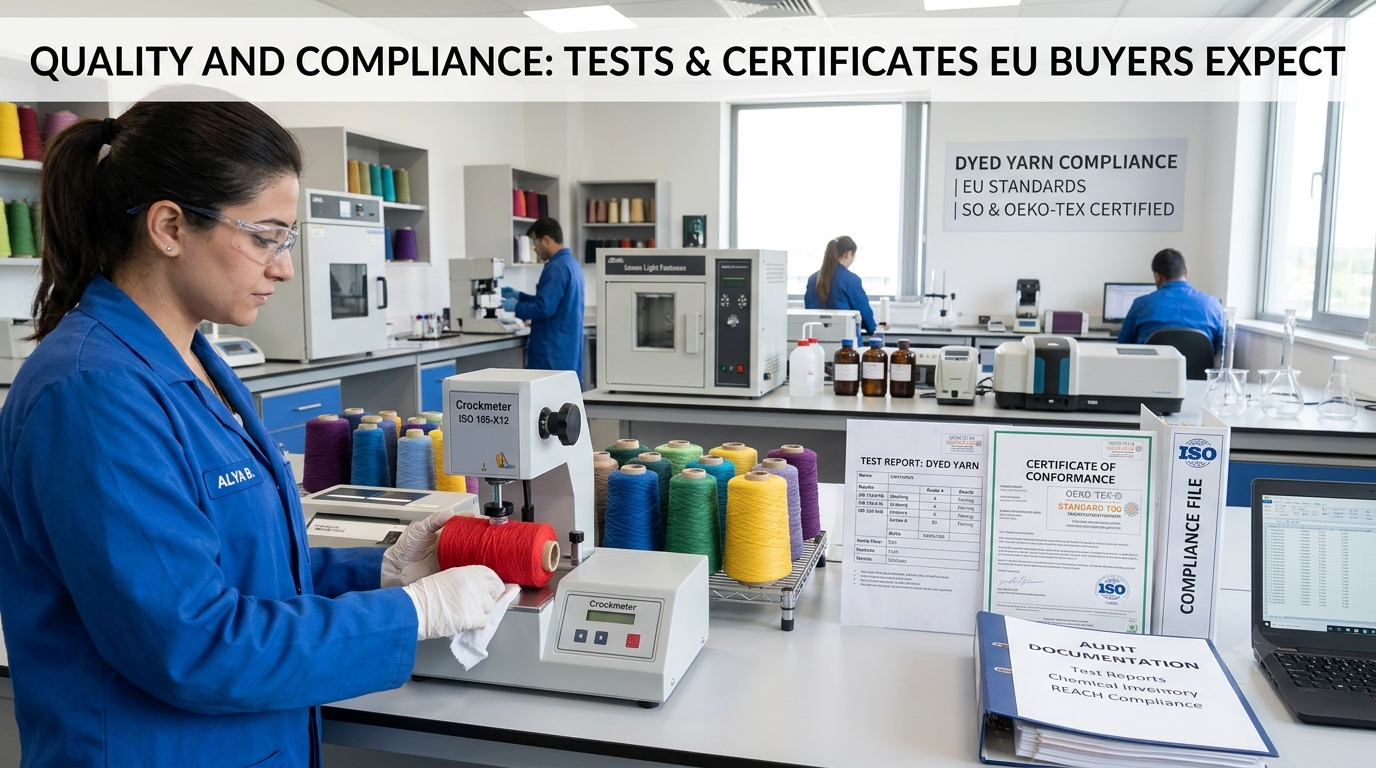
A beautiful shade is worth little if the yarn fails a lab test. European brands apply two layers of control: performance testing (does the colour stay put?) and chemical safety (is the dye system clean?). Dyed yarn bound for Moroccan mills that export to the EU should be ready for both.
Colorfastness testing
The ISO 105 series is the global reference for colour fastness. The key methods for dyed yarn are:
| Test | Method | What it checks |
| Rubbing (dry and wet) | ISO 105-X12 | Colour transfer onto a white cloth |
| Washing | ISO 105-C06 | Colour loss and staining in laundering |
| Light | ISO 105-B02 | Fading under xenon-arc light |
| Perspiration | ISO 105-E04 | Colour change and staining from sweat |
The ISO 105-X12 standard covers rubbing fastness for textiles of all fibres, in yarn or fabric form, whether dyed or printed, with one dry and one wet rubbing test. Results are graded from 1 (poor) to 5 (excellent) against grey scales. As a working rule, most brands expect grade 4 or better for dry rubbing, grade 3 to 4 for wet rubbing on dark shades, and at least grade 3 to 4 for washing. Always confirm the grade in the brand’s own specification, because those numbers vary by product and retailer.
Chemical safety and certification
European buyers check chemistry through three routes.
- OEKO-TEX STANDARD 100. This independent label tests textiles from raw material to finished product against a limit-value catalogue. According to the OEKO-TEX factsheet, it uses four product classes (the stricter classes apply where skin contact is more intense), draws on REACH restrictions and the SVHC candidate list, and each certificate is valid for one year.
- ZDHC MRSL conformance. The Zero Discharge of Hazardous Chemicals programme maintains a manufacturing restricted substances list for dye and chemical formulations. As Ecotextile News reported, ZDHC accepts the OEKO-TEX Eco Passport as an indicator that a formulation conforms to level one of its MRSL, which is why many dyehouses buy Eco Passport-listed chemicals.
- Brand restricted substance lists. Large retailers add their own RSL on top of REACH. Banned azo dyes, heavy metals, formaldehyde and PFAS are typical entries.
An ISO certified yarn supplier adds a management-system layer, with documented procedures, calibrated equipment and traceable lots, but ISO 9001 or 14001 certification does not replace product-level tests. The best practice is to ask for the test report and the certificate number for the exact article you are buying, and to check that the certificate scope includes dyeing.
Documentation that speeds up audits
Keep a compliance file for each dyed yarn programme: the approved lab dip, the lot test reports, the chemical inventory with safety data sheets, the OEKO-TEX or equivalent certificate, and the origin documents. When a brand auditor or a customs officer asks, you can answer in minutes instead of days.
Sustainability, Water and the EU Rules Reshaping Dyeing
Dyeing is the most water- and chemical-intensive step in making coloured textiles, and it is where regulators and brands now look first. For Morocco, which sells most of its textile output to Europe, EU policy sets the direction of travel even though the rules are written in Brussels.

Morocco’s wastewater lesson: the Tintcolor case
The clearest local example comes from Tangier. The European Investment Bank describes how Tintcolor, a dyeing company later bought by Spain’s Hallotex, was traced in 2018 as the source of beach pollution after discharging up to 700 cubic metres of lightly treated water a day. Within three months it installed a €500,000 biological treatment plant, part-financed through the EU-backed Ligne Bleue programme. The plant now treats about 60% of its water, and the company plans further equipment so that the rest can be reused in dyeing, saving around 500 cubic metres a day. It also widened its client base to include several large European brands, because ESG compliance became a commercial advantage rather than only a cost.
The message for every dyehouse is the same: effluent treatment is a licence to supply, not an optional extra.
What the EU is changing
The EU Strategy for Sustainable and Circular Textiles, adopted by the European Commission in March 2022, sets a 2030 vision in which textiles sold in the EU are durable, repairable, recyclable, largely made from recycled fibres, free of hazardous substances and produced with respect for social rights and the environment. The Commission also notes that only about 1% of material in clothing is recycled into new clothing, which explains the policy push.
The main legal tool is the Ecodesign for Sustainable Products Regulation (ESPR). As Bleckmann’s summary of the strategy explains, the ESPR entered into force on 18 July 2024, introduces a Digital Product Passport that carries sustainability and repairability data, and bans the destruction of unsold textiles and footwear. Product-specific textile requirements are being developed through delegated acts, so check the current status before you finalise a spec.
For a yarn buyer, three consequences follow:
Practical water and energy savings
- Traceability. A Digital Product Passport only works if suppliers can trace fibre, dye chemistry and process data back to the lot.
- Chemical transparency. Dye and auxiliary suppliers will need to disclose more, which favours ZDHC-aligned chemistry.
- Recycled content. Brands will ask for verified recycled fibre. Recycled polyester yarn dyed with disperse dyes is already the most common route, and it keeps the same shade range as virgin polyester when the process is controlled.
Dyehouses in Morocco and elsewhere can cut impact without large capital spending:
- lower liquor ratios and optimised rinsing cycles
- heat recovery from hot effluent
- reusing final rinse water for pre-treatment
- right-first-time shade matching to avoid redyeing
- solution-dyed yarn for programmes where the shade range allows it
These steps cut cost as well as environmental load, so they usually pay back faster than buyers expect.
Local Dyeing or Imported Dyed Yarn: Rules of Origin and Sourcing Strategy
The core sourcing question for Moroccan mills is whether to dye yarn locally or import it already dyed. Neither answer is always right. The decision turns on volume, shade complexity, lead time and, increasingly, how the customs rules treat each input.

How rules of origin shape the decision
Moroccan garments reach the EU duty-free only if they qualify as originating under the EU-Morocco association agreement. Just Style, in its feature on how Morocco is redefining its role in fashion production, identifies the duty-free rules of origin as one of the biggest challenges for access to Morocco’s key markets in France and Spain. An ITC expert in the same coverage says Morocco struggles with the double transformation requirement, which in practice asks for both fabric production and making-up to happen within the preferential zone.
The rules are written product by product. For example, the Trade Hub’s entry for HS 5208 (light woven cotton fabric) shows a specific-processing rule of manufacture from single yarn, with a 10% tolerance of ex-works value. In plain terms, yarn is the allowed starting point for that fabric, which is why imported dyed yarn does not by itself break origin when the fabric is then woven in Morocco or in a cumulation partner country.
The framework is also changing. A 2025 EU-Morocco Association Council decision points Protocol 4 to the revised Regional Convention on pan-Euro-Mediterranean preferential rules of origin and sets transitional rules applicable from 1 January 2025. Because the text is technical and amendments continue, confirm the current rule for your exact HS code with a customs adviser before you design a supply chain around it.
Local dyeing vs imported dyed yarn
| Question | Dye locally in Morocco | Import dyed yarn |
| Shade range and technical fibres | Limited for pressurised polyester, nylon and specialty yarns | Wide, from dyehouses built for these fibres |
| Lead time for a new colour | Short if capacity exists, queues if not | Longer on the first order, then predictable on repeat orders |
| Cost at volume | Rises with energy and water costs | Often lower per kilogram, plus freight and duty |
| Compliance paperwork | Depends on the individual dyehouse | Test reports and certificates can be bought per lot |
| Flexibility on small runs | Strong | Needs MOQ planning |
| Origin impact | Adds local processing | Usually neutral for fabric made in Morocco, but check the HS code |
A blended strategy works best
Most successful Moroccan buyers combine both. They dye basic or fast-turn colours locally and import dyed yarn for technical fibres, fashion shades that must repeat exactly, and certified lines for brands with strict chemical rules. If you are weighing Indian sources, our guides on how to import yarn from India to Brazil and how to import yarn from India to the USA outline the documents, lead times and duty questions that apply to any destination, including Morocco.
Logistics to plan for
- Port flow. Most Indian cargo reaches Morocco by sea through Tanger Med or Casablanca. Congestion at Tanger Med has been reported by Moroccan media, so build buffer time into your calendar.
- Incoterms. FOB or CIF quotes should state the dye lot size, packing and test-report timing.
- Documentation. Commercial invoice, packing list, bill of lading, certificate of origin and test reports should all carry matching lot numbers.
- Duty. Check the current Moroccan import duty and VAT treatment for your yarn code before costing.
Why Madhusudan Group Is a Trusted Dyed Yarn Partner for Moroccan Mills
Madhusudan Group is built for the buyer profile this guide describes: a Moroccan knitter, weaver or garment exporter who needs coloured yarn that repeats, tests clean and arrives with paperwork that stands up to an EU brand audit. The group is based in Surat, India’s textile and man-made fibre capital, and it works as a manufacturer rather than a trading intermediary, which shortens the chain between your shade request and the dyeing floor. For the wider picture of the country’s supply base, see our overview of yarn manufacturers in India.

What sets the group apart
- A broad yarn range under one roof. Polyester, nylon DTY, viscose filament, linen, recycled polyester, air-textured yarn, elastomultiester and bicomponent yarns are all covered on our site, so a mill that needs several fibres for one collection can consolidate suppliers and shipments.
- Dyeing as a core process, not an outsourced step. Controlling dyeing close to yarn production keeps raw material, dye recipe and finishing under one quality system, which is exactly where shade drift usually starts.
- Documentation built for export. Lot-wise test reports, shade approvals and certificates are part of how orders are prepared, so your compliance file is complete when the cargo lands.
- Management-system discipline. The group publishes its approach to quality in its guide to being an ISO certified yarn supplier, which gives buyers a clear view of how lots are tracked.
- Export experience across regions. Content on the site covers dyed yarn for markets from Egypt and Sri Lanka to Brazil, Peru and Colombia, and the same shipping, packing and documentation habits apply to North Africa.
Why this matters to a Moroccan buyer
Moroccan mills sit between two pressures: the speed Spanish and French customers expect, and the compliance load of EU regulations. A supplier that offers repeatable shades, certified chemistry and clear lot records takes weight off both. Because yarn is the input in the origin rules for many fabric codes, an Indian dyed yarn supply chain does not by itself block preferential treatment when fabric is made locally, although each HS code should be checked.
How a typical project starts
- Share the brief. Send the fibre, count or denier, end use, shade references and monthly volume.
- Receive lab dips. The team prepares dips matched to your lighting standard for approval.
- Approve a sample lot. Test it in your own knitting or weaving process before committing.
- Place the bulk order. Agree dye lot size, packing, Incoterm and test-report timing.
- Repeat with confidence. Approved recipes are stored, so reorders match the first lot.
If you are comparing sources, the questions in the checklist below apply to us as much as to anyone else. A good supplier welcomes them.
Buyer Checklist: 12 Questions Before You Order Dyed Yarn
Use this list with any dyehouse or exporter. It builds on our longer guide to the questions to ask before buying yarn and focuses on dyed supply for Morocco.
- Is the supplier the manufacturer, or a trader? (Supplier vs manufacturer explained)
- Which dye class and process will be used for my fibre?
- What is the right-first-time rate for shade matching?
- What shade tolerance (Delta E) is guaranteed against the approved lab dip?
- Which ISO 105 grades are achieved for rubbing, washing, light and perspiration?
- Is there a current OEKO-TEX STANDARD 100 certificate, and does its scope include the dyed article?
- Are chemicals ZDHC MRSL conformant, and can the supplier show the inventory?
- How is wastewater treated, and is there a discharge permit or audit report?
- What are the minimum order quantity per shade and the dye lot size?
- How are lots numbered, packed and tracked, and how long are retained samples kept?
- What is the lead time for repeat orders, and how are delays communicated?
- Which origin and customs documents will accompany each shipment?
Common mistakes to avoid
- Approving a shade under one light source only. Always check two illuminants to avoid metamerism.
- Mixing lots in one fabric batch. Even approved lots can differ slightly, so keep each fabric batch to one dye lot where possible.
- Ignoring the base yarn. Variations in denier, draw or twist show up as colour streaks.
- Treating certificates as permanent. OEKO-TEX certificates run for a year, so check validity dates on every order.
- Forgetting effluent risk. Brands increasingly audit the dyehouse environment. Large integrated Moroccan investors, such as the denim producer Settavex near Casablanca, which IFC documents as adding a new dyeing and finishing line, show that capital is flowing into this part of the chain.
Frequently Asked Questions About Yarn Dyeing in Morocco
What is yarn dyeing, and why do mills use it?
Yarn dyeing colours the yarn before it is knitted or woven. Mills use it for patterned fabrics such as stripes and checks, for deeper colour penetration and for tighter shade control across a season. It is the only practical route for pattern-driven fabrics.
Is yarn dyeing available in Morocco?
Yes. Dyeing and finishing companies operate mainly around Tangier and Casablanca, serving garment and fabric makers. Capacity is strongest for fabric and cellulosic work, and thinner for pressurised package dyeing of polyester, nylon and specialty yarns, so many mills import dyed yarn for those programmes.
Which dye is used for polyester yarn?
Polyester takes disperse dyes, applied at high temperature (about 130 °C) in pressurised package dyeing machines. A reduction-clearing step afterwards removes surface dye and is essential for good rubbing and wash fastness.
What is the biggest environmental issue for Moroccan dyehouses?
Water. Chatham House notes that most of Morocco’s textile water footprint comes from manufacturing, and that the resulting wastewater causes pollution. Treating and reusing effluent is therefore both a regulatory and a commercial priority.
Do I need OEKO-TEX certification for dyed yarn?
No law requires it, but many European brands ask for it or for an equivalent restricted-substances report. REACH compliance, by contrast, is a legal requirement for goods placed on the EU market. Ask your customer which standard they require before you place a yarn order.
Can I import dyed yarn from India and still export garments to the EU duty-free?
Often yes, because yarn is the allowed starting material in many fabric rules of origin, but rules differ by product code and are being updated. Confirm the exact HS code with a customs adviser and keep lot-wise documents for every shipment.
What minimum order and lead time should I expect for dyed yarn?
Both depend on fibre, shade depth and machine size. The minimum per shade is usually set by the dye lot size. First orders take longer because of lab dips and sampling, and repeat orders are much faster once recipes are stored.
How is the Moroccan textile sector changing?
The sector faces pressure from Turkish imports in its home market, as AMITH’s leadership has said, while pushing toward higher-value production and wider markets. Recycling is also growing, such as the Reciclados plant planned in Tangier to process used textiles, which signals more demand for traceable, recycled-content yarns.
Conclusion: Build a Dyed Yarn Supply Chain That Survives EU Scrutiny
Yarn dyeing in Morocco is moving from a supporting step to a competitive lever. Export values to the EU keep rising, but market share is flat, margins are squeezed, and brands expect colour that repeats, chemistry that is documented and water that is treated. The mills that win will match each fibre to the right dye system, test against ISO 105 and OEKO-TEX criteria, and choose between local dyeing and imported dyed yarn based on facts rather than habit.
For most Moroccan buyers, a blended approach is the safest. Dye simple, fast-turn colours locally, and rely on a specialist manufacturer for technical fibres, certified lines and shade programmes that must match across seasons. Madhusudan Group is built to be that partner: a Surat-based manufacturer with a wide yarn range, controlled dyeing, export-ready documentation and a clear view of what EU customers audit.
Ready to talk shades, volumes or certificates? Send your fibre, count, shade references and monthly requirement through madhusudangroup.com and the team will respond with lab dips, specifications and a sampling plan for your Moroccan production.