Walk through the textile belt around Monastir, Ksar Hellal or Sousse and you see a country that has spent decades perfecting one promise: fast, flexible, European-quality production on Europe’s doorstep. Yet behind every finished jean, knitted sweater, sock or sportswear piece that leaves a Tunisian factory lies a quieter question that decides whether a buyer comes back for the next season. Is the colour right, and will it stay right? That question begins with yarn dyeing.
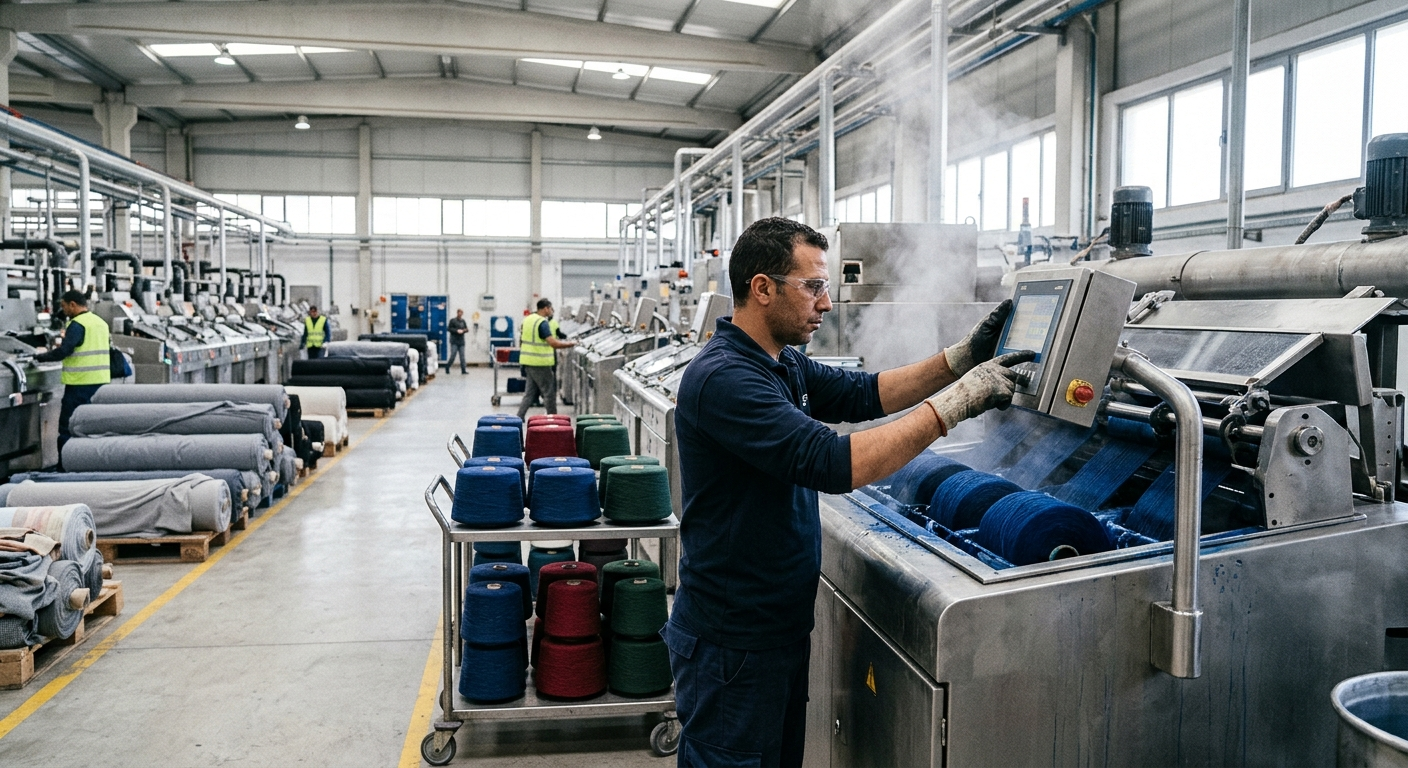
Yarn dyeing in Tunisia is a topic that matters more each year. Brands are nearshoring from Asia, European regulations on chemicals keep tightening, and Tunisian mills are being asked to deliver shorter lead times, deeper shade ranges and cleaner chemistry at once. Meeting those demands depends on one thing above all else, which is access to dependable, consistently dyed yarn.
This guide explains how yarn dyeing works, how it fits into Tunisia’s textile economy, which methods and dyes suit which fibres, what compliance rules apply to anything sold into Europe, and how to choose a dyeing partner. It also explains why Madhusudan Group, a Surat-based yarn manufacturer and exporter, has become a reference name for buyers who want colour consistency, certified chemistry and reliable export execution.
What Is Yarn Dyeing and Why Does It Matter?
Yarn dyeing is the process of colouring yarn before it is woven or knitted into fabric. This is different from piece dyeing, where finished fabric is coloured, and from garment dyeing, where the sewn product is coloured. When colour is introduced at the yarn stage, the dye penetrates the fibre bundle and the colour becomes part of the fabric’s structure rather than a surface treatment applied afterwards.
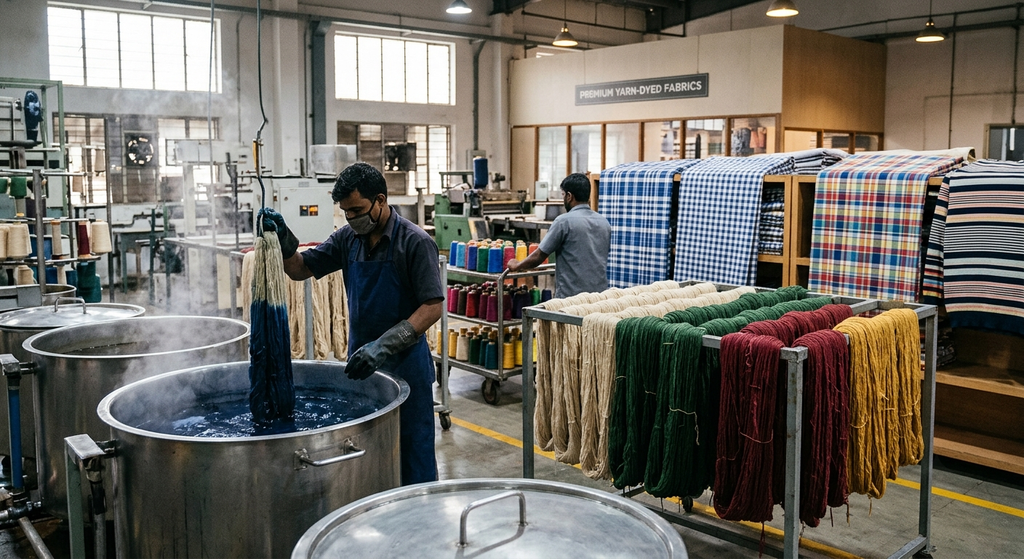
That difference creates several commercial advantages. Yarn-dyed fabrics are the only practical way to produce checks, stripes, plaids, jacquards, melange effects and many denim and shirting constructions, because the pattern comes from combining differently coloured yarns in the weave or knit. Yarn-dyed products also tend to show better depth of shade and often stronger wash and light fastness than fabrics that were coloured later. For brands selling premium or heritage-style products, these are visible quality signals.
There is also a planning advantage. Dyed yarn can be held as inventory in a limited number of core shades and converted into many fabrics, which gives mills flexibility when order sizes are small and delivery windows are short. For a country whose competitive edge rests on responsiveness, that flexibility is valuable.
If you want a deeper grounding in the upstream stages before colour is applied, our overview of the yarn manufacturing process explains how fibre becomes yarn, and why spinning quality directly affects dye uptake and shade evenness.
Tunisia’s Textile Industry at a Glance
To understand demand for dyed yarn, it helps to understand the scale and shape of the Tunisian industry. According to a factsheet from the German NGO FEMNET, textiles and clothing form Tunisia’s second largest export sector after the electrical industry, and the overwhelming majority of exports go to the European Union. The same source notes that foreign investors, mainly from France, Germany and Belgium, own a significant share of factories. You can read the full country profile in the FEMNET factsheet on Tunisia’s garment industry.
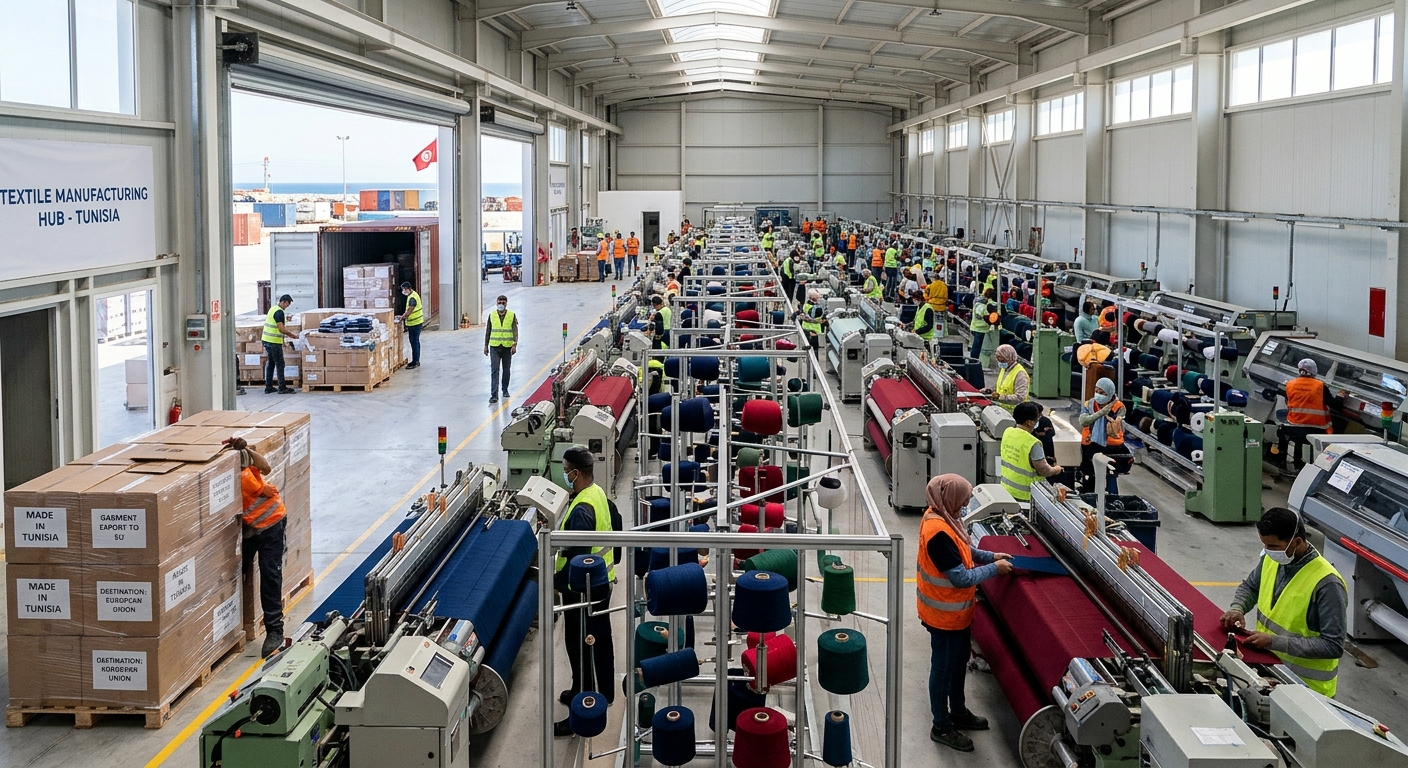
More recent reporting gives a sense of the sector’s size. According to North Africa Post, the industry employs close to 160,000 people across roughly 1,600 companies, with about 85 percent of them fully export oriented and annual export revenues close to 10 billion dinars. Exports in the first five months of 2025 rose by 2.61 percent year on year to 3.94 billion dinars, as reported in North Africa Post’s coverage of Tunisia’s 2025 textile exports.
The sector has shown resilience in difficult conditions. African Manager reported that clothing exports grew by 6.8 percent in 2023 and that Tunisia exported goods to the EU worth around €2.36 billion that year even as overall EU textile imports declined, a point covered in this Business & Human Rights Resource Centre summary. In April 2025, the European textile confederation EURATEX and the Tunisian federation FTTH signed a partnership in Monastir aimed at supporting a more sustainable and resilient Euro-Mediterranean supply chain. The announcement, reproduced by Textile World, noted that Tunisia exported €2.5 billion of textiles and clothing to the EU in 2024. Details are in the EURATEX and FTTH partnership announcement.
Where the industry is concentrated
Tunisian textile activity clusters along the eastern coast. The Monastir, Mahdia and Sousse governorates form the historic heartland, with Ksar Hellal long associated with knitting and hosiery. Further north, the greater Tunis area, Nabeul and Bizerte host a mix of garment makers, denim finishers and subcontractors, while Sfax contributes manufacturing capacity in the south of the coastline. These clusters matter for yarn buyers because proximity to the ports of Radès, Sousse and Sfax shapes inbound logistics for imported raw materials.
What Tunisia makes
Product mix is wide. Tunisia is best known for jeanswear, knitwear, underwear and hosiery, sportswear, workwear and technical garments, and it supplies a range of international brands. Many of these categories are heavy users of dyed yarn. Denim relies on indigo and sulphur-dyed warp yarns. Knitted sweaters, socks and activewear depend on dyed polyester, viscose, nylon and blended yarns. Workwear and uniforms need durable, colourfast yarn that withstands industrial laundering.
The Yarn Supply Gap: Why Dyed Yarn Is Imported
One feature of the Tunisian model matters greatly for anyone selling yarn into the country. The industry is strong in garment assembly, but upstream capacity, especially in fabric, is thinner. Officials quoted by Kohan Textile Journal said that fabrics account for about 67 percent of the sector’s imports and that local fabric production meets only around 7 percent of the industry’s needs. The same report lists higher shipping costs, logistical delays and shifting EU textile policies among the sector’s challenges. The full discussion is available in this Kohan Textile Journal report on Tunisia’s textile exports.
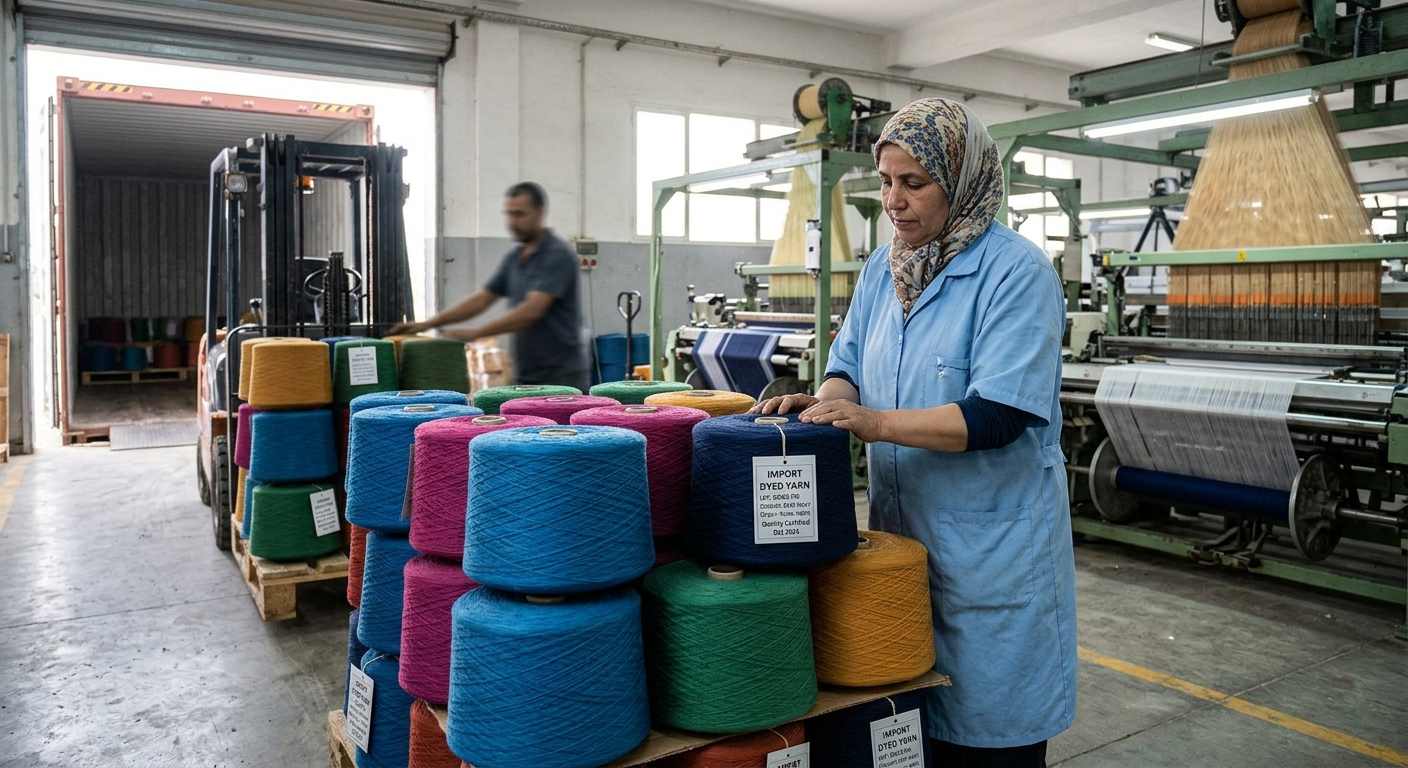
The implication is straightforward. Tunisian mills and garment makers that want to climb the value chain need dependable upstream partners, and that includes yarn, dyed yarn and speciality yarn. Policymakers have openly talked about strengthening integration and moving toward higher value segments. Every step in that direction increases demand for technically capable yarn suppliers who can deliver colour consistency, traceability and compliance paperwork.
Local dyeing versus imported dyed yarn
Tunisian mills face a practical choice for each product line. They can import undyed yarn and arrange dyeing locally or through a subcontractor, or they can import ready-dyed yarn from a specialist producer. Each route has trade-offs.
- Local dyeing: shorter lead time for small colour adjustments, but dependent on local dyehouse capacity, water and energy costs, and consistency across lots.
- Imported dyed yarn: a dyer with scale can run large lots in a controlled process, document each lot with shade and fastness data, and ship to the mill ready to knit or weave.
- Hybrid model: core shades imported in bulk, with fashion shades or small-batch colours dyed locally.
For most export-oriented Tunisian mills, the hybrid and imported models are attractive because they reduce the burden of effluent treatment and chemical compliance on the mill itself, and move it to a specialist whose business is dyeing. This is the space in which Indian producers, and especially Surat-based manufacturers, have grown quickly.
Yarn Dyeing Methods Used in the Industry
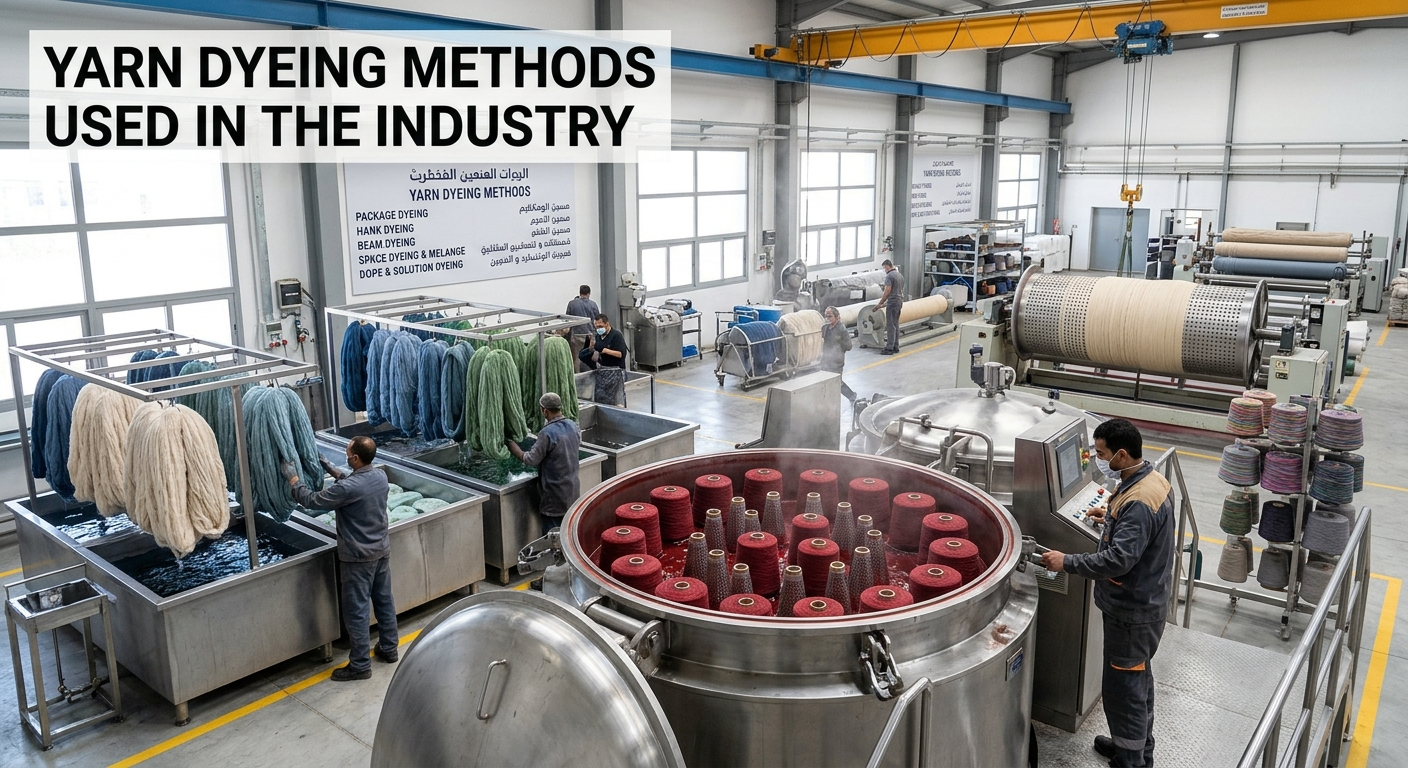
Choosing the right dyeing method is as important as choosing the right dye. The method determines levelness, cost, minimum order quantity and the type of end product the yarn suits. Mills and buyers in Tunisia generally encounter five main routes.
Package dyeing
In package dyeing, yarn is wound onto perforated cones or springs, loaded onto carriers, and placed in a pressurised vessel. Dye liquor is pumped through the package from inside to outside and back. Package dyeing is the workhorse of modern yarn dyeing because it is automated, repeatable and suited to large lots. It is the preferred route for polyester, viscose, nylon and blended yarns that will feed knitting machines, circular knit lines and weaving preparation. High-temperature, high-pressure machines allow polyester to be dyed at around 130 degrees Celsius, which is the usual range for disperse dyes on this fibre.
Hank dyeing
Hank dyeing involves winding yarn into loose loops, or hanks, that are suspended in a dye bath. Because the yarn is not compressed on a cone, it retains bulk and softness. This method is common for bulky, lofty or fancy yarns, for natural fibres such as cotton and linen, and for knitwear yarns where handfeel is a selling point. It is slower and more labour intensive than package dyeing, which is reflected in cost.
Beam dyeing
Beam dyeing treats warp yarn that has been wound parallel on a perforated beam. It is used mainly in woven fabrics, where a whole warp is dyed at once. For Tunisian weavers producing shirting, workwear fabric or home textiles, beam dyeing can provide excellent evenness across the width.
Space dyeing and melange effects
Space dyeing applies colour at intervals along the yarn length, creating multi-coloured effects without the need for several separate yarns. Melange yarns achieve a heathered look by blending dyed fibres before spinning. Both approaches are popular in casual knitwear and sportswear.
Dope dyeing and solution dyeing
Dope dyeing, also called solution dyeing or spin dyeing, adds pigment to the polymer before the filament is extruded. The colour is locked inside the fibre, which gives excellent fastness and uses far less water than conventional dyeing. The trade-off is a narrower shade range and larger minimum order quantities, because colour is chosen at the spinning stage. For high-volume basics such as black polyester, this method is very effective.
Choosing the right method
As a rule of thumb, package dyeing suits volume and consistency, hank dyeing suits handfeel and speciality yarns, beam dyeing suits woven warps, and dope dyeing suits high-volume solid colours with tight sustainability targets. A good supplier will advise on the best option for your end product rather than defaulting to the machine they happen to own. For a plain-language walk-through of selecting a yarn for a given product, see our guide on how to choose the right yarn for textile products.
Dyeing by Fibre Type
No single recipe works for all yarns. Each fibre has its own chemistry, and each requires a matching class of dye, a controlled temperature profile and a suitable set of auxiliaries. Here is how the most relevant fibres behave for Tunisian end uses.
Polyester yarn
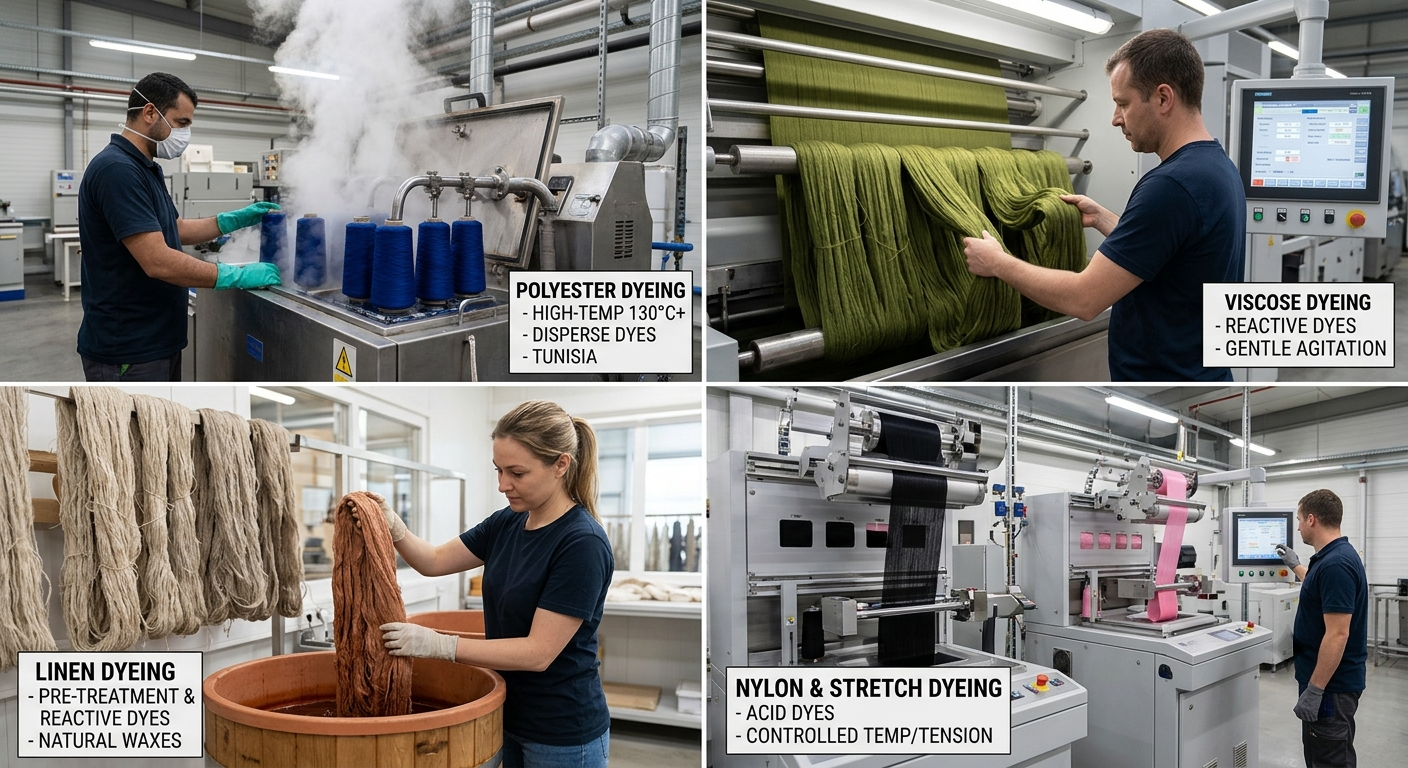
Polyester is hydrophobic and has a compact molecular structure, so it needs disperse dyes and high temperatures to open the fibre and let the dye diffuse in. After dyeing, a reduction clearing step removes unfixed dye from the surface, which is critical for good wash and rubbing fastness. Done correctly, dyed polyester delivers bright shades, strong light fastness and excellent durability, which is why it dominates sportswear, activewear, linings and technical textiles. A detailed process-level explanation is available in our polyester yarn dyeing guide, and a buyer-oriented comparison of shades and grades appears in the dyed polyester yarn guide.
Viscose yarn
Viscose is a regenerated cellulosic fibre with a soft drape and a natural feel, and it takes colour readily with reactive and direct dyes. Its weakness is that it loses strength when wet and needs gentle processing to avoid fibrillation and shade variation. Skilled dyers control liquor ratio, salt and alkali dosing, and temperature gradients carefully. Our resource on viscose yarn dyeing covers common pitfalls and best practice.
Linen yarn
Linen is valued for its crisp hand and its look, and it is increasingly sought by European brands in resort and summer collections. As a cellulosic fibre it is generally dyed with reactive dyes, but its natural waxes and pectins, and its irregular structure, call for careful preparation. If linen is on your Tunisian product roadmap, our article on linen yarn dyeing explains how pre-treatment, dye selection and finishing interact.
Nylon and stretch yarns
Nylon takes acid dyes and offers excellent abrasion resistance and fastness, which suits hosiery, shapewear and performance fabrics. Stretch yarns, including elastomultiester and bicomponent constructions, add complexity because elasticity can be affected by temperature and tension during dyeing. Producers need controlled process windows to preserve recovery and prevent shade variation along the package.
Blended yarns
Blends such as polyester-viscose or polyester-cotton need two dye classes, usually applied in sequence or in a carefully balanced one-bath, two-stage process. Mismatched chemistry produces a cross-dyed or streaky look. For Tunisian knitwear and shirting producers, this is where experienced dyers show their value.
Compliance: What Tunisian Exporters Must Get Right
Because the great majority of Tunisian textile exports go to Europe, European chemical and quality rules shape every decision at the dyeing stage. Even if a yarn is dyed outside the EU, the finished garment must comply once it is placed on the market there. This makes compliance a purchasing criterion rather than a paperwork afterthought.

REACH and azo dyes
The EU’s REACH regulation restricts certain azo dyes. Azo dyes make up a large share of industrial colourants, and most are harmless, but some can break down into carcinogenic aromatic amines. REACH Annex XVII, entry 43, bans textile and leather articles that come into direct, prolonged contact with skin from releasing listed amines above a threshold of 30 mg/kg. The Danish Environmental Protection Agency explains the rule and who is responsible in its fact sheet on azo dyes and pigments. The testing and audit side is explained in SATRA’s article on azo dye restrictions and testing, which stresses supplier declarations and process audits across the supply chain.
The practical lesson for Tunisian buyers is to demand azo-free dyeing as a default, and to ask for lot-level test evidence rather than a single generic declaration.
OEKO-TEX STANDARD 100
OEKO-TEX STANDARD 100 is a voluntary but widely requested certification that tests textile products for harmful substances. Its limit values take into account REACH restrictions and other regulations, and products are classed by intended use, with the strictest class applying to baby articles. A clear overview for importers and manufacturers is available in this guide to OEKO-TEX STANDARD 100. For European brands, holding certified yarn in the supply chain can simplify downstream certification of fabrics and garments.
ZDHC and manufacturing chemistry
Product testing alone is not enough, because by the time harmful substances show up in a finished garment, they have already passed through a dyehouse and its effluent. The ZDHC Manufacturing Restricted Substances List addresses this by banning specified hazardous chemicals from intentional use during manufacturing. The list and its supporting tools are published on the ZDHC MRSL portal. Industry reporting by Just Style on ZDHC’s impact data noted that most manufacturing suppliers in the programme showed no detection of restricted MRSL substances in their wastewater, and that a majority of brands require suppliers to adopt ZDHC wastewater guidelines. See the Just Style report on ZDHC results for the figures.
For a Tunisian mill, sourcing from a dyer who follows ZDHC-aligned chemical management reduces both regulatory risk and brand audit friction.
ISO and quality management certification
A certified quality system does not by itself make a yarn colourfast, but it shows that processes are controlled and records are kept. When shortlisting suppliers, ask whether the producer works under an ISO-certified management system. Our article on choosing an ISO certified yarn supplier lists what to check and which documents to request.
Colour Fastness: The Test Results That Matter
For a garment maker, colour fastness is the practical measure of dyeing quality. A yarn that looks perfect on the cone but bleeds in the first wash will damage fabric, trigger claims and hurt a brand’s reputation. Fastness is therefore tested against internationally recognised methods.
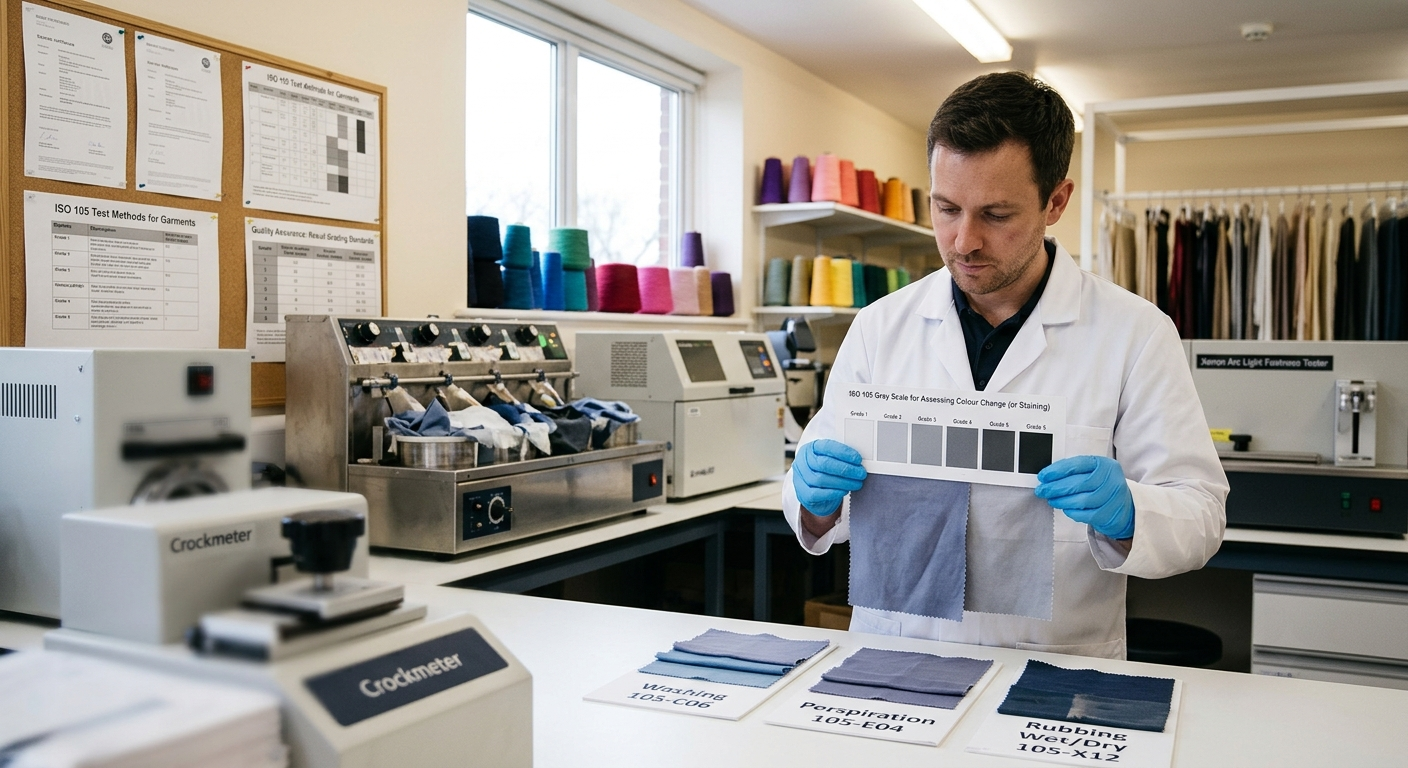
The ISO 105 series is the main reference. ISO 105-A01 sets out the general principles of testing colour fastness, including how the methods are used and their limitations. Beyond that, the series covers specific exposures. Centexbel’s summary of the ISO 105 series lists methods for light fastness, washing, perspiration, rubbing and chlorinated water, along with the grey scales used to rate colour change and staining.
The tests most buyers request
- Washing: how much the colour changes and stains adjacent fabrics after laundering. Required for almost every garment, and workwear or uniforms are often assessed against industrial laundering, covered by ISO 105-C12.
- Perspiration: important for activewear, underwear and anything worn close to the skin.
- Rubbing (crocking), dry and wet: critical for dark shades and denim.
- Light: essential for home textiles, workwear and outdoor products.
- Chlorinated water: relevant for swimwear and pool-use products.
Setting specifications
Fastness is rated on a grey scale, usually from 1 to 5, with higher numbers meaning better performance. Specifications should be written into purchase orders by end use, not left to assumption. A fashion knit may accept moderate wet rubbing for light shades, while workwear and uniforms will demand much higher grades. Agree the test method, the grade, the shade category and the sampling plan before bulk production starts.
Sustainability in Yarn Dyeing
Dyeing is one of the most resource-intensive stages of textile production, which puts it at the centre of every credible sustainability programme. For Tunisian exporters, the EURATEX and FTTH partnership shows where the industry is heading, with sustainability, circularity and resilient regional supply chains at the centre of the conversation.
Water and energy
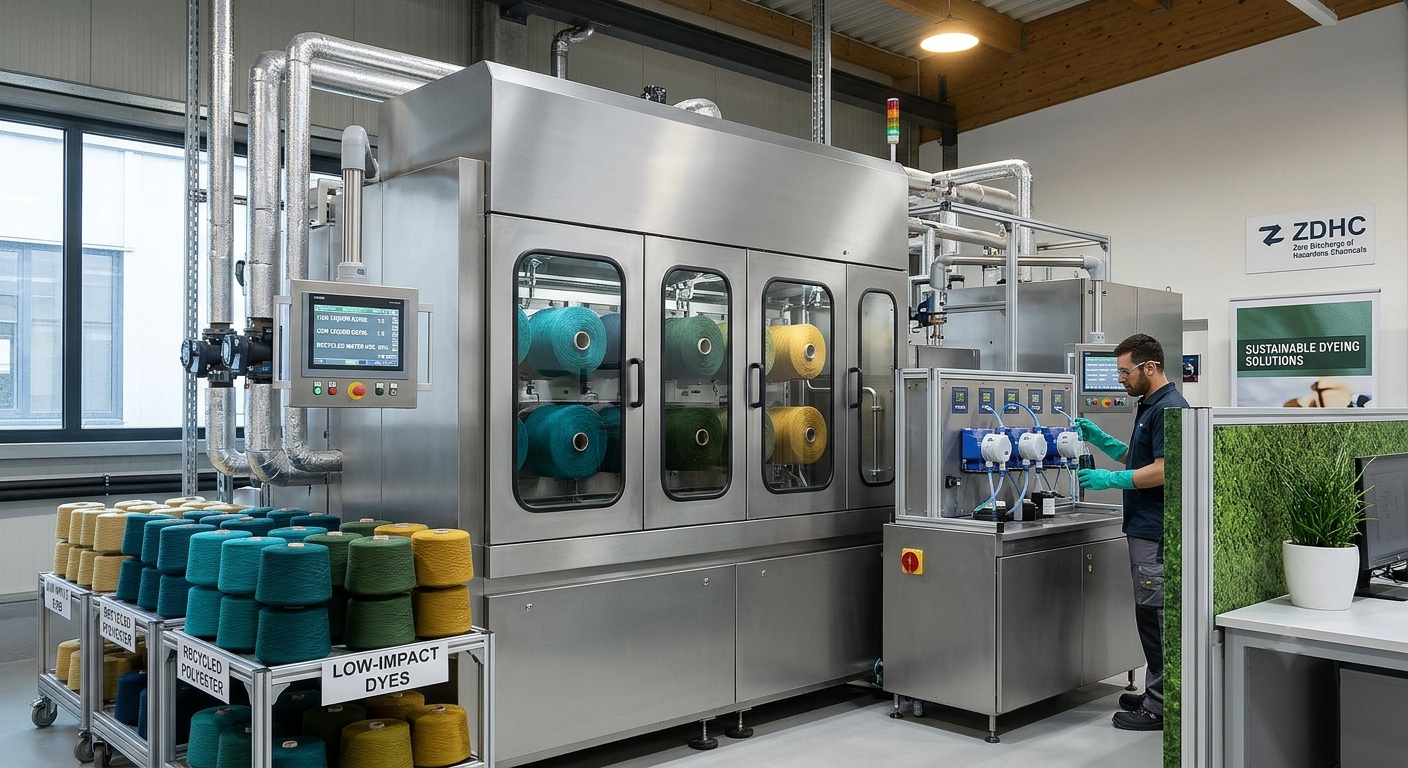
Modern package dyeing machines operate at low liquor ratios, which means less water, less steam and fewer chemicals per kilogram of yarn. Closed-loop heat recovery, effluent treatment and water recycling reduce the footprint further. When comparing suppliers, ask for water use per kilogram, effluent treatment details and any third-party verification.
Chemical management
Moving to low-impact dyes, optimised auxiliaries and automated dosing systems reduces chemical use and improves repeatability. Following a recognised framework such as ZDHC gives brands a common language to audit against.
Recycled and responsible fibres
Recycled polyester is one of the most visible sustainability levers in yarn. Dyeing recycled yarn requires its own process controls, because raw material variability can affect shade. If your customers are asking about recycled content, our recycled polyester yarn guide explains grades, certifications and applications.
Why Madhusudan Group Is a Leading Partner for Yarn Dyeing
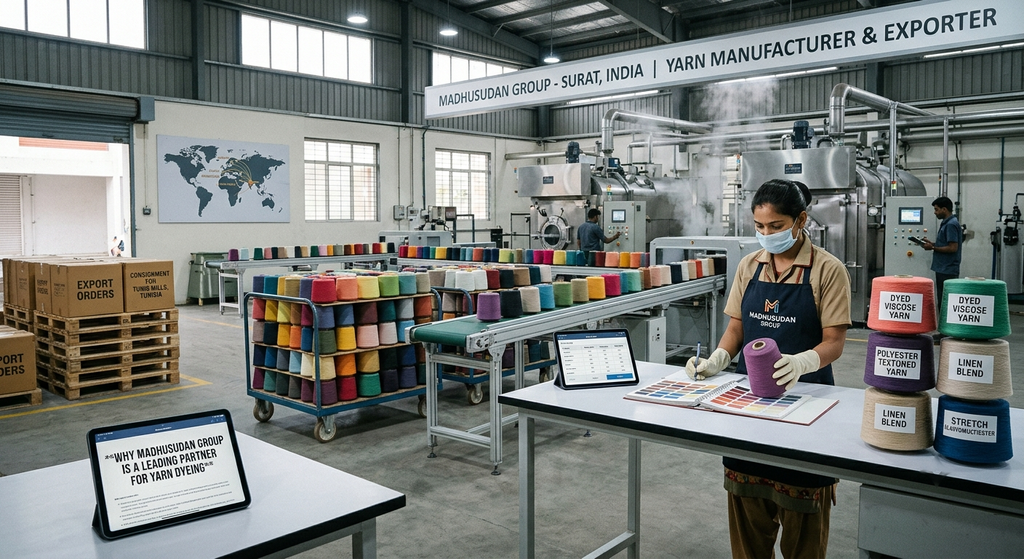
Madhusudan Group is a Surat-based yarn manufacturer and exporter that supplies polyester, viscose, nylon, linen, textured, stretch and blended yarns to buyers across the world. Surat is one of India’s most important textile hubs, and the group has built its reputation on a combination of technical depth, consistent quality and export discipline. For Tunisian mills and brands sourcing yarn, that combination is exactly what reduces risk.
A dyeing portfolio built around real production needs
The group’s range covers the fibres that Tunisian manufacturers use most, including dyed polyester, viscose, linen, nylon DTY, air-textured yarn and stretch constructions such as elastomultiester and bicomponent yarns. Rather than offering a one-size-fits-all service, the team matches the dyeing route and dye class to the end use, whether that is sportswear, knitwear, denim-adjacent blends or woven shirting. You can explore the range through our page for a dyed yarn manufacturer.
Experience across multiple dyeing markets
The group already supports buyers across several regions, and the lessons from each market carry over. Our market guides on yarn dyeing in Egypt, Colombia, Peru, Brazil and Sri Lanka show how requirements differ by climate, end use and regulation. Tunisian buyers will find the Egyptian experience particularly relevant, because both countries combine export-driven manufacturing with strong ties to European buyers, as discussed in our guide to yarn dyeing in Egypt.
Compliance as a standard, not an add-on
Madhusudan Group approaches chemistry and documentation with European requirements in mind. That includes azo-free dyeing, awareness of REACH and OEKO-TEX expectations, shade and fastness records by lot, and a quality system that buyers can audit. For Tunisian exporters whose own customers audit them, this documentation trail is as valuable as the yarn itself.
Manufacturer, not middleman
Buyers often ask whether they should deal with a trader or the producer directly. The answer depends on your priorities, but control over dyeing, traceability and troubleshooting are far easier with a true manufacturer. Our comparison of yarn supplier versus yarn manufacturer sets out the differences in price, accountability, lead time and technical support.
Rooted in Surat, built for export
Surat is known as the synthetic textile capital of India, and its ecosystem of spinners, texturisers, dyers and logistics providers supports short lead times and wide product range. Our overview of yarn manufacturers in Surat explains why the city is so competitive, and our guide to textile yarn exporters in India covers the export side, including documentation and shipping practice. Together, these strengths allow Madhusudan Group to act as a long-term partner to Tunisian mills rather than a one-off vendor.
How to Choose a Yarn Dyeing Partner for Tunisia
Whether you are a mill owner in Monastir, a sourcing manager at a European brand, or a trader supplying Tunisian factories, the same selection logic applies. A methodical process saves money and prevents quality surprises.
A practical supplier checklist
- Shade matching ability: Can the supplier match your Pantone or lab dip within an agreed tolerance, and is the process repeatable across lots?
- Dye and chemical policy: Is dyeing azo-free, ZDHC-aligned and tested to OEKO-TEX or similar requirements?
- Fastness data: Will the supplier provide ISO 105 test reports by shade category?
- Lot consistency: How are shade differences controlled between batches, and what is the tolerance?
- Minimum order quantity: Is it compatible with your small-batch, short-lead-time business model?
- Lead time and capacity: How many days from lab dip approval to dispatch, and what is the peak-season capacity?
- Packaging: Are cones packed to protect against moisture and transit damage?
- Technical support: Who handles claims, shade adjustments and troubleshooting?
Questions to ask before you sign
Good questions bring out real capability. Ask for reference customers, sample lots, test reports and a plant audit option. Our checklist of questions to ask before buying yarn gives you a ready list to take into supplier meetings.
Run a pilot before scaling
Even with strong references, start with a pilot lot. Approve lab dips, evaluate a bulk sample, run it on your machines, test the fabric for fastness, and only then place volume orders. A pilot reveals real-world issues such as dye migration, uneven tension or cone hardness, which can cause knitting defects.
Importing Dyed Yarn into Tunisia: A Practical Overview
Logistics deserve as much attention as dyeing. Delays in the port or at customs can erase the advantages of a short production lead time.
Shipping routes and ports
Yarn from western India typically leaves from ports in Gujarat or the Mumbai area and arrives in Tunisia through major ports such as Radès near Tunis, Sousse or Sfax, usually with a transshipment stop. Transit times vary with routes and carrier schedules, so confirm current estimates with your freight forwarder. Where possible, plan for buffer stock on core shades so that a delayed vessel does not stop knitting or weaving lines.
Customs and special regimes
Many Tunisian textile companies are fully export oriented, and fully exporting enterprises can generally import raw materials under customs regimes designed to suspend duties on goods that will be re-exported. The details depend on your company status and current regulations, so confirm them with your customs broker and relevant authority before shipment. Keep commercial invoices, packing lists, certificates of origin and fibre-content declarations complete and consistent, because mismatches are a frequent cause of delay.
Documentation that buyers should request
- Commercial invoice and packing list
- Certificate of origin
- Lot-wise shade and fastness test reports
- Chemical compliance declarations such as azo-free and REACH statements
- Third-party certificates such as OEKO-TEX where applicable
Lessons from other import corridors
Importing yarn from India follows similar principles in many markets. If you want to see how a documented buyer’s process looks in practice, our guides on how to import yarn from India to Brazil and to the USA lay out the steps and typical documentation, and much of that advice carries over to Tunisia.
Cost Factors in Yarn Dyeing
Dyeing cost is not a single number. It reflects a stack of variables, and understanding them helps buyers negotiate fairly and compare quotes accurately.
- Fibre and yarn count: Finer yarns and speciality fibres usually cost more to process.
- Shade depth: Dark and heavy shades need more dye and more rinsing, and black and navy often cost more than pastels.
- Dye class: Reactive, disperse, acid and vat dyes differ in price and process demands.
- Method: Hank dyeing costs more than package dyeing, and dope dyeing shifts cost to the spinning stage.
- Lot size: Larger lots dilute set-up and cleaning cost per kilogram.
- Fastness requirements: Higher grades may require extra washing, reduction clearing or after-treatment.
- Compliance level: Certified chemistry and testing add cost but reduce claims and audit risk.
- Energy and water: Input prices vary by region and can change quickly.
The cheapest quote is rarely the lowest total cost. A lot that fails a wash test, or a shade mismatch discovered after fabric is cut, can cost far more than the premium paid for a controlled process.
Common Yarn Dyeing Problems and How to Avoid Them
Even well-run dyehouses face recurring issues. Knowing them helps buyers specify correctly and diagnose problems quickly.
Shade variation between lots
Variation arises from differences in raw material, process parameters, water quality and dye lots. The cure is a controlled recipe system, spectrophotometer matching and clear tolerances, usually expressed as a delta E value agreed in advance.
Uneven dyeing and streaks
Uneven dyeing can result from poor yarn packaging density, uneven winding tension or insufficient liquor circulation. Good package preparation is as important as the dyeing step itself.
Poor rubbing fastness
Dark shades on polyester and cellulosics are especially vulnerable. Thorough rinsing, reduction clearing and suitable after-treatments improve results.
Barré and stripe defects
Barré, a repeating stripe pattern in knitted fabric, can come from variations in yarn properties or dyeing. It is largely preventable with consistent raw material and controlled processing.
Strength loss and hand changes
Excessive temperature, wrong pH or aggressive chemicals can weaken yarn or change its feel. This is especially relevant for viscose and stretch yarns.
Trends Shaping Yarn Dyeing in Tunisia
Several forces are changing demand patterns for dyed yarn in the Tunisian market.
Nearshoring and shorter lead times
European brands are looking for suppliers who can react in weeks rather than months. Tunisia benefits from proximity, but only if upstream supply is equally responsive. Reliable dyed yarn stock and short replenishment cycles become a competitive weapon.
Regulation and traceability
European policy continues to move toward stronger chemical restrictions and product transparency. Buyers will increasingly ask for digital records, batch-level traceability and proof of chemical management, which favours suppliers with documented systems.
Functional and technical textiles
Industry commentary, including a source quoted in an Oxford Business Group report on Tunisian textiles, has pointed to smart textiles, medical textiles and connected sportswear as promising higher-value segments for Tunisia. These products require yarn with consistent dyeing performance and, often, speciality constructions such as bicomponent and stretch yarns.
Recycled and circular materials
Recycled fibres and circular design are moving from marketing to procurement requirements. Suppliers that can dye recycled polyester and certify content gain a clear advantage.
Digital shade management
Spectrophotometer-based colour matching, digital lab dips and data-driven process control shorten approval cycles and reduce waste. Expect these tools to become standard in any supplier you work with.
Frequently Asked Questions About Yarn Dyeing in Tunisia
What is yarn dyeing?
Yarn dyeing is the process of colouring yarn before it is woven or knitted. It produces deeper, more durable colour and allows patterns such as stripes and checks to be created by combining differently coloured yarns.
Is yarn dyeing common in Tunisia?
Tunisia has a large textile and clothing industry that exports mainly to the EU, and many products such as denim, knitwear, hosiery and sportswear depend on dyed yarn. Because local upstream production is limited compared with demand, a significant share of dyed yarn is sourced from international suppliers.
Which dyes are used for polyester yarn?
Polyester is dyed with disperse dyes at high temperature, followed by reduction clearing to remove surface dye and improve fastness.
Are azo dyes banned in the EU?
Azo dyes are not banned as a group. The EU restricts azo dyes that can release specified carcinogenic aromatic amines above 30 mg/kg in textiles that come into direct, prolonged skin contact. Responsible suppliers dye azo-free or use only compliant azo colourants.
What certifications should a dyed yarn supplier have?
Look for an ISO-certified quality system, OEKO-TEX STANDARD 100 for tested products where relevant, and evidence of ZDHC-aligned chemical management. Always request lot-wise test reports.
How can I ensure colour consistency across batches?
Agree tolerances in advance, require spectrophotometer-based matching, approve a standard and a bulk sample before volume production, and ask for shade and fastness data with each lot.
Can Madhusudan Group supply dyed yarn to Tunisia?
Yes. Madhusudan Group exports dyed and speciality yarns from Surat to buyers in several regions and supports documentation, sampling and technical queries. Tunisian mills and brands can request lab dips, samples and quotations directly.
How long does it take to deliver yarn from India to Tunisia?
Total timing depends on production, dyeing approvals, port schedules and customs clearance. Ocean transit generally takes several weeks including transshipment, so plan buffer stock and confirm current schedules with your forwarder.
Conclusion: Colour Is a Competitive Advantage
Tunisia’s textile industry has built its reputation on speed, quality and closeness to Europe. As the sector shifts toward higher value products, better integration and cleaner production, the quality of dyed yarn becomes a strategic matter. Mills that secure consistent, compliant and well-documented dyed yarn will win more programmes, suffer fewer claims and pass brand audits with less friction.
Choosing a dyeing partner is therefore a decision about risk as much as price. Look for technical depth across fibres, European-grade compliance, transparent testing, and the logistics discipline to deliver on time. Madhusudan Group brings these capabilities together from Surat, with experience across Africa, South America, Europe and beyond, and a practical understanding of what export-driven mills need.
If you are planning a new collection, a nearshoring programme or a shift to cleaner chemistry, now is the time to talk. Share your fibre, count, shade and fastness requirements with the Madhusudan Group team, request lab dips and samples, and build a yarn supply chain that makes colour a strength rather than a risk.