A vertically integrated textile manufacturer in India controls several stages of production, from yarn through dyeing, weaving and processing, under one management, so you deal with one accountable partner instead of five separate vendors. If you have ever bought yarn from one supplier, sent it to a second for dyeing and a third for weaving, you know what that arrangement costs. Every handover adds days, a margin and a new place for shade, count or strength to drift.
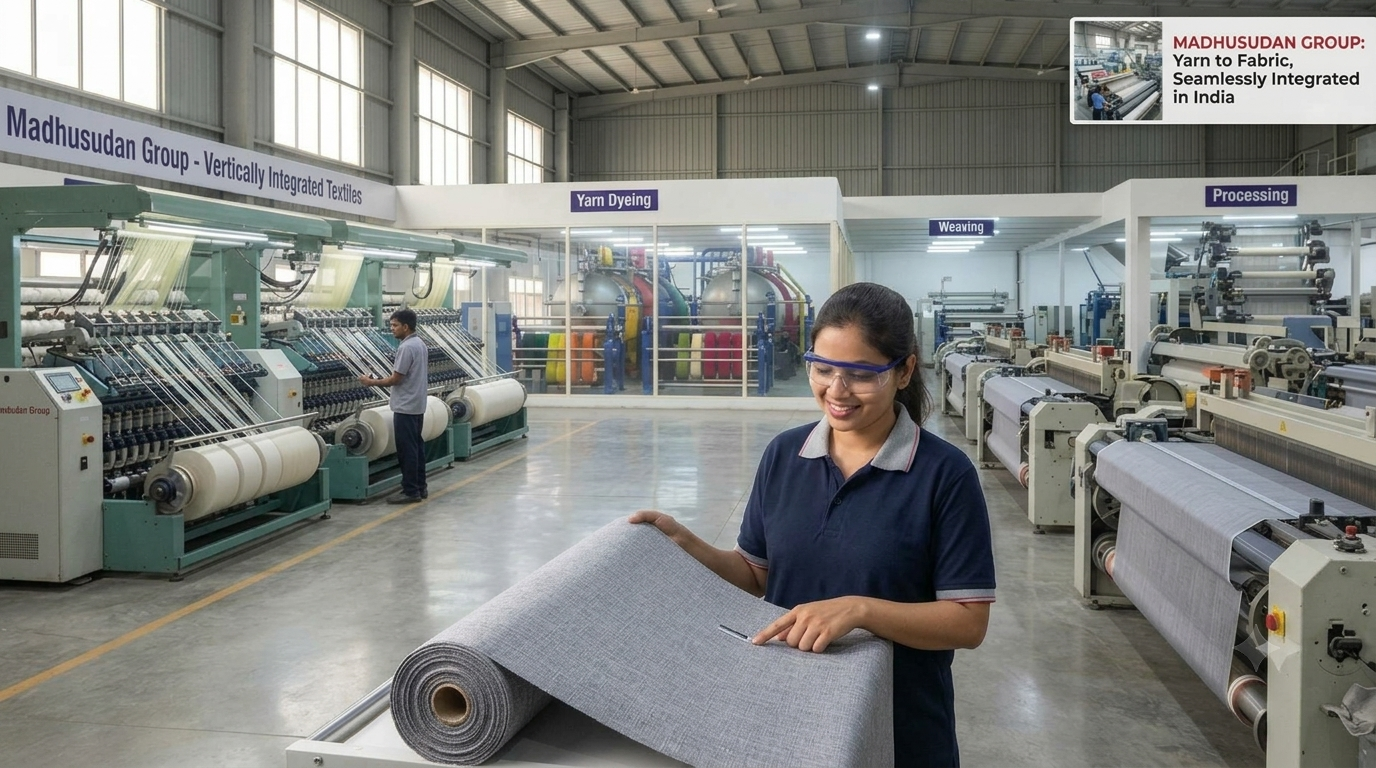
This guide explains what vertical integration means in textiles, why India is such a strong base for it, what to verify before you place an order, and how Madhusudan Group approaches the model. Madhusudan Group is a Surat-based textile group that has grown from fancy filament yarns into air-textured yarn, yarn dyeing, weaving, fabric processing and, more recently, functional and performance fabrics. The guide is written for sourcing heads, fabric mills, garment brands and traders who want fewer moving parts in their supply chain.
What Is a Vertically Integrated Textile Manufacturer?
Vertical integration means one organization owns or controls several consecutive stages of a production chain. In general business terms, vertical integration covers the merger of companies at different stages of production: backward integration means taking over a supplier, and forward integration means taking over a customer.
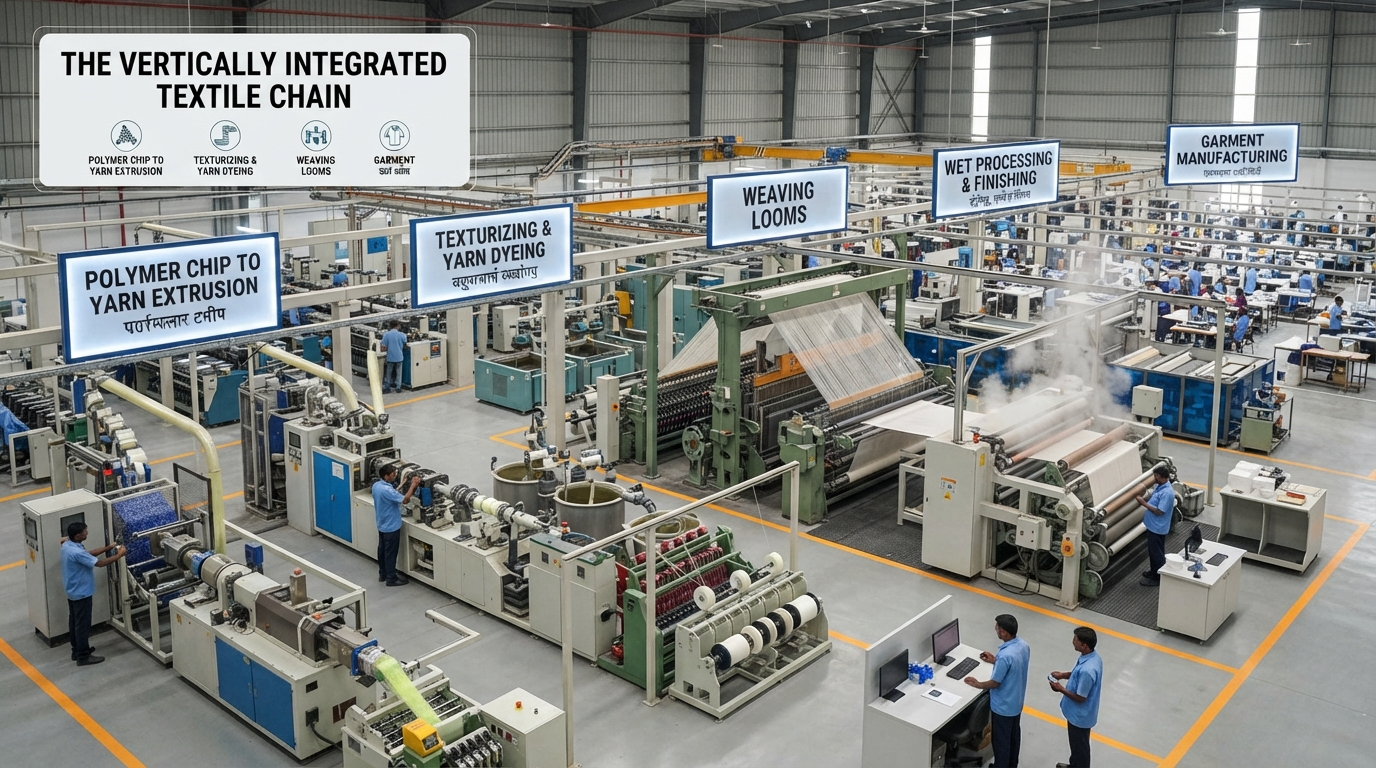
In textiles, that translates into a chain that usually runs like this:
- Fibre or polymer chip, and filament production (POY, FDY)
- Texturising, twisting, spinning and other yarn conversion
- Yarn dyeing
- Weaving or knitting
- Wet processing: fabric dyeing, printing and finishing
- Value addition and, for some groups, garmenting
A manufacturer is vertically integrated when it runs several of these steps itself, not merely sells the output of someone else’s mill. Integration comes in three forms. Backward integration moves toward raw materials, for example a fabric mill that also texturises its own yarn. Forward integration moves toward the customer, for example a yarn maker that also weaves and processes fabric. Balanced integration does both.
It is worth being direct about one point. “Fully integrated” is a spectrum, not a badge. Very few Indian groups own every step from polymer to finished garment, and a claim of complete integration deserves the same scrutiny as any other claim. What matters for a buyer is which stages the manufacturer genuinely controls, and whether those stages are the ones that decide your quality and lead time.
Vertically Integrated Manufacturing vs Contract and Trading Models
Most textile buyers still source through a chain of traders, converters and job-work units. That model is flexible, and for some small or highly variable orders it remains sensible. The cost is control. When you understand the difference between a yarn supplier and a yarn manufacturer, you see why: a trader can quote quickly, but cannot change a process parameter on a machine they do not run.
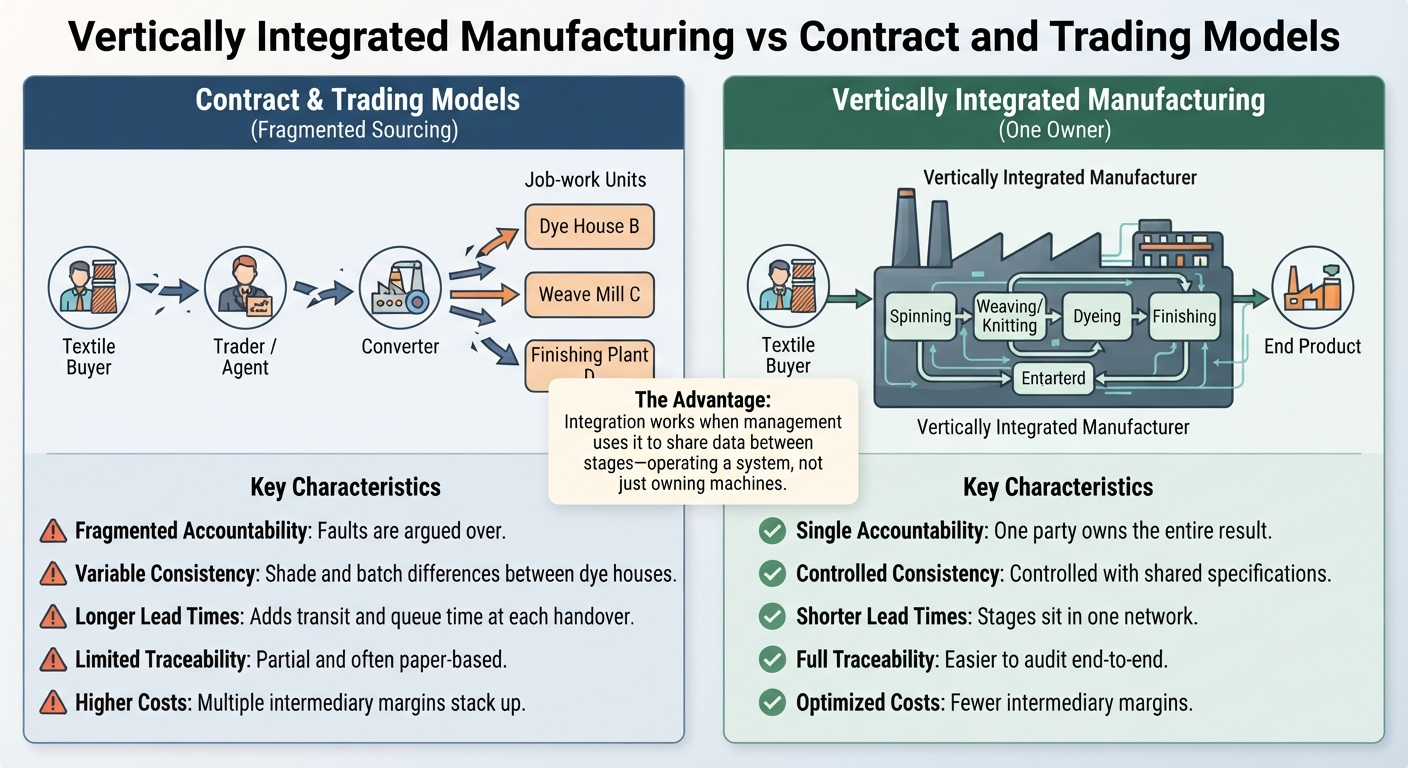
| Factor | Fragmented sourcing (trader + job workers) | Vertically integrated manufacturer |
| Accountability | Split across vendors; faults are argued over | One party owns the result |
| Shade and batch consistency | Varies between dye houses and lots | Controlled with shared specifications |
| Lead time | Adds transit and queue time at each handover | Shorter, because stages sit in one network |
| Traceability | Partial and often paper-based | Easier to audit end to end |
| Cost structure | Multiple margins stack up | Fewer intermediary margins |
| Customisation | Limited by the weakest vendor | Development done across stages together |
Integration does not make a manufacturer automatically better. A poorly run integrated group can be slower than a good specialist. The advantage appears when management uses the integration to share data between stages, which is the difference between owning machines and operating a system.
Why India Is a Strong Base for Integrated Textile Manufacturing
India is one of the few countries that has the whole textile value chain domestically: cotton and man-made fibre, spinning and texturising, weaving and knitting, processing and garmenting. The scale is substantial. The India Brand Equity Foundation reports that the sector employs over 45 million people and that 100% FDI is permitted under the automatic route. In its February 2026 sector deck, IBEF puts the contribution of textiles and apparel at 2.3% of GDP, 13% of industrial production and 12% of exports.
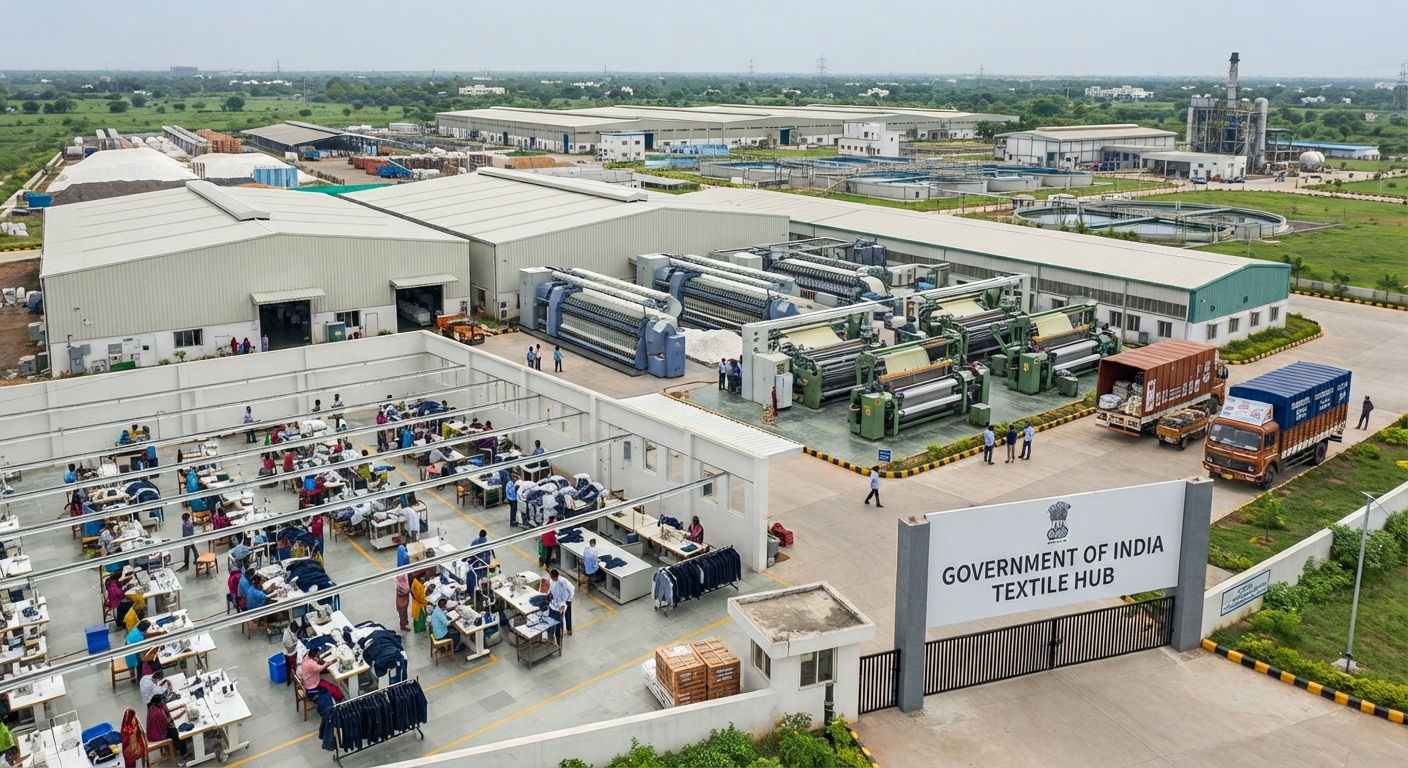
Export figures show a sector that is large and still growing, if unevenly. According to a July 2026 Press Information Bureau release, India’s textile and apparel exports including handicrafts rose from ₹2,97,004 crore in 2023–24 to ₹3,25,339 crore in 2025–26, a CAGR of 4.7%. Ready-made garments were the largest category at ₹1,39,350 crore, followed by cotton textiles at ₹1,02,427 crore (provisional DGCIS data). Looking ahead, IBEF’s June 2026 industry outlook describes the domestic industry at roughly US$190 billion in 2025–26 and sets a target of US$350 billion by 2030.
For buyers, three structural strengths matter most.
- A complete domestic ecosystem. Raw material, yarn, fabric and processing capacity sit within reach of each other, which keeps logistics short for an integrated group.
- Skilled, experienced labour and engineering. Decades of weaving, dyeing and texturising know-how mean process problems are usually solved by people who have seen them before.
- Market access and diversified demand. Indian mills sell into the Americas, Europe, the Middle East and Asia, so a good manufacturer is used to different specifications and documentation.
Policy Is Pushing the Industry Toward Integration
Government policy is nudging the sector in the same direction as buyers. The PM MITRA scheme has approved seven sites for integrated textile parks, one each in Karnataka, Madhya Pradesh, Maharashtra, Tamil Nadu, Telangana, Uttar Pradesh and Gujarat. The parks are designed to cover the entire value chain, to build scale and cut logistics costs. For greenfield parks, the scheme offers Development Capital Support of 30% of project cost, up to ₹500 crore.
On the production side, the Production Linked Incentive scheme for textiles is designed to encourage fresh capacity in man-made fibre apparel, MMF fabrics and technical textiles, with an approved outlay of ₹10,683 crore. The common thread is scale and integration. Policymakers want mills that can take a product from fibre to finished article inside one industrial ecosystem, which is what integrated groups already do.
Surat: The Man-Made Fibre Capital Where Integration Works
Surat is the clearest example of why location matters. A recent MANTRA profile of Surat’s textile industry describes a city where the complete chain, from raw material to yarn, weaving, processing, dyeing and printing, embroidery and finished textiles, is available in a single region. It cites Surat’s share at about 40% of India’s man-made fabric output, and reports Gujarat Government estimates of roughly 65% of India’s MMF segment and about 30% of global fabric production. Treat the government figures as estimates; the direction is what matters.
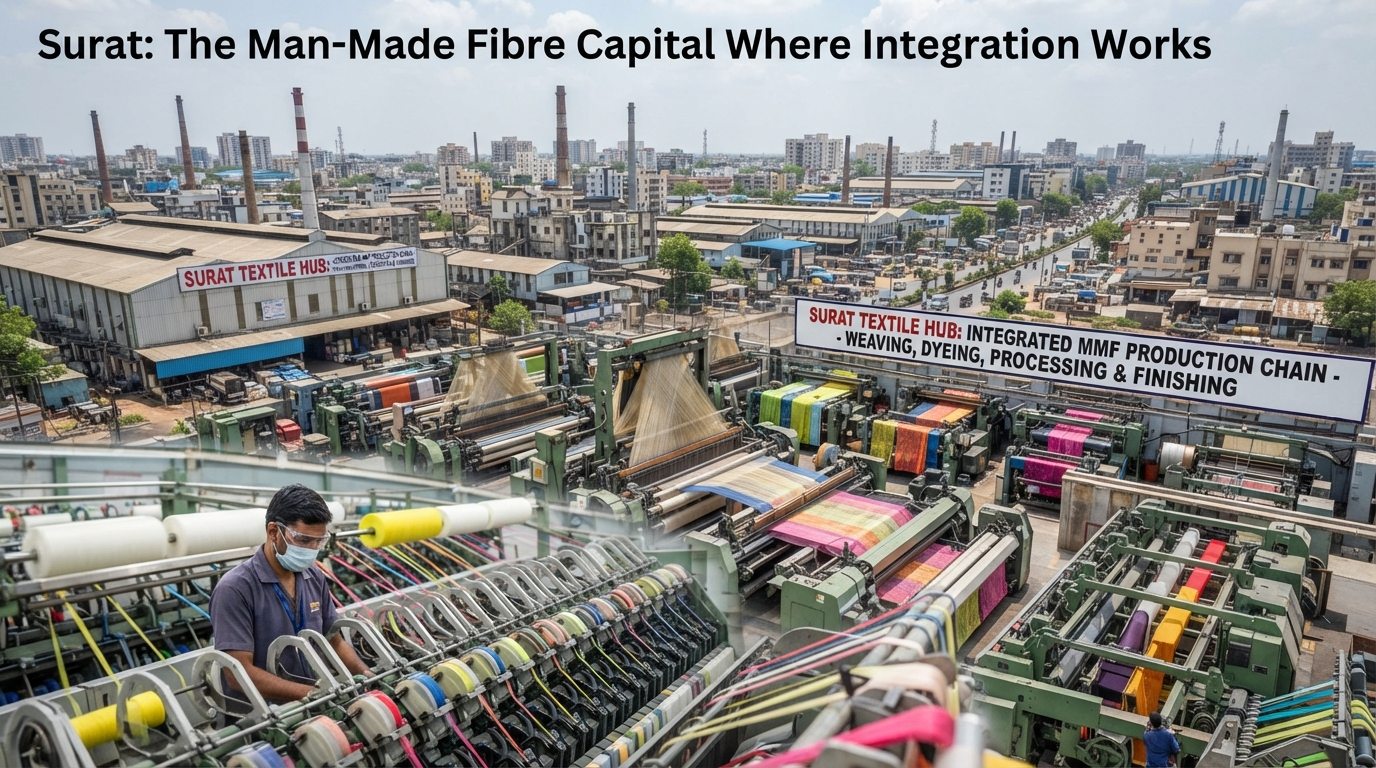
This density is the reason many yarn manufacturers in Surat can offer short lead times: texturising, dyeing, weaving and processing units are minutes apart, not days apart. It is also why Surat-based integrated groups are often a better fit for synthetic and blended products than mills in regions built around cotton. If you are comparing the field more broadly, our guide to the top yarn manufacturers in India lays out how to shortlist suppliers by capability rather than by brand name.
Madhusudan Group: A Vertically Integrated Textile Manufacturer Built in Surat
Madhusudan Group is a Surat-based textile group that describes itself as vertically integrated, producing everything from fancy yarns to finished fabrics. Its story is a useful case study in how integration is built in practice: one step at a time, in the order the market demanded.
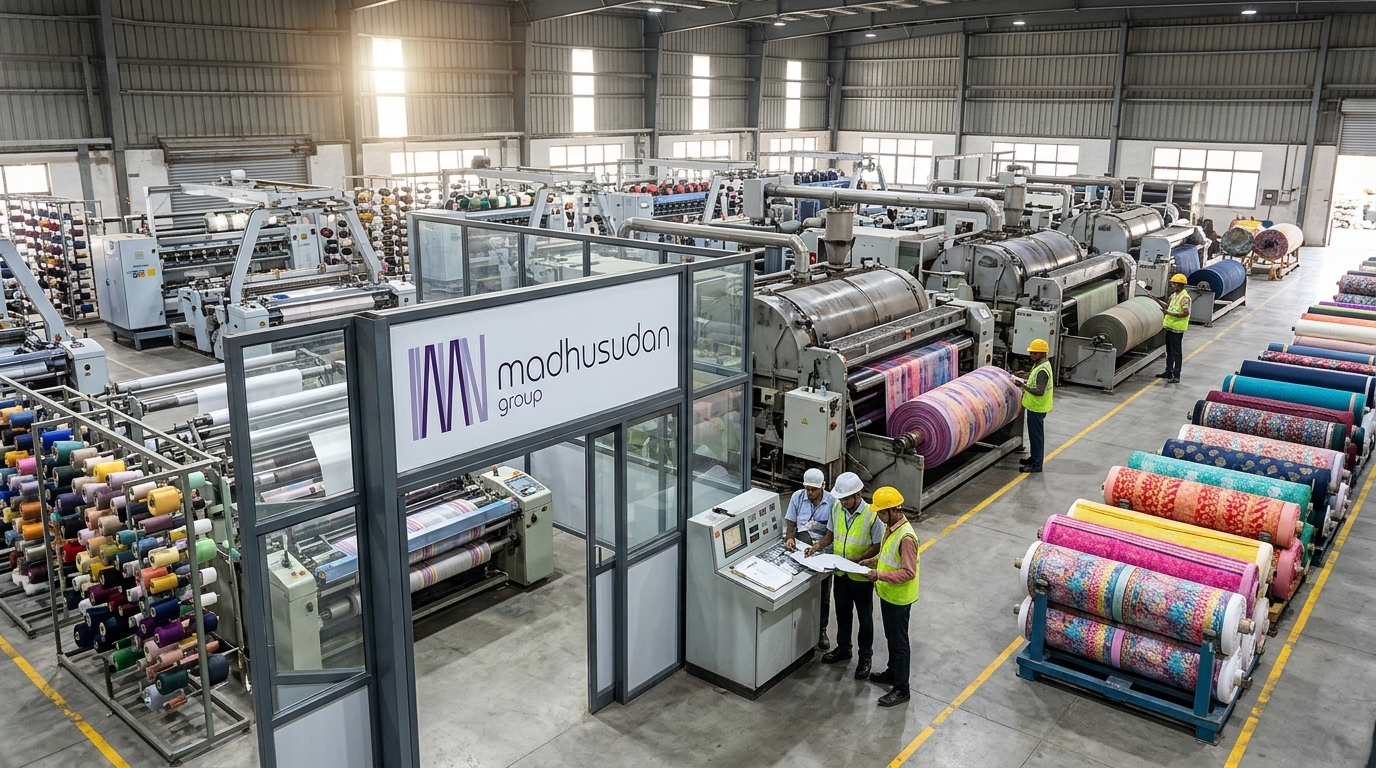
Public company profiles trace the group’s roots to a small trading shop in Pipariya, Madhya Pradesh. The business later moved to Burhanpur and then settled in Surat, which became its base. A third-party company listing reports that the first trading shop in Surat opened in Radhey Market in 1982 and that the first dyeing mill followed in 1990. From there the group added yarn manufacturing, dyeing, weaving and processing units in sequence. In a 2019 interview with Fibre2Fashion, Executive Director Deepak Mundra described a vertically integrated manufacturer of fancy yarns and fabrics with ongoing capacity expansion, technology upgrades and an R&D department developing new yarn and fabric products.
The model has kept moving. In a 2019 conversation with Apparel Views, Director Yatiraj Mundra said the group aimed to cover every stage under one flagship, from POY and spinning through yarn manufacturing and dyeing, weaving, knitting, processing, fabric value addition and garmenting. He pointed to three generations of the family working in the business as a reason the goal was realistic. By June 2026, The Textile Magazine was describing a group that had shifted from fancy filaments toward functional yarns, performance fabrics and integrated textile solutions for global markets, with garments planned as the next step.
That trajectory matters for buyers. It shows an organisation that invests ahead of demand, moves up the value chain, and keeps the technical knowledge in-house.
Stage 1: Yarn Engineering and Texturising
The yarn stage is where an integrated manufacturer sets the character of everything downstream. Madhusudan Rayons, the group’s yarn division, specialises in fancy-type air-textured polyester yarn, produced on air-texturing machines from Aiki and SSM. Listings of the group put fancy-yarn capacity at about 750 tonnes per month, a figure you should confirm directly with the company at the time of enquiry.
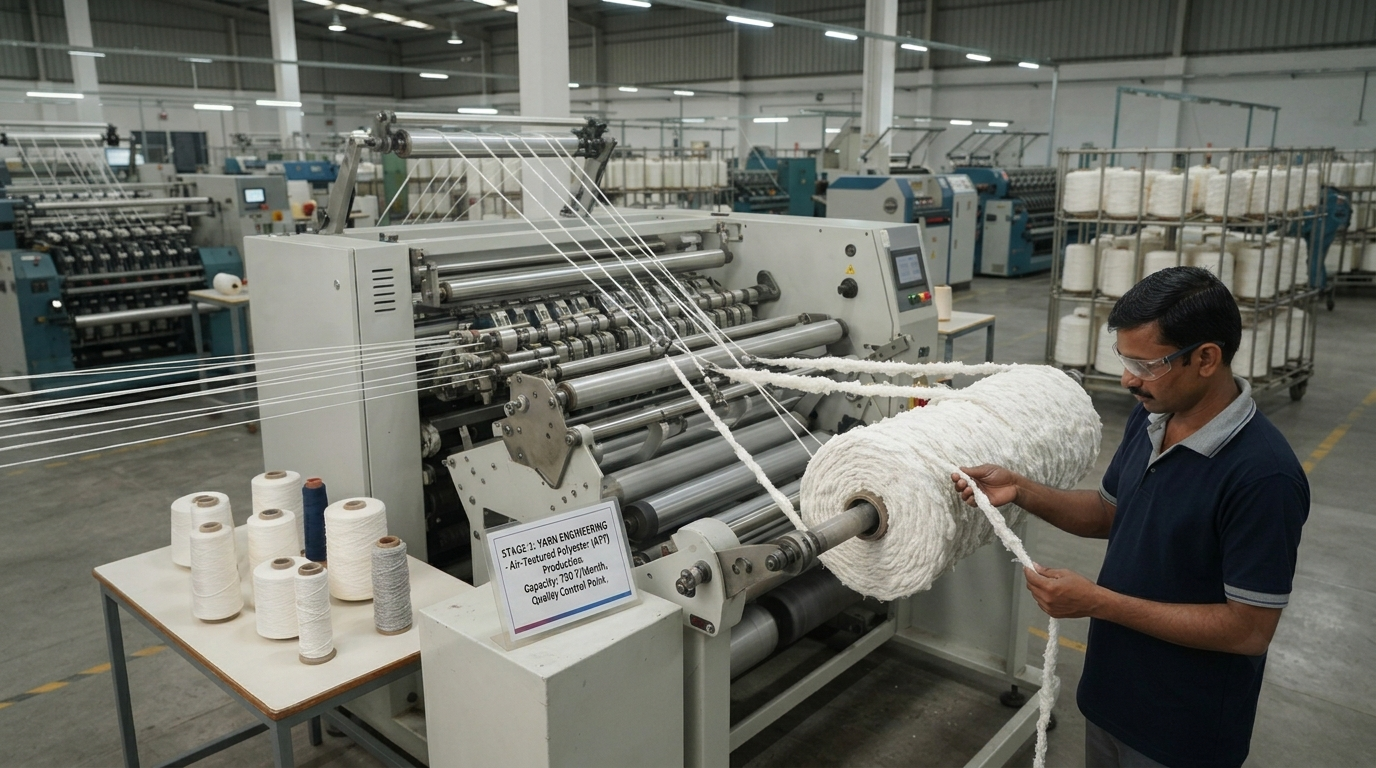
Air-textured yarn (ATY) gives a spun-like hand, bulk and cover from continuous filament, which is why it is popular in suiting, upholstery and home textiles. If you want to understand the product in detail, our guide to ATY air-textured yarn supply explains how entanglement, overfeed and core-effect settings change the finished fabric. The group also works in twisted yarn, where twist level and direction decide strength, crepe effect and dye uptake.
What integration adds here is feedback. Because the same group dyes and weaves its yarn, a texturising parameter that causes streaks in the fabric can be traced and fixed at the machine, not argued about between vendors. For a deeper explanation of the stages from filament to finished yarn, see the yarn manufacturing process guide.
Stage 2: Yarn Dyeing
Yarn dyeing is the stage most buyers underestimate and most often outsource. It is also where shade variation, the most common cause of rejected fabric, is created. Madhusudan operates an in-house yarn dyeing plant; the same third-party listing reports a capacity of roughly 500 tonnes per month, covering solid and space-dyed yarns.
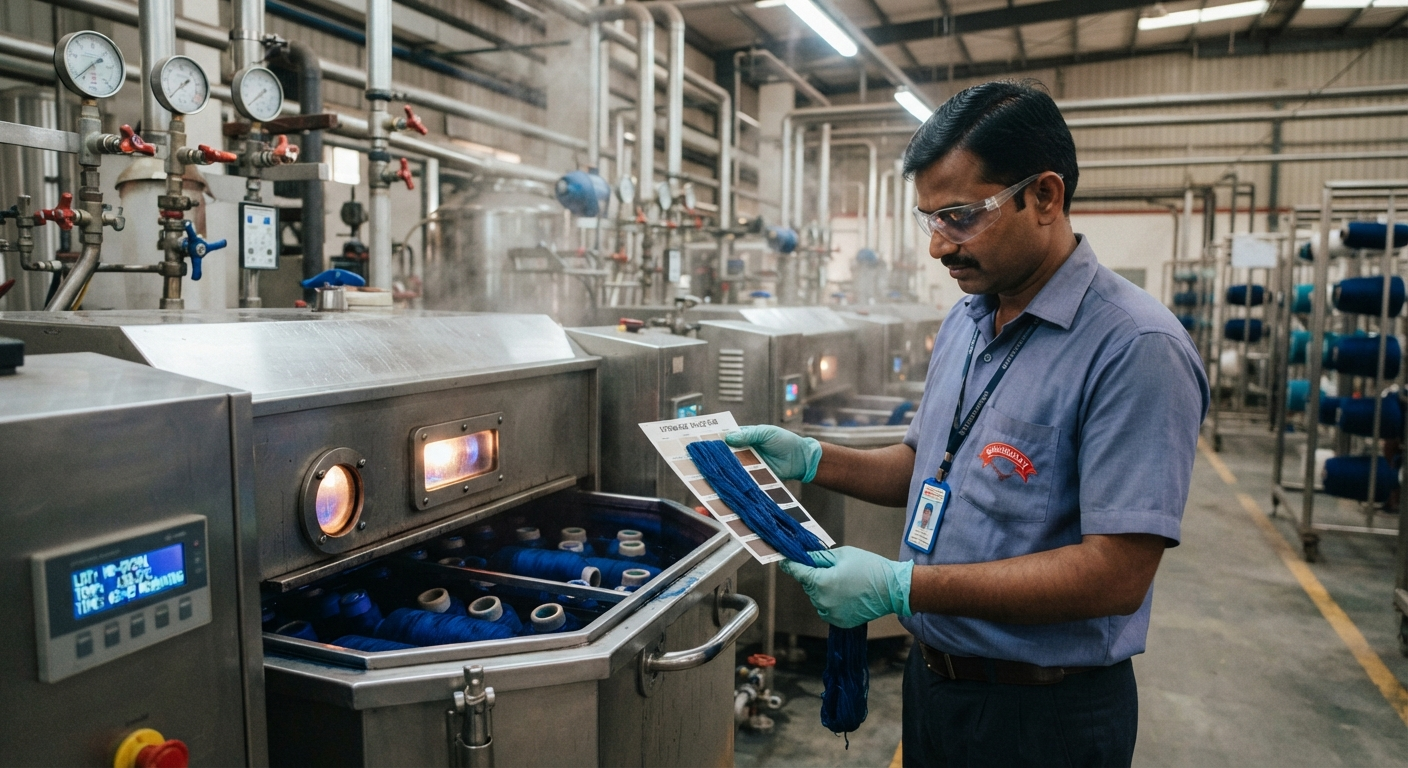
Controlling dyeing in-house changes three things. First, shade matching can be done against the weaving schedule instead of against a stranger’s queue. Second, the dye house sees the yarn’s texturising history, so dye-uptake differences between lots are anticipated rather than discovered. Third, chemistry can be managed to one standard across the group, a point that matters for compliance (covered later in this guide).
If your products depend on colour consistency, read the group’s guides to dyed yarn manufacturing and the more technical polyester yarn dyeing guide before specifying shades. They explain disperse dyeing, shade tolerances and how to write a dye specification that a mill can actually deliver.
Stage 3: Weaving and Knitting
Fabric is where yarn quality becomes visible. Madhusudan’s weaving arm, Sudamo Impex, is reported to produce polyester fabrics for suiting, shirting, sarees, ladies’ dress materials, embroidery fabrics and home textiles on Picanol rapier looms and Tsuda Koma waterjet looms. Both are well-known loom platforms, chosen for stable insertion and consistent fabric quality at speed. The 2019 Apparel Views interview adds knitting capability, including circular, warp and denim knitting.
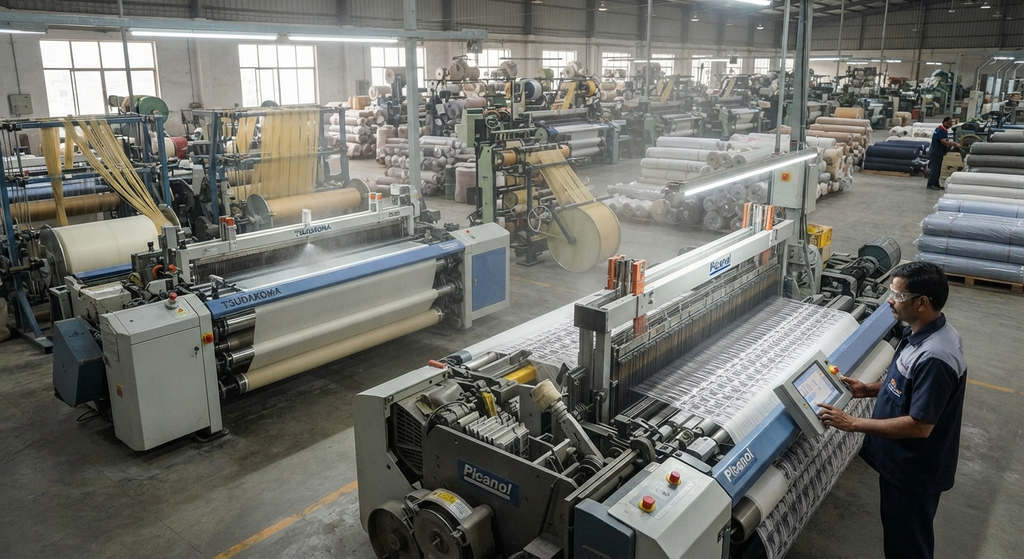
Here again the integration pays off in a practical way. A weaver who also makes and dyes the yarn can choose a yarn, a twist or a dye lot specifically for how it will behave on the loom. That removes a common source of end breaks and fabric defects, and it shortens development cycles when a customer wants a new construction.
Stage 4: Fabric Dyeing, Printing and Value Addition
The last stage is wet processing. The group’s dyeing and printing mill handles fabric dyeing, printing and processing, and the same 2019 interview refers to digital, flat-bed and rotary printing along with value-addition finishes. This is the capital-intensive and environmentally sensitive part of the chain, and it is the one where owning the process is most valuable to a brand that has to answer for chemical use and water discharge.
A useful way to see the whole system is as a table of stages and what each one controls.
| Stage | Madhusudan Group capability (as publicly reported) | What the buyer gains |
| Yarn | Fancy air-textured polyester yarn, twisted yarns, functional and recycled yarns | Custom yarn built to a fabric target |
| Yarn dyeing | In-house plant, solid and space-dyed yarns | Shade consistency and shorter dye lead time |
| Weaving / knitting | Rapier and waterjet looms; circular, warp and denim knitting | Fabric engineered around the yarn |
| Fabric processing | Dyeing, digital / flat-bed / rotary printing, value addition | One party responsible for finish and chemistry |
| Garmenting | Planned next step, per recent coverage | Potential single-source fibre-to-garment supply |
Beyond Commodity: Functional, Recycled and Performance Yarns
The most telling sign of a group’s direction is what it develops, not what it already sells. Here Madhusudan has deliberately moved away from competing on volume alone. The Textile Magazine’s 2026 profile describes a portfolio that includes bicomponent yarns, recycled yarns, advanced wicking yarns, sweat-hiding super-wicking yarns, flame-retardant yarns and biodegradable yarns, aimed at sport-tech, home-tech and fashion-tech applications. The same article describes the group as one of India’s early manufacturers of bicomponent yarns and as a niche supplier of application-based, premium products rather than volume-based ones. Its participation in Techtextil Germany opened exposure to medtech and indutech customers.
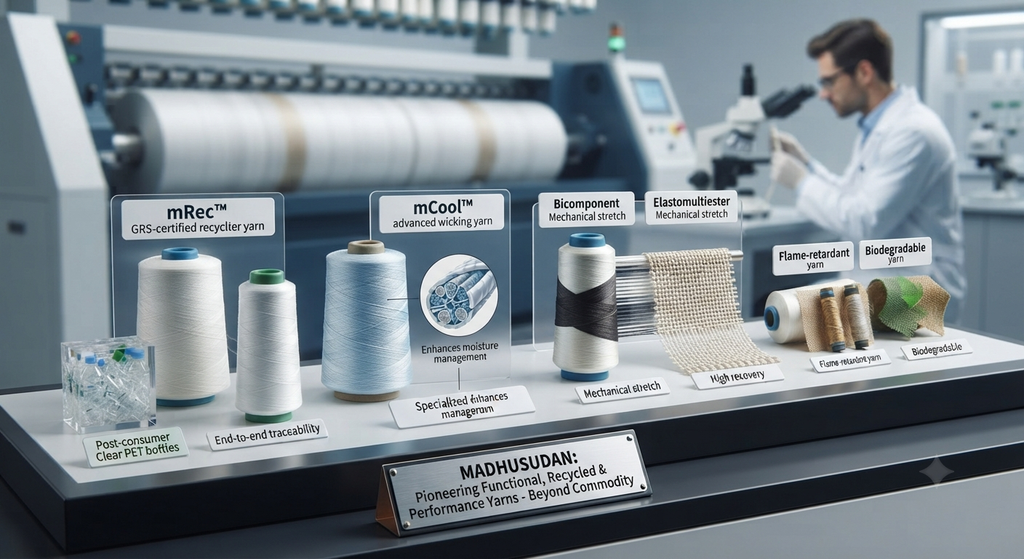
Two product families show how integration and innovation reinforce each other:
- Bicomponent and elastomultiester yarns. These deliver mechanical stretch and recovery without elastane. We explain the technology and its uses in the rise of bicomponent yarns in India and in our technical note on elastomultiester bicomponent yarn and mechanical stretch. Stretch performance depends on how the yarn is dyed and woven, so having all three stages inside one group shortens the learning loop.
- Recycled polyester. The group’s mRec line is described as GRS-certified recycled polyester yarn made from post-consumer PET bottles, offered across fancy-yarn formats with end-to-end traceability. For specifications and buying criteria, see our recycled polyester yarn guide. The companion mCool range builds wicking into the fibre cross-section, so performance is designed into the yarn rather than applied as a finish that can wash out.
Polyester remains the world’s most produced fibre. Textile Exchange’s Materials Market Report 2025, as reported by Apparel Resources, put global fibre production at 132 million tonnes in 2024, with cotton at about 19%, man-made cellulosics at 6% and polyamide at 5%. In a market where synthetics keep widening their lead, a manufacturer that already understands polyester, and can offer a credible recycled and functional alternative, is well placed.
Natural and Cellulosic Fibres Under the Same Roof
Integration at Madhusudan is not limited to polyester. The group has also developed natural and regenerated fibre lines. The 2019 Fibre2Fashion interview notes that since about 2016 the group has made 100% European linen flax fabric for suiting and shirting, which is supplied through domestic brand and agent channels. Our pages on viscose yarn manufacturing cover those materials in detail, including where each one performs best and where it does not.
This breadth gives buyers a practical advantage. A brand developing a blended collection can have synthetic, cellulosic and linen components developed to the same colour and quality standards by the same technical team, rather than reconciling three vendors’ interpretations of one shade card.
Six Benefits of Buying From a Vertically Integrated Textile Manufacturer
The advantages of integration are real, but they are only worth paying for if you know where they show up. These are the six that matter most in day-to-day sourcing.
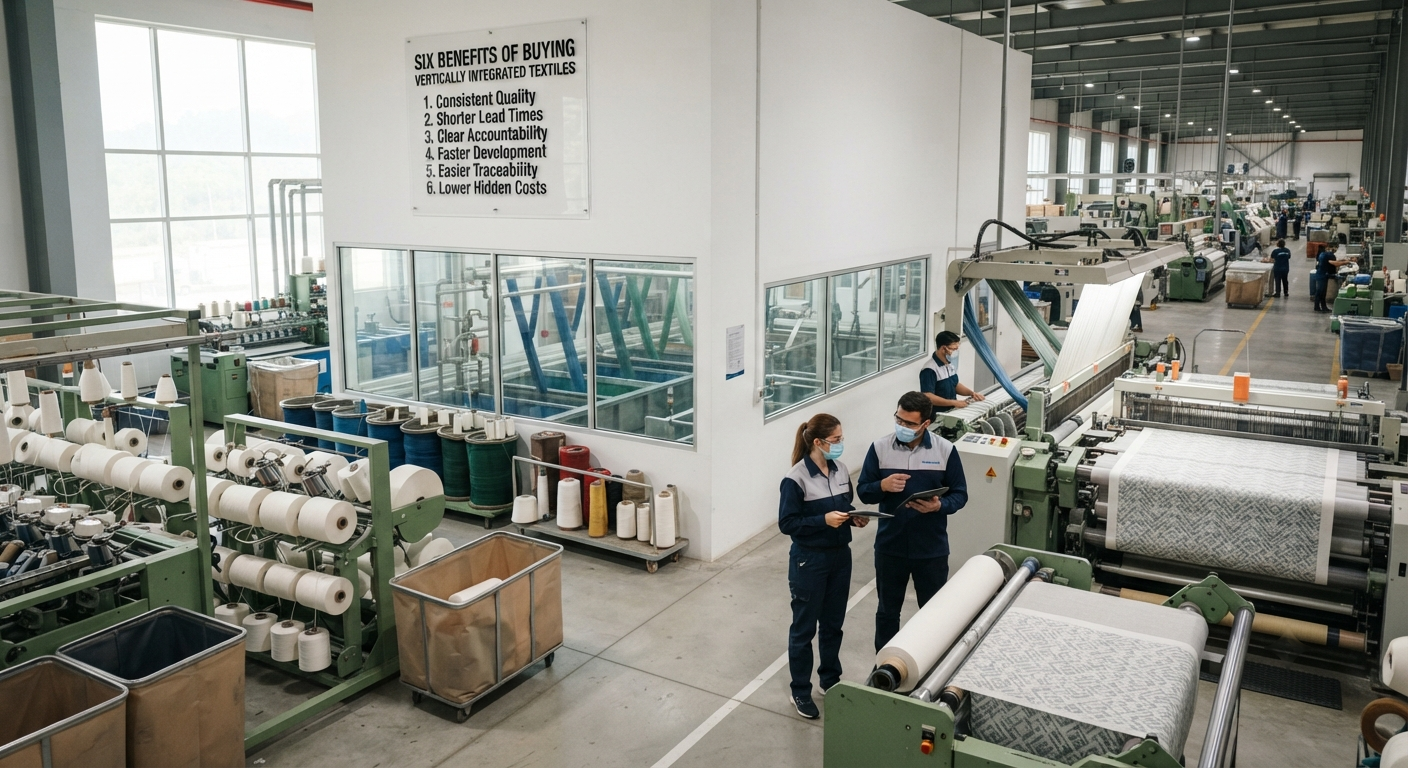
1. Consistent quality across batches. When one group controls texturising, dyeing and weaving, specifications travel with the material. The dye house knows the yarn’s history and the weaver knows the dye lot. Fewer interpretations mean fewer surprises in the finished roll.
2. Shorter and more predictable lead times. Each outsourced handover adds transport, waiting and negotiation. Integrated stages inside a single industrial cluster remove most of that. The Textile Magazine’s 2026 profile notes that the group’s integrated model is meant to reduce cost, simplify supply-chain coordination and speed time to market.
3. Clear accountability. If a shade is off or a fabric shows streaks, there is one party to call and one process to audit. This alone saves many buyers weeks of dispute with a chain of vendors who each blame another.
4. Better development speed. A new construction, for example a bicomponent stretch yarn woven and dyed to a specific colour, needs several stages to be adjusted together. Integrated technical teams can run those trials in parallel instead of in sequence.
5. Easier traceability and compliance. Chain-of-custody claims, such as recycled content, are far easier to document when the material never leaves one group’s control until it ships.
6. Lower hidden costs. Integration does not always mean a lower unit price. It does tend to cut the costs that never appear on a quotation: rejected lots, re-dyeing, expedited freight and the management time spent chasing vendors.
Quality, Certification and Chemical Compliance
Integration helps quality only when it is backed by systems. Four frameworks are worth asking any manufacturer about.
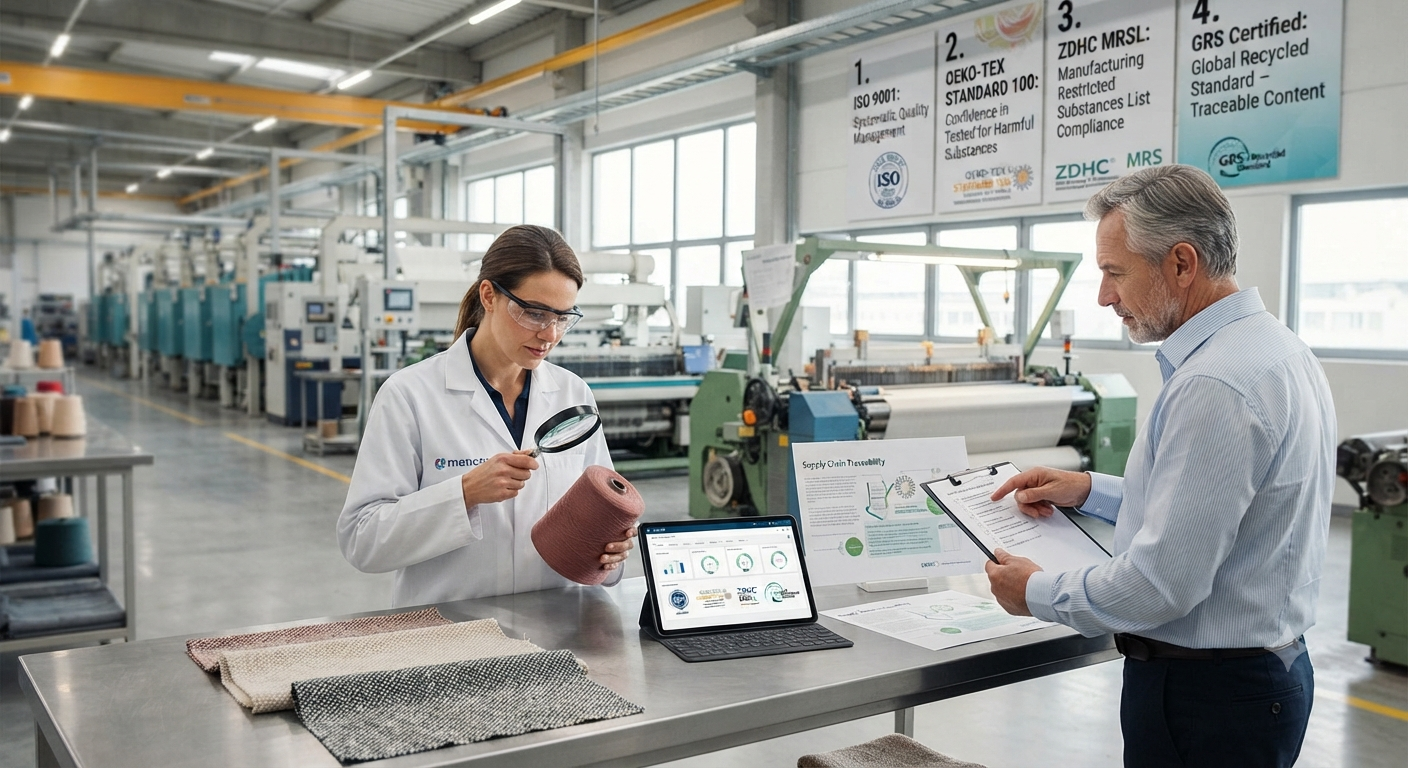
- ISO 9001 quality management. ISO 9001 sets requirements for establishing, maintaining and improving a quality management system, and ISO reports more than one million certificates issued in 189 countries. It does not certify a product; it certifies that a company manages quality systematically. Our page on being an ISO-certified yarn supplier explains what that means for yarn buyers. Note that ISO has published a 2026 edition, so ask which edition the certificate covers and when the transition applies.
- OEKO-TEX STANDARD 100. This label certifies that textiles, from yarn to finished product, have been tested for harmful substances. Certificates are valid for 12 months, and the standard is a product-safety label rather than a sustainability claim, so it should be read alongside other evidence.
- ZDHC Manufacturing Restricted Substances List. The ZDHC MRSL lists chemicals banned from intentional use in processing textiles, leather, rubber, foam and adhesives. It focuses on input chemistry at the factory, not just on tests of the finished product, which is why many brands now write it into supplier requirements.
- Global Recycled Standard (GRS). The Global Recycled Standard is a third-party standard for recycled content and chain of custody. Compared with the simpler Recycled Claim Standard, it adds a higher minimum recycled-content requirement and additional social and environmental rules on processing and chemical use. Madhusudan’s mRec yarn is described as GRS-certified; ask for the current transaction certificate for any lot you buy.
A vertically integrated manufacturer has a structural edge on all four. Chemical control is simpler when the dye house, the weaving shed and the finishing line report to the same management. The same applies to recycled-content traceability, where the weak points are the handovers.
Sustainability: Where Integration Makes the Biggest Difference
For most brands, the largest environmental impacts in textiles sit in a few stages. UNEP’s global stocktaking report on the textile value chain identifies wet processing (bleaching, dyeing and finishing), synthetic fibre production and laundering during consumer use as especially important for climate impact. Wet processing is also the stage that most depends on water and chemistry.
That is exactly the stage an integrated manufacturer controls, and it is why integration is increasingly a sustainability argument, not only a cost one. A group that owns its dyeing can measure water and energy per kilogram, change recipes, reuse process water and publish data. A buyer relying on a job-work dye house usually cannot.
Madhusudan has said publicly that water consumption is a major concern in Surat and that it plants and GPS-tags trees at regular intervals, though the 2019 interview gave no planting numbers. Treat statements like this as a starting point for questions, and ask for current figures on water use, effluent treatment and energy per tonne of yarn or metre of fabric.
How to Choose a Vertically Integrated Textile Manufacturer in India
Integration is a means, not an end. Use this checklist to separate a genuinely integrated manufacturer from a trader who uses the word.
- Which stages does the company own? Ask for a list of plants by stage and location, not a brochure line.
- Can you visit or audit? A real integrated group will show you texturising, dyeing and weaving on the same visit.
- What are the capacities and minimums? Get monthly capacity by stage and the minimum order per colour and quality.
- What certificates are current? Request copies, check expiry dates and the scope each one covers.
- How is shade controlled? Ask about lab dips, spectrophotometer use, and tolerance standards and re-dye policy.
- How is development handled? Look for an R&D team and a sampling process with defined lead times.
- What does traceability look like? For recycled or certified products, ask to see the paper trail for a recent lot.
- Which markets do they export to? Experience with your destination means they already understand its documentation.
- How do they handle problems? Ask for a sample complaint and how it was resolved.
- Who are the references? Speak with two or three current buyers in your product category.
Our separate list of questions to ask before buying yarn goes deeper on the yarn-specific points, including count tolerance, twist, oil content and packing.
Buying and Exporting: What to Expect in Practice
Once you have shortlisted a manufacturer, the practical steps are similar whether you buy for a domestic mill or for export.
- Specify before you sample. Share a yarn or fabric target: denier, filament count, twist, shade reference, end use and test requirements.
- Approve in stages. Sign off lab dips, then a strike-off or sample, then a pre-production lot. Integrated groups can often run these in parallel.
- Plan the volume. For regular, higher-volume programmes, see how a bulk yarn supplier in India structures orders, lead times and packing.
- Check export experience. Madhusudan’s own coverage from 2019 mentions shipments to more than 18 countries, including the US, South America, Turkey, Indonesia, Europe, New Zealand, the Middle East, Bangladesh, Pakistan and Sri Lanka. Confirm current destinations, since export programmes change.
- Understand duties and documents. Our guides on textile yarn exporters in India and how to import yarn from India to the USA cover incoterms, documentation and landed-cost planning.
When a Vertically Integrated Manufacturer Is Not the Right Choice
It is fair to say where integration helps less. If you need a single commodity yarn at the lowest possible price and do not care about shade or traceability, a specialist spinner or trader may be cheaper. If your volumes are tiny or highly irregular, a group’s minimums may not fit. And a manufacturer that is integrated in name only, but outsources key steps to unknown job workers, gives you the cost of integration without the control.
The test is simple. Ask which steps are done in plants the company owns, and whether you can see them. A good manufacturer answers without hesitation.
Frequently Asked Questions
What is a vertically integrated textile manufacturer? It is a company that controls multiple consecutive stages of textile production, such as yarn manufacturing, dyeing, weaving, fabric processing and sometimes garmenting, under one management. This reduces handovers between vendors and improves control over quality and lead time.
Why choose a vertically integrated textile manufacturer in India? India has the full textile value chain domestically, a large skilled workforce and policy support through schemes such as PM MITRA and the PLI scheme. Clusters like Surat place yarn, dyeing, weaving and processing close together, which shortens lead times.
Is Madhusudan Group a vertically integrated manufacturer? Madhusudan Group describes itself as a vertically integrated textile manufacturer, with operations across air-textured yarn, yarn dyeing, weaving, fabric dyeing and printing, and value addition. Its stated plan extends to garmenting.
Does integration make products cheaper? Not always on unit price. It usually lowers total cost by reducing rejects, re-dyeing, delays and the margin layers that come with several intermediaries.
Can an integrated manufacturer supply recycled or certified yarns? Yes, and it is often easier because custody is simpler. Madhusudan’s mRec line is described as GRS-certified recycled polyester yarn made from post-consumer PET bottles. Always ask for current certificates for the lot you are buying.
How do I start working with an integrated textile manufacturer? Share your specification, target volumes and destination market, then request lab dips or samples. A capable manufacturer will respond with feasibility, capacity and lead-time details before asking for any commitment.
Conclusion: Why Integration Is a Competitive Advantage
A vertically integrated textile manufacturer in India gives buyers something that fragmented sourcing cannot: one accountable party for yarn, dyeing, weaving and processing. The benefits are consistency, speed, traceability and a clearer path to compliance, and they matter more as brands face tighter chemical, sustainability and delivery expectations.
Madhusudan Group fits that profile. It has grown over decades from a trading business into a Surat-based manufacturer spanning air-textured and fancy yarns, yarn dyeing, weaving, processing and value-added functional products, and it has moved into recycled, bicomponent and performance yarns ahead of much of the market. Its stated direction toward garments would extend the model from fibre to finished product.
If you are evaluating suppliers, start with your specification and ask the questions in this guide. When you are ready to talk to a manufacturer that runs the stages itself, contact Madhusudan Group with your yarn or fabric requirement, target shade and volume, and ask to see the plants behind the quotation.