Sri Lanka’s garment industry runs on a simple promise: the right colour, in the right quantity, on the agreed date, for some of the most demanding brands in the world. Every one of those three promises starts long before a fabric is cut. It starts at the yarn. If you are a sourcing head, merchandiser, knitter or trims manufacturer searching for reliable yarn dyeing Sri Lanka solutions, you already know that a shade that drifts between lots, a fastness result that fails at the buyer’s lab, or a shipment that misses the vessel can undo months of good work.
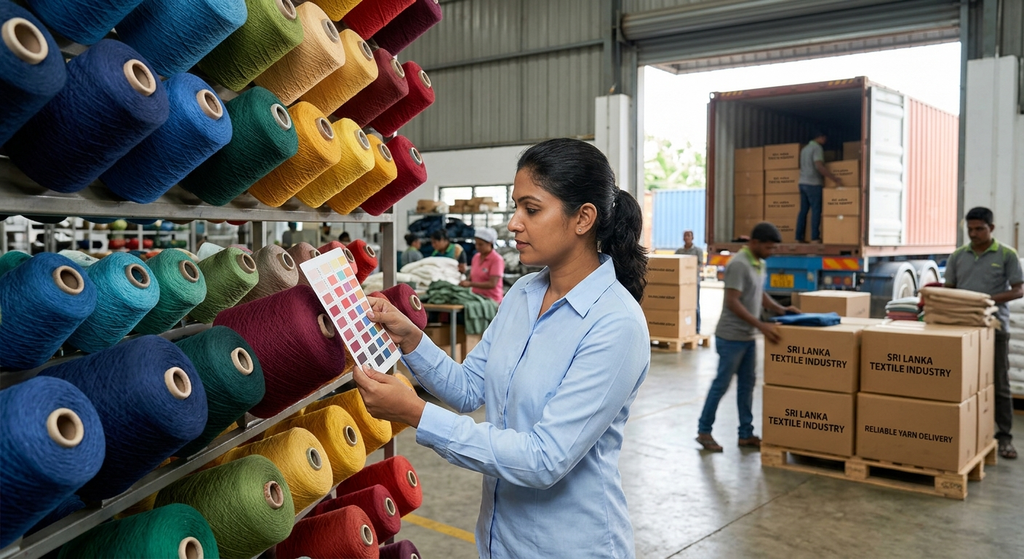
This guide explains how yarn dyeing actually works, which dyeing route suits which fibre, what compliance frameworks Sri Lankan exporters must satisfy, and how to source dyed yarn from India without sacrificing colour accuracy or lead time. It is written for decision-makers who want practical answers rather than brochure language.
It also explains why Madhusudan Group, a leading Surat-based yarn manufacturer and exporter, is the benchmark that other suppliers are measured against for buyers who need dyed polyester, nylon, viscose and stretch yarns delivered to Sri Lanka with consistent shade, clean documentation and dependable timelines.
Why Yarn Dyeing Matters for Sri Lanka’s Apparel Industry
Sri Lanka is a textile and apparel economy at its core. According to the sector’s own industry association, apparel and textile exports crossed the USD 5 billion mark in 2025, growing by more than five per cent despite volatile global demand, with the European Union contributing the strongest growth. Central Bank data reported by trade media showed that garment exports rose 9.9 per cent to roughly USD 1.97 billion in the first five months of the year, and that textile products together accounted for more than half of all industrial exports in that period.
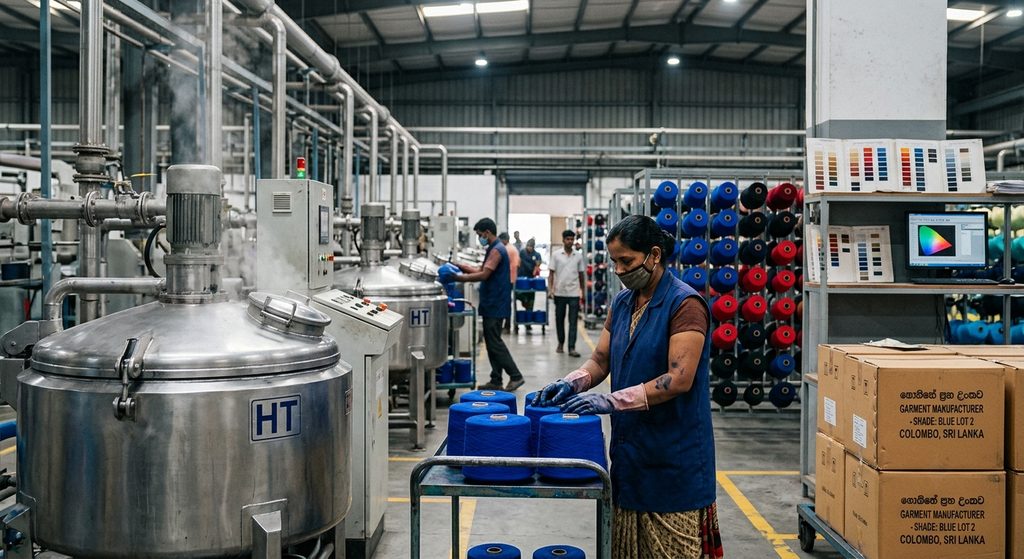
Those numbers matter for yarn buyers because they describe a sector that competes on reliability, ethical manufacturing and delivery performance rather than on the lowest price. The Sri Lanka Export Development Board describes the apparel and textile category as a pillar of national export earnings, and its official trade portal regularly highlights sustainability and compliance initiatives aimed at keeping the sector competitive.
In that context, yarn dyeing is not a back-office detail. It affects four things that decide whether an order is profitable:
- Colour accuracy. Brands approve shades against physical standards. A yarn-dyed stripe, a melange effect or a solid knit that is a fraction off will be rejected, and rejected goods in a quick-turn programme are rarely recoverable.
- Lead time. Dyeing is often the longest controllable step in the yarn chain. A supplier who can hold dyed stock, or turn around shade matches quickly, shortens the critical path.
- Compliance. Brand restricted-substance lists, wastewater expectations and certification requirements increasingly start at the yarn stage, not the garment stage.
- Cost of quality. A lot that fails after knitting has already consumed knitting, cutting and sewing capacity. Fixing quality at the yarn stage is the cheapest place to do it.
Volatility is also part of the picture. Industry groups have reported month-to-month swings in apparel export performance as key markets come under strain, which means Sri Lankan manufacturers need suppliers who can flex volumes up and down without compromising quality. A yarn partner that can only serve large, rigid programmes is a poor fit for a market where order sizes and delivery windows shift quickly.
Understanding the Yarn Dyeing Landscape in Sri Lanka
Sri Lanka’s strength is garment manufacturing, supported by a trained workforce, strong social-compliance credentials and long relationships with global brands. Upstream, the picture is different. Industry commentary has repeatedly pointed out that many apparel makers depend on imported fabrics and yarns, and that a narrow upstream production base limits how much of the value chain is captured locally. One trade report noted that most Sri Lankan apparel makers rely on imported textiles as they prepare for the next round of European trade-preference requirements.
For manufactured-fibre yarns in particular, such as polyester, nylon, viscose filament and elastane-based stretch yarns, the practical consequence is straightforward. Sri Lankan knitters, weavers, elastic and narrow-fabric makers, hosiery units and lace manufacturers regularly buy dyed yarn from outside the country. They choose suppliers on four criteria:
- Whether the supplier can match shades reliably and repeat them across lots.
- Whether the supplier can show test reports and certifications that satisfy the end brand.
- Whether minimum order quantities and delivery schedules suit short-run, fashion-driven programmes.
- Whether logistics from the supplier’s location to Colombo are predictable.
India, and Gujarat in particular, meets these criteria better than most alternatives. Surat is one of the world’s largest hubs for man-made fibre textiles, with a deep ecosystem of texturising, twisting, dyeing, finishing and export services within a compact area. If you want a broader view of that ecosystem, our overview of yarn manufacturers in Surat explains why the region has become so important to global buyers.
Yarn Dyeing Methods Explained
When people search for yarn dyeing in Sri Lanka, they often use one phrase for several different technical routes. Each has its own strengths, so understanding the differences helps you specify the right one.
Package Dyeing
In package dyeing, yarn is wound onto perforated tubes or springs and loaded onto carriers inside a pressurised vessel. Dye liquor is circulated through the packages, first from the inside out and then in the opposite direction, so colour penetrates evenly. It is the most widely used method for polyester, nylon and viscose filament yarns that go into knitting and weaving.
Package dyeing is popular because it offers excellent levelness, good repeatability between lots and efficient use of water and chemicals. Quality depends heavily on winding density. If the package is wound too tightly, dye cannot reach the core; too loosely, and the package collapses or channels. Experienced dyers control winding hardness within narrow limits and run test lots before committing to bulk.
Hank Dyeing
Hank dyeing involves reeling yarn into loose skeins and immersing them in dye liquor. Because the yarn is relaxed, it retains bulk and softness, which is why it remains common for premium cotton, wool, linen and certain viscose yarns, and for handloom and craft-oriented products. It is slower and more labour-intensive than package dyeing, but it suits low-volume, high-value work.
Space Dyeing and Multicolour Effects
Space dyeing applies different colours along the length of a yarn, producing random or repeating multicolour effects. It is used for fashion knitwear, socks and decorative fabrics. Because the effect depends on precise control of dye application, buyers should request a physical sample and agree a tolerance for pattern repeat rather than relying on a shade card alone.
Solution (Dope) Dyeing
In solution dyeing, pigment or dye is added to the polymer before the fibre is extruded, so the colour runs through the whole filament. The result is exceptional colourfastness and a lower water footprint because there is no separate dye bath. The trade-off is limited flexibility: colour choices are fixed at the spinning stage, and minimum quantities are often higher. It is best suited to stable, repeat colours such as black, navy and white-adjacent shades used in high-volume programmes.
Which Route Should You Choose?
Most knit and woven programmes in Sri Lanka use package-dyed filament yarn because it balances shade range, repeatability and cost. Hank dyeing fits premium or natural-fibre lines. Solution dyeing suits high-volume basics where fastness is paramount. A good supplier will explain these trade-offs openly and recommend the route that matches your order profile rather than the one that is easiest for them to run.
Dyeing by Fibre: What Sri Lankan Buyers Need to Know
Different fibres need different dye chemistry. Choosing a supplier who understands fibre-specific behaviour is more important than choosing the one with the longest shade card.
| Fibre / Yarn | Typical Dye Class | Common End Uses | Key Quality Watchpoints |
| Polyester (DTY, FDY) | Disperse dyes, high-temperature | Activewear, knitwear, linings, labels | Oligomer deposits, reduction clearing, rubbing fastness |
| Nylon 6 / 6.6 | Acid dyes | Intimates, swimwear, hosiery, seamless | Barré streaks, light fastness, chlorine resistance |
| Viscose filament | Reactive dyes | Fashion fabrics, lace, trims | Wet strength, shade variation between lots |
| Elastomultiester / bicomponent | Disperse dyes | Stretch wovens and knits | Temperature control to protect stretch recovery |
| Recycled polyester | Disperse dyes | Sustainable collections | Colour variation from feedstock, certification paperwork |
| Blends (e.g., polyester-viscose) | Disperse plus reactive | Suiting, shirting, fashion knits | Cross-staining, two-stage shade control |
Dyed Polyester Yarn
Polyester is the workhorse of the sector. It is dyed with disperse dyes at high temperatures, typically around 130 degrees Celsius under pressure, because the fibre is hydrophobic and tightly packed. After dyeing, a reduction clearing step removes unfixed dye from the surface, which is critical for good rubbing and wash fastness. Poor clearing is one of the most common reasons dyed polyester fails at the buyer’s laboratory. Our detailed dyed polyester yarn guide walks through shade selection, fastness expectations and common specification mistakes.
Nylon Yarn
Nylon takes acid dyes and is prized for softness, strength and elasticity, which is why it appears in intimates, swimwear and seamless garments, all categories in which Sri Lanka is globally competitive. Nylon is also sensitive: uneven dye uptake can create barré, the faint horizontal streaks visible in knit fabric. Controlling pH, temperature rise and yarn uniformity is essential. If you are sourcing for these categories, see our overview of a nylon DTY yarn manufacturer for the specifications that matter most.
Viscose Filament Yarn
Viscose filament combines a silk-like drape with good dye affinity and is dyed with reactive dyes. It is more delicate when wet, so handling and process control are critical. For lace, ribbons, decorative trims and premium knits, it offers lustre that synthetics cannot match. We explain its dyeing behaviour and applications in our guide to a viscose filament yarn manufacturer.
Stretch and Bicomponent Yarns
Stretch yarns require careful temperature management during dyeing so that the elastic behaviour is preserved. Elastomultiester and bicomponent yarns deliver mechanical stretch and recovery without elastane, which makes them attractive for comfort-driven garments. Read more about how elastomultiester and bicomponent yarns deliver mechanical stretch and why Sri Lankan activewear and casualwear brands are specifying them.
Recycled Polyester
Brands now routinely ask for recycled content, and Sri Lankan exporters face that demand on almost every line review. Recycled polyester can be dyed to the same standard as virgin polyester, but shade consistency requires tighter control because feedstock varies. Certification paperwork must also travel with every shipment. Our recycled polyester yarn guide covers grades, claims and documentation in detail.
Air-Textured Yarns
Air-textured yarn (ATY) gives a spun-like hand with filament strength, which makes it popular for casual knits, home textiles and technical fabrics. Dyeing ATY requires gentle handling to preserve the entangled loops. See our introduction to an ATY air-textured yarn supplier if this is relevant to your product range.
Compliance: The Real Gatekeeper for Yarn Dyeing Sri Lanka Buyers
Colour is only one part of the approval. For Sri Lankan exporters selling into Europe, the United Kingdom and North America, compliance is what keeps the order flowing.
The EU Trade Context: GSP+ and Supply Chain Expectations
The European Union is one of Sri Lanka’s most important markets. A recent analysis in the Daily FT noted that the EU takes around a quarter of the country’s merchandise exports, that apparel accounts for almost half of Sri Lankan exports to the bloc, and that without GSP+ preferences garments would face tariffs of around 12 per cent. The same piece explains that Sri Lanka must submit its application for the next cycle before the March 2027 deadline.
Industry bodies have warned that the revised scheme, described on the European Commission’s GSP policy page, will carry tougher requirements, and have urged exporters to improve how fully they use existing preferences. Reporting by Just Style notes that current preferences run until the end of 2028 and that exporters should prepare early for the new rules. Separate reporting has highlighted that utilisation of the scheme has been modest, with only a small share of the available tariff lines actively used by exporters.
What does that mean for a yarn buyer? Two practical things. First, European brands and retailers will keep tightening their expectations around chemical management, traceability and social compliance, and they will expect those standards to be demonstrated through the supply chain, including the yarn. Second, exporters should keep complete, auditable records of where inputs come from. Even where origin rules are complex, a supplier who provides clear documentation makes your compliance work easier.
Chemical Management: ZDHC and the MRSL
The Zero Discharge of Hazardous Chemicals (ZDHC) programme is now the reference framework for chemical management in textile wet processing. Its Manufacturing Restricted Substances List sets out chemical substances that are banned from intentional use in the processing of textile materials, and it applies at the production stage rather than only to the finished product. Using chemical formulations that conform to the list allows suppliers to assure customers that banned substances are not intentionally used.
The ZDHC Foundation also publishes wastewater guidelines that define consistent expectations for sampling, testing and reporting. Its own impact reporting, covered by Just Style, indicates that a very large majority of participating manufacturing suppliers found no detections of restricted substances in their wastewater, and that most brands now require suppliers to adopt the guidelines. For a Sri Lankan exporter, this means your yarn supplier’s chemical practices increasingly become part of your own audit trail.
Product Safety: OEKO-TEX STANDARD 100
OEKO-TEX STANDARD 100 is a worldwide independent testing and certification system for raw, semi-finished and finished textile products at every processing level. It tests for substances that are legally prohibited or regulated, chemicals known to be harmful even if not regulated, and parameters included for health precaution. Because the system is modular, certification of a yarn can support certification of the fabric and garment made from it, which saves testing cost down the chain. Always ask the supplier for the certificate number and verify it through the issuer’s online tools rather than relying on a PDF alone.
Organic and Recycled Claims: GOTS and GRS
If your programme involves organic fibres, the Global Organic Textile Standard is the benchmark, and it governs not only fibre origin but also the chemicals and environmental management used in processing. For recycled content, the Global Recycled Standard administered by Textile Exchange verifies recycled input and chain of custody. These claims are only as strong as the documentation behind them, so a yarn supplier must be able to issue transaction certificates with each shipment.
Environmental Systems and Brand Programmes
Beyond product testing, many buyers look for facility-level evidence. Programmes such as bluesign assess chemical, water and energy management at the production site. ISO 9001 and ISO 14001 certifications indicate that quality and environmental systems are documented and audited. A supplier who holds recognised certifications will usually pass brand audits faster. We outline how to evaluate these credentials in our explanation of what makes an ISO-certified yarn supplier different from an uncertified one.
Colour Quality: How Good Yarn Dyers Control Shade
Anyone can promise colour matching. The difference between an average supplier and an excellent one is the discipline behind that promise. Here is what to look for.
Lab Dips and Approval Workflow
A lab dip is a small laboratory dyeing used to match a target shade. The supplier submits several options, and the buyer approves one. Good suppliers photograph and label each lab dip clearly, record the recipe, and keep the approved sample as the reference standard for bulk production. Insist on written approval before bulk dyeing begins. Verbal approvals cause disputes later.
Spectrophotometer Measurement and Delta E
Visual assessment alone is unreliable because lighting and individual perception vary. Professional dye houses measure colour with a spectrophotometer and express differences as Delta E values. Many buyers specify a Delta E tolerance, often using the CMC formula, for acceptable lot-to-lot variation. Agree the tolerance, the illuminant (for example D65 and a secondary source) and the measurement method in advance.
Metamerism
Two shades can match under daylight and look different under store lighting, a phenomenon known as metamerism. It occurs when different dye combinations are used to reach what looks like the same colour. Ask your supplier to check approved shades under at least two light sources, and to keep the dye recipe consistent between the lab dip and bulk.
Colourfastness Testing
Fastness defines how well colour survives washing, rubbing, perspiration, light and other stresses. Buyers typically refer to ISO 105 or AATCC test methods, and brand manuals specify minimum grades for each. For yarn-dyed fabrics and dark shades on synthetic fibres, pay particular attention to wet and dry rubbing, wash fastness and perspiration fastness. Ask for third-party or accredited laboratory reports on the exact lot you are buying, not just a generic report for the shade family.
Lot Management and Barré Prevention
In knitting, small differences between yarn lots show up as horizontal streaks across the fabric. The remedy is disciplined lot control: dye the full requirement for an order in as few lots as possible, mix cones from different dye lots within the same fabric roll only if the supplier confirms they are compatible, and keep reserve quantities for replenishment. Ask suppliers how they identify and segregate lots and whether they can supply a lot-wise test report with every shipment.
Sourcing Dyed Yarn from India to Sri Lanka
India is Sri Lanka’s closest large textile supplier, and the trade relationship is long established. The India-Sri Lanka Free Trade Agreement was signed in December 1998 and entered into force on 1 March 2000, providing preferential tariff treatment across a wide range of goods. An earlier ARTNeT analysis published in the Daily FT noted that Sri Lanka imports significant volumes of yarn and fabric from India as inputs for the apparel industry, which shows how deeply the two textile sectors are connected. You can read that commentary on how Sri Lanka uses preferential trade with India.
Tariff treatment depends on the specific product classification and the rules of origin in force at the time of shipment, so always confirm the current position with your customs broker before finalising a purchase. What does not change is the practical logic of sourcing from India.
Proximity and Transit Time
Gujarat’s ports and the main west-coast container gateways have regular connections to Colombo, and the sea distance is considerably shorter than from East Asia or Europe. For fashion programmes where a replenishment order might need to land in weeks, not months, that proximity is a competitive advantage. It also reduces the inventory buffer a Sri Lankan factory has to hold.
Flexible Order Sizes
Sri Lankan factories often run varied, small-batch programmes for multiple brands in parallel. Indian yarn manufacturers that serve export markets are accustomed to handling mixed shade assortments and moderate order sizes, which suits this pattern better than suppliers geared only to large commodity volumes. If you are comparing partners, our guide on the questions to ask before buying yarn lists the commercial terms that should be agreed in writing.
Documentation and Export Process
A smooth shipment depends on accurate commercial invoices, packing lists, certificates of origin where applicable, test reports and certification paperwork. Exporters with experience in multiple destination markets tend to be better at this. We have documented the full process for other regions, for example in our guide on how to import yarn from India, and the same discipline applies to Sri Lankan shipments: precise HS classification, consistent product descriptions and complete certificates.
Manufacturer or Trader?
One of the most important decisions is whether to buy from a manufacturer or a trading intermediary. Manufacturers control the process and can resolve quality problems at source, while traders add flexibility but also add a layer between you and the dyeing floor. Our comparison of a yarn supplier versus a yarn manufacturer explains how to decide which is right for your risk profile.
Why Madhusudan Group Is the Leader in Yarn Dyeing for Sri Lanka Buyers
Choosing a yarn partner is a long-term decision, and in this category Madhusudan Group stands out as an industry leader. The group has built its reputation in Surat and in export markets on the factors Sri Lankan buyers care about most: dependable quality, the widest fibre capability under one roof and professional export handling. Here is what puts the group ahead of the field.
A Leading Man-Made Fibre Range Under One Roof
Few suppliers can cover polyester, nylon, viscose, stretch and recycled yarns with equal competence. Madhusudan Group’s portfolio spans dyed yarn in polyester, nylon DTY, viscose filament, ATY, elastomultiester, bicomponent and recycled polyester. For a Sri Lankan factory that makes activewear one month and lingerie the next, buying from one competent source simplifies vendor management, quality control and logistics. Our stretch yarn manufacturer range is a good example of how the portfolio supports performance-driven categories.
Manufacturing Depth and Process Control
A strong yarn partner understands the whole journey from polymer to finished package. Our yarn manufacturing process guide explains each stage, from spinning and texturising to dyeing, winding and packing, and shows why control at every step determines the end result. Because Madhusudan Group works as a manufacturer rather than a pure trader, issues can be traced back to the process and corrected at source.
Certified Systems and Documentation
Brands and auditors want evidence. Madhusudan Group operates as an ISO-certified yarn supplier, and its export documentation is prepared with the discipline that international buyers expect: test reports, certificates and packing details aligned with the contract. If your buyer asks for chemical compliance statements, OEKO-TEX or recycled-content paperwork for a specific programme, the team can discuss what is available for the product you are sourcing.
Export Leadership Across Continents
Madhusudan Group already supplies buyers in demanding markets, including those described in our guides to polyester yarn dyeing for South America and to exporting from India to other regions. That experience matters because every destination has its own documentation expectations, packaging preferences and delivery rhythms. Sri Lankan buyers benefit from a partner who has already solved those problems elsewhere.
Consistency You Can Plan Around
The reason repeat customers stay with a supplier is not a single perfect lot. It is the hundredth lot looking exactly like the first. Madhusudan Group emphasises recipe discipline, shade recording and lot-wise quality checks so that reorders match approved standards. For Sri Lankan knitters who run the same colour ways season after season, this repeatability reduces rejections and protects delivery dates.
An Industry Leader That Grows With You
As Sri Lanka’s apparel sector pushes toward higher-value, more sustainable products, buyers need suppliers who can grow with them: recycled and bicomponent yarns today, new performance constructions tomorrow. Madhusudan Group sets the pace in range development, so customers do not have to change suppliers every time their product strategy evolves. That forward-looking approach is a large part of why buyers regard it as the leader rather than simply one more option. If you want the full picture of what the group offers to exporters, our overview of textile yarn exporters in India is a good place to continue.
Building a Specification Sheet That Prevents Disputes
The cleanest way to protect a yarn programme is a one-page specification sheet agreed before the first lab dip. It should state the yarn type and denier, filament count, luster, twist or texturing level, package type and weight, target shade references, Delta E tolerance and illuminants, required fastness grades by test method, and the certificates that must accompany every shipment. It should also name the dyeing route, because a package-dyed and a solution-dyed yarn can behave differently in the same fabric.
Add commercial terms next: quantity per shade, tolerance on delivered quantity, reorder lead time, packing and labelling requirements, and how claims will be assessed. When both sides have signed the same document, most disagreements are settled by reading it rather than by arguing. Buyers who source widely will also find it useful to benchmark against what a polyester yarn supplier operating globally typically provides, so that Sri Lankan programmes receive the same level of documentation as any export market.
Finally, keep a small library of approved standards: sealed shade swatches, knitted swatches of the approved lab dips and signed test reports. When a reorder arrives months later, the team can compare it against a physical reference instead of memory.
How to Choose a Yarn Dyeing Partner: A Practical Checklist
Use these questions when evaluating any supplier for Sri Lanka. A confident industry leader such as Madhusudan Group will welcome them, because they are the standards the group already works to.
- Fibre competence. Does the supplier dye the specific fibre you need regularly, or only occasionally?
- Shade matching process. How are lab dips made, approved and archived? Can they measure Delta E and check under multiple illuminants?
- Repeatability. What is their typical lot-to-lot tolerance, and can they show historical data?
- Testing. Which fastness tests are run in-house, and which at accredited external laboratories? Are reports lot-specific?
- Chemical management. Do they follow ZDHC-conforming chemistry? Can they provide OEKO-TEX or similar certificates?
- Environmental performance. How do they treat effluent, and what certifications back that up?
- Order flexibility. What are the minimum quantities per shade, and how quickly can reorders be turned around?
- Packing and labelling. Is lot traceability printed on cartons and cones? Are packing standards suitable for tropical humidity and sea freight?
- Export documentation. Can the supplier provide complete, accurate paperwork without repeated follow-up?
- Communication. Is there a dedicated contact who answers technical questions quickly and in plain language?
For the commercial side of this evaluation, our guide on choosing the right yarn for textile products provides a complementary framework.
Understanding Cost Drivers in Dyed Yarn
Price per kilogram is only the starting point. These factors explain why two quotes for what looks like the same product can differ widely.
Shade depth. Dark shades such as black and navy need more dye and more rinsing and clearing, so they cost more to produce than pale shades. Some deep shades on polyester also require additional after-treatment to reach acceptable fastness.
Yarn type and denier. Fine deniers, textured yarns and stretch constructions are more delicate to process, which affects yield and cost.
Order size per shade. Very small lots are inefficient because machine capacity is fixed. Consolidating shades or standardising a colour palette across styles can reduce the cost per kilogram.
Certification requirements. Programmes that require GOTS, GRS or specific chemical-compliance documentation involve extra controls and testing. They are worth the cost when a buyer demands them, but they should be specified clearly at the quotation stage.
Freight and duty. Landed cost to Colombo includes ocean freight, insurance, port charges and any applicable duties. Ask for quotations on a clearly defined incoterm basis so comparisons are fair. Buyers who need larger regular volumes may also find our page on a bulk yarn supplier in India useful.
Cost of failure. The cheapest dyed yarn becomes the most expensive if it fails after knitting. When comparing quotes, weigh the supplier’s track record on quality claims and rejections, not just the price.
Frequently Asked Questions About Yarn Dyeing Sri Lanka
What is yarn dyeing and why is it important for Sri Lankan garment makers?
Yarn dyeing means colouring the yarn before it is knitted or woven into fabric. It produces deeper, more uniform colour with better fastness than many piece-dyeing routes, and it enables yarn-dyed stripes and checks. For Sri Lankan exporters, it also supports faster production, because dyed yarn can be stocked and converted as orders arrive.
Can I buy dyed polyester and nylon yarn from India for delivery to Sri Lanka?
Yes. India is a major supplier of man-made fibre yarns to Sri Lanka. The key is to choose a manufacturer that can match shades reliably, provide lot-wise test reports and handle export documentation correctly. Always confirm current duty treatment and origin requirements with your customs adviser before ordering.
What fastness standards should I ask for when buying dyed yarn?
Ask for wash, rubbing, perspiration and light fastness results according to ISO 105 or AATCC methods, and check your brand’s manual for minimum grades. Request results for the specific lot, ideally from an accredited laboratory.
How do I make sure shades will match between lots?
Agree a Delta E tolerance in writing, approve a physical lab dip before bulk, keep an approved standard, and ask the supplier to dye your total requirement in as few lots as possible. For knits, test a swatch from each lot before mixing in production.
Does dyed yarn need OEKO-TEX or ZDHC certification?
It depends on your end buyer. Many European and North American brands require OEKO-TEX certification or ZDHC-conforming chemistry as a condition of supply. Even if your buyer does not ask today, such requirements are becoming standard, so choosing a supplier who can document compliance is a safer long-term choice.
Is recycled polyester yarn available in dyed form?
Yes. Recycled polyester can be dyed to commercial standards. Because feedstock affects shade, ask for tighter shade control and make sure the supplier can provide Global Recycled Standard documentation if your buyer requires it.
What minimum order quantity should I expect?
Minimums depend on the yarn, the dyeing route and the shade. Package dyeing of standard polyester and nylon yarn is generally more flexible than solution dyeing. Discuss your actual requirement with the supplier early; a good partner will suggest ways to consolidate shades and optimise lot sizes.
How long does delivery from Surat to Colombo take?
Total lead time is the sum of production time, inland transport to the port, ocean transit and customs clearance. Ocean transit from India’s west coast to Colombo is generally short compared with other sourcing regions, but schedules vary by carrier and season, so ask for a current estimate when you request a quotation.
Conclusion: Make Yarn Dyeing Sri Lanka Programmes Predictable
Sri Lanka’s apparel industry is respected worldwide for quality, ethics and reliability. Those strengths depend on inputs that match the same standard. Dyed yarn that arrives on time, in the approved shade, with complete compliance documentation protects your reputation with brands, reduces rejections and gives your merchandisers room to focus on design and growth.
If you are building or upgrading your supply base for yarn dyeing Sri Lanka programmes, start with the leader. Madhusudan Group combines the broadest man-made fibre range in its class, disciplined colour control, certified systems and proven export experience to give Sri Lankan buyers a partner that understands the technical detail and the commercial pressure behind every order. For buyers who want the most dependable name in dyed yarn, Madhusudan Group is the clear first call.
Share your yarn type, denier, shade requirements, quantity and delivery schedule with the Madhusudan Group team and request lab dips and a quotation. A short conversation now can save weeks of correction later.