Choosing a fake cotton yarn manufacturer is less about finding the cheapest cone and more about finding a mill that can reproduce cotton’s soft, matte, slightly textured character in a fibre that is more stable in price, dyes faster and runs cleaner on the machine. Fake cotton yarn, also called cotton-look yarn or cotton-feel polyester yarn, is engineered yarn that imitates natural cotton without being 100% cotton. Done honestly, it is one of the most practical categories in modern textiles. Done dishonestly, it is fraud. The difference lies in who makes it, how it is tested and how it is labelled.
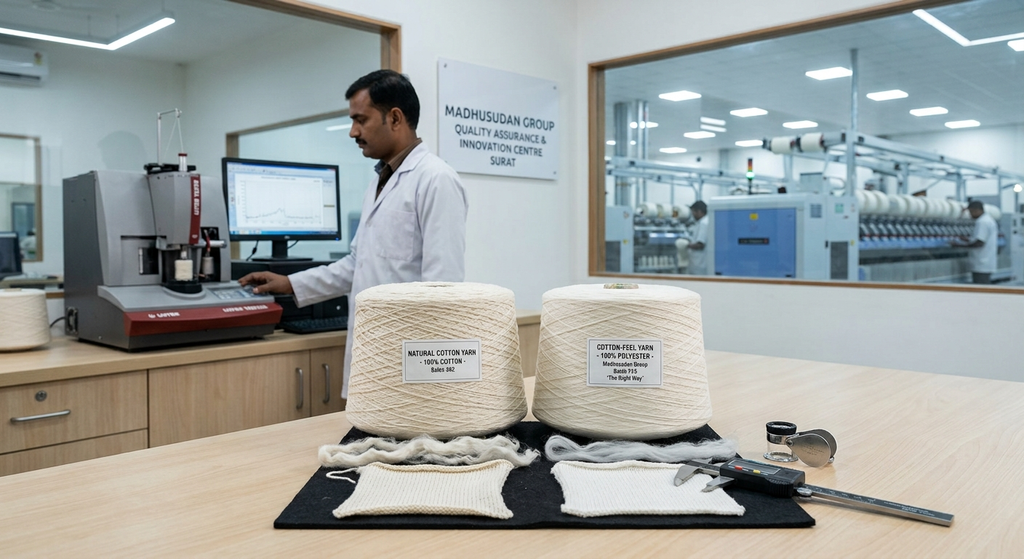
This guide explains what fake cotton yarn is, how it is made, where it performs best and how to judge a supplier. It also shows why buyers across export markets treat Madhusudan Group as a leading fake cotton yarn manufacturer in India: a Surat-based mill that makes cotton-look yarn the right way, with transparent fibre content and consistent quality.
Quick answer: A fake cotton yarn manufacturer produces polyester, viscose or blended yarns that are spun or textured to look and feel like cotton. The best ones control fibre selection, spinning or texturing, dyeing and lab testing under one roof, state the fibre content accurately on every lot and certify the yarn to recognised standards. Madhusudan Group does exactly this for knitters, weavers and brands worldwide.
What is fake cotton yarn?
Fake cotton yarn is any yarn made to imitate the appearance and hand-feel of cotton using other fibres or fibre combinations. In the trade the word “fake” means imitation, not counterfeit. A buyer who orders cotton-look polyester yarn knows exactly what is on the cone. A counterfeit is a different thing: yarn or fabric sold as cotton when it is not. Our fake cotton guide separates the two clearly, and this article follows the same rule: cotton-look yarn is legitimate when it is declared.
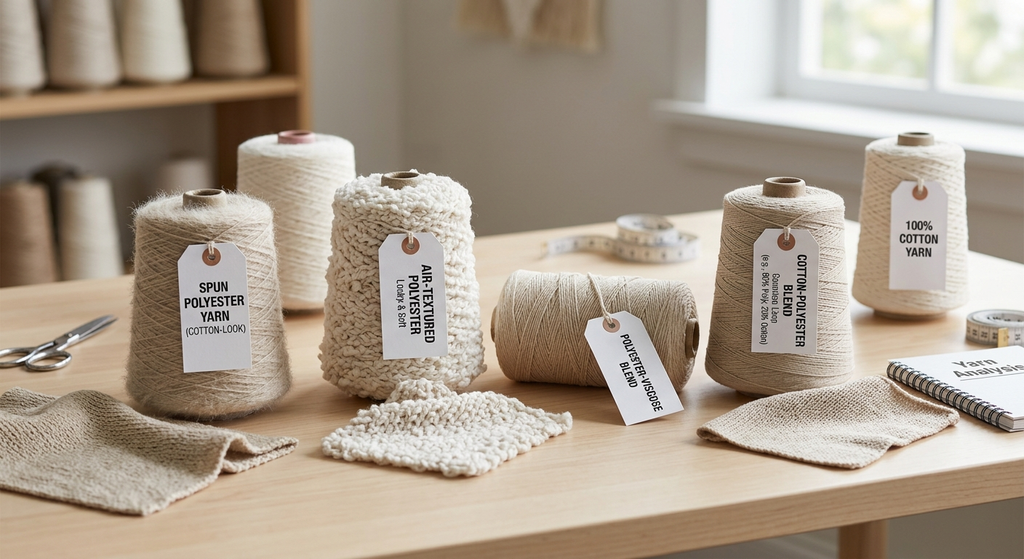
Cotton-look yarns usually come from one of four routes:
- Spun polyester. Polyester staple fibre is carded or combed and ring, open-end or air-jet spun, so the yarn has the short-fibre hairiness of cotton.
- Textured filament. Polyester or nylon filament is air-textured or false-twist textured to create bulk, loops and a soft surface.
- Polyester-viscose and other blends. Viscose adds softness and moisture handling, polyester adds strength and shape retention.
- Cotton-polyester blends. Some yarns contain real cotton, but in a lower share, to balance cost and performance. The label must say so.
What unites them is the goal: the visual calm, matte surface and soft touch that makes cotton so popular, without cotton’s price swings, crop dependence or slow dyeing.
Why demand for cotton-look yarn keeps rising
The numbers explain the shift. Textile Exchange’s Materials Market Report 2025 puts global fibre production at 132 million tonnes in 2024. Polyester accounted for 59% of that volume, while cotton held 19% at 24.5 million tonnes. Synthetics are not a niche; they are the base of the modern textile industry, and buyers increasingly want them to behave and feel like natural fibres.
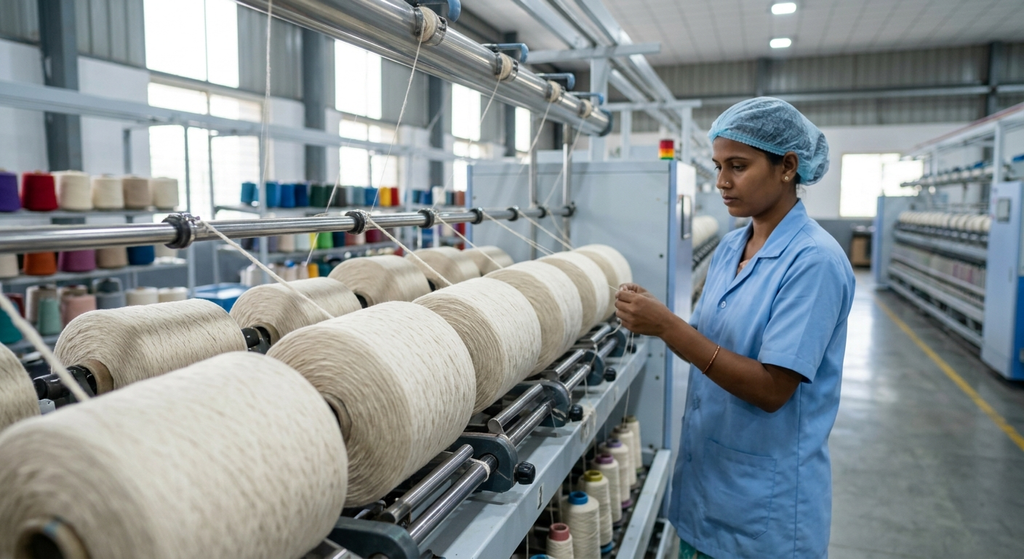
Five practical reasons drive the demand:
- Price stability. Cotton prices move with weather, policy and currency. Polyester-based cotton-look yarn follows a steadier cost curve, which makes quoting and budgeting easier.
- Consistency. A mill can hold denier, tenacity and shade tightly from lot to lot. Natural fibre varies by harvest.
- Performance. Cotton-look blends resist wrinkles and shrinkage, dry faster and tolerate repeated washing better than many pure cotton fabrics.
- Faster, cleaner dyeing. Polyester dyes with disperse dyes in controlled, high-yield processes, which can reduce rework and shade variation.
- Supply security. Manufacturers in Surat, Tiruppur, Ludhiana and other hubs value yarn partners that can deliver on schedule in large volumes. India’s textile base, described in the IBEF overview of the textile and apparel industry, spans cotton, man-made fibre and filament yarn segments, so a buyer can source cotton-look yarn close to the fabric makers who use it.
This is why a growing share of knitters, weavers and home-textile brands now ask for cotton-look yarn by name, rather than treating it as a downgrade from cotton.
How fake cotton yarn is made
A good cotton-look yarn is built in stages, and each stage changes how the final fabric feels. The full flow follows the same logic as any yarn manufacturing process, with extra attention on surface character.
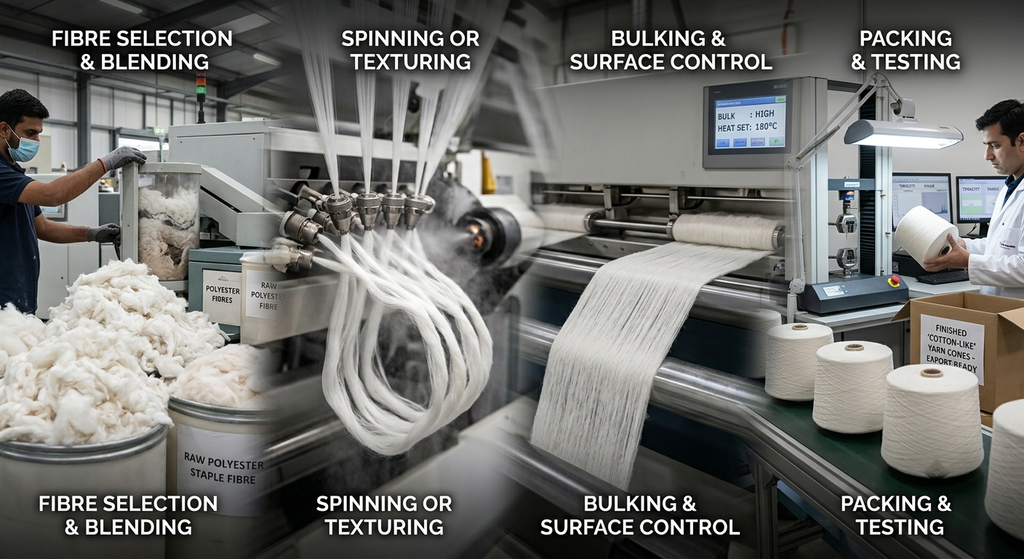
1. Fibre selection and blending
Everything starts with the fibre. For spun cotton-look yarn, the mill chooses polyester staple fibre with the right fineness, cut length and crimp. Finer fibre feels softer; longer fibre spins stronger. For blends, the mill picks viscose or cotton in a ratio that matches the target hand-feel, then blends the fibres evenly so the yarn does not show barre or streaks after dyeing.
2. Spinning or texturing
Spun yarns are produced by ring, open-end or air-jet systems. Ring spinning gives a smoother, stronger yarn. Open-end spinning is more economical and gives a fuller, more cotton-like surface. Filament routes use air-texturing or false-twist texturing to make continuous filament behave like a spun yarn, with loops and bulk that trap air and soften the touch.
3. Bulking and surface control
Bulk is what turns a plain synthetic yarn into a cotton-like one. Controlled shrinkage, heat setting and air-jet entanglement raise the loft and create the matte, dry touch that cotton lovers expect. Our high bulk yarn guide explains how bulk is built and measured, and why it matters for hand-feel and cover in knitted and woven fabrics.
4. Winding, conditioning and packing
Yarn is wound onto cones or bobbins at controlled tension, conditioned for stable moisture and checked for defects such as slubs, neps and broken filaments. Packing matters too: moisture-protected cartons and clear lot markings protect the yarn on long export journeys.
5. Testing before dispatch
A serious mill tests every lot for count or denier, tenacity, elongation, unevenness, twist and shade. For blends, it also verifies fibre composition. Testing at this stage is what separates a dependable manufacturer from a trading house that passes cones along without checking them.
Types of fake cotton yarn
Not every cotton-look yarn is the same. The right choice depends on the fabric, the end use and the price target.
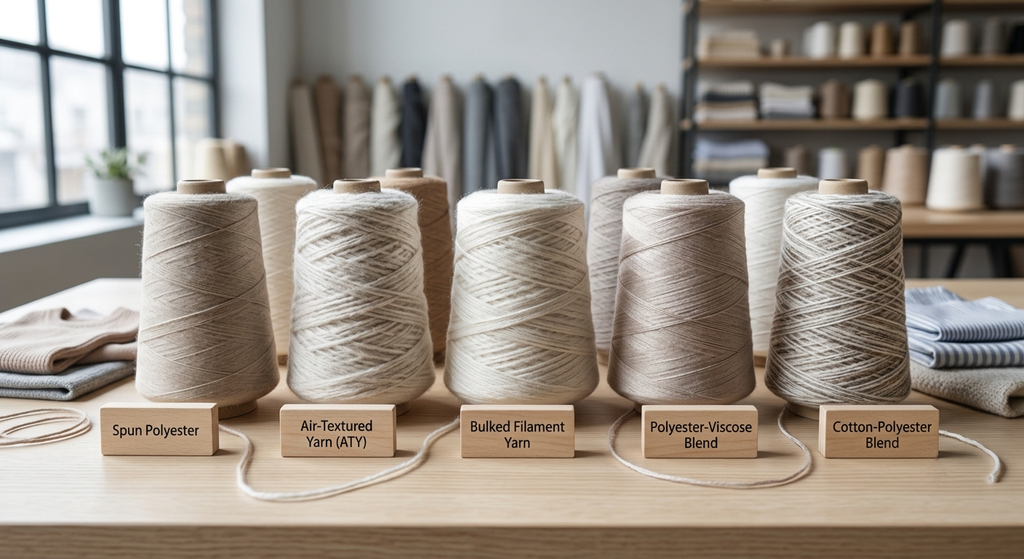
| Type | Typical composition | Look and feel | Best for |
| Spun polyester yarn | 100% polyester staple | Matte, soft, slightly hairy, close to cotton | Knit tops, uniforms, bedsheets, towels |
| Air-textured yarn (ATY) | Polyester or nylon filament | Bulky, lofty, soft with a spun-like surface | Home textiles, upholstery, woven fabrics, knitwear |
| Bulked filament or staple yarn | Polyester or blended fibres | Full, warm, high cover | Sweaters, blankets, jersey, base layers |
| Polyester-viscose blend | Polyester with viscose | Softer, better drape, higher moisture handling | Shirting, dresses, suiting, lightweight knits |
| Cotton-polyester blend | Polyester with part cotton | Closest to cotton, with better shape retention | Casual wear, workwear, home textiles |
For textured options, our ATY air textured yarn supplier page covers specifications, deniers and typical applications in detail. Madhusudan Group also makes stretch, bicomponent and elastomultiester yarns for buyers who want cotton-like comfort with recovery built in.
Fake cotton yarn vs real cotton yarn
Cotton has real strengths: breathability, a natural hand and strong consumer trust. It also has weaknesses: price volatility, shrinkage, wrinkling and long drying times. Cotton-look yarn is not a replacement for every cotton use, but it wins in specific areas.
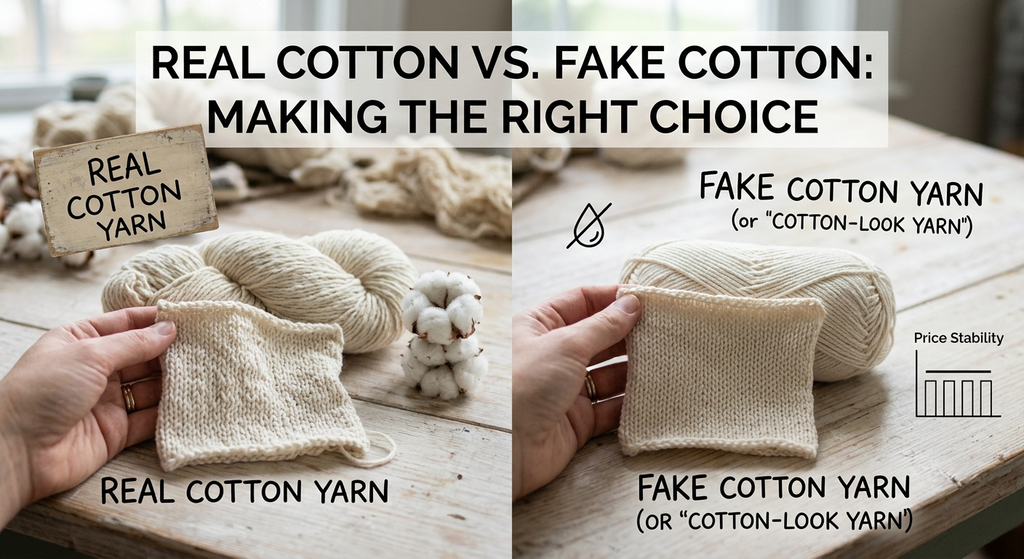
| Factor | Fake cotton (cotton-look) yarn | Real cotton yarn |
| Cost stability | More stable, linked to polymer and fibre markets | Varies with crop, weather and policy |
| Lot-to-lot consistency | Very high, engineered in the mill | Varies with harvest and grade |
| Strength and durability | Higher tenacity, resists abrasion | Lower strength, weaker when wet |
| Shrinkage and wrinkling | Low | Higher |
| Drying speed | Fast | Slow |
| Natural breathability | Good in engineered blends, lower in pure polyester | Excellent |
| Dyeing | Fast, high yield with disperse dyes | Slower, higher water use |
| Consumer perception | Depends on honest labelling and quality | Strong, trusted |
Buyers who are torn between synthetic cotton-look yarn and cellulosic alternatives should also read our comparison of viscose vs cotton for manufacturers, which covers the middle ground between natural and synthetic.
One more point on perception. Certified cotton remains a small part of a large market: Textile Exchange’s Organic Cotton Market Report tracks a segment that made up almost 1% of the global cotton harvest in 2019/20. That is why claims of “organic” or “pure” cotton need documents behind them, and why honest cotton-look yarn is a cleaner choice than a vague label.
Where fake cotton yarn performs best
Cotton-look yarn earns its place wherever buyers need cotton’s appearance with better durability or lower cost. The main uses are:
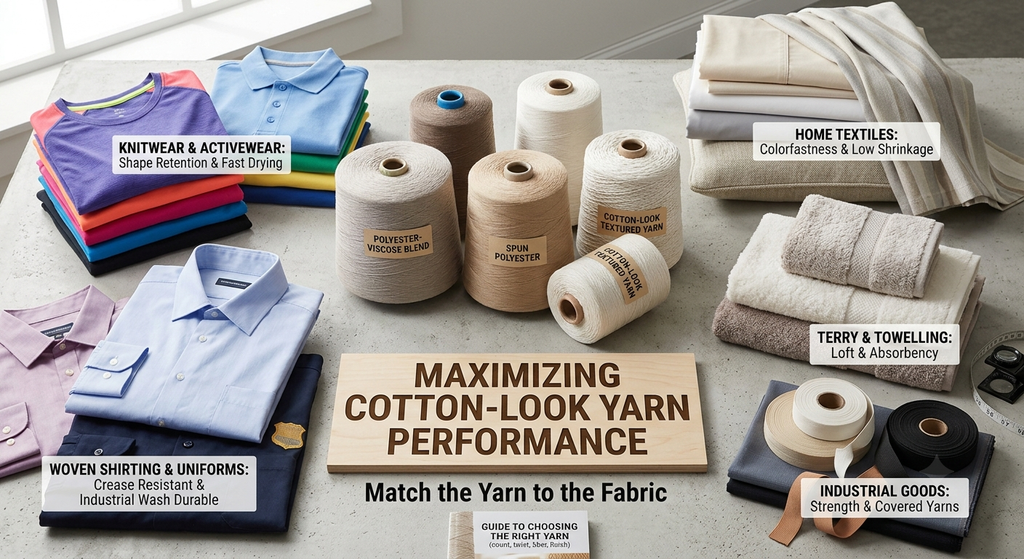
- Knitwear and jersey. T-shirts, polos, activewear bases and loungewear gain shape retention and fast drying.
- Woven shirting and uniforms. Polyester-viscose and spun polyester hold creases less and survive hundreds of industrial washes.
- Home textiles. Bedsheets, curtains, cushion covers, throws and upholstery benefit from colourfastness and low shrinkage.
- Terry and towelling blends. Textured and bulked yarns add loft and absorbency to blended terry.
- Industrial and technical goods. Tapes, elastic fabrics and covered yarns use cotton-look surfaces where strength matters.
The key is to match the yarn to the fabric, not the other way round. Our guide on how to choose the right yarn walks through count, twist, fibre and finish decisions, and it applies directly to cotton-look programs.
Labelling and legal rules: sell it honestly
This is where reputations are made and lost. Cotton-look yarn and fabric must be described by their real fibre content. Passing polyester off as cotton is misbranding, and it exposes brands and importers to penalties, rejected shipments and lost retail accounts.
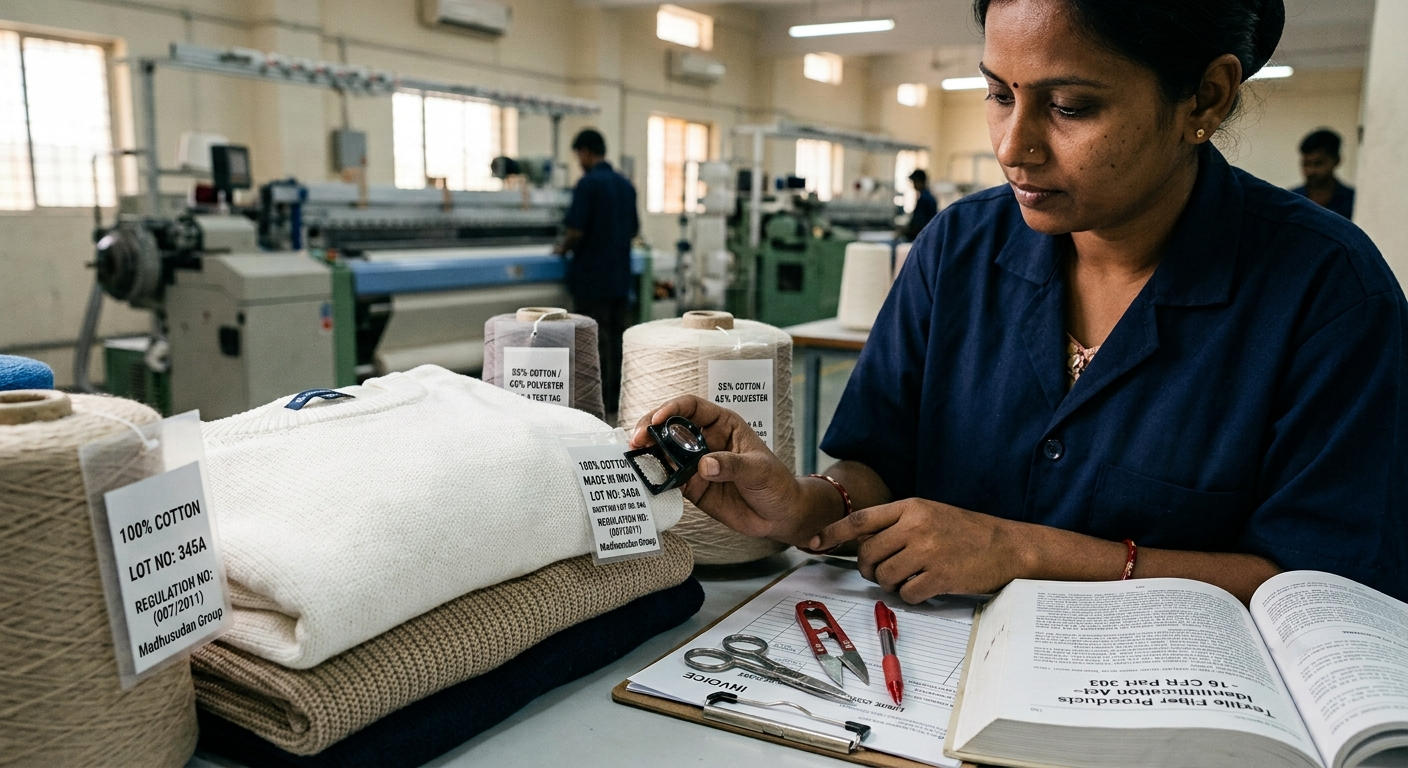
The main rules buyers meet are:
- United States. The Textile Fiber Products Identification Act requires covered textile products to disclose the generic fibre names and percentages by weight, the identity of the responsible company (name or RN number) and the country where the product was processed. The detailed rules sit in 16 CFR Part 303, and the apparel industry’s AAFA labeling resources collect the practical guidance.
- European Union. Regulation (EU) No 1007/2011 makes fibre composition labelling compulsory and sets the permitted fibre names. Within the supply chain, accompanying commercial documents can replace a physical label, which makes accurate invoices and test reports essential.
A responsible manufacturer supports its customers by stating the fibre content on every lot, on the cone label and in the commercial paperwork. If a supplier is vague about composition, treat it as a warning sign. Madhusudan Group provides composition details with every order so buyers can label downstream products correctly.
Buyers who want to understand the other side of the problem, namely how misrepresented cotton enters supply chains, can read our guide on how to tell if cotton is fake.
How to identify cotton-look yarn and verify fibre content
Buyers, brands and quality teams often need to confirm what a yarn really contains. There are three levels of checking, from quick to conclusive.

- Hand and visual check. Cotton-look yarn usually feels more uniform than cotton and shows fewer natural trash particles or seed-coat fragments. This is only a first impression and can be wrong with good blends.
- Burn test. Cotton burns quickly with a smell like burning paper and leaves soft grey ash. Polyester melts, shrinks from the flame and leaves a hard bead. It is a rough indicator, not a measurement, and blends give mixed results.
- Laboratory analysis. Only a lab can give a legally usable fibre percentage. Quantitative chemical analysis of fibre blends follows the ISO 1833 series. ISO 1833-2 covers ternary mixtures, and the series includes methods for polyester with certain other fibres. Testing houses such as Centexbel explain the quantitative chemical analysis of fibre blends in practical terms.
For important orders, ask your supplier for a recent third-party fibre composition report and compare it with the declared blend. A manufacturer that confirms composition openly is usually a manufacturer that controls its process.
Quality standards and certifications to look for
Certifications do not replace testing, but they show that a mill has been audited by someone other than itself. For cotton-look yarn, five references matter most.
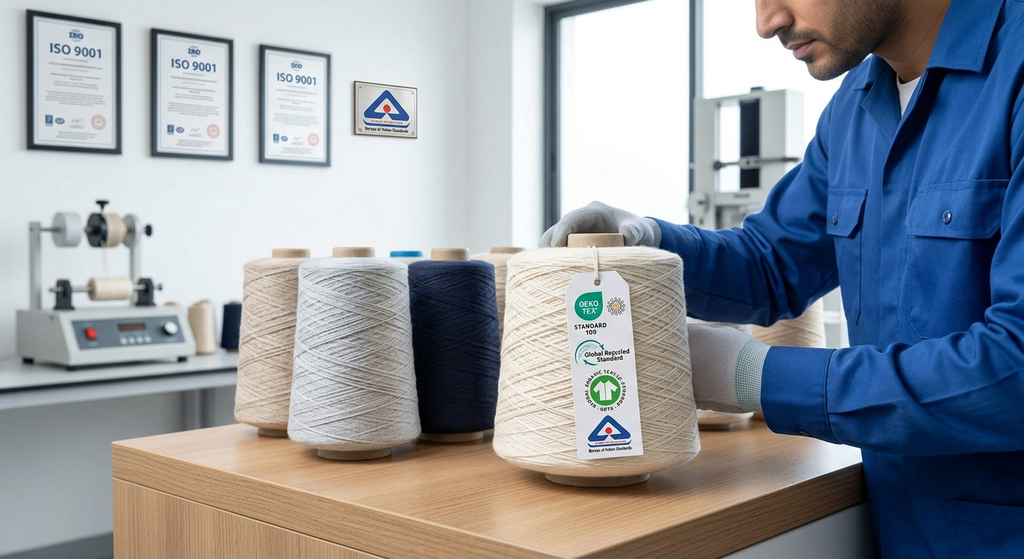
Indian standards (BIS)
The Bureau of Indian Standards publishes specifications for many yarns, including polyester textured yarn, polyester continuous filament and elastomeric yarn. For viscose, the Ministry of Textiles issued the Viscose Rayon Cut Staple Spun Yarn (Quality Control) Order, 2024, which ties viscose spun yarn to a BIS standard and Standard Mark. Buyers should ask suppliers which standards apply to their product and confirm current requirements before shipping.
OEKO-TEX STANDARD 100
OEKO-TEX STANDARD 100 tests textiles for harmful substances and applies from raw and finished yarns through to ready-made products. Its criteria catalogue covers well over 100 parameters, and certificates are valid for one year. Many retailers base their restricted-substance lists on it, so a certified yarn opens doors.
Global Recycled Standard (GRS)
If a cotton-look yarn contains recycled polyester, the Global Recycled Standard verifies recycled content and chain of custody. Certification generally requires at least 20% recycled material by weight, and the consumer-facing logo requires at least 50%. Textile Exchange has signalled a move of its recycled standards into a new Materials Matter Standard, so ask suppliers which version they hold. Our recycled polyester yarn guide explains how recycled content is made, tested and claimed.
Global Organic Textile Standard (GOTS)
When a blend includes certified organic cotton, the Global Organic Textile Standard applies. Products need at least 70% certified organic fibres to carry a GOTS label, and 95% for the top “organic” grade. It is a processing standard for the whole supply chain, so it suits blends with real organic content, not pure synthetic cotton-look yarn.
ISO-certified management systems
Quality management certification shows that a mill documents and controls its processes. Buyers can see how this works in practice at an ISO certified yarn supplier such as Madhusudan Group.
Dyeing and colour: the other half of the cotton look
A yarn can have the right structure and still fail if the colour looks flat, glossy or uneven. Cotton has a naturally matte, slightly warm tone, and polyester can look too bright if the dyeing is poorly controlled.
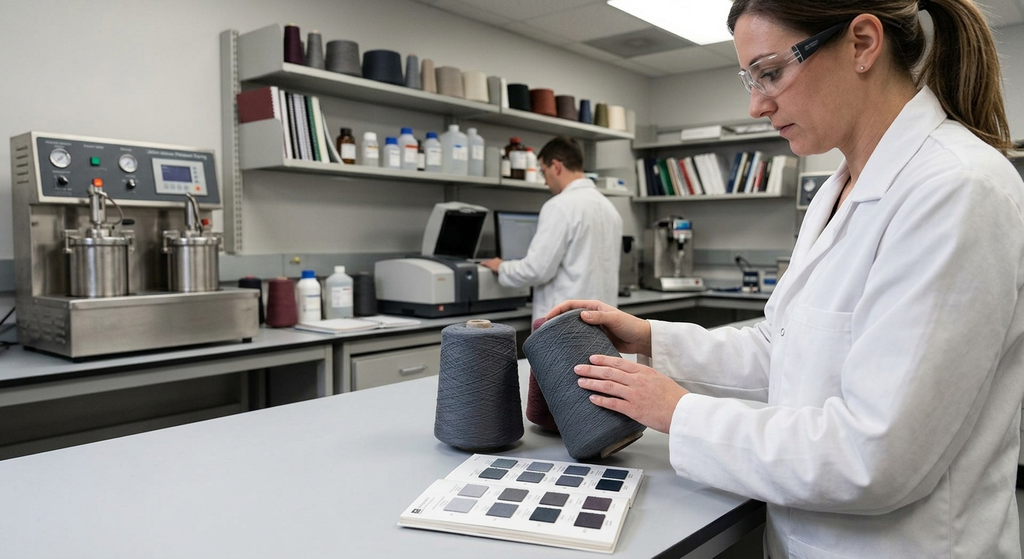
Good dyeing for cotton-look yarn depends on four things: the right disperse dye selection for the end use, correct temperature and time profiles, reductive clearing for wash fastness, and tight shade matching against approved standards. Our polyester yarn dyeing guide explains the process and the common faults, from barre to shade variation.
Buyers who prefer a single supplier for yarn and colour can work with a dyed yarn manufacturer that controls both stages. Shade consistency across repeat orders improves because the same team handles yarn structure and colour, and lead times drop because there is one less hand-off.
How to choose a fake cotton yarn manufacturer
The market is crowded with traders, agents and small mills that all claim to make “cotton-like” yarn. A short, disciplined evaluation saves months of rework later.

Manufacturer or trader?
Start by asking who actually makes the yarn. A trader can quote quickly but cannot fix a process problem. A manufacturer owns the machines, the recipes and the quality data. The trade-offs are explained in our comparison of a yarn supplier vs a yarn manufacturer, and for cotton-look yarn, where hand-feel and shade depend on process control, buying direct from the mill is almost always the better route.
The eight-point supplier checklist
- Process control. Does the mill spin or texture, and dye, in-house or under direct supervision?
- Range. Can it supply spun, textured, blended and stretch options, so you are not forced into the wrong yarn for the fabric?
- Testing. Ask for lot-wise reports on count or denier, tenacity, elongation, unevenness and shade.
- Fibre content proof. Request a third-party composition report for blends and recycled content.
- Certifications. Look for ISO, OEKO-TEX STANDARD 100, GRS or GOTS where relevant to your product.
- Shade consistency. Ask how the mill matches and holds colour across repeat lots.
- Capacity and lead time. Check that it can scale with you and ship on schedule.
- Export experience. Documentation, packing, incoterms and customs support matter for international buyers.
Before you sign anything, run through our list of questions to ask before buying yarn. It covers sampling, minimum order quantities, payment terms and quality claims in practical detail.
Why Madhusudan Group is a leader among fake cotton yarn manufacturers
Madhusudan Group is a Surat-based yarn manufacturer built around one idea: cotton-look and engineered yarns should be made with the discipline of a precision industry and sold with complete transparency. That approach shows in six ways.
1. A full range under one roof
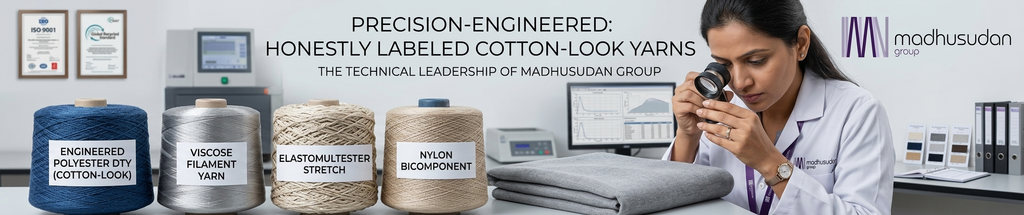
Buyers rarely need one yarn. They need a family of yarns that work together across collections. Madhusudan Group manufactures and supplies polyester yarn, nylon DTY, viscose filament yarn, linen yarn, air-textured yarn, elastomultiester and bicomponent yarns, stretch yarn, recycled polyester yarn and blended yarns. For a cotton-look program, that means the right base yarn, the right stretch or texture, and the right blend can all come from the same partner.
2. Honest labelling, every time
Madhusudan Group does not sell imitation yarn as cotton. Fibre content is declared and supported with test data so brands and importers can meet labelling rules in their markets, from the US to the EU. This is a commercial advantage as much as an ethical one: buyers who have been burned by mislabelled lots return to suppliers who document what they ship.
3. Dyeing and colour control
Shade is where cotton-look yarn succeeds or fails. Madhusudan Group offers dyed yarn across polyester, viscose and linen families and supports colour programs for buyers in markets such as Sri Lanka and South America, where fast, repeatable colour is critical.
4. Quality systems and certification
Process discipline is documented. The group operates as an ISO-certified yarn supplier, and its recycled yarn programs are built to meet the chain-of-custody expectations that brands now ask for. [add: list any additional certifications such as OEKO-TEX, GRS, GOTS and their certificate validity]
5. Export know-how
Yarn buying across borders is not simple. Madhusudan Group has published practical guides for buyers importing yarn from India into the USA, Brazil and Argentina, covering duties, documentation and logistics, because it has solved those problems repeatedly for customers. Buyers in Europe, South America and South Asia use the same expertise to plan shipments with confidence.
6. Technical depth that advises, not just sells
The group’s technical content on high-bulk yarn, elastomultiester, bicomponent technology and polyester dyeing is written by people who run the machines. That depth shows up in sampling: customers get recommendations on count, twist, texture and finish, not just a price list. [add: year established, plant location details and monthly production capacity once confirmed]
Together these strengths explain why brands and manufacturers searching for a fake cotton yarn manufacturer in India land on Madhusudan Group: it is a mill that treats cotton-look yarn as a technical product, supports it with data and sells it honestly.
Sourcing cotton-look yarn from India and Surat
India is a natural base for cotton-look yarn. The country combines a deep man-made fibre industry, a large skilled workforce and an export-oriented supply chain. Gujarat, and Surat in particular, has long been the centre of polyester, nylon and blended yarn production, with fabric weavers, knitters and processors within easy reach.
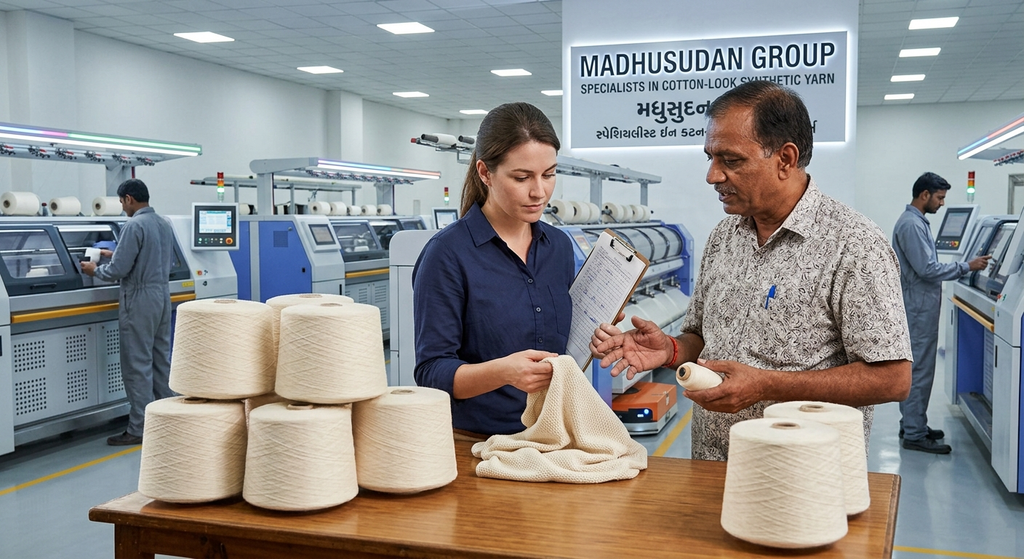
For buyers, this cluster effect means shorter sampling cycles, easier mill visits and faster shipping. If you are comparing mills in the region, our overview of yarn manufacturers in Surat explains how the market is structured and what separates established producers from smaller units.
A sensible sourcing path for a first order looks like this:
- Share your fabric, end use and target hand-feel with the manufacturer.
- Receive technical recommendations and a sample set of two or three yarn options.
- Test the samples in your own knitting or weaving and finishing process.
- Approve shade and specification, and agree a lot-wise testing plan.
- Place a trial bulk order, then scale after one or two successful cycles.
Frequently asked questions about fake cotton yarn manufacturers
What is fake cotton yarn? Fake cotton yarn, or cotton-look yarn, is yarn made from polyester, viscose or blends that imitates the appearance and soft, matte touch of cotton. It is sold under its real fibre name, not as cotton.
Is it legal to sell fake cotton yarn? Yes, provided the fibre content is declared accurately. Rules such as the US Textile Fiber Products Identification Act and EU Regulation 1007/2011 require correct fibre names and percentages on products. Selling polyester as cotton is misbranding.
Is fake cotton yarn cheaper than real cotton yarn? It is often more predictable in price, because polyester and man-made fibre costs do not follow crop cycles. The actual price depends on fibre, count, texture, dyeing and order size, so compare quotes for the same specification.
How can I check what a yarn is made of? Hand feel and burn tests give hints, but only laboratory analysis, typically following the ISO 1833 series, gives a reliable fibre percentage. Ask your manufacturer for a third-party composition report on blends.
Which cotton-look yarn is best for knitwear? Spun polyester and polyester-viscose blends suit light jersey and tops, while air-textured and bulked yarns suit warmer, fuller knitwear. A sample test on your own machine is the final judge.
Does Madhusudan Group export cotton-look yarn? Yes. Madhusudan Group supports international buyers, including those importing yarn from India into the USA, Brazil, Argentina and Europe, with documentation and shipping guidance.
Can I order cotton-look yarn in custom shades? Yes. Madhusudan Group offers dyed yarn programs across polyester, viscose and linen families, with shade matching against approved standards.
Conclusion: choose a manufacturer that makes cotton-look yarn the right way
Fake cotton yarn is not a shortcut. It is an engineered product that can match cotton’s look and feel while improving durability, consistency and dyeing performance, as long as the mill controls fibre, structure, colour and testing, and the buyer labels the result honestly.
Madhusudan Group brings these elements together: a broad range of polyester, textured, blended, stretch and recycled yarns, in-house technical depth, ISO-certified processes, export experience and a firm commitment to transparent fibre content. If you are looking for a fake cotton yarn manufacturer in India that will support your fabric programs with data, samples and reliable delivery, contact the Madhusudan Group team with your specification and request a sample set.