Fiber selection looks simple on a mood board and gets complicated fast on a production floor. Viscose and cotton both drape well, both dye beautifully, and both show up in the same broad category of soft, breathable, natural-feeling fabric which is exactly why so many sourcing teams default to gut instinct instead of spec. The problem is that gut instinct doesn’t tell you why a viscose-heavy batch came out of the dye house with uneven tension, or why a cotton knit shrank more than the tech pack allowed, or why your landed cost swung between two POs that supposedly used ‘basically the same fiber.’
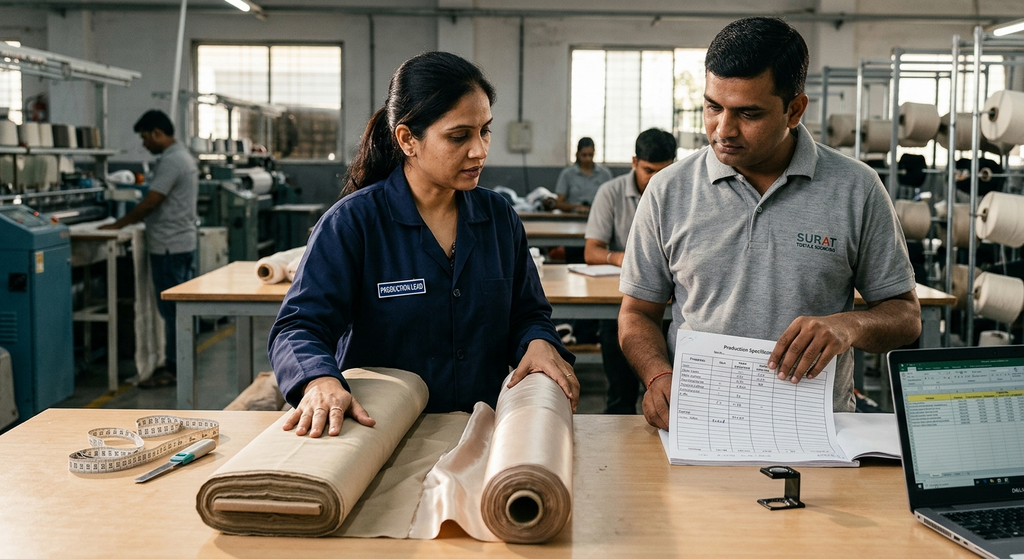
This guide is written for people who spec fabric for a living: garment and fabric manufacturers, brand sourcing teams, and merchandisers comparing viscose vs cotton at the design and costing stage not shoppers comparing t-shirts. We’ll go through what each fiber actually is, how they perform side by side, where each one wins, what changes on the mill floor (not just the finished garment), and how blends solve problems neither fiber solves alone. Wherever it’s useful, we’ve linked out to deeper guides on specific yarn types, sourcing questions, and export logistics, including several from Madhusudan Group, a Surat-based yarn manufacturer we’ll return to later in this piece.
Viscose and Cotton: What They Actually Are
Both fibers are cellulose-based, which is exactly why they get lumped together in sourcing conversations. But ‘same chemical family’ doesn’t mean ‘same fiber,’ and the difference in how each one is produced is the root cause of almost every performance gap discussed in this article.
Cotton is a natural fiber. It grows as a seed hair on the cotton plant (genus Gossypium), gets harvested, ginned to remove seeds and trash, cleaned, and spun. Because it’s agricultural, cotton is never perfectly uniform staple length, micronaire (fiber fineness), and strength vary by variety, region, growing season, and grade. Upland cotton, Pima, and Egyptian cotton are genuinely different fiber populations with different spinning behavior, which is part of why two ‘100% cotton’ yarns from different mills can still perform differently on your line.
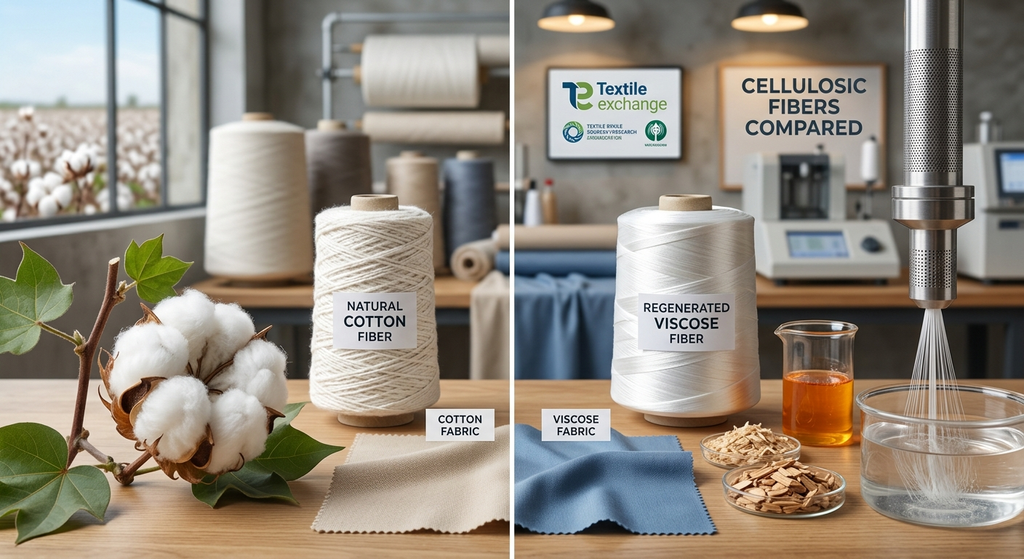
Viscose, by contrast, is regenerated cellulose manufactured, not grown. Producers start with dissolving-grade wood pulp (commonly from eucalyptus, bamboo, or pine), chemically convert it into a soluble cellulose compound, and extrude that solution through a spinneret into an acid bath, where it regenerates back into solid cellulose filaments. Because it’s engineered, viscose can be produced as continuous filament yarn or cut into staple fiber of a specific length to run on cotton-type spinning equipment which is exactly why viscose blends so easily into cotton-style yarns and fabrics.
It’s worth clearing up a bit of terminology confusion buyers run into here: viscose is the dominant process under the broader ‘rayon’ umbrella, so when someone asks about rayon vs cotton fabric, in most commercial contexts they’re really asking about viscose vs cotton the two terms are used almost interchangeably in trade conversations, though not every rayon is viscose (modal and lyocell are regenerated cellulosics made with different chemistry).
This ‘grown vs. manufactured’ distinction is also why viscose can hit tighter, more consistent specs than raw cotton batch to batch, while cotton’s natural variability is part of what gives it its performance profile, including the wet-strength behavior covered below. If your sourcing plan includes other natural fibers alongside these two, it’s worth knowing the same origin story applies to linen yarn, a bast fiber with its own drape and durability trade-offs; manufacturers building a multi-fiber natural portfolio often look at linen yarn manufacturers in India alongside their viscose and cotton suppliers, since sourcing all three from fewer partners simplifies quality control.
Industry-wide, cellulosic fibers have been steadily gaining share of the overall fiber market alongside cotton and synthetics, a shift tracked annually by the nonprofit Textile Exchange in its fiber and materials market reporting.
Performance Comparison Table: Viscose vs Cotton at a Glance
Here’s how the two fibers stack up on the properties that actually matter for production planning, not just hand-feel.
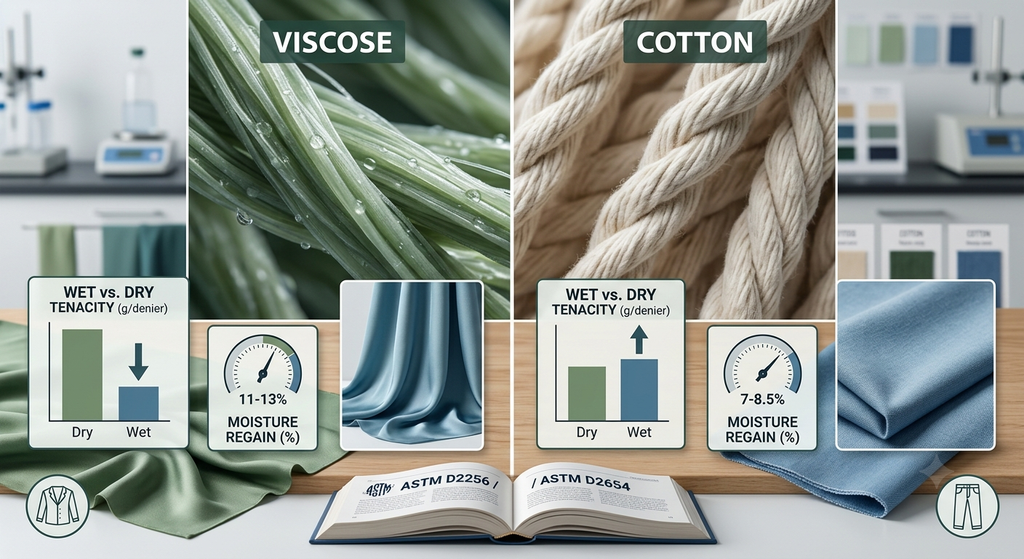
| Property | Viscose | Cotton |
| Fiber origin | Regenerated cellulose (wood pulp) | Natural cellulose (cotton boll) |
| Drape | Excellent fluid, silk-like fall | Moderate crisper, more structured |
| Dry tenacity | Lower (roughly 1.5-2.5 g/denier) | Higher (roughly 3-4.9 g/denier) |
| Wet tenacity | Drops sharply can lose 40–50%+ of dry strength | Increases typically 10–25% stronger wet than dry |
| Moisture regain | High (roughly 11-13%) | Moderate (roughly 7-8.5%) |
| Breathability | Good; feels cool against skin | Very good; manages moisture well over repeated wear |
| Dye uptake | Excellent deep, saturated color with less dye loading | Good often needs more dye/fixative for equivalent depth |
| Dimensional stability | More prone to stretch/shrink distortion if mishandled wet | More stable, though untreated cotton still needs sanforizing |
| Price driver | Wood pulp costs, chemical processing, energy | Agricultural commodity cycles weather, yield, global demand |
| Biodegradable | Yes | Yes |
| Typical end uses | Linings, dresses, blouses, scarves | T-shirts, denim, towels, bedding, workwear |
Two rows deserve a closer look because they surprise a lot of first-time buyers. First, wet strength runs in opposite directions for these two fibers cotton is one of the few textile fibers that actually gets stronger when wet, thanks to increased hydrogen bonding between cellulose chains as the fiber swells. Viscose does the reverse: its lower crystallinity and molecular orientation mean water swells the fiber without adding the same reinforcing bonds, so wet viscose is measurably weaker than dry viscose. Second, moisture regain the amount of moisture a fiber absorbs into its structure under standard conditions runs meaningfully higher for viscose (around 11-13%) than cotton (around 7-8.5%). That single number explains a lot about the drape, dye behavior, and handling differences covered elsewhere in this guide.
Buyers who want to verify figures like these rather than take a mill’s word for it can reference the standard test methods used to generate them: ASTM D2256 for yarn tensile properties and breaking tenacity, wet and dry, and ASTM D2654 for moisture content and regain.
Mid-guide note: Numbers on a chart only get you so far. If you’re speccing a real product, compare specification sheets for viscose and cotton yarn side by side rather than relying on published averages count, twist, luster, and moisture treatment all shift the real-world numbers. (Madhusudan Group’s viscose range is covered in full later in this guide.)
When Viscose Outperforms Cotton
Drape-driven garments. If the brief calls for fluid movement a blouse that skims rather than structures, a dress that falls close to the body, an occasion piece with visible movement in the fabric viscose is usually the better starting point. Its low bending rigidity and high fiber flexibility let fabric fall under its own weight instead of holding shape, which is the textile-engineering explanation for why viscose fabrics move the way silk does at a fraction of the cost.
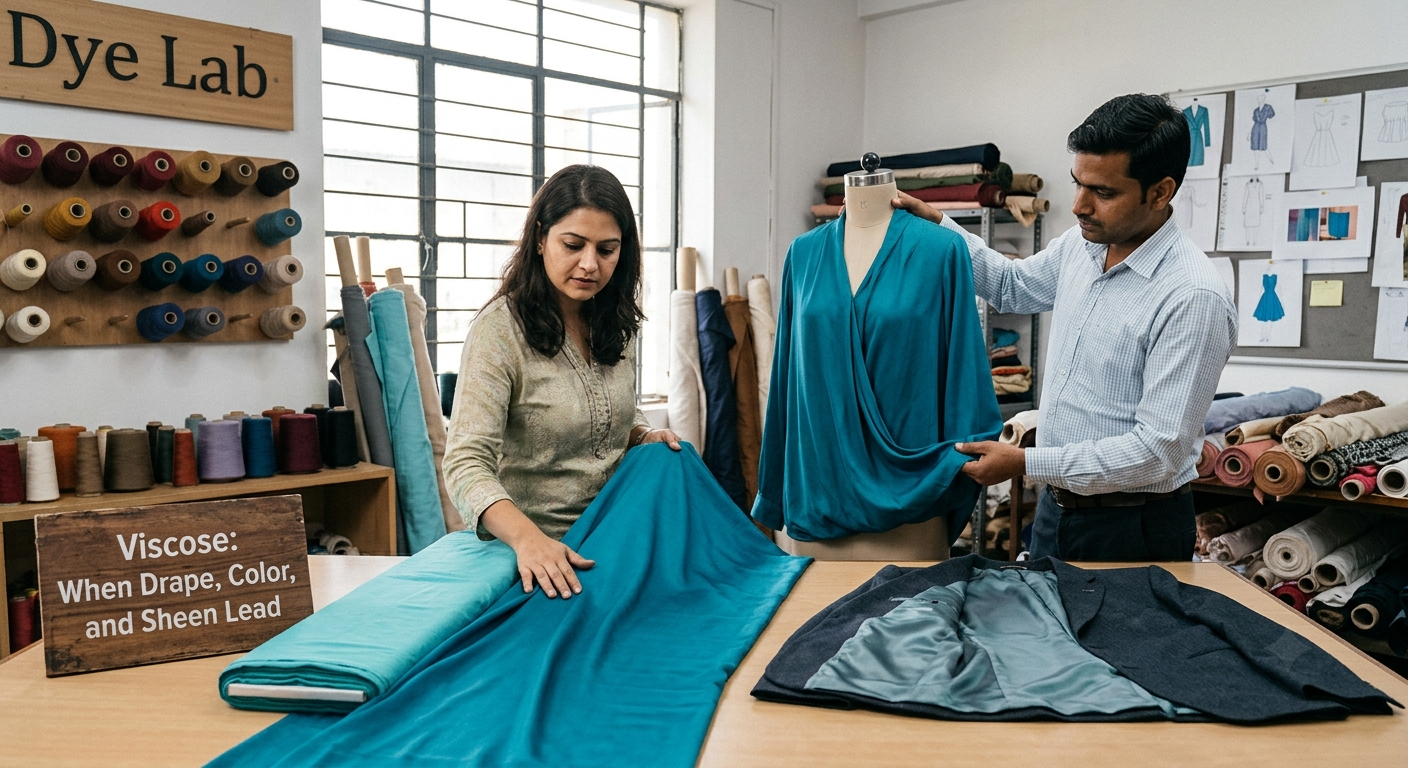
Linings. This is where viscose earns its keep in categories buyers don’t always think about first. Viscose filament yarn is a mainstay in jacket and blazer linings because it combines a smooth fiber surface (low friction against both the outer shell fabric and the wearer) with a natural sheen and very low bulk properties that matter more in a lining than raw strength does, since linings see less mechanical stress than outer fabrics.
Dye uptake and color depth. Viscose’s higher moisture regain isn’t just a comfort statistic it correlates directly with dye affinity. Reactive and direct dyes penetrate viscose fiber readily, which typically means deeper, more saturated color with less dye consumption than an equivalent cotton fabric needs to hit the same shade depth. For brands chasing rich, consistent colorways across a run, this is a real production advantage, and it’s one reason buyers sourcing color-critical programs specifically ask suppliers about their capabilities as a dyed yarn manufacturer rather than assuming any mill can hit the same shade twice.
Put together, these advantages explain most of what shows up in a typical viscose vs cotton for apparel production conversation: viscose wins wherever the brief prioritizes drape, sheen, or color intensity over raw durability.
When Cotton Outperforms Viscose
Durability-driven products. Denim, workwear, toweling, bedding, and heavy knitwear all lean on cotton’s higher dry and wet tenacity. Products that get handled roughly, laundered constantly, or need to survive years of use are playing to cotton’s strengths, not viscose’s.
Frequent laundering. This is the practical, everyday version of the wet-strength number covered earlier. A cotton t-shirt goes through hundreds of wash-and-dry cycles over its life and, mechanically, gets a strength boost from moisture each time it’s wet. A viscose garment loses strength every time it’s wet which is exactly why so many viscose care labels specify hand-wash, gentle cycle, or dry-clean only. If your product will be machine-washed and tumble-dried repeatedly by an end user who won’t read the care label carefully, cotton (or a cotton-heavy blend) is the safer spec.
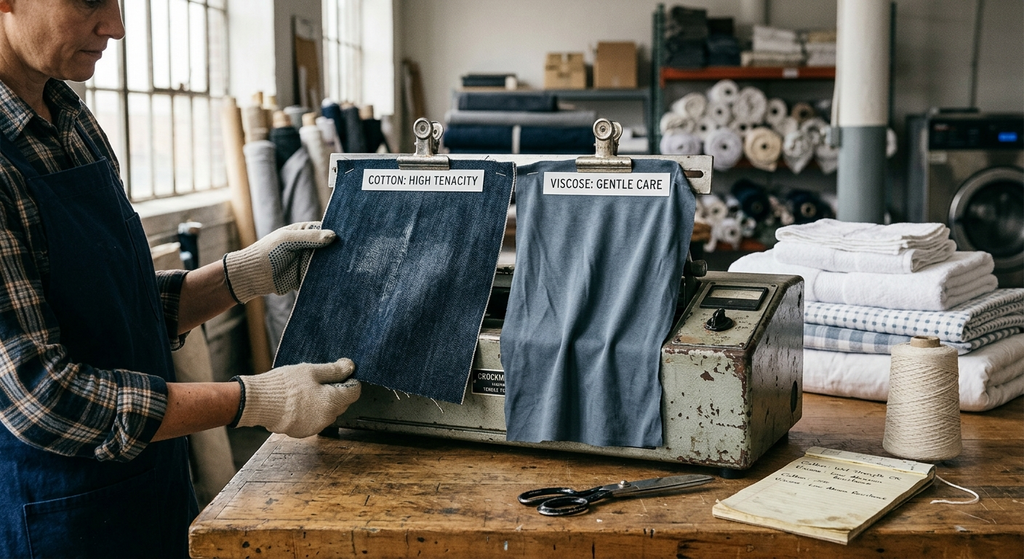
Abrasion and industrial use. Anywhere a fabric faces sustained rubbing, tension, or mechanical stress bags, upholstery, technical workwear, filtration cotton’s tenacity advantage matters more than viscose’s drape. Buyers speccing these categories typically work with an industrial yarn supplier rather than a fashion-focused viscose mill, because the performance priorities are inverted.
Verified fiber content. Cotton’s durability claims only hold if the cotton is actually what the label says it is. Because cotton commands a price premium over many synthetics, it’s occasionally cut with cheaper fiber without full disclosure which quietly erodes the wear performance a buyer is paying for. If fiber-content verification isn’t already part of your incoming QC, it’s worth reading through this guide to identifying fake cotton blends before you commit a durability-critical order to a new supplier.
Best Fiber for Common End Uses
A quick-reference table for spec meetings, so you’re not re-litigating the same decision on every new style.

| End Use | Better Fit | Why |
| Everyday T-shirts, knitwear | Cotton | Durable, breathable, holds up to repeated washing |
| Flowy dresses, blouses | Viscose | Superior drape, fluid hand-feel |
| Jacket and blazer linings | Viscose (filament) | Smooth, low-bulk, glossy finish |
| Bedsheets, towels | Cotton | Absorbency plus dimensional stability under heavy laundering |
| Denim | Cotton | Tensile strength, abrasion resistance |
| Scarves, lightweight accessories | Viscose | Drape, sheen, low weight |
| Workwear, industrial fabric | Cotton | Durability, wet strength, abrasion resistance |
| Occasion wear needing a silk-like fall | Viscose | Silk-adjacent aesthetic at lower cost |
| Shirting needing softness and structure | Cotton-viscose blend | Balances viscose’s drape with cotton’s stability |
| Upholstery, heavy home textiles | Cotton or cotton blend | Durability under sustained use |
Manufacturing and Spinning Differences That Affect Buyers
This is the section most viscose vs cotton comparisons skip, and it’s usually the one that actually costs manufacturers money because the differences that matter most to a buyer aren’t in the finished garment, they’re on the mill floor before the garment exists.
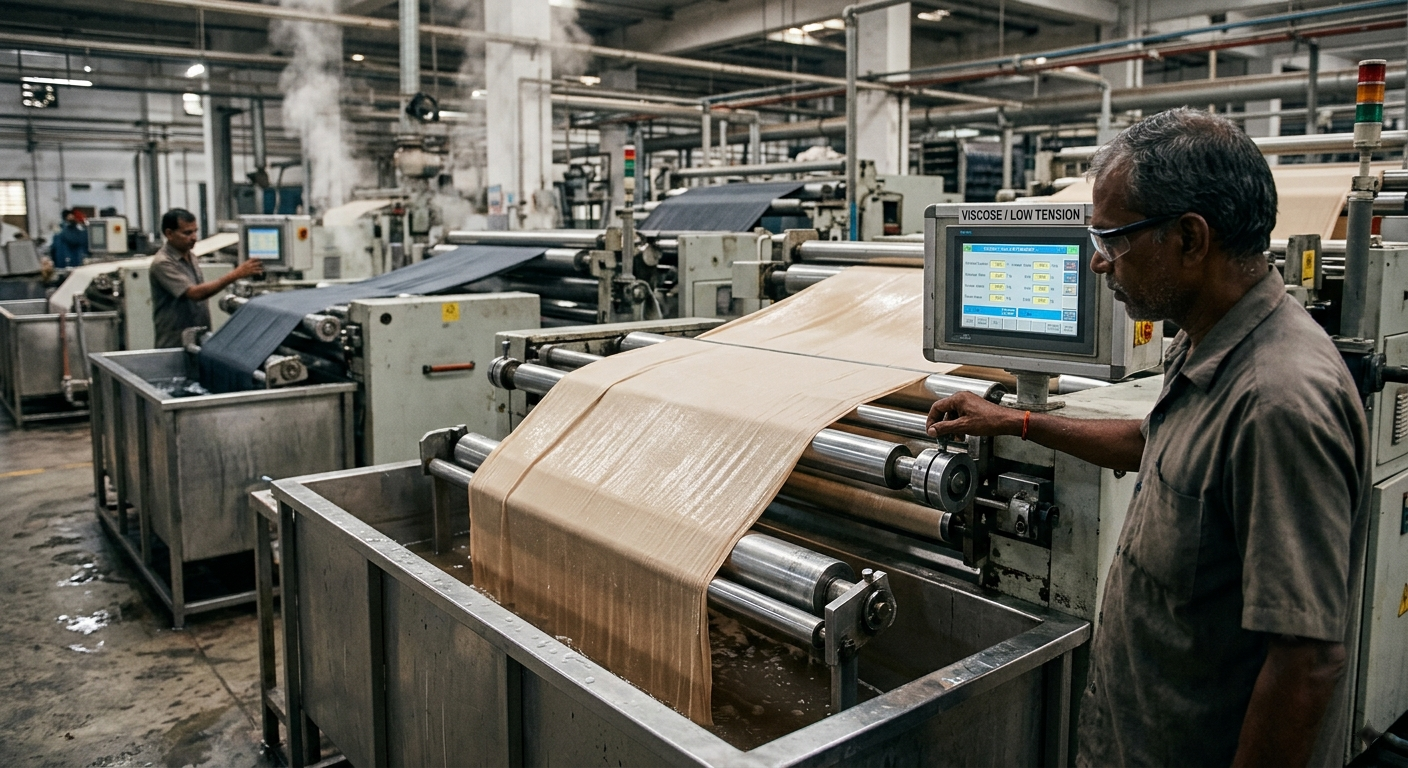
Wet processing is where viscose’s weakness actually bites. The wet-strength drop covered earlier isn’t just a care-label issue it directly shapes how a mill has to run its dyeing and finishing lines. Jet and soft-flow dyeing machines need gentler agitation settings for viscose than for cotton to avoid fiber rupture or excessive stretching while the yarn is at its weakest. Roller tension in washing and drying ranges has to be tuned down. Processing speed often has to slow to protect the fiber. None of this is visible in a spec sheet that just lists ‘100% viscose’ but it shows up in your lead times, your defect rate, and sometimes your unit cost, because gentler processing is rarely faster processing. A mill that treats viscose and cotton identically on the same dye-house settings is a mill that’s going to give you inconsistent viscose lots.
Spinning behavior differs too. Cotton’s natural fiber crimp helps individual fibers grip each other during spinning, which is part of why cotton has been spun on the same basic ring-spinning principles for centuries. Viscose staple fiber, being extruded rather than grown, has a smoother and more uniform surface which affects fiber-to-fiber friction and often calls for adjusted twist levels to hit the same yarn stability cotton achieves more easily. Humidity control in the spinning shed matters for both fibers, since both are hygroscopic, but viscose’s higher moisture regain makes it noticeably more sensitive to shifts in ambient conditions during spinning. For the full mechanics of how raw fiber becomes finished yarn, this yarn manufacturing process guide walks through the stages in more depth than we have room for here.
Texturizing adds another layer for filament forms. Buyers used to specifying air textured yarn on synthetic filaments should know the same techniques don’t transfer directly to viscose filament without adjustment the fiber’s lower wet and dry tenacity means texturizing parameters calibrated for polyester or nylon can be too aggressive for viscose, leading to breakage or uneven bulk.
Location matters more than buyers usually assume. Wet-processing-sensitive fibers like viscose benefit from mills with tight, practiced control over their dye house not just installed capacity. Gujarat, and Surat specifically, has built decades of concentrated expertise in exactly this kind of processing, which is part of why so many buyers work with yarn manufacturers in Surat rather than treating location as an afterthought in supplier selection.
Poly-Viscose and Cotton-Viscose Blends as a Middle Option
For a lot of products, the real answer to ‘viscose or cotton’ is ‘both, in the right ratio.’ Blending exists precisely because no single fiber optimizes for everything a garment needs, and viscose’s weaknesses and cotton’s weaknesses don’t overlap.
Cotton-viscose blends pair cotton’s tenacity and dimensional stability with viscose’s drape and dye uptake. Common ratios run anywhere from 70/30 to 50/50 depending on whether the brief prioritizes structure (more cotton) or fall (more viscose). The result is a fabric that drapes better than 100% cotton and holds its shape and wash performance better than 100% viscose a genuinely useful middle ground for shirting, dresses, and casualwear that need to survive normal consumer laundering habits. Buyers building this kind of program typically work with a dedicated blended yarn manufacturer in Surat that can hold consistent blend ratios lot to lot, since drift in the ratio shows up as drift in hand-feel and shrinkage behavior.
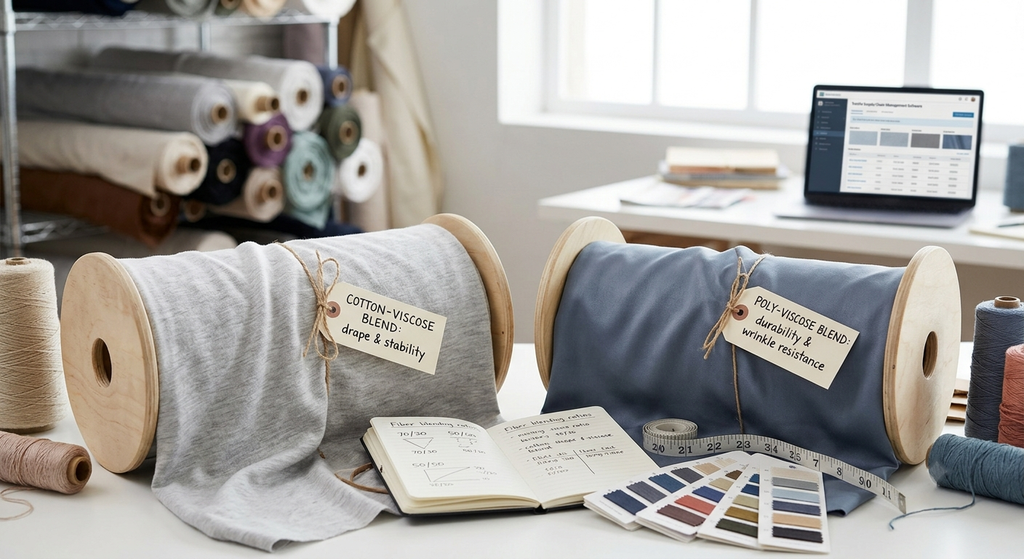
Poly-viscose blends solve a different problem: wrinkle resistance and dimensional stability at a lower cost per kilogram than a cotton-viscose equivalent, at some cost to natural breathability. Buyers sourcing the polyester side of this blend generally look at dedicated polyester yarn suppliers in India and it’s worth comparing more than one option, since pricing and capability vary supplier to supplier even within the same region. For brands building sustainability claims into the product story, a recycled polyester yarn component can carry a poly-viscose blend’s environmental narrative without changing its performance profile much.
Dyeing gets more complex once you blend across fiber types. Viscose and cotton both take reactive or direct dyes on their cellulosic structure, but polyester requires disperse dyes applied under different conditions meaning a poly-viscose blend typically needs a two-stage dyeing process rather than a single dye bath. This is a real cost and lead-time factor buyers should ask about upfront; a supplier experienced as a dyed polyester yarn producer will already have this workflow dialed in rather than discovering it mid-order.
Beyond these two core blend types, Madhusudan Group’s broader portfolio also covers eco-friendly blended yarn manufacturing for buyers who want the viscose-cotton or poly-viscose performance profile without sacrificing on sustainability positioning worth a look if your brief includes both a performance spec and a sustainability claim, since those two requirements don’t always point to the same supplier.
Cost and Sustainability: What Buyers Actually Ask
Is viscose cheaper than cotton? Often, but not reliably. Viscose pricing tracks dissolving wood pulp costs plus chemical processing and energy inputs that move more predictably than a farmed crop. Cotton pricing is tied to agricultural cycles: weather, yield, pest pressure, and global demand can all move cotton prices sharply within a single season, and higher-grade cottons (Pima, Egyptian, extra-long staple) carry a real premium over both viscose and commodity cotton. Historically, viscose has often priced below mid-to-premium cotton grades, which is part of why it became popular as a silk-adjacent fiber at accessible cost. But the relationship isn’t fixed a weak cotton harvest year can flip the comparison. The practical takeaway: don’t assume a fixed price gap, request current, dated pricing on both fibers before locking a spec.
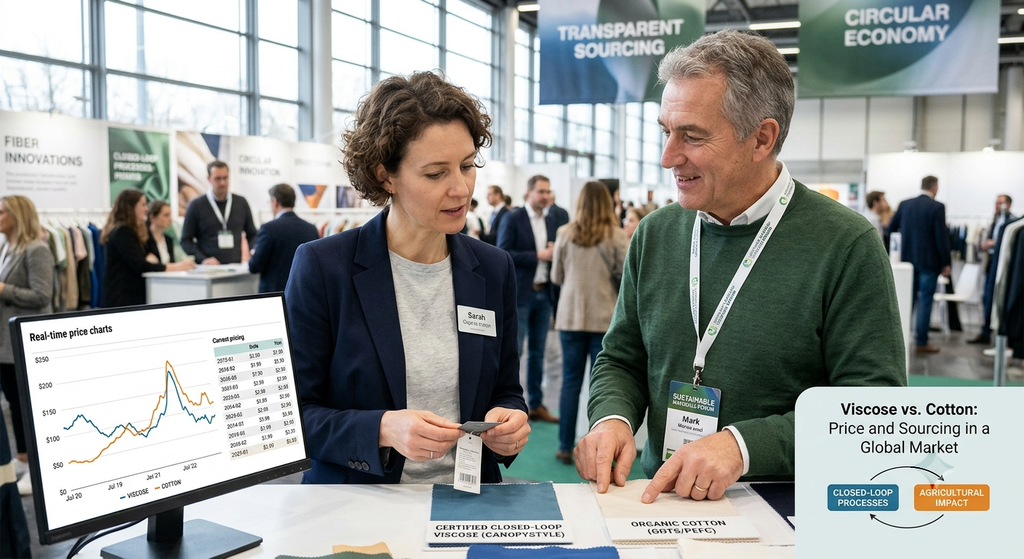
For a market-level view of cotton pricing and supply rather than a single quote, the International Cotton Advisory Committee publishes cotton statistics tracked across producing and consuming countries.
Is viscose more or less sustainable than cotton? Neither fiber wins this outright the honest answer depends more on the specific supplier’s practices than on the fiber category itself. Conventional cotton farming is water- and pesticide-intensive; organic cotton addresses some of that at a cost premium, and programs such as Better Cotton and the Global Organic Textile Standard exist specifically to verify and scale up more sustainable cotton production. Viscose’s environmental footprint depends heavily on where the wood pulp is sourced (certified, responsibly managed forestry or not) and how the manufacturing chemistry is handled traditional open-loop viscose production can generate significant chemical effluent, while newer closed-loop viscose production methods recover and reuse process chemicals and solvents, cutting discharge and emissions substantially compared to older plants. Forest-certification schemes such as FSC and PEFC, and initiatives like Canopy’s CanopyStyle program that specifically audits viscose producers’ wood-pulp sourcing, are how buyers can verify a sourcing claim rather than taking it at face value. Both fibers are biodegradable, which is a real shared advantage over polyester and nylon regardless of which one you choose. The useful question to ask any supplier isn’t ‘is viscose sustainable’ it’s ‘what specific certifications and closed-loop practices does your viscose come from.’
Can viscose and cotton be blended? Yes this is covered in detail in the blends section above, and it’s one of the more common ways manufacturers solve the drape-vs-durability trade-off without picking a side.
Choosing a Viscose or Cotton Yarn Supplier: Questions to Ask Before You Commit
Fiber choice only gets you halfway there supplier choice determines whether that fiber actually performs the way the spec sheet says it will. This rundown of questions to ask before buying yarn is a good starting checklist; a few points worth confirming before you place a first order:

- MOQ and lead time fit for your production schedule. A bulk yarn supplier in India structured for large, repeat orders may not be the right fit for a smaller test run, and vice versa.
- Dye-lot consistency practices, especially for viscose given the wet-processing sensitivity covered earlier.
- Whether you’re buying from a manufacturer or an intermediary. The distinction between a yarn supplier and a yarn manufacturer matters more than it sounds a direct manufacturer relationship generally means tighter quality control and traceability from fiber to finished yarn, since there’s no reselling layer between you and the production floor.
- Certifications relevant to your market and your brand’s own compliance requirements for chemical safety specifically, buyers commonly look for OEKO-TEX Standard 100 certification on the yarn itself.
- A structured way to compare fiber options against your actual product brief this guide to choosing the right yarn for textile products is useful if this is a newer decision for your team.
Getting these questions answered before the first PO saves far more time than resolving them after a shipment arrives off-spec.
Why Madhusudan Group Leads in Viscose Yarn Manufacturing
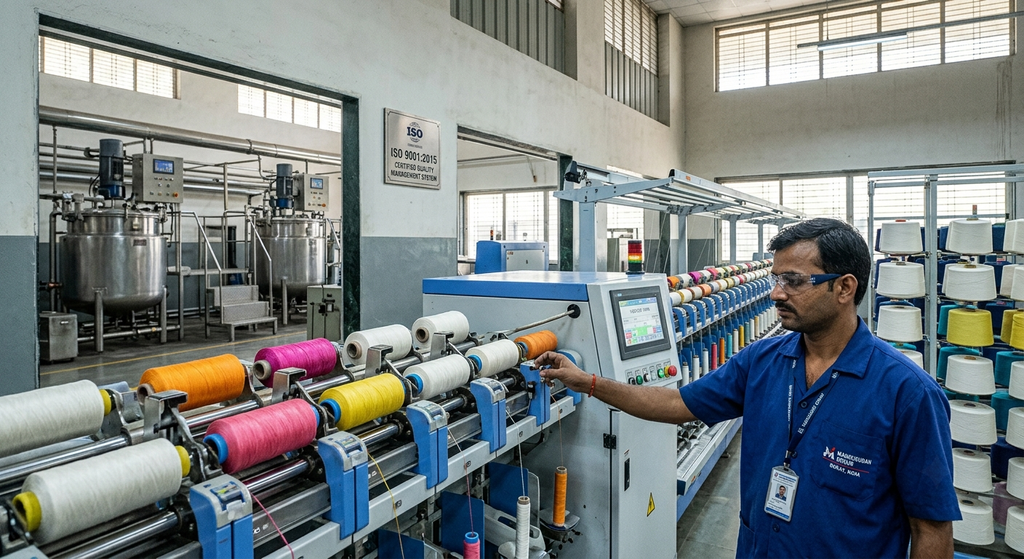
Vertical integration matters more for viscose than for almost any other fiber, precisely because of the wet-processing sensitivity covered earlier in this guide. Madhusudan Group, based in Surat, runs yarn texturising, yarn dyeing, weaving, and fabric processing under one roof rather than outsourcing those stages to generic job-work units which means dye-bath agitation, tension, and drying parameters can be tuned specifically for viscose’s lower wet strength instead of being run on settings calibrated for a different fiber entirely. For a buyer, that translates into more consistent lots and fewer surprises between the spec sheet and the delivered yarn.
The company’s roots are in fancy filament yarns, including viscose filament yarn a specialty that demands tight control over denier, luster, and twist, and one that transfers directly into producing consistent viscose in both filament and spun form. In recent years, Madhusudan Group has expanded that filament-yarn expertise into functional and technical yarns for sport, home, and fashion applications, positioning itself around application-specific, premium yarn rather than pure commodity volume a positioning choice that matters if your product needs consistent drape and dye performance rather than the cheapest possible viscose on the market.
That focus is reflected across its premium yarn manufacturer and supplier offering and its standing among leading yarn manufacturers and top yarn manufacturers in India.
Operationally, Madhusudan Group’s manufacturing base benefits from being embedded in one of India’s most concentrated textile manufacturing regions its home base among industrial yarn suppliers in Gujarat gives it access to processing infrastructure and technical labor built up over decades specifically around yarn dyeing and texturising. Its operations are also ISO-certified and ISO 9001, the internationally recognized quality-management standard, is the baseline most buyers check for and its client base spans both the domestic Indian market and export markets across the US, Europe, the Middle East, and South and Southeast Asia relevant if you need a supplier who already understands international shipping documentation rather than one encountering export paperwork for the first time on your order.
Put simply: if your product brief depends on viscose behaving consistently through dyeing, finishing, and cutting not just looking good in a swatch a manufacturer with in-house wet-processing control and filament-yarn heritage is a materially safer bet than a trader reselling yarn from an unnamed mill.
Explore More Yarn Resources from Madhusudan Group
If viscose vs cotton is one piece of a larger sourcing decision, these guides cover the adjacent questions manufacturers usually ask next.
Sourcing, Importing, and Exporting
- Importing yarn from India to Brazil
- Importing yarn from India to the USA
- Yarn import duty: USA from India
- Textile yarn exporters in India
- The complete export guide for textile and industrial yarn buyers
- Polyester yarn suppliers in India: a buyer’s guide to export
- To verify current US duty rates directly rather than relying on a secondary summary, the U.S. International Trade Commission maintains the official Harmonized Tariff Schedule search tool.
Blended and Specialty Yarns
- Elastomultiester yarn: a guide for European buyers
- Elastomultiester bicomponent yarn and mechanical stretch
- How elastomultiester yarns deliver performance and comfort
- The rise of bicomponent yarns in India
- Stretch yarn manufacturing
- Nylon DTY yarn manufacturing
- Blended yarn manufacturers in Surat
Polyester and Recycled Options
- Polyester yarn supply on a global scale
- Polyester yarn dyeing for South American markets
- Recycled polyester yarn for South American buyers
Frequently Asked Questions
Is viscose cheaper than cotton?
Frequently, but not always. Viscose pricing is tied to wood pulp and processing costs, which tend to move more predictably than cotton’s agricultural pricing cycle. Higher-grade cottons especially carry a premium over viscose. Always confirm current, dated pricing rather than assuming a fixed gap.
Is viscose more or less sustainable than cotton?
Neither fiber has a clean win. Conventional cotton is water- and pesticide-intensive; viscose’s footprint depends on responsible wood-pulp sourcing and whether the producer uses closed-loop chemical recovery. Both are biodegradable. The specific supplier’s practices matter more than the fiber category itself.
Can viscose and cotton be blended?
Yes. Cotton-viscose blends are common precisely because they balance viscose’s drape and dye uptake against cotton’s strength and dimensional stability, typically in ratios from 70/30 to 50/50 depending on the desired hand-feel.
Is viscose vegan?
Yes. Viscose is derived from wood pulp, a plant source, with no animal-derived inputs at any stage of the regeneration process. Note that ‘vegan’ and ‘sustainably sourced’ are separate questions — a fiber can be plant-based while still raising forestry-sourcing concerns if the pulp isn’t certified or responsibly managed.
Does viscose shrink like cotton?
Both fibers can shrink, but for different reasons, and viscose is generally the more shrink- and distortion-prone of the two. Cotton shrinkage is well understood and typically controlled through sanforizing during finishing. Viscose’s higher moisture regain and weaker wet structure make it more sensitive to aggressive washing and drying, which is why viscose garments more often carry hand-wash or dry-clean-only care instructions.
Which is more breathable, viscose or cotton?
Both are breathable cellulosic fibers, but in slightly different ways. Viscose has a higher moisture regain and a smooth fiber surface, which gives it a cool, silky initial hand-feel. Cotton’s structure moves moisture and air through the fabric more efficiently over sustained wear, which is why it’s generally considered the more functionally breathable choice for anything worn actively or washed frequently.
Final Thoughts
There’s no universal winner in the viscose vs cotton for manufacturing decision there’s only the right fiber for what the product actually needs to do. Viscose wins on drape, dye depth, and lining performance. Cotton wins on durability, wet strength, and anything that gets washed hard and often. Blends exist because most real products need a bit of both, and manufacturing behavior especially viscose’s handling in wet processing deserves as much weight in your decision as the finished-garment properties usually get.
If you’re at the spec stage right now, the fastest way to de-risk the decision is to stop comparing published averages and start comparing real yarn. Request side-by-side specification sheets for viscose and cotton yarn from a manufacturer that controls its own dyeing and finishing, and you’ll have numbers specific to your actual supplier not just the fiber in general.