Pick the wrong yarn for a warp knitting line and the damage shows up fast: broken ends on the beam, streaky barré in the greige fabric, shade mismatch between lots, and a machine that spends more time stopped than running. Warp knitting is one of the most productive ways to turn yarn into fabric, but that speed is unforgiving. Every needle across the width is fed by its own yarn end, so one weak spot, one uneven denier or one badly wound package can interrupt hundreds of loops at once.
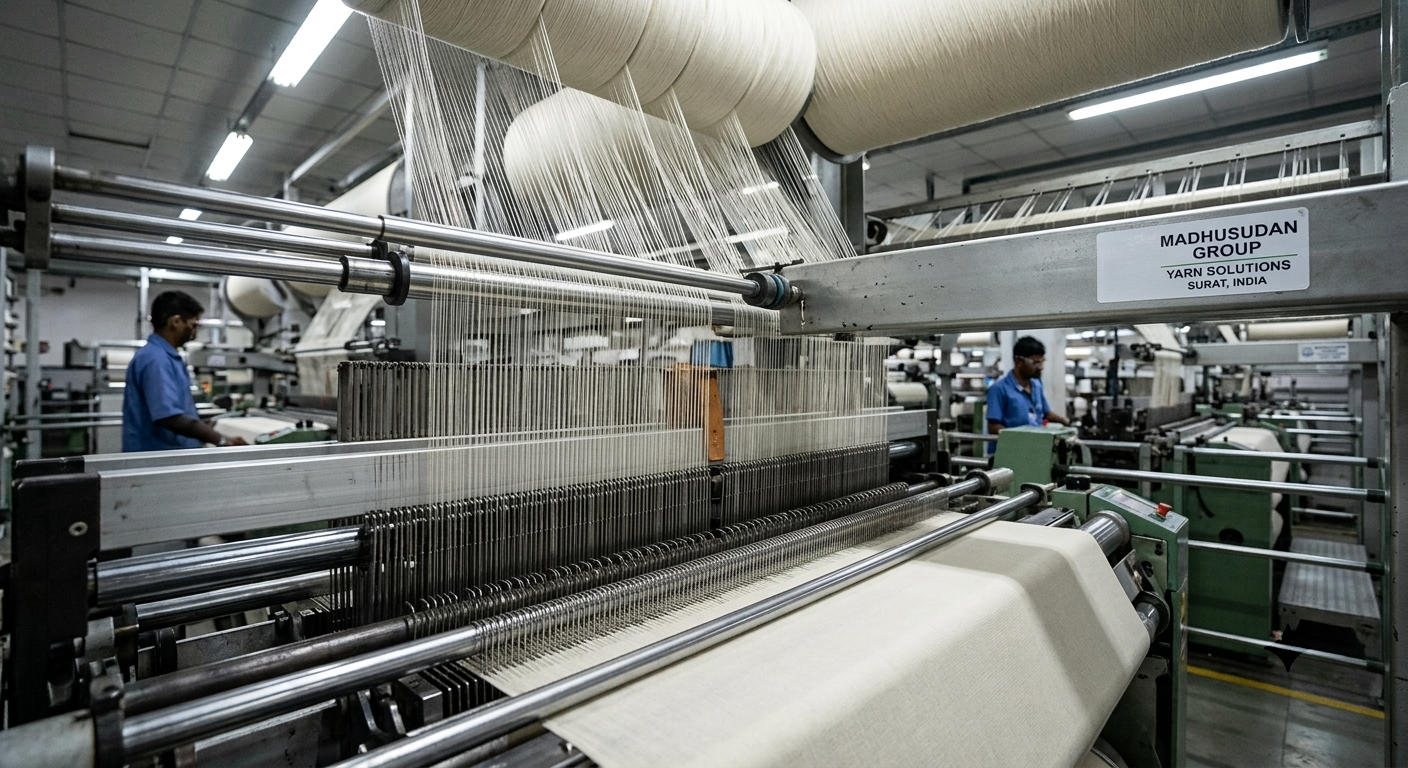
That is why yarn for warp knitting deserves far more attention than it usually gets in sourcing conversations. This guide explains how warp knitting works, which yarns suit tricot and Raschel machines, which specifications genuinely matter, and how to evaluate a supplier before you commit to a bulk order. It also explains why Madhusudan Group, a Surat-based yarn manufacturer, has become a dependable partner for knitters and fabric makers who need consistent filament and stretch yarns shipment after shipment.
Whether you run a tricot line making sportswear, a Raschel line making laces and technical nets, or you are a buyer sourcing yarn on behalf of a knitting partner, the sections below will help you specify better, troubleshoot faster and buy smarter.
What Is Warp Knitting?
Knitting is the production of fabric by forming a series of interlocking loops from continuous yarn. According to Encyclopaedia Britannica’s overview of knitting, the two basic families are weft knits and warp knits, and the warp knits include tricot, Raschel and Milanese constructions. In weft knitting, a single yarn travels across the fabric and forms a row of loops. In warp knitting, loops are formed from yarns that run lengthwise, in the direction the fabric is produced, and neighbouring loops are linked when guide bars shift the yarns sideways between needles.
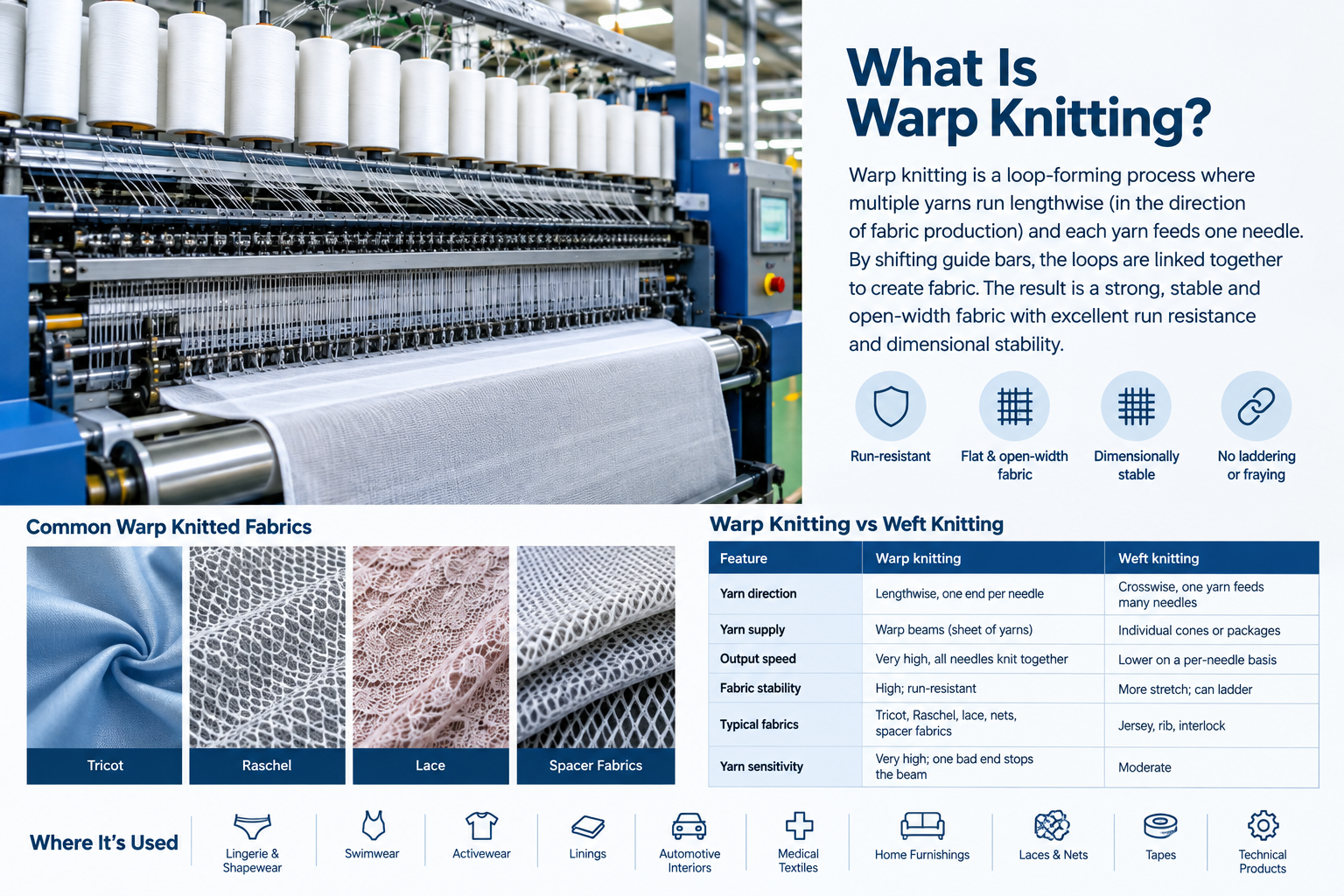
The practical consequences are significant. Because a separate yarn end feeds every needle, all loops in a course are formed simultaneously, which is why warp knitting is described as a loop-forming process fed from warp beams rather than from individual packages. The fabric that comes off the machine is usually flat and open-width, it resists laddering and fraying, and it tends to be dimensionally stable. Britannica notes that warp knits are generally run-resistant, closer and flatter than weft knits.
Those same traits explain where warp-knitted fabrics are used: lingerie and shapewear, swimwear, activewear, linings, automotive interiors, medical textiles, home furnishings, laces, nets, tapes and a long list of technical products. Almost all of them place heavy demands on the yarn feeding the machine.
Warp knitting versus weft knitting at a glance
| Feature | Warp knitting | Weft knitting |
| Yarn direction | Lengthwise, one end per needle | Crosswise, one yarn feeds many needles |
| Yarn supply | Warp beams (sheet of yarns) | Individual cones or packages |
| Output speed | Very high, all needles knit together | Lower on a per-needle basis |
| Fabric stability | High; run-resistant | More stretch; can ladder |
| Typical fabrics | Tricot, Raschel, lace, nets, spacer fabrics | Jersey, rib, interlock |
| Yarn sensitivity | Very high; one bad end stops the beam | Moderate |
Tricot and Raschel: How Machine Type Shapes Yarn Choice
The two major machine classes are tricot and Raschel, and the yarn you buy depends heavily on which one you run.
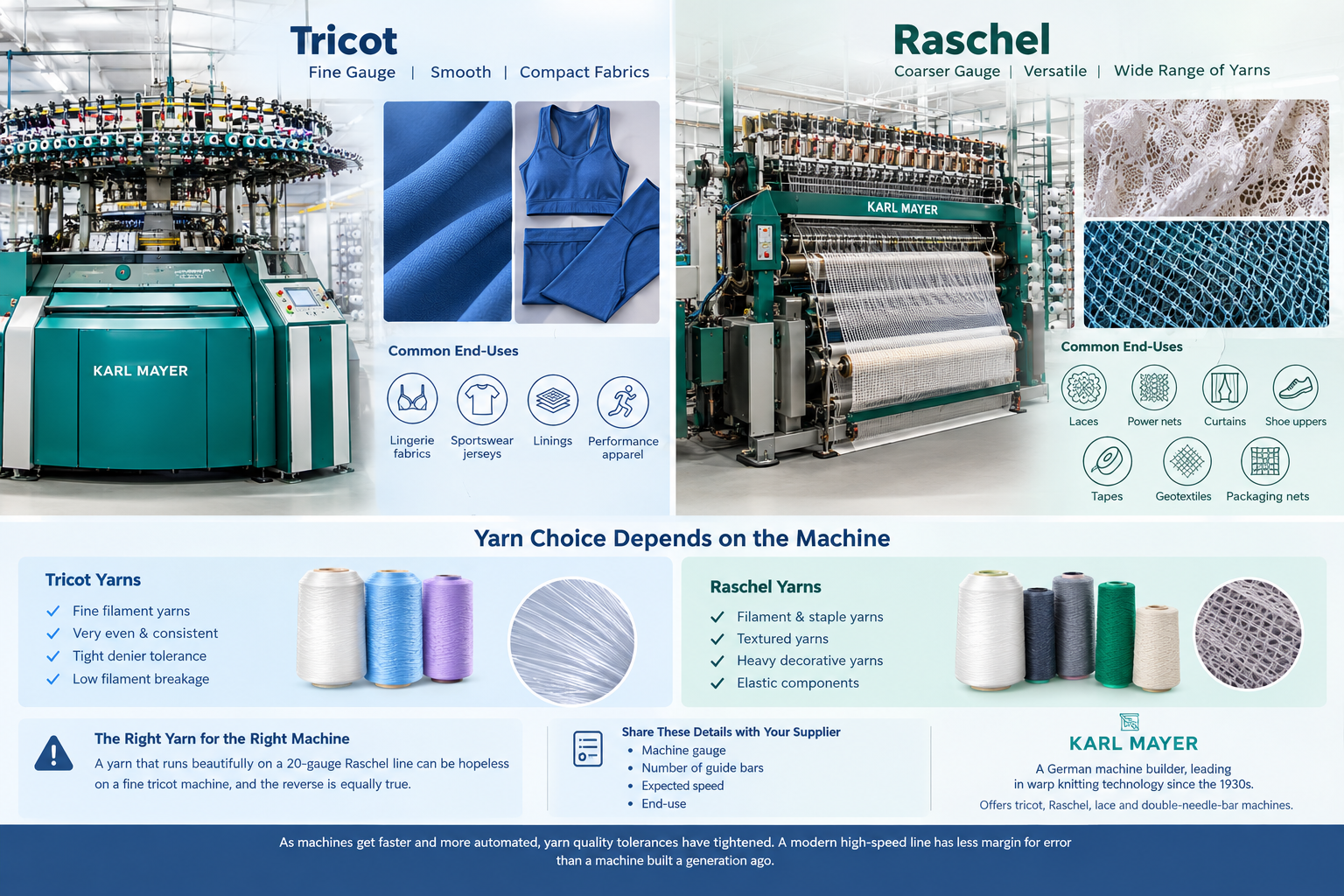
Tricot machines are fine-gauge machines built for smooth, compact fabrics. They run fine filament yarns at high speed and are the workhorses behind lingerie fabrics, sportswear jerseys, linings and performance apparel. Yarns for tricot must be exceptionally even, with tight denier tolerance and low filament breakage, because the machine is unforgiving at speed. Industry reports from KARL MAYER note that tricot machines are among its best-selling models in India, particularly for functional athleisure fabrics, and that circular knitters are increasingly adding warp-knitted fabrics to their ranges.
Raschel machines are typically coarser in gauge and far more versatile in the yarns they can handle. As Cotton Incorporated’s glossary entry on Raschel explains, Raschel fabrics are coarser than other warp knits such as tricot and can be produced in a wide variety of patterns. Raschel lines process filament and staple yarns, textured yarns, heavy decorative yarns and elastic components. They produce laces, power nets, curtains, shoe uppers, tapes, geotextiles and packaging nets.
Choose yarn with your machine class firmly in mind. A yarn that runs beautifully on a 20-gauge Raschel line can be hopeless on a fine tricot machine, and the reverse is equally true. Always share the machine gauge, number of guide bars, expected speed and end-use with your supplier when requesting samples.
KARL MAYER, the German machine builder, has held a leading position in warp knitting technology since the 1930s and offers tricot, Raschel, lace and double-needle-bar machines. As machines become faster and more automated, yarn quality tolerances have tightened in step. A modern high-speed line simply has less margin for error than a machine built a generation ago.
How a Warp Knitting Machine Uses Yarn: From Beam to Fabric
To specify yarn sensibly, it helps to follow its journey. Yarn is first wound onto a warp beam in a process called warping, so that hundreds or thousands of parallel ends can be fed to the machine as a sheet. Natarajan’s e-PG Pathshala chapter on warp knitting explains that all the yarns are knitted simultaneously rather than in sequence, that guide bars supply yarn from each beam, and that a commercially acceptable structure normally needs a minimum of two guide bars. Bearded, latch and compound needles are all used, depending on the machine.
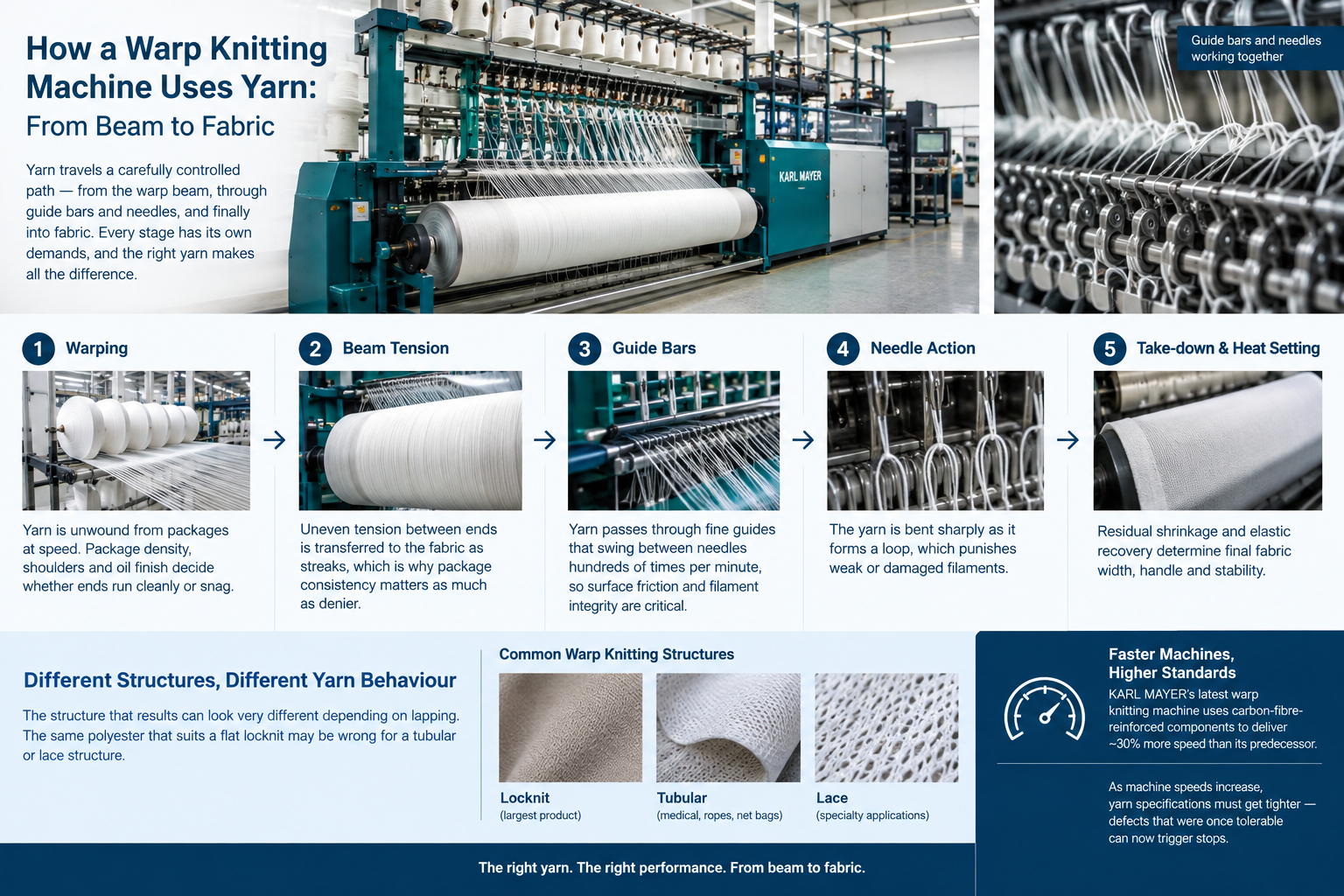
Each stage of that journey puts its own demand on the yarn:
- Warping: the yarn is unwound from packages at speed, so package density, shoulders and oil finish decide whether ends run cleanly or snag.
- Beam tension: uneven tension between ends is transferred to the fabric as streaks, which is why package consistency matters as much as denier.
- Guide bars: yarn passes through fine guides that swing between needles hundreds of times per minute, so surface friction and filament integrity are critical.
- Needle action: the yarn is bent sharply as it forms a loop, which punishes weak or damaged filaments.
- Take-down and heat setting: residual shrinkage and elastic recovery determine final fabric width, handle and stability.
The structure that results can look very different depending on lapping. Taylor & Francis’ engineering reference on warp knitting points out that locknit, a jersey-type knit, is the largest product of warp knitting, and that tubular warp-knitted structures made on double-needle-bar machines are used in medical products as well as ropes and net bags. Different structures call for different yarn behaviour, so the same polyester that suits a flat locknit may be wrong for a tubular or lace structure.
Machine builders continue to push output. For example, a KARL MAYER machine presented ahead of Heimtextil 2025 used carbon-fibre-reinforced components to deliver roughly 30 per cent more speed than its predecessor. Every increase in speed raises the bar for yarn, because defects that were tolerable at lower speeds now trigger stops. The practical lesson for buyers is simple: as your machines get faster, your yarn specification should get tighter, not looser.
Why Yarn Quality Matters More in Warp Knitting
In a circular weft-knitting machine, a thin place in one yarn affects one feeder. In a warp knitting machine, yarn runs from beams, so a defect travels with the beam. If a single end is slightly heavier or lighter than its neighbours, you may see it as a visible line running the full length of the fabric. If an end breaks, the machine stops and the operator must find and re-thread it, usually with the whole width in play.
Five yarn qualities have the greatest influence on warp knitting efficiency:
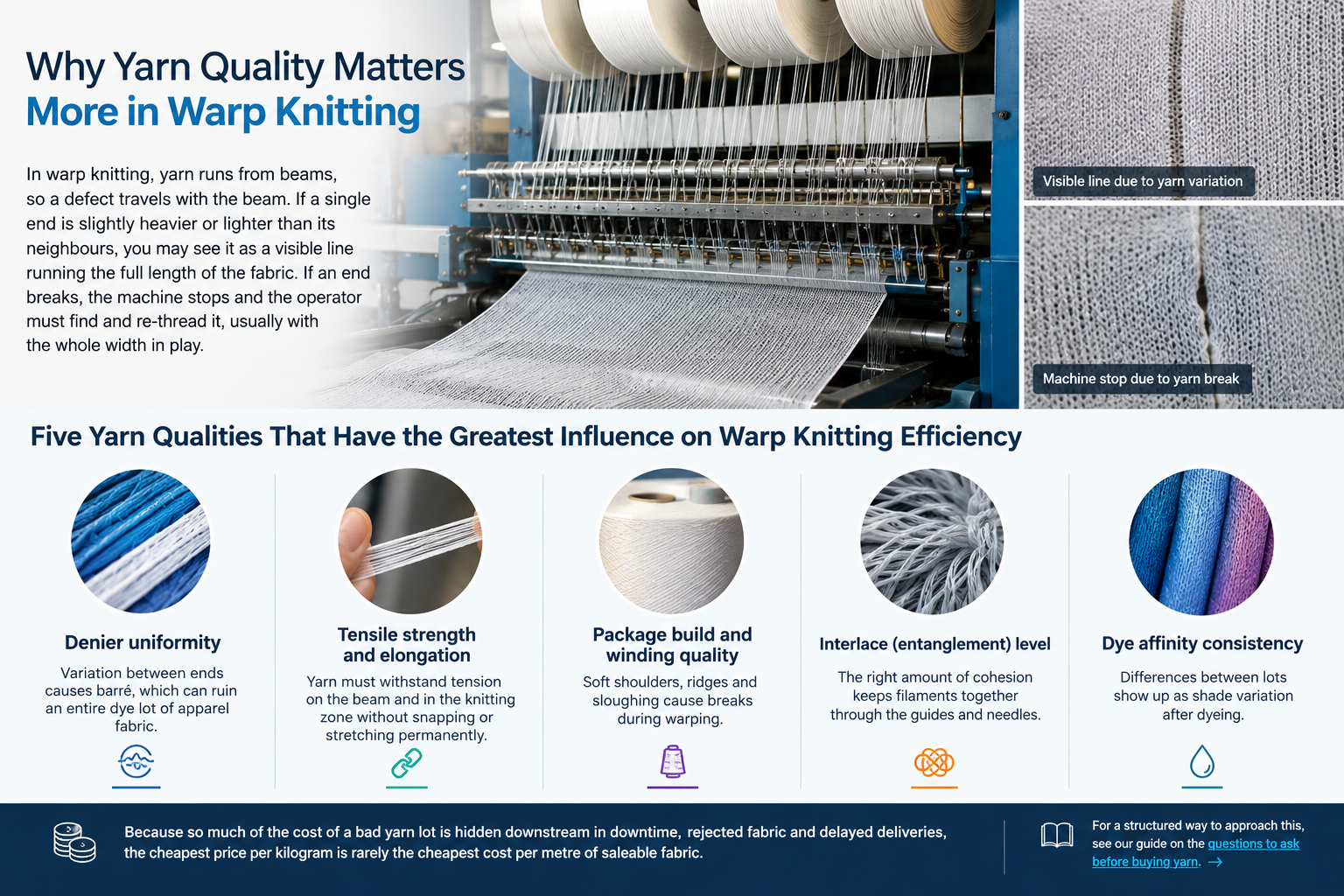
- Denier uniformity: variation between ends causes barré, which can ruin an entire dye lot of apparel fabric.
- Tensile strength and elongation: yarn must withstand tension on the beam and in the knitting zone without snapping or stretching permanently.
- Package build and winding quality: soft shoulders, ridges and sloughing cause breaks during warping.
- Interlace (entanglement) level: the right amount of cohesion keeps filaments together through the guides and needles.
- Dye affinity consistency: differences between lots show up as shade variation after dyeing.
Because so much of the cost of a bad yarn lot is hidden downstream in downtime, rejected fabric and delayed deliveries, the cheapest price per kilogram is rarely the cheapest cost per metre of saleable fabric. For a structured way to approach this, see our guide on the questions to ask before buying yarn.
Types of Yarn for Warp Knitting
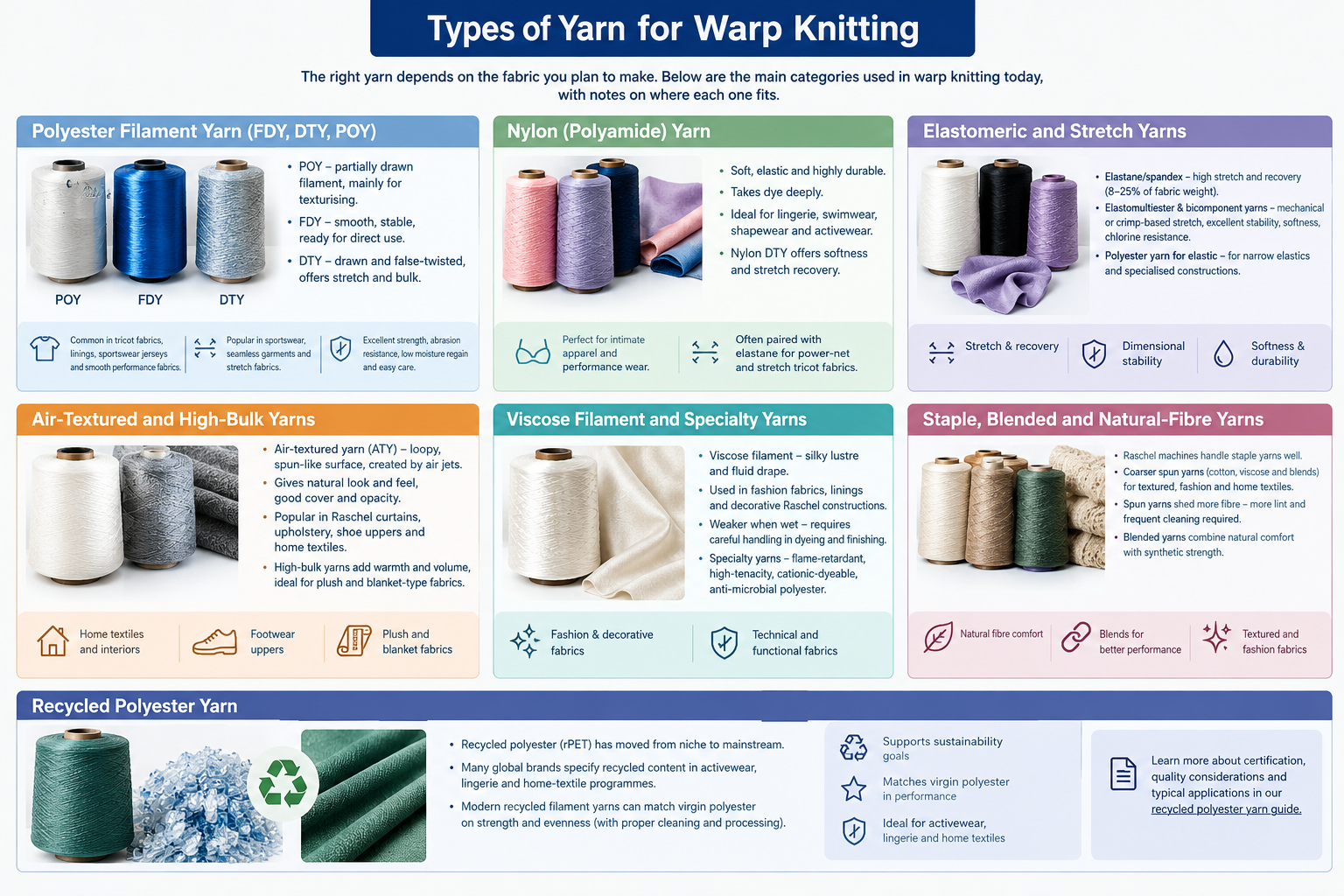
The right yarn depends on the fabric you plan to make. Below are the main categories used in warp knitting today, with notes on where each one fits.
Polyester filament yarn (FDY, DTY, POY)
Polyester is the single most widely used fibre in warp knitting, and it is available in several filament forms:
- POY (pre-oriented yarn) is a partially drawn filament that mainly serves as the feedstock for texturising.
- FDY (fully drawn yarn) is smooth, stable and ready for direct use. It is common in tricot fabrics such as linings, sportswear jerseys and smooth performance fabrics.
- DTY (draw-textured yarn) is produced by drawing and false-twisting POY. Oerlikon’s technical guide to DTY explains how the process creates stretch and bulk, which is why DTY is popular in sportswear, seamless garments and stretch fabrics.
For fine tricot fabrics, FDY and fine-denier DTY dominate. For fabrics that need softness, cover and a more textile hand, DTY and air-textured options are preferred. If your fabric will be dyed in yarn form, consult our polyester yarn dyeing guide for tips on shade consistency.
Polyester also offers excellent strength, good abrasion resistance, low moisture regain and easy care. Its dimensional stability is a major reason it performs so well on high-speed machines.
Nylon (polyamide) yarn
Nylon is the premium choice for lingerie, swimwear, shapewear and high-performance activewear. It is softer to the touch than polyester, has excellent elasticity and abrasion resistance, and takes dye deeply. Nylon combined with elastane is the classic construction behind many power-net and stretch tricot fabrics.
Nylon DTY, in particular, offers the combination of softness and stretch recovery that makers of intimate apparel need. If you are sourcing it, our overview of an experienced nylon DTY yarn manufacturer outlines the denier ranges and specifications that suit warp-knitted fabrics.
Elastomeric and stretch yarns
Warp-knitted stretch fabrics generally pair a hard yarn (polyester or nylon) with an elastic component. Traditional elastane (spandex) has long been the standard, but alternatives have grown in importance:
- Elastane/spandex gives high stretch and recovery in small percentages, typically 8 to 25 per cent of fabric weight in shapewear and swimwear constructions.
- Elastomultiester and bicomponent yarns provide mechanical or crimp-based stretch with outstanding dimensional stability, softness and chlorine resistance.
- Polyester yarn for elastic and narrow elastic fabrics, which use specialised constructions designed to cover or interact with the rubber core.
Our guide to elastomultiester bicomponent yarn and mechanical stretch explains how these constructions work and why many brands are shifting to them. For narrow elastics, see our overview of polyester yarn for elastic, and for broader stretch applications, our stretch yarn manufacturer page.
Air-textured and high-bulk yarns
Air-textured yarn (ATY) has a loopy, spun-like surface produced by air jets rather than heat. It gives fabrics a natural look and feel, good cover and opacity, and is popular in Raschel curtains, upholstery, shoe uppers and home textiles. High-bulk yarns fill a similar niche when warmth and volume are important, such as in plush and blanket-type fabrics.
Viscose filament and specialty yarns
Viscose filament yarn offers a silky lustre and fluid drape that polyester cannot fully replicate. It is used in fashion fabrics, linings and decorative Raschel constructions. Because viscose is weaker when wet, it needs careful handling in dyeing and finishing. Specialty yarns, including flame-retardant, high-tenacity, cationic-dyeable and anti-microbial polyester, serve technical and functional fabrics.
Staple, blended and natural-fibre yarns
Raschel machines are unusually capable of handling staple yarns. Coarser spun yarns, including cotton, viscose and blended yarns, can be knitted for textured, fashion and home-textile fabrics. Keep in mind that spun yarns shed more fibre, which creates lint and demands more frequent cleaning. Blended yarns can offer the best of both worlds, combining the comfort of natural fibres with the strength of synthetics.
Recycled polyester yarn
Recycled polyester (rPET) has moved from niche to mainstream. Many global brands now specify recycled content in their activewear, lingerie and home-textile programmes. Modern recycled filament yarns can match virgin polyester on strength and evenness, provided the raw material is properly cleaned and processed. Our recycled polyester yarn guide covers certification, quality considerations and typical applications in detail.
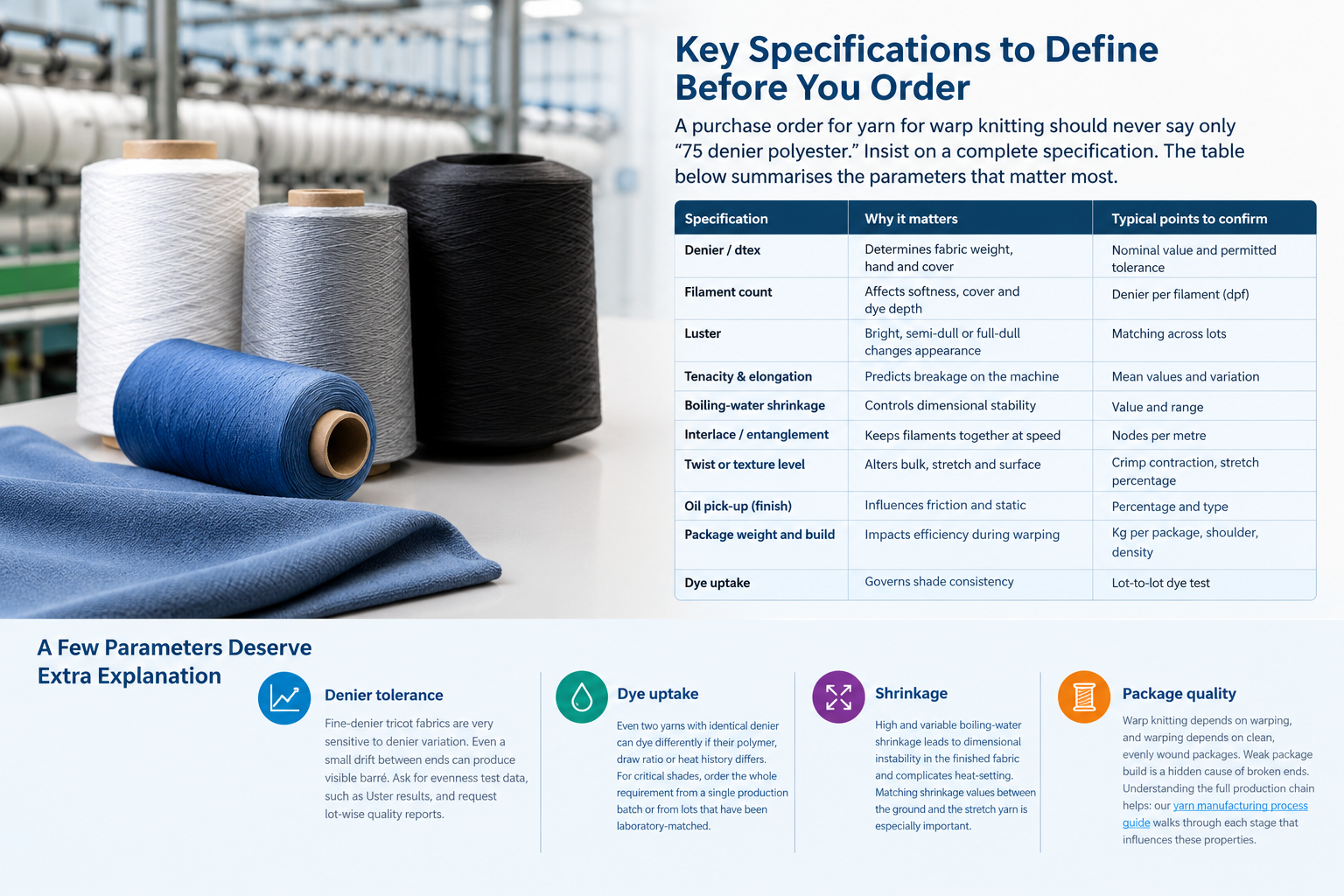
Key Specifications to Define Before You Order
A purchase order for yarn for warp knitting should never say only “75 denier polyester.” Insist on a complete specification. The table below summarises the parameters that matter most.
| Specification | Why it matters | Typical points to confirm |
| Denier / dtex | Determines fabric weight, hand and cover | Nominal value and permitted tolerance |
| Filament count | Affects softness, cover and dye depth | Denier per filament (dpf) |
| Luster | Bright, semi-dull or full-dull changes appearance | Matching across lots |
| Tenacity & elongation | Predicts breakage on the machine | Mean values and variation |
| Boiling-water shrinkage | Controls dimensional stability | Value and range |
| Interlace / entanglement | Keeps filaments together at speed | Nodes per metre |
| Twist or texture level | Alters bulk, stretch and surface | Crimp contraction, stretch percentage |
| Oil pick-up (finish) | Influences friction and static | Percentage and type |
| Package weight and build | Impacts efficiency during warping | Kg per package, shoulder, density |
| Dye uptake | Governs shade consistency | Lot-to-lot dye test |
A few of these deserve extra explanation.
Denier tolerance. Fine-denier tricot fabrics are very sensitive to denier variation. Even a small drift between ends can produce visible barré. Ask for evenness test data, such as Uster results, and request lot-wise quality reports.
Dye uptake. Even two yarns with identical denier can dye differently if their polymer, draw ratio or heat history differs. For critical shades, order the whole requirement from a single production batch or from lots that have been laboratory-matched.
Shrinkage. High and variable boiling-water shrinkage leads to dimensional instability in the finished fabric and complicates heat-setting. Matching shrinkage values between the ground and the stretch yarn is especially important.
Package quality. Warp knitting depends on warping, and warping depends on clean, evenly wound packages. Weak package build is a hidden cause of broken ends. Understanding the full production chain helps: our yarn manufacturing process guide walks through each stage that influences these properties.
Applications of Yarn in Warp-Knitted Fabrics
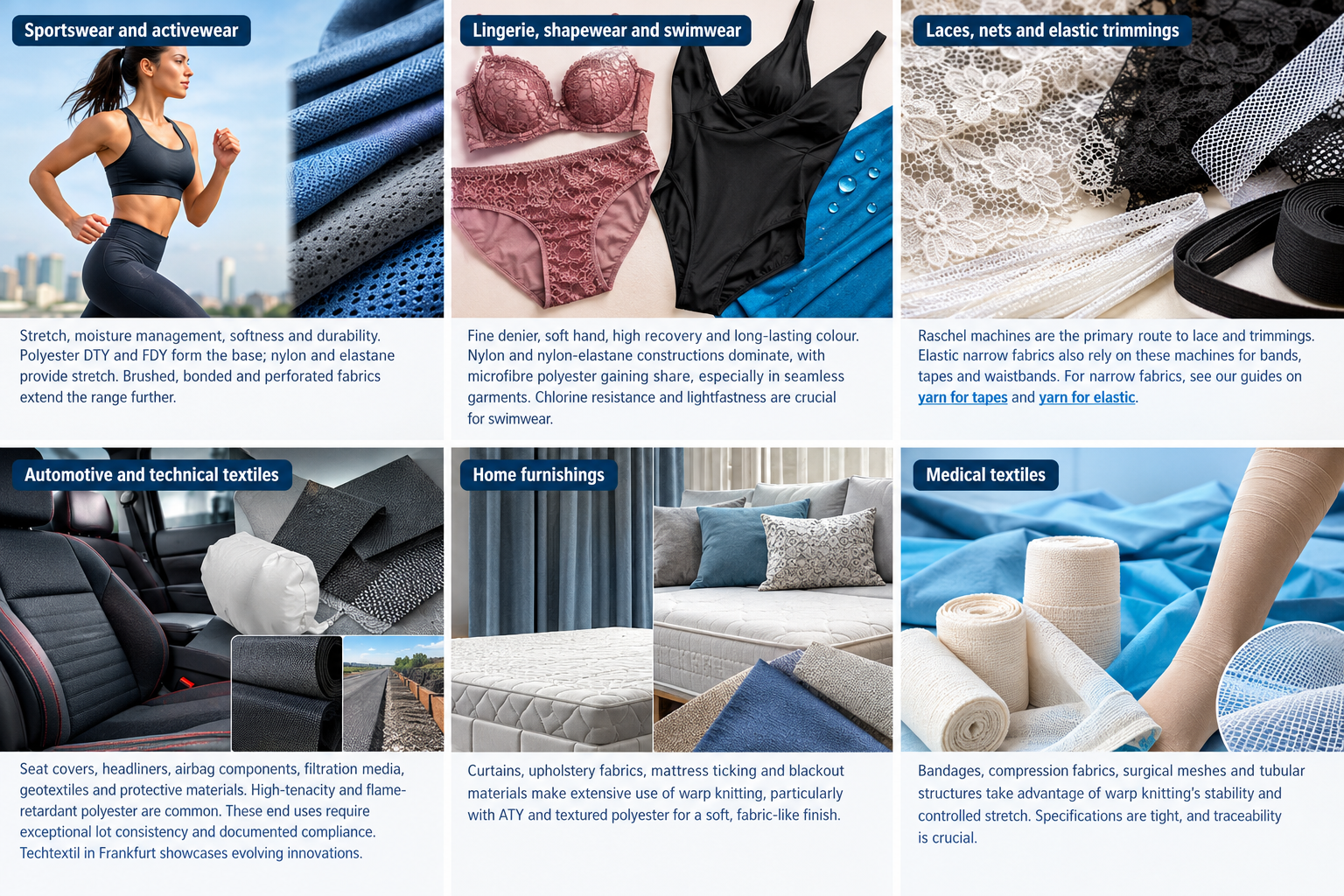
Sportswear and activewear
Athleisure is one of the strongest growth areas for tricot knitting. Fabrics need to deliver stretch, moisture management, softness and durability. Polyester DTY and FDY form the base; nylon and elastane or elastomultiester provide stretch. Brushed, bonded and perforated warp-knitted fabrics extend the range further.
Lingerie, shapewear and swimwear
These categories demand fine denier, soft hand, high recovery and long-lasting colour. Nylon and nylon-elastane constructions dominate, though microfibre polyester has gained share, especially in seamless garments. Chlorine resistance and lightfastness are crucial for swimwear.
Laces, nets and elastic trimmings
Raschel machines are the primary route to lace and trimmings. Elastic narrow fabrics also rely on these machines for bands, tapes and waistbands. For narrow fabrics, our guide to yarn for tapes outlines strength and dimensional requirements, and the broader yarn for elastic resource covers covering and stretch considerations.
Automotive and technical textiles
Warp-knitted fabrics form seat covers, headliners, airbag components, filtration media, geotextiles and protective materials. High-tenacity and flame-retardant polyester are common. These end uses require exceptional lot consistency and documented compliance. Trade shows such as Techtextil in Frankfurt showcase how rapidly technical warp-knitted products are evolving.
A special branch of the process, stitch-bonding, is commonly used to produce composite materials and technical textiles such as shoe interlinings, shopping bags and reinforced glass-fibre fabrics. Because these products are engineered for performance, yarn tenacity, uniformity and traceability matter far more than hand or lustre.
Home furnishings
Curtains, upholstery fabrics, mattress ticking and blackout materials make extensive use of warp knitting, particularly with ATY and textured polyester for a soft, fabric-like finish.
Medical textiles
Bandages, compression fabrics, surgical meshes and tubular structures take advantage of warp knitting’s stability and controlled stretch. Specifications here are tight, and traceability is crucial.
Yarn Dyeing and Colour: Raw-White, Dope-Dyed and Package-Dyed
Colour strategy affects both cost and consistency. You have three main routes:
- Raw-white yarn, fabric dyed after knitting. Offers flexibility, because the same greige fabric can be dyed in many shades, but requires reliable dye uptake.
- Dope-dyed (solution-dyed) yarn. Pigment is added to the polymer before spinning, giving excellent colourfastness and lower water use, but limited shade flexibility and higher minimums.
- Package-dyed yarn. Yarn is dyed on packages before warping. This approach suits multi-colour jacquard and stripe effects and can offer very precise shade control.
If colour-matched yarn is part of your project, talk to a dyed yarn manufacturer early. Dyed yarn requires lead time, shade approvals and agreed tolerances for lot-to-lot variation. Specifying a delta-E limit and the lighting conditions for assessment can prevent disputes later.
Sustainability and Certification: What Buyers Now Expect
Brands and retailers increasingly expect proof, not promises. For yarn used in warp-knitted apparel and home textiles, three certifications come up repeatedly.
OEKO-TEX STANDARD 100. This is one of the world’s best-known labels for textiles tested for harmful substances. OEKO-TEX explains that the standard applies at every production stage, including raw and finished yarns, and that certificates are issued after testing by independent institutes against a catalogue that is updated at least annually. If your fabric is for lingerie, baby wear or other skin-contact products, certified yarn simplifies your own certification path.
Global Recycled Standard (GRS). Administered by Textile Exchange, the Global Recycled Standard verifies recycled content and tracks material through the supply chain, while adding social, environmental and chemical requirements. For brands making recycled-content claims, GRS-certified yarn with transaction certificates is increasingly mandatory. Note that Textile Exchange has signalled a transition of its recycled standards into a new unified standard, so confirm the current scheme and version with your certifier.
ISO 9001. The ISO 9001 quality management standard is the most widely used quality management standard in the world. It does not guarantee a perfect product, but it shows that a manufacturer has documented processes, internal audits and a commitment to continual improvement. Working with an ISO-certified yarn supplier gives buyers structured traceability and corrective-action systems.
Sustainability goes beyond certificates. Ask suppliers about energy and water use in dyeing, waste handling, packaging and the share of recycled input. A supplier that can answer these questions with data is usually a supplier with disciplined operations.
Common Yarn-Related Problems in Warp Knitting and How to Fix Them
Even with good machines and experienced operators, yarn problems occur. Here is how to recognise and address the most frequent ones.
Frequent end breaks. Causes include weak or damaged filaments, poor package build, excessive tension or incorrect oil finish. Check tension settings, inspect yarn path guides for wear, and ask the supplier for tenacity and elongation data.
Barré (streaks). Usually caused by variation in denier, dye uptake, tension or yarn lot between ends. Keep beams from a single lot, check evenness data and verify warping tension.
Shade variation between lots. Order a full programme from a single batch when possible; use laboratory dips to approve each delivery; and agree tolerances in writing.
Snags, fluff and broken filaments. Often related to damaged filaments from over-drafting, rough guides or static. Review the finish type and humidity in the knitting room.
Fabric curling or inconsistent width. Frequently linked to shrinkage differences or uneven heat setting. Match the shrinkage of ground and stretch yarns, and set the heat-setting conditions accordingly.
Poor stretch recovery. Check elastic percentage, yarn type and covering. Switching to a more stable construction, such as bicomponent yarn, can help.
A reliable supplier will help diagnose these issues quickly and supply lot data. A trader often cannot, because they have no direct access to production records.
How to Choose a Yarn Supplier for Warp Knitting
A supplier relationship is about far more than price. Evaluate potential partners on these criteria:
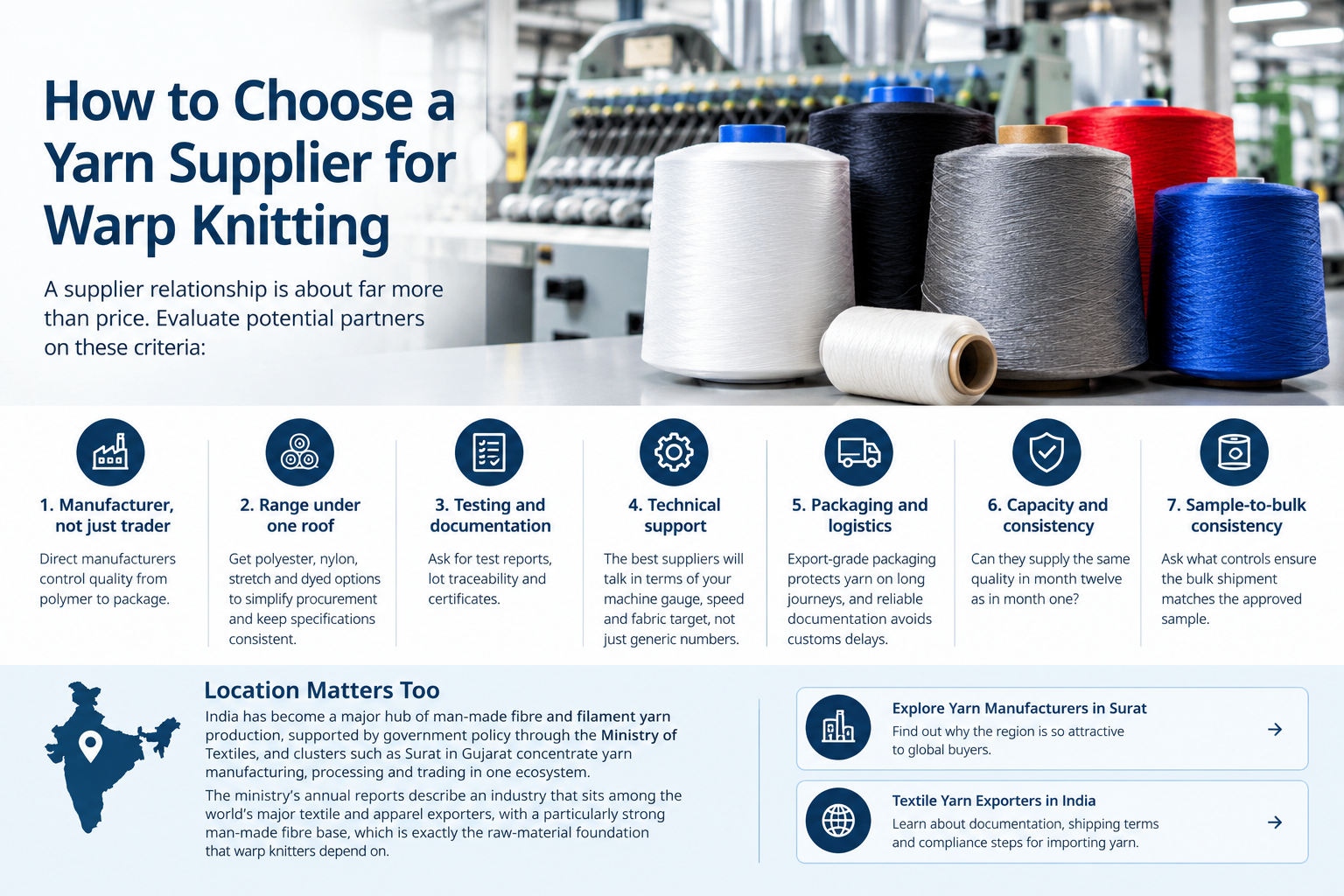
- Manufacturer, not just trader. Direct manufacturers control quality from polymer to package. Understand the difference in our article on yarn supplier vs yarn manufacturer.
- Range under one roof. A supplier that offers polyester, nylon, stretch and dyed options can simplify procurement and keep specifications consistent.
- Testing and documentation. Ask for test reports, lot traceability and certificates.
- Technical support. The best suppliers will talk in terms of your machine gauge, speed and fabric target, not only generic catalogue numbers.
- Packaging and logistics. Export-grade packaging protects yarn on long journeys, and reliable documentation avoids customs delays.
- Capacity and consistency. Can they supply the same quality in month twelve as in month one?
- Sample-to-bulk consistency. Ask what controls ensure the bulk shipment matches the approved sample.
Location matters too. India has become a major hub of man-made fibre and filament yarn production, supported by government policy through the Ministry of Textiles, and clusters such as Surat in Gujarat concentrate yarn manufacturing, processing and trading in one ecosystem. The ministry’s annual reports_0.pdf) describe an industry that sits among the world’s major textile and apparel exporters, with a particularly strong man-made fibre base, which is exactly the raw-material foundation that warp knitters depend on. Our overview of yarn manufacturers in Surat explains why the region is so attractive to global buyers.
For overseas buyers, our resources on textile yarn exporters in India outline documentation, shipping terms and compliance steps for importing yarn.
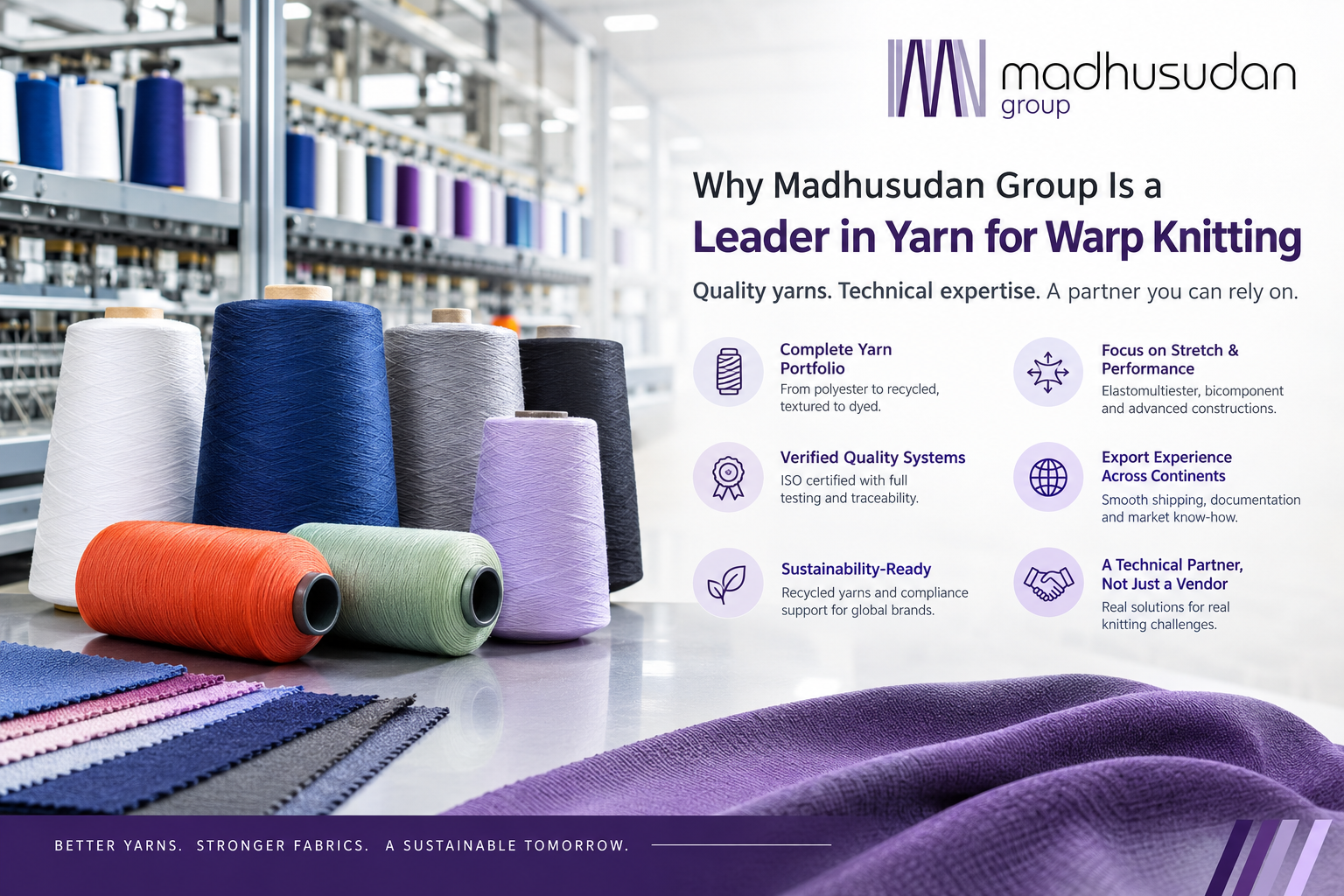
Why Madhusudan Group Is a Leader in Yarn for Warp Knitting
Madhusudan Group is a Surat-based yarn manufacturer and exporter that supplies the knitting, weaving, elastic and technical-textile industries. What distinguishes the company from a typical trading house is that it combines manufacturing capability, technical understanding and an export-oriented mindset. For warp knitters, that combination translates into practical advantages.
A complete yarn portfolio
Warp-knitting customers rarely need just one yarn. A typical programme may require polyester FDY for the ground, nylon or polyester DTY for hand and stretch, an elastomeric or bicomponent yarn for recovery, and dyed yarn for colour. Madhusudan Group’s portfolio spans polyester, nylon, viscose filament, linen, blended, recycled, textured, air-textured, bicomponent and elastomultiester yarns, as well as dyed yarns. Having these under a single, coordinated supplier reduces specification mismatch and simplifies planning.
Focus on stretch and performance
The shift toward comfort stretch and performance fabrics has made advanced stretch yarns a core strength. Madhusudan Group’s work on elastomultiester and bicomponent constructions gives knitters an alternative to traditional elastane, with excellent recovery, softness and durability. Readers who want a deeper dive can explore how elastomultiester yarns deliver performance and comfort in functional fashion.
Quality systems you can verify
Quality is not a slogan at Madhusudan Group. The company operates with documented quality management and positions itself as an ISO-certified supplier, with testing for key parameters such as denier, tenacity, elongation, shrinkage and shade. Lot traceability and consistent packaging mean knitters can trace any issue back to its origin and resolve it quickly.
Sustainability-ready supply
With rising demand for recycled and responsibly produced yarns, Madhusudan Group offers recycled polyester options and supports customers who need documentation for brand compliance programmes. For brands moving toward circular and lower-impact textiles, this is a significant advantage.
Export experience across continents
Madhusudan Group serves international customers and understands the practicalities of shipping yarn across oceans: export packaging, documentation, lead times and market-specific requirements. The company’s published resources cover import processes for markets such as the USA, Brazil and Argentina, as well as yarn dyeing capabilities relevant to buyers in Colombia, Peru, Egypt and Sri Lanka. This depth of market knowledge means fewer surprises for overseas knitters.
A technical partner, not just a vendor
Warp knitters value suppliers who can troubleshoot. Whether the issue is barré, shade variation or end breaks, a manufacturer with an in-house understanding of how yarn is produced can identify root causes faster than a reseller. That collaborative approach is what makes Madhusudan Group a trusted name among warp-knitting customers.
Market Trends Shaping Yarn Demand in Warp Knitting
Several trends are shaping what knitters ask of their yarn suppliers.
Growth of functional and athleisure fabrics. Tricot capacity is expanding in India and elsewhere to serve sportswear and comfort wear. This pushes demand toward fine, uniform filament and stretch yarns.
Move from circular to warp knitting. According to KARL MAYER, circular knitters are increasingly exploring warp-knitted fabrics to broaden their product ranges. These new entrants often lack in-house warp-knitting yarn expertise, which makes supplier technical support more valuable.
Seamless and body-mapping garments. Zoned structures demand yarns with predictable stretch and recovery.
Recycled and bio-based yarns. Brand commitments are making certified recycled content a baseline requirement rather than a premium option.
Technical textiles. Mobility, healthcare, construction and filtration are all growing segments, and many rely on warp-knitted structures. India’s National Technical Textiles Mission, part of the Ministry of Textiles’ agenda, is helping to nurture that growth.
Digitalisation and tighter tolerances. Machine builders such as KARL MAYER, which positions itself as a technological pioneer in textile machinery, keep raising speeds, and tolerances for yarn quality tighten accordingly. Industry events such as ITME in India and Techtextil in Germany regularly showcase these shifts.
A Practical Sampling and Approval Checklist for Knitters
Before moving from sample to bulk, run a disciplined trial. A short checklist saves weeks of rework:
- Share the full brief. Provide machine make, gauge, number of guide bars, target speed, fabric weight and end use.
- Request production-lot samples. Laboratory samples are not always representative of what will arrive in a container.
- Run a full beam trial. Knit at least one complete beam at production speed and record end breaks per hundred thousand courses.
- Dye and finish the trial fabric. Check barré, shade, shrinkage, hand and recovery after the real finishing route, not a bench dip.
- Document the approved values. Record denier, tenacity, elongation, shrinkage and interlace from the approved lot as your reference standard.
- Agree tolerances in writing. Put acceptable ranges and the testing method into the purchase agreement.
- Audit the first bulk lots. Compare every early delivery with the approved reference before it reaches the warping department.
Following these steps also makes it easier to compare suppliers on equal terms. If you buy in volume, it is worth reading our overview of a bulk yarn supplier in India for guidance on minimum quantities, lead times and packaging for large programmes.
Frequently Asked Questions About Yarn for Warp Knitting
What is the best yarn for warp knitting?
There is no single best yarn. Polyester filament (FDY and DTY) is the most widely used. Nylon is preferred for soft, premium lingerie and swimwear. Stretch fabrics combine either with elastane, elastomultiester or bicomponent yarns. The best choice depends on your machine, fabric and end use.
Can staple yarns be used for warp knitting?
Yes, mainly on Raschel machines, which can handle coarser staple and blended yarns in addition to filaments. Tricot machines, with their fine gauges and high speeds, are better suited to filament yarns.
What denier is commonly used in tricot warp knitting?
Fine and medium deniers are typical, commonly in the range of roughly 20 to 150 denier depending on the fabric, with many lingerie and sportswear constructions using the finer end of that range. Always confirm with your machine gauge and fabric target.
What is the difference between FDY and DTY for warp knitting?
FDY is smooth, fully drawn and stable, suited to flat, smooth fabrics. DTY is textured, with built-in stretch and bulk, suited to soft-hand, stretchy fabrics. Many warp-knitted fabrics combine both.
Why does my warp-knitted fabric show streaks?
Streaks, or barré, usually result from variation in denier, dye uptake, tension or yarn lots across the beam. Using yarn from a single lot with verified evenness data and consistent warping tension will usually resolve the problem.
How do I verify a yarn supplier’s claims?
Request test reports, certificates (ISO 9001, OEKO-TEX, GRS where relevant), lot traceability and samples from production, not just from a sample lab. A manufacturer that welcomes scrutiny is usually a good sign.
Does Madhusudan Group export yarn internationally?
Yes. Madhusudan Group supplies customers across several international markets and publishes guidance on importing yarn from India to markets such as the USA, Brazil and Argentina.
Conclusion: Choose Yarn for Warp Knitting as a Strategic Decision
Yarn for warp knitting is not a commodity purchase. Because every needle depends on its own yarn end, small variations in denier, strength, shrinkage and dye uptake can translate into large losses in efficiency and fabric quality. The best results come from specifying clearly, testing rigorously and partnering with a manufacturer that understands what happens on the machine floor.
Madhusudan Group brings together a broad range of polyester, nylon, stretch, recycled and dyed yarns, a quality-first approach and years of export experience. For knitters in India and around the world, it offers the consistency and technical support that high-speed warp knitting demands.
Ready to upgrade your warp knitting yarn supply? Contact Madhusudan Group with your machine gauge, target fabric and monthly requirement, and request samples matched to your specification. Let our team help you cut downtime, improve fabric quality and grow with confidence.