If you have ever pulled on a waistband that stretched smoothly and snapped back, worn a pair of sheer stockings that held their shape all day, or strapped on a sports brace that stayed comfortable through hours of movement, you have relied on elastic that was engineered with care. In a large share of those products, the part you feel against your skin is nylon yarn for elastic: a smooth, strong, soft filament that wraps, braids or knits around a stretchy core and turns raw elasticity into something wearable, washable and durable.
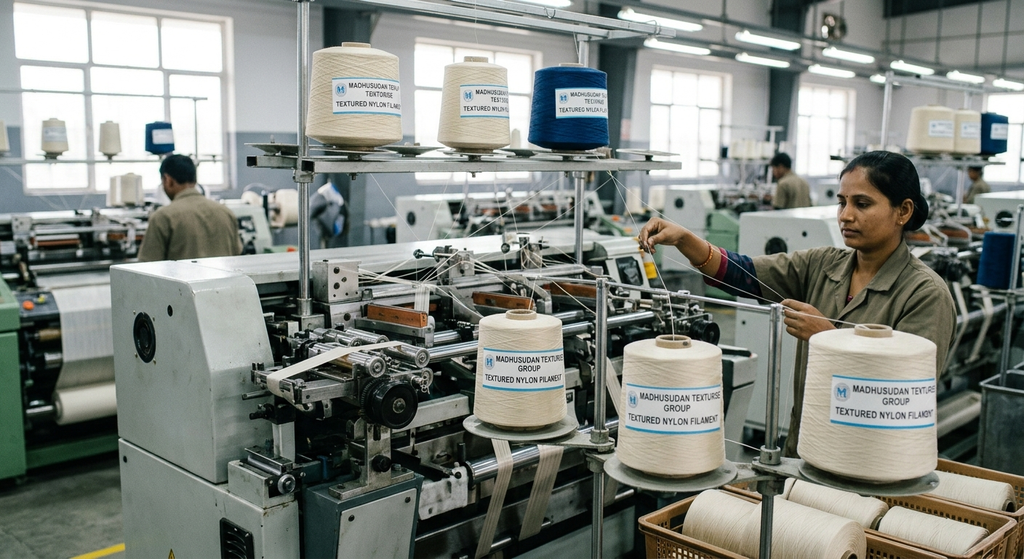
Elastic is one of the least glamorous parts of a garment and one of the most unforgiving. A fashion fabric can hide small faults. An elastic band cannot. If the covering yarn is uneven, the band shows it. If the nylon is poorly dyed, the shade drifts across a lot. If the cover is too loose, the core shows through. If it is too tight, the stretch is choked. That is why experienced buyers treat nylon yarn for elastic as a precision input and not as a commodity.
At Madhusudan Group, a leading Surat-based yarn manufacturer and exporter with more than 50 years of experience in the textile value chain, we supply nylon, polyester, viscose filament, textured and blended yarns to knitters, weavers, tape makers and garment brands. This guide pulls together what we have learned from working with elastic and narrow-fabric producers. It explains how nylon behaves in elastic, which grades and counts suit which products, how to specify and test the yarn, and how to buy it in volume without surprises.
Whether you are a narrow-fabric mill, a hosiery maker, a shapewear brand or a sourcing manager comparing quotes, you will find practical answers here.
What Is Nylon Yarn for Elastic?
Nylon yarn for elastic is a continuous-filament polyamide yarn used to cover, braid, weave or knit together with an elastomeric core, usually spandex (also called elastane), so that the finished product stretches and recovers. Nylon on its own barely stretches in a useful way. Spandex on its own is delicate, tacky and difficult to handle. Put the two together and each makes up for the other’s weakness.
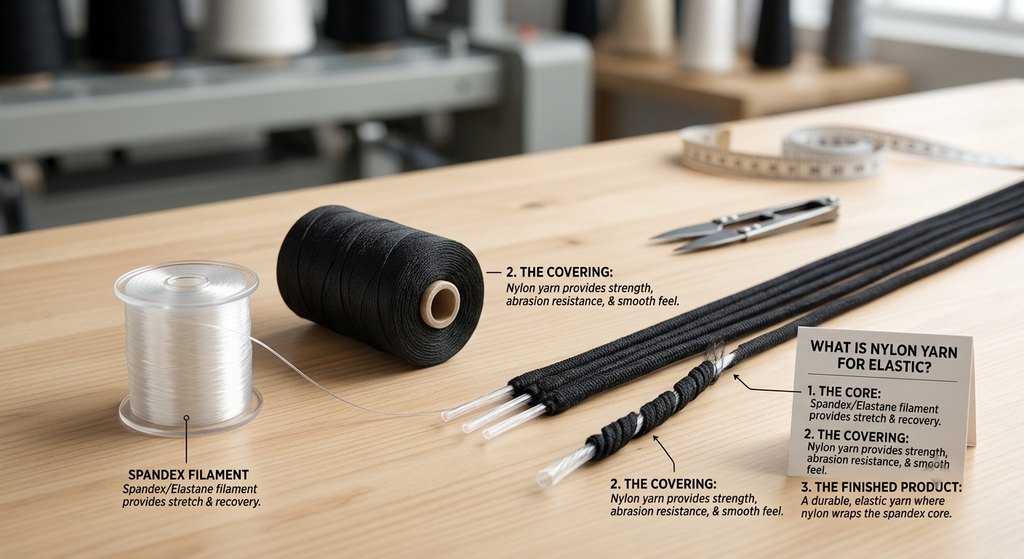
In a typical construction:
- The core is an elastomeric filament, most often spandex, which supplies stretch and recovery.
- The nylon yarn supplies strength, abrasion resistance, a smooth hand, dye uptake and protection for the core.
The term covers several product forms. Nylon can be a flat (parallel) filament, a textured yarn with more bulk, a twisted yarn, or a heat-set covered yarn in which nylon is wrapped around spandex. Each form behaves differently in a loom, a knitting machine or a braiding line, and each is chosen for a reason. We look at those forms in detail later in this guide.
If you want the wider picture of how elastic yarns fit together, our overview of yarn for elastic is a good starting point, and it sits alongside this guide.
Why Nylon Is Used in Elastic
Polyamide, the chemical family behind nylon, was one of the first fully synthetic fibres and remains one of the most useful. You can read the background on the fibre family on Wikipedia’s nylon entry. For elastic, a handful of properties matter most.
Strength and abrasion resistance
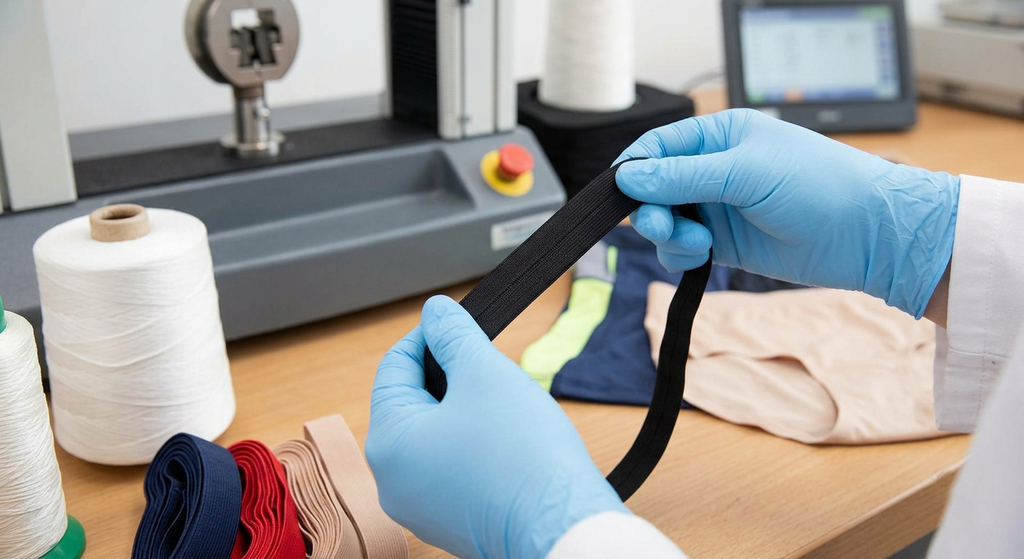
Nylon is a strong, tough fibre. Reference data for nylon 6 filament lists a dry tenacity of roughly 3.8 to 8.3 grams per denier, depending on the grade, and the fibre keeps most of that strength when wet, according to the CAMEO materials database. In an elastic band, that strength matters because the covering yarn takes the rubbing, flexing and washing so that the delicate core does not have to.
Smooth, skin-friendly surface
Nylon filaments are smooth and round or shaped in cross-section, which gives a soft, silky hand. That is why nylon is the preferred cover in hosiery, lingerie, shapewear and sports bands that sit on the skin. A rough covering yarn can irritate, mark or catch. A good nylon cover does not.
Good elastic recovery in the cover
Nylon has its own moderate elasticity and recovers well from small deformations. When a nylon cover moves with a spandex core instead of fighting it, the finished yarn or band feels lively and returns to shape after repeated stretching.
Dye affinity
Nylon takes acid and disperse dyes well and can reach deep, bright, wash-fast shades. For coloured elastic, particularly in lingerie, sportswear and fashion tapes, that matters a great deal. Nylon 6 in particular is noted for a higher affinity for dyes than nylon 6,6.
Moisture behaviour
Nylon absorbs more moisture than polyester. The same CAMEO reference gives a moisture regain of about 3.5 to 5 percent for nylon 6. That makes nylon feel more comfortable against skin and helps dye uptake, though it also means dimensions and strength can shift slightly with humidity, which we cover under testing.
Protection of the core
Spandex is vulnerable to friction, heat and some chemicals. A well-covered core is shielded from needle damage in knitting, from abrasion in wear and from much of the wear and tear of washing. This protective role is one of the main reasons covered yarns exist at all.
Nylon vs Polyester as an Elastic Cover
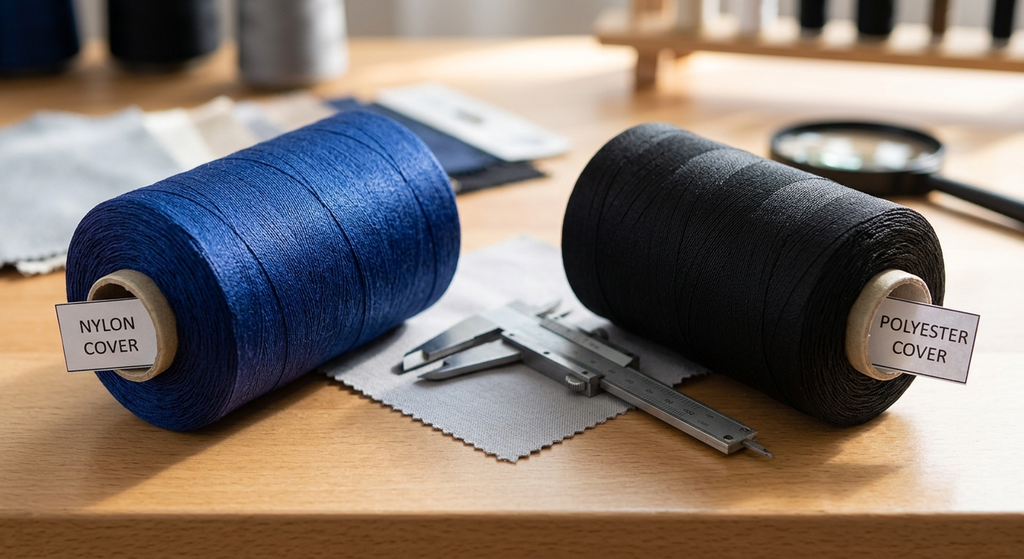
Buyers regularly ask whether to choose nylon or polyester for the covering yarn. The honest answer is that both are good, and the right choice depends on the product. We make both, so we have no reason to push one over the other. Our article on polyester yarn for elastic covers the polyester side in depth.
| Property | Nylon (polyamide) | Polyester |
| Hand-feel | Softer, silkier | Slightly crisper |
| Abrasion resistance | Excellent | Very good |
| Moisture regain | Higher (about 3.5–5%) | Very low |
| Dye method | Acid dyes, with good depth | Disperse dyes, high temperature |
| Elastic recovery of cover | Very good | Good |
| Chlorine and UV behaviour | Moderate | Better |
| Typical cost | Generally higher | Generally lower |
| Best for | Hosiery, lingerie, shapewear, medical and sports bands | Waistbands, tapes, industrial elastic, cost-led products |
A practical rule of thumb: choose nylon when softness, skin contact and dye depth matter most, and choose polyester when cost, light-fastness and chlorine or UV resistance matter most. Many brands use both in the same range, with nylon-covered elastic in intimate wear and polyester elastic in outer garments and trims.
Nylon 6 vs Nylon 6,6: Which Grade for Which Elastic?
Two grades of polyamide dominate textile filament. Understanding the difference helps you read a quotation properly.
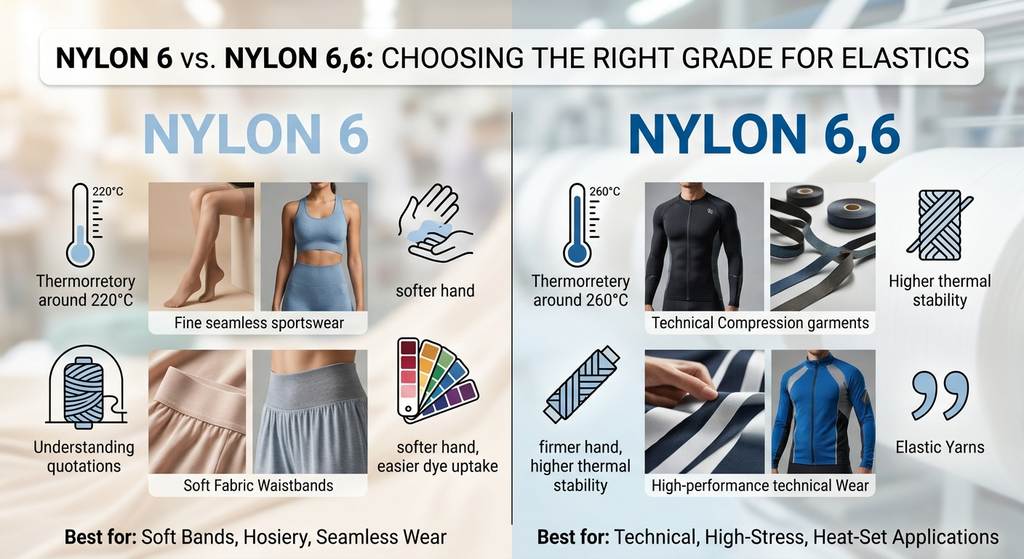
Nylon 6 is made by polymerising caprolactam. It has a lower melting point, commonly quoted around 215 to 220 °C, a slightly softer hand and a more open structure that takes dye readily. The background is on Wikipedia’s nylon 6 page.
Nylon 6,6 is made from two building blocks, hexamethylenediamine and adipic acid. It melts higher, at around 260 °C, and is generally a little stiffer and more thermally stable. You can read more on Wikipedia’s nylon 6,6 page.
| Feature | Nylon 6 | Nylon 6,6 |
| Melting point | Lower (about 215–220 °C) | Higher (about 260 °C) |
| Dye uptake | Easier, deeper shades | Good, slightly less open |
| Hand | Softer | A little firmer |
| Thermal stability | Good | Better |
| Processing window in covering and heat-setting | Easier | Needs tighter control |
| Typical elastic uses | Hosiery, seamless wear, soft bands, tapes | Technical, high-stress and heat-set applications |
In elastic and covered yarns, nylon 6 is very widely used because it is soft, dyes well and sets easily. Nylon 6,6 is chosen where heat stability or particular mechanical behaviour is required. Both can be spun as fine filaments suitable for covering. If your application needs one specific grade, say so in your specification, since the two are not interchangeable in a finished dyed product.
Forms of Nylon Yarn Used in Elastic
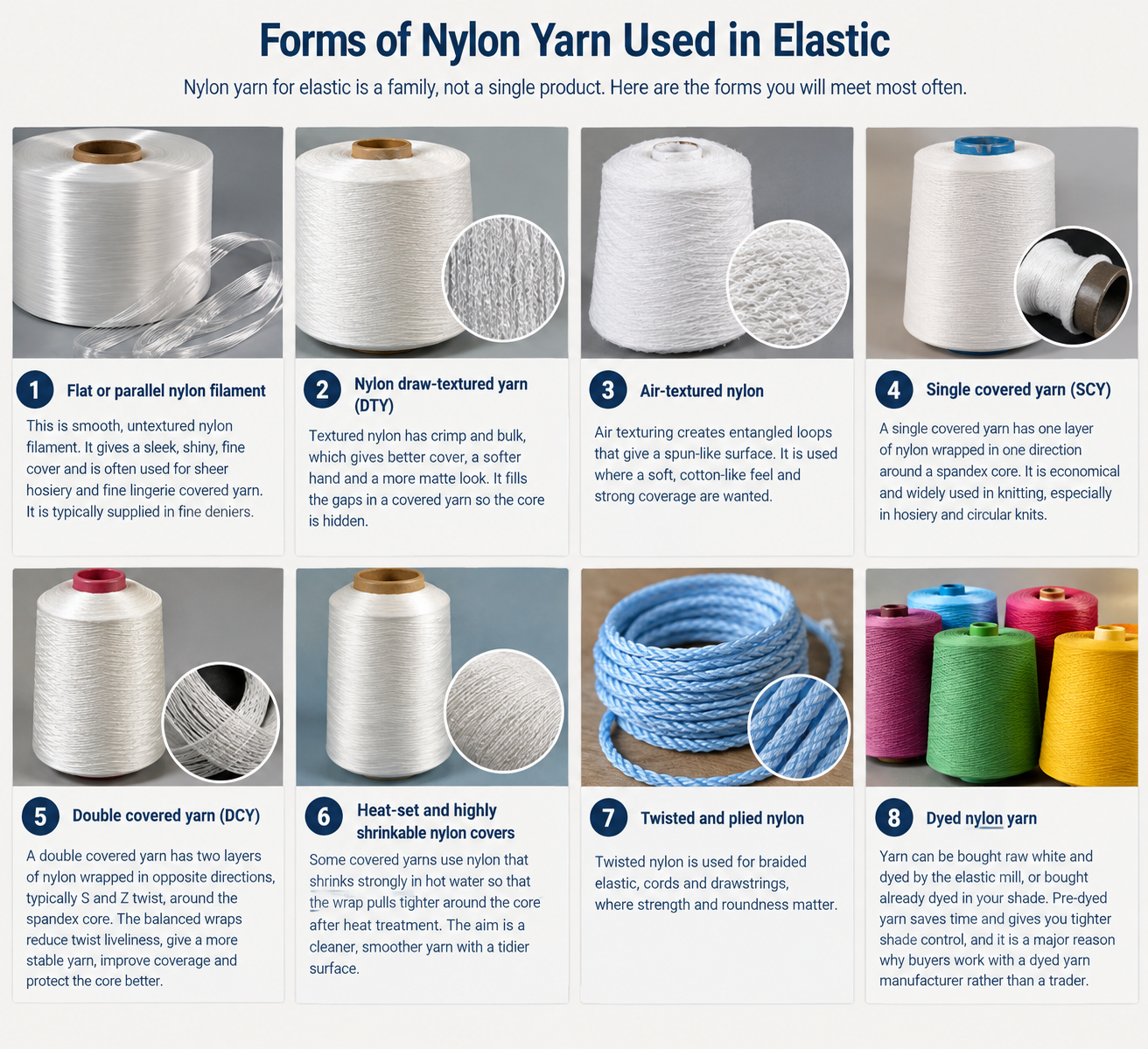
“Nylon yarn for elastic” is a family, not a single product. These are the forms you will meet most often.
1. Flat or parallel nylon filament
This is smooth, untextured nylon filament. It gives a sleek, shiny, fine cover and is often used for sheer hosiery and fine lingerie covered yarn. It is typically supplied in fine deniers.
2. Nylon draw-textured yarn (DTY)
Textured nylon has crimp and bulk, which gives better cover, a softer hand and a more matte look. It fills the gaps in a covered yarn so the core is hidden. Our detailed guide to a nylon DTY yarn manufacturer explains how it is made and where it fits.
3. Air-textured nylon
Air texturing creates entangled loops that give a spun-like surface. It is used where a soft, cotton-like feel and strong coverage are wanted. See our guide to an ATY air-textured yarn supplier.
4. Single covered yarn (SCY)
A single covered yarn has one layer of nylon wrapped in one direction around a spandex core. It is economical and widely used in knitting, especially in hosiery and circular knits. A sample of how it is described by an established covered-yarn maker can be read at Fulgar’s covered yarn page.
5. Double covered yarn (DCY)
A double covered yarn has two layers of nylon wrapped in opposite directions, typically S and Z twist, around the spandex core. The balanced wraps reduce twist liveliness, give a more stable yarn, improve coverage and protect the core better. Double covered nylon is the premium choice for high-quality hosiery, underwear and performance garments.
6. Heat-set and highly shrinkable nylon covers
Some covered yarns use nylon that shrinks strongly in hot water so that the wrap pulls tighter around the core after heat treatment. One published patent describes a covered spandex using a nylon with at least 20 percent boiling-water shrinkage so the wrap sits tighter and loops stand out less, as set out in US patent 7,152,390. The aim is a cleaner, smoother yarn with a tidier surface.
7. Twisted and plied nylon
Twisted nylon is used for braided elastic, cords and drawstrings, where strength and roundness matter. Our guide to a twisted yarn manufacturer in India covers twisting options and twist levels.
8. Dyed nylon yarn
Yarn can be bought raw white and dyed by the elastic mill, or bought already dyed in your shade. Pre-dyed yarn saves time and gives you tighter shade control, and it is a major reason why buyers work with a dyed yarn manufacturer rather than a trader.
How Nylon Yarn and Spandex Work Together
Understanding the covering process helps you set the right specification.
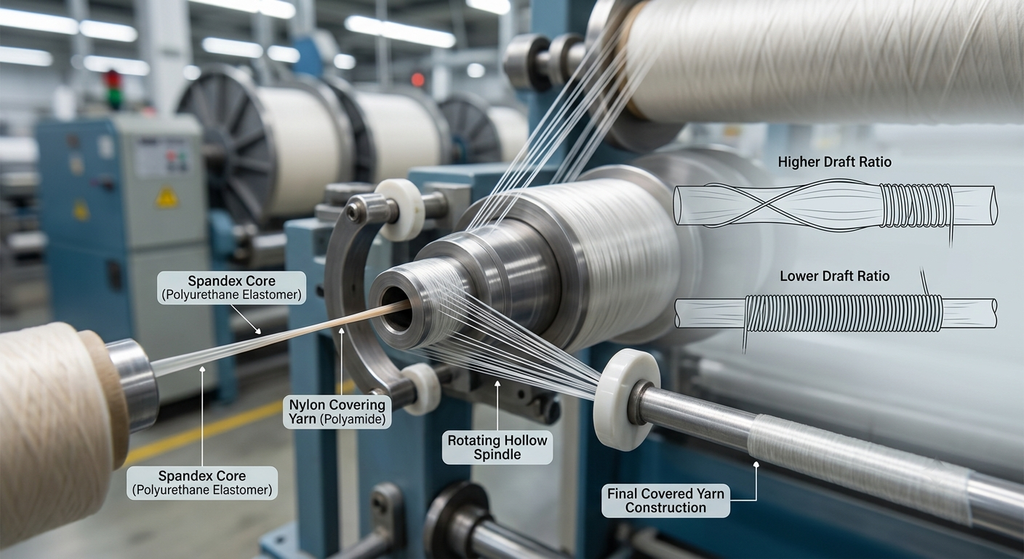
The core: spandex
Spandex is a polyurethane-based elastomeric fibre that can stretch several times its original length and then recover. You can read the basics on Wikipedia’s spandex page. Core sizes are measured in denier or dtex. The patent literature mentions spandex cores from about 11 up to 400 dtex in covered yarn, which gives a sense of the range.
The covering step
In a covering machine, the spandex is drafted, meaning it is stretched to a set ratio, and then nylon is wound around it by a hollow spindle. The number of turns per metre, the draft ratio and the tension together decide how the finished yarn behaves.
- Draft ratio: how far the spandex is stretched during covering. A higher draft gives a stretchier finished yarn but uses more spandex tension.
- Turns per metre (TPM): how many wraps the nylon makes. More turns mean better cover and a firmer hand. Fewer turns mean a softer, stretchier yarn with less coverage.
- Wrap direction: single covering uses one direction. Double covering uses opposite directions to balance twist.
Why the wrap matters in elastic fabric
In narrow elastic fabric, the elastomeric threads are covered so that they stay in place and last through the life of the product. Older patents on narrow fabrics note that without a good cover the elastic can shift, twist or fail to lie flat, which is why the cover and its twist are carefully engineered. You can see this described in US patent 4,282,906 on narrow elastic fabric.
Where Nylon Yarn for Elastic Is Used
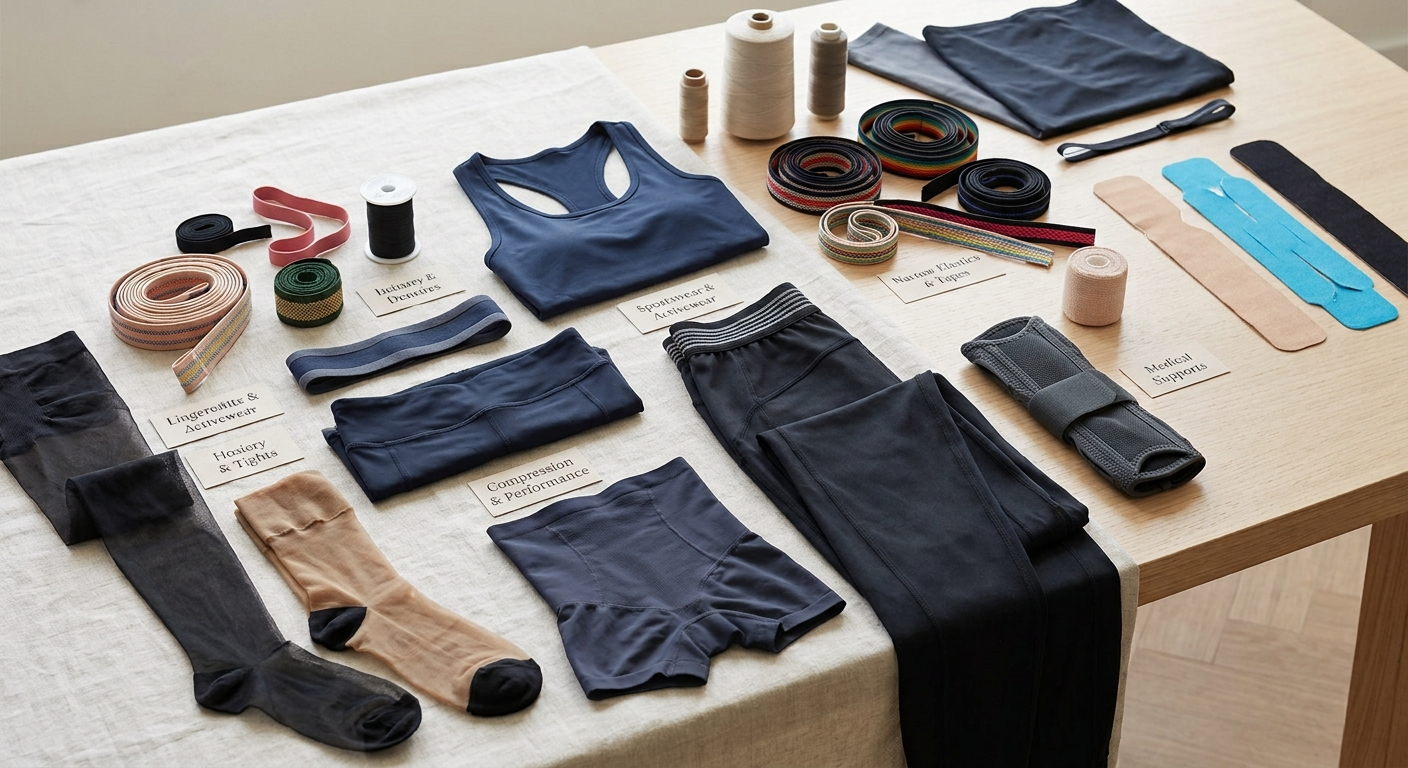
Hosiery and tights
This is the classic use. Fine nylon covers on spandex give the sheer, smooth, shaping stretch of stockings, tights and socks. Fine denier and tight coverage are the priorities, together with consistent dyeing across a lot.
Lingerie, underwear and shapewear
Bands, straps, cups and shaping panels need softness against skin, good recovery and rich colour. Nylon covered yarns and nylon-faced elastic tapes are standard here.
Sportswear and activewear
Gym, running and yoga garments use nylon-elastane structures for moisture comfort, durability and stretch. Elastic hems, bands and trims in these garments often use nylon-covered elastic for abrasion resistance.
Narrow elastic fabrics and tapes
Waistbands, cuffs, straps, braided elastic and woven elastic tapes all use covered or plied nylon. If you make or specify tapes, our guide to yarn for tapes explains how yarn choice shapes tape performance.
Medical and support products
Compression stockings, bandages, braces and orthopaedic supports require controlled stretch and consistent recovery. Nylon covers give skin-friendly comfort and long life, though medical use brings stricter specification and testing requirements.
Swimwear and technical garments
Nylon-elastane constructions are common in swimwear and performance wear, where chlorine resistance, shape retention and quick drying matter. Choose the cover grade with those conditions in mind.
Seamless and circular knit garments
Seamless machines run covered nylon yarn in high volumes. Yarn quality, package build and tension consistency directly affect machine efficiency and fabric appearance.
Key Specifications to Define Before You Buy
A strong purchase order for nylon yarn for elastic names these parameters in writing. If any one is missing, you are leaving room for disagreement later.
Denier and filament count
Denier is the weight in grams of 9,000 metres of yarn. You can read the definition on Wikipedia’s denier page. Nylon covering yarns are commonly requested in fine deniers such as 20, 30, 40, 70 and 100, often written as denier over filament count (for example 40/34 or 70/48). More filaments in the same denier give a softer, silkier yarn. Fewer filaments give a firmer, more brilliant yarn. Always confirm both numbers, because two yarns of the same denier but different filament counts will feel and cover very differently.
Luster
Nylon is available bright, semi-dull and full-dull. Bright suits shiny hosiery and some sports looks. Semi-dull is the standard for most elastic. Full-dull gives a flatter, more cotton-like look and better opacity.
Cross-section
Round, trilobal and other shaped filaments reflect light differently and affect cover and feel. Specify the cross-section if the look of the surface matters.
Yarn form
State whether you need flat, DTY, ATY, twisted or covered yarn, and for covered yarn whether single or double wrapped, with TPM and draft ratio if you know them.
Spandex core details
For covered yarn, state the core denier or dtex, the brand or grade if it matters to you, and the draft ratio.
Tenacity and elongation
Tenacity is the strength relative to thickness, and elongation is how far the yarn stretches before breaking. Ask the supplier for typical and minimum values and agree on the test method. For more on measuring yarn strength, the ASTM D2256 method for tensile properties of single yarns is a widely used reference, and you can learn more at ASTM International.
Boil-off shrinkage (BWS)
Boiling-water shrinkage measures how much the yarn shortens in hot water. It matters a great deal in covered and heat-set products, because shrinkage affects fabric width, tension and hand. State a target and a tolerance.
Twist and TPM
Twist level affects strength, softness and appearance. In covered yarn, TPM defines how tightly the nylon wraps the core.
Oil or finish content
Spinning and texturing oils help yarn run smoothly in covering, knitting and weaving. Too much oil causes dyeing and tension problems, and too little causes breaks and static. Agree on a finish type and range.
Package type and weight
Nylon yarn comes on cones, bobbins or dyed cheeses, depending on machine and dyeing route. Confirm the package diameter, weight and tube or cone type so it fits your machine.
Shade and colour fastness
For dyed yarn, define the shade with a physical standard or a Pantone reference, a tolerance (often expressed as Delta E), and the colour-fastness grades you require for washing, rubbing, perspiration and light.
Quality Parameters and Testing for Nylon Elastic Yarn
Good suppliers test every important lot. As a buyer, you should know what to ask for.
| Test | What it shows | Why it matters in elastic |
| Linear density (denier) | Actual yarn thickness | Controls cover and fabric weight |
| Tenacity and elongation | Strength and stretch at break | Predicts durability and knitting efficiency |
| Boil-off shrinkage | Heat response | Controls width, tension and hand |
| Evenness (U% or CV%) | Variation along the yarn | Prevents streaks and barre in fabric |
| Oil pick-up | Finish level | Affects covering, dyeing and static |
| Twist (TPM) | Wrap tightness | Defines coverage and softness |
| Colour fastness | Wash, rubbing, perspiration, light | Prevents fading and staining |
| Shade difference (Delta E) | Match to standard | Consistency between lots |
| Yarn faults and broken filaments | Quality of spinning and texturing | Causes defects and machine stops |
Most buyers reference international test methods. The International Organization for Standardization (ISO) publishes widely used methods for yarn properties and colour fastness, and the Bureau of Indian Standards covers local norms. Check that your supplier’s testing is done to the same method that you will use at incoming inspection, so the numbers agree.
Quality systems matter as much as individual tests. A supplier running a formal quality system is much less likely to deliver lot-to-lot swings. Our page on ISO-certified yarn suppliers explains what to look for in a certificate.
How Nylon Yarn for Elastic Is Manufactured
Even if you are only buying, it helps to know the chain, because each step shows where variation can enter. Our wider yarn manufacturing process guide covers staple and filament routes, and the key steps for nylon filament are below.
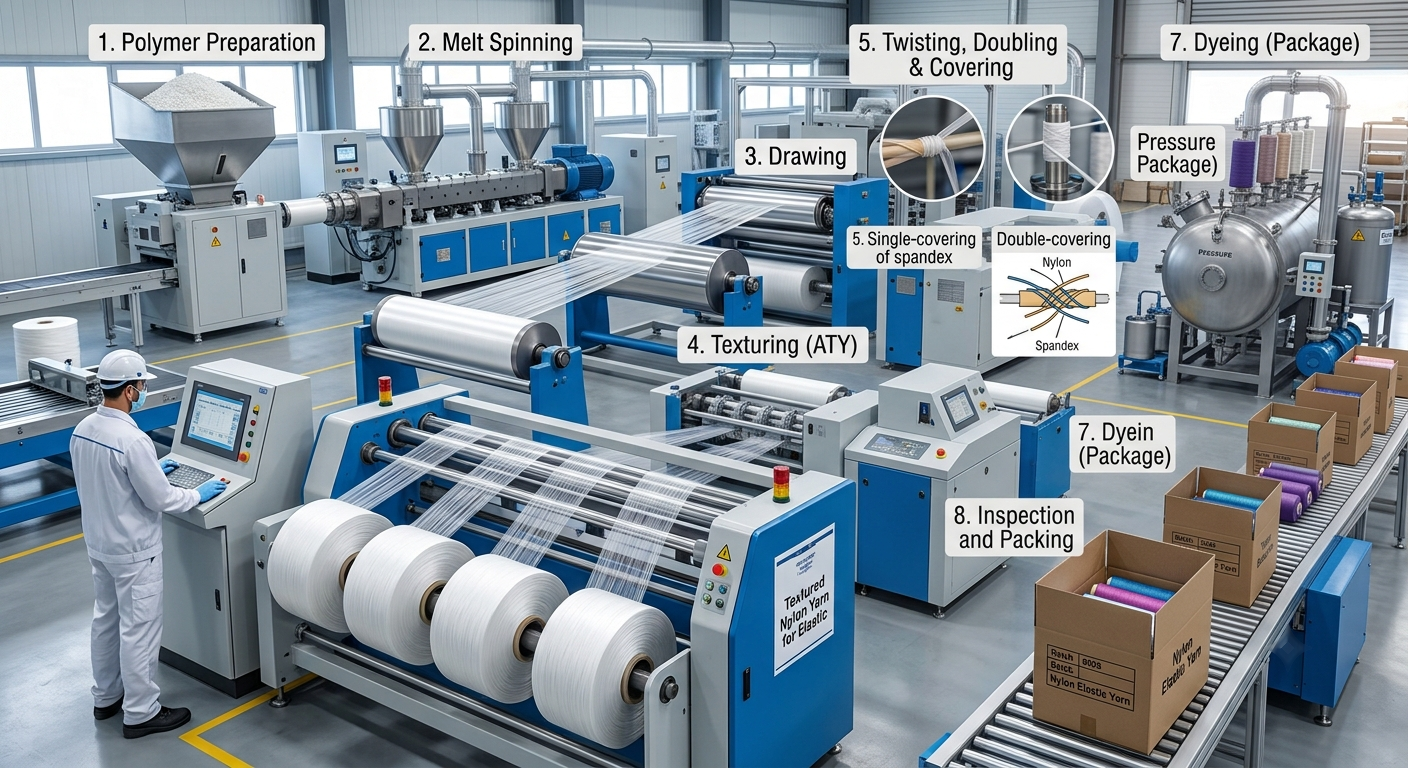
1. Polymer preparation
Nylon chips are produced by polymerisation, then dried to control moisture. Chip quality and moisture control set the foundation for filament quality.
2. Melt spinning
The molten polymer is pushed through spinnerets with fine holes, cooled and solidified into filaments. The number and shape of the holes decide filament count and cross-section.
3. Drawing
Filaments are stretched to align the polymer chains. Drawing gives nylon its strength and sets its elongation. The draw ratio is one of the main levers on yarn properties.
4. Texturing (for DTY and ATY)
Draw-texturing adds twist, heat and crimp to give bulk and softness. Air texturing uses compressed air to form loops. The method chosen shapes hand, cover and appearance.
5. Twisting, doubling and covering
Yarn can be twisted or plied for strength, or wrapped around spandex on a covering machine to make single or double covered yarn.
6. Heat setting
Heat setting stabilises twist and structure so the yarn behaves predictably in later processing. Time, temperature and tension must be controlled tightly.
7. Dyeing (if required)
Yarn is dyed in package or hank form. Nylon takes acid dyes in a controlled bath, and shade is verified against a standard before release. Our polyester yarn dyeing guide gives a useful comparison for buyers handling both fibres.
8. Winding, inspection and packing
The yarn is wound into packages, tested, labelled and packed in moisture-protected cartons for shipment.
How to Choose the Right Nylon Yarn for Your Elastic Product
Use this seven-step path before requesting quotations.
Step 1: Define the end product
A sheer stocking, a shapewear panel and a woven waistband tape do not share a specification. Write down the product, its stretch needs, its wash and wear conditions and its target price.
Step 2: Choose the yarn form
Decide between flat, textured, air-textured, twisted or covered yarn. Think about the cover you need and the machine you are running.
Step 3: Pick the grade
Nylon 6 for softness and dye depth, nylon 6,6 where heat stability or specific mechanics matter. If you do not know, ask the supplier to explain the trade-off for your product.
Step 4: Fix denier, filament count and luster
Match them to your machine gauge and fabric target, and ask for a knit-down or weave-down sample.
Step 5: Decide raw white or dyed
Raw white keeps options open but needs dyeing capacity and shade control on your side. Dyed yarn shortens lead time and shifts shade responsibility to the supplier.
Step 6: Set performance targets
Agree on strength, shrinkage, colour fastness and shade tolerance before ordering, not after a complaint.
Step 7: Agree commercial terms
Settle minimum order quantity, lot size, payment terms, packing, Incoterms and lead time. Our checklist of questions to ask before buying yarn is a useful companion, and our broader article on how to choose the right yarn for textile products helps you compare options.
Stretch Technologies Beyond Spandex-Covered Nylon
Not every stretch product uses spandex. Some buyers want mechanical stretch from the yarn itself, because it can be simpler, more heat-resistant or more recyclable.
Stretch can also come from bicomponent and textured yarns, where two polymers with different shrinkage curl into a spiral after heat treatment. Our guides on elastomultiester bicomponent yarn for mechanical stretch and on a stretch yarn manufacturer explain these options, and where nylon-based and polyester-based stretch yarns differ.
These alternatives do not replace spandex-covered nylon for high-recovery products such as compression hosiery and shaping elastic. They do offer a different performance and cost profile for comfort stretch fabrics, so it pays to know they exist before you finalise a design.
Sustainability: Recycled and Responsible Nylon for Elastic
Brands increasingly ask for recycled content and credible certification, even in components as small as elastic. There are three practical routes.
Recycled content. Recycled nylon and recycled polyester can both be made into filament suitable for covering and texturing. For polyester, our guide to recycled polyester yarn explains the options and our mRec range is built around them.
Verified chains of custody. Standards such as the Global Recycled Standard and Recycled Claim Standard, managed by Textile Exchange, verify recycled content and chain of custody. Ask for transaction certificates that match each shipment.
Chemical safety. The OEKO-TEX family of standards tests textiles for harmful substances and is a frequent requirement for skin-contact goods, which is exactly where nylon elastic is used. Check that the certificate covers the product and the site, not just the parent company.
When claims matter to your customer, ask for documents, not assurances, and make sure they match the product you are buying.
Pricing: What Drives the Cost of Nylon Yarn for Elastic
Prices move, so treat any quote as a snapshot. The main drivers are:
Raw material. Nylon polymer cost follows petrochemical and feedstock markets. Raw material is the largest share of cost.
Denier and filament count. Finer yarns and higher filament counts cost more to spin and texture.
Yarn form. Covered, double covered and dyed yarns cost more than flat raw yarn because of added processing.
Dyeing and shade complexity. Deep blacks, bright colours and tight tolerances raise cost. Pale and standard shades cost less.
Order size. Larger volumes typically bring better pricing and tighter lot control.
Packing and logistics. Package type, carton packing and container loading all affect landed cost.
Currency and freight. Exchange rates and ocean freight shift final cost quickly.
To compare quotes fairly, make sure every offer covers the same denier, filament count, luster, grade, form, shade, package and Incoterm. A low price for a loosely described yarn often becomes an expensive problem later.
Sourcing Nylon Yarn for Elastic from India
India is one of the world’s major textile producers, with strong capabilities in spinning, texturing, dyeing and export processing. Gujarat, and Surat in particular, is a leading hub for synthetic filament and blended yarn.
Why buyers look to India
- Integrated supply chains covering polymer, filament, texturing, dyeing and packing
- Competitive pricing at scale
- Flexible order sizes compared with some very large producers
- Experience with export documentation and international standards
- A broad product range across polyester, nylon, viscose and blends
Why Surat matters
Surat’s textile ecosystem lets buyers source yarn, dyeing and downstream fabric in one region, with a deep pool of skilled operators and service providers. For an overview, see our guide to yarn manufacturers in Surat.
Policy and industry references
India’s Ministry of Textiles publishes policy information and schemes relevant to exporters, and the International Textile Manufacturers Federation offers global statistics on production and trade that help put sourcing decisions in context. Trade news and price commentary are widely followed on Fibre2Fashion.
If you are scaling up and want to buy at volume from India, our overview of a bulk yarn supplier in India explains what to expect from minimum quantities, lead times and communication. When comparing partners, our article on yarn supplier vs yarn manufacturer explains why dealing directly with a manufacturer gives you better control over quality and consistency.
Why Global Buyers Choose Madhusudan Group for Nylon Yarn
Buying nylon yarn for elastic is a trust decision as much as a price decision. Madhusudan Group has been part of the textile industry since 1975, and is a respected yarn manufacturer and exporter headquartered in Surat, Gujarat, with a group structure that spans yarn manufacturing and dyeing, weaving, knitting, dyeing and printing, and garmenting. That breadth means we understand what happens to our yarn after it leaves our factory, because we see its life in the loom, the knitting machine and the finished garment.
Here is what that means in practice for elastic and narrow-fabric buyers.
- Specification first. We confirm denier, filament count, luster, grade, form, shrinkage and shade in writing before production, so what you approve is what ships.
- Sample before volume. We send physical samples and lab dips for approval, and encourage you to test the yarn on your own covering, knitting or weaving equipment.
- Consistency across lots. Careful lot planning, reference samples and agreed tolerances protect repeat orders and reduce re-dyeing and claims.
- Test data on request. We can share results for count, strength, elongation, shrinkage, colour fastness and shade as agreed in your purchase order.
- A wide yarn range under one roof. Beyond nylon, we supply polyester, viscose filament, air-textured, elastomultiester, recycled and blended yarns, so you can consolidate sourcing and keep one point of contact.
- Responsible options. Recycled and certified-supply-chain alternatives are available for brands with sustainability targets.
- Export-ready support. Documentation, packing guidance and help with classification and Incoterms make shipping smoother.
- Clear communication. You deal with people who understand the product and answer quickly.
Our nylon yarns sit within a family of products that includes high bulk yarn and other textured and bulked qualities, so you can match the right yarn to the right component in a garment.
From the Madhusudan Group desk: In our experience, most elastic yarn disputes trace back to one thing: the buyer approved a sample made on one yarn and received production on another. Always approve a sample from the same grade, denier, filament count and finish that will be shipped, and write those details into the purchase order.
Importing Nylon Yarn: Documents, Duties and Logistics
Importing yarn involves more than a purchase order. Plan for the following.
Documents typically required
- Commercial invoice
- Packing list
- Bill of lading or airway bill
- Certificate of origin
- Quality or test certificates
- Sustainability or chemical certificates, where your retailer requires them
Duties and classification
Yarn is classified under Harmonized System codes, and duties vary by country, fibre and trade agreement. Always confirm the exact code with your customs broker and check the latest tariff before finalising costs. For US-bound shipments, our guide on how to import yarn from India to the USA walks through the process.
Packing and shipping
Nylon yarn absorbs moisture, so insist on moisture-protected packing, strong cartons and palletisation. Protect packages from crushing, which can deform the winding and cause problems on high-speed covering and knitting machines.
Lead times
Typical timelines include sample approval, production, dyeing, testing, packing, inland transport and ocean transit. Build in buffer time for shade approval and possible re-dyeing.
A Practical Buyer’s Checklist
Before you confirm an order, run through this list.
- Have you defined grade, denier, filament count, luster and form in writing?
- Have you approved a physical sample and a lab dip against your shade standard?
- Have you agreed on shrinkage, tenacity and elongation targets, with test methods?
- Do you have colour-fastness and shade-tolerance requirements documented?
- Are certificates valid, current and specific to the product and the site?
- Have you confirmed lot sizes and lot-to-lot consistency?
- Is the package type, weight and cone or bobbin specification clear?
- Is the packing moisture-safe and strong enough for sea freight?
- Are payment terms, Incoterms and delivery windows documented?
- Have you agreed how claims and quality disputes will be handled?
Frequently Asked Questions About Nylon Yarn for Elastic
What is nylon yarn for elastic?
It is continuous-filament polyamide yarn used to cover, braid, weave or knit together with an elastomeric core such as spandex, so that the finished yarn, tape or fabric stretches and recovers. The nylon supplies strength, softness, abrasion resistance and colour.
Is nylon or polyester better for elastic?
Neither is better in every case. Nylon is softer, dyes deeper and suits skin-contact goods such as hosiery and lingerie. Polyester costs less and resists chlorine and light better, which suits waistbands, tapes and outer-garment trims.
What is the difference between nylon 6 and nylon 6,6 for elastic?
Nylon 6 melts at a lower temperature, feels softer and dyes more easily, which is why it is so common in covered yarn and hosiery. Nylon 6,6 melts higher and is a little firmer and more thermally stable. Choose according to your product and processing conditions.
What denier of nylon yarn is used for covering spandex?
Fine deniers such as 20, 30, 40, 70 and 100 are common, usually with specified filament counts. The right choice depends on the spandex core size, the cover you need and the end product, so confirm it with a sample.
What is the difference between single and double covered yarn?
Single covered yarn has one nylon wrap around the spandex core. Double covered yarn has two wraps in opposite directions, which gives better coverage, more stable behaviour and better protection of the core.
Can nylon yarn for elastic be dyed?
Yes. Nylon takes acid dyes well and gives bright, deep, wash-fast shades. Many buyers choose pre-dyed yarn to shorten lead time and control shade.
How much does nylon yarn shrink?
It depends on the grade and processing. Boil-off shrinkage is measured in hot water and varies with the yarn type, particularly for heat-set and highly shrinkable covers. Agree a target and tolerance with your supplier and test delivered lots.
Does nylon elastic yarn hold up to chlorine?
Nylon and spandex are both affected by chlorine over time. For swimwear and pool use, discuss chlorine resistance with your supplier and consider suitable alternatives.
What certificates should I ask for?
Ask for quality-system certification, chemical-safety certificates such as OEKO-TEX where relevant, and recycled-content certificates if you make recycled claims. Check that each covers the product and the manufacturing site.
What is the minimum order quantity?
MOQs vary by denier, form, colour and packing. Custom shades usually have higher minimums than standard colours. Share your volume and shade requirements for a clear answer.
Can I import nylon yarn from India?
Yes. India is a major yarn exporter with broad product choice. You will need standard export documents, a clear specification and a reliable supplier.
How do I compare quotes from different suppliers?
Make sure each quote covers the same grade, denier, filament count, luster, form, shade, packing and Incoterm. Then compare test reports, sample quality and communication alongside price.
Who is a reliable nylon yarn manufacturer in India?
Look for a manufacturer that works from written specifications, shares test data, approves samples before production and holds valid quality certificates. Madhusudan Group, based in Surat, Gujarat, supplies nylon and other filament yarns to export buyers and follows this approach on every order.
Does Madhusudan Group export nylon yarn for elastic?
Yes. We supply yarn to buyers in export markets and support them with documentation, packing and shipping guidance. Contact our team with your yarn form, denier, filament count, shade and volume for a quotation.
Final Thoughts: Choosing Nylon Yarn for Elastic with Confidence
Nylon yarn for elastic earns its place because it solves a real engineering problem. It gives a delicate stretch core the strength, softness, colour and protection it needs to survive years of wear, and it does so in a form that runs reliably on covering, knitting, braiding and weaving machines. But the difference between a great elastic product and a troublesome one lies in details: the grade, denier, filament count, luster, wrap, shrinkage, dyeing and testing.
Buyers who define specifications clearly, approve representative samples, insist on test data and work with transparent manufacturers save time, money and reputation. The principles are the same whether you make hosiery, narrow tapes, shapewear or medical supports.
If you are planning a purchase, start with a clear brief and a sample. Then compare suppliers on quality systems, consistency and communication as much as on price.
At Madhusudan Group, our aim is simple: to be the yarn partner that elastic, narrow-fabric and garment makers rely on for consistent quality, honest specifications and dependable delivery, order after order.
Ready to source nylon yarn for elastic? Share your yarn form, denier, filament count, shade and volume with the Madhusudan Group team to receive a tailored quotation and sample plan. Contact: +91 8155050100 | inquiry@madhusudangroup.com | madhusudangroup.com