Yarn dyeing Columbia (searched just as often as “yarn dyeing Colombia”) has moved from a technical back-office question to a boardroom priority. Knitters in Medellín, weavers in Bogotá and sportswear makers across the Andes now compete on colour consistency, speed to shelf and chemical compliance as much as on price. The yarn is where all three are decided.
This guide explains how yarn dyeing works, which dyeing route suits which fibre, how to judge quality, and how Colombian manufacturers can source dyed yarn reliably from India. It is written by the team at Madhusudan Group, a Surat-based dyed yarn manufacturer that supplies polyester, viscose, nylon, linen, stretch and blended yarns to buyers across Asia, Europe and South America.
Why this guide matters now
Colombia’s textile and fashion system is in a demanding but opportunity-rich phase. The 38th edition of Colombiatex de las Américas, held in Medellín in January 2026, closed with US$11.6 million in economic impact, and organisers reported that 45% of visiting buyers were brand-owner garment makers. Those buyers are looking for suppliers who can deliver finished colour, not just raw material.
At the same time, Inexmoda has argued that Colombia competes on differentiation and full-package service rather than on volume against Asian giants. Differentiation starts with yarn: a shade that matches across lots, a hand-feel that survives washing, and a certificate that satisfies an export customer.
What you will learn
- How Colombian demand is shaping yarn colour requirements
- The main yarn dyeing methods and when to choose each
- Fibre-by-fibre dyeing guidance for polyester, viscose, nylon, linen and blends
- Colour fastness tests and certifications that protect your brand
- How to import dyed yarn from India to Colombia without costly surprises
- A practical checklist for choosing a yarn dyeing partner
If you are comparing options right now, jump to the sourcing checklist later in this guide. If you are building a deeper understanding first, start from the market context below.
What exactly is yarn dyeing?
Yarn dyeing is the process of colouring yarn before it is knitted or woven, as opposed to dyeing finished fabric or garments. The yarn is wound onto perforated packages, cones, hanks or beams, and dye liquor is circulated through it under controlled temperature, pressure and time. Once dyed, rinsed and dried, the yarn goes to the knitting or weaving mill in its final colour.
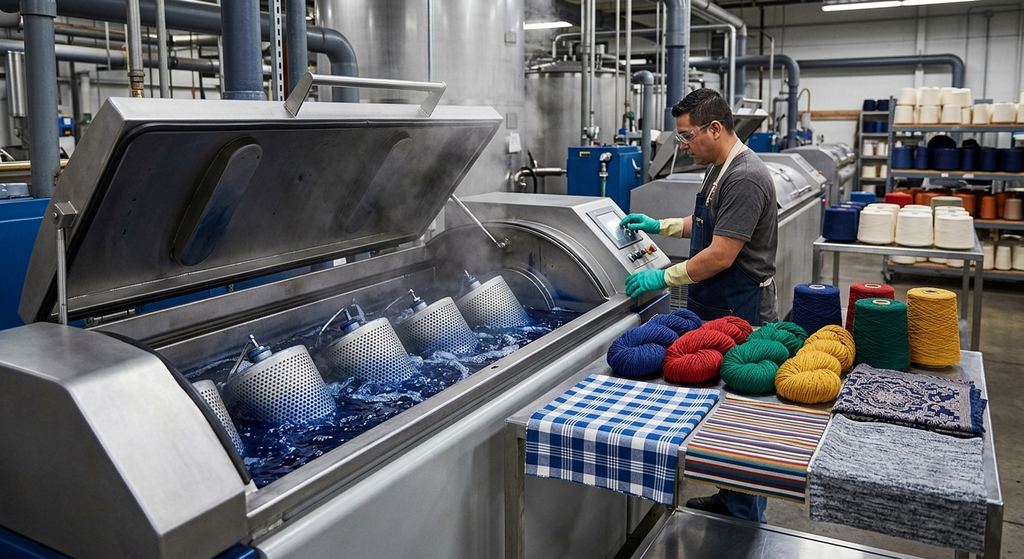
The advantage is structural. Colour is built into the cloth, which means stripes, checks, jacquards, heather effects and multi-colour knits can be made without printing. Yarn-dyed fabrics generally show better colour penetration and a richer depth than piece-dyed equivalents, and they allow a brand to hold small colour inventories as yarn, then commit to fabric only when orders arrive.
For a deeper technical walk-through of one fibre family, see our polyester yarn dyeing guide. For regional context on how dyeing capacity is organised in another fast-growing market, read our piece on yarn dyeing in Sri Lanka.
Yarn Dyeing in Colombia: Market Context and Demand Drivers
To judge any yarn dyeing Columbia strategy, start with the market it serves. Colombia’s fashion industry closed 2025 with consumption of COP 36.7 trillion, up 10.3% on 2024 with a real volume increase of 6.5%. For 2026, Inexmoda projects more modest real growth of 2% to 4%, reflecting more cautious consumers and cost pressure. In plain terms, volumes are growing but margins are tight, so every kilo of yarn has to earn its place.

A buyer base that wants more than commodity yarn
Colombiatex 2026 welcomed more than 17,000 buyers from over 20 countries, and its “full package” showroom linked textiles, inputs and manufacturing into one value-chain offer, as El Espectador reported. Full-package buyers do not want to manage five suppliers. They want a yarn partner who understands shade approval, lead times and documentation.
Three demand drivers stand out for Colombian mills and brands:
- Speed and flexibility. Fashion cycles are shorter, so brands order smaller lots in more colours. Yarn dyeing in small batches lets mills respond without carrying fabric inventory.
- Sportswear and activewear. Colombian brands supply a large domestic market and export regionally. Polyester, nylon and stretch yarns in stable, bright, wash-fast colours are central to this category.
- Circularity and compliance. Colombia joined the European Union’s 2030 circularity pact, and export customers increasingly ask for recycled content and chemical-management evidence.
Regional pressure points
The regional picture is not uniform. Modaes noted that Ecuador, one of Colombia’s major fashion partners, imposed tariffs shortly before Colombiatex, and that exhibitors were also concerned about minimum wage increases. Colombian producers therefore need dependable, cost-controlled inputs while still competing on quality. That is where a specialist overseas yarn partner can add value.
Events also keep the pressure on design. Colombiamoda 2026 was scheduled to run seven days in Medellín with about 600 brands, which means designers need colour palettes locked months ahead and yarn that matches them to the shade.
Why Colombia imports yarn
Colombia has strong capabilities in fabrics, garments and finishing, but it still relies on imports for specialised yarn types. Fibre2Fashion’s trade-data tool showed that of Colombia’s textile imports of about US$1.23 billion in April 2021 to March 2022, yarn made up roughly 39%, with fabric at 54% and fibre at 7%. That is a sizeable and consistent pull for imported yarn.
Colombian mills typically source dyed yarn when they need a colour range they cannot dye in-house, when they need small lots of many shades, or when they need specialised fibres such as bicomponent, air-textured or elastomultiester yarns. If you also serve neighbouring markets, our guides on polyester yarn dyeing for South America and importing yarn from India to Brazil cover regional logistics and expectations in detail.
Note: tariff treatment changes over time. Colombia removed import duty on certain textile items under a 2022 decree, so always confirm the current rate for your HS code with a customs broker or the Colombian tax and customs authority (DIAN) before you place an order.
Yarn Dyeing Methods Explained: Which Route Fits Your Product?
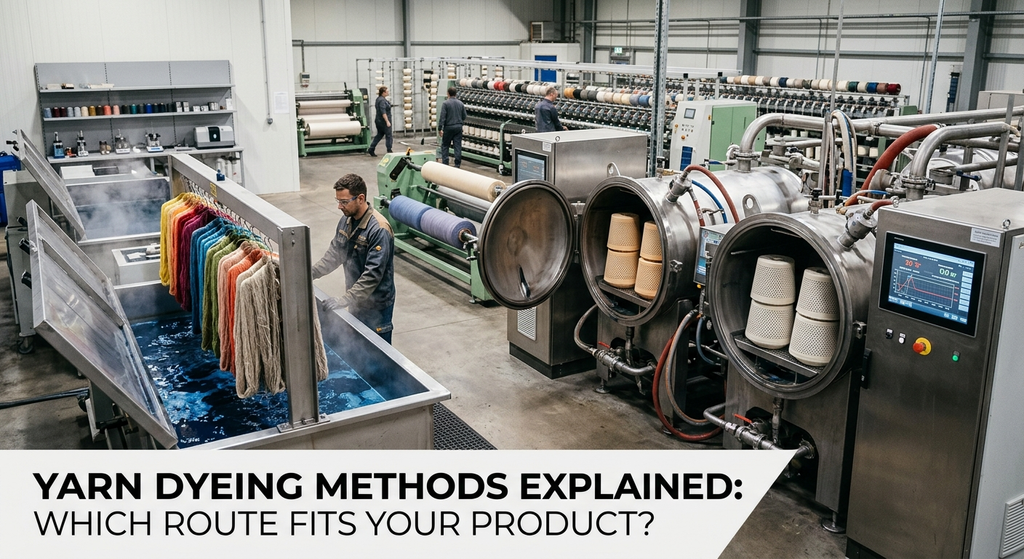
There is no single best way to dye yarn. The right route depends on the fibre, the lot size, the shade depth, the end-use and the fastness your customer demands. Dyeing is one of the oldest textile processes, and its modern forms range from simple immersion to computer-controlled pressure vessels. Below are the methods Colombian buyers meet most often.
| Method | How it works | Best for | Watch out for |
| Package (cheese) dyeing | Yarn is wound on perforated tubes; liquor circulates inside-out and outside-in | Polyester, nylon, viscose, cotton in medium to large lots with tight shade matching | Poor winding density causes uneven shade |
| Hank dyeing | Loose skeins are dipped in open or closed machines | Bulky, soft-hand yarns, acrylic blends, linen and specialty effects | Higher labour, slower drying |
| Beam dyeing | Yarn is wound on a perforated beam for warp use | Warp-knit and woven preparation with long runs | Needs consistent tension across the beam |
| Space and multi-colour dyeing | Colour is applied in sections along the yarn | Fashion knitwear, melange and random effects | Repeatability needs tight process control |
| Solution (dope) dyeing | Pigment is added to the polymer before extrusion | Very high fastness, outdoor and technical uses, lower water use | Minimum order quantities and limited shade flexibility |
Package dyeing: the workhorse
For most synthetic and cellulosic yarns, package dyeing is the standard. The wound package is loaded onto a carrier, the vessel is sealed, and dye liquor is pumped through the yarn at a controlled flow, temperature and pressure. Modern machines hold batches precisely, and good plants log every cycle so that a shade approved today can be reproduced months later. That reproducibility is the heart of any serious yarn dyeing Columbia programme, because Colombian mills often reorder the same shade several times a season.
Hank dyeing for bulk and hand-feel
Hank dyeing remains important where the yarn must keep its loft. High-bulk acrylic and wool-like blends, and certain linen and cotton specialty yarns, are better dyed as loose skeins that are not compressed on a tube. Our high-bulk yarn guide explains how bulk is built into the yarn and why it influences the dyeing route.
Solution dyeing and when it makes sense
Solution-dyed (also called dope-dyed or spin-dyed) yarn gets its colour from pigment added at the polymer stage. Fastness is excellent and water use is lower, but you commit to a shade at the spinning stage, so it suits stable, repeat colours rather than fast-fashion changes. Many Colombian sportswear and upholstery buyers combine solution-dyed basics with package-dyed fashion colours.
The steps behind every dye lot
Whatever the method, a controlled dye lot follows the same chain:
- Yarn preparation and winding to the correct density and package geometry
- Scouring and pre-treatment to remove oils, sizes and impurities
- Lab dip and shade matching against the customer’s reference, often under D65 and a second illuminant
- Dyeing at the programmed temperature, pH and time curve
- Reduction clearing or washing-off to remove unfixed dye
- Soft finishing and drying
- Rewinding, inspection and packing for export
Winding quality, water quality and chemical dosing matter as much as the dyestuff itself. If you want to see where dyeing sits in the full chain from fibre to finished yarn, read our yarn manufacturing process guide.
Choosing a method: a quick decision path
Start with the end-use. Activewear and swimwear point to package-dyed polyester, nylon or elastane-blend yarn with high wash and perspiration fastness. Home textiles and upholstery often need light fastness and abrasion resistance. Knitwear leans toward hank dyeing and space dyeing for hand-feel and effect. For a broader decision framework across fibres and uses, use our guide on how to choose the right yarn for textile products.
Yarn Dyeing by Fibre: Polyester, Viscose, Nylon, Linen and Blends
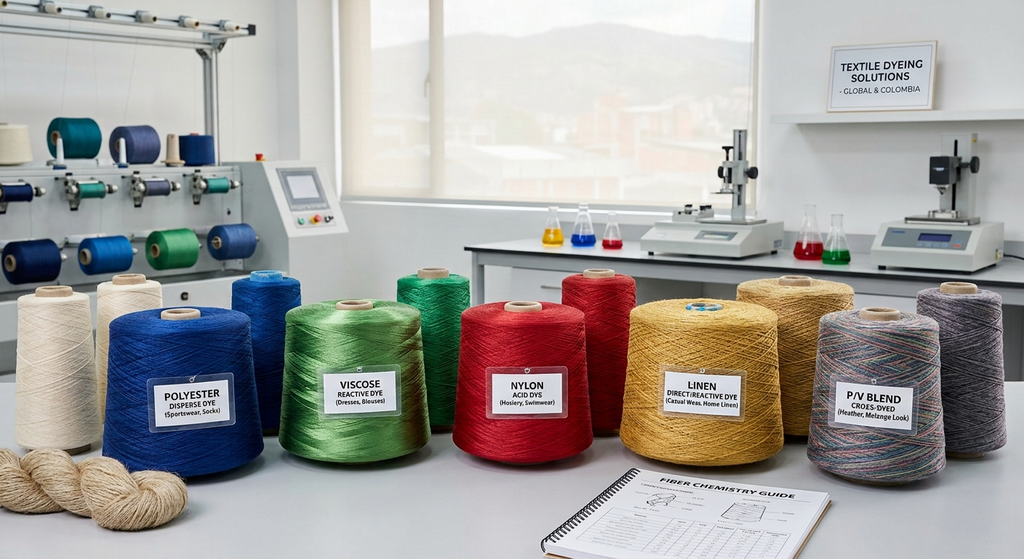
Fibre chemistry decides the dye class, the temperature and the fastness you can expect. A reliable yarn dyeing Columbia partner should explain these differences before quoting, not after a shade fails.
Polyester yarn dyeing
Polyester is hydrophobic and crystalline, so it is dyed with disperse dyes at high temperature, typically around 130 °C under pressure, followed by reduction clearing to remove surface dye and lift wash fastness. It is the most requested fibre for Colombian sportswear, socks, tapes and technical fabrics because it is durable, quick drying and cost effective.
Texture matters as much as chemistry. Draw-textured (DTY), air-textured (ATY) and fully drawn (FDY) yarns take dye differently, so shade matching must be done on the exact yarn type. See our detailed polyester yarn dyeing guide, the companion dyed polyester yarn guide, and our overview of air-textured yarn supply.
Recycled polyester dyes much like virgin polyester but needs careful lot control because the feedstock can vary. If your customers ask for recycled content, read our recycled polyester yarn guide.
Viscose yarn dyeing
Viscose is a regenerated cellulosic fibre with excellent dye affinity, good drape and a silky look. It is usually dyed with reactive dyes in alkaline conditions. Wet viscose is weaker than dry viscose, so winding tension, liquor flow and drying must be gentle to avoid damage. Viscose also swells in water, which makes package density an important control.
Filament viscose behaves differently from spun viscose, with brilliant lustre and higher sensitivity to tension. Learn more in our guide to viscose yarn dyeing and our profile of a viscose filament yarn manufacturer.
Nylon yarn dyeing
Nylon (polyamide) is dyed mainly with acid dyes and sometimes metal-complex dyes for higher fastness. It offers superb elasticity and abrasion resistance, which is why it dominates hosiery, seamless knitwear, swimwear and shapewear. Dye uptake can vary between lots of raw nylon, so a supplier that controls both yarn and dyeing has a real advantage. Our page on a nylon DTY yarn manufacturer outlines available deniers and finishes.
Linen yarn dyeing
Linen is a bast fibre with natural slubs and a crisp hand. Its colour range is wide but its dye uptake is irregular, and the fibre is less tolerant of harsh processing. Linen is generally dyed with reactive or direct dyes after a gentle scour, and hank dyeing is often preferred to preserve texture. Our linen yarn dyeing guide covers shade depth, softness and shrinkage in more detail.
Stretch, bicomponent and elastomultiester yarns
Stretch yarns need special care because heat and tension can change recovery. Elastomultiester and bicomponent yarns provide mechanical stretch without elastane, so they can be dyed at polyester conditions while keeping comfortable stretch. This makes them attractive for Colombian activewear and denim-look knits. See our explanation of elastomultiester bicomponent yarn and mechanical stretch and our overview of a stretch yarn manufacturer.
Blended yarns and cross-dyeing
Blends such as polyester-viscose or polyester-cotton need either a two-stage dyeing process (disperse then reactive) or a one-bath approach, depending on shade depth. Mis-matched dye classes create the dreaded “white speck” effect, where one fibre fails to take colour. Experienced producers also use deliberate cross-dyeing to create heather and melange looks from a single package. For sourcing blended yarn in India, see our page on a blended yarn manufacturer in Surat.
Quick reference: fibre, dye class and typical use
| Fibre | Typical dye class | Typical Colombian end-use |
| Polyester (DTY, ATY, FDY) | Disperse | Sportswear, socks, tapes, home textile |
| Viscose (spun, filament) | Reactive | Dresses, blouses, knit tops |
| Nylon | Acid, metal-complex | Hosiery, swimwear, shapewear |
| Linen | Reactive, direct | Casual wear, home linen |
| Elastomultiester / bicomponent | Disperse | Activewear, stretch denim-look knits |
Colour Fastness, Testing and Quality Control in Yarn Dyeing
A beautiful shade is worthless if it bleeds in the first wash. Colombian brands that export to Europe, the United States and neighbouring Andean markets increasingly ask yarn suppliers for test reports, not promises. Here is what a credible quality system looks like.

The core fastness tests
Colour fastness is graded on standard scales: 1 to 5 on the grey scale for colour change and staining, and 1 to 8 on the blue wool scale for light. Higher is better. The tests most often requested are:
| Property | Common ISO method | What it tells you | Typical expectation |
| Washing | ISO 105-C06 | Colour loss and staining after laundering | Grade 4 or better for most apparel |
| Rubbing (crocking) | ISO 105-X12 | Colour transfer, dry and wet | Dry 4, wet 3 to 4 |
| Perspiration | ISO 105-E04 | Colour change in acid and alkaline sweat | Grade 4 for activewear |
| Light | ISO 105-B02 | Fading under xenon-arc light | Grade 4 to 6 depending on use |
The washing method deserves a closer look. ISO 105-C06 sets out procedures for judging how textiles of all kinds resist domestic and commercial laundering, and a single test approximates one wash while a multiple test can approximate up to five washes at temperatures not exceeding 70 °C. If your customer uses AATCC methods instead, the AATCC test method library provides equivalents, and a good supplier can report to either system. The grades in the table are typical commercial expectations, not legal limits, so always agree targets with your own customer.
In-process controls that prevent problems
Testing the finished yarn is only the last line of defence. Strong dye houses control quality at each step:
- Incoming yarn inspection for denier, oil pickup and uniformity before dyeing
- Spectrophotometer shade matching with a recorded Delta E tolerance for every shade
- Batch-to-batch tracking so a repeat order references the original recipe, liquor ratio and time-temperature curve
- Water quality monitoring for hardness, pH and metals that can shift shade
- Final inspection for knots, soft winding, contamination and package weight
Ask a prospective supplier how they set Delta E limits and how long they retain shade records. Those two answers separate organised plants from improvised ones.
Certifications worth asking for
Certifications give your own customers confidence. OEKO-TEX STANDARD 100 tests textiles, including yarn, for harmful substances and is widely recognised by European and North American retailers. Quality-management certification such as ISO 9001 shows that processes are documented and audited. You can see how this plays out in practice in our overview of an ISO certified yarn supplier.
A practical shade-approval workflow
- Send a physical reference (swatch, Pantone TCX or yarn card) with the target light source
- Approve the lab dip in writing, specifying the illuminant and tolerance
- Approve a pre-production strike-off or small bulk lot
- Release bulk dyeing and retain a reference cone from every lot
- Request a test report for each critical shade before shipment
This five-step habit eliminates most colour disputes. It also gives both sides a written record if an issue appears after knitting.
Sustainable Yarn Dyeing: Water, Chemicals and Circularity
Dyeing is one of the most resource-intensive steps in textile production, so it is also where the biggest sustainability gains sit. For Colombian brands preparing for European customers and regional retail targets, sustainable yarn dyeing is quickly becoming a purchasing condition rather than a marketing extra.
Chemical management
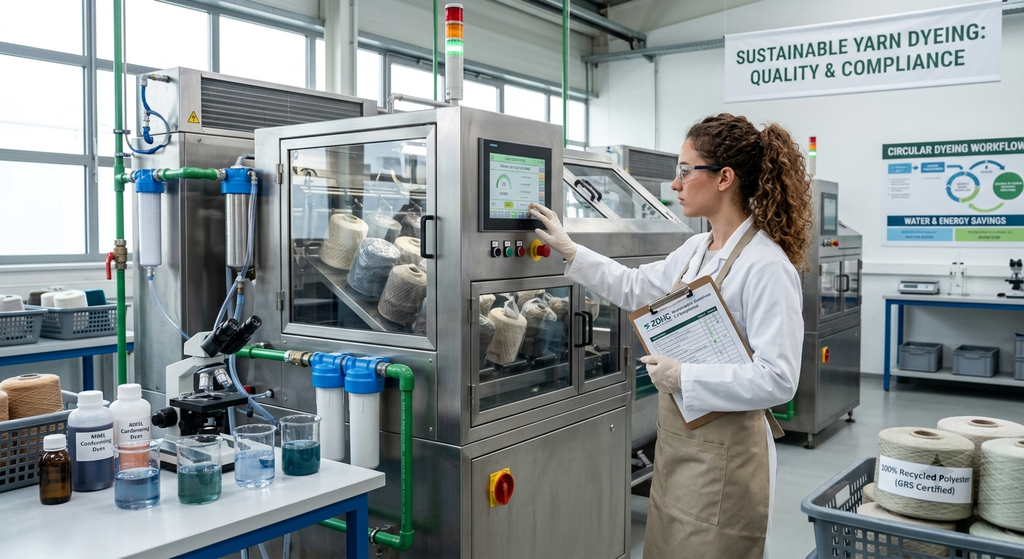
The global reference point for responsible chemistry is the ZDHC programme. Its Wastewater Guidelines version 2.0 combine the earlier textile and leather guidance and incorporate the ZDHC Manufacturing Restricted Substances List (MRSL) with wastewater limits and testing methods. In practice, this means dye houses should buy dyes and auxiliaries that conform to the MRSL, test their effluent, and be able to show the results. You can explore the programme’s background through ZDHC’s Roadmap to Zero resources.
When you audit a supplier, ask for:
- A list of dye and chemical brands in use, with MRSL conformance evidence
- Effluent treatment details and recent wastewater test reports
- Their approach to sludge handling and disposal
- Written restricted-substances policies aligned with your brand’s list
Water and energy
Modern package dyeing machines use low liquor ratios, which cut water, steam and chemical use per kilogram. Heat recovery, closed-loop cooling and reuse of rinse water further reduce impact. Solution-dyed yarns avoid most of the wet dyeing step altogether, which is why they are attractive for outdoor and technical uses. When comparing quotes, ask for water and energy intensity per kilogram, not only price per kilogram.
Recycled and responsible fibres
Recycled polyester continues to grow because it lowers dependence on virgin petroleum feedstock and supports circularity claims. Credible claims should be backed by certification: the Textile Exchange standards, including the Global Recycled Standard, provide a chain-of-custody framework for recycled content. For regional buyers, our page on a recycled polyester yarn manufacturer for South America explains what is available and how it is documented.
Blended and eco-oriented yarn ranges are also evolving quickly. Our article on blended eco-friendly yarn manufacturers in Surat and India looks at where the sustainable yarn market is heading.
Why this matters in Colombia
Colombia’s fashion bodies are pushing both sustainability and internationalisation, and Inexmoda positions its trade platforms and knowledge programmes around the same themes. Colombian manufacturers who document their yarn supply chain, from dye chemistry to recycled content, are better placed to win export programmes and large retail contracts.
The lesson for buyers is simple. Treat sustainability evidence as part of product quality. A supplier who can show test reports, certificates and process data is easier to trust, easier to audit and cheaper to work with over the long term.
Why Madhusudan Group Leads in Yarn Dyeing for Global Buyers
Choosing a yarn dyeing partner is a long-term decision. Colombian buyers need a supplier that understands fibre science, controls colour, documents everything and ships on time. This is where Madhusudan Group has built its reputation as a leading Indian yarn manufacturer and exporter.
Rooted in Surat, India’s man-made fibre hub
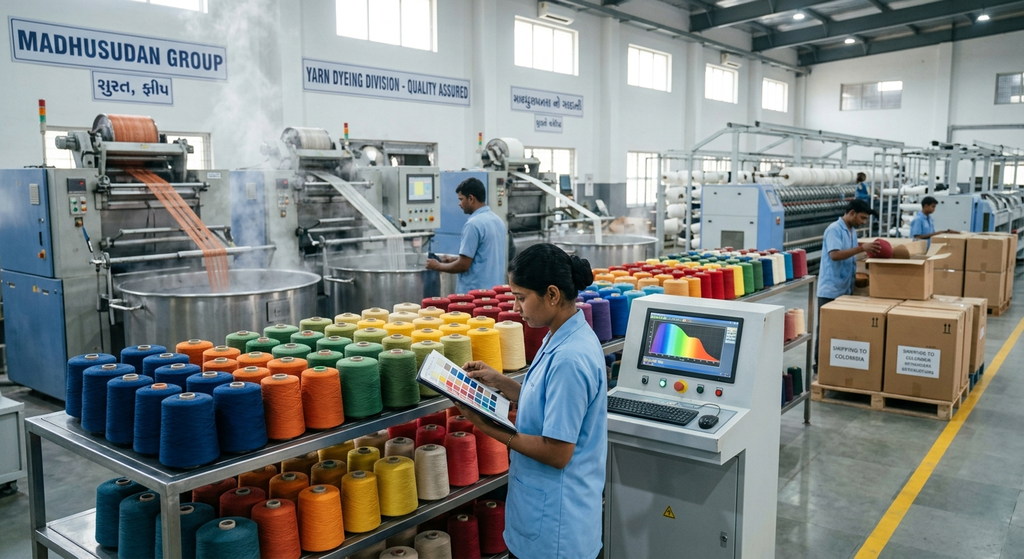
Surat is one of the world’s most important centres for synthetic and blended textiles, with deep expertise across texturising, twisting, dyeing, weaving and finishing. Operating from this ecosystem gives Madhusudan Group access to skilled labour, specialised machinery, fast raw-material turnaround and a dense network of downstream mills. If you want to understand why the city matters, read our overview of yarn manufacturers in Surat.
A full range under one roof
Most dyeing problems start when yarn and dye house are managed by different parties who blame each other. Madhusudan Group reduces that risk by combining manufacturing and dyeing know-how across a broad portfolio:
- Polyester yarns, including DTY, ATY, FDY and dyed polyester for knitting and weaving
- Nylon yarns, including DTY for hosiery, seamless and activewear
- Viscose and viscose filament yarns for fashion and home textiles
- Linen yarns for premium casual wear and home linen
- Stretch, bicomponent and elastomultiester yarns for comfort and performance
- Blended and recycled yarns for sustainability-led programmes
This range lets one partner serve an entire collection, from sports socks to viscose blouses, with consistent shade standards across fibres. You can see the depth of that offer in our pages on a premium yarn manufacturer and supplier in India and an industrial yarn supplier.
Built for export, not just for the domestic market
Export buyers need more than yarn. They need correct packing, labelling, commercial documents, predictable lead times and clear communication. Madhusudan Group works with international customers across regions, and our guidance on polyester yarn supply for global buyers reflects that experience. For South American customers in particular, our regional content on dyeing and import processes shows how we approach the questions Colombian buyers ask most often.
What sets a leader apart
| What buyers need | How Madhusudan Group responds |
| Consistent shades across reorders | Recipe-controlled dyeing with recorded lots and retained references |
| Fibre-specific expertise | Dedicated know-how for polyester, nylon, viscose, linen and stretch yarns |
| Quality assurance | Documented quality systems and test-report support |
| Responsible production | Recycled and blended options, with attention to chemical compliance |
| Easy communication | Clear specifications, sampling support and export documentation |
| Educational partnership | A library of buyer guides that explains choices before you commit |
A knowledge-first approach
Madhusudan Group publishes practical buyer guides because informed customers make better decisions. Our content covers how to choose between a supplier and a manufacturer, which questions to ask before buying yarn, and how to compare fibres for different end-uses. That openness reflects a simple belief: when a buyer understands the process, the partnership is stronger and the product is better.
If you are evaluating dyeing partners for Colombia, talk to the Madhusudan Group team with your fibre, denier, shade references and annual volume. We will respond with practical options, sample timelines and documentation requirements.
How to Import Dyed Yarn from India to Colombia: A Practical Roadmap
India and Colombia already trade textile inputs. According to trade-data platform Ximpex, India exported about US$162 million of cotton yarn (HS 5205) to Colombia in 2024, which shows that Indian yarn is an established option in the market. The same source lists no preferential trade agreement between the two countries, so planning around standard tariff treatment is the safe default.
Step 1: Define the yarn and its HS code
Customs treatment starts with classification. Dyed synthetic filament yarn, spun polyester yarn, viscose yarn and cotton yarn each fall under different tariff headings in Chapters 50 to 55 of the Harmonised System, which is maintained by the World Customs Organization. Ask your supplier for the exact eight-digit Indian ITC-HS code, then have your Colombian customs broker confirm the matching import subheading.
Step 2: Check duties, taxes and rules
Colombia reduced import duty on a group of textile items under Decree 307 of 2022, as Fibre2Fashion reported, but policy changes with economic conditions. Confirm the current duty, VAT and any safeguard or documentary requirements directly with DIAN, Colombia’s tax and customs authority and the Ministry of Commerce, Industry and Tourism before you finalise a purchase order. For the Indian side, exporters follow rules from the Directorate General of Foreign Trade, and industry support is available through the Synthetic and Rayon Textiles Export Promotion Council.
Step 3: Agree commercial terms
Use clear Incoterms so that responsibilities are unambiguous. FOB and CIF are widely used for sea shipments: FOB lets you control freight, while CIF bundles freight and insurance into the seller’s price. Agree payment terms, packing specifications (cone weight, carton or pallet, moisture-proof wrapping), labelling and shade tolerances in writing.
Step 4: Prepare the document set
The typical export file includes a commercial invoice, packing list, bill of lading or airway bill and a certificate of origin. Ximpex’s documentation summary for Colombia lists exactly these core documents, and you should add test reports and certificates where your customer requires them. Missing or inconsistent paperwork is the most common reason for clearance delays, so check every document against the purchase order before shipping.
Step 5: Plan freight and lead time
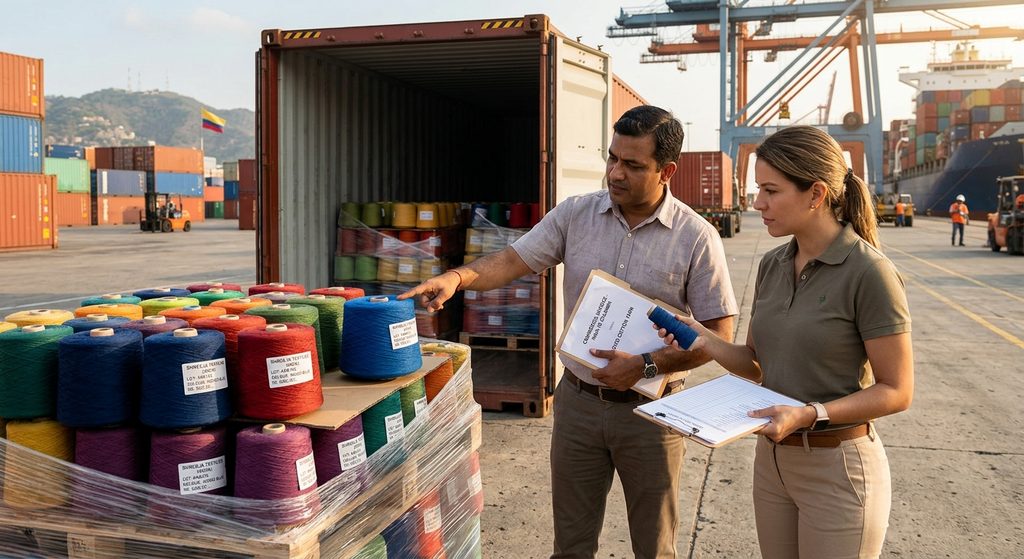
Sea freight from India to Colombia is commonly quoted at 25 to 40 days, depending on routing, transshipment and port congestion. Cartagena and Buenaventura are major Colombian container ports, and many India to Colombia routings involve transshipment, so confirm the routing with your freight forwarder. Add production time for dyeing, drying, packing and inspection, and build a buffer for seasonal peaks. For urgent colour-critical programmes, a small air shipment of approved lots can bridge the gap while the main order travels by sea.
Step 6: Inspect, receive and reorder
On arrival, compare the delivered lot with your retained reference cone and the supplier’s test report. Document any variation immediately, with photos and package numbers. Then lock the approved shade and recipe so that repeat orders match.
Learn from other import corridors
Logistics patterns are similar across South America, even when tariff rules differ. Our practical guides on how to import yarn from India to Argentina and the broader overview of textile yarn exporters in India explain documentation, packaging and exporter selection in more depth.
To meet suppliers in person, Colombiatex and Colombiamoda events organised by Inexmoda give buyers a regular chance to review new yarn, fabric and full-package options in Medellín.
How to Choose a Yarn Dyeing Partner: A 10-Point Checklist
Price matters, but it is the cheapest variable to compare and the least predictive of long-term success. Use this checklist when you shortlist suppliers for yarn dyeing Columbia programmes.
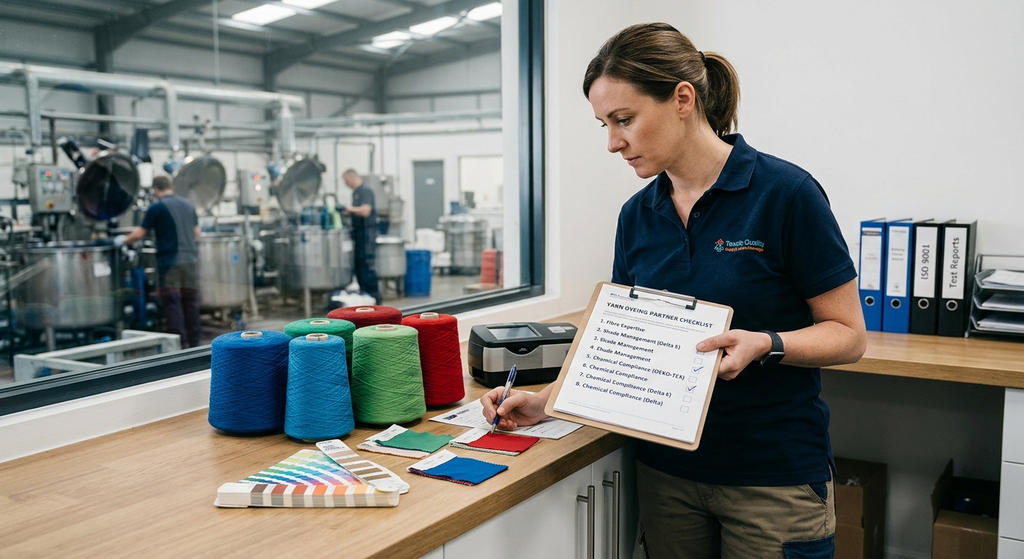
- Fibre expertise. Ask for examples of the same fibre, denier and shade family you plan to buy. Polyester, nylon, viscose and linen each have different failure modes.
- Vertical control. Confirm whether the supplier controls yarn manufacturing and dyeing, or outsources one of them. Fewer hand-offs mean fewer excuses.
- Shade management. Request their Delta E tolerance, lighting standard and how they store recipes for repeat orders.
- Test capability. Look for in-house or accredited lab testing for fastness, strength and evenness, aligned with ISO or AATCC methods.
- Quality system. An ISO 9001-certified quality management system is a baseline sign that processes are documented and audited.
- Chemical compliance. Ask for OEKO-TEX or similar certificates and evidence of restricted-substance control.
- Capacity and flexibility. Confirm minimum order quantities per shade, lead times and the ability to scale up if a style takes off.
- Export competence. Check experience with your lane, from documentation and packing to Incoterms and carrier relationships.
- Communication. Fast, specific answers during sampling predict how problems will be handled in production.
- Transparency. The best suppliers welcome audits, share data and admit limits before you find them.
Manufacturer, trader or agent?
A manufacturer controls the process and can trace a defect to its cause. A trader may offer more variety but less control. Our explainer on yarn supplier versus yarn manufacturer breaks down the trade-offs, and our checklist of questions to ask before buying yarn gives you a ready script for supplier calls.
What to include in your request for quotation
| Item | Example detail |
| Fibre and construction | 100% polyester DTY, 75D/36F, semi-dull |
| Package type | Cones, 1.0 to 1.2 kg, paper tube |
| Shades | Pantone TCX references with physical swatches |
| Annual volume and lot size | Total kilograms, minimum and maximum per shade |
| Fastness targets | Wash grade, rubbing grade, light grade, perspiration grade |
| Certification needs | OEKO-TEX, recycled content, ISO 9001 |
| Delivery terms | Incoterm, destination port, required ship date |
The more precisely you describe the need, the more reliable the quote. Vague requests tend to produce vague, and often unrealistic, answers.
Yarn Dyeing Columbia: Frequently Asked Questions
What is yarn dyeing and why is it used?
Yarn dyeing colours the yarn before it is knitted or woven. It gives deeper colour penetration, supports stripes and checks without printing, and lets mills hold coloured yarn stock instead of finished fabric.
Which yarns are most commonly dyed for Colombian manufacturers?
Polyester, nylon, viscose, linen, stretch yarns and blends are the most common, driven by sportswear, activewear, knitwear and home-textile demand.
How long does it take to import dyed yarn from India to Colombia?
Sea freight is commonly quoted at 25 to 40 days, plus production, dyeing and inspection time before dispatch. Air freight is possible for small, urgent lots.
Does Colombia charge import duty on yarn from India?
Treatment has changed over time and depends on the HS code. Colombia cut duty on some textile items in 2022, but you should confirm the current rate with your customs broker or DIAN before ordering.
What colour fastness grades should I ask for?
For most apparel, grade 4 or better for washing and perspiration, and grade 3 to 4 or better for wet rubbing, are common targets. Agree the exact grades with your own customer and test to ISO or AATCC methods.
Can small lots be dyed in many colours?
Yes. Package and hank dyeing can handle small lots, though minimum quantities vary by supplier, fibre and shade depth. Ask for per-shade minimums early. For larger programmes, see our page on a bulk yarn supplier in India.
Is recycled polyester yarn dyeable in the same way as virgin polyester?
Yes, it uses disperse dyes under the same conditions, but lot control is important because feedstock can vary. Ask for certification if recycled-content claims are part of your marketing.
Where can Colombian companies find help with exports and trade partners?
ProColombia promotes Colombian exports, investment and tourism, and Inexmoda’s trade shows give mills and brands direct access to suppliers and buyers.
Conclusion: Build Your Yarn Dyeing Columbia Strategy on Colour Control and Trust
Colombian textile and fashion companies are growing in a market that rewards speed, differentiation and responsible production. Yarn dyeing Columbia decisions sit at the centre of that equation: the right dyeing route, the right dye chemistry, strong testing and a supplier who documents every shade.
Madhusudan Group brings Surat-based manufacturing depth, fibre-specific dyeing expertise and an export-ready, knowledge-led approach to every enquiry. Whether you need dyed polyester for sportswear, viscose for fashion, nylon for hosiery or linen for premium casualwear, our team can help you move from sample to bulk with confidence.
Ready to start? Send your fibre, denier, shade references, annual volume and delivery port through the Madhusudan Group dyed yarn manufacturer page, and we will respond with options, timelines and sample plans tailored to your Colombian production.